Results by title
991 books match the query 'Writing' and 65 start with s

Storying the Self
Performance and CommunitiesJess Moriarty and Ross Adamson
Intellect Books, 2023
Through a wide array of texts and methodologies, Storying the Self spotlights autoethnographic research—and pushes the discipline in new directions. This edited volume aims to explore critical and creative approaches to understanding the self in relation to vital social, cultural, and political spheres. Chapters touch on memory and nostalgia, voluntourism in Malawi, the importance of intersectionality, documentary filmmaking, epilepsy, and other experiences to examine the role of the self, as both researcher and storyteller.
Storying the Self features contributions by Ross Adamson, Suzy Bamblett, Emily Bell, Jenni Cresswell, Hannah Davita Ludikhuijze, Sandra Lyndon, Vanessa Marr, Éva Mikuska, Jess Moriarty, Deirdre Russell, Louise Spiers, Holly Stewart, and Lucianna Whittle. It is the first book in Intellect’s innovative new series Performance and Communities, which celebrates, challenges, and researches performance in the real world.
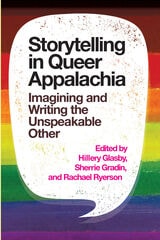
Storytelling in Queer Appalachia
Imagining and Writing the Unspeakable OtherHillery Glasby
West Virginia University Press, 2020
Focusing especially on disciplinary approaches from rhetoric and composition, the volume explores sexual identities in rural places, community and individual meaning-making among the Appalachian diaspora, the storytelling infrastructure of queer Appalachia, and the role of the metronormative in discourses of difference. Storytelling in Queer Appalachia affirms queer people, fights for queer visibility over queer erasure, seeks intersectional understanding, and imagines radically embodied queer selves through social media.
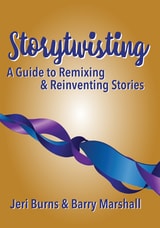
Storytwisting
A Guide to Remixing and Reinventing Traditional StoriesJeri Burns & Barry Marshall
Parkhurst Brothers, Inc., 2018
Strange Gourmets
Sophistication, Theory, and the NovelJoseph Litvak
Duke University Press, 1997
Though commonly thought of as a kind of worldliness at its best and an elitist snobbery at its worst, sophistication, Litvak reminds us, remains tied to its earlier, if forgotten, meaning of "perversion"—a perversion whose avatars are the homosexual and the intellectual. Proceeding with his investigations from a specifically gay academic perspective, Litvak presents thoroughly inventive readings of novels by Austen, Thackeray, and Proust, and of theoretical works by Adorno and Barthes, each text epitomizing sophistication in one of its more familiar modes. Among the issues he explores are the ways in which these texts teach sophistication, the embarrassment that sophistication causes the sophisticated, and how the class politics of sophistication are inseparable from its sexual politics. Helping gay, queer, feminist, and other provocative critics to make the most of their bad publicity, Litvak mindfully celebrates sophistication’s economy of taste and pleasure.
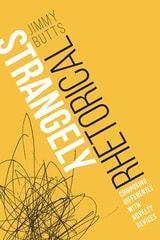
Strangely Rhetorical
Composing Differently With Novelty Devicesby Jimmy Butts
Utah State University Press, 2022
Using a new theoretical framework—that strangeness is inherent within all rhetorical interactions and is potentially useful—Butts demonstrates how rhetoric is always already coming from an Other, offering an ethical context for how defamiliarized texts work with different audiences. Applying examples of seven figures for composing in and across written, aural, visual, electronic, and spatial texts (the WAVES of media), Butts shows how divergence is possible in all sorts of refigured multimodal ways.
Strangely Rhetorical rethinks what exactly rhetoric is and does, considering the ways that strange compositions help rhetors connect across a broad range of networks in a world haunted by distance. This is a book about strange rhetoric for makers and creatives, for students and teachers, and for composers of all sorts.
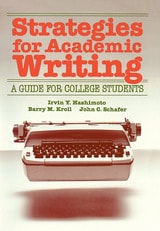
Strategies for Academic Writing
A Guide for College StudentsIrvin Y. Hashimoto, Barry M. Kroll, and John C. Schafer
University of Michigan Press, 1982
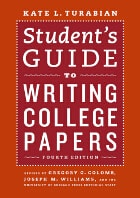
Student's Guide to Writing College Papers
Fourth EditionKate L. Turabian
University of Chicago Press, 2010
High school students, two-year college students, and university students all need to know how to write a well-reasoned, coherent research paper—and for decades Kate Turabian’s Student’s Guide to Writing College Papers has helped them to develop this critical skill. In the new fourth edition of Turabian’s popular guide, the team behind Chicago’s widely respected The Craft of Research has reconceived and renewed this classic for today’s generation. Designed for less advanced writers than Turabian’s Manual of Writers of Research Papers, Theses, and Dissertations, Seventh Edition, Gregory G. Colomb and Joseph M. Williams here introduce students to the art of defining a topic, doing high-quality research with limited resources, and writing an engaging and solid college paper.
The Student’s Guide is organized into three sections that lead students through the process of developing and revising a paper. Part 1, "Writing Your Paper," guides students through the research process with discussions of choosing and developing a topic, validating sources, planning arguments, writing drafts, avoiding plagiarism, and presenting evidence in tables and figures. Part 2, "Citing Sources," begins with a succinct introduction to why citation is important and includes sections on the three major styles students might encounter in their work—Chicago, MLA, and APA—all with full coverage of electronic source citation. Part 3, "Style," covers all matters of style important to writers of college papers, from punctuation to spelling to presenting titles, names, and numbers.
With the authority and clarity long associated with the name Turabian, the fourth edition of Student’s Guide to Writing College Papers is both a solid introduction to the research process and a convenient handbook to the best practices of writing college papers. Classroom tested and filled with relevant examples and tips, this is a reference that students, and their teachers, will turn to again and again.
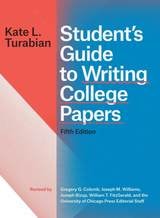
Student’s Guide to Writing College Papers, Fifth Edition
Kate L. Turabian
University of Chicago Press, 2019
This new edition includes fresh examples of research topics, clarified terminology, more illustrations, and new information about using online sources and citation software. It features updated citation guidelines for Chicago, MLA, and APA styles, aligning with the latest editions of these popular style manuals. It emphasizes argument, research, and writing as extensions of activities that students already do in their everyday lives. It also includes a more expansive view of what the end product of research might be, showing that knowledge can be presented in more ways than on a printed page.
Friendly and authoritative, the fifth edition of Student’s Guide to Writing College Papers combines decades of expert advice with new revisions based on feedback from students and teachers. Time-tested and teacher-approved, this book will prepare students to be better critical thinkers and help them develop a sense of inquiry that will serve them well beyond the classroom.
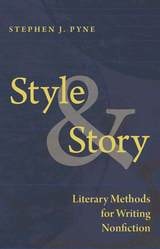
Style and Story
Literary Methods for Writing NonfictionStephen J. Pyne
University of Arizona Press, 2018
Style and Story is for those who wish to craft nonfiction texts that do more than simply relay facts and arguments. Pyne explains how writers can employ literary tools and strategies to have art and craft add value to their theme. With advice gleaned from nearly a dozen years of teaching writing to graduate students, Pyne offers pragmatic guidance on how to create powerful nonfiction, whether for an academic or popular audience.
Each chapter offers samples that span genres, showcasing the best kinds of nonfiction writing. Pyne analyzes these examples that will help writers understand how they can improve their nonfiction through their choice of voice, words, structure, metaphors, and narrative. Pyne builds on his previous guide, Voice and Vision, expanding the range of topics to include openings and closings, humor and satire, historical writing, setting scenes, writing about technical matters and deep details, long and short narration, reading for craft, and thoughts on writing generally. He also includes in this volume a set of exercises to practice writing techniques.
Style and Story will be treasured by anyone, whether novice or expert, who seeks guidance to improve the power of their nonfiction writing.
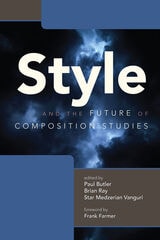
Style and the Future of Composition Studies
Paul Butler
Utah State University Press, 2020
Many college writing teachers operate under the belief that style still refers primarily to the kinds of issues discussed in Strunk and White’s popular but outdated book The Elements of Style. This work not only challenges this view but also offers theories and pedagogies from diverse perspectives that help teachers and students develop strategic habits and mindsets to negotiate languages, genres, and discourse conventions. The chapters explore the ways in which style directly affects—and is affected by—multiple sources of shifting disciplinary inquiry, contributing new insights by drawing on research in cultural studies, sociolinguistics, discourse studies, translingualism, and writing across the curriculum, as well as new approaches to classical rhetorical theory.
The reemergence of stylistic inquiry can be used dynamically to produce new insights not only about emerging disciplinary interests but also about the study of style as a kind of language in and of itself. Style and the Future of Composition Studies demonstrates that style deserves to be a central focus of writing teaching. More than just the next style collection, the book advocates for style’s larger prominence in composition discussions generally. It will be of interest to a broad range of students and scholars of writing studies, as well as a wider set of readers in academe.
Contributors:
Cydney Alexis, Laura Aull, Anthony Box, Jimmy Butts, Mike Duncan, William FitzGerald, Melissa Goldthwaite, Eric House, TR Johnson, Almas Khan, Zak Lancaster, Eric Leake, Andrea Olinger, Thomas Pace, Jarron Slater, Jonathan Udelson
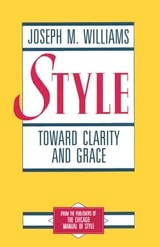
Style
Toward Clarity and GraceJoseph M. Williams
University of Chicago Press, 1990
"Buy Williams's book. And dig out from storage your dog-eared old copy of The Elements of Style. Set them side by side on your reference shelf."—Barbara Walraff, Atlantic
"Let newcoming writers discover this, and let their teachers and readers rejoice. It is a practical, disciplined text that is also a pleasure to read."—Christian Century
"An excellent book....It provides a sensible, well-balanced approach, featuring prescriptions that work."—Donald Karzenski, Journal of Business Communication
"Intensive fitness training for the expressive mind."—Booklist
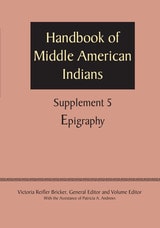
Supplement to the Handbook of Middle American Indians, Volume 5
EpigraphyEdited by Victoria Reifler Bricker
University of Texas Press, 1991
In 1981, under the editorship of Victoria Bricker, UT Press began to issue supplemental volumes to the classic sixteen-volume work Handbook of Middle American Indians. These supplements are intended to update scholarship in various areas and to cover topics of current interest that may not have been included in the original Handbook.
This volume is designed to recognize the important role that epigraphy has come to play in Middle American scholarship and to document significant achievements in three areas: dynastic history, phonetic decipherment, and calendrics. The book covers four of the major pre-Columbian scripts in the region (Zapotec, Mixtec, Aztec, and Maya) and one that is relatively unknown (Tlapanec).
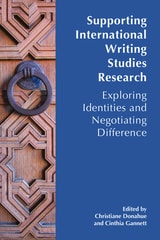
Supporting International Writing Studies Research
Cultivating Capacity through International ExchangesTiane Donahue
University Press of Colorado, 2025
Shedding light on international and transnational writing studies, this edited collection addresses the complexities of research and writing across global contexts. Based on the observation that knowledge-making transcends national borders and is contingent upon the interplay of local cultures and practices, the contributors to the volume contradict the notion that knowledge circulates freely in a “flat world.” Presenting diverse perspectives on writing research, they showcase the need for mutual understanding across borders and reflect the rich tapestry of writing research traditions worldwide, emphasizing interconnectedness and collective insight rather than hierarchical models of knowledge dissemination. Supporting International Writing Studies Research encourages readers and researchers to engage with and respect scholarship beyond English-language contexts, advocates for collaborative global dialogues in writing education, and underscores the importance of continued efforts to incorporate diverse scholarly voices and methodologies in the evolving landscape of writing studies.

Swallowing the Sea
On Writing & Ambition, Boredom, Purity & SecrecyLee Upton
Tupelo Press, 2012
Systems Shift
Creating and Navigating Change in Rhetoric and Composition AdministrationGenesea M. Carter
University Press of Colorado, 2024