Results by title
4030 books match the query 'Language Arts & Disciplines' and 263 start with s
Situating Writing Processes
Physicality, Improvisation, and the Teaching of WritingHannah Rule
University Press of Colorado, 2020
Situations and Attitudes
Jon Barwise and John Perry
CSLI, 1983
Sixteen Teachers Teaching
Two-Year College PerspectivesPatrick Sullivan
Utah State University Press, 2020
All of these teachers have spent their careers teaching multiple sections of writing classes each semester or term, so this book presents readers with an impressive—and perhaps unprecedented—abundance of pedagogical expertise, teaching knowledge, and classroom experience. Sixteen Teachers Teaching is a book filled with joyfulness, wisdom, and pragmatic advice. It has been designed to be a source of inspiration for high school and college English teachers as they go about their daily work in the classroom.
Contributors: Peter Adams, Jeff Andelora, Helane Adams Androne, Taiyon J. Coleman, Renee DeLong, Kathleen Sheerin DeVore, Jamey Gallagher, Shannon Gibney, Joanne Baird Giordano, Brett Griffiths, Holly Hassel, Darin Jensen, Jeff Klausman, Michael C. Kuhne, Hope Parisi, and Howard Tinberg
Skim, Dive, Surface
Teaching Digital ReadingJenae Cohn
West Virginia University Press, 2021
Students are reading on screens more than ever—how can we teach them to be better digital readers?
Smartphones, laptops, tablets: college students are reading on-screen all the time, and digital devices shape students’ understanding of and experiences with reading. In higher education, however, teachers rarely consider how digital reading experiences may have an impact on learning abilities, unless they’re lamenting students’ attention spans or the distractions available to students when they’re learning online.
Skim, Dive, Surface offers a corrective to these conversations—an invitation to focus not on losses to student learning but on the spectrum of affordances available within digital learning environments. It is designed to help college instructors across the curriculum teach digital reading in their classes, whether they teach face-to-face, fully online, or somewhere in between. Placing research from cognitive psychology, neuroscience, learning science, and composition in dialogue with insight from the scholarship of teaching and learning, Jenae Cohn shows how teachers can better frame, scaffold, and implement effective digital reading assignments. She positions digital reading as part of a cluster of literacies that students should develop in order to communicate effectively in a digital environment.
Slavic in Head-Driven Phrase Structure Grammar
Edited by Robert D. Borsley and Adam Przepiórkowski
CSLI, 1999
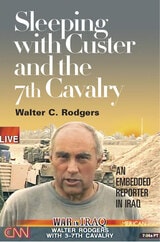
Sleeping with Custer and the 7th Cavalry
An Embedded Reporter in IraqWalter C. Rodgers
Southern Illinois University Press, 2005
An essential document of the first American war of the new century
Under a full opalescent moon in the spring of 2003, CNN correspondent Walter C. Rodgers and three colleagues climbed into an unarmored Humvee loaded with satellite transmission equipment and fell into column formation with the MIAI Abrams battle tanks and Bradley fighting vehicles of Apache Troop, Third Squadron, of the storied 7th Cavalry and crossed the Line of Departure between Kuwait and Iraq. Sleeping with Custer and the 7th Cavalry: An Embedded Reporter in Iraq is Rodgers’s account of the fight from the Kuwaiti border to the Iraqi capital of Baghdad.
Rodgers was embedded with the “tip of the tip of the spear,” the armored reconnaissance unit tasked with clearing the way for the invasion of Iraq. For the next three weeks Rodgers—a seasoned combat correspondent who has covered armed conflicts in the West Bank, along the “Green Line” in Lebanon, and in Sarajevo, Azerbaijan, and Afghanistan—was a first-person witness to the opening campaign of the most significant war America has embarked upon since Vietnam.
Rodgers and his journalistic colleagues in Operation Iraqi Freedom became pioneers in the process of embedding, the placing of journalists who can transmit video reports in real time under combat conditions with no censoring authority to block their reporting. During this journey into war, Rodgers and his crew embraced the dangers, the numbing fatigue, and the moments of stark fear of the young armored cavalrymen they lived with twenty-four hours each day, an experience that created for them the lifelong bond that only soldiers serving together under fire share.
Rodgers also details his return visit to Iraq a year later, reflecting on the nature of war and sharing his personal feelings about a conflict that has claimed the lives of over fifteen hundred American men and women. The volume is illustrated with photographs taken during the invasion by Jeff Barwise, the CNN engineer who accompanied Rodgers.
Small Altars
Justin Gardiner
Tupelo Press, 2024
In Small Altars, Justin Gardiner delves into the world of comic books and superheroes as a means for coming to terms with the many struggles of his brother’s life, as well as his untimely death, offering a lyric and honest portrayal of the tolls of mental illness, the redemptive powers of art and familial love, and the complex workings of grief.

Small Business and the Public Library
Strategies for a Successful PartnershipLuise Weiss
American Library Association, 2011
Small Public Library Management
Jane Pearlmutter
American Library Association, 2012
Small Public Library Management, Second Edition
Cindy Fesemyer and Christina Jones
American Library Association, 2025
- benefit from this handbook’s up-to-date perspectives on what it takes to run your library in today’s post-pandemic, politically polarized, technologically advanced, socially isolated world;
- receive to-the-point advice on governance, strategic planning, human resources, policy development, facilities, services and programs, and other foundational tasks;
- become informed on how to safeguard intellectual freedom, handle challenges to materials and programming, and protect patron privacy;
- get pointers on broadening their personal network, understanding what outside resources are available, and spearheading effective advocacy and community engagement;
- learn from real-life “Success Stories” and “On the Job” words of wisdom sprinkled throughout the text; and
- find adaptable templates, self-enrichment activities, and other tools to facilitate ongoing professional development.
Small Worlds
Adopted Sons, Pet Piranhas, and Other Mortal ConcernsRobert Klose
University of Missouri Press, 2006

Snapshots Of Reality
A Practical Guide To FormativeMary Snyder Broussard
Assoc of College & Research Libraries, 2014
Snapshots of Reality
A Practical Guide to Formative Assessment in Library InstructionMary Snyder Broussard
Assoc of College & Research Libraries, 2014
So Much to Be Angry About
Appalachian Movement Press and Radical DIY Publishing, 1969–1979Shaun Slifer
West Virginia University Press, 2021
In a remarkable act of recovery, So Much to Be Angry About conjures an influential but largely obscured strand in the nation’s radical tradition—the “movement” printing presses and publishers of the late 1960s and 1970s, and specifically Appalachian Movement Press in Huntington, West Virginia, the only movement press in Appalachia. More than a history, this craft- and activist-centered book positions the frontline politics of the Appalachian Left within larger movements in the 1970s. As Appalachian Movement Press founder Tom Woodruff wrote: “Appalachians weren’t sitting in the back row during this struggle, they were driving the bus.”
Emerging from the Students for a Democratic Society chapter at Marshall University, and working closely with organizer and poet Don West, Appalachian Movement Press made available an eclectic range of printed material, from books and pamphlets to children’s literature and calendars. Many of its publications promoted the Appalachian identity movement and “internal colony” theory, both of which were cornerstones of the nascent discipline of Appalachian studies. One of its many influential publications was MAW, the first feminist magazine written by and for Appalachian women.
So Much to Be Angry About combines complete reproductions of five of Appalachian Movement Press’s most engaging publications, an essay by Shaun Slifer about his detective work resurrecting the press’s history, and a contextual introduction to New Left movement publishing by Josh MacPhee. Amply illustrated in a richly produced package, the volume pays homage to the graphic sensibility of the region’s 1970s social movements, while also celebrating the current renaissance of Appalachia’s DIY culture—in many respects a legacy, Slifer suggests, of the movement publishing documented in his book.
So You Want to Be an Academic Library Director
Colleen S. Harris
American Library Association, 2017
Soapbox Rebellion
The Hobo Orator Union and the Free Speech Fights of the Industrial Workers of the World, 1909-1916Matthew S. May
University of Alabama Press, 2013
Soccer's Neoliberal Pitch
The Sport's Power, Profit, and Discursive PoliticsJohn M. Sloop
University of Alabama Press, 2023
A powerful cultural critique of soccer’s public rhetoric
American sports agnostics might raise an eyebrow at the idea that soccer represents a staging ground for cultural, social, and political possibility. It is just another game, after all, in a society where mass-audience spectator sports largely avoid any political stance other than a generic, corporate-friendly patriotism. But John M. Sloop picks up on the work of Laurent Dubois and others to see in American soccer—a sport that has achieved immense participation and popularity despite its struggle to establish major league status—a game that permits surprisingly diverse modes of thinking about national identity because of its marginality.
As a rhetorician who draws on both critical theory and culture, Sloop seeks to read soccer as the game intersects with gender, race, sexuality, and class. The result of this engagement is a sense of both enormous possibility and real constraint. If American soccer offers more possibility because of its marginality, looking at how those possibilities are constrained can provide valuable insights into neoliberal logics of power, profit, politics, and selfhood.
In Soccer’s Neoliberal Pitch, Sloop analyzes a host of soccer-adjacent phenomena: the equal pay dispute between the US women’s national team and the US Soccer Federation, the significance of hooligan literature, the introduction of English soccer to American TV audiences, the strange invisibility of the Mexican soccer league despite its consistent high TV ratings, and the reading of US national teams as “underdogs” despite the nation’s quasi-imperial dominance of the Western hemisphere. An invaluable addition to a growing bookshelf on soccer titles, Soccer’s Neoliberal Pitch serves as a model for critical cultural work with sports, with appeal to not only sports studies, but cultural studies, communication, and even gender studies classrooms.
Social Constructions of Deafness
Examining Deaf Languacultures in EducationThomas P. Horejes
Gallaudet University Press, 2012
Thomas P. Horejes’s new book focuses on revealing critical knowledge that addresses certain social justice issues, including deafness, language, culture, and deaf education. He conveys this information through discourses about his own experiences being deaf and through his research in which he “stresses the contingency of the social” in educational institutions.
In Social Constructions of Deafness: Examining Deaf Languacultures in Education, Horejes contends that schools as social institutions play powerful and exacting roles in the creation and maintenance of social constructions such as language and culture for deaf children. He subscribes to Michael Agar’s concept of “languaculture,” defined as the inextricable relationship between language and culture in which a specific language will shape and influence culture. His approach employs other anthropological terminology as he connects his personal experience as a deaf student (emic) to academic research on deafness (etic) to bring understanding to the multidimensional aspects of his own negotiated identities.
Horejes extends his inquiry through his analysis of two kindergarten classes for deaf students, one orally oriented and the other conducted using sing language. His findings are sobering evidence of the myriad challenges educators face in defining appropriate academic, linguistic, and cultural pedagogy for deaf children in schools and other social institutions.
Social Controversy and Public Address in the 1960s and Early 1970s
A Rhetorical History of the United States, Volume IXRichard J. Jensen
Michigan State University Press, 2017
Social Media Curation
Joyce Kasman Valenza
American Library Association, 2014
Social Studies in the Storytelling Classroom
Exploring Our Cultural Voices and PerspectivesJane Stenson
Parkhurst Brothers, Inc., 2012
“Accessible, inspirational and practical plans that make storytelling a portal to multifaceted insights about culture, history, geography and identity.”
– Janice M. Del Negro, Ph.D., GSLIS Dominican University
Social Writing/Social Media
Publics, Presentations, and PedagogiesDouglas M. Walls
University Press of Colorado, 2018
Social media have been (for quite some time now) part of the fabric of our lives. But as with many new technologies, it often takes a while for us to be able to step back, assess the tool's impact, and consider what's next. This collection offers one of the first sets of scholarly work in our field that responds to social media's influence on both popular and extra-curricular writing as well as on scholarly communication. Too frequently, social media is dismissed as non-academic, unworthy of sustained attention by researchers. The authors featured here present compelling reasons why this oft-neglected form of writing deserves—and demands—continued academic response.
Social Writing/Social Media: Publics, Presentations, and Pedagogies makes this contribution by examining the impact of social media on three writing-related themes: publics and audiences, presentation of self and groups, and pedagogy at various levels of higher education. The contributors to this collection urge readers to pay attention to an undertheorized aspect of writing online—the acts of composing that occur specifically in social-media spaces. Organized in three sections—social media and public audiences; social media and presentation; and social media and pedagogy—it builds on previous explorations of the role of multimodality in composition studies by extending ongoing conversations that have asked readers to expand notions of literacy in the twenty-first century. By addressing the wide range of composing activities that take place in social media and the rich variety of genres, audiences, stylistic choices, and pedagogical possibilities, this collection offers an important contribution to our understanding of pedagogy and practice in social media spaces.

Socially Engaged Creative Practice
Contemporary Case StudiesEdited by Jess Moriarty and Kate Aughterson
Intellect Books, 2024
Each chapter of Socially Engaged Creative Practice focuses on an individual or group’s mode of working and methodological practice of performance across a range of modes, disciplines, and media, from community opera to online queer performance; from anti-racist classroom pedagogy to 1980s cabaret in nightclubs; from community art projects in schools to community writing projects in transport interchanges. The performers, writers, and creators represented here engage and grapple with contemporary performance as a situated practice and as a problem.
The personal perspective of each performer—as directors, librettists, producers, and writers—is explicitly located in a community, and the book offers a series of case studies detailing socially engaged work that aligns with concepts of performance and community.

Society as Text
Essays on Rhetoric, Reason, and RealityRichard Harvey Brown
University of Chicago Press, 1987

Sociolinguistic Constructs of Ethnic Identity
The Syntactic Delineation of an American Indian English, Volume 77Clare J. Dannenberg, ed.
Duke University Press, 0
Sociolinguistic Pathways in Sign Languages
Studies in Honor of Ceil LucasJoseph C. Hill
Gallaudet University Press, 2026
Sociolinguistic Variation in American Sign Language
Ceil Lucas
Gallaudet University Press, 2001
Sociolinguistic Variation
Data, Theory, and AnalysisEdited by Jennifer Arnold, Renee Blake, and Brad Davidson
CSLI, 1996
Sociolinguistics in Deaf Communities
Ceil Lucas
Gallaudet University Press, 1995
The first volume in the new Sociolinguistics in Deaf Communities series presents a rich collection of essays showcasing the breadth and depth of this exciting discipline. Topics of inquiry in the premiere volume include fingerspelling in Langue des Signes Quebecoise (LSQ) in Quebec, Canada; language used by a Navajo family with deaf children; language policy, classroom practice, and multiculturalism in deaf education; aspects of American Sign Language (ASL) discourse and of Filipino Sign Language discourse; and the nature and role of rhetorical language in Deaf social movements.
Among the noted contributors are Dominique Machabee, Arlene Blumenthal-Kelly, Jeffrey Davis, Melanie Metzger, Samuel Supalla, Barbara Gerner de Garcia, Liza B. Martinez, Kathy Jankowski, and also Ceil Lucas. Sociolinguistics in Deaf Communities affords an invaluable opportunity to assess up-to-date information on sign language linguistics worldwide and its impact on policy and planning in education, interaction with spoken languages, interpreting, and the issues of empowerment.
Sojourning in Disciplinary Cultures
A Case Study of Teaching Writing in EngineeringMaureen Mathison
Utah State University Press, 2019
This volume represents the collective experiences and insights of writing consultants involved in the large-scale curriculum reform of the entire College of Engineering; they collaborated closely with faculty members of the various departments and taught writing to engineering students in engineering classrooms. Collaborators developed syllabi that incorporated writing into their courses in meaningful ways, designed lessons to teach various aspects of writing, created assignments that integrated engineering and writing theory and concepts, and worked one-on-one with students to provide revision feedback. Though interactions were sometimes tense, the two groups––writing and engineering––developed a “third culture” that generally placed students at the center of learning.
Sojourning in Disciplinary Cultures provides a guide to successful collaborations with STEM faculty that will be of interest to WPAs, instructors, and a range of both composition scholars and practitioners seeking to understand more about the role of writing and communication in STEM disciplines.
Contributors:
Linn K. Bekins, Sarah A. Bell, Mara K. Berkland, Doug Downs, April A. Kedrowicz, Sarah Read, Julie L. Taylor, Sundy Watanabe
Soldiers of the Pen
The Writers' War Board in World War IIThomas Howell
University of Massachusetts Press, 2019
The WWB received federal money while retaining its status as a private organization that could mount campaigns without government oversight. Historian Thomas Howell argues that this unique position has caused its history to fall between the cracks, since it was not recognized as an official part of the government's war effort. Yet the WWB's work had a huge impact on the nation's wartime culture, and this fascinating history will inform contemporary thinking on propaganda, the media, and American society.
Solving Problems in Technical Communication
Edited by Johndan Johnson-Eilola and Stuart A. Selber
University of Chicago Press, 2012
The field of technical communication is rapidly expanding in both the academic world and the private sector, yet a problematic divide remains between theory and practice. Here Stuart A. Selber and Johndan Johnson-Eilola, both respected scholars and teachers of technical communication, effectively bridge that gap.
Somebody Told Me
The Newspaper Stories of Rick BraggRick Bragg
University of Alabama Press, 2000
Over the past twenty years, writer Rick Bragg has earned legions of fans with his award-winning newspaper stories and with his critically aclaimed memoir All Over but the Shoutin'. His unique storytelling talent and his sympathy for the day-to-day struggles of everyday people set him apart from journalists who focus on political intrigue and the foibles of the rich and famous.
This collection showcases Bragg's talent for turning seemingly ordinary situations into extraordinary stories by bringing together more than sixty of his most recent feature articles, most of them written for the New York Times. Bragg explores such questions as: What happens to someone released from prison for a crime he didn't commit? Who takes care of the graves of poor people? What keeps an elderly woman from selling her land for a tidy profit? Bragg's curiosity often leads him to society's margins, where he wins the confidence of those who have good reason to mistrust others.
Bragg has reported on some of the most newsworthy tragedies in the nation, and his unfolding coverage of events such as the Oklahoma City bombing and the Susan Smith child murders is included here. Once again, though, his special ability to connect with people allows him accesss and perspectives that many other reporters do not achieve.
Whether he's profiling the sheriff who broke the Smith case or relating the efforts of Alabama churchgoers to understand a Sunday morning tornado strike, Bragg writes with genuine compassion and sentiment but without being sensationalist. He looks where others don’t and gets behind the headlines to the people standing there stunned and often, until he finds them, voiceless. When asked how he came up with his remarkable stories, Bragg has his answer down pat: “Somebody told me.”
Something Funny Happened at the Library
How to Create Humorous Programs for Children and Young AdultsAmerican Library Association, 2003
Something Old, Something New
College Writing Teachers and Classroom ChangeWendy Bishop. Foreword by Patrick Hartwell
Southern Illinois University Press, 1990
How do college writing teachers learn new ways to teach? Most current composition research focuses almost exclusively on student writers, ignoring the role the teacher plays in classroom development. Here is the first book to focus on college writing teachers and the ways in which they are affected by graduate rhetoric pedagogy courses.
Wendy Bishop observed teachers enrolled in a doctoral seminar, titled "Teaching Basic Writing," and then conducted case studies of five of those teachers in their college writing classrooms to investigate how their teaching practices changed and how their previous professional and personal histories influenced their ability to make those changes.
Sonic Persuasion
Reading Sound in the Recorded AgeGreg Goodale
University of Illinois Press, 2011
Sonora Yaqui Language Structures
John M. Dedrick and Eugene H. Casad
University of Arizona Press, 1999
The book includes useful sections on quantifiers and adverbial and deictic particles, often inadequately treated in reference grammars. A section on auxiliary verbs and well-documented information on voice, aspect, and other features of verbal inflection provide readers with useful data for particular lines of linguistic inquiry. Each grammatical point is illustrated by example sentences distinguished by their naturalness and cultural relevance. At the end of the book, a Yaqui text provides a sample of connected sentences in a natural context.
Sonora Yaqui Language Structures is a valuable source not only for research on this language family but also for anthropological studies of the Arizona-Sonora cultural region. In addition, it documents an indigenous language for future generations of Yaqui speakers.
Sound Reporting, Second Edition
The NPR Guide to Broadcast, Podcast and Digital JournalismJerome Socolovsky
University of Chicago Press, 2024
A lot has changed in media in recent years, but one thing that remains steadfast is National Public Radio’s (NPR) position as a trusted source of news in the United States. Now producing dozens of shows and podcasts, plus livestreams and coverage on other media platforms, NPR is the leading authority on reporting, writing, and delivering audio news and storytelling to today's diverse audiences. In this completely revised guide, audio journalism trainer Jerome Socolovsky offers a look into just how NPR does it, following the same journey a story would from idea to the moment it reaches its listeners.
Based on more than eighty interviews with producers, reporters, editors, hosts, and other NPR staffers, Sound Reporting reveals how stories get pitched; how they are reported, produced, written, edited, voiced, and tailored to multiple media formats; and how shows and podcasts are put together. It begins with a presentation of NPR's values and includes a new chapter on journalist safety, a topic of timely importance. Podcasts, now part of the mainstream of the media universe, are treated alongside traditional programs throughout.
In these pages, the voices of NPR staff offer a glimpse into their profession. Discover how correspondent Ruth Sherlock overcame seemingly insurmountable odds as she raced to the scene of a devastating earthquake in Turkey, the four main ways Ramtin Arablouei incorporates music into podcasts, and how “Weekend Edition” host Ayesha Rascoe touches listeners so deeply she received a pair of homemade potholders in the mail from one of them. Reading this book is like sitting in a room full of top-notch producers, seasoned correspondents, trusted hosts, and rigorous editors—all telling you inspiring stories about their craft to help you learn from their experience.
At a time when the legitimacy and authority of journalism are under critique, transparency into how the news is made is more important than ever. This book offers a fascinating look behind the scenes at a premier public media organization and will be a trusted resource for anyone in or exploring a future in audio journalism.
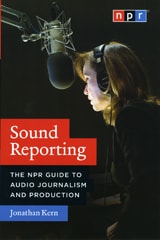
Sound Reporting
The NPR Guide to Audio Journalism and ProductionJonathan Kern
University of Chicago Press, 2008
Jonathan Kern, who has trained NPR’s on-air staff for years, is a gifted guide, able to narrate a day in the life of a host and lay out the nuts and bolts of production with equal wit and warmth. Along the way, he explains the importance of writing the way you speak, reveals how NPR books guests ranging from world leaders to neighborhood newsmakers, and gives sage advice on everything from proposing stories to editors to maintaining balance and objectivity. Best of all—because NPR wouldn’t be NPR without its array of distinctive voices—lively examples from popular shows and colorful anecdotes from favorite personalities animate each chapter.
As public radio’s audience of millions can attest, NPR’s unique guiding principles and technical expertise combine to connect with listeners like no other medium can. With today’s technologies allowing more people to turn their home computers into broadcast studios, Sound Reporting couldn’t have arrived at a better moment to reveal the secrets behind the story of NPR’s success.
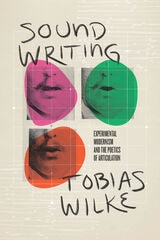
Sound Writing
Experimental Modernism and the Poetics of ArticulationTobias Wilke
University of Chicago Press, 2022
Avant-garde writers and artists of the twentieth century radically reconceived poetic language, appropriating scientific theories and techniques as they turned their attention to the physical process of spoken language. This modernist “sound writing” focused on the bodily production of speech, which it rendered in poetic, legible, graphic form.
Modernist sound writing aims to capture the acoustic phenomenon of vocal articulation by graphic means. Tobias Wilke considers sound writing from its inception in nineteenth-century disciplines like physiology and experimental phonetics, following its role in the aesthetic practices of the interwar avant-garde and through to its reemergence in the postwar period. These projects work with the possibility of crossing over from the audible to the visible, from speech to notation, from body to trace. Employing various techniques and concepts, this search for new possibilities played a central role in the transformation of poetry into a site of radical linguistic experimentation. Considering the works of writers and artists—including Raoul Hausmann, Kurt Schwitters, Viktor Shklovsky, Hugo Ball, Charles Olson, and Marshall McLuhan—Wilke offers a fresh look at the history of the twentieth-century avant-garde.
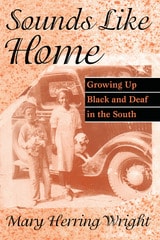
Sounds Like Home
Growing Up Black and Deaf in the SouthMary Herring Wright
Gallaudet University Press, 1999
New edition available: Sounds Like Home: Growing Up Black and Deaf in the South, 20th Anniversary Edition, ISBN 978-1-944838-58-4
Features a new introduction by scholars Joseph Hill and Carolyn McCaskill
Mary Herring Wright’s memoir adds an important dimension to the current literature in that it is a story by and about an African American deaf child. The author recounts her experiences growing up as a deaf person in Iron Mine, North Carolina, from the 1920s through the 1940s. Her story is unique and historically significant because it provides valuable descriptive information about the faculty and staff of the North Carolina school for Black deaf and blind students from the perspective of a student as well as a student teacher. In addition, this engrossing narrative contains details about the curriculum, which included a week-long Black History celebration where students learned about important Blacks such as Madame Walker, Paul Laurence Dunbar, and George Washington Carver. It also describes the physical facilities as well as the changes in those facilities over the years. In addition, Sounds Like Home occurs over a period of time that covers two major events in American history, the Depression and World War II.
Wright’s account is one of enduring faith, perseverance, and optimism. Her keen observations will serve as a source of inspiration for others who are challenged in their own ways by life’s obstacles.
South American Indian Languages
Retrospect and ProspectEdited by Harriet E. Manelis Klein and Louisa R. Stark
University of Texas Press, 1985
This book fills the crucial need for a single volume that gives broad coverage and synthesizes findings for both the general reader and the specialist. This collection of twenty-two essays from fifteen well-known scholars presents linguistic research on the indigenous languages of South America, surveying past research, providing data and analysis gathered from past and current research, and suggesting prospects for future investigation.
Of interest not only to linguists but also to anthropologists, historians, and geographers, South American Indian Languages offers a wide perspective, both temporal and regional, on an area noted for its enormous linguistic diversity and for the lack of knowledge of its indigenous languages. An invaluable source book and reference tool, its appearance is especially timely when exploitation of the rich natural resources in a number of areas in South America must surely result in the demise and/or acculturation of some indigenous groups.
Southern Digitalities
Reimagining Digital Studies from the Global SouthEdited by Clovis Bergère, Marwan M. Kraidy, and Marina R. Krikorian
University of Illinois Press, 2026
Beyond entrenched notions of digital studies research
Western histories and ideas dominate studies of digital technologies despite the fact most of today’s digital users live outside the West. Clovis Bergère, Marwan M. Kraidy, and Marina R. Krikorian curate essays that explore new ways of understanding global digital life by centering the experiences, practices, and infrastructures of Africa, Asia, Latin America, and the Middle East.
The contributors proceed from the idea that the plural term “digitalities” reflects how material conditions, social hierarchies, and local histories shape digital life. Their approach sees so-called Southern digitalities as a gateway to rethinking digital theory from a starting point that draws on grounded knowledge, multilingual concepts, and place‑based research. Four organizing themes—data, belonging, work, and epistemologies—reveal how scholars can navigate and reinterpret digital systems with concepts and methods that challenge established ways of studying and understanding international digital life.
A merger of the theoretical and imaginative, Southern Digitalities provides a blueprint for uncovering more inclusive understandings of contemporary digital worlds.
Southern Frontier, 1670-1732
1670-1732Verner W. Crane
University of Michigan Press, 1929
Sovereign, Settler, Leaker, Lie
Forms of the Secret in US Political RhetoricAtilla Hallsby
The Ohio State University Press, 2026
In Sovereign, Settler, Leaker, Lie, Atilla Hallsby argues that secrets play a pivotal role in organizing political discourse in the United States. Hallsby takes up contemporary case studies—ranging from the Valerie Plame scandal during the George W. Bush presidency, to the use of Saul Alinsky’s name as a partisan codeword for politicizing Obama’s Blackness, to Chelsea Manning’s public naming and outing—to show how dramatic revelations increasingly fail to produce meaningful change and instead reproduce entrenched racial, gendered, and colonial hierarchies.
The core feature of these interlinked moments of crisis is the secret: a rhetorical patterning of political life organized by specific forms, each one lending a familiar shape to the shadows of American empire. These forms, theorized here as tropes, connect decades of secrets, linking the George W. Bush administration’s War on Terror to the Trump-era reemergence of “deep state” conspiracy theories. As an extension of secrecy and surveillance studies, and with the aim of attaining a more accountable and just form of US governmentality, Sovereign, Settler, Leaker, Lie explains how still-unfolding political realities in the United States emerged, transformed, and regenerate.

Space Monkeys!
Remembering the Nonhuman Astronauts in US Space ExplorationJohn A. Lynch
University of Alabama Press, 2026
Exposes how emotion, memory, and national pride shape the stories we tell about science, animals, and the history of the “race to space”
Before humans ever left Earth’s atmosphere, a handful of primates paved the way—earning fame and fascination but leaving behind a complicated and often highly debated legacy. As the Cold War intensified, the US space program turned to monkeys—Able, Baker, Ham, and Enos—to test and explore the limits of human survival in space. These animals became media sensations, museum exhibits, and symbols of American ingenuity, even as their suffering was often overlooked.
With insight and empathy, Lynch unpacks the stories we tell about these primates and how they are remembered through culture and time, both modern and historically. Lynch argues that the public memory of these animals often justifies their use in the name of scientific progress. Sometimes they are portrayed as tools, other times as human stand-ins, and frequently as objects of sympathy—but rarely as subjects of critique.
Lynch shows how feelings—compassion, cuteness, patriotism, and the technological sublime—shape the stories we tell about these animals and the ethical frameworks we build around them. Each chapter focuses on a different genre of memory-making, from newspaper and photojournalism to museum exhibits, children’s literature, and fictional films.
By reframing these animal pioneers, Lynch uncovers the ethical and emotional narratives that shape how we remember science. Space Monkeys! is a vital reflection on memory, identity, and the more-than-human costs of progress.
Spaces, Worlds, and Grammar
Edited by Gilles Fauconnier and Eve Sweetser
University of Chicago Press, 1996
These twelve original papers extend the mental-spaces framework and demonstrate its utility in solving deep problems in linguistics and discourse theory. Investigating the ties between mental constructs, they analyze a wide range of phenomena, including analogical counterfactuals; the metaphor system for conceptualizing the self; abstract change expressions in Japanese; mood in Spanish; deictic expressions; copular sentences in Japanese; conditional constructions; and reference in American Sign Language.
The ground-breaking research presented in this volume will be of interest to linguists and cognitive scientists.
The contributors are Claudia Brugman, Gilles Fauconnier, George Lakoff, Yo Matsumoto, Errapel Mejias-Bikandi, Laura A. Michaelis, Gisela Redeker, Jo Rubba, Shigeru Sakahara, Jose Sanders, Eve Sweetser, and Karen van Hoek.
Spatial Literacy in Public Health
Faculty-Librarian Teaching CollaborationsLaureen P. Cantwell-Jurkovic
Assoc of College & Research Libraries, 2024
Chapters include step-by-step learning activities, teaching tips, recommended readings, and four-color maps as well as other useful illustrations—these not only support student learning, but also professional development for librarians interested in spatial literacy instruction and in pitching such instruction to potential faculty collaborators. Interdisciplinary topics include supply chain management, social media campaigns, data visualization, racial disparities, and other demographic themes related to immunization patterns, epidemiology, recreation access, and community health and environmental health/environmental science.
Spatial Literacy in Public Health offers specific plans for collaborative, interdisciplinary spatial literacy instruction and activities. Chapters also connect with supplementary content in the ACRL Framework for Information Literacy Sandbox (https://sandbox.acrl.org), including activity-focused slide decks and more, all findable with the tag “#SpatialLit” and freely available. Learning activities support open-source tools, open educational resources (OER), and other institutional cost-saving initiatives, and the ability to adapt from in-person to virtual instruction settings.
Speaking Respect, Respecting Speech
Richard L. Abel
University of Chicago Press, 1998
Speaking Up, Speaking Out
Lived Experiences of Non-Tenure-Track Faculty in Writing StudiesJessica Edwards
Utah State University Press, 2020
Each chapter suggests tangible ways that writing departments and supporters can be more thoughtful about their policies and practices as they work to create more equitable spaces for NTTF. Speaking Up, Speaking Out considers the rhetorical power of labeling and asserts why contingent faculty, for far too long, have been compared to and against TT faculty and often encouraged to reach the same or similar productivity with scholarship, teaching, and service that TT faculty produce. The myopic ideas about what is valued and whose position is deemed more important impacts contingent faculty in ways that, as contributors in this collection share, effect and affect faculty productivity, emotional health, and overall community involvement.
Contributors: Norah Ashe-McNalley, Sarah Austin, Rachel Azima, Megan Boeshart Burelle, Peter Brooks, Denise Comer, Jessica Cory, Liz Gumm, Brendan Hawkins, Heather Jordan, Nathalie Joseph, Julie Karaus, Christopher Lee, John McHone, Angie McKinnon Carter, Dauvan Mulally, Seth Myers, Liliana M. Naydan, Linda Shelton, Erica Stone, Elizabeth Vincelette, Lacey Wootton