Results by title
1488 books match the query 'Media Studies' and 106 start with s
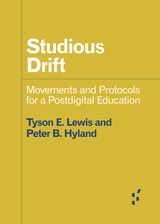
Studious Drift
Movements and Protocols for a Postdigital EducationPeter Hyland
University of Minnesota Press, 2022
What kind of university is possible when digital tools are not taken for granted, but hacked for a more experimental future?
The global pandemic has underscored contemporary reliance on digital environments. This is particularly true among schools and universities, which, in response, shifted much of their instruction online. Because the rise of e-learning logics, ed-tech industries, and enterprise learning-management systems all threaten to further commodify and instrumentalize higher education, these technologies and platforms have to be creatively and critically struggled over.
Studious Drift intervenes in this struggle by reviving the relationship between studying and the generative space of the studio in service of advancing educational experimentation for a world where digital tools have become a permanent part of education. Drawing on Alfred Jarry’s pataphysics, the “science of imaginary solutions,” this book reveals how the studio is a space-time machine capable of traveling beyond the limits of conventional online learning to redefine education as interdisciplinary, experimental, public study.
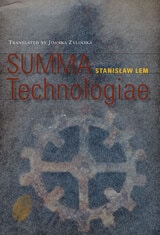
Summa Technologiae
Stanislaw Lem
University of Minnesota Press, 2014
The Polish writer Stanislaw Lem is best known to English-speaking readers as the author of the 1961 science fiction novel Solaris, adapted into a meditative film by Andrei Tarkovsky in 1972 and remade in 2002 by Steven Soderbergh. Throughout his writings, comprising dozens of science fiction novels and short stories, Lem offered deeply philosophical and bitingly satirical reflections on the limitations of both science and humanity.
In Summa Technologiae—his major work of nonfiction, first published in 1964 and now available in English for the first time—Lem produced an engaging and caustically logical philosophical treatise about human and nonhuman life in its past, present, and future forms. After five decades Summa Technologiae has lost none of its intellectual or critical significance. Indeed, many of Lem’s conjectures about future technologies have now come true: from artificial intelligence, bionics, and nanotechnology to the dangers of information overload, the concept underlying Internet search engines, and the idea of virtual reality. More important for its continued relevance, however, is Lem’s rigorous investigation into the parallel development of biological and technical evolution and his conclusion that technology will outlive humanity.
Preceding Richard Dawkins’s understanding of evolution as a blind watchmaker by more than two decades, Lem posits evolution as opportunistic, shortsighted, extravagant, and illogical. Strikingly original and still timely, Summa Technologiae resonates with a wide range of contemporary debates about information and new media, the life sciences, and the emerging relationship between technology and humanity.
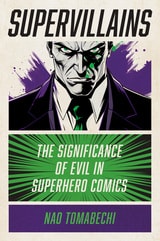
Supervillains
The Significance of Evil in Superhero ComicsNao Tomabechi
Rutgers University Press, 2025
Bringing together different approaches and critical perspectives across disciplines, author Nao Tomabechi troubles overly hero-centered works in comics studies to reconsider the modern American myths of the superheroes. Considering the likes of Lex Luthor, the Joker, Catwoman, Harley Quinn, Loki, Venom, and more, Supervillians explores themes such as gender and sexuality, disability, and many forms of Otherness in relation to the notion of evil as it appears in the superhero genre. The book investigates how supervillains uphold and, at times, trouble dominant ideals expressed by the heroism of our superheroes.
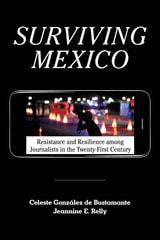
Surviving Mexico
Resistance and Resilience among Journalists in the Twenty-first CenturyBy Celeste González de Bustamante and Jeannine E. Relly
University of Texas Press, 2021
Mott KTA Journalism and Mass Communication Research Award, Kappa Tau Alpha
Tankard Book Award, Association for Education in Journalism and Mass Communication (AEJMC)
Knudson Latin America Prize, Association for Education in Journalism and Mass Communication (AEJMC)
Since 2000, more than 150 journalists have been killed in Mexico. Today the country is one of the most dangerous in the world in which to be a reporter. In Surviving Mexico, Celeste González de Bustamante and Jeannine E. Relly examine the networks of political power, business interests, and organized crime that threaten and attack Mexican journalists, who forge ahead despite the risks.
Amid the crackdown on drug cartels, overall violence in Mexico has increased, and journalists covering the conflict have grown more vulnerable. But it is not just criminal groups that want reporters out of the way. Government forces also attack journalists in order to shield corrupt authorities and the very criminals they are supposed to be fighting. Meanwhile some news organizations, enriched by their ties to corrupt government officials and criminal groups, fail to support their employees. In some cases, journalists must wait for a “green light” to publish not from their editors but from organized crime groups. Despite seemingly insurmountable constraints, journalists have turned to one another and to their communities to resist pressures and create their own networks of resilience. Drawing on a decade of rigorous research in Mexico, González de Bustamante and Relly explain how journalists have become their own activists and how they hold those in power accountable.

Sustainability, Participation and Culture in Communication
Edited by Jan Servaes
Intellect Books, 2013
Swift Viewing
The Popular Life of Subliminal InfluenceCharles R. Acland
Duke University Press, 2012