Results by title
22279 books match the query 'Social Science' and 1635 start with s
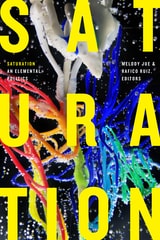
Saturation
An Elemental PoliticsMelody Jue and Rafico Ruiz, editors
Duke University Press, 2021
Contributors. Marija Cetinić, Jeff Diamanti, Bishnupriya Ghosh, Lisa Yin Han, Stefan Helmreich, Mél Hogan, Melody Jue, Rahul Mukherjee, Max Ritts, Rafico Ruiz, Bhaskar Sarkar, John Shiga, Avery Slater, Janet Walker, Joanna Zylinska
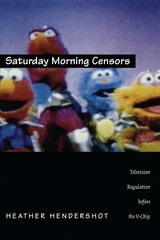
Saturday Morning Censors
Television Regulation before the V-ChipHeather Hendershot
Duke University Press, 1999
Drawing on archival studio material, interviews with censors and animators, and social science research, Hendershot analyzes media activist strategies, sexism and racism at the level of cartoon manufacture, and the product-linked cartoons of the 1980s, such as Strawberry Shortcake and Transformers. But in order to more fully examine adult reception of children’s TV, she also discusses “good” programs like Sesame Street and Fat Albert and the Cosby Kids. Providing valuable historical context for debates surrounding such current issues as the V-chip and the banning of Power Rangers toys in elementary schools, Saturday Morning Censors demonstrates how censorship can reveal more fears than it hides.
Saturday Morning Censors will appeal to educators, parents, and media activists, as well as to those in cultural studies, television studies, gender studies, and American social history.
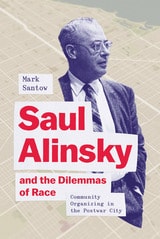
Saul Alinsky and the Dilemmas of Race
Community Organizing in the Postwar CityMark Santow
University of Chicago Press, 2023
Saul Alinsky is the most famous—even infamous—community organizer in American history. Almost single-handedly, he invented a new political form: community federations, which used the power of a neighborhood’s residents to define and fight for their own interests. Across a long and controversial career spanning more than three decades, Alinsky and his Industrial Areas Foundation organized Eastern European meatpackers in Chicago, Kansas City, Buffalo, and St. Paul; Mexican Americans in California and Arizona; white middle-class homeowners on the edge of Chicago’s South Side black ghetto; and African Americans in Rochester, Buffalo, Chicago, and other cities.
Mark Santow focuses on Alinsky’s attempts to grapple with the biggest moral dilemma of his age: race. As Santow shows, Alinsky was one of the few activists of the period to take on issues of race on paper and in the streets, on both sides of the color line, in the halls of power, and at the grassroots, in Chicago and in Washington, DC. Alinsky’s ideas, actions, and organizations thus provide us with a unique and comprehensive viewpoint on the politics of race, poverty, and social geography in the United States in the decades after World War II. Through Alinsky’s organizing and writing, we can see how the metropolitan color line was constructed, contested, and maintained—on the street, at the national level, and among white and black alike. In doing so, Santow offers new insight into an epochal figure and the society he worked to change.

Saul Alinsky and the Dilemmas of Race
Community Organizing in the Postwar CityMark Santow
University of Chicago Press, 2023
A groundbreaking examination of Saul Alinsky's organizing work as it relates to race.
Saul Alinsky is the most famous—even infamous—community organizer in American history. Almost single-handedly, he invented a new political form: community federations, which used the power of a neighborhood’s residents to define and fight for their own interests. Across a long and controversial career spanning more than three decades, Alinsky and his Industrial Areas Foundation organized Eastern European meatpackers in Chicago, Kansas City, Buffalo, and St. Paul; Mexican Americans in California and Arizona; white middle-class homeowners on the edge of Chicago’s South Side black ghetto; and African Americans in Rochester, Buffalo, Chicago, and other cities.
Mark Santow focuses on Alinsky’s attempts to grapple with the biggest moral dilemma of his age: race. As Santow shows, Alinsky was one of the few activists of the period to take on issues of race on paper and in the streets, on both sides of the color line, in the halls of power, and at the grassroots, in Chicago and in Washington, DC. Alinsky’s ideas, actions, and organizations thus provide us with a unique and comprehensive viewpoint on the politics of race, poverty, and social geography in the United States in the decades after World War II. Through Alinsky’s organizing and writing, we can see how the metropolitan color line was constructed, contested, and maintained—on the street, at the national level, and among white and black alike. In doing so, Santow offers new insight into an epochal figure and the society he worked to change.
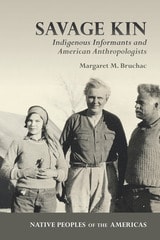
Savage Kin
Indigenous Informants and American AnthropologistsMargaret M. Bruchac
University of Arizona Press, 2018
This book reconceptualizes the intimate details of encounters with Native interlocutors who by turns inspired, facilitated, and resisted the anthropological enterprise. Like other texts focused on this era, Savage Kin features some of the elite white men credited with salvaging material that might otherwise have been lost. Unlike other texts, this book highlights the intellectual contributions and cultural strategies of unsung Indigenous informants without whom this research could never have taken place.
These bicultural partnerships transgressed social divides and blurred the roles of anthropologist/informant, relative/stranger, and collector/collected. Yet these stories were obscured by collecting practices that separated people from objects, objects from communities, and communities from stories. Bruchac’s decolonizing efforts include “reverse ethnography”—painstakingly tracking seemingly unidentifiable objects, misconstrued social relations, unpublished correspondence, and unattributed field notes—to recover this evidence. Those early encounters generated foundational knowledges that still affect Indigenous communities today.
Savage Kin also contains unexpected narratives of human and other-than-human encounters—brilliant discoveries, lessons from ancestral spirits, prophetic warnings, powerful gifts, and personal tragedies—that will move Native and non-Native readers alike.
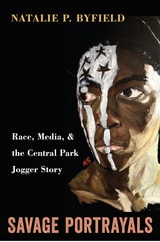
Savage Portrayals
Race, Media and the Central Park Jogger StoryNatalie Byfield
Temple University Press, 2014
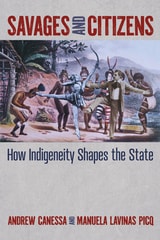
Savages and Citizens
How Indigeneity Shapes the StateAndrew Canessa and Manuela Lavinas Picq; Foreword by Jeff Ganohalidoh Corntassel
University of Arizona Press, 2024
Delving into European political philosophy, comparative politics, and contemporary international law, the book shows how the concept of indigeneity has shaped the development of the modern state. The exclusion of Indigenous people was not a collateral byproduct; it was a political project in its own right. The book argues that indigeneity is a political identity relational to modern nation-states and that Indigenous politics, although marking the boundary of the state, are co-constitutive of colonial processes of state-making. In showing how indigeneity is central to how the international system of states operates, the book forefronts Indigenous peoples as political actors to reject essentializing views that reduce them to cultural “survivors” rooted in the past.
With insights drawn from diverse global contexts and empirical research from Bolivia and Ecuador, this work advocates for the relevance of Indigenous studies within political science and argues for an ethnography of sovereignty in anthropology. Savages and Citizens makes a compelling case for the centrality of Indigenous perspectives to understand the modern state from political theory to international studies.
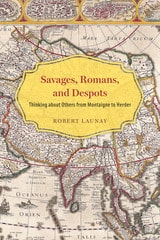
Savages, Romans, and Despots
Thinking about Others from Montaigne to HerderRobert Launay
University of Chicago Press, 2018
Beginning with Mandeville and Montaigne, and working through Montesquieu, Diderot, Gibbon, Herder, and others, Launay traces how Europeans both admired and disdained unfamiliar societies in their attempts to work through the inner conflicts of their own social worlds. Some of these writers drew caricatures of “savages,” “Oriental despots,” and “ancient” Greeks and Romans. Others earnestly attempted to understand them. But, throughout this history, comparative thinking opened a space for critical reflection. At its worst, such space could give rise to a sense of European superiority. At its best, however, it could prompt awareness of the value of other ways of being in the world. Launay’s masterful survey of some of the Western tradition’s finest minds offers a keen exploration of the genesis of the notion of “civilization,” as well as an engaging portrait of the promises and perils of cross-cultural comparison.
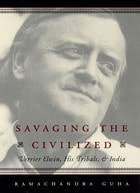
Savaging the Civilized
Verrier Elwin, His Tribals, and IndiaRamachandra Guha
University of Chicago Press, 1999
Described by his contemporaries as a cross between Albert Schweitzer and Paul Gauguin, Elwin was a man of contradictions, at times taking on the role of evangelist, social worker, political activist, poet, government worker, and more. He rubbed elbows with the elite of both Britain and India, yet found himself equally at home among the impoverished and destitute. Intensely political, the Oxford-trained scholar tirelessly defended the rights of the indigenous and, despite the deep religious influences of St. Francis and Mahatma Gandhi on his early career, staunchly opposed Hindu and Christian puritans in the debate over the future of India's tribals. Although he was ordained as an Anglican priest, Elwin was married twice to tribal women and enthusiastically (and publicly) extolled the tribals' practice of free sex. Later, as prime minister Nehru's friend and advisor in independent India, his compelling defense of tribal hedonism made him at once hugely influential, extremely controversial, and the polemical focal point of heated discussions on tribal policy and economic development.
Savaging the Civilized is both biography and history, an exploration through Elwin's life of some of the great debates of the twentieth century: the future of development, cultural assimilation versus cultural difference, the political practice of postcolonial as opposed to colonial governments, and the moral practice of writers and intellectuals.

Save Venice Inc.
American Philanthropy and Art Conservation in Italy, 1966-2021Christopher Carlsmith
University of Massachusetts Press, 2022
In 1966, the most destructive flood in the history of Venice temporarily submerged the city and threatened its extraordinary art and architecture. Among the organizations that mobilized to protect this fragile heritage was Save Venice Inc. Founded in Boston and now headquartered in New York City, this nonprofit has become the largest and most active committee dedicated to preserving the artistic legacy of Venice.
Christopher Carlsmith tells the fascinating story of Save Venice Inc., from its origins to its fiftieth anniversary. It continues to provide an influential model for philanthropy in the cultural sector, raising substantial funds to conserve and restore paintings, sculptures, books, mosaics, and entire buildings at risk from human and environmental impacts. Employing extensive archival research, oral interviews, and newspaper accounts, Save Venice Inc. explores a range of topics, including leadership, conservation projects, fundraising, and educational outreach. Using a range of methodologies from cultural history and art history, Carlsmith traces the achievements and challenges faced by this and other historic preservation organizations and by this unique city on the sea.

Saved for a Purpose
A Journey from Private Virtues to Public ValuesJames A. Joseph
Duke University Press, 2015
In an engaging and personal style, Joseph shows how his commitment to applying moral and ethical principles to large groups and institutions played out in his work in the civil rights movement in Alabama and as a college chaplain in California in the turbulent 1960s. His time later as vice president of the Cummins Engine Company provided an opportunity to promote corporate ethics, and his tenure as Under Secretary of the Interior in the Carter Administration underscored the difficulty and weight of making the right decisions while balancing good policy analysis with transcendent moral principles.
In 1996 President Clinton selected Joseph to become the United States Ambassador to South Africa. His recollections of working with Nelson Mandela, whom he describes as a noble and practical politician, and his observations about what he learned from Desmond Tutu and others about reconciliation contain some of the book’s most poignant passages.
Saved for a Purpose is unique, as Joseph combines his insights from working to integrate values into America’s public and private sectors with his long engagement with ethics as an academic discipline and as a practical guide for social behavior. Ultimately, it reflects Joseph’s passionate search for values that go beyond the personal to include the ethical imperatives that should be applied to the communal.

Saving Animals
Multispecies Ecologies of Rescue and CareElan Abrell
University of Minnesota Press, 2021
A fascinating and unprecedented ethnography of animal sanctuaries in the United States
In the past three decades, animal rights advocates have established everything from elephant sanctuaries in Africa to shelters that rehabilitate animals used in medical testing, to homes for farmed animals, abandoned pets, and entertainment animals that have outlived their “usefulness.” Saving Animals is the first major ethnography to focus on the ethical issues animating the establishment of such places, where animals who have been mistreated or destined for slaughter are allowed to live out their lives simply being animals.
Based on fieldwork at animal rescue facilities across the United States, Elan Abrell asks what “saving,” “caring for,” and “sanctuary” actually mean. He considers sanctuaries as laboratories where caregivers conceive and implement new models of caring for and relating to animals. He explores the ethical decision making around sanctuary efforts to unmake property-based human–animal relations by creating spaces in which humans interact with animals as autonomous subjects. Saving Animals illustrates how caregivers and animals respond by cocreating new human–animal ecologies adapted to the material and social conditions of the Anthropocene.
Bridging anthropology with animal studies and political philosophy, Saving Animals asks us to imagine less harmful modes of existence in a troubled world where both animals and humans seek sanctuary.

Saving Babies?
The Consequences of Newborn Genetic ScreeningStefan Timmermans and Mara Buchbinder
University of Chicago Press, 2012
Saving Face
The Emotional Costs of the Asian Immigrant Family MythAngie Y. Chung
Rutgers University Press, 2016

Saving New Sounds
Podcast Preservation and HistoriographyJeremy Wade Morris and Eric Hoyt, editors
University of Michigan Press, 2021
Over seventy-five million Americans listen to podcasts every month, and the average weekly listener spends over six hours tuning into podcasts from the more than thirty million podcast episodes currently available. Yet despite the excitement over podcasting, the sounds of podcasting’s nascent history are vulnerable and they remain mystifyingly difficult to research and preserve. Podcast feeds end abruptly, cease to be maintained, or become housed in proprietary databases, which are difficult to search with any rigor. Podcasts might seem to be highly available everywhere, but it’s necessary to preserve and analyze these resources now, or scholars will find themselves writing, researching, and thinking about a past they can’t fully see or hear.
This collection gathers the expertise of leading and emerging scholars in podcasting and digital audio in order to take stock of podcasting’s recent history and imagine future directions for the format. Essays trace some of the less amplified histories of the format and offer discussions of some of the hurdles podcasting faces nearly twenty years into its existence. Using their experiences building and using the PodcastRE database—one of the largest publicly accessible databases for searching and researching podcasts—the volume editors and contributors reflect on how they, as media historians and cultural researchers, can best preserve podcasting’s booming audio cultures and the countless voices and perspectives podcasting adds to our collective soundscape.
Saving Our Children From Poverty
What the United States Can Learn From FranceBarbara R. Bergmann
Russell Sage Foundation, 1996

Saving Seeds, Preserving Taste
Heirloom Seed Savers in AppalachiaBill Best
Ohio University Press, 2013
The Brown Goose, the White Case Knife, Ora’s Speckled Bean, Radiator Charlie’s Mortgage Lifter—these are just a few of the heirloom fruits and vegetables you’ll encounter in Bill Best’s remarkable history of seed saving and the people who preserve both unique flavors and the Appalachian culture associated with them. As one of the people at the forefront of seed saving and trading for over fifty years, Best has helped preserve numerous varieties of beans, tomatoes, corn, squashes, and other fruits and vegetables, along with the family stories and experiences that are a fundamental part of this world. While corporate agriculture privileges a few flavorless but hardy varieties of daily vegetables, seed savers have worked tirelessly to preserve genetic diversity and the flavors rooted in the Southern Appalachian Mountains—referred to by plant scientists as one of the vegetative wonders of the world.
Saving Seeds, Preserving Taste will introduce readers to the cultural traditions associated with seed saving, as well as the remarkable people who have used grafting practices and hand-by-hand trading to keep alive varieties that would otherwise have been lost. As local efforts to preserve heirloom seeds have become part of a growing national food movement, Appalachian seed savers play a crucial role in providing alternatives to large-scale agriculture and corporate food culture. Part flavor guide, part people’s history, Saving Seeds, Preserving Taste will introduce you to a world you’ve never known—or perhaps remind you of one you remember well from your childhood.

Saving the Security State
Exceptional Citizens in Twenty-First-Century AmericaInderpal Grewal
Duke University Press, 2017
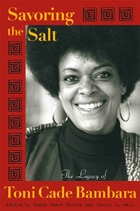
Savoring the Salt
The Legacy of Toni Cade Bambaraedited by Linda Janet Holmes and Cheryl A. Wall
Temple University Press, 2007
Admiring readers have kept Bambara's fiction in print since her first collection of stories, Gorilla, My Love, was published in 1972. She continued to write -- and her audience and reputation continued to grow -- until her untimely death in 1995. Savoring the Salt includes excerpts from her published and unpublished writings, along with interviews and photos of Bambara. The mix of poets and scholars, novelists and critics, political activists and filmmakers represented here testifies to the ongoing importance and enduring appeal of her work.

Savu
History and Oral Tradition on an Island of IndonesiaGeneviève Duggan and Hans Hägerdal
National University of Singapore Press, 2018

Saxony in German History
Culture, Society, and Politics, 1830-1933James Retallack, Editor
University of Michigan Press, 2000
Focusing on the east German state of Saxony, the contributors to this volume refuse easy resolution of that tension, seeking instead to illustrate how local, regional, and national cultures commingled, diverged, and influenced each other over time. By considering both the erosion and the persistence of traditional identities and regional boundaries, these essays help to restore an appreciation of regional "ways of seeing," suggesting they really did matter--in their own right, and for the nation as a whole.
Topics considered include the expansion of a German reading public, Jewish emancipation, the formation of socio-moral milieus, working-class leisure, the expansion of the public sphere, the rise of consumer co-operatives, gendered attempts to fashion the "new" liberal man, and degradation rituals in the 1920s. Presenting to English-reading audiences the fruits of cutting-edge research conducted in Saxon archives since 1989, the contributors offer innovative ways to reassess the larger sweep of German history.
This book serves as a how-to guide for the study of any region in history. Beyond its primary appeal to European historians, it will also speak to students and scholars in comparative politics and sociology.
James Retallack is Professor of History, University of Toronto.
Say Her Name
Centering Black Feminism and Black Women in SportLetisha Engracia Cardoso Brown
Rutgers University Press, 2025
Say Her Name delves deeply into issues of gender, the politics of punishment, athlete activism, the politics of Black hair, fingernails and fashion, and the representation and commodification of Blackgirlwomen in sport and society. An entry point into the growing research in sport studies and beyond from a Black feminist lens, Say Her Name offers a clear window into the power and potential of nuanced examinations of sport. As a reflection of the larger social world, sport provides a framework for understanding larger social issues, including racism, sexism, and misogynoir. Blackgirlwomen have varied experiences in sport, and Say Her Name provides a window into those experiences. The book discusses Black women in sports including the South African runner Caster Semenya and the American runners Florence Griffith Joyner and Sha’Carri Richardson, as well as Venus and Serena Williams, Gabby Douglas, and Simone Biles. The women in this book have lived experiences that speak to the larger experiences of Black women and girls in sport and society, while also leaning into a larger discussion of the importance of the social movement #SayHerName.
Scales of Captivity
Racial Capitalism and the Latinx ChildMary Pat Brady
Duke University Press, 2022
Scales of Resistance
Indigenous Women’s Transborder ActivismMaylei Blackwell
Duke University Press, 2022

Scaling Preservice Training in Comprehensive Contraception and Abortion Care and Research across Ethiopia
A Case Study of a Five-Year Project with Schools of Medicine and MidwiferySolomon W. Beza
Michigan Publishing Services, 2019
The case study is produced by UM-CIRHT with funding from an anonymous donor.

Scammer's Yard
The Crime of Black Repair in JamaicaJovan Scott Lewis
University of Minnesota Press, 2020
Tells the story of Jamaican “scammers” who use crime to gain autonomy, opportunity, and repair
There is romance in stealing from the rich to give to the poor, but how does that change when those perceived rich are elderly white North Americans and the poor are young Black Jamaicans? In this innovative ethnography, Jovan Scott Lewis tells the story of Omar, Junior, and Dwayne. Young and poor, they strive to make a living in Montego Bay, where call centers and tourism are the two main industries in the struggling economy. Their experience of grinding poverty and drastically limited opportunity leads them to conclude that scamming is the best means of gaining wealth and advancement. Otherwise, they are doomed to live in “sufferation”—an inescapable poverty that breeds misery, frustration, and vexation.
In the Jamaican lottery scam run by these men, targets are told they have qualified for a large loan or award if they pay taxes or transfer fees. When the fees are paid, the award never arrives, netting the scammers tens of thousands of U.S. dollars. Through interviews, historical sources, song lyrics, and court testimonies, Lewis examines how these scammers justify their deceit, discovering an ethical narrative that reformulates ideas of crime and transgression and their relationship to race, justice, and debt.
Scammer’s Yard describes how these young men, seeking to overcome inequality and achieve autonomy, come to view crime as a form of liberation. Their logic raises unsettling questions about a world economy that relegates postcolonial populations to deprivation even while expecting them to follow the rules of capitalism that exacerbate their dispossession. In this groundbreaking account, Lewis asks whether true reparation for the legacy of colonialism is to be found only through radical—even criminal—means.

Scandalous Practices
Homosexuality, Male Prostitution, and Sexual Citizenship in Post-Fascist ItalyAlessio Ponzio
Temple University Press, 2027
From the 1940s to the 1970s, homosexual men in Italy began to express themselves authentically after years of silence under Fascist repression. In Scandalous Practices, Alessio Ponzio deftly recounts the socio-cultural shifts that occurred for queer Italians during this period.
In tabloids and other publications, journalists sensationalized same-sex male prostitution, dramatized scandalous homosexual murders, and portrayed homosexuality as devious, dangerous, and threatening to the “new” post-war masculinity. Homosexual Italians responded to this public shaming and these negative stereotypes through resistance. As part of an ongoing struggle for gender and sexual equality, they established networks and created public discussions that engendered pride, rights awareness, and a political commitment to emancipation.
Ponzio meticulously details how Italy as a nation and culture dealt with emerging representation of queer sexuality through a reinvention that fomented self-understanding and self-representations. Instead of marginalizing it, the popular media unintentionally made homosexuality understandable to many who did not know what it was or could not make sense of their own desires. Scandalous Practices illustrates how this new sexual knowledge spread publicly across social classes and fostered the development of positive queer identities and communities.
In the series Sexuality Studies
Scandinavians in Chicago
The Origins of White Privilege in Modern AmericaErika K. Jackson
University of Illinois Press, 2019
Scapegoats of September 11th
Hate Crimes & State Crimes in the War on TerrorWelch, Michael
Rutgers University Press, 2006
The altered American landscape, however, includes more than security measures and ID cards. The country's desperate quest for security is visible in many less obvious, yet more insidious ways. In Scapegoats of September 11th, criminologist Michael Welch argues that the "war on terror" is a political charade that delivers illusory comfort, stokes fear, and produces scapegoats used as emotional relief. Regrettably, much of the outrage that resulted from 9/11 has been targeted at those not involved in the attacks on the Pentagon or the Twin Towers. As this book explains, those people have become the scapegoats of September 11th. Welch takes on the uneasy task of sorting out the various manifestations of displaced aggression, most notably the hate crimes and state crimes that have become embarrassing hallmarks both at home and abroad.
Drawing on topics such as ethnic profiling, the Abu Ghraib scandal, Guantanamo Bay, and the controversial Patriot Act, Welch looks at the significance of knowledge, language, and emotion in a post-9/11 world. In the face of popular and political cheerleading in the war on terror, this book presents a careful and sober assessment, reminding us that sound counterterrorism policies must rise above, rather than participate in, the propagation of bigotry and victimization.
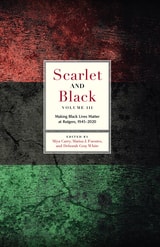
Scarlet and Black, Volume Three
Making Black Lives Matter at Rutgers, 1945-2020Miya Carey
Rutgers University Press, 2021
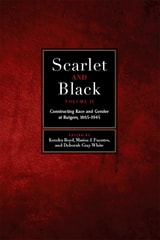
Scarlet and Black, Volume Two
Constructing Race and Gender at Rutgers, 1865-1945Kendra Boyd
Rutgers University Press, 2020
To learn more about the work of the Committee on Enslaved and Disenfranchised Population in Rutgers History, visit the project's website at http://scarletandblack.rutgers.edu
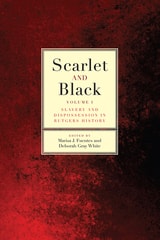
Scarlet and Black
Slavery and Dispossession in Rutgers HistoryFuentes, Marisa J
Rutgers University Press, 2016
Scarlet and Black documents the history of Rutgers’s connection to slavery, which was neither casual nor accidental—nor unusual. Like most early American colleges, Rutgers depended on slaves to build its campuses and serve its students and faculty; it depended on the sale of black people to fund its very existence. Men like John Henry Livingston, (Rutgers president from 1810–1824), the Reverend Philip Milledoler, (president of Rutgers from 1824–1840), Henry Rutgers, (trustee after whom the college is named), and Theodore Frelinghuysen, (Rutgers’s seventh president), were among the most ardent anti-abolitionists in the mid-Atlantic.
Scarlet and black are the colors Rutgers University uses to represent itself to the nation and world. They are the colors the athletes compete in, the graduates and administrators wear on celebratory occasions, and the colors that distinguish Rutgers from every other university in the United States. This book, however, uses these colors to signify something else: the blood that was spilled on the banks of the Raritan River by those dispossessed of their land and the bodies that labored unpaid and in bondage so that Rutgers could be built and sustained. The contributors to this volume offer this history as a usable one—not to tear down or weaken this very renowned, robust, and growing institution—but to strengthen it and help direct its course for the future.
The work of the Committee on Enslaved and Disenfranchised Population in Rutgers History.
Visit the project's website at http://scarletandblack.rutgers.edu
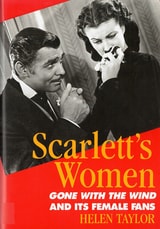
Scarlett's Women
Gone With the Wind and Its Female FansTaylor, Helen
Rutgers University Press, 1989
Scarlett's Women
Gone With the Wind and Its Female FansTaylor, Helen
Rutgers University Press, 1969
Scarred Landscapes
Place, Trauma, and Memory in Caribbean Latinx ArtStephanie Lewthwaite
University of Arizona Press, 2025
The book combines formal analysis with artist testimony, exhibition histories, and theoretical frameworks from trauma, memory, and archipelagic studies, to offer a multifaceted examination of Caribbean Latinx art. Lewthwaite explores how these artists practice “archipelagic memory,” a generative, decolonial, and coalitional form of memory work that envisions alternative modes of belonging in difference and solidarity with others. By connecting different people, pasts, and places, Caribbean Latinx artists expose the reverberations of trauma while imagining other worlds beyond it.
This work puts Caribbean Latinx artists at the center of debates about the exclusions of dominant memory narratives and contemporary art worlds, highlighting their contributions to a wider decolonial project of remembrance. By revealing the interconnectedness of traumatic histories and the potential for art to foster empathy and justice, Lewthwaite’s work underscores the importance of relational and decolonial thought for imagining a better society.
Scattered Finds
Archaeology, Egyptology and MuseumsAlice Stevenson
University College London, 2018
Scattered Hegemonies
Postmodernity and Transnational Feminist PracticesInderpal Grewal
University of Minnesota Press, 1994
Scenes From Postmodern Life
Beatriz Sarlo
University of Minnesota Press, 2001
Scenes and Their Senses
Close Reading as Theory and MethodRobin Wagner-Pacifici
University of Chicago Press, 0
Makes the case for close readings of small scenes appearing in works of literature, scholarship, film, and visual art, showing how close attention to details can reveal the meaningful sociological action that often occurs on the margins.
Why do certain images, stories, and scenes impress upon us so strongly, inviting us to linger over the nuances of their meaning? In Scenes and Their Senses, sociologist Robin Wagner-Pacifici seeks to uncover the deeper meaning behind twenty “scenes” that have captured her theoretical imagination over her lifetime. Some of these come from classics of sociological theory or literature—Geertz, Habermas, Lévi-Strauss, Zola—and some are more contemporary, including the films Good Will Hunting and Luis Buñuel’s The Phantom ofLiberty. She seeks here to understand each scene less as examples of a given condition or conundrum and more as worlds in themselves.
As Wagner-Pacifici shows, close attention to the forms and flows of these minor, often quiet scenes reveals how meaningful action occurs in what might appear to be the margins or interstices of the bigger, noisier story being told. Providing an entry point to larger social conditions, relations, and change, the scenes analyzed here evoke sociological themes of belonging and exile, strength and weakness, cleanliness and pollution, reality and fantasy, courage and cowardice, and vision and obscurity, among others. As an ethnography of texts recalled from previous readings and revisited by the author, the scenes highlight the role of memory in sense-making. Furthermore, the activation of the scenes as a focused point of sustained contemplation functions as a remarkable bridge between method and theory.
Scenes from la Cuenca de Los Angeles y otros Natural Disasters
Susana Chávez-Silverman
University of Wisconsin Press, 2010

Scenes from the High Desert
JULIAN STEWARD'S LIFE AND THEORYVirginia Kerns
University of Illinois Press, 2002
Scenes from the Shadows
Afro-Argentine Life in the Twentieth CenturyRobert J. Cottrol and Lea Geler
Ohio University Press, 2027
Scenes from the Shadows challenges one of the most enduring myths of Argentine history: that Afro-Argentines had disappeared by the twentieth century. Bringing together leading scholars of race, culture, and history, the volume demonstrates that Afro-descendant communities remained a vital part of Argentine society even as official narratives, public institutions, and popular memory rendered them increasingly invisible. Drawing on oral histories, community newspapers, family archives, ethnography, and archival research, the contributors recover the lives, organizations, and cultural worlds that persisted beneath the surface of Argentina’s self-image as a White, European nation.
Focusing on Buenos Aires—home to the country’s largest Afro-descendant population and the epicenter of debates over race and national identity—the book situates Argentina within the broader history of the African diaspora in Latin America and examines how ideologies of Whitening (blanqueamiento), racial classification, urban development, and national identity obscured Afro-descendant presence throughout the twentieth century. The chapters explore Black celebrity and performance culture, tango, Afro-Porteño associational life, community journalism, public employment, migration, gender, and the formation of Afro-descendant social networks, revealing how Afro-Argentines negotiated exclusion while sustaining vibrant traditions of community, creativity, and belonging.
More than a recovery of forgotten histories, Scenes from the Shadows offers a new interpretation of modern Argentina itself. It shows how race continued to shape social life even in a society that denied its importance and how Afro-descendant communities endured despite powerful pressures toward erasure. A major contribution to Afro-Latin American studies, Argentine history, and diaspora scholarship, the volume restores Afro-Argentines to their place in the story of twentieth-century Argentina and provides a powerful framework for understanding the relationship between race, memory, and nationhood.
Contributors
Paulina L. Alberto
Judith M. Anderson
Laura Colabella
Robert J. Cottrol
Alejandra Egido
Alejandro Frigerio
Lea Geler
Lucas Glasman
Miriam Gomes
Chisu Teresa Ko
Eva Lamborghini
Marta Maffia
Carmen Yannone
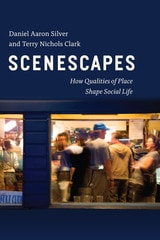
Scenescapes
How Qualities of Place Shape Social LifeDaniel Aaron Silver and Terry Nichols Clark
University of Chicago Press, 2016
In Scenescapes, Daniel Aaron Silver and Terry Nichols Clark examine the patterns and consequences of the amenities that define our streets and strips. They articulate the core dimensions of the theatricality, authenticity, and legitimacy of local scenes—cafes, churches, restaurants, parks, galleries, bowling alleys, and more. Scenescapes not only reimagines cities in cultural terms, it details how scenes shape economic development, residential patterns, and political attitudes and actions. In vivid detail and with wide-angle analyses—encompassing an analysis of 40,000 ZIP codes—Silver and Clark give readers tools for thinking about place; tools that can teach us where to live, work, or relax, and how to organize our communities.

Scepticism and Hope in Twentieth Century Fantasy Literature
Kath Filmer
University of Wisconsin Press, 1992

Schneider on Schneider
The Conversion of the Jews and Other Anthropological StoriesDavid M. Schneider, as told to Richard Handler
Duke University Press, 1995
In this work, based on conversations with Richard Handler, Schneider tells the story of his days devoted to anthropology—as a student of Clyde Kluckhohn and Talcott Parsons and as a writer and teacher whose work on kinship and culture theory revolutionized the discipline. With a master’s sense of the telling anecdote, he describes his education at Cornell, Yale, and Harvard, his fieldwork on the Micronesian island of Yap and among the Mescalero Apache, and his years teaching at the London School of Economics, Berkeley, and the University of Chicago. Musing on the current state and the future of anthropology, Schneider’s cast of characters reads like a who’s who of postwar social science. His reflections on anthropological field research and academic politics address some of the most pressing ethical and epistemological issues facing scholars today, while yielding tales of unexpected amusement.
With its humor and irony, its wealth of information and searching questions about the state of anthropology, Schneider on Schneider not only provides an important resource for the history of twentieth-century social science, but also brings to life the entertaining voice of an engaging storyteller.

School Principal
Managing in PublicDan C. Lortie
University of Chicago Press, 2009
When we think about school principals, most of us imagine a figure of vague, yet intimidating authority—for an elementary school student, being sent to the principal’s office is roughly on par with a trip to Orwell’s Room 101. But with School Principal, Dan C. Lortie aims to change that. Much as he did for teachers with his groundbreaking book Schoolteacher, Lortie offers here an intensive and detailed look at principals, painting a compelling portrait of what they do, how they do it, and why.
Lortie begins with a brief history of the job before turning to the daily work of a principal. These men and women, he finds, stand at the center of a constellation of competing interests around and within the school. School district officials, teachers, parents, and students all have needs and demands that frequently clash, and it is the principal’s job to manage these conflicting expectations to best serve the public. Unsurprisingly then, Lortie records his subjects’ professional dissatisfactions, but he also vividly depicts the pleasures of their work and the pride they take in their accomplishments. Finally, School Principal offers a glimpse of the future with an analysis of current issues and trends in education, including the increasing presence of women in the role and the effects of widespread testing mandated by the government.
Lortie’s scope is both broad and deep, offering an eminently useful range of perspectives on his subject. From the day-to-day toil to the long-term course of an entire career, from finding out just what goes on inside that office to mapping out the larger social and organizational context of the job, School Principal is a truly comprehensive account of a little-understood profession.

School Yearbook
The Untold Story of a Cringey Tradition and Its Digital AfterlifeKate Eichhorn
University of Chicago Press, 2025
We’re all familiar with the embarrassment that washes over us when recalling our high school yearbooks. Questionable fashion choices, gravity-defying hair, a melodramatic quote—what were we thinking? Even as school yearbooks decline in popularity among contemporary teens, they continue to impact our lives in shocking ways. Collected, digitized, aggregated, and recombined in ways that would have been impossible to imagine just a few decades ago, yearbooks are no longer bound personal archives of adolescent memories. In the twenty-first century, they are shaping our lives in surprising and sometimes disturbing ways. And what could be a more fitting afterlife for these cringey books?
In School Yearbook, cultural critic Kate Eichhorn investigates this ubiquitous object. On the surface, school yearbooks are easily dismissed as innocuous collections of embarrassing photographs and cheesy affirmations, but as Eichhorn reveals, there has never been anything innocent about the school yearbook tradition. Since the early twentieth century, yearbooks have circulated as forms of public relations, propaganda, and hate speech. They have been routinely used by police detectives, private investigators, and even the FBI to identify and profile suspects. With over half a million yearbooks now available online, these books have also acquired the power to continue shaping our lives long after graduation. Would-be landlords, employers, and even creditors can now turn to data culled from their embarrassing pages to make judgments about who we are and what we merit.
In a digital era, school yearbooks have acquired the ability to keep judging us in perpetuity. Both timely and insightful, School Yearbook explores how these books have always been used to rank and judge us.
School Zone
A Problem Analysis of Student Offending and VictimizationPamela Wilcox, Graham C. Ousey, and Marie Skubak Tillyer
Temple University Press, 2022
Schools should be safe—but they are not always safe for everybody. Authors Pamela Wilcox, Graham Ousey, and Marie Skubak Tillyer studied crime among students located across diverse middle- and high-school settings to investigate why some students engage in delinquency—but others do not—and why some students are more prone to victimization. School Zone focuses on the three key interactional elements—context, victims, and offenders—to understand and explain the impact of common crimes such as theft, weapon carrying, drug possession and the verbal, physical, and sexual harassment of classmates.
The authors also consider how individual students and schools respond to crime and threats. They analyze the variables that schools can control in planning and practice that explain why some schools have higher crime rates. School Zone uses empirical studies to provide a comprehensive understanding of the patterns and causes of variation in individual- and aggregate-level school-based offending and victimization experiences while also addressing the adequacy of wide-ranging criminological explanations and crime prevention policies.
In their conclusion, the authors assess the extent to which currently popular strategies of school crime prevention align with what they have discovered through their problem-analysis framework and scientific understandings of student offending and victimization.
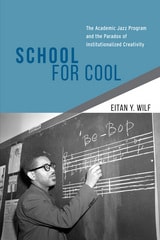
School for Cool
The Academic Jazz Program and the Paradox of Institutionalized CreativityEitan Y. Wilf
University of Chicago Press, 2014
Few art forms epitomize the anti-institutional image more than jazz, but it’s precisely at the academy where jazz is now flourishing. This shift has introduced numerous challenges and contradictions to the music’s practitioners. Solos are transcribed, technique is standardized, and the whole endeavor is plastered with the label “high art”—a far cry from its freewheeling days. Wilf shows how students, educators, and administrators have attempted to meet these challenges with an inventive spirit and a robust drive to preserve—and foster—what they consider to be jazz’s central attributes: its charisma and unexpectedness. He also highlights the unintended consequences of their efforts to do so. Ultimately, he argues, the gap between creative practice and institutionalized schooling, although real, is often the product of our efforts to close it.

School
A NovelRay Levy
University of Alabama Press, 2023
Both an exorcism of contemporary academia and a comedic portrait of an artist seeking the means to survive.
At once angry and jubilant, Ray Levy’s School is a curse on a dying system and an incantation for transforming pain into a vessel for capacious, creative selfhood.
A dissertation manuscript possessed by the spirit of Marquis de Sade; a lecture on psychoanalysis delivered as stand-up comedy by a dysphoric graduate student; a review of a found-footage horror movie that’s also a YouTube video of a conference presentation on French theory; an interview with an avant-garde filmmaker that’s really an invocation for conjuring your demon brother; oversharing and withholding, chanting and channeling, School is a slapstick roast of Derrida’s corpse and a mystical vision of a life in which you have not lost.