Results by title
967 books match the query 'Theater' and 108 start with s
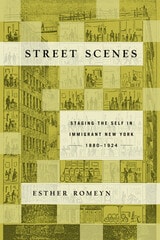
Street Scenes
Staging the Self in Immigrant New York, 1880–1924Esther Romeyn
University of Minnesota Press, 2008
The turn of the twentieth century in New York City was characterized by radical transformation as the advent of consumer capitalism confronted established social hierarchies, culture, and conceptions of selfhood. The popular stage existed in a symbiotic relationship with the city and uniquely captured the contested terms of immigrant identity of the time.
Street Scenes focuses on the intersection of modern city life and stage performance. From street life and slumming to vaudeville and early cinema, to Yiddish theater and blackface comedy, Esther Romeyn discloses racial comedy, passing, and masquerade as gestures of cultural translation. In these performances she detects an obsession with the idea of the city as theater and the self as actor, which was fueled by the challenges that consumer capitalism presented to notions of an “authentic” self.
It was exactly this idea of “authentic” immigrant selfhood that was at stake in many performances on the popular stage, and Romeyn ultimately demonstrates how these diverse and potent immigrant works influenced the emergence of a modern metropolitan culture.
[more]

Subjects of Affection
Rights of Resistance on the Early Modern French StageAnna Rosensweig
Northwestern University Press, 2022
Subjects of Affection offers an alternative to the modern model of human rights in an unexpected archive: the monarchist tragedies that shaped Louis XIV’s absolutist France. Pairing political theory with performance studies, Anna Rosensweig argues that the right of resistance, largely thought to have disappeared from French political thought in the aftermath of the religious wars of the sixteenth century, actually endured throughout the seventeenth century as a conceptual framework embedded and embodied in tragic drama.
Contemporary scholars have critiqued the modern rights paradigm for its failure to acknowledge the ways in which individual rights depend upon state protection and national belonging. Through a reappraisal of early modern French tragedy, Rosensweig provides a corrective to accounts of human rights that begin with the French Revolution, exploring previously unrecognized models for collective action that had emerged during the religious wars. Subjects of Affection reveals how French tragedy sustained these models of collective action by binding together individuals and groups through affect. Rosensweig places sixteenth-century political treatises in dialogue with dramas by Robert Garnier, Jean Rotrou, Pierre Corneille, and Jean Racine that were performed and published between 1550 and 1700. In so doing, she demonstrates how these tragedies, through their poetics and performance potential, stage a subject of rights whose collective constitution differs from the individualism of our modern rights framework. Through fresh insights and incisive readings, Subjects of Affection explores a form of political subjectivity that locates political power in connection to others—from staged characters and choruses to unseen collectives.
Contemporary scholars have critiqued the modern rights paradigm for its failure to acknowledge the ways in which individual rights depend upon state protection and national belonging. Through a reappraisal of early modern French tragedy, Rosensweig provides a corrective to accounts of human rights that begin with the French Revolution, exploring previously unrecognized models for collective action that had emerged during the religious wars. Subjects of Affection reveals how French tragedy sustained these models of collective action by binding together individuals and groups through affect. Rosensweig places sixteenth-century political treatises in dialogue with dramas by Robert Garnier, Jean Rotrou, Pierre Corneille, and Jean Racine that were performed and published between 1550 and 1700. In so doing, she demonstrates how these tragedies, through their poetics and performance potential, stage a subject of rights whose collective constitution differs from the individualism of our modern rights framework. Through fresh insights and incisive readings, Subjects of Affection explores a form of political subjectivity that locates political power in connection to others—from staged characters and choruses to unseen collectives.
[more]
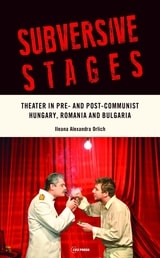
Subversive Stages
Theater in Pre- and Post-Communist Hungary, Romania and BulgariaIleana Alexandra Orlich
Central European University Press, 2017
Exploring theater practices in communist and post-communist Hungary, Romania and Bulgaria, this book analyzes intertextuality or "inter-theatricality" as a political strategy, designed to criticize contemporary political conditions while at the same time trying to circumvent censorship. Plays by Romanian, Hungarian and Bulgarian dramatists are examined, who are "retrofitting" the past by adapting the political crimes and horrifying tactics of totalitarianism to the classical theatre (with Shakespeare a favorite) to reveal the region's traumatic history. By the sustained analysis of the aesthetic devices used as political tools, Orlich makes a very strong case for the continued relevance of the theater as one of the subtlest media in the public sphere. She embeds her close readings in a thorough historical analysis and displays a profound knowledge of the political role of theater history. In the Soviet bloc the theater of the absurd, experimentation, irony, and intertextual distancing (estrangement) are not seen as mere aesthetic language games but as political strategies that use indirection to say what cannot be said directly.
[more]
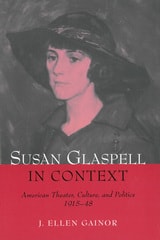
Susan Glaspell in Context
American Theater, Culture, and Politics, 1915-48J. Ellen Gainor
University of Michigan Press, 2003
Susan Glaspell in Context not only discusses the dramatic work of this key American author -- perhaps best known for her short story "A Jury of Her Peers" and its dramatic counterpart, Trifles -- but also places it within the theatrical, cultural, political, social, historical, and biographical climates in which Glaspell's dramas were created: the worlds of Greenwich Village and Provincetown bohemia, of the American frontier, and of American modernism.
J. Ellen Gainor is Professor of Theatre, Women's Studies, and American Studies, Cornell University. Her other books include Performing America: Cultural Nationalism in American Theater (co-edited with Jeffrey D. Mason) from the University of Michigan Press.
[more]
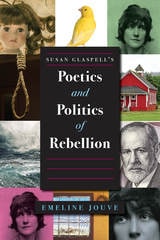
Susan Glaspell's Poetics and Politics of Rebellion
Emeline Jouve
University of Iowa Press, 2017
A pioneer of American modern drama and founding member of the Provincetown Players, Susan Glaspell (1876–1948) wrote plays of a kind that Robert Brustein defines as a “drama of revolt,” an expression of the dramatists’ discontent with the prevailing social, political, and artistic order. Her works display her determination to put an end to the alienating norms that, in her eyes and those of her bohemian peers, were stifling American society. This determination both to denounce infringements on individual rights and to reform American life through the theatre shapes the political dimension of her drama of revolt.
Analyzing plays from the early Trifles (1916) through Springs Eternal (1943) and the undated, incomplete Wings, author Emeline Jouve illustrates the way that Glaspell’s dramas addressed issues of sexism, the impact of World War I on American values, and the relationship between individuals and their communities, among other concerns. Jouve argues that Glaspell turns the playhouse into a courthouse, putting the hypocrisy of American democracy on trial. In staging rebels fighting for their rights in fictional worlds that reflect her audience’s extradiegetic reality, she explores the strategies available to individuals to free themselves from oppression. Her works envisage a better future for both her fictive insurgents and her spectators, whom she encourages to consider which modes of revolt are appropriate and effective for improving the society they live in. The playwright defines social reform in terms of collaboration, which she views as an alternative to the dominant, alienating social and political structures. Not simply accusing but proposing solutions in her plays, she wrote dramas that enacted a positive revolt.
A must for students of Glaspell and her contemporaries, as well as scholars of American theatre and literature of the first half of the twentieth century.
[more]

Swim Pretty
Aquatic Spectacles and the Performance of Race, Gender, and NatureJennifer A. Kokai
Southern Illinois University Press, 2017
Drawing on cultural associations with bodies of water, the spectacle of pretty women, and the appeal of the concept of “family-friendly” productions, performative aquatic spectacles portray water as an exotic fantasy environment exploitable for the purpose of entertainment. In Swim Pretty, Jennifer A. Kokai reveals the influential role of aquatic spectacles in shaping cultural perceptions of aquatic ecosystems in the United States over the past century.
Examining dramatic works in water and performances at four water parks, Kokai shows that the evolution of these works and performances helps us better understand our ever-changing relationship with the oceans and their inhabitants. Kokai sorts the regard for and harnessing of water in aquatic spectacles into three categories—natural, tamed, and domesticated—and discusses the ways in which these modes of water are engaged in the performances throug an aesthetics of descension. Ultimately, this study links the uncritical love of aquatic spectacles to a disregard for the rights of marine animals and lack of concern for the marine environment.
Examining dramatic works in water and performances at four water parks, Kokai shows that the evolution of these works and performances helps us better understand our ever-changing relationship with the oceans and their inhabitants. Kokai sorts the regard for and harnessing of water in aquatic spectacles into three categories—natural, tamed, and domesticated—and discusses the ways in which these modes of water are engaged in the performances throug an aesthetics of descension. Ultimately, this study links the uncritical love of aquatic spectacles to a disregard for the rights of marine animals and lack of concern for the marine environment.
[more]

Symptoms of the Self
Tuberculosis and the Making of the Modern StageRoberta Barker
University of Iowa Press, 2022
2023 Le Prix Ann Saddlemyer Award, Winner
Symptoms of the Self offers the first full study of the stage consumptive. In the nineteenth and early twentieth centuries in France, Britain, and North America, tuberculosis was a leading killer. Its famous dramatic and operatic victims—Marguerite Gautier in La Dame aux Camélias and her avatar Violetta in La Traviata, Mimì in La Bohème, Little Eva in Uncle Tom’s Cabin, and Edmund Tyrone in Long Day’s Journey into Night, to name but a few—are among the most iconic figures of the Western stage. Its classic symptoms, the cough and the blood-stained handkerchief, have become global performance shorthand for life-threatening illness.
The consumptive character became a vehicle through which standards of health, beauty, and virtue were imposed; constructions of class, gender, and sexuality were debated; the boundaries of nationhood were transgressed or maintained; and an exceedingly fragile whiteness was held up as a dominant social ideal. By telling the story of tuberculosis on the transatlantic stage, Symptoms of the Self uncovers some of the wellsprings of modern Western theatrical practice—and of ideas about the self that still affect the way human beings live and die.
[more]
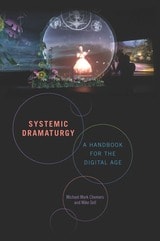
Systemic Dramaturgy
A Handbook for the Digital AgeMichael Mark Chemers and Mike Sell
Southern Illinois University Press, 2022
Working theatrically with technology
Systemic Dramaturgy offers an invigorating, practical look at the daunting cultural problems of the digital age as they relate to performance. Authors Michael Mark Chemers and Mike Sell reject the incompatibility of theatre with robots, digital media, or video games. Instead, they argue that technology is the original problem of theatre: How can we tell this story and move this audience with these tools? And if we have different tools, how can that change the stories we tell?
This volume attunes readers to “systemic dramaturgy”—the recursive elements of signification, innovation, and history that underlie all performance—arguing that theatre must be understood as a system of systems, a concatenation of people, places, things, politics, feelings, and interpretations, ideally working together to entertain and edify an audience. The authors discuss in-depth the application of time-tested dramaturgical skills to extra-theatrical endeavors, including multi-platform performance, installations, and videogames. And they identify the unique interventions that dramaturgs can and must make into these art forms.
More than any other book that has been published in the field, Systemic Dramaturgy places historical dramaturgy in conversation with technologies as old as the deus ex machina and as new as artificial intelligence. Spirited and playful in its approach, this volume collates histories, transcripts, and case studies and applies the concepts of systemic dramaturgy to works both old and avant-garde. Between chapters, Chemers and Sell talk with with some of the most forward-thinking, innovative, and creative people working in live media as they share their diverse approaches to the challenges of making performances, games, and digital media that move both heart and mind. This volume is nothing less than a guide for thinking about the future evolution of performance.
[more]