Results by title
28167 books match the query 'History' and 1838 start with s
Stories That Make History
Mexico through Elena Poniatowska’s CrónicasLynn Stephen
Duke University Press, 2021
Stories about Posts
Vedic Variations around the Hindu GoddessMadeleine Biardeau
University of Chicago Press, 2004
After exploring several ethnographic facts that have escaped the notice of previous observers, Biardeau presents a variety of hunches, hypotheses, and insights building up to the provocative thesis of Stories about Posts: that the variations found in the contemporary cult of the Goddess—in both her royal and rural village aspects—reveal untraced regional histories of the Vedic sacrificial post, the yupa. Biardeau's work opens up new ways of thinking about Vedic sacrificial themes and elements as they recur in post-Vedic texts and iconographies. It also connects wayside stones in Maharashtra named after the buffalo to stones, posts, and people named after a so-called Buffalo King in Maharashtra, Andhra Pradesh, Karnataka, and Tamilnadu.
A work of magnificent scholarship and fieldwork, Stories about Posts, in ways no previous work has attempted, much less accomplished, unravels much of the mystery surrounding contemporary Hindu ritual by connecting it to the ancient Sanskrit epics. As such, it will fascinate students of Indology, religious studies, and anthropology for years to come.

Stories and Histories of Islamic Art in Italy
Supplements to the Memoirs of the American Academy in RomeEdited by Silvia Armando
University of Michigan Press, 2027
In the past decades, scholarship on Islamic art has challenged the parameters of the discipline, but in the process, the Italian context has often been overlooked. Gathering the voices of prominent international specialists, the book fills an important gap by presenting new research on topics ranging from the medieval to modern periods. Contributors investigate how Islamic artifacts were collected, categorized, and studied; examine Orientalism(s) in Italy and beyond; reconstruct the genealogies of scholars who helped found and develop the academic discipline and museum practices; and offer new scholarship on ceramics, textiles, metalwork, rock crystals, numismatics, and archaeology. The volume reveals the interchange between romantic reveries and more “scientific” Islamic art studies. Following the model of counter-Orientalism proposed by Karla Mallette, it raises questions of identity, otherness, and self-representation within a cultural and geographical context where the Islamic “component” was—and is—perceived either as exotic or integral to Italian identity.
With over 100 illustrations, Stories and Histories of Islamic Art in Italy explores how amateurs, artists, and intellectuals perceived of, depicted, and wrote about the Islamic world, offering new ways to examine Italy’s Islamic past.
Stories from Jonestown
Leigh Fondakowski
University of Minnesota Press, 2010
The saga of Jonestown didn’t end on the day in November 1978 when more than nine hundred Americans died in a mass murder-suicide in the Guyanese jungle. While only a handful of people present at the agricultural project survived that day in Jonestown, more than eighty members of Peoples Temple, led by Jim Jones, were elsewhere in Guyana on that day, and thousands more members of the movement still lived in California. Emmy-nominated writer Leigh Fondakowski, who is best known for her work on the play and HBO film The Laramie Project, spent three years traveling the United States to interview these survivors, many of whom have never talked publicly about the tragedy. Using more than two hundred hours of interview material, Fondakowski creates intimate portraits of these survivors as they tell their unforgettable stories.
Collectively this is a record of ordinary people, stigmatized as cultists, who after the Jonestown massacre were left to deal with their grief, reassemble their lives, and try to make sense of how a movement born in a gospel of racial and social justice could have gone so horrifically wrong—taking with it the lives of their sons and daughters, husbands and wives, fathers and mothers, and brothers and sisters. As these survivors look back, we learn what led them to join the Peoples Temple movement, what life in the church was like, and how the trauma of Jonestown’s end still affects their lives decades later.
What emerges are portrayals both haunting and hopeful—of unimaginable sadness, guilt, and shame but also resilience and redemption. Weaving her own artistic journey of discovery throughout the book in a compelling historical context, Fondakowski delivers, with both empathy and clarity, one of the most gripping, moving, and humanizing accounts of Jonestown ever written.
Stories from the Land
A Navajo Reader about Monument ValleyRobert S. McPherson
University Press of Colorado, 2022
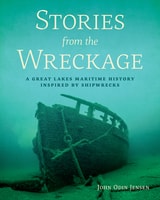
Stories from the Wreckage
A Great Lakes Maritime History Inspired by ShipwrecksJohn Odin Jensen
Wisconsin Historical Society Press, 2019
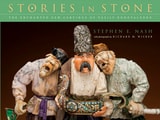
Stories in Stone
The Enchanted Gem Carvings of Vasily KonovalenkoStephen E. Nash
University Press of Colorado, 2016
Part art catalogue and part life history, Stories in Stone tells the tale of Konovalenko’s impressive works, explaining their conception, creation, and symbolism. Each handcrafted figure depicts a scene from life in the Soviet Union—a bowman hunting snow geese, a woman reposing in a hot spring surrounded by ice, peasants spinning wool, a pair of gulag prisoners sawing lumber—painstakingly rendered in precious stones and metals. The materials used to make the figurines are worth millions of dollars, but as cultural artifacts, the sculptures are priceless. Author Stephen Nash draws upon oral history and archival research to detail the life of their creator, revealing a rags-to-riches and life-imitates-art narrative full of Cold War intrigue, Communist persecution, and capitalist exploitation.
Augmented by Richard M. Wicker’s exquisite and revelatory photographs of sixty-five Konovalenko sculptures from museums, state agencies, and private collections around the world, Stories in Stone is a visually stunning glimpse into a unique corner of Russian art and cultural history, the craft and science of gem carving, and the life of a Russian artist and immigrant who loved people everywhere.
Co-published with the Denver Museum of Nature & Science, home to the most significant collection of Russian gem-carving sculptures by Vasily Konovalenko in the world.
Stories of New Jersey
Stockton, Frank
Rutgers University Press, 1961
Stories of Oka
Land, Film, and LiteratureIsabelle St-Amand
University of Manitoba Press, 2018
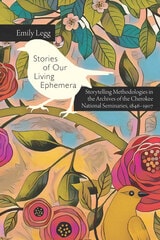
Stories of Our Living Ephemera
Storytelling Methodologies in the Archives of the Cherokee National Seminaries, 1846-1907Emily Legg
Utah State University Press, 2023
Emily Legg turns to the Cherokee medicine wheel and cardinal directions as a Cherokee rhetorical discipline of knowledge making in the archives, an embodied and material practice that steers knowledge through the four cardinal directions around all relations. Going beyond historiography, Legg delineates educational practices that are intertwined with multiple strands of traditional Cherokee stories that privilege Indigenous and matriarchal theoretical lenses. Stories of Our Living Ephemera synthesizes the connections between contemporary and nineteenth-century academic experiences to articulate the ways that colonial institutions and research can be Indigenized by centering Native American sovereignty.
By undoing the erasure of Cherokee literacy and educational practices, Stories of Our Living Ephemera celebrates the importance of storytelling, especially for those who are learning about Indigenous histories and rhetorics. This book is of cultural importance and value to academics interested in composition and pedagogy, the Cherokee Nation, and a general audience seeking to learn about Indigenous rhetorical devices and Cherokee history.

Stories of Survival
Arkansas Farmers during the Great DepressionWilliam Downs Jr.
University of Arkansas Press, 2015
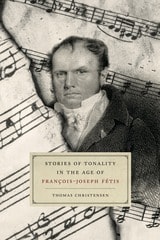
Stories of Tonality in the Age of François-Joseph Fétis
Thomas Christensen
University of Chicago Press, 2019
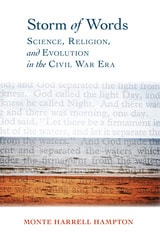
Storm of Words
Science, Religion, and Evolution in the Civil War EraMonte Harrell Hampton
University of Alabama Press, 2014
A study of the ways that southern Presbyterians in the wake of the Civil War contended with a host of cultural and theological questions
Southern Presbyterian theologians enjoyed a prominent position in antebellum southern culture. Respected for both their erudition and elite constituency, these theologians identified the southern society as representing a divine, Biblically ordained order. Beginning in the 1840s, however, this facile identification became more difficult to maintain, colliding first with antislavery polemics, then with Confederate defeat and reconstruction, and later with women’s rights, philosophical empiricism, literary criticisms of the Bible, and that most salient symbol of modernity, natural science.
As Monte Harrell Hampton shows in Storm of Words, modern science seemed most explicitly to express the rationalistic spirit of the age and threaten the Protestant conviction that science was the faithful “handmaid” of theology. Southern Presbyterians disposed of some of these threats with ease. Contemporary geology, however, posed thornier problems. Ambivalence over how to respond to geology led to the establishment in 1859 of the Perkins Professorship of Natural Science in Connexion with Revealed Religion at the seminary in Columbia, South Carolina. Installing scientist-theologian James Woodrow in this position, southern Presbyterians expected him to defend their positions.
Within twenty-five years, however, their anointed expert held that evolution did not contradict scripture. Indeed, he declared that it was in fact God’s method of creating. The resulting debate was the first extended evolution controversy in American history. It drove a wedge between those tolerant of new exegetical and scientific developments and the majority who opposed such openness. Hampton argues that Woodrow believed he was shoring up the alliance between science and scripture—that a circumscribed form of evolution did no violence to scriptural infallibility. The traditionalists’ view, however, remained interwoven with their identity as defenders of the Lost Cause and guardians of southern culture.
The ensuing debate triggered Woodrow’s dismissal. It also capped a modernity crisis experienced by an influential group of southern intellectuals who were grappling with the nature of knowledge, both scientific and religious, and its relationship to culture—a culture attempting to define itself in the shadow of the Civil War and Reconstruction.
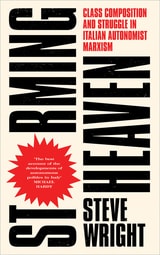
Storming Heaven
Class Composition and Struggle in Italian Autonomist MarxismSteve Wright
Pluto Press, 2017
Story Of Reo Joe
Work, Kin, And CommunityLisa M. Fine
Temple University Press, 2004
Story of a Stammer
Gábor Vida
Seagull Books, 2022
In the novel Story of a Stammer, Gábor Vida asks a fundamental question: Where does stammering come from? In the process of answering this question, he discovers that an entire historical period and an entire world have been stammering, too. Through Vida’s eyes, we see that stammering comprises all the lies accumulated over time and over generations because nobody had ever articulated what they felt or thought, nor done what they really wanted. Nobody, Vida shows, had ever told the truth.
Describing life in the 1970s and ’80s under Romanian Communist dictator Nicolae Ceauçescu’s authoritarian regime, Vida writes with disarming honesty, breaking taboos and chronicling the ways in which tyranny and exploitation seep into family relationships. The novel charts the first two decades of a young Hungarian man’s life in Romania, telling a story of coming to terms with a stammer, loneliness, and an unstimulating environment where religion, alcoholism, and suicide are the most common escape strategies. A Bildungsroman, a novel about Transylvania, a chronicle of minority life, a sociological analysis of cultural identity, and ultimately a deeply personal account of a historical era, Story of a Stammer is a major contribution to contemporary Hungarian literature—an unfailingly serious yet humorously delightful witness to a turbulent period in recent history.

Storytellers of Art Histories
Living and Sustaining a Creative LifeEdited by Yasmeen Siddiqui and Alpesh Kantilal Patel
Intellect Books, 2021
With a focus on gender, race (including whiteness), class, sexuality, and transnationality—all of which are often marginalized in dominant art histories—each individual has provided short, often personal contributions detailing how they become passionate about their practice. The contributors’ offerings are varied and surprising, appealing equally to people enmeshed in the field through their work as well as those with a beginner’s interest. Their pieces take various forms—epistolary, children’s fable, interview, coauthored narrative, pastiche, memoir, manifesto, and apology—and a number of the essays perform in their structure or content the theories they explore about publishing, curating, and archival work.
Storytelling Globalization from the Chaco and Beyond
Mario Blaser
Duke University Press, 2010
Storytelling and Science
Rewriting Oppenheimer in the Nuclear AgeDavid K. Hecht
University of Massachusetts Press, 2015
No single figure embodies Cold War science more than the renowned physicist J. Robert Oppenheimer. Although other scientists may have been more influential in establishing the institutions and policies of the nuclear age, none has loomed larger in the popular imagination than the “father of the atomic bomb.” Americans have been drawn to the story of the Manhattan Project Oppenheimer helped lead and riveted by the McCarthy-era politics that caught him in its crosshairs. Journalists and politicians, writers and artists have told Oppenheimer's story in many different ways since he first gained notoriety in 1945. In Storytelling and Science, David K. Hecht examines why they did so, and what they hoped to achieve through their stories.
From the outset, accounts of Oppenheimer's life and work were deployed for multiple ends: to trumpet or denigrate the value of science, to settle old scores or advocate new policies, to register dissent or express anxieties. In these different renditions, Oppenheimer was alternately portrayed as hero and villain, establishment figure and principled outsider, “destroyer of worlds” and humanist critic. Yet beneath the varying details of these stories, Hecht discerns important patterns in the way that audiences interpret, and often misinterpret, news about science. In the end, he argues, we find that science itself has surprisingly little to do with how its truths are assimilated by the public. Instead its meaning is shaped by narrative traditions and myths that frame how we think and write about it.
Storytelling in Queer Appalachia
Imagining and Writing the Unspeakable OtherHillery Glasby
West Virginia University Press, 2020
Focusing especially on disciplinary approaches from rhetoric and composition, the volume explores sexual identities in rural places, community and individual meaning-making among the Appalachian diaspora, the storytelling infrastructure of queer Appalachia, and the role of the metronormative in discourses of difference. Storytelling in Queer Appalachia affirms queer people, fights for queer visibility over queer erasure, seeks intersectional understanding, and imagines radically embodied queer selves through social media.
Storytelling in Sixteenth-Century France
Negotiating Shifting FormsEmily E. Thompson
University of Delaware Press, 2022
Published by the University of Delaware Press. Distributed worldwide by Rutgers University Press.
Storyville, New Orleans
Being an Authentic, Illustrated Account of the Notorious Red-Light DistrictAl Rose
University of Alabama Press, 1978
A true-to-life impression of Storyville, the only legally established red light district in the US
At the turn of the twentieth-century, there were hundreds of red-light districts in the United States, ranging in size from a discreet “house” or two in or near small towns and cities to block after bawdy block of brothels in larger cities such as Chicago and San Francisco. Storyville, New Orleans: Being an Authentic, Illustrated Account of the Notorious Red Light District seeks to offer the reader a reasonably true-to-life impression of Storyville, the most famous of the large districts and the only such district in the United States that was legally established.
Storyville was an area, carefully defined by law, outside of which prostitutes or women “notoriously abandoned to lewdness” were not permitted to live or work. Prostitutes working within the District were considered to be engaged in legal enterprises so long as they confined themselves to prostitution and other related activities such as dispensing food and drink to their customers.
From the early days of the French colony of Louisiana, a great number of prostitutes, women from correctional centers, and those with so-called “loose morals” were transported to the New World, resulting in a large proportion of the earliest female residents in New Orleans engaging in prostitution. During the course of Storyville’s legal existence from January 1, 1898 to November 12, 1917—it is evident that in establishing this district the New Orleans city council acted out of a sense of frustration after decades of attempting to deal rationally with a serious social problem. As the author says in the preface, “You may see this as a disorderly book about disorderly houses—and so it may be. But I doubt you will find it dull.”
Stowe in Her Own Time
A Biographical Chronicle of Her Life, Drawn from Recollections, Interviews, and Memoirs by Family, FSusan Belasco
University of Iowa Press, 2009
One of the first celebrity authors, Harriet Beecher Stowe (1811–1896) became famous almost overnight when Uncle Tom’s Cabin—which sold more than 300,000 copies in its first year of publication—appeared in 1852. Known by virtually all famous writers in the United States and many in England and regarded by many women writers as a role model because of her influence in the literary marketplace, Stowe herself was the subject of many books, articles, essays, and poems during her lifetime.
This volume brings together for the first time a range of primary materials about Stowe’s private and public life written by family members, friends, and fellow writers who knew or were influenced by her before and after Uncle Tom’s Cabin catapulted her to fame. Included are periodical articles by Fanny Fern and Charles Dudley Warner; biographical essays by Sarah Josepha Hale and Rose Terry Cooke; letters by Oliver Wendell Holmes, Elizabeth Barrett Browning, and Harriet Jacobs; recollections by Frederick Douglass, Annie Adams Fields, Isabella Beecher Hooker, and Charles Beecher; and poems by Paul Laurence Dunbar and John Greenleaf Whittier. An introduction at the beginning of each essay connects it to its historical and cultural context, explanatory notes provide information about people and places, and the book includes a detailed introduction and a chronology of Stowe’s life.
The thirty-eight recollections gathered in Stowe in Her Own Time form a biographical narrative designed to provide several perspectives on the famous author, sometimes in conflict and sometimes in agreement but always perceptive. The figure who emerges from this insightful, analytical collection is far more complex than the image she helped construct in her lifetime.
Straddling Worlds
The Jewish-American Journey of Professor Richard W. LeopoldSteven J. Harper
Northwestern University Press, 2008
Author Steven J. Harper pays tribute to a well-respected teacher with this biography of a distinguished William Smith Mason Professor of History at Northwestern University, Richard W. Leopold. Harper had maintained contact with his former professor, as had hundreds of other alumni, meeting with him in the apartment to which his age and health confined him. When Leopold invited him to review his biographical materials to prepare a New York Times obituary, Harper began to catch glimpses of a deeper history in Leopold’s life: that of Jews in America after the turn of the century.
Across two years of Sundays, Leopold’s life came together and Harper began to notice parallels between the life of his professor and the life of his recently deceased father-in-law. Both grew up in less orthodox households but were still identified as Jewish by others; both attended Ivy League colleges, fighting (and beating) anti-Semitism there; and both served their country with distinction in World War II. The two men persevered through a twentieth century Jewish-American experience that they and many others shared, but rarely discussed. Steven Harper has caught them both on the page just in time to document their lives, their culture, and the nation that grew and changed alongside them.
Straight Writes and Jabs
An Inside Look at Another Year in BoxingThomas Hauser
University of Arkansas Press, 2013
Straight and True
A Select History of the ArrowHugh D. H. Soar
Westholme Publishing, 2012
From Spears and Blowpipe Darts to the Ultimate Human-Powered Projectile
The arrow, essentially a specialized spear, is among the most ancient human inventions and can be found in cultures throughout the world. The need to launch a projectile farther and with greater accuracy than is possible with the human arm gave rise to a variety of solutions. Spearthrowers which extend the length of the user’s arm and therefore transfer greater power to the projectile were developed far back in prehistory, and both the American Indian atlatl and the Australian woomera are examples of this technology. Blowpipes, too, are recorded in various cultures and represent another ancient technology. It was soon discovered that a stringed bow could launch a small spearlike projectile we now know as the arrow, and this combination became the dominant method for shooting projectiles for tens of thousands of years. A wonderfully simple device, the arrow and bow revolutionized both hunting and warfare, not only because of the speed, force, and accuracy that could be achieved, but by the fact that the arrow makes almost no sound as it flies toward its target, providing an essential element of surprise.
In Straight and True: A Select History of the Arrow, Hugh D. H. Soar describes the transition from hand-thrown spear to bow-launched arrow and then follows the arrow’s developments in cultures around the world and across time. The book describes arrows found in Neolithic sites; those used by North and South American Indians—including a detailed discussion of poison-tipped arrows; arrows used in China, Japan, and Mongolia; and finally the arrow in Europe, where it was successfully paired with the longbow during the Middle Ages. After discussing the development of the arrow for sport and recreation, the author completes his survey with the changes in technology introduced during the twentieth century though the use of the alloy of aluminum with other lightweight metals as well as synthetic materials to construct parts of the arrow. Relying on his considerable knowledge accumulated through decades of research, the author provides the reader with an appreciation for a humble device that, coupled with the bow, changed the history of the world.
Strained Relations
US Foreign-Exchange Operations and Monetary Policy in the Twentieth CenturyMichael D. Bordo, Owen F. Humpage, and Anna J. Schwartz
University of Chicago Press, 2015
Strained Sisterhood
Gender and Class in the Boston Female Anti-Slavery SocietyDebra Gold Hansen
University of Massachusetts Press, 1993
Debra Gold Hansen explores the origins of the equality-versus-difference debate by examining the Boston Female Anti-Slavery Society, which disbanded in 1840 over this very issue. After establishing a historical framework for women's lives in early nineteenth-century Boston, Hansen analyzes the membership of the Society along the lines of race, religion, and socioeconomic status. Through her findings, she concludes that many of the issues that estranged female abolitionists in antebellum Boston continue to divide women today, testifying not to the strength of the bonds between women but to the fragility of those ties.
Straining at the Anchor
The Argentine Currency Board and the Search for Macroeconomic Stability, 1880-1935Gerardo della Paolera and Alan M. Taylor
University of Chicago Press, 2001
With many countries now using—or seriously contemplating—monetary arrangements similar to Argentina's, this important and persuasive study maps out one of history's most interesting monetary experiments to show what works and what doesn't.
Strains of Dissent
Popular Music and Everyday Resistance in WWII France, 1940 - 1945Kelly Jakes
Michigan State University Press, 2019
Strange Bodies
Gender and Identity in the Novels of Carson McCullersSarah Gleeson-White
University of Alabama Press, 2003
Adapts Mikhail Bakhtin's theory of the grotesque, as well as the latest in gender and psychoanalytic theory, to the major works of acclaimed southern writer Carson McCullers.
This innovative reconsideration of the themes of Carson McCullers's fiction argues that her work has heretofore suffered under the pall of narrow gothic interpretations, obscuring a more subversive agenda. By examining McCullers’s major novels—The Heart is a Lonely Hunter, Reflections in a Golden Eye, The Member of the Wedding, and The Ballad of the Sad Café—Gleeson-White locates a radical and specific form of the grotesque in the author's fiction: the liberating and redemptive possibilities of errant gender roles and shifting sexuality. She does this by employing Bakhtin's theory of the grotesque, which is both affirming and revolutionary, and thereby moves McCullers's texts beyond the 'gloom and doom' with which they have been charged for over fifty years.
The first chapter explores female adolescence by focusing on McCullers's tomboys in the context of oppressive southern womanhood. The second chapter analyzes McCullers's fascinating struggle to depict homosexual desire outside of traditional stereotypes. Gleeson-White then examines McCullers's portrayals of feminine and masculine gender through the tropes of cross-dressing, transvestism, and masquerade. The final chapter takes issue with earlier readings of androgyny in the texts to suggest a more useful concept McCullers herself called "the hybrid." Underpinning the whole study is the idea of a provocative, dynamic form of the grotesque that challenges traditional categories of normal and abnormal.
Because the characters and themes of McCullers's fiction were created in the 1940s and 1950s, a time of tension between the changing status of women and the southern ideal of womanhood, they are particularly fertile ground for a modern reexamination of this nature. Gleeson-White's study will be valued by scholars of American literature and gender and queer studies, by students of psychology, by academic libraries, and by readers of Carson McCullers. Strange Bodies is a thoughtful, highly credible analysis that adds dimension to the study of southern literature.
Strange Cocktail
Translation and the Making of Modern Hebrew PoetryAdriana X. Jacobs
University of Michigan Press, 2018
For centuries, poets have turned to translation for creative inspiration. Through and in translation, poets have introduced new poetic styles, languages, and forms into their own writing, sometimes changing the course of literary history in the process. Strange Cocktail is the first comprehensive study of this phenomenon in modern Hebrew literature of the late nineteenth century to the present day. Its chapters on Esther Raab, Leah Goldberg, Avot Yeshurun, and Harold Schimmel offer close readings that examine the distinct poetics of translation that emerge from reciprocal practices of writing and translating. Working in a minor literary vernacular, the translation strategies that these poets employed allowed them to create and participate in transnational and multilingual poetic networks. Strange Cocktail thereby advances a comparative and multilingual reframing of modern Hebrew literature that considers how canons change and are undone when translation occupies a central position—how lines of influence and affiliation are redrawn and literary historiographies are revised when the work of translation occupies the same status as an original text, when translating and writing go hand in hand.
Strange Duets
Impresarios and Actresses in the American Theatre, 1865-1914Kim Marra
University of Iowa Press, 2006

Strange Enemies
Indigenous Agency and Scenes of Encounters in AmazoniaAparecida Vilaça
Duke University Press, 2010
During the 1940s and 1950s, white rubber tappers invading the Wari’ lands raided the native villages, shooting and killing their victims as they slept. These massacres prompted the Wari’ to initiate a period of intense retaliatory warfare. The national government and religious organizations subsequently intervened, seeking to “pacify” the Indians. Aparecida Vilaça was able to interview both Wari’ and non-Wari’ participants in these encounters, and here she shares their firsthand narratives of the dramatic events. Taking the Wari’ perspective as its starting point, Strange Enemies combines a detailed examination of these cross-cultural encounters with analyses of classic ethnological themes such as kinship, shamanism, cannibalism, warfare, and mythology.
Strange Footing
Poetic Form and Dance in the Late Middle AgesSeeta Chaganti
University of Chicago Press, 2018
Exploring the complex relationship between medieval dance and medieval poetry, Strange Footing argues that the intersection of texts and dance produced an experience of poetic form based in disorientation, asymmetry, and even misstep. Medieval dance guided audiences to approach poetry not in terms of the body’s regular marking of time and space, but rather in the irregular and surprising forces of virtual motion around, ahead of, and behind the dancing body. Reading medieval poems through artworks, paintings, and sculptures depicting dance, Seeta Chaganti illuminates texts that have long eluded our full understanding, inviting us to inhabit their strange footings askew of conventional space and time.
Strange Footing deploys the motion of dance to change how we read medieval poetry, generating a new theory of poetic form for medieval studies and beyond.
Strange Future
Pessimism and the 1992 Los Angeles RiotsMin Hyoung Song
Duke University Press, 2005
Song considers works that address the riots and often the traumatic place of the Korean American community within them: the independent documentary Sa-I-Gu (Korean for April 29, the date the riots began), Chang-rae Lee’s novel Native Speaker, the commercial film Strange Days, and the experimental drama of Anna Deavere Smith, among many others. He describes how cultural producers have used the riots to examine the narrative of national decline, manipulating language and visual elements, borrowing and refashioning familiar tropes, and, perhaps most significantly, repeatedly turning to metaphors of bodily suffering to convey a sense of an unraveling social fabric. Song argues that these aesthetic experiments offer ways of revisiting the traumas of the past in order to imagine more survivable futures.
Strange Haven
A Jewish Childhood in Wartime ShanghaiSigmund Tobias
University of Illinois Press, 1998
Strange Philadelphia
Stories from the City of Brotherly LoveLou Harry
Temple University Press, 1995
Most history books paint Philadelphia as a place of revolutionary greatness, but there exists a forgotten, alternative history of the City of Brotherly Love. For example, did you know that
•when Ben Franklin was Deputy Postmaster General for the American colonies, he ignored rival printers' requests for mailing priveleges. Instead, he loaded down the mail carriers with his own papers and enjoyed the use of a private delivery system that cut off the competition.
•
the Slinky was created by a marine engineer stationed in Philadelphia, who later became an evangelist and Bible salesman in Bolivia, leaving behind his wife, his children, and the Slinky fortune.
•
50,000 people gathered in Fairmount Park in 1953 hoping to see a vision of the Virgin Mary, who three schoolgirls claimed to have seen near a park bush. Though the Blessed Mother never did appear, visitors to the site left behind offerings of rosaries, flowers, crutches, and over $6,000.
•
while 11,000 spectators sat in the Spectrum waiting for the Ice Capades to begin, 32-mile-an-hour winds blew a chunk of the roof off the city's newly constructed stadium.
Find these and a hundred more "strange" and fascinating stories in this collection of vignettes. These pieces of the past can't be found in history books—they are surprising side bars to the famous and not-so-famous events and people of historical Philadelphia.
Strange Science
Investigating the Limits of Knowledge in the Victorian AgeEdited by Lara Karpenko and Shalyn Claggett
University of Michigan Press, 2017
Strange Tales of an Oriental Idol
An Anthology of Early European Portrayals of the BuddhaEdited by Donald S. Lopez Jr.
University of Chicago Press, 2016
Featuring writings by soldiers, adventurers, merchants, missionaries, theologians, and colonial officers, this volume contains a wide range of portraits of the Buddha. The descriptions are rarely flattering, as all manner of reports—some accurate, some inaccurate, and some garbled—came to circulate among European savants and eccentrics, many of whom were famous in their day but are long forgotten in ours. Taken together, these accounts present a fascinating picture, not only of the Buddha as he was understood and misunderstood for centuries, but also of his portrayers.
Strangers No Longer
Latino Belonging and Faith in Twentieth-Century WisconsinSergio M. González
University of Illinois Press, 2024
Hospitality practices grounded in religious belief have long exercised a profound influence on Wisconsin’s Latino communities. Sergio M. González examines the power relations at work behind the types of hospitality--welcoming and otherwise--practiced on newcomers in both Milwaukee and rural areas of the Badger State. González’s analysis addresses central issues like the foundational role played by religion and sacred spaces in shaping experiences and facilitating collaboration among disparate Latino groups and across ethnic lines; the connections between sacred spaces and the moral justification for social justice movements; and the ways sacred spaces evolved into places for mitigating prejudice and social alienation, providing sanctuary from nativism and repression, and fostering local and transnational community building.
Perceptive and original, Strangers No Longer reframes the history of Latinos in Wisconsin by revealing religion’s central role in the settlement experience of immigrants, migrants, and refugees.
Strangers and Neighbors
Relations between Blacks and Jews in the United StatesMaurianne Adams
University of Massachusetts Press, 1999
Much has been written about the historic relationship between American blacks and Jews. Some accounts stress the strong alliance for social justice between the two groups during the civil rights movement, while others portray bleaker moments and include accusations of Jewish racism or black anti-Semitism. What is often missing is a larger historical perspective. This volume provides a wide range of analyses and documents that help us move beyond stereotypes and portray the full complexity of black-Jewish relations in America over the past three hundred years.
Following two introductory sections addressing “Themes and Issues” and “African Americans as the Chosen People,” the book is divided into five historical periods: the Atlantic slave trade and slavery in the New World; emancipation to the Great Depression; the era of the Depression and World War II; World War II through 1967; and 1968 to the present. Each section contains a mix of scholarly articles, historical documents, and contemporary perspectives. A final section entitled “Where Do We Go from Here?” suggests ways to rebuild a coalition between blacks and Jews in the twenty-first century. Throughout the volume, the editors' goal is not to achieve closure but to invite further discussion about the historical relationship between two large, evolving, and diverse peoples. The selections reveal that the experiences of American blacks and Jews, although intersecting at several critical junctures, have not been parallel, and that significant geographical, class, political, and religious differences exist within both communities that preclude easy generalizations.
Strangers in the Land
Patterns of American Nativism, 1860-1925Higham, John
Rutgers University Press, 1988
Strata
William Smith’s Geological MapsEdited by the Oxford University Museum of Natural History
University of Chicago Press, 2020
This sumptuous volume begins with an introduction by Douglas Palmer that places Smith’s work in the context of earlier, concurrent, and subsequent ideas regarding the structure and natural processes of the earth, geographical mapping, and biostratigraphical theories. The book is then organized into four parts, each beginning with four sheets from Smith’s hand-colored, 1815 strata map, accompanied by related geological cross-sections and county maps, and followed by fossil illustrations by Smith contemporary James Sowerby, all organized by strata. Essays between each section explore the aims of Smith’s work and its application in the fields of mining, agriculture, cartography and hydrology. Strata concludes with reflections on Smith’s later years as an itinerant geologist and surveyor, plagiarism by a rival, receipt of the first Wollaston Medal in recognition of his achievements, and the influence of his geological mapping and biostratigraphical theories on the sciences—all of which culminated in the establishment of the modern geological timescale.
Featuring a foreword by Robert Macfarlane, Strata is a glorious testament to the lasting geological and illustrative genius of William Smith, a collection as colossal and awe-inspiring as the layers of the Earth themselves.
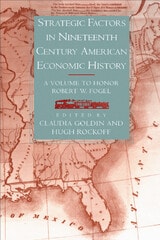
Strategic Factors in Nineteenth Century American Economic History
A Volume to Honor Robert W. FogelEdited by Claudia Goldin and Hugh Rockoff
University of Chicago Press, 1992
These sixteen essays reveal, by example, the continuing vitality of Fogel's approach. The authors use an astonishing variety of data, including genealogies, the U.S. federal population census manuscripts, manumission and probate records, firm accounts, farmers' account books, and slave narratives, to address collectively market integration and its impact on the lives of Americans. The evolution of markets in agricultural and manufacturing labor is considered first; that concerning capital and credit follows. The demography of free and slave populations is the subject of the third section, and the final group of papers examines the extra-market institutions of governments and unions.
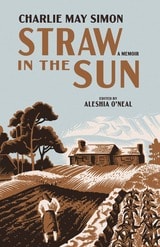
Straw in the Sun
A MemoirCharlie May Simon
University of Arkansas Press, 2025
These opening lines of Charlie May Simon’s Straw in the Sun invite readers on a personal journey of remembrance as Simon recounts her homesteading experiment in Depression-era Arkansas. Years before she established herself as a regional author of national renown, she chose a spot near Cove Creek, now part of Ouachita National Forest, to forge a home from rugged land, meeting both a backbreaking series of challenges and a vivid cast of characters in the process.
Nationally popular upon its release in 1945, Simon’s lyrical memoir was praised from the outset for its warmth and charm. At once an ethnographic narrative of a hill community and an accessible portrait of Ozarks memories at their most idyllic, Straw in the Sun, offered here with a robust introduction from Simon scholar Aleshia O’Neal, is a classic ready for rediscovery by a new generation of readers.

Streaming at the End of the World
Cinema in the Age of ChaosAlex Sayf Cummings
Rutgers University Press, 2027
Streaming at the End of the World explores the pessimistic and often apocalyptic themes that have pervaded popular culture in the United States and global cinema in the new millennium. The book argues that recent films, from the art-house fare of Melancholia (2011) to the popular science fiction of Annihilation (2018), embody an ambient feeling that continually haunts people in today's capitalist world—an ineluctable impression there is no alternative to the status quo. It seems like nothing is ever really going to change; hence, we are drawn to visions of the end of everything. Written in an accessible, conversational style, this book offers a popular culture spin on the late British philosopher Mark Fisher's maxim that it’s "easier to imagine an end to the world than an end to capitalism."
Street Archives and City Life
Popular Intellectuals in Postcolonial TanzaniaEmily Callaci
Duke University Press, 2017
Street Corner Secrets
Sex, Work, and Migration in the City of MumbaiSvati P. Shah
Duke University Press, 2014
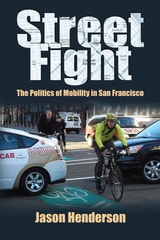
Street Fight
The Politics of Mobility in San FranciscoJason Henderson
University of Massachusetts Press, 2013
Faced with intolerable congestion and noxious pollution, cities around the world are rethinking their reliance on automobiles. In the United States a loosely organized livability movement seeks to reduce car use by reconfiguring urban space into denser, transit-oriented, walkable forms, a development pattern also associated with smart growth and new urbanism. Through a detailed case study of San Francisco, Jason Henderson examines how this is not just a struggle over what type of transportation is best for the city, but a series of ideologically charged political fights over issues of street space, public policy, and social justice.
Historically San Francisco has hosted many activist demonstrations over its streets, from the freeway revolts of the 1960s to the first Critical Mass bicycle rides decades later. Today the city's planning and advocacy establishment is changing zoning laws to limit the number of parking spaces, encouraging new car-free housing near transit stations, and applying “transit first” policies, such as restricted bus lanes. Yet Henderson warns that the city's accomplishments should not be romanticized. Despite significant gains by livability advocates, automobiles continue to dominate the streets, and the city's financially strained bus system is slow and often unreliable.
Both optimistic and cautionary, Henderson argues that ideology must be understood as part of the struggle for sustainable cities and that three competing points of view—progressive, neoliberal, and conservative—have come to dominate the contemporary discourse about urban mobility. Consistent with its iconic role as an incubator of environmental, labor, civil rights, and peace movements, San Francisco offers a compelling example of how the debate over sustainable urban transportation may unfold both in the United States and globally.