Results by title
28167 books match the query 'History' and 1838 start with s
Street Life under a Roof
Youth Homelessness in South AfricaEmily Margaretten
University of Illinois Press, 2015
In Street Life under a Roof, Emily Margaretten draws on ten years of up-close fieldwork to explore the distinct cultural universe of the Point Place community. Margaretten's sensitive investigations reveal how young men and women draw on customary notions of respect and support to forge an ethos of connection and care that allows them to live far richer lives than ordinarily assumed. Her discussion of gender dynamics highlights terms like nakana--to care about or take notice of another--that young women and men use to construct "outside" and "inside" boyfriends and girlfriends and to communicate notions of trust. Margaretten exposes the structures of inequality at a local, regional, and global level that contribute to socioeconomic and political dislocation. But she also challenges the idea that Point Place's marginalized residents need "rehabilitation." As she argues, these young men and women want love, secure homes, and the means to provide for their dependents--in short, the same hopes and aspirations mirrored across South African society.
Street Nihonga
The Art of Jimmy Tsutomu MirikitaniMaki Kaneko
Amsterdam University Press, 2026
This volume features 163 color illustrations alongside scholarly essays and reflections that frame Mirikitani’s practice as both artistic achievement and political intervention. Maki Kaneko’s introduction situates the exhibition within the artist’s distinctive “street Nihonga” aesthetic—a collaged form of artmaking, storytelling, and community collaboration. Contributors Noriko Murai, Scott Tsuchitani, Yukinori Okamura, and Kris Ercums offer wide-ranging perspectives, including the transnational legacy of Nihonga, the memory politics of Japanese American incarceration, the evolving lineage of “A-bomb art,” and the curatorial process behind the exhibition. Linda Hattendorf and Masa Yoshikawa, Mirikitani’s close friends and documentarians, provide intimate insights into his life and art.
At once scholarly and inviting, Street Nihonga encourages readers to encounter Mirikitani not as an artist of the margins but as a radical reinterpreter of convention and a witness to histories often left untold. This catalogue remains open-ended—a living collage and a call to engage with Mirikitani’s extraordinary life and work.
Street Occupations
Urban Vending in Rio de Janeiro, 1850–1925By Patricia Acerbi
University of Texas Press, 2017
Winner, Warren Dean Memorial Prize, Conference on Latin American History (CLAH), 2018
Street vending has supplied the inhabitants of Rio de Janeiro with basic goods for several centuries. Once the province of African slaves and free blacks, street commerce became a site of expanded (mostly European) immigrant participation and shifting state regulations during the transition from enslaved to free labor and into the early post-abolition period. Street Occupations investigates how street vendors and state authorities negotiated this transition, during which vendors sought greater freedom to engage in commerce and authorities imposed new regulations in the name of modernity and progress.
Examining ganhador (street worker) licenses, newspaper reports, and detention and court records, and considering the emergence of a protective association for vendors, Patricia Acerbi reveals that street sellers were not marginal urban dwellers in Rio but active participants in a debate over citizenship. In their struggles to sell freely throughout the Brazilian capital, vendors asserted their citizenship as urban participants with rights to the city and to the freedom of commerce. In tracing how vendors resisted efforts to police and repress their activities, Acerbi demonstrates the persistence of street commerce and vendors’ tireless activity in the city, which the law eventually accommodated through municipal street commerce regulation passed in 1924.
A focused history of a crucial era of transition in Brazil, Street Occupations offers important new perspectives on patron-client relations, slavery and abolition, policing, the use of public space, the practice of free labor, the meaning of citizenship, and the formality and informality of work.

Street Scenes
Brecht, Benjamin and BerlinNicolas Whybrow
Intellect Books, 2004
Bertolt Brecht, meanwhile, stands as one of the principal thinkers about art and politics in the 20th century. The "Street Scene" model, which was the foundation for his theory of an epic theatre, relied precisely on establishing a connection between art's functioning and everyday life. His preoccupation with the ceaselessness of change, an impulse implying rupture and movement as the key characteristics informing the development of a democratic cultural identity, correlates resonantly with the notion of an ever-evolving city.
Premised on an understanding of performance as the articulation of movement in space, Street Scenes interrogates what kind of "life" is permitted to "flow" in the "new Berlin." Central to this method is the flaneur figure, a walker of streets who provides detached observations on the revealing "detritus of modern urban existence." Walter Benjamin, himself a native of Berlin as well as friend and seminal critic of Brecht, exercised the practice in exemplary form in his portrait of the city One-Way Street.
Street Scenes offers various points of entry for the reader, including those interested in: theatre, performance, visual art, architecture, theories of everyday life and culture, and the politics of identity. Ultimately, it is an interdisciplinary book, which strives to establish the 'porosity' of areas of theory and practice rather than hard boundaries.
Street Scenes
Staging the Self in Immigrant New York, 1880–1924Esther Romeyn
University of Minnesota Press, 2008
Street Scenes focuses on the intersection of modern city life and stage performance. From street life and slumming to vaudeville and early cinema, to Yiddish theater and blackface comedy, Esther Romeyn discloses racial comedy, passing, and masquerade as gestures of cultural translation. In these performances she detects an obsession with the idea of the city as theater and the self as actor, which was fueled by the challenges that consumer capitalism presented to notions of an “authentic” self.
It was exactly this idea of “authentic” immigrant selfhood that was at stake in many performances on the popular stage, and Romeyn ultimately demonstrates how these diverse and potent immigrant works influenced the emergence of a modern metropolitan culture.
Street Smarts and Critical Theory
Listening to the VernacularThomas McLaughlin
University of Wisconsin Press, 1996
Everybody’s got a theory . . . or do they?
Thomas McLaughlin argues that critical theory—raising serious, sustained questions about cultural practice and ideology—is practiced not only by an academic elite but also by savvy viewers of sitcoms and TV news, by Elvis fans and Trekkies, by labor organizers and school teachers, by the average person in the street.
Like academic theorists, who are trained in a tradition of philosophical and political skepticism that challenges all orthodoxies, the vernacular theorists McLaughlin identifies display a lively and healthy alertness to contradiction and propaganda. They are not passive victims of ideology but active questioners of the belief systems that have power over their lives. Their theoretical work arises from the circumstances they confront on the job, in the family, in popular culture. And their questioning of established institutions, McLaughlin contends, is essential and healthy, for it energizes other theorists who clarify the purpose and strategies of institutions and justify the existence of cultural practices.
Street Smarts and Critical Theory leads us through eye-opening explorations of social activism in the Southern Christian anti-pornography movement, fan critiques in the ‘zine scene, New Age narratives of healing and transformation, the methodical manipulations of the advertising profession, and vernacular theory in the whole-language movement. Emphasizing that theory is itself a pervasive cultural practice, McLaughlin calls on academic institutions to recognize and develop the theoretical strategies that students bring into the classroom.
“This book demystifies the idea of theory, taking it out of the hands of a priestly caste and showing it as the democratic endowment of the people.”—Daniel T. O’Hara, Temple University, author of Radical Parody: American Culture and Critical Agency after Foucault and Lionel Trilling: The Work of Liberation.
“McLaughlin takes seriously the critical and theoretical activity of everyday people and does so in a way that will empower these very populations to take seriously their own activities as theorists. . . . A manifesto that is sure to be heard by the younger generation of thinkers in American cultural studies.”—Henry Jenkins, MIT, author of Textual Poachers: Television Fans and Participatory Culture

Street by Street
Dispossessing Jewish Apartments in Wartime ParisIsabelle Backouche
Rutgers University Press, 2027
During the Holocaust, nearly 40,000 apartments in Paris inhabited by Jewish families were completely emptied by the German authorities, and many of their tenants lost their rights to continue renting the apartments. In Street by Street, Isabelle Backouche, Sarah Gensburger, and Eric Le Bourhis tell this little-known history of how Parisians took advantage of the persecution of the Jews to improve their own housing in a time of crisis. In the aftermath of the war, the French Republic ensured that the dispossession became permanent, silencing Jewish claims to their prewar homes.
Based on a ten-year investigation and written in a narrative style, this recounting of an unknown chapter of the history of the Holocaust in Western Europe goes beyond the study of individual behavior to highlight how material benefits and privileges can foster systemic antisemitism. The book includes a map of the sites and neighborhoods discussed, as well as photographs of views from windows and doors, courtyards, and building entryways, in both affluent and working-class neighborhoods. The authors tell the story of the organized disappearance of tenants identified as Jewish and the lack of justice that persists to this day.

Street of Dreams
The Nature and Legacy of the 1960sDouglas M. Knight
Duke University Press, 1989
Streets of Glory
Church and Community in a Black Urban NeighborhoodOmar M. McRoberts
University of Chicago Press, 2003
McRoberts finds, for example, that most of the churches in Four Corners are attended and run by people who do not live in the neighborhood but who worship there because of the low overhead. These churches, McRoberts argues, are communities in and of themselves, with little or no attachment to the surrounding area. This disconnect makes the churches less inclined to cooperate with neighborhood revitalization campaigns and less likely to respond to the immediate needs of neighborhood residents. Thus, the faith invested in inner-city churches as beacons of local renewal might be misplaced, and the decision to count on them to administer welfare definitely should be revisited.
As the federal government increasingly moves toward delivering social services through faith-based organizations, Streets of Glory must be read for its trenchant revisionist view of how churches actually work in depressed urban areas.
Streets, Railroads, and the Great Strike of 1877
David O. Stowell
University of Chicago Press, 1999
Whereas most historians treat the event solely as a massive labor strike that targeted the railroads, David O. Stowell examines America's predicament more broadly to uncover the roots of this rebellion. He studies the urban origins of the Strike in three upstate New York cities—Buffalo, Albany, and Syracuse. He finds that locomotives rumbled through crowded urban spaces, sending panicked horses and their wagons careening through streets. Hundreds of people were killed and injured with appalling regularity. The trains also disrupted street traffic and obstructed certain forms of commerce. For these reasons, Stowell argues, The Great Strike was not simply an uprising fueled by disgruntled workers. Rather, it was a grave reflection of one of the most direct and damaging ways many people experienced the Industrial Revolution.
"Through meticulously crafted case studies . . . the author advances the thesis that the strike had urban roots, that in substantial part it represented a community uprising. . . .A particular strength of the book is Stowell's description of the horrendous accidents, the toll in human life, and the continual disruption of craft, business, and ordinary movement engendered by building railroads into the heart of cities."—Charles N. Glaab, American Historical Review
Strength Coaching in America
A History of the Innovation That Transformed SportsBy Jason P. Shurley, Jan Todd, and Terry Todd
University of Texas Press, 2019
Shortlisted for the North American Society for Sports History 2020 Monograph Prize
It’s hard to imagine, but as late as the 1950s, athletes could get kicked off a team if they were caught lifting weights. Coaches had long believed that strength training would slow down a player. Muscle was perceived as a bulky burden; training emphasized speed and strategy, not “brute” strength. Fast forward to today: the highest-paid strength and conditioning coaches can now earn $700,000 a year. Strength Coaching in America delivers the fascinating history behind this revolutionary shift.
College football represents a key turning point in this story, and the authors provide vivid details of strength training’s impact on the gridiron, most significantly when University of Nebraska football coach Bob Devaney hired Boyd Epley as a strength coach in 1969. National championships for the Huskers soon followed, leading Epley to launch the game-changing National Strength Coaches Association. Dozens of other influences are explored with equal verve, from the iconic Milo Barbell Company to the wildly popular fitness magazines that challenged physicians’ warnings against strenuous exercise. Charting the rise of a new athletic profession, Strength Coaching in America captures an important transformation in the culture of American sport.
Strength in Unity
Christian Base Communities and the Urban Popular Movement in Guadalajara, 1965–1994Brad H. Wright
University of Alabama Press, 2026
Examines how poor and working-class communities in Guadalajara organized through faith, education, and culture to claim dignity, justice, and the right to the city.
Strength in Unity: Christian Base Communities and the Urban Popular Movement in Guadalajara, 1965–1994 presents the grassroots history of Guadalajara’s urban popular movement, centering the voices and struggles of poor and working-class communities, especially women, who organized for dignity, justice, and the right to the city. Brad H. Wright brings to light the transformative role of Christian base communities and Freirean popular education as incubators of political consciousness and collective action in the face of authoritarian repression and neoliberal coaptation.
Drawing from oral histories, personal archives, and the records of the Sagrado Corazón nuns, Wright reconstructs a powerful counternarrative to dominant portrayals of marginalized populations as “apathetic” and “uneducated.” Strength in Unity reveals a vibrant culture of resistance where women led campaigns for basic services, built schools, and demanded access to transportation, using tools such as community newspapers, street theater, and music to mobilize and sustain solidarity.
This deeply researched and compellingly told history challenges conventional accounts of urban development and social movements in Latin America. Strength in Unity is essential reading for scholars, students, and activists interested in grassroots organizing, liberation theology, and the enduring power of community-led change.
Strength through Diversity
Harlem Prep and the Rise of MulticulturalismBarry M. Goldenberg
Rutgers University Press, 2025
strengththroughdiversity.com
Strengthening Young Bodies, Building the Nation
A Social History of the Child Health and Welfare in Greece (1890–1940)Vassiliki Theodorou
Central European University Press, 2019
Strictly from Hungary
Ladislas Farago
Westholme Publishing, 2004
Known for his best-selling military histories, Ladislas Farago also wrote a witty tribute to his homeland, Strictly from Hungary. Noting that Hungary has produced some of the world's most renowned artists, scientists, and financiers as well as its share of world-class con-artists, charlatans, and rakes, Farago sets out to explain just how one tiny country can be responsible for so much talent, both good and bad. Using stories from his days as a struggling writer in the bustling café scenes of Budapest and New York City, Farago demonstrates the Hungarian knack for remaining irrepressible and optimistic even in the face of catastrophe. Here we meet Zoltan, a fellow Bohemian who presents his astonished benefactor with a play "about nothing," a theme later made famous by another writer of Hungarian descent, Jerry Seinfeld. Farago also introduces us to "Baby Kiss," a vivacious Hungarian beauty queen, and the story of how she ended up in Fort Worth, Texas; Orkeny, a double agent for America at the height of the Cold War who "spiced up" his reports to keep everyone happy, and the author's own experience getting mustered into the supposedly non-existent Royal Hungarian Army. Farago's reminiscence validates what most Hungarians believe: that Hungary is the center of the world and that everyone has some connection to the land of the Magyars. In that spirit, Farago learns that George Washington himself was "strictly from Hungary." This edition is introduced by the author's son, who shows that the same vibrant spirit described by his father remains the hallmark of the Hungarian temperament.
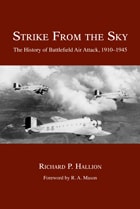
Strike From the Sky
The History of Battlefield Air Attack, 1910-1945Richard P. Hallion, foreword by R. A. Mason
University of Alabama Press, 2010
The definitive history of how air power transformed the battlefield between two world wars.
Strike from the Sky: The History of Battlefield Air Attack, 1910–1945 is a comprehensive examination of the emergence and evolution of battlefield aviation during the first half of the twentieth century. Written by renowned aviation historian Richard P. Hallion, the book traces the development of air-ground warfare from the earliest military use of aircraft in combat through the decisive campaigns of World War II. Combining operational history with analysis of doctrine, technology, and leadership, Hallion reveals how battlefield air attack became a critical element of modern military strategy.
The study explores major conflicts including the First World War, the Spanish Civil War, colonial campaigns, and the global battles of World War II. Hallion examines the evolution of close air support, air interdiction, reconnaissance, command and control systems, and the aircraft that carried out these missions. He also analyzes how military organizations adapted to the challenges of integrating air and ground forces, creating doctrines that continue to influence military operations today.
Strike from the Sky demonstrates how advances in aviation transformed the battlefield and altered the conduct of war. It remains an essential resource for understanding the origins of modern air power and the technological and strategic innovations that reshaped twentieth-century combat.

Strike!
Mary Heaton Vorse
University of Illinois Press, 1991
The story is told by Mary Heaton Vorse, the leading labor reporter of the period, who had covered major strikes since 1912. This novel was the first of six inspired by the Gastonia strike. Critics hailed it as the best.
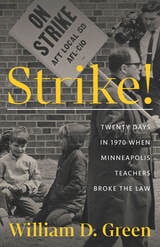
Strike!
Twenty Days in 1970 When Minneapolis Teachers Broke the LawWilliam D. Green
University of Minnesota Press, 2022
When viewed from our turbulent times, the Minneapolis of fifty years ago might seem serene, but Minneapolis schoolteachers of the day remember it quite differently. It was, author William D. Green said of their recollections, as if they’d been through war. This book recreates twenty days in April 1970 when a then-illegal strike by Minneapolis’s public school teachers marked a singular moment of cultural upheaval—and forever changed the city’s politics, labor law, educational climate, and the right to collective bargaining.
Since the inception of public education in Minnesota, teachers were expected to pursue their vocation out of civic spirit, with low wages, no benefits, and no job security. Strike! describes the history and circumstances leading to the teachers’ extraordinary action, which pitted the progressive and conservative teachers’ unions against each other—and both against the all-powerful school district, a hostile governor and state legislature, and a draconian Minnesota law. Capturing the intense emotions and heated rivalries of the strike, Green profiles the many actors involved, the personal and professional stakes, and the issues of politics, law, and the business of education.
Informed by interviews, firsthand accounts, news reports, and written records, Strike! brings to life a pivotal moment not just for Minneapolis’s teachers but for the city itself, whose government, school system, and culture would, in a complex but inexorable way, change course for good.
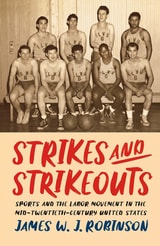
Strikes and Strikeouts
Sports and the Labor Movement in the Mid-Twentieth-Century United StatesJames W. J. Robinson
Rutgers University Press, 2027
During the first half of the twentieth century, the introduction of cheap or free recreation to the workplace provided a metaphorical place where ordinary working-class people of all races and genders gained access to physical leisure and developed bonds of camaraderie in the anti-fascist labor movement. Strikes and Strikeouts: Sports and the Labor Movement in the Mid-Twentieth-Century United States illustrates how this largely forgotten Labor Sports movement was critical in helping unions become forces for larger cultural change and essential to understanding the potency of the 1930-40s labor movement. Drawing from ten different labor and leftist social movement archives, Robinson strives to reconstruct the “people’s history." At its height, from the late 1930s to the early 1950s, the Labor Sports movement presented a real alternative to both apolitical and conservative sports and involved millions of working-class people. It was a key part of improving the lives of average Americans and helped build an anti-racist, anti-fascist, working class counterculture that helped change the United States through a strong labor movement. This movement brought higher living standards for working class people and the end of racial segregation in sports, which in turn aided the Civil Rights movement.
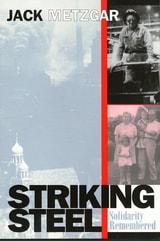
Striking Steel
Jack Metzgar
Temple University Press, 2000
Combining personal memoir and historical narrative, Striking Steel argues for reassessment of unionism in American life during the second half of the twentieth century and a recasting of "official memory." As he traces the history of union steelworkers after World War II, Metzgar draws on his father's powerful stories about the publishing work in the mills, stories in which time is divided between "before the union" and since. His father, Johnny Metzgar, fought ardently for workplace rules as a means of giving "the men" some control over their working conditions and protection from venal foremen. He pursued grievances until he eroded management's authority, and he badgered foremen until he established shop-floor practices that would become part of the next negotiated contract. As a passionate advocate of solidarity, he urged coworkers to stick together so that the rules were upheld and everyone could earn a decent wage.
Striking Steel's pivotal event is the four-month nationwide steel strike of 1959, a landmark union victory that has been all but erased from public memory. With remarkable tenacity, union members held out for the shop-floor rules that gave them dignity in the workplace and raised their standard of living. Their victory underscored the value of sticking together and reinforced their sense that they were contributing to a general improvement in American working and living conditions.
The Metzgar family's story vividly illustrates the larger narrative of how unionism lifted the fortunes and prospects of working-class families. It also offers an account of how the broad social changes of the period helped to shift the balance of power in a conflict-ridden, patriarchal household. Even if the optimism of his generation faded in the upheavals of the 1960s, Johnny Metzgar's commitment to his union and the strike itself stands as an honorable example of what a collective action can and did achieve. Jack Metzgar's Striking Steel is a stirring call to remember and renew the struggle.

Striking a Balance
Making National Economic PolicyAlbert Rees
University of Chicago Press, 1984
Striking a Balance sets forth in clear, nontechnical language the principal goals of national economic policy, the instruments used to achieve these goals, and the political and economic problems arising from conflicting goals and the choice of inappropriate instruments. It is written not for economics students but for the general public and for students in the related fields of public policy, journalism, and law. Unlike economics textbooks, it is not organized according to theoretical categories such as supply and demand, but around issues such as full employment and inflation. It has no ideological axe to grind and tries to present different views of controversial issues fairly.
Striking a Balance benefits from the wisdom and experience of a mature economist. Albert Rees achieves the rare feat of explicating complex issues without oversimplification or trivialization.
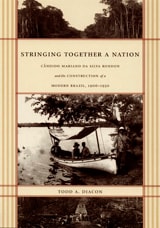
Stringing Together a Nation
Cândido Mariano da Silva Rondon and the Construction of a Modern Brazil, 1906–1930Todd A. Diacon
Duke University Press, 2004
Using an impressive array of archival and documentary sources, Diacon chronicles the Rondon Commission’s arduous construction of telegraph lines across more than eight hundred miles of the Amazon Basin; its exploration, surveying, and mapping of vast areas of northwest Brazil; and its implementation of policies governing relations between the Brazilian state and indigenous groups. He considers the importance of Positivist philosophy to Rondon’s thought, and he highlights the Rondon Commission’s significant public relations work on behalf of nation-building efforts. He reflects on the discussions—both contemporaneous and historiographical—that have made Rondon such a fundamental and controversial figure in Brazilian cultural history.
Stripped and Script
Loyalist Women Writers of the American RevolutionKacy Dowd Tillman
University of Massachusetts Press, 2019
Strolling in the Ruins
The Caribbean's Non-sovereign Modern in the Early Twentieth CenturyFaith Smith
Duke University Press, 2023
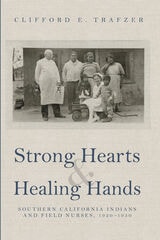
Strong Hearts and Healing Hands
Southern California Indians and Field Nurses, 1920–1950Clifford E. Trafzer
University of Arizona Press, 2021
Over time, field nurses and Native people formed a positive working relationship that resulted in the decline of mortality from infectious diseases. Many Native Americans accepted and used Western medicine to fight pathogens, while also continuing Indigenous medicine ways. Nurses helped control tuberculosis, measles, influenza, pneumonia, and a host of gastrointestinal sicknesses. In partnership with the community, nurses quarantined people with contagious diseases, tested for infections, and tracked patients and contacts. Indians turned to nurses and learned about disease prevention. With strong hearts, Indians eagerly participated in the tuberculosis campaign of 1939–40 to x-ray tribal members living on twenty-nine reservations. Through their cooperative efforts, Indians and health-care providers decreased deaths, cases, and misery among the tribes of Southern California.

Strong Inside
Perry Wallace and the Collision of Race and Sports in the SouthAndrew Maraniss
Vanderbilt University Press, 2024
2015 RFK Book Awards Special Recognition
2015 Lillian Smith Book Award
2015 AAUP Books Committee "Outstanding" Title
When Strong Inside was first published ten years ago, no one could have predicted the impact the book would have on Vanderbilt University, Nashville, and communities across the nation. What began as a biography of Perry Wallace—the first African American basketball player in the Southeastern Conference (SEC)—became a catalyst for meaningful change and reconciliation between Wallace and the city that had rejected him. In this tenth-anniversary edition, scholars of race and sports Louis Moore and Derrick E. White provide a new foreword that places the story in the context of the study of sports and society, and author Andrew Maraniss adds a concluding chapter filling readers in on how events unfolded between Strong Inside’s publication in 2014 and Perry Wallace’s death in 2017 and exploring Wallace’s continuing legacy.
Wallace entered kindergarten the year that Brown v. Board of Education upended “separate but equal.” As a twelve-year-old, he sneaked downtown to watch the sit-ins at Nashville’s lunch counters. A week after Martin Luther King Jr.’s “I Have a Dream” speech, Wallace entered high school, and later saw the passage of the Civil Rights and Voting Rights acts. On March 19, 1966, his Pearl High School basketball team won Tennessee’s first integrated state tournament—the same day Adolph Rupp’s all-white Kentucky Wildcats lost to the all-Black Texas Western Miners in an iconic NCAA title game.
The world seemed to be opening up at just the right time, and when Vanderbilt recruited him, Wallace courageously accepted the assignment to desegregate the SEC. His experiences on campus and in the hostile gymnasiums of the Deep South turned out to be nothing like he ever imagined.

Strong Inside
Perry Wallace and the Collision of Race and Sports in the SouthAndrew Maraniss
Vanderbilt University Press, 2014
2015 RFK Book Awards Special Recognition
2015 Lillian Smith Book Award
2015 AAUP Books Committee "Outstanding" Title
Based on more than eighty interviews, this fast-paced, richly detailed biography of Perry Wallace, the first African American basketball player in the SEC, digs deep beneath the surface to reveal a more complicated and profound story of sports pioneering than we've come to expect from the genre. Perry Wallace's unusually insightful and honest introspection reveals his inner thoughts throughout his journey.
Wallace entered kindergarten the year that Brown v. Board of Education upended "separate but equal." As a 12-year-old, he sneaked downtown to watch the sit-ins at Nashville's lunch counters. A week after Martin Luther King Jr.'s "I Have a Dream" speech, Wallace entered high school, and later saw the passage of the Civil Rights and Voting Rights acts. On March 16, 1966, his Pearl High School basketball team won Tennessee's first integrated state tournament--the same day Adolph Rupp's all-white Kentucky Wildcats lost to the all-black Texas Western Miners in an iconic NCAA title game.
The world seemed to be opening up at just the right time, and when Vanderbilt recruited him, Wallace courageously accepted the assignment to desegregate the SEC. His experiences on campus and in the hostile gymnasiums of the Deep South turned out to be nothing like he ever imagined.
On campus, he encountered the leading civil rights figures of the day, including Stokely Carmichael, Martin Luther King Jr., Fannie Lou Hamer, and Robert Kennedy--and he led Vanderbilt's small group of black students to a meeting with the university chancellor to push for better treatment.
On the basketball court, he experienced an Ole Miss boycott and the rabid hate of the Mississippi State fans in Starkville. Following his freshman year, the NCAA instituted "the Lew Alcindor rule," which deprived Wallace of his signature move, the slam dunk.
Despite this attempt to limit the influence of a rising tide of black stars, the final basket of Wallace's college career was a cathartic and defiant dunk, and the story Wallace told to the Vanderbilt Human Relations Committee and later The Tennessean was not the simple story of a triumphant trailblazer that many people wanted to hear. Yes, he had gone from hearing racial epithets when he appeared in his dormitory to being voted as the university's most popular student, but, at the risk of being labeled "ungrateful," he spoke truth to power in describing the daily slights and abuses he had overcome and what Martin Luther King had called "the agonizing loneliness of a pioneer."
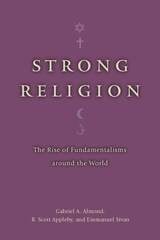
Strong Religion
The Rise of Fundamentalisms around the WorldGabriel A. Almond, R. Scott Appleby, and Emmanuel Sivan
University of Chicago Press, 2003
To answer questions like these, Strong Religion draws on the results of the Fundamentalism Project, a decade-long interdisciplinary study of antimodernist, antisecular militant religious movements on five continents and within seven world religious traditions. The authors of this study analyze the various social structures, cultural contexts, and political environments in which fundamentalist movements have emerged around the world, from the Islamic Hamas and Hizbullah to the Catholic and Protestant paramilitaries of Northern Ireland, and from the Moral Majority and Christian Coalition of the United States to the Sikh radicals and Hindu nationalists of India. Offering a vividly detailed portrait of the cultures that nourish such movements, Strong Religion opens a much-needed window onto different modes of fundamentalism and identifies the kind of historical events that can trigger them.
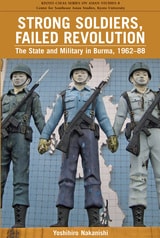
Strong Soldiers, Failed Revolution
The State and Military in Burma, 1962-88Yoshihiro Nakanishi
National University of Singapore Press, 2013
The tatmadaw’s anti-communist propaganda during the 1950s was a key element in state ideology under the Ne Win regime, and the direct participation of tatmadaw officers in the Burma Socialist Programme Party and government ministries at the national and local level transformed the political party system and civilian bureaucracy. Personal relationships — between Ne Win and the tatmadaw officer corps, and within the military — were central to the growing influence of the military, and to the outcome of the political crisis and subsequent military coup d’état in 1988.
Nakanishi’s discussion of these processes reveals many heretofore-unknown facts about this “dark age” in the country’s political history, and highlights its institutional legacy for the post-1988 military regime and the reformist government that succeeded it. His thought-provoking conclusions are significant for Southeast Asia specialists and for students of politics generally, and his insights will be useful for anyone seeking to engage with Myanmar as it comes to terms with an outside world it once kept at arm’s length.
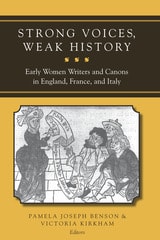
Strong Voices, Weak History
Early Women Writers and Canons in England, France, and ItalyPamela J Benson and Victoria Kirkham, Editors
University of Michigan Press, 2005

Strong Winds and Widow Makers
Workers, Nature, and Environmental Conflict in Pacific Northwest Timber CountrySteven C. Beda
University of Illinois Press, 2023
Often cast as villains in the Northwest's environmental battles, timber workers in fact have a connection to the forest that goes far beyond jobs and economic issues. Steven C. Beda explores the complex true story of how and why timber-working communities have concerned themselves with the health and future of the woods surrounding them. Life experiences like hunting, fishing, foraging, and hiking imbued timber country with meanings and values that nurtured a deep sense of place in workers, their families, and their communities. This sense of place in turn shaped ideas about protection that sometimes clashed with the views of environmentalists--or the desires of employers. Beda's sympathetic, in-depth look at the human beings whose lives are embedded in the woods helps us understand that timber communities fought not just to protect their livelihood, but because they saw the forest as a vital part of themselves.
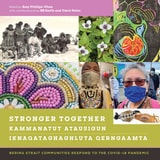
Stronger Together / Kammanatut Atausigun / Iknaqataghaghluta Qerngaamta
Bering Strait Communities Respond to the COVID-19 PandemicAmy Phillips-Chan
University of Alaska Press, 2024
The featured artists narrativize works inspired by the pandemic, from walrus ivory masks and sealskin face coverings to scenes of subsistence activities and informal family portraits. Full-color illustrations enliven the text with vibrant images of local community members, activities, and artwork from those who call this northern expanse of rolling tundra and icy seas home.
Stronger Together features hopeful and redemptive behind-the-scenes perspectives of how remote Alaskan communities endured the COVID-19 pandemic and appeals to anyone looking for hopeful and redemptive stories of this time, as well as museum, public arts, and culture program administrators; student and scholars of Indigenous and Alaska Native languages and culture; the Alaska anthropology community; artists and art enthusiasts; and those with a general interest in Alaska.
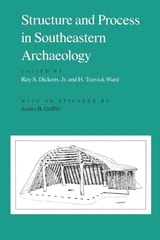
Structure and Process in Southeastern Archaeology
Edited by Roy Dickens Jr and H. Trawick Ward
University of Alabama Press, 1985
A Dan Josselyn Memorial Publication
Within the general structure-and-process theme of this compendium, the authors have focused on either intrasite problems (those dealing with the formation and structure of a site, type of site, or type of feature) or intersite problems (those dealing with behavioral organization and process as developed from comparative site data). These papers, from a broad range of specialists, present a comprehensive study of southeastern archaeology.
Structure and Process in Southeastern Archaeology is a foundational work that reshapes how scholars understand the cultural and social dynamics of prehistoric communities in the Southeastern United States. Roy S. Dickens, Jr. and H. Trawick Ward bring together decades of fieldwork, theoretical insight, and regional expertise to explore how ancient societies organized themselves, interacted, and evolved over time. Rather than focusing solely on artifacts or isolated site reports, this volume emphasizes the broader patterns—both structural and processual—that define the archaeological record of the Southeast.
Through a careful synthesis of settlement data, material culture, and environmental context, the authors reveal how social organization, political structures, and cultural practices were deeply embedded in the landscape. Their approach integrates processual archaeology with a nuanced understanding of regional variation, offering readers a dynamic view of how prehistoric communities adapted to changing conditions and interacted across space and time.
This book is particularly valuable for archaeologists, anthropologists, and historians seeking to move beyond descriptive accounts toward more interpretive frameworks. It provides a model for analyzing archaeological data in ways that illuminate the lived experiences of ancient peoples, making it a vital resource for both academic research and classroom instruction. The authors’ clear writing and thoughtful analysis make complex ideas accessible without sacrificing scholarly rigor.
Whether you're studying Mississippian chiefdoms, Woodland period settlements, or the broader cultural landscapes of the American South, Structure and Process in Southeastern Archaeology offers essential tools for understanding the past. It stands as a testament to the importance of theory-driven, context-rich archaeological interpretation.
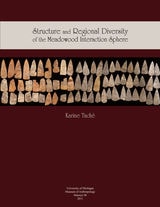
Structure and Regional Diversity in the Meadowood Interaction Sphere
Karine Taché
University of Michigan Press, 2011

Structures in the Stream
Water, Science, and the Rise of the U.S. Army Corps of EngineersBy Todd Shallat
University of Texas Press, 1994
As the Mississippi and other midwestern rivers inundated town after town during the summer of 1993, concerned and angry citizens questioned whether the very technologies and structures intended to "tame" the rivers did not, in fact, increase the severity of the floods. Much of the controversy swirled around the apparent culpability of the U.S. Army Corps of Engineers, the builder of many of the flood control systems that failed.
In this book, Todd Shallat examines the turbulent first century of the dam and canal building Corps and follows the agency's rise from European antecedents through the boom years of river development after the American Civil War. Combining extensive research with a lively style, Shallat tells the story of monumental construction and engineering fiascoes, public service and public corruption, and the rise of science and the army expert as agents of the state.
More than an institutional history, Structures in the Stream offers significant insights into American society, which has alternately supported the public works projects that are a legacy of our French heritage and opposed them based on the democratic, individualist tradition inherited from Britain. It will be important reading for a wide audience in environmental, military, and scientific history, policy studies, and American cultural history.
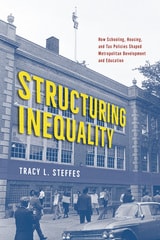
Structuring Inequality
How Schooling, Housing, and Tax Policies Shaped Metropolitan Development and EducationTracy L. Steffes
University of Chicago Press, 2024
As in many American metropolitan areas, inequality in Chicagoland is visible in its neighborhoods. These inequalities are not inevitable, however. They have been constructed and deepened by public policies around housing, schooling, taxation, and local governance, including hidden state government policies.
In Structuring Inequality, historian Tracy L. Steffes shows how metropolitan inequality in Chicagoland was structured, contested, and naturalized over time even as reformers tried to change it through school desegregation, affordable housing, and property tax reform. While these efforts had modest successes in the city and the suburbs, reformers faced significant resistance and counter-mobilization from affluent suburbanites, real estate developers, and other defenders of the status quo who defended inequality and reshaped the policy conversation about it. Grounded in comprehensive archival research and policy analysis, Structuring Inequality examines the history of Chicagoland’s established systems of inequality and provides perspective on the inequality we live with today.
Structuring Inequality
How Schooling, Housing, and Tax Policies Shaped Metropolitan Development and EducationTracy L. Steffes
University of Chicago Press, 2024
How inequality was forged, fought over, and forgotten through public policy in metropolitan Chicago.
As in many American metropolitan areas, inequality in Chicagoland is visible in its neighborhoods. These inequalities are not inevitable, however. They have been constructed and deepened by public policies around housing, schooling, taxation, and local governance, including hidden state government policies.
In Structuring Inequality, historian Tracy L. Steffes shows how metropolitan inequality in Chicagoland was structured, contested, and naturalized over time even as reformers tried to change it through school desegregation, affordable housing, and property tax reform. While these efforts had modest successes in the city and the suburbs, reformers faced significant resistance and counter-mobilization from affluent suburbanites, real estate developers, and other defenders of the status quo who defended inequality and reshaped the policy conversation about it. Grounded in comprehensive archival research and policy analysis, Structuring Inequality examines the history of Chicagoland’s established systems of inequality and provides perspective on the inequality we live with today.

Structuring the Void
The Struggle for Subject in Contemporary American FictionJerome Klinkowitz
Duke University Press, 1992
Among the writers Klinkowitz discusses are Richard Brautigan, Kurt Vonnegut, Max Apple, Saul Bellow, Erica Jong, Susan Quist, Gerald Rosen, Rob Swigart, and Grace Paley. He shows how, in the absence of subject matter, these writers persist in the act of structuring—by organizing autobiography as a narrative device, ritualizing national history and popular culture, or formalizing a comic response to a new imaginative state, the state of California. Klinkowitz also considers subjects such as gender and war, which, though they cannot be represented, nevertheless exercise contraints on a writer’s intention to structure.
What emerges from Klinkowitz’s analysis is a clear sense of what today’s fiction—and fiction writing—is about. As such, Structuring the Void will prove invaluable to anyone with an interest in contemporary literature.
Struggle for the Gulf Borderlands
The Creek War and the Battle of New Orleans, 1812-1815Frank L. Owsley
University of Alabama Press, 2000
Using American, British, and Spanish documents, many previously unknown, Frank Owsley’s study establishes the Creek War and the struggle to control the Gulf borderlands as integral parts of the War of 1812. The war between the United States and a large part of the Creek nation is usually studied as local or regional history. These documentary sources, however, show the larger picture. They show Spain to have been a major influence in the Creek War and indicate the extent to which the British were aiding the Indians and using them to redirect American troops. On the other hand, Andrew Jackson, in charge of the American forces on the Gulf Coast, emerged from the conflict as a first-rate military commander. His victories on the Gulf gave the West a leader and aided in shifting political power from the eastern seaboard to the South and West.
Owsley concludes that the victories in the Gulf region were of sufficient magnitude to justify the claim that the War of 1812 was not a draw but a decisive American victory and that had there been a general of Jackson's caliber on the northern frontier, the United States might have had a clear-cut victory there.
As a result of the war, the United States held its claim on Louisiana, annexed the Mobile district, forced Spain out of Florida, and broke the power of the southern Indians, thus opening vast lands for settlement from the new nation on the eastern seaboard.
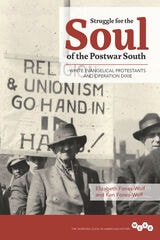
Struggle for the Soul of the Postwar South
White Evangelical Protestants and Operation DixieElizabeth Fones-Wolf and Ken Fones-Wolf
University of Illinois Press, 2015
The authors' nuanced look at working class religion reveals how laborers across the surprisingly wide evangelical spectrum interpreted their lives through their faith. Factors like conscience, community need, and lived experience led individual preachers to become union activists and mill villagers to defy the foreman and minister alike to listen to organizers. As the authors show, however, all sides enlisted belief in the battle. In the end, the inability of northern organizers to overcome the suspicion with which many evangelicals viewed modernity played a key role in Operation Dixie's failure, with repercussions for labor and liberalism that are still being felt today.
Identifying the role of the sacred in the struggle for southern economic justice, and placing class as a central aspect in southern religion, Struggle for the Soul of the Postwar South provides new understandings of how whites in the region wrestled with the options available to them during a crucial period of change and possibility.
Struggle on the North Santiam
Power and Community on the Margins of the American WestBob H Reinhardt
Oregon State University Press, 2020
In this deeply researched account, historian Bob H. Reinhardt connects the North Santiam Canyon’s history to that of the Pacific Northwest and the United States more broadly. Readers will learn about specific events that illuminate themes in the region’s history: railroad development as seen through the failed dreams of the Oregon Pacific Railroad, federal land scams in the Oregon land fraud trials of the early twentieth century, the causes and consequences of mid-century river development projects like Detroit Dam, the post-war booms and busts of the timber industry, the spotted owl/ancient forest debate in the 1980s and 1990s, and the promises and perils of Oregon’s recreational tourism economy.
From nineteenth-century interactions between Native and non-Native peoples to the changing fortunes of the timber industry and questions about economic and environmental sustainability in the twenty-first century, the book offers important insights into power dynamics in small communities and marginal places. Struggle on the North Santiam will be of interest to scholars of the American West and thoughtful readers interested in Oregon and Pacific Northwest history.
Struggle over Identity
The Official and the Alternative "Belarusianness"Nelly Bekus
Central European University Press, 2010
Rejecting the cliché about “weak identity and underdeveloped nationalism,” Bekus argues for the co-existence of two parallel concepts of Belarusianness—the official and the alternative one—which mirrors the current state of the Belarusian people more accurately and allows for a different interpretation of the interconnection between the democratization and nationalization of Belarusian society.
The book describes how the ethno-symbolic nation of the Belarusian nationalists, based on the cultural capital of the Golden Age of the Belarusian past (17th century) competes with the “nation” institutionalized and reified by the numerous civic rituals and social practices under the auspices of the actual Belarusian state.
Comparing the two concepts not only provides understanding of the logic that dominates Belarusian society’s self-description models, but also enables us to evaluate the chances of alternative Belarusianness to win this unequal struggle over identity.
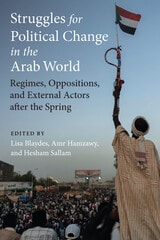
Struggles for Political Change in the Arab World
Regimes, Oppositions, and External Actors after the SpringEdited by Lisa Blaydes, Amr Hamzawy, and Hesham Sallam
University of Michigan Press, 2022
The advent of the Arab Spring in late 2010 was a hopeful moment for partisans of progressive change throughout the Arab world. Authoritarian leaders who had long stood in the way of meaningful political reform in the countries of the region were either ousted or faced the possibility of political if not physical demise. The downfall of long-standing dictators as they faced off with strong-willed protesters was a clear sign that democratic change was within reach. Throughout the last ten years, however, the Arab world has witnessed authoritarian regimes regaining resilience, pro-democracy movements losing momentum, and struggles between the first and the latter involving regional and international powers.
This volume explains how relevant political players in Arab countries among regimes, opposition movements, and external actors have adapted ten years after the onset of the Arab Spring. It includes contributions on Egypt, Morocco, Kuwait, Saudi Arabia, Syria, Algeria, Sudan, Lebanon, Iraq, Jordan, Yemen, and Tunisia. It also features studies on the respective roles of the United States, China, Iran, and Turkey vis-à-vis questions of political change and stability in the Arab region, and includes a study analyzing the role of Saudi Arabia and its allies in subverting revolutionary movements in other countries.
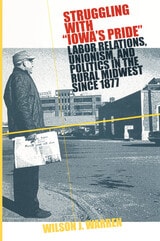
Struggling With Iowas Pride
Labor Relations, Unionism, and Politics in the Rural Midwest since 1877Warren, Wilson J.
University of Iowa Press, 2000
Recognized between 1880 and 1910 by its trademark label "Iowa's Pride," John Morrell and Company is best known for contributing one of the most important local unions to the progressive United Packinghouse Workers of America. During the 1930s and 1940s, its members pursued a militant brand of unionism. By the early 1950s, the local's militancy became a source of contention among the membership. By explaining the effect of Morrell-Ottumwa's union leaders on local and state Democratic politics, especially in the development of the Congress of Industrial Organizations' Iowa State Industrial Union Council and the AFL-CIO's Iowa Federation of Labor, Wilson Warren makes an important contribution to the literature on labor's involvement in the Democratic party's ascendancy across much of the industrial North following World War II.
This history of Ottumwa's meatpacking workers provides insights into the development of several forms of labor relations, including the evangelical Christian paternalism, welfare capitalism, and unionism that were distinctive to one blue-collar community but that also reflected workers' experiences in many other rural midwestern industrial communities. By carefully analyzing all relevant labor and industrial sources and by revealing the deeply held aspirations and concerns expressed by both workers and managers, Warren constructs a window through which Iowa's industrial and labor history over the past 120 years can be viewed.

Stubborn Twig
Three Generations in the Life of a Japanese American FamilyLauren Kessler
Oregon State University Press, 2005
To celebrate Oregon's 150th birthday, the Oregon Library Association has chosen one book for all Oregonians to read: Stubborn Twig. Lauren Kessler's award-winning book, the selection for the statewide Oregon Reads program, is a classic story of immigrants making their way in a new land. It is a living work of social history that rings with the power of truth and the drama of fiction, a moving saga about the challenges of becoming an American.
Masuo Yasui traveled from Japan across the other Oregon Trail — the one that spanned the Pacific Ocean — in 1903. Like most immigrants, he came with big dreams and empty pockets. Working on the railroads, in a cannery, and as a houseboy before settling in Hood River, Oregon, he opened a store, raised a large family, and became one of the area's most successful orchardists.
As Masuo broke the race barrier in the local business community, his American-born children broke it in school, scouts and sports, excelling in most everything they tried. For the Yasuis' first-born son, the constraints and contradictions of being both Japanese and American led to tragedy. But his seven brothers and sisters prevailed, becoming doctors, lawyers, teachers, and farmers. It was a classic tale of the American dream come true — until December 7, 1941, changed their lives forever.
The Yasuis were among the 120,000 people of Japanese ancestry along the West Coast who were forced from their homes and interned in vast inland "relocation camps." Masuo was arrested as a spy and imprisoned for the rest of the war; his family was shamed and broken. Yet the Yasuis endured, as succeeding generations took up the challenge of finding their identity as Americans. Stubborn Twig is their story — a story at once tragic and triumphant, one that bears eloquent witness to both the promise and the peril of America.
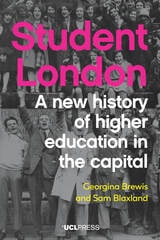
Student London
A New History of Higher Education in the CapitalGeorgina Brewis and Sam Blaxland
University College London, 2026
Centers student experiences in London’s history to tell the two-hundred-year story of student life in the capital.
Offering a detailed examination of life at the original London University (known as University College London since 1836) and many other institutions, this book captures a range of higher education experiences and perspectives in London. With insights into histories of education, class, gender, race, LGBTQ+ culture, leisure, politics, protest, housing, and charity in the capital, Student London draws on a rich and wide-ranging source base that includes several hundred student memoirs and oral history interviews; student newspapers, magazines, and film; visual and material culture; and Mass Observation data, court reports, and secret service files.
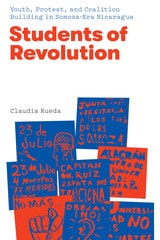
Students of Revolution
Youth, Protest, and Coalition Building in Somoza-Era NicaraguaBy Claudia Rueda
University of Texas Press, 2019
Students played a critical role in the Sandinista struggle in Nicaragua, helping to topple the US-backed Somoza dictatorship in 1979—one of only two successful social revolutions in Cold War Latin America. Debunking misconceptions, Students of Revolution provides new evidence that groups of college and secondary-level students were instrumental in fostering a culture of insurrection—one in which societal groups, from elite housewives to rural laborers, came to see armed revolution as not only legitimate but necessary.
Drawing on student archives, state and university records, and oral histories, Claudia Rueda reveals the tactics by which young activists deployed their age, class, and gender to craft a heroic identity that justified their political participation and to help build cross-class movements that eventually paralyzed the country. Despite living under a dictatorship that sharply curtailed expression, these students gained status as future national leaders, helping to sanctify their right to protest and generating widespread outrage while they endured the regime’s repression. Students of Revolution thus highlights the aggressive young dissenters who became the vanguard of the opposition.
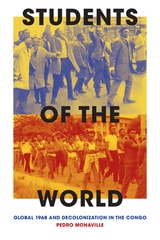
Students of the World
Global 1968 and Decolonization in the CongoPedro Monaville
Duke University Press, 2022
Studia Philonica Annual XXVI, 2014
David T. Runia
SBL Press, 2014
The best current research on Philo and Hellenistic Judaism
The Studia Philonica Annual is a scholarly journal devoted to the study of Hellenistic Judaism, particularly the writings and thought of the Hellenistic-Jewish writer Philo of Alexandria (circa 15 BCE to circa 50 CE).
Features:
- Articles on aspects of Hellenistic Judaism written by experts in the field
- Bibliography
- Book reviews

Studies in American Culture
Dominant Ideas and ImagesJoseph J. Kwiat and Mary C. Turpie, Editors
University of Minnesota Press, 1960
Studies in American Culture was first published in 1960. Minnesota Archive Editions uses digital technology to make long-unavailable books once again accessible, and are published unaltered from the original University of Minnesota Press editions.
The last decade has seen a revolutionary interest at colleges and universities both in this country and abroad in the field known variously as American Studies, American Civilization, or American Culture. Now the time is ripe for a critical look at the field, to assess its intellectual and cultural problems, and to anticipate its future. This is what the contributors to this volume do, through thoughtful discussions and interesting examples of studies in American ideas and images.
There are sixteen contributors, members of the faculties of a number of colleges and universities, and representatives of various specialties such as literary history and criticism; social, intellectual, and aesthetic history; political, economic, and social theory.
In the introductory chapter, Henry Nash Smith discusses the problems of method which confront scholars in American Studies. The chapters which follow contain outstanding examples of scholarship in American Studies. The authors are Reuel Denney, John W. Ward, Mulford Q. Sibley, David R. Weimer, William Van O'Connor, Bernard Bowron, Leo Marx, Arnold Rose, Allen Tate, David W. Noble, J. C. Levenson, Joseph J. Kwiat, Theodore C. Blegen, and Charles H. Foster. In the final chapter, Robert E. Spiller looks at the past, present, and future of American Studies.
All the contributors as well as the editors are now or have been associated with the American Studies program at the University of Minnesota and with the late Tremaine McDowell, chairman of the program for thirteen years and a pioneer in the development of the discipline.
The book will be useful to anyone interested in American thought, culture, and society, to those conducting American Studies programs, and to their students.