Results by title
4030 books match the query 'Language Arts & Disciplines' and 263 start with s
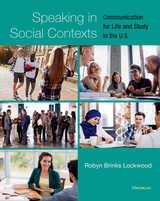
Speaking in Social Contexts
Communication for Life and Study in the U.S.Robyn Brinks Lockwood
University of Michigan Press, 2018
The text provides language to use for a variety of functions as they might related to life on a university campus: offering greetings and goodbyes, making introductions, giving opinions, agreeing and disagreeing, using the phone, offering assistance, asking for advice, accepting and declining invitations, giving and receiving compliments, complaining, giving congratulations, expressing condolences, and making small talk. Users are also taught to think beyond the words and to interpret intonation and stress (how things sound).
Each of the 10 units includes discussion prompts, language lessons, practice activities, get acquainted tasks (interacting with native speakers), and analysis opportunities (what did they discover and what can they apply?).
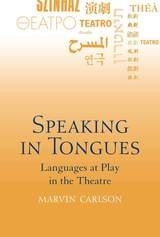
Speaking in Tongues
Languages at Play in the TheatreMarvin Carlson
University of Michigan Press, 2010
The book begins by investigating various "levels" of language-high and low style, prose and poetry-and the ways in which these have been used historically to mark social positions and relationships. It next considers some of the political and historical implications of dialogue theatre, as well as theatre that literally employs several languages, from classical Greek examples to the postmodern era. Carlson treats with special attention the theatre of the postcolonial world, and especially the triangulation of the local language, the national language, and the colonial language, drawing on examples of theatre in the Caribbean, Africa, Australia, and New Zealand. Finally, Carlson considers the layering of languages in the theatre, such as the use of supertitles or simultaneous signing.
Speaking in Tongues draws important social and political conclusions about the role of language in cultural power, making a vital contribution to the fields of theatre and performance.
Marvin Carlson is Sidney E. Cohn Professor of Theatre and Comparative Literature, CUNY Graduate Center. He is author of Performance: A Critical Introduction; Theories of the Theatre: A Historical and Critical Survey, from the Greeks to the Present; and The Haunted Stage: The Theatre as Memory Machine, among many other books.
Speaking into the Air
A History of the Idea of CommunicationJohn Durham Peters
University of Chicago Press, 1999
"This is a most interesting and thought-provoking book. . . . Peters maintains that communication is ultimately unthinkable apart from the task of establishing a kingdom in which people can live together peacefully. Given our condition as mortals, communication remains not primarily a problem of technology, but of power, ethics and art." —Antony Anderson, New Scientist
"Guaranteed to alter your thinking about communication. . . . Original, erudite, and beautifully written, this book is a gem." —Kirkus Reviews
"Peters writes to reclaim the notion of authenticity in a media-saturated world. It's this ultimate concern that renders his book a brave, colorful exploration of the hydra-headed problems presented by a rapid-fire popular culture." —Publishers Weekly
What we have here is a failure-to-communicate book. Funny thing is, it communicates beautifully. . . . Speaking Into the Air delivers what superb serious books always do-hours of intellectual challenge as one absorbs the gradually unfolding vision of an erudite, creative author." —Carlin Romano, Philadelphia Inquirer
Speaking of Alabama
The History, Diversity, Function, and Change of LanguageEdited by Thomas E. Nunnally
University of Alabama Press, 2019
Thomas E. Nunnally’s fascinating volume presents essays by linguists who examine with affection and curiosity the speech varieties occurring both past and present across Alabama. Taken together, the accounts in this volume offer an engaging view of the major features that characterize Alabama’s unique brand of southern English.
Written in an accessible manner for general readers and scholars alike, Speaking of Alabama includes such subjects as the special linguistic features of the Southern drawl, the “phonetic divide” between north and south Alabama, “code-switching” by African American speakers in Alabama, pejorative attitudes by Alabama speakers toward their own native speech, the influence of foreign languages on Alabama speech to the vibrant history and continuing influence of non-English languages in the state, as well as ongoing changes in Alabama’s dialects.
Adding to these studies is a foreword by Walt Wolfram and an afterword by Michael B. Montgomery, both renowned experts in southern English, which place both the methodologies and the findings of the volume into their larger contexts and point researchers to needed work ahead in Alabama, the South, and beyond. The volume also contains a number of useful appendices, including a guide to the sounds of Southern English, a glossary of linguistic terms, and online sources for further study.
Language, as presented in this collection, is never abstract but always examined in the context of its speakers’ day-to-day lives, the driving force for their communication needs and choices. Whether specialist or general reader, Alabamian or non-Alabamian, all readers will come away from these accounts with a deepened understanding of how language functions between individuals, within communities, and across regions, and will gain a new respect for the driving forces behind language variation and language change.
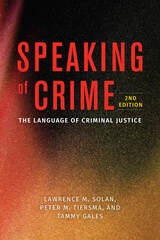
Speaking of Crime
The Language of Criminal JusticeLawrence M. Solan, Peter M. Tiersma, and Tammy Gales
University of Chicago Press, 2025
An essential introduction to the use and misuse of language within the criminal justice system, updated for a new generation.
Does everyone understand the Miranda warning? Why do people confess to a crime they did not commit? Can linguistic experts identify who wrote an anonymous threatening letter? Since its first publication, Speaking of Crime has been answering these questions. Introducing major topics and controversies at the intersection of language and law, Lawrence M. Solan, Peter M. Tiersma, and Tammy Gales apply multidisciplinary insights to examine the complex role of language within the US justice system.
The second edition features in-depth discussions of recent cases, new legislation, and innovative research advances, and includes a new chapter on who interprets the laws governing linguistic contexts. Thoroughly updated and approachable, Speaking of Crime is a state-of-the-art survey that will be useful to scholars, students, and practitioners throughout the criminal justice system.
Speaking of Writing
Selected Hopwood LecturesNicholas Delbanco, Editor
University of Michigan Press, 1990
These essays were originally presented at the Hopwood Lecture series at the University of Michigan in conjunction with the annual awarding of the Hopwood Prizes in creative writing. The internationally recognized awards are granted by the bequest of playwright Avery Hopwood (1884-1928), who sought to encourage student work in the fields of dramatic writing, fiction, poetry, and the essay. The essays speak to the apprentice writer, finding their focus in a twinned discussion of the craft of prose and the art of poetry. The authors share an assumption that literature matters, and vitally, to the culture it reports on and sustains.
Specifying Syntactic Structures
Edited by Patrick Blackburn and Maarten de Rijke
CSLI, 1997
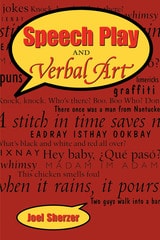
Speech Play and Verbal Art
By Joel Sherzer
University of Texas Press, 2002
Puns, jokes, proverbs, riddles, play languages, verbal dueling, parallelism, metaphor, grammatical stretching and manipulation in poetry and song— people around the world enjoy these forms of speech play and verbal artistry which form an intrinsic part of the fabric of their lives. Verbal playfulness is not a frivolous pursuit. Often indicative of people's deepest values and worldview, speech play is a significant site of intersection among language, culture, society, and individual expression.
In this book, Joel Sherzer examines many kinds of speech play from places as diverse as the United States, France, Italy, Bali, and Latin America to offer the first full-scale study of speech play and verbal art. He brings together various speech-play forms and processes and shows what they have in common and how they overlap. He also demonstrates that speech play explores and indeed flirts with the boundaries of the socially, culturally, and linguistically possible and appropriate, thus making it relevant for anthropological and linguistic theory and practice, as well as for folklore and literary criticism.
Speechwright
An Insider's Take on Political RhetoricWilliam F. Gavin
Michigan State University Press, 2011
For almost thirty years, William F. Gavin wrote speeches at the highest levels of government. Speechwright is his insider’s view of politics, a shrewd critique of presidential and congressional rhetoric, and a personal look at the political leaders for whom he wrote speeches. While serving President Richard Nixon and candidate Ronald Reagan, Gavin advocated for “working rhetoric”—well-crafted, clear, hard-hitting arguments that did not off er visions of the unattainable, but instead limited political discourse to achievable ends reached through practical means. Filled with hard-earned wisdom about politics and its discontents, Speechwright describes Gavin’s successes, his failures, and his call for political rhetoric built on strong argument rather than the mere search for eloquence.

Spirits of the Cold War
Contesting Worldviews in the Classical Age of American Security StrategyNed O'Gorman
Michigan State University Press, 2012
In spring of 1953, newly elected President Eisenhower sat down with his staff to discuss the state of American strategy in the cold war. America, he insisted, needed a new approach to an urgent situation. From this meeting emerged Eisenhower’s teams of “bright young fellows,” charged with developing competing policies, each of which would come to shape global politics. In Spirits of the Cold War, Ned O’Gorman argues that the early Cold War was a crucible not only for contesting political strategies, but also for competing conceptions of America and its place in the world. Drawing on extensive archival research and wide reading in intellectual and rhetorical histories, this comprehensive account shows cold warriors debating “worldviews” in addition to more strictly instrumental tactical aims. Spirits of the Cold War is a rigorous scholarly account of the strategic debate of the early Cold War—a cultural diagnostic of American security discourse and an examination of its origins.
Spirituality and the Writer
A Personal InquiryThomas Larson
Ohio University Press, 2019
Today, the surprisingly elastic form of the memoir embraces subjects that include dying, illness, loss, relationships, and self-awareness. Writing to reveal the inner self—the pilgrimage into one’s spiritual and/or religious nature—is a primary calling. Contemporary memoirists are exploring this field with innovative storytelling, rigorous craft, and new styles of confessional authorship. Now, Thomas Larson brings his expertise as a critic, reader, and teacher to the boldly evolving and improvisatory world of spiritual literature.
In his book-length essay Spirituality and the Writer, Larson surveys the literary insights of authors old and new who have shaped religious autobiography and spiritual memoir—from Augustine to Thomas Merton, from Peter Matthiessen to Cheryl Strayed. He holds them to an exacting standard: they must render transcendent experience in the writing itself. Only when the writer’s craft prevails can the fleeting and profound personal truths of the spirit be captured. Like its predecessor, Larson’s The Memoir and the Memoirist,Spirituality and the Writer will find a home in writing classrooms and book groups, and be a resource for students, teachers, and writers who seek guidance with exploring their spiritual lives.
Spoken Sibe
Morphology of the Inflected Parts of SpeechVeronika Zikmundová
Karolinum Press, 2013
Sport History in the Digital Era
Edited by Gary Osmond and Murray G. Phillips
University of Illinois Press, 2015
Chapters consider how the philosophical and theoretical understanding of the meaning of history influence a willingness to engage with digital history, and conceptualize the relationship between history making and the digital era. As the writers show, digital media's mostly untapped potential for studying the recent past via blogs, chat rooms, gambling sites, and the like forge a symbiosis between sports and the internet, and offer historians new vistas to explore and utilize.
Sport History in the Digital Era also shows how the best digital history goes beyond a static cache of curated documents. Instead, it becomes a truly public history that serves as a dynamic site of enquiry and discussion. In such places, scholars enter into a give-and-take with individuals while inviting the audience to grapple with, rather than passively absorb, the evidence being offered.
Timely and provocative, Sport History in the Digital Era affirms how the information revolution has transformed sport and sport history--and shows the road ahead.
Contributors include Douglas Booth, Mike Cronin, Martin Johnes, Matthew Klugman, Geoffery Z. Kohe, Tara Magdalinski, Fiona McLachlan, Bob Nicholson, Rebecca Olive, Gary Osmond, Murray G. Phillips, Stephen Robertson, Synthia Sydnor, Holly Thorpe, and Wayne Wilson.
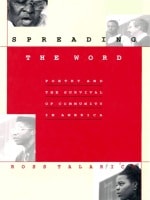
Spreading the Word
Poetry and the Survival of Community in AmericaRoss Talarico
Duke University Press, 1995
Drawing on his workshops in Rochester, Talarico describes a unique approach for eliciting poetry from people of many ages and backgrounds—particularly underpriviledged urban kids and the elderly. The process—from dialogue to self-expression to publication to public event—illuminates the urgency and meaning of releasing the spirit captured in each man and woman and child’s experience. "Some people say that Ross Talarico has done the impossible," the Today Show remarked of his success in Rochester; and with this book Talarico offers the same opportunity to others. Teachers, community leaders, parents, and children will be able to follow his practical, hands-on approach to encouraging self-expression in diverse, even unlikely, settings. They will see here how poetry is indeed relevant, ever more crucial to our identity as the culture evolves—how it is, finally, the place where the inarticulate can come to speak for themselves.

Staff Development Strategies That Work!
Stories and Strategies from New LibrariansAmerican Library Association, 2009
Staff Development on a Shoestring
A How-To-Do-It Manual for LibrariansAmerican Library Association, 2011
Staff Development
A Practical GuideCarol Zsulya
American Library Association, 2013
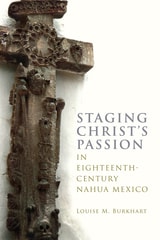
Staging Christ's Passion in Eighteenth-Century Nahua Mexico
Louise M. Burkhart
University Press of Colorado, 2023
A cast with over fifty distinct roles acted out events extending from Palm Sunday to Christ’s death on the cross. One actor became a localized embodiment of Jesus through a process of investiture and mimesis that carried aspects of pre-Columbian materialized divinity into the later colonial period. The play told afar richer version of the Passion story than what later colonial Nahuas typically learned from their priests or catechists. And by assimilating Jesus to an Indigenous, or macehualli, identity, the players enacted a protest against colonial rule.
The situation in eighteenth-century New Spain presents both a unique confrontation between Indigenous communities and Enlightenment era religious reformers and a new chapter in an age-old power game between popular practice and religious orthodoxy. By focusing on how Nahuas localized the universalizing narrative of Christ’s Passion, Staging Christ’s Passion in Eighteenth-Century Nahua Mexico offers an unusually in-depth view of religious life under colonial rule.
Burkhart’s accompanying website also makes available transcriptions and translations of the six Nahuatl-language plays, four Spanish-language plays composed in response to the suppression of the Nahuatl practice, and related documentation, providing a valuable resource for anyone interested in consulting the original material.
Comments restricted to single page
plays composed in response to the suppression of the Nahuatl practice, and related documentation,
providing a valuable resource for anyone interested in consulting the original material
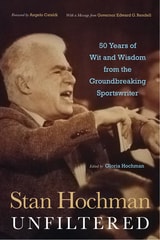
Stan Hochman Unfiltered
50 Years of Wit and Wisdom from the Groundbreaking SportswriterGloria Hochman
Temple University Press, 2020
The late Philadelphia Daily News sportswriter Stan Hochman was known for his many zingers, such as “Harry Litwack, the stoic Temple coach, stalks the sidelines like a blind man at a nudist colony.” As a reporter, he was more interested in how athletes felt, what their values were, how they lived their lives, or what made them tick than he was about how many runs they scored or punches they landed.
In Stan Hochman Unfiltered, his wife Gloria collects nearly 100 of his best columns from the Daily News about baseball, horse racing, boxing, football, hockey, and basketball (both college and pro), as well as food, films, and even Liz Taylor. Each section is introduced by a friend or colleague, including Garry Maddox, Bernie Parent, Larry Merchant, and Ray Didinger, among others.
Hochman penned a candid, cantankerous column about whether Pete Rose belongs in the Baseball Hall of Fame; wrote a graphic account of the Muhammad Ali and Joe Frazier fight of the century; and skewered Norman “Bottom Line” Braman, the one-time owner of the Eagles. He also wrote human-interest stories, including features about the importance of kids with special needs playing sports.
In addition to being a beloved writer, Hochman was also known for his stint on WIP’s radio as the Grand Imperial Poobah, where he would settle callers’ most pressing debates. Hochman long earned the respect and admiration of his subjects, peers, and readers throughout his career, and Stan Hochman Unfiltered is a testament to his enduring legacy.
Standing at the Threshold
Working through Liminality in the Composition and Rhetoric TAshipWilliam J. Macauley
Utah State University Press, 2021
These authors enrich the TA experience by supporting agency and self-efficacy, encouraging TAs to take active roles in understanding their positions and making the most of that experience. Many chapters are written by current or former TAs who are writing as a means of preparing, informing, and guiding new rhet/comp TAs, encouraging them to make choices about how they want to think through and participate in their teaching work.
The first work on the market to delve deeply into the TAship itself and what it means for the larger discipline, Standing at the Threshold provides a rich new theorizing based in the real experiences and liminalities of teaching assistants in composition and rhetoric, approached from a productive array of perspectives.
Contributors: Lew Caccia, Lillian Campbell, Rachel Donegan, Jaclyn Fiscus-Cannady, Jennifer K. Johnson, Ronda Leathers Dively, Faith Matzker, Jessica Restaino, Elizabeth Saur, Megan Schoettler, Kylee Thacker Maurer
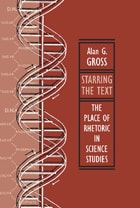
Starring the Text
The Place of Rhetoric in Science StudiesAlan G. Gross
Southern Illinois University Press, 2006
Starring the Text: The Place of Rhetoric in Science Studies firmly establishes the rhetorical analysis of science as a respected field of study. Alan G. Gross, one of rhetoric’s foremost authorities, summarizes the state of the field and demonstrates the role of rhetorical analysis in the sciences. He documents the limits of such analyses with examples from biology and physics, explores their range of application, and sheds light on the tangled relationships between science and society. In this deep revision of his important Rhetoric of Science, Gross examines how rhetorical analyses have a wide range of application, effectively exploring the generation, spread, certification, and closure that characterize scientific knowledge. Gross anchors his position in philosophical rather than in rhetorical arguments and maintains there is rhetorical criticism from which the sciences cannot be excluded.
Gross employs a variety of case studies and examples to assess the limits of the rhetorical analysis of science. For example, in examining avian taxonomy, he demonstrates that both taxonomical and evolutionary species are the product of rhetorical interactions. A review of Newton’s two formulations of optical research illustrates that their only significant difference is rhetorical, a difference in patterns of style, arrangement, and argument. Gross also explores the range of rhetorical analysis in his consideration of the “evolution of evolution” of Darwin’s notebooks. In his analysis of science and society, he explains the limits of citizen action in executive, judicial, and legislative democratic realms in the struggle to prevent, ameliorate, and provide adequate compensation for occupational disease. By using philosophical, historical, and psychological perspectives, Gross concludes, rhetorical analysis can also supplement other viewpoints in resolving intellectual problems.
Starring the Text, which includes fourteen illustrations, is an updated, readable study geared to rhetoricians, historians, philosophers, and sociologists interested in science. The volume effectively demonstrates that the rhetoric of science is a natural extension of rhetorical theory and criticism.
Start a Revolution
Stop Acting Like a LibraryBen Bizzle
American Library Association, 2014
Starting, Strengthening and Managing Institutional Repositories
Jonathan A. Nabe
American Library Association, 2010

States at War, Volume 2
A Reference Guide for New York in the Civil WarEdited by Richard F. Miller
University Press of New England, 2014
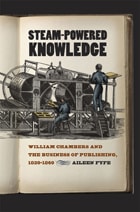
Steam-Powered Knowledge
William Chambers and the Business of Publishing, 1820-1860Aileen Fyfe
University of Chicago Press, 2012
With the overwhelming amount of new information that bombards us each day, it is perhaps difficult to imagine a time when the widespread availability of the printed word was a novelty. In early nineteenth-century Britain, print was not novel—Gutenberg’s printing press had been around for nearly four centuries—but printed matter was still a rare and relatively expensive luxury. All this changed, however, as publishers began employing new technologies to astounding effect, mass-producing instructive and educational books and magazines and revolutionizing how knowledge was disseminated to the general public.
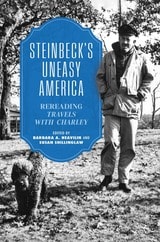
Steinbeck’s Uneasy America
Rereading “Travels with Charley”Edited by Barbara A. Heavilin and Susan Shillinglaw
University of Alabama Press, 2025
A road trip through Steinbeck’s America—revisited, reimagined, and reinterpreted.
Steinbeck’s Uneasy America is the first collection of critical scholarship devoted to Travels with Charley in Search of America, John Steinbeck’s best-selling, late-career travel memoir. In 1960, Steinbeck was a renowned man of American letters. Many considered him America’s troubadour of ordinary people, the conscience of the country. But weakened by two small strokes and anxious that he had lost touch with America, he embarked on a cross-country road trip accompanied by his wife’s standard poodle, Charley. Two years later, he published Travels with Charley to popular acclaim and robust sales.
Throughout this narrative, Steinbeck insists that all of our perceptions are “warped” by personality, history, and society. And while this hybrid and experimental book has long been accepted as an accurate account of his journey, journalists and scholars agree that the narrative is part factual, part fiction—America as seen through Steinbeck’s particular “warp.” The work is long overdue for scholarly assessment.
Steinbeck’s Uneasy America explores three main topics. Part 1 explores genre and form to consider the degree to which the work is fiction or nonfiction. Part 2 assesses Steinbeck’s increasingly bleak assessment of America—almost a jeremiad that warns citizens of ecological excess and political apathy. Part 3 focuses on Travels with Charley as a road text, travel adventure, and literary influence.
This volume’s authors offer rich scholarly insights and a wealth of stories, facts, and anecdotes about Steinbeck and the adventures and misadventures he and Charley met on the road. Lively and groundbreaking, the collection both enlightens and enlivens discussions of Steinbeck and of the twentieth-century American book world.
Stick Houses
StoriesMatthew L.M. Fletcher
Michigan State University Press, 2025
These stories explore themes of home and belonging, and how Native people are not just one thing; they are both Native and non-Native blood. Some are deeply connected to their Anishinaabe heritage, while others have suffered a complete loss of their culture. Many Native people are conflicted about their background and suffer intergenerational trauma. These stories originate in dynamic environments and situations such as airports, college, Indian lawyering, and high school baseball games.
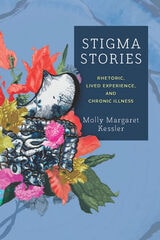
Stigma Stories
Rhetoric, Lived Experience, and Chronic IllnessMolly Margaret Kessler
The Ohio State University Press, 2022
Engaging interdisciplinary conversations from the rhetoric of health and medicine, disability studies, narrative medicine, and sociology, Kessler takes an innovative look at how stigma functions on individual, interpersonal, and societal levels. In doing so, Kessler reveals how stories and lived experiences have much to teach us not only about how stigma functions but also about how it can be dismantled.
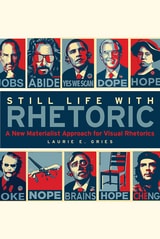
Still Life with Rhetoric
A New Materialist Approach for Visual RhetoricsLaurie Gries
Utah State University Press, 2015
In Still Life with Rhetoric, Laurie Gries forges connections among new materialism, actor network theory, and rhetoric to explore how images become rhetorically active in a digitally networked, global environment. Rather than study how an already-materialized “visual text” functions within a specific context, Gries investigates how images often circulate and transform across media, genre, and location at viral rates. A four-part case study of Shepard Fairey’s now iconic Obama Hope image elucidates how images reassemble collective life as they actualize in different versions, enter into various relations, and spark a firework of activity across the globe.
While intent on tracking the rhetorical life of a single, multiple image, Still Life with Rhetoric is most concerned with studying rhetoric in motion. To account for an image’s widespread circulation and emergent activities, Gries introduces iconographic tracking—a digital research method for tracing an image’s divergent rhetorical becomings. Yet Gries also articulates a dynamic set of theoretical principles for studying rhetoric as a distributed, generative, and unforeseeable event that is applicable beyond the study of visual rhetoric. With an eye toward futurity—the strands of time beyond a thing’s initial moment of production and delivery—Still Life with Rhetoric intends to be taken up by those interested in visual rhetoric, research methods, and theory.
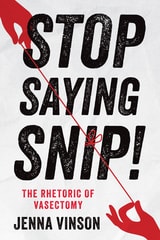
Stop Saying Snip!
The Rhetoric of VasectomyJenna Vinson
Rutgers University Press, 2026
In the US, the most common contraceptive methods rely on women’s time, labor, and vulnerability to risk. Comparatively few people rely on vasectomies as a means of preventing pregnancies. Something is happening rhetorically—through meaning-making symbols and the material practices they manifest—that sustains a collective disinterest in vasectomies. Jenna Vinson draws from her feminist rhetorical study of thirty-seven television and film representations, health insurance policies, and interviews with seventeen people who have experienced vasectomy, surfacing barriers to vasectomy uptake, including problematic tropes and practices that keep vasectomy unappealing, out of mind, and inaccessible. Stop Saying Snip! also illustrates tactics and circumstances that lead people to get a vasectomy, sharing real vasectomy stories and showing that women often play an important (and until now unheeded or pathologized) role in this communication process. This book intervenes in the misogynistic cultural expectation that it is women’s responsibility to endure the pain, labor, and risks of managing fertility by identifying the rhetorics that make men’s reproductive bodies seem unnatural sites for pregnancy prevention work. Fostering a persuasive vision of vasectomy is an urgent project that contributes to the movement toward reproductive justice.
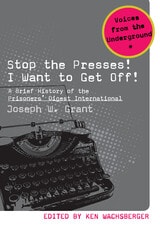
Stop the Presses! I Want to Get Off!
A Brief History of the Prisoners’ Digest InternationalJoseph W. Grant
Michigan State University Press, 2012
The final book in the groundbreaking Voices from the Underground series, Stop the Presses! I Want to Get Off!, is the inspiring, frenetic, funny, sad, always-cash-starved story of Joe Grant, founder and publisher of Prisoners’ Digest International, the most important prisoners’ rights underground newspaper of the Vietnam era. From Grant’s military days in pre-Revolutionary Cuba during the Korean War, to his time as publisher of a pro-union newspaper in Cedar Rapids and his eventual imprisonment in Leavenworth, Kansas, Grant’s personal history is a testament to the power of courage under duress. One of the more notorious federal penitentiaries in the nation, Leavenworth inspired Grant to found PDI in an effort to bring hope to prisoners and their families nationwide.
Stories from First-Year Composition
FYC Pedagogies that Foster Student Writing Identity and AgencyJo-Anne Kerr
University Press of Colorado, 2020
Stories of Becoming
Demystifying the Professoriate for Graduate Students in Composition and RhetoricClaire Lutkewitte
Utah State University Press, 2021
Using data from the study, the authors offer six specific strategies—including how to manage time, how to create a work/life balance, and how to collaborate with others—that readers can use to prepare for the composition and rhetoric job market and to begin their careers as full-time faculty members. Readers will learn about the possible responsibilities they may take on as new faculty, particularly those that go beyond teaching, research, service, and administration to include navigating the politics of higher education and negotiating professional identity construction. And they will also engage in activities and answer questions designed to deepen their understanding of the field and help them identify their own values and desired career trajectory.
Stories of Becoming demystifies the professoriate, compares what current new faculty have to say of their job expectations with the realities that students might face when on the job, and brings to light the invisible, behind-the-scenes work done by new faculty. It will be invaluable to graduate students, those who teach graduate students, new faculty, and hiring administrators in composition and rhetoric.

Stories of Open
Opening Peer Review through Narrative InquiryEmily Ford
Assoc of College & Research Libraries, 2021
Stories of Open: Opening Peer Review through Narrative Inquiry examines the methods and processes of peer review, as well as the stories of those who have been through it. Eleven chapters are divided into three parts:
• Part 1: Orientation. This section offers a conceptual frame for the book, providing details about narrative inquiry as a methodology and the author’s worldview and research approach.
• Part 2: The Stories (The Story Middle). What is the standard experience of peer review in our field? This section shares stories told from a variety of viewpoints and roles—author, editor, and referee—and explores how these roles interact, the tension between them, and the duality and sometimes multiplicity of roles experienced by any one individual.
• Part 3: Coda. These four chapters tie the stories to the idea of open and look in detail at the research method, as well as imagine how we might move forward—reflecting on our past stories to create future ones.
When we open ourselves to others’ experiences, we reflect on our own. Stories of Open offers questions for reflection at the end of many chapters in order to assist in the continued exploration of your own experiences with peer review, and encourages the use of these reflections in creating new and improved peer review methods.
This book is also available as an open access edition at https://bit.ly/ACRLStoriesofOpen
Stories of Our Living Ephemera
Storytelling Methodologies in the Archives of the Cherokee National Seminaries, 1846-1907Emily Legg
Utah State University Press, 2023
Emily Legg turns to the Cherokee medicine wheel and cardinal directions as a Cherokee rhetorical discipline of knowledge making in the archives, an embodied and material practice that steers knowledge through the four cardinal directions around all relations. Going beyond historiography, Legg delineates educational practices that are intertwined with multiple strands of traditional Cherokee stories that privilege Indigenous and matriarchal theoretical lenses. Stories of Our Living Ephemera synthesizes the connections between contemporary and nineteenth-century academic experiences to articulate the ways that colonial institutions and research can be Indigenized by centering Native American sovereignty.
By undoing the erasure of Cherokee literacy and educational practices, Stories of Our Living Ephemera celebrates the importance of storytelling, especially for those who are learning about Indigenous histories and rhetorics. This book is of cultural importance and value to academics interested in composition and pedagogy, the Cherokee Nation, and a general audience seeking to learn about Indigenous rhetorical devices and Cherokee history.
Stories, Songs, and Stretches!
Creating Playful Storytimes with Yoga and MovementKatie Scherrer
American Library Association, 2017
Story of Willow Run
Marion F. Wilson
University of Michigan Press, 1956
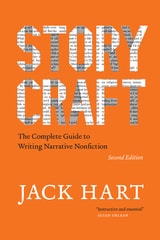
Storycraft, Second Edition
The Complete Guide to Writing Narrative NonfictionJack Hart
University of Chicago Press, 2021
In this new edition, Hart has expanded the book’s range to delve into podcasting and has incorporated new insights from recent research into storytelling and the brain. He has also added dozens of new examples that illustrate effective narrative nonfiction.
This edition of Storycraft is also paired with Wordcraft, a new incarnation of Hart’s earlier book A Writer’s Coach, now also available from Chicago.
Storycraft
The Complete Guide to Writing Narrative NonfictionJack Hart
University of Chicago Press, 2011
From the work of the New Journalists in the 1960s, to the New Yorker essays of John McPhee, Susan Orlean, Atul Gawande, and a host of others, to blockbuster book-length narratives such as Mary Roach’s Stiff or Erik Larson’s Devil in the White City, narrative nonfiction has come into its own. Yet writers looking for guidance on reporting and writing true stories have had few places to turn for advice. Now in Storycraft, Jack Hart, a former managing editor of the Oregonian who guided several Pulitzer Prize–winning narratives to publication, delivers what will certainly become the definitive guide to the methods and mechanics of crafting narrative nonfiction.
Hart covers what writers in this genre need to know, from understanding story theory and structure, to mastering point of view and such basic elements as scene, action, and character, to drafting, revising, and editing work for publication. Revealing the stories behind the stories, Hart brings readers into the process of developing nonfiction narratives by sharing tips, anecdotes, and recommendations he forged during his decades-long career in journalism. From there, he expands the discussion to other well-known writers to show the broad range of texts, styles, genres, and media to which his advice applies. With examples that draw from magazine essays, book-length nonfiction narratives, documentaries, and radio programs, Storycraft will be an indispensable resource for years to come.
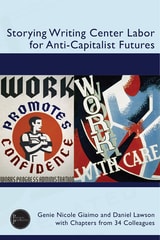
Storying Writing Center Labor for Anti-Capitalist Futures
Genie Nicole Giaimo
University Press of Colorado, 2025

Storying the Self
Performance and CommunitiesJess Moriarty and Ross Adamson
Intellect Books, 2023
Through a wide array of texts and methodologies, Storying the Self spotlights autoethnographic research—and pushes the discipline in new directions. This edited volume aims to explore critical and creative approaches to understanding the self in relation to vital social, cultural, and political spheres. Chapters touch on memory and nostalgia, voluntourism in Malawi, the importance of intersectionality, documentary filmmaking, epilepsy, and other experiences to examine the role of the self, as both researcher and storyteller.
Storying the Self features contributions by Ross Adamson, Suzy Bamblett, Emily Bell, Jenni Cresswell, Hannah Davita Ludikhuijze, Sandra Lyndon, Vanessa Marr, Éva Mikuska, Jess Moriarty, Deirdre Russell, Louise Spiers, Holly Stewart, and Lucianna Whittle. It is the first book in Intellect’s innovative new series Performance and Communities, which celebrates, challenges, and researches performance in the real world.
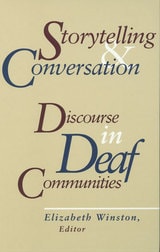
Storytelling and Conversation
Discourse in Deaf CommunitiesElizabeth A. Winston
Gallaudet University Press, 1999
In this intriguing book, renowned sociolinguistics experts explore the importance of discourse analysis, a process that examines patterns of language to understand how users build cooperative understanding in dialogues. It presents discourse analyses of sign languages native to Bali, Italy, England, and the United States.
Studies of internal context review the use of space in ASL to discuss space, how space in BSL is used to “package” complex narrative tasks, how signers choose linguistic tools to structure storytelling, and how affect, emphasis, and comment are added in text telephone conversations. Inquiries into external contexts observe the integration of deaf people and sign language into language communities in Bali, and the language mixing that occurs between deaf parents and their hearing children.
Both external and internal contexts are viewed together, first in an examination of applying internal ASL text styles to teaching written English to Deaf students and then in a consideration of the language choices of interpreters who must shift footing to manage the “interpreter’s paradox.” Storytelling and Conversation casts new light on discourse analysis, which will make it a welcome addition to the sociolinguistics canon.
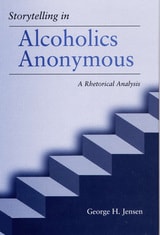
Storytelling in Alcoholics Anonymous
A Rhetorical AnalysisGeorge H. Jensen
Southern Illinois University Press, 2000
Based on an ethnographic study spanning four years, George H. Jensen’s Storytelling in Alcoholics Anonymous: A Rhetorical Analysis calls upon Bakhtinian theory to analyze storytelling in AA.
Jensen introduces his study with an analysis of “Bill W.’s Story” as it appears in the first chapter of AA’s central text, Alcoholics Anonymous. Drawing on Walter Ong’s work on orality and literacy, he argues that “Bill W.’s Story” as it appears in print cannot fully capture the oral tradition of storytelling as it occurs in AA meetings.
In his first section, Jensen discusses storytelling as practiced by the Washingtonians, a temperance organization much like AA. He also discusses the influence of the Oxford Group’s (an international and interdenominational religious movement seeking to recapture the enthusiasm and dedication of first-century Christianity) spiritual program to the development of AA’s Twelve Steps. The remainder of the first section serves as an introduction of the culture of AA to outsiders.
In the second section, Jensen covers Bakhtin’s theory of the relationship between the author and the hero of a text, using Lillian Roth’s autobiographies as counterexamples of AA talks. He devotes an entire chapter in this section to explaining how AA meetings provide an example of what Bakhtin meant by carnival, a process through which humor, irony, and parody supply a mechanism for questioning commonly held beliefs. He shows how newcomers to AA move away from their egocentric personae as practicing alcoholics to adopt a new identity within AA. Drawing further on Bakhtin, he examines the autobiographical moments of AA talks, stressing that these moments never become fully autobiographical. AA talks, Jensen argues, are fragmented, yet achieve coherence through the interweaving of two important chronotopes. Finally, using Bakhtin’s discussion of heroes in autobiography, Jensen discusses the kinds of heroes one typically finds in AA talks.
Storytime Magic
400 Fingerplays, Flannelboards, and Other ActivitiesKathy MacMillan
American Library Association, 2009
Storytimes for Everyone!
Developing Young Children's Language and LiteracySaroj Nadkarni Ghoting
American Library Association, 2013
Storytimes for Two-Year-Olds
Judy American Library Association
American Library Association, 2007
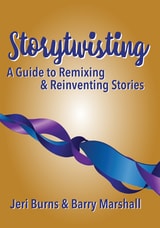
Storytwisting
A Guide to Remixing and Reinventing Traditional StoriesJeri Burns & Barry Marshall
Parkhurst Brothers, Inc., 2018
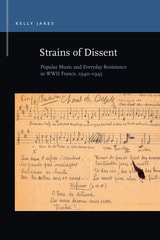
Strains of Dissent
Popular Music and Everyday Resistance in WWII France, 1940 - 1945Kelly Jakes
Michigan State University Press, 2019
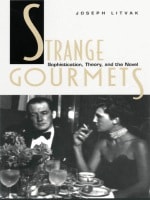
Strange Gourmets
Sophistication, Theory, and the NovelJoseph Litvak
Duke University Press, 1997
Though commonly thought of as a kind of worldliness at its best and an elitist snobbery at its worst, sophistication, Litvak reminds us, remains tied to its earlier, if forgotten, meaning of "perversion"—a perversion whose avatars are the homosexual and the intellectual. Proceeding with his investigations from a specifically gay academic perspective, Litvak presents thoroughly inventive readings of novels by Austen, Thackeray, and Proust, and of theoretical works by Adorno and Barthes, each text epitomizing sophistication in one of its more familiar modes. Among the issues he explores are the ways in which these texts teach sophistication, the embarrassment that sophistication causes the sophisticated, and how the class politics of sophistication are inseparable from its sexual politics. Helping gay, queer, feminist, and other provocative critics to make the most of their bad publicity, Litvak mindfully celebrates sophistication’s economy of taste and pleasure.
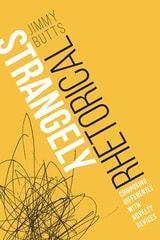
Strangely Rhetorical
Composing Differently With Novelty Devicesby Jimmy Butts
Utah State University Press, 2022
Using a new theoretical framework—that strangeness is inherent within all rhetorical interactions and is potentially useful—Butts demonstrates how rhetoric is always already coming from an Other, offering an ethical context for how defamiliarized texts work with different audiences. Applying examples of seven figures for composing in and across written, aural, visual, electronic, and spatial texts (the WAVES of media), Butts shows how divergence is possible in all sorts of refigured multimodal ways.
Strangely Rhetorical rethinks what exactly rhetoric is and does, considering the ways that strange compositions help rhetors connect across a broad range of networks in a world haunted by distance. This is a book about strange rhetoric for makers and creatives, for students and teachers, and for composers of all sorts.