Results by title
8113 books match the query 'Literary Criticism' and 542 start with s

Sexual Generations
Star Trek: The Next Generation and GenderRobin Roberts
University of Illinois Press, 1999
The incisive and innovative readings in Sexual Generations provide food for thought about how the final frontier can clarify pressing questions of our own space and time.
Sexual Hegemony
Statecraft, Sodomy, and Capital in the Rise of the World SystemChristopher Chitty
Duke University Press, 2020
Sexual Textualities
Essays on Queer/ing Latin American WritingBy David William Foster
University of Texas Press, 1997
Since the 1991 publication of his groundbreaking book Gay and Lesbian Themes in Latin American Writing, David William Foster has proposed a series of theoretical and critical principles for the analysis of Latin American culture from the perspectives of the queer. This book continues that project with a queer reading of literary and cultural aspects of Latin American texts.
Moving beyond its predecessor, which provided an initial inventory of Latin American gay and lesbian writing, Sexual Textualities analyzes questions of gender representation in Latin American cultural productions to establish the interrelationships, tensions, and irresolvable conflicts between heterosexism and homoeroticism. The topics that Foster addresses include Eva Peron as a cultural/sexual icon, feminine pornography, Luis Humberto Hermosillo's classic gay film Doña Herlinda y su hijo, homoerotic writing and Chicano authors, Matias Montes Huidobro's Exilio and the representation of gay identity, representation of the body in Alejandra Pizarnik's poetry, and the crisis of masculinity in Argentine fiction from 1940 to 1960.
Sexuality and Being in the Poststructuralist Universe of Clarice Lispector
The Différance of DesireBy Earl E. Fitz
University of Texas Press, 2001
Driven by an unfulfilled desire for the unattainable, ultimately indefinable Other, the protagonists of the novels and stories of acclaimed Brazilian writer Clarice Lispector exemplify and humanize many of the issues central to poststructuralist thought, from the nature of language, truth, and meaning to the unstable relationships between language, being, and reality. In this book, Earl Fitz demonstrates that, in turn, poststructuralism offers important and revealing insights into all aspects of Lispector's writing, including her style, sense of structure, characters, themes, and socio-political conscience.
Fitz draws on Lispector's entire oeuvre—novels, stories, crônicas, and children's literature—to argue that her writing consistently reflects the basic tenets of poststructuralist theory. He shows how Lispector's characters struggle over and humanize poststructuralist dilemmas and how their essential sense of being is deeply dependent on a shifting, and typically transgressive, sense of desire and sexuality.
Sexuality and Form
Caravaggio, Marlowe, and BaconGraham Hammill
University of Chicago Press, 2000
Sexuality, Disability, and Aging
Queer Temporalities of the PhallusJane Gallop
Duke University Press, 2019
Shadowed Dreams
Women's Poetry of the Harlem RenaissanceMcKay, Nellie
Rutgers University Press, 2006
The first edition of Shadowed Dreams was a groundbreaking anthology that brought to light the contributions of women poets to the Harlem Renaissance. This revised and expanded version contains twice the number of poems found in the original, many of them never before reprinted, and adds eighteen new voices to the collection to once again strike new ground in African American literary history. Also new to this edition are nine period illustrations and updated biographical introductions for each poet.
Shadowed Dreams features new poems by Gwendolyn Bennett, Anita Scott Coleman, Mae Cowdery, Blanche Taylor Dickinson, Alice Dunbar-Nelson, Jessie Fauset, Angelina Weld Grimké, Gladys Casely Hayford (a k a Aquah Laluah), Virginia Houston, Georgia Douglas Johnson, Helene Johnson, Effie Lee Newsome, Esther Popel, and Anne Spencer, as well as writings from newly discovered poets Carrie Williams Clifford, Edythe Mae Gordon, Alvira Hazzard, Gertrude Parthenia McBrown, Beatrice Murphy, Lucia Mae Pitts, Grace Vera Postles, Ida Rowland, and Lucy Mae Turner, among others.
Covering the years 1918 through 1939 and ranging across the period’s major and minor journals, as well as its anthologies and collections, Shadowed Dreams provides a treasure trove of poetry from which to mine deeply buried jewels of black female visions in the early twentieth century.
Shadows of the Enlightenment
Tragic Drama during Europe’s Age of ReasonEdited by Blair Hoxby
The Ohio State University Press, 2022
Shaggy Muses
The Dogs who Inspired Virginia Woolf, Emily Dickinson, Elizabeth Barrett Browning, Edith Wharton, and Emily BrontëMaureen Adams
University of Chicago Press, 2011
“You’ll call this sentimental—perhaps—but then a dog somehow represents the private side of life, the play side,” Virginia Woolf confessed to a friend. In this charming and engaging book, Maureen Adams celebrates this private, playful side telling readers about the relationships between five remarkable women writers and their dogs.
In Shaggy Muses, Adams explores the work and lives of these authors through the various roles played by their most devoted companions. Elizabeth Barrett Browning was rescued from a life of passivity and illness by Flush, a lively, possessive (and frequently dog-napped!) golden Cocker Spaniel. Emily Brontë’s fierce Mastiff mix, Keeper, provided a safe and loving outlet for the writer’s equally fierce spirit. Emily Dickinson found companionship with Carlo, the gentle, giant Newfoundland who soothed her emotional terrors. A troop of ever-faithful Pekingese warmed Edith Wharton’s lonely heart during her restless travels among Europe and America’s social and intellectual elite. And Virginia Woolf developed a deep attachment to Pinka, a black Cocker Spaniel who was both gift from her lover, Vita Sackville-West, and a link to her husband Leonard.
Based on diaries, letters, and other contemporary accounts—and featuring many illustrations of the writers and their dogs—these five miniature biographies allow unparalleled intimacy with women of genius in their hours of domestic ease and inner vulnerability.

Shaker Vision
Seeing Beauty in Early AmericaJoseph Manca
University of Massachusetts Press, 2019
In Shaker Vision, Joseph Manca explores original texts, especially diaries and travel journals, and material culture to demonstrate that Shakers enjoyed a remarkably deep experience of the visual world. Shakers shared tastes with mainstream Americans and often employed a similar aesthetic vocabulary, but all within a belief system that made them distinct. In addition to their well-known ascetic architecture, furniture, and handicraft styles, they expressed themselves through ornate and detailed spiritual art and in vivid, visionary experiences. Based on firsthand accounts of the believers themselves, this richly illustrated volume will dramatically change how we assess the visual world of this uniquely American religious sect.
Shakespeare Dwelling
Designs for the Theater of LifeJulia Reinhard Lupton
University of Chicago Press, 2018
Focusing on five works (Romeo and Juliet, Macbeth, Pericles, Cymbeline, and The Winter’s Tale), Lupton remakes the concept of dwelling by drawing on a variety of sources, including modern design theory, Renaissance treatises on husbandry and housekeeping, and the philosophies of Hannah Arendt and Martin Heidegger. The resulting synthesis not only offers a new entry point into the contemporary study of environments; it also shows how Shakespeare’s works help us continue to make sense of our primal creaturely need for shelter.
Shakespeare Only
Jeffrey Knapp
University of Chicago Press, 2009
Shakespeare and Baseball
Reflections of a Shakespeare Professor and Detroit Tigers FanSamuel Crowl
Ohio University Press, 2024
Shakespeare and Chekhov in Production and Reception
Theatrical Events and Their AudiencesTulloch, John
University of Iowa Press, 2005
With a focus on the canonical institutions of Shakespeare and Chekhov, John Tulloch brings together for the first time new concepts of “the theatrical event” with live audience analysis. Using mainstream theatre productions from across the globe that were highly successful according to both critics and audiences, this book of case studies—ethnographies of production and reception—offers a combined cultural and media studies approach to analyzing theatre history, production, and audience.
Tulloch positions these concepts and methodologies within a broader current theatrical debate between postmodernity and risk modernity. He also describes the continuing history of Shakespeare and Chekhov as a series of stories “currently and locally told” in the context of a blurring of academic genres that frames the two writers. Drawn from research conducted over nearly a decade in Australia, Britain, and the U.S., Shakespeare and Chekhov in Production and Reception will be of interest to students and scholars of theatre studies, media studies, and audience research.
Shakespeare and Contemporary Fiction
Theorizing Foundling and Lyric PlotsBarbara L. Estrin
University of Delaware Press, 2012
In the first book to use fiction as theory, Barbara L. Estrin reverses chronological direction, beginning with contemporary novels to arrive at a re-visioned Shakespeare, uncovering a telling difference in the stories that script us and that influence our political unconscious in ways that have never been explored in literary-critical interpretations. Describing the animus against foreign blood, central to the dynamic of the foundling and lyric plots that form the nexus of her study, Estrin describes how late modern writers change those plots. Reading backward through the theoretical lens of their revisions allows us to rethink the Shakespeare we thought we knew. That innovative methodology, in turn, encourages us to read forward again with different tellings, ones that challenge the mythological homogeneity of the traditional classifications and that suggest new formulaic paradigms.
With close readings of four contemporary novels and three Shakespeare plays, Estrin identifies the cultural walls that contribute to political gate-keeping as she chronicles the connection between plot variations and gender revisionism in the work of Caryl Phillips, Liz Jensen, Anne Michaels, and W.G. Sebald, as well as two film-makers (Mona Hatoum and Mieke Bal) who demonstrate an understanding that mythical repercussions prove dangerous in the twentieth and twenty-first centuries even as they suggest how the heritage shaping their work, and to which they are themselves drawn, in turn proposes an alternative Shakespeare, one who frees us to ask other questions: At the time that the nation state was beginning to coalesce, what does Shakespeare’s frequent use of the foundling plot and his significant variations portend? How does his infusion of a revised lyric dynamic in The Merchant of Venice, Othello and The Winter’s Tale change our reading of plays where the two plots coalesce as they do in the contemporary novels that shape Estrin’s late modern interpretations? All the works in this study share the underlying premise that the connection between cultural origins and political destinies is reciprocal and that it is necessary and possible to transform the constructs—in memory and imagination—that continue to shape our lives.
Published by University of Delaware Press. Distributed worldwide by Rutgers University Press.
Shakespeare and Interpretation, or What You Will
Brayton Polka
University of Delaware Press, 2011
Brayton Polka takes both a textual and theoretical approach to seven plays of Shakespeare: Macbeth, Othello, Twelfth Night, All’s Well That Ends Well, Julius Caesar, Troilus and Cressida, and Hamlet. He calls upon the Bible and the ideas of major European thinkers, above all, Kierkegaard and Spinoza, to argue that the concept of interpretation that underlies both Shakespeare’s plays and our own lives as moderns is the golden rule of the Bible: the command to love your neighbor as yourself. What you will (the alternative title of Twelfth Night ) thus captures the idea that interpretation is the very act by which we constitute our lives. For it is only in willing what others will—in loving relationships—that we enact a concept of interpretation that is adequate to our lives.
Polka argues that it is the aim of Shakespeare, when representing the ancient world in plays like Julius Caesar and Troilus and Cressida, and also in his long narrative poem “The Rape of Lucrece,” to dramatize the fundamental differences between ancient (pagan) values and modern (biblical) values or between what he articulates as contradiction and paradox. The ancients are fatally destroyed by the contradictions of their lives of which they remain ignorant. In contrast, we moderns in the biblical tradition, like those who figure in Shakespeare’s other works, are responsible for addressing and overcoming the contradictions of our lives through living the interpretive paradox of “what you will,” of treating all human beings as our neighbor. Shakespeare’s comedies and tragedies, notwithstanding their dramatically different form, share this interpretive framework of paradox. As the author shows in his book, texts without interpretation are blind and interpretation without texts is empty.
Published by University of Delaware Press. Distributed worldwide by Rutgers University Press.

Shakespeare and Trump
Jeffrey R. Wilson
Temple University Press, 2020
Should we draw an analogy between Shakespeare’s tyrants—Richard III, Julius Caesar, Macbeth, and King Lear—and Donald Trump? In Shakespeare and Trump, Jeffrey Wilson applies literary criticism to real life, examining plot, character, villainy, soliloquy, tragedy, myth, and metaphor to identify the formal features of the Trump phenomenon, and its hidden causes, structure, and meanings.
Wilsonapproaches his comparison prismatically. He first considers two high-concept (read: far-fetched) Shakespeare adaptations penned by Trump’s former chief political strategist Steve Bannon. He looks at University of Pennsylvania students protesting Trump by taking down a monument to Shakespeare. He reads Trump’s first 100 days in office against Netflix’s House of Cards. Wilson also addresses the summer 2017 Shakespeare in the Park production of Julius Caesar wherein an assassination of a Trump-ian leader caused corporations to withdraw sponsorship.
These stories reveal a surprising—and bizarre—relationship between the provincial English playwright and the billionaire President of the United States, ostensibly a medieval king living in a modern world. The comparison reveals a politics that blends villainy and comedy en route to tragedy.

Shakespeare and the Denial of Death
James Calderwood
University of Massachusetts Press, 1987
Shakespeare and the French Poet
Yves Bonnefoy
University of Chicago Press, 2004
Translated specifically for an American readership, Shakespeare and the French Poet also features a new interview with Bonnefoy. For Shakespeare scholars, Bonnefoy enthusiasts, and students of literary translation, Shakespeare and the French Poet is a celebration of the global language of poetry and the art of "making someone else's voice live again in one's own."
Shakespeare and the Idea of Western Civilization
R.V. Young
Catholic University of America Press, 2022
Shakespeare and the Law
A Conversation among Disciplines and ProfessionsEdited by Bradin Cormack, Martha C. Nussbaum, and Richard Strier
University of Chicago Press, 2013
The book’s opening essays offer perspectives on law and literature that emphasize both the continuities and contrasts between the two fields. The second section considers Shakespeare’s awareness of common law thinking and common law practice, while the third inquires into Shakespeare’s general attitudes toward legal systems. The fourth part of the book looks at how law enters into conversation with issues of politics and community, whether in the plays, in Shakespeare’s world, or in our own world. Finally, a colloquy among Supreme Court Justice Stephen Breyer, Judge Richard Posner, Martha C. Nussbaum, and Richard Strier covers everything from the ghost in Hamlet to the nature of judicial discretion.
Shakespeare and the Legacy of Loss
Emily Hodgson Anderson
University of Michigan Press, 2018
How do we recapture, or hold on to, the live performances we most love, and the talented artists and performers we most revere? Shakespeare and the Legacy of Loss tells the story of how 18th-century actors, novelists, and artists, key among them David Garrick, struggled with these questions through their reenactments of Shakespearean plays. For these artists, the resurgence of Shakespeare, a playwright whose works just decades earlier had nearly been erased, represented their own chance for eternal life. Despite the ephemeral nature of performance, Garrick and company would find a way to make Shakespeare, and through him the actor, rise again.
In chapters featuring Othello, Richard III, Hamlet, The Winter’s Tale, and The Merchant of Venice, Emily Hodgson Anderson illuminates how Garrick’s performances of Shakespeare came to offer his contemporaries an alternative and even an antidote to the commemoration associated with the monument, the portrait, and the printed text. The first account to read 18th-century visual and textual references to Shakespeare alongside the performance history of his plays, this innovative study sheds new light on how we experience performance, and why we gravitate toward an art, and artists, we know will disappear.
Shakespeare and the Nature of Love
Literature, Culture, EvolutionMarcus Nordlund
Northwestern University Press, 2007
After addressing critical issues about love, biology, and culture raised by his method, Nordlund considers four specific forms of love in seven of Shakespeare’s plays. Examining the vicissitudes of parental love in Titus Andronicus and Coriolanus, he argues that Shakespeare makes a sustained inquiry into the impact of culture and society upon the natural human affections. King Lear offers insight into the conflicted relationship between love and duty. In two problem plays about romantic love, Troilus and Cressida and All’s Well that Ends Well, the tension between individual idiosyncrasies and social consensus becomes especially salient. And finally, in Othello and The Winter’s Tale, Nordlund asks what Shakespeare can tell us about the dark avatar of jealousy.
Shakespeare and the Senses
Holly E. Dugan
Arizona Center for Medieval and Renaissance Studies, 2024
Could something as seemingly natural as a smell, taste, sight, or sound be socially constructed and change over time? Shakespeare and the Senses argues that understanding the original conditions in which Shakespeare’s plays were performed allows us to explore the senses as both visceral, bodily experiences and constructed, social phenomena. As Ben Jonson famously wrote in the First Folio of 1623, Shakespeare can seem to be “not of an age, but for all time.” While this is clever marketing, Shakespeare did write his plays in a particular time and place far removed from our own. Many of his most powerful metaphors rely on sensory details—Aaron’s black hue; Cleopatra’s strange, invisible perfumes; Fluellen’s Welsh accent; Lady Macbeth’s overly scrubbed hands; Malvolio’s yellow stockings—which Elizabethan-era audiences may have understood very differently from us.
Shakespeare and the Senses draws on interdisciplinary research methods in the new field of sensory studies to expand our understanding of what Shakespeare meant to his first audiences.
Shakespeare from the Margins
Language, Culture, ContextPatricia Parker
University of Chicago Press, 1996
Combining feminist and historical approaches with attention to the "matter" of language as well as of race and gender, Parker's brilliant "edification from the margins" illuminates much that has been overlooked, both in Shakespeare and in early modern culture. This book, a reexamination of popular and less familiar texts, will be indispensable to all students of Shakespeare and the early modern period.
Shakespeare in Theory
The Postmodern Academy and the Early Modern TheaterStephen Bretzius
University of Michigan Press, 1997
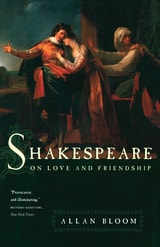
Shakespeare on Love and Friendship
Allan Bloom
University of Chicago Press, 2000
This volume includes essays on five plays, Romeo and Juliet, Anthony and Cleopatra, Measure for Measure, Troilus and Cressida, and The Winter's Tale, and within these Bloom meditates on Shakespeare's work as a whole. He also draws on his formidable knowledge of Plato, Rousseau, and others to bring both ancients and moderns into the conversation. The result is a truly synoptic treatment of eros—not only a philosophical reflection on Shakespeare, but a survey of the human spirit and its tendency to seek what Bloom calls the "connectedness" of love and friendship.
These highly original interpretations of the plays convey a deep respect for their author and a deep conviction that we still have much to learn from him. In Bloom's view, we live in a love-impoverished age; he asks us to turn once more to Shakespeare because the playwright gives us a rich version of what is permanent in human nature without sharing our contemporary assumptions about erotic love.
"Provocative and illuminating." —Michiko Kakutani, New York Times
"A brilliant analysis of the erotic ugliness and the balancing erotic grace of The Winter's Tale . . . and Bloom makes more sense of [Measure for Measure] than anyone else I have read." —A. S. Byatt, Washington Post Book World
At his death in 1992, Allan Bloom was the John U. Nef Distinguished Service Professor in the Committee on Social Thought at the University of Chicago. He is the author of several books, including Shakespeare's Politics (with Harry V. Jaffa) and The Closing of the American Mind.
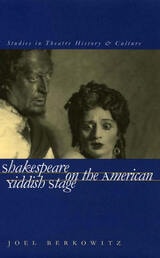
Shakespeare on the American Yiddish Stage
Joel Berkowitz
University of Iowa Press, 2002
The professional Yiddish theatre started in 1876 in Eastern Europe; with the assassination of Tsar Alexander II in 1881, masses of Eastern European Jews began moving westward, and New York—Manhattan’s Bowery and Second Avenue—soon became the world’s center of Yiddish theatre. At first the Yiddish repertoire revolved around comedies, operettas, and melodramas, but by the early 1890s America's Yiddish actors were wild about Shakespeare. In Shakespeare on the American Yiddish Stage, Joel Berkowitz knowledgeably and intelligently constructs the history of this unique theatrical culture.
The Jewish King Lear of 1892 was a sensation. The year 1893 saw the beginning of a bevy of Yiddish versions of Hamlet; that year also saw the first Yiddish production of Othello. Romeo and Juliet inspired a wide variety of treatments. The Merchant of Venice was the first Shakespeare play published in Yiddish, and Jacob Adler received rave reviews as Shylock on Broadway in both 1903 and 1905. Berkowitz focuses on these five plays in his five chapters. His introduction provides an orientation to the Yiddish theatre district in New York as well as the larger picture of Shakespearean production and the American theatre scene, and his conclusion summarizes the significance of Shakespeare’s plays in Yiddish culture.
Shakespeare the Actor and the Purposes of Playing
Meredith Anne Skura
University of Chicago Press, 1993
Despite the obvious differences between our theater and Shakespeare's, sixteenth-century testimony suggests that the experience of acting has not changed much over the centuries. Beginning with a psychoanalytically informed account of acting today, Skura shows how this intense and ambivalent experience appears not only in literal references to acting in Shakespearean drama but also in recurring narrative concerns, details of language, and dramatic strategies used to engage the audience. Looking at the plays in the context of both public and private worlds outside the theater, Skura rereads the canon to identify new configurations in the plays and new ways of understanding theatrical self-consciousness in Renaissance England. Rich in theatrical, psychoanalytic, biographical, and historical insight, this book will be invaluable to students of Shakespeare and instructive to all readers interested in the dynamics of performance.
Shakespeare without Boundaries
Essays in Honor of Dieter MehlChrista Jansohn
University of Delaware Press, 2011
Shakespeare without Boundaries: Essays in Honor of Dieter Mehl offers a wide-ranging collection of essays written by an international team of distinguished scholars who attempt to define, to challenge, and to erode boundaries that currently inhibit understanding of Shakespeare, and to exemplify how approaches that defy traditional bounds of study and criticism may enhance understanding and enjoyment of a dramatist who acknowledged no boundaries in art.
The Volume is published in tribute to Professor Dieter Mehl, whose critical and scholarly work on authors from Chaucer through Shakespeare to D. H. Lawrence has transcended temporal and national boundaries in its range and scope, and who, as Ann Jennalie Cook writes, has contributed significantly to the erasure of political boundaries that have endangered the unity of German literary scholarship and, more broadly, through his work for the International Shakespeare Association, to the globalization of Shakespeare studies.
Published by University of Delaware Press. Distributed worldwide by Rutgers University Press.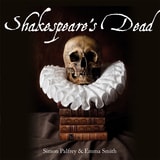
Shakespeare's Dead
Stages of Death in Shakespeare's PlayworldsSimon Palfrey and Emma Smith
Bodleian Library Publishing, 2016
Published to accompany a major exhibition at the Bodleian Library, University of Oxford, Shakespeare’s Dead documents the many ways Shakespeare’s characters meet their demise, from suicide to murder, from death by workaday dagger to the more creative method of being baked and fed to one’s family in a meat pie. Through these examples, Simon Palfrey and Emma Smith show Shakespeare’s mastery at choreographing death as a means of rediscovery. Some characters refuse to go quietly, dying in stages, as in Nick Bottom’s performance as Pyramus killing himself with much flourish in A Midsummer Night’s Dream. Others are remembered in elegies, and still others are resurrected or reappear as ghosts. Shakespeare’s death scenes also often speak to the boundaries between theater and everyday life, with funerals and scenes of mourning that are undercut by their staged inauthenticity.
Extensively illustrated with contemporary drawings and images from stage history, Shakespeare’s Dead takes readers through the playwright’s great death scenes and tragic figures, exploring in them the theme of life in death and delineating the cultural, religious, and social contexts.
Shakespeare's Folktale Sources
Charlotte Artese
University of Delaware Press, 2015
Published by University of Delaware Press. Distributed worldwide by Rutgers University Press.
Shakespeare's Freedom
Stephen Greenblatt
University of Chicago Press, 2010
Shakespeare lived in a world of absolutes—of claims for the absolute authority of scripture, monarch, and God, and the authority of fathers over wives and children, the old over the young, and the gentle over the baseborn. With the elegance and verve for which he is well known, Stephen Greenblatt, author of the best-selling Will in the World, shows that Shakespeare was strikingly averse to such absolutes and constantly probed the possibility of freedom from them. Again and again, Shakespeare confounds the designs and pretensions of kings, generals, and churchmen. His aversion to absolutes even leads him to probe the exalted and seemingly limitless passions of his lovers.
Greenblatt explores this rich theme by addressing four of Shakespeare’s preoccupations across all the genres in which he worked. He first considers the idea of beauty in Shakespeare’s works, specifically his challenge to the cult of featureless perfection and his interest in distinguishing marks. He then turns to Shakespeare’s interest in murderous hatred, most famously embodied in Shylock but seen also in the character Bernardine in Measure for Measure. Next Greenblatt considers the idea of Shakespearean authority—that is, Shakespeare’s deep sense of the ethical ambiguity of power, including his own. Ultimately, Greenblatt takes up Shakespearean autonomy, in particular the freedom of artists, guided by distinctive forms of perception, to live by their own laws and to claim that their creations are singularly unconstrained.
A book that could only have been written by Stephen Greenblatt, Shakespeare’s Freedom is a wholly original and eloquent meditation by the most acclaimed and influential Shakespearean of our time.
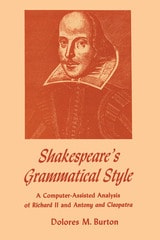
Shakespeare's Grammatical Style
A Computer-assisted Analysis of Richard II and Anthony and CleopatraBy Dolores M. Burton
University of Texas Press, 1973
Shakespeare’s Grammatical Style is the first full-scale, systematic study using an examination of Shakespeare’s syntax as a key to the interpretation of his work.
Dolores M. Burton presents information on the application of linguistic and statistical techniques to the description and analysis of style, and she has applied the insights and techniques of the major schools of linguistic inquiry, including those of London and Prague.
Just as studies of imagery and vocabulary have aided interpretations of the plays, so an examination of the grammatical features of Shakespeare’s language indicates that they, too, perform a poetic and dramatic function. For example, noun modifiers like possessives and definite articles yield insights into a speaker’s point of view or subtly aid in defining the fictional world of the plays. With respect to stylistic development, Shakespeare’s handling of word order moved from a concentration of dislocated sentences and clause constituents to greater emphasis on varied and frequent permutations in nominal and verbal phrases.
A computer-generated concordance of function words facilitated the study of syntactic features, which included an examination of formal aspects of diction, nominal group structure, the function and frequency of relative clauses, and the classification of sentences by mood and type. Several problems associated with quantitative and linguistic studies of a full-length literary work are discussed and exemplified.
Style itself is defined mathematically as a propositional function S(A), and from this definition stylistic parameters are derived by correlating critical notions like fictional world, point of view, and characterization with differences in the syntax of the two plays.
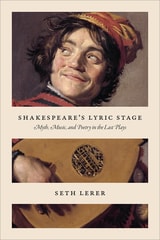
Shakespeare's Lyric Stage
Myth, Music, and Poetry in the Last PlaysSeth Lerer
University of Chicago Press, 2018
As Seth Lerer shows in this pioneering book, Shakespeare’s late plays invite us to contemplate that very question, offering up lyric as a displaced and sometimes desperate antidote to situations of duress or powerlessness. Lerer argues that the theme of lyric misalignment running throughout The Tempest, The Winter’s Tale, Henry VIII, and Cymbeline serves a political purpose, a last-ditch effort at transformation for characters and audiences who had lived through witch-hunting, plague, regime change, political conspiracies, and public executions.
A deep dive into the relationship between aesthetics and politics, this book also explores what Shakespearean lyric is able to recuperate for these “victims of history” by virtue of its disjointed utterances. To this end, Lerer establishes the concept of mythic lyricism: an estranging use of songs and poetry that functions to recreate the past as present, to empower the mythic dead, and to restore a bit of magic to the commonplaces and commodities of Jacobean England. Reading against the devotion to form and prosody common in Shakespeare scholarship, Lerer’s account of lyric utterance’s vexed role in his late works offers new ways to understand generational distance and cultural change throughout the playwright’s oeuvre.
Shakespeare's Noise
Kenneth Gross
University of Chicago Press, 2001
Kenneth Gross explores Shakespeare's deep fascination with dangerous and disorderly forms of speaking—especially rumor, slander, insult, vituperation, and curse—and through them offers a vision of the work of words in his plays. Coriolanus's taunts or Lear's curses force us to think not just about how Shakespeare's characters speak, but also about how they hear, overhear, and mishear what is spoken, how rumor becomes tragic knowledge for Hamlet, or opens Othello to fantastic jealousies. Gross also shows how Shakespeare's preoccupation with "noisy" speech echoed and transformed a broader cultural obsession with the perils of rumor, slander, and libel in Renaissance England.
Elegantly written and passionately argued, Shakespeare's Noise will challenge and delight anyone who loves his plays, from scholars to general readers, actors, and directors.
Shakespeare's Once and Future Child
Speculations on SovereigntyJoseph Campana
University of Chicago Press, 2024
Politicians are fond of saying that “children are the future.” How did the child become a figure for our political hopes? Joseph Campana’s book locates the source of this idea in transformations of childhood and political sovereignty during the age of Shakespeare, changes spectacularly dramatized by the playwright himself. Shakespeare’s works feature far more child figures—and more politically entangled children—than other literary or theatrical works of the era. Campana delves into this rich corpus to show how children and childhood expose assumptions about the shape of an ideal polity, the nature of citizenship, the growing importance of population and demographics, and the question of what is or is not human. As our ability to imagine viable futures on our planet feels ever more limited, and as children take up legal proceedings to sue on behalf of the future, it behooves us to understand the way past child figures haunt our conversations about intergenerational justice. Shakespeare offers critical precedents for questions we still struggle to answer.
Shakespeare's Politics
Allan Bloom
University of Chicago Press, 1981
In essays looking at Julius Caesar, Othello, and The Merchant of Venice, Bloom shows how Shakespeare presents a picture of man that does not assume privileged access for only literary criticism. With this claim, he argues that political philosophy offers a comprehensive framework within which the problems of the Shakespearean heroes can be viewed. In short, he argues that Shakespeare was an eminently political author. Also included is an essay by Harry V. Jaffa on the limits of politics in King Lear.
"A very good book indeed . . . one which can be recommended to all who are interested in Shakespeare." —G. P. V. Akrigg
"This series of essays reminded me of the scope and depth of Shakespeare's original vision. One is left with the impression that Shakespeare really had figured out the answers to some important questions many of us no longer even know to ask."-Peter A. Thiel, CEO, PayPal, Wall Street Journal
Allan Bloom was the John U. Nef Distinguished Service Professor on the Committee on Social Thought and the co-director of the John M. Olin Center for Inquiry into the Theory and Practice of Democracy at the University of Chicago. Harry V. Jaffa is professor emeritus at Claremont McKenna College and Claremont Graduate School.
Shakespeare's Reformation
Christian Humanism and the Death of GodNalin Ranasinghe
St. Augustine's Press, 2022
"I will try to claim that Shakespeare offers an esoteric vindication of the human soul itself, not merely poetry, against the looming backdrop of the Counter-Reformation in Europe and the Puritan perversion of English Anglicanism. Neither the Scholasticism of the former nor the fundamentalism of the latter had any sympathy for the claims of men like Bottom or the Bastard to see beyond the confines of scripture and sacred social structures. While poetry could indulge in metaphysical fantasy, it could not take on the status quo without the assistance of more learned allies; this Shakespeare seems to do by his re-telling of Classical and English history. As disingenuous as Bottom (or Erasmus) in this artful use of ignorance and folly to conceal his serious goals, Shakespeare is thus tying poetry to history and giving us an alternate, if playful, account of Western Civilization."
Shakespeare's Reparative Comedies
A Psychoanalytic View of the Middle AgesJoseph Westlund
University of Chicago Press, 1984
Shakespeare's Roman Trilogy
The Twilight of the Ancient WorldPaul A. Cantor
University of Chicago Press, 2017
Cantor analyzes the way Shakespeare chronicles the rise and fall of the Roman Republic and the emergence of the Roman Empire. The transformation of the ancient city into a cosmopolitan empire marks the end of the era of civic virtue in antiquity, but it also opens up new spiritual possibilities that Shakespeare correlates with the rise of Christianity and thus the first stirrings of the medieval and the modern worlds.
More broadly, Cantor places Shakespeare’s plays in a long tradition of philosophical speculation about Rome, with special emphasis on Machiavelli and Nietzsche, two thinkers who provide important clues on how to read Shakespeare’s works. In a pathbreaking chapter, he undertakes the first systematic comparison of Shakespeare and Nietzsche on Rome, exploring their central point of contention: Did Christianity corrupt the Roman Empire or was the corruption of the Empire the precondition of the rise of Christianity? Bringing Shakespeare into dialogue with other major thinkers about Rome, Shakespeare’s Roman Trilogy reveals the true profundity of the Roman Plays.
Shakespeare's Rome
Republic and EmpirePaul A. Cantor
University of Chicago Press, 2017
In Shakespeare’s Rome, Cantor examines the political settings of Shakespeare’s Roman plays, Coriolanus and Antony and Cleopatra, with references as well to Julius Caesar. Cantor shows that Shakespeare presents a convincing portrait of Rome in different eras of its history, contrasting the austere republic of Coriolanus, with its narrow horizons and martial virtues, and the cosmopolitan empire of Antony and Cleopatra, with its “immortal longings” and sophistication bordering on decadence.
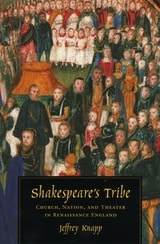
Shakespeare's Tribe
Church, Nation, and Theater in Renaissance EnglandJeffrey Knapp
University of Chicago Press, 2004
To be sure, Renaissance playwrights rarely sermonized in their plays, which seemed preoccupied with sex, violence, and crime. During a time when acting was regarded as a kind of vice, many theater professionals used their apparent godlessness to advantage, claiming that it enabled them to save wayward souls the church could not otherwise reach. The stage, they argued, made possible an ecumenical ministry, which would help transform Reformation England into a more inclusive Christian society.
Drawing on a variety of little-known as well as celebrated plays, along with a host of other documents from the English Renaissance, Shakespeare's Tribe changes the way we think about Shakespeare and the culture that produced him.
Winner of the Best Book in Literature and Language from the Association of American Publishers' Professional/Scholarly division, the Conference on Christianity and Literature Book Award, and the Roland H. Bainton Prize for Literature from the Sixteenth Century Society and Conference.
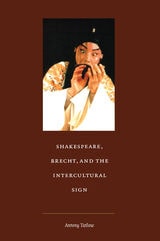
Shakespeare, Brecht, and the Intercultural Sign
Antony Tatlow
Duke University Press, 2001
Reflecting on how, why, and to what effect knowledges and styles of performance pollinate across cultures, Tatlow demonstrates that the employment of one culture’s material in the context of another defamiliarizes the conventions of representation in an act that facilitates access to what previously had been culturally repressed. By reading the intercultural, Tatlow shows, we are able not only to historicize the effects of those repressions that create a social unconscious but also gain access to what might otherwise have remained invisible.
This remarkable study will interest students of cultural interaction and aesthetics, as well as readers interested in theater, Shakespeare, Brecht, China, and Japan.
Shakespearean Cultures
Latin America and the Challenges of Mimesis in Non-Hegemonic CircumstancesJoão Cezar de Castro Rocha
Michigan State University Press, 2019
Shakespearean Educations
Power, Citizenship, and PerformanceCoppélia Kahn
University of Delaware Press, 2011
Published by University of Delaware Press. Distributed worldwide by Rutgers University Press.

Shakespearean Metadrama
The Argument of the Play in Titus Andronicus, Love’s Labour’s Lost, Romeo and Juliet, A Midsummer Night’s Dream, and Richard IIJames L. Calderwood
University of Minnesota Press, 1971
Shakespearean Metadrama was first published in 1971. Minnesota Archive Editions uses digital technology to make long-unavailable books once again accessible, and are published unaltered from the original University of Minnesota Press editions.
In a new approach to Shakespeare criticism, the author interprets five of Shakespeare's early plays as metadramas, dramas that are not only about the various moral, social, political, and other thematic issues with which critics have so long been concerned but also about the plays themselves. Professor Calderwood demonstrates that in these five plays Shakespeare writes about his dramatic art -- its nature, its media of language and theater, its generic forms and conventions, its relationship to truth and the social order.
In an introductory chapter the author explains his theory of metadrama, placing it in a general critical context as well as in the specific framework of Shakespeare's plays. He distinguishes between the meaning of metadrama and the similar terms "metaplay" and "metatheare." He points out that the dominant metadramatic aspect of the five plays under study is the interplay of language and action in drama. A separate chapter is devoted to the interpretation of each of the plays.
Professor Calderwood is aware that in presenting his critical theory and interpretations he may be met with skepticism by other scholars and critics. He anticipates such a situation in the introduction: "To the critic trying on introductory styles for a book on Shakespearean metadrama," he writes, "the plight of Falstaff at the Boar's Head Tavern comes all to readily to mind. 'What trick," he must ask himself, 'what device, what starting-hole, canst thou now find out to hide thee from this open and apparent shame?'"
Shakespearean Pragmatism
Market of His TimeLars Engle
University of Chicago Press, 1993
To Engle, the problems of worth, price, and value that appear so frequently in Shakespeare's works reveal a playwright dramatizing the negotiable nature of perception and belief—in short, the nature of his audience's purchase on reality. This innovative argument is the first to view Shakespeare in the context of contemporary pragmatism and to show that Shakespeare in many ways anticipated pragmatism as it has been developed in the thought of Richard Rorty, Barbara Herrnstein Smith, and others. With detailed reference to the sonnets and plays, Engle explores Shakespeare's tendency to treat knowledge, truth, and certainty as relatively stable goods within a theatrical economy of social interaction. He shows the playwright recasting kingship, aristocracy, and poetic immortality in pragmatic terms.
As attentive to history as it is to contemporary theory, this book mediates between current and traditional accounts of Shakespeare. In doing so, it offers a sweeping new account of Shakespeare's enterprise that will interest philosophers, literary theorists, and Shakespeare scholars alike.
Shakespearean Territories
Stuart Elden
University of Chicago Press, 2018
Shakespeare’s Hand
Jonathan Goldberg
University of Minnesota Press, 2002
A provocative exploration of the relationship between gender, history, and Shakespeare’s plays.
Over the past fifteen years, Jonathan Goldberg’s wide-ranging essays have been among the most sophisticated, influential, and controversial writing about Shakespeare. He challenges the critical orthodoxy, provoking scholars to reassess both their own assumptions and those underpinning the field of Shakespeare studies. Collected in one volume for the first time, these essays offer a sustained, energetic, and rigorous examination of issues of gender and sexuality that pervade Shakespeare’s plays, as well as a road map of the shifts during the past two decades in our understanding of English literature’s most canonical figure.
Central to these essays are concerns about textuality as considered from a number of vantage points, including deconstructionist, psychoanalytic, and historicist. Goldberg studies most of Shakespeare’s plays, giving particular emphasis to Henry IV, Parts 1 and 2, and to Romeo and Juliet; he focuses throughout on the relationship between the text as material object and the reality created or reflected by that text. Among the issues he considers are the textual instability of Shakespeare’s plays and the historical instabilities of gender and sexuality depicted in those plays, the construction of gender and the dehumanization implicit in treating characters as a textual production, the function of letters and other documents within the Shakespearean texts, and the correlation of sexual politics and textual desire. Tracing a path from characters in the scriptive sense to their embodiment in characters marked by gender and sexuality, Shakespeare's Hand provides a brilliant set of inquiries into the production, critical reception, and conditions of Shakespearean texts.