Results by title
5550 books match the query 'Biography & Autobiography' and 348 start with s
Someone to Watch Over Me
The Life and Music of Ben WebsterFrank Büchmann-Møller
University of Michigan Press, 2010
Early in his career, Webster worked with many of the greatest orchestras of the time, including those led by Willie Bryant, Cab Calloway, Benny Carter, Fletcher Henderson, Andy Kirk, Bennie Moten, and Teddy Wilson. In 1940 Webster became Duke Ellington's first major tenor soloist, and during the next three years he played on many famous recordings, including "Cotton Tail."
Someone to Watch Over Me tells, for the first time, the complete story of Ben Webster's brilliant and troubled career. For this comprehensive study of Webster, author Frank Büchmann-Møller interviewed more than fifty people in the United States and Europe, and he includes numerous translated excerpts from European periodicals and newspapers, none previously available in English. In addition, the author studies every known Webster recording and film, including many private recordings from Webster's home collection not available to the public.
Exhaustively researched, this is a much needed and long overdue study of the life and music of one of jazz's most important artists.
Something I Said?
Innuendo and Out the OtherMichael Feldman
University of Wisconsin Press, 2004
What we have here is another mighty slim volume from Michael Feldman, best known (when known at all) for his public radio show "Whad'ya Know" (sic). Feldman, who spouts off about things he knows "not much" about weekly, here writes them down:
· how to get your own radio show and what you can do with it once you do
· paranoia
· marriage (or as Feldman likes to refer to it, "a long-term bad relationship")
· Hitler
· SUVs
· child-rearing (although it sounds like it's the author who is being reared)
· a number of short pieces on places he and his crew have visited for their "remote possibilities"
· more references to "gentiles" than absolutely necessary (seems to be an issue for Feldman, although he is tickled with the
notion that, to a Mormon, he is one)
· some attempts to misrepresent scientific or social research for humorous purposes
· many personal revelations that prove the examined life is not necessarily worth living either
· and pages and pages of fluff.
Mr. Feldman has not been compared, to our knowledge, to S. J. Perlman.
But here is some of what Michael Feldman says in Something I Said:
"The paranoid no longer is: paranoia has outlived its usefulness when everybody is out to get us."
"Take the phrase 'no problem': I can use it, although it is the very opposite of my two-word world view ('Nothing works')."
"Whatever latitude beauty may have in the eye of the beholder, funny is not readily apparent to all, and, who knows, they may be right. More importantly, they may be bigger."
Includes a music CD by Michael Feldman and John Sieger.
Something Incredibly Wonderful Happens
Frank Oppenheimer and His Astonishing ExploratoriumK. C. Cole
University of Chicago Press, 2012

Something Spectacular
My Great Lakes Salmon StoryHoward A. Tanner
Michigan State University Press, 2018
Something for Everyone
Memories of Lauerman Brothers Department StoreMichael Leanah
Wisconsin Historical Society Press, 2013
This book traces the history of the Lauerman enterprise and its importance to the community of Marinette and dozens of counties in northern Wisconsin and the UP. The author takes readers on a tour of the store’s most memorable and delightful features, from the plethora of merchandise offered to the record-listening booths to the famous frosted malt cones. Along the way we hear the recollections of dozens of former customers and employees whose memories form a unique tapestry of family, business, and community story. As it brings to life the people who worked and shopped at Lauermans, Something for Everyone will have readers fondly recalling their own favorite shopping destinations during the golden age of department stores.
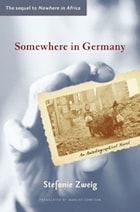
Somewhere in Germany
A NovelStefanie Zweig, Translated by Marlies Comjean
University of Wisconsin Press, 2006
In Frankfurt, Regina matures into a woman and, though her parents want her to marry an upstanding Jewish man, her love life progresses in its own idiosyncratic fashion. She develops a passion for art and journalism and begins her professional career at a Frankfurt newspaper. Walter at last finds professional success as a lawyer, but never quite adjusts to life in Frankfurt, recalling with nostalgia his childhood in Upper Silesia and his years in Africa. Only his son Max truly finds what Walter had hoped for: a new homeland in Germany.
Although the Redlichs receive kindness from strangers, they also learn anti-Semitism still prevails in post-Nazi Germany. They partake in the West German “economic miracle” with their own home, a second-hand car, and the discovery of television, but young Max’s discovery of the Holocaust revives long-buried memories. Rich in memorable moments and characters, this novel portrays the reality of postwar German society in vivid and candid detail.
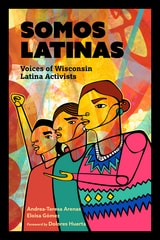
Somos Latinas
Voices of Wisconsin Latina ActivistsAndrea-Teresa Arenas
Wisconsin Historical Society Press, 2018
Celebrated Latina civil rights activist Dolores Huerta once said, “Every moment is an organizing opportunity, every person a potential activist, every minute a chance to change the world.” These are the stories of some of the Latina activists from Wisconsin who have lived Huerta’s words. Somos Latinas shares the powerful narratives of 25 activists—from outspoken demonstrators to collaborative community-builders to determined individuals working for change behind the scenes—providing proof of the long-standing legacy of Latina activism throughout Wisconsin.
Somos Latinas draws on activist interviews conducted as part of the Somos Latinas Digital History Project, housed at the Wisconsin Historical Society, and looks deep into the life and passion of each woman. Though Latinas have a rich history of community activism in the state and throughout the country, their stories often go uncelebrated. Somos Latinas is essential reading for scholars, historians, activists, and anyone curious about how everyday citizens can effect change in their communities.
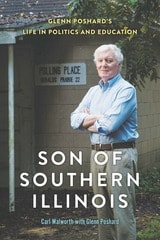
Son of Southern Illinois
Glenn Poshard’s Life in Politics and EducationCarl Walworth with Glenn Poshard
Southern Illinois University Press, 2023
A life of principles, service, and faith
This first biography of Glenn Poshard traces the life of a young man who rose from rural poverty in Southern Illinois to become a United States congressman and president of the Southern Illinois University system. This profound portrait unveils a life and career dedicated to making higher education affordable and improving the quality of life for the community of Southern Illinois.
Beginning with his childhood in a two-room home near Herald, Illinois and the early, tragic loss of his sister, this biography navigates Poshard’s service in the military, his time as a state senator and United States congressman, his run for governor, his years at Southern Illinois University, and the establishment of the Poshard Foundation for Abused Children. Intimacies of his personal life are disclosed, such as his struggles with and treatment for depression, his passion for education, and the lasting bonds he formed with his teachers. His unpopular decision to refuse PAC donations is also highlighted, along with the work that went into sponsoring the Illinois Wilderness Act, and his relationship with civil rights activist John Lewis. Glenn Poshard’s efforts for the Wilderness Act designated Southern Illinois’s famous Garden of the Gods as a National Wilderness Preservation System, which continues to attract visitors from around the world.
Poshard’s path from poverty was riddled with hardship, but his perseverance and family values ultimately allowed for longstanding personal and civic growth. From an admirable work ethic to a steadfast commitment to problem-solving, this biography illuminates the life and accomplishments of an impressive and generous leader.
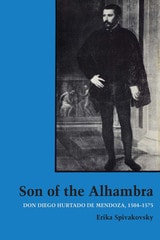
Son of the Alhambra
Don Diego Hurtado de Mendoza, 1504-1575By Erika Spivakovsky
University of Texas Press, 1970
Last of the Spanish Renaissance men, Diego Hurtado de Mendoza (1504–1575) was a master of the humanist disciplines as well as an active diplomat whose correspondence provides insight into the workings of power politics in the first post-Machiavellian decades.
This account of Mendoza's diplomatic career is a living commentary on the mid-sixteenth century, the time of the Spanish Inquisition and the Reformation, with its upheavals in the European balance of power. Mendoza served as ambassador of Charles V to Venice and Rome and as governor of Siena. His political life complements the reign of the Emperor whose ambition was to become a universal monarch.
An interesting contradiction in Mendoza's thought—his humanist theories versus personal ambition—prevented him from successful implemention of tyrannical imperial policies. His role in the government of the Holy Roman Empire shows how the exertion of imperialist power, humanist ethics notwithstanding, inevitably entails corruption, hypocrisy, greed, and imbalance in the one who tries to wield this power.
Gifted to the point of universal genius, Mendoza was perhaps the foremost representative of the splendid but little-known epoch of Spanish humanism, the era between the death of Queen Isabel (1504) and the abdication of her grandson Charles V (1556). Spain's short-lived Renaissance came to an abrupt end with the accession of Philip II and the almost simultaneous onset of the Counter Reformation. To this changed Spain, under monolithic thought control now exacted and enforced by monarch and Inquisition, Mendoza returned to live the last third of his life, mostly in obscurity, and in the last few years in royal disgrace.
Based on primary sources, this first biography of Mendoza in English also examines the relevance of some of Don Diego's disputed literary works to the legend that grew up around him as a spokesman for latent unorthodox opinion.
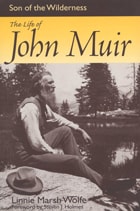
Son of the Wilderness
The Life of John MuirLinnie Marsh Wolfe
University of Wisconsin Press, 2003
Working closely with Muir’s family and with his papers, Wolfe was able to create a full portrait of her subject, not only as America’s firebrand conservationist and founder of the national park system, but also as husband, father, and friend. All readers who have admired Muir’s ruggedly individualistic lifestyle, and those who wish a greater appreciation for the history of environmental preservation in America, will be enthralled and enlightened by this splendid biography.
The story follows Muir from his ancestral home in Scotland, through his early years in the harsh Wisconsin wilderness, to his history-making pilgrimage to California.
This book, originally published in 1945 and based in large part on Wolfe’s personal interviews with people who knew and worked with Muir, is one that could never be written again. It is, and will remain, the standard Muir biography.

Song Noir
Tom Waits and the Spirit of Los AngelesAlex Harvey
Reaktion Books, 2022
Song Noir examines the formative first decade of Tom Waits’s career, when he lived, wrote, and recorded nine albums in Los Angeles: from his soft, folk-inflected debut, Closing Time in 1973, to the abrasive, surreal Swordfishtrombones in 1983. Starting his songwriting career in the seventies, Waits absorbed Los Angeles’s wealth of cultural influences. Combining the spoken idioms of writers like Kerouac and Bukowski with jazz-blues rhythms, he explored the city’s literary and film noir traditions to create hallucinatory dreamscapes. Waits mined a rich seam of the city’s low-life locations and characters, letting the place feed his dark imagination. Mixing the domestic with the mythic, Waits turned quotidian, autobiographical details into something more disturbing and emblematic, a vision of Los Angeles as the warped, narcotic heart of his nocturnal explorations.
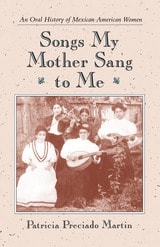
Songs My Mother Sang to Me
An Oral History of Mexican American WomenPatricia Preciado Martin
University of Arizona Press, 1992
Martin's quest took her to ranches, mining towns, and cities throughout southern Arizona, for she sought to document as varied an experience of the contributions of Mexican American women as possible. The interviews covered family history and genealogy, childhood memories, secular and religious traditions, education, work and leisure, environment and living conditions, rites of passage, and personal values. Each of the ten oral histories reflects not only the spontaneity of the interview and personality of each individual, but also the friendship that grew between Martin and her subjects.
Songs My Mother Sang to Me collects voices not often heard and brings to print accounts of social change never previously recorded. These women document more than the details of their own lives; in relating the histories of their ancestors and communities, they add to our knowledge of the culture and contributions of Mexican American people in the Southwest.
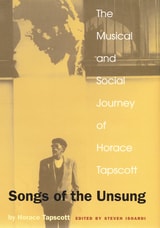
Songs of the Unsung
The Musical and Social Journey of Horace TapscottHorace Tapscott
Duke University Press, 2001
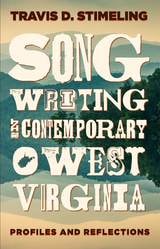
Songwriting in Contemporary West Virginia
Profiles and ReflectionsTravis D. Stimeling
West Virginia University Press, 2018
Stimeling is attentive to breadth and diversity, presenting sketches of established personalities like Larry Groce, who oversees Mountain Stage, and emerging musicians like Maria Allison, who dreams of one day performing there. Each profile includes a brief selected discography to guide readers to recordings of these musicians’ work.
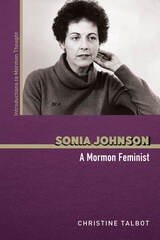
Sonia Johnson
A Mormon FeministChristine Talbot
University of Illinois Press, 2024
Few figures in the history of the Church of Jesus Christ of Latter-day Saints provoke such visceral responses as Sonia Johnson. Her unrelenting public support of the Equal Rights Amendment (ERA) made her the face of LDS feminism while her subsequent excommunication roiled the faith community.
Christine Talbot tells the story of Sonia’s historic confrontation with the Church within the context of the faith’s first large-scale engagement with the feminist movement. A typical if well-educated Latter-day Saints homemaker, Sonia was moved to action by the all-male LDS leadership’s opposition to the ERA and a belief the Church should stay out of politics. Talbot uses the activist’s experiences and criticisms to explore the ways Sonia’s ideas and situation sparked critical questions about LDS thought, culture, and belief. She also illuminates how Sonia’s excommunication shaped LDS feminism, the Church’s antagonism to feminist critiques, and the Church itself in the years to come.
A revealing and long-overdue account, Sonia Johnson explores the life, work, and impact of the LDS feminist.
Sonoran Strongman
Ignacio Pesqueira and His TimesRodolfo F. Acuña
University of Arizona Press, 1974
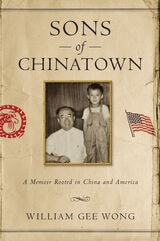
Sons of Chinatown
A Memoir Rooted in China and AmericaWilliam Gee Wong
Temple University Press, 2024
As Pop grappled with the systemic racism towards Asians during the exclusion era, Wong wistfully depicts Pop’s efforts to establish a family business and build a life for his family in segregated Oakland. As the exclusion law ended in 1943, young William was assimilating into American life and developing his path as a journalist. Writing for the Wall Street Journal, Oakland Tribune, and Asian American periodicals, Wong chronicled Asian American experiences while honoring Chinese American history and identity, but he too faced discrimination.
Sons of Chinatown poignantly weaves these father and son stories together with admiration and righteous anger. Through the mirrored lens of his father, Wong reflects on the hardships Asian Americans endured—and continue to face—with American exceptionalism. Wong’s inspiring memoir provides a personal history that also raises the question of whether America welcomes or repels immigrants.

Sophia Loren
Moulding the StarPauline Small
Intellect Books, 2009
In films from Houseboat to The Millionairess to Two Women, Sophia Loren established herself as an actress whose stardom spanned Italy, Europe, and finally Hollywood. Hers was a highly original rise to fame for a European film actress, and in Sophia Loren, Pauline Small highlights a unique career which transcended Italian film culture.
Sophia Loren is the first book to explore in detail the transfer of Loren’s stardom from Italy to Hollywood and the reasons for her American success, particularly during the 1960s. Looking individually at Loren’s major films and drawing on rare archival materials in Italy, Small provides a thorough exploration of the commercial and cultural forces that combined to ensure Loren’s enduring star status.
Perfect for scholars and aficionados of 1960s Italian and American film, Sophia Loren is a fascinating look at one of the major personalities of modern cinema.

Sophia Peabody Hawthorne
A Life, Volume 2, 1848-1871Patricia Dunlavy Valenti
University of Missouri Press, 2015
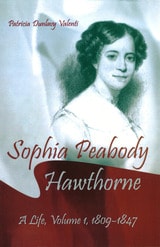
Sophia Peabody Hawthorne
A Life, Volume I, 1809-1847Patricia Dunlavy Valenti
University of Missouri Press, 2004
Sophia was born into an expansive, somewhat chaotic home in which women provided financial as well as emotional sustenance. She was a precocious, eager student whose rigorous education, in her mother’s and her sisters’ schools, began her association with the children of New England’s elite. Sophia aspired to become a professional, self-supporting painter, exhibiting her art and seeking criticism from established mentors. She relished an eighteen-month sojourn in Cuba. Nathaniel’s reclusive family, his reluctant early education, his anonymous pursuit of a career, and his relatively circumscribed life contrast markedly with the experience of the woman who became his wife and the mother of his children. Those differences resulted in a creative abrasion that ignited his fiction during the first years of their marriage.
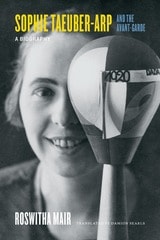
Sophie Taeuber-Arp and the Avant-Garde
A BiographyRoswitha Mair
University of Chicago Press, 2018
Now Roswitha Mair has brought us the first biography of this unique polymath, illuminating not just Tauber-Arp’s own life and work, but also the various milieux and movements in which she traveled. No fan of the Dadaists and their legacy will want to miss this first English-language translation.
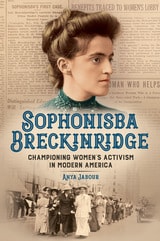
Sophonisba Breckinridge
Championing Women's Activism in Modern AmericaAnya Jabour
University of Illinois Press, 2019
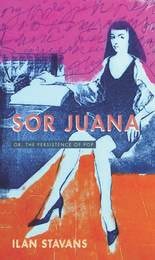
Sor Juana
Or, the Persistence of PopIlan Stavans
University of Arizona Press, 2018
Sor Juana: Or, the Persistence of Pop encapsulates the life, times, and legacy of Sor Juana. In this immersive work, essayist Ilan Stavans provides a biographical and meditative picture of the ways in which popular perceptions of her life and body of work both shape and reflect modern Latinx culture.
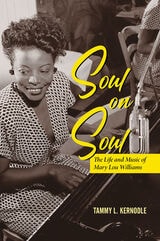
Soul on Soul
The Life and Music of Mary Lou WilliamsTammy L. Kernodle
University of Illinois Press, 2020
The jazz musician-composer-arranger Mary Lou Williams spent her sixty-year career working in—and stretching beyond—a dizzying range of musical styles. Her integration of classical music into her works helped expand jazz's compositional language. Her generosity made her a valued friend and mentor to the likes of Thelonious Monk, Charlie Parker, and Dizzy Gillespie. Her late-in-life flowering of faith saw her embrace a spiritual jazz oriented toward advancing the civil rights struggle and helping wounded souls.
Tammy L. Kernodle details Williams's life in music against the backdrop of controversies over women's place in jazz and bitter arguments over the music's evolution. Williams repeatedly asserted her artistic and personal independence to carve out a place despite widespread bafflement that a woman exhibited such genius. Embracing Williams's contradictions and complexities, Kernodle also explores a personal life troubled by lukewarm professional acceptance, loneliness, relentless poverty, bad business deals, and difficult marriages.
In-depth and epic in scope, Soul on Soul restores a pioneering African American woman to her rightful place in jazz history.
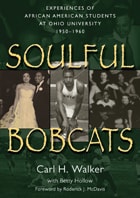
Soulful Bobcats
Experiences of African American Students at Ohio University, 1950–1960Carl H. Walker
Ohio University Press, 2013
During the 1950s, when less than 20 percent of American high school graduates attended college, a group of ambitious young African Americans enrolled at Ohio University, a predominantly white school in Athens, Ohio. Because they were a tiny, barely tolerated minority, they banded together, supported each other, and formed lasting bonds. Years later, at a series of “Soulful Reunions,” they recalled the joys and challenges of living on a white campus before the civil rights era, and eighteen of them decided to share their stories.
The authors of the eighteen autobiographical sketches in Soulful Bobcats were a diverse group. They were athletes, rhetoricians, musicians, and actresses; they aspired to professions in the military, business, education, government, architecture, and the arts. Some grew up in poor families, while others enjoyed the comforts of the middle class. But they had several things in common. They all came from families that believed education was important. They had been taught to avoid trouble, to persist despite setbacks, and to expect to encounter prejudice and even discrimination.
The authors vividly describe instances in which they were humiliated—by other students, by professors, or by townspeople—as well as the few occasions when violence seemed inevitable. In addition, they describe their “first,” including becoming the first African American students at Ohio University to be awarded scholarships for their prowess in football, basketball, track, and tennis; the first to compete for titles such as “Mr. Fraternity” or “Queen of the Military Ball”; the first to appear in theatrical performances alongside their white schoolmates. They also tell of their success in providing a social life for themselves by organizing two Greek letter fraternities and one sorority, holding their own off-campus dances, and joining the few campus organizations that were open to them. Above all, their stories speak to a resilience that allowed these “Soulful Bobcats” to learn from their experiences at Ohio University, to engage in meaningful careers, and to lead rich, fulfilling lives.
Soulside
Inquiries into Ghetto Culture and CommunityUlf Hannerz
University of Chicago Press, 2004
Originally published 35 years ago, Soulside became an urban anthropological classic. The book helped to dispel many false impressions about ghetto life and questioned the idea, precipitated in the influential Moynihan Report and in notions of a "culture of poverty," that the poor had chosen to lead the lives they do. Raising central moral and political questions about American society in a turbulent period, Soulside became an example of public engagement in anthropology. In a new afterword, Ulf Hannerz discusses the book's place in the debates of the time and its relevance to current arguments in anthropology.
Sounding for Cool
Donald Morrill
Michigan State University Press, 2002
Sounding for Cool is about self-transformation, about growing up on one’s own as a product of contemporary America, and about how to become not just a man, but a contributing adult in society. Donald Morrill presents the day-to-day lives of seven young men (white, black, Hispanic, immigrant, middle-class, thick-headed, poor, and smart), who for various reasons have become homeless. Placed in a Transitional Living Program facility (TLP) by the courts, these men must learn to navigate in the world of “normal” values and reasonable rules. Streetwise and callow, trained to seek shortcuts or to make excuses, they struggle with the structures and assumptions inherent in living a law-abiding, bill-paying life. While sorting out their souls, they learn how to connect with others.
In turn, Sounding for Cool scrutinizes the staff of the TLP, one woman and three men, who variously come to terms with their lives by settling accounts from the past. As a TLP volunteer, Donald Morrill often finds himself bridging the gap between staff and client. In the process of telling their stories, he chronicles his own journey to understand the past. Ultimately, Sounding for Cool asks the enduring questions, “Who am I in the world and what can I become?”

Soundless Roar
Stories, Poems, and DrawingsAva Kadishson Schieber
Northwestern University Press, 2002
Schieber's drawings, paintings, poetry, and prose are all intimate reflections of one another. Her experience forged the unusual sense of time that shapes Schieber's stories. In her preface, Phyllis Lassner writes: "The timetable of Ava's stories often consists of circles within circles, of patterns of an intertwined past, the past present of hiding, and the present looking back at those distinctly separate but inseparable pasts."
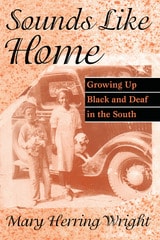
Sounds Like Home
Growing Up Black and Deaf in the SouthMary Herring Wright
Gallaudet University Press, 1999
New edition available: Sounds Like Home: Growing Up Black and Deaf in the South, 20th Anniversary Edition, ISBN 978-1-944838-58-4
Features a new introduction by scholars Joseph Hill and Carolyn McCaskill
Mary Herring Wright’s memoir adds an important dimension to the current literature in that it is a story by and about an African American deaf child. The author recounts her experiences growing up as a deaf person in Iron Mine, North Carolina, from the 1920s through the 1940s. Her story is unique and historically significant because it provides valuable descriptive information about the faculty and staff of the North Carolina school for Black deaf and blind students from the perspective of a student as well as a student teacher. In addition, this engrossing narrative contains details about the curriculum, which included a week-long Black History celebration where students learned about important Blacks such as Madame Walker, Paul Laurence Dunbar, and George Washington Carver. It also describes the physical facilities as well as the changes in those facilities over the years. In addition, Sounds Like Home occurs over a period of time that covers two major events in American history, the Depression and World War II.
Wright’s account is one of enduring faith, perseverance, and optimism. Her keen observations will serve as a source of inspiration for others who are challenged in their own ways by life’s obstacles.
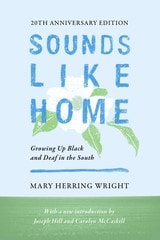
Sounds Like Home
Growing Up Black and Deaf in the SouthMary Herring Wright
Gallaudet University Press, 2019
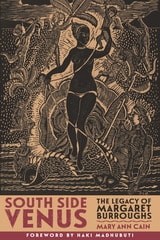
South Side Venus
The Legacy of Margaret BurroughsMary Ann Cain; Foreword by Haki Madhubuti
Northwestern University Press, 2018
As Mary Ann Cain's South Side Venus: The Legacy of Margaret Burroughs reveals, the primary motivations for these efforts were love and hope. Burroughs was spurred by her love for Chicago's African American community—largely ill served by mainstream arts organizations—and by her hope that these new, black-run cultural centers would welcome many generations of aspiring artists and art lovers.
This first, long–awaited biography of Burroughs draws on interviews with peers, colleagues, friends, and family, and extensive archival research at the DuSable Museum, the Art Institute of Chicago, and the Chicago Public Library. Cain traces Burroughs's multifaceted career, details her work and residency on Chicago's South Side, and highlights her relationships with other artists and culture makers. Here, we see Burroughs as teacher and mentor as well as institution builder.
Anchored by the author's talks with Burroughs as they stroll through her beloved Bronzeville, and featuring portraits of Burroughs with family and friends, South Side Venus will enlighten anyone interested in Chicago, African American history, social justice, and the arts.
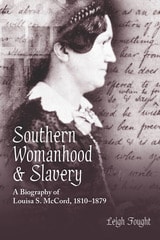
Southern Womanhood and Slavery
A Biography of Louisa S. McCord, 1810-1879Leigh Fought
University of Missouri Press, 2018
Southern Womanhood and Slavery is the first full-length biography of Louisa S. McCord, one of the most intriguing intellectuals in antebellum America. The daughter of South Carolina planter and politician Langdon Cheves, and an essayist in her own right, McCord supported unregulated free trade and the perpetuation of slavery and opposed the advancement of women’s rights. This study examines the origins of her ideas.
Leigh Fought constructs an exciting narrative that follows McCord from her childhood as the daughter of a state representative and president of the Bank of the United States through her efforts to accept her position as wife and mother, her career as an author and plantation mistress, and the Union invasion of South Carolina during the Civil War, to the end of her life in the emerging New South. Fought analyzes McCord’s poetry, letters, and essays in an effort to comprehend her acceptance of slavery and the submission of women. Fought concludes that McCord came to a defense of slavery through her experience with free labor in the North, which also reinforced her faith in the paternalist model for preserving social order.
McCord’s life as a writer on “unfeminine” subjects, her reputation as strong-minded and masculine, her late marriage, her continued ownership of her plantation after marriage, and her position as the matron of a Civil War hospital contradicted her own philosophy that women should remain the quiet force behind their husbands. She lived during a time of social flux in which free labor, slavery, and the role of women underwent dramatic changes, as well as a time that enabled her to discover and pursue her intellectual ambitions. Fought examines the conflict that resulted when those ambitions clashed with McCord’s role as a woman in the society of the South.
McCord’s voice was an interesting, articulate, and necessary feminine addition to antebellum white ideology. Moreover, her story demonstrates the ways in which southern women negotiated through patriarchy without surrendering their sense of self or disrupting the social order. Engaging and very readable, Southern Womanhood and Slavery will be of special interest to students of southern history and women’s studies, as well as to the general reader.
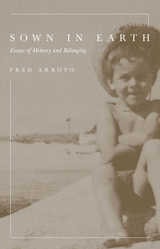
Sown in Earth
Essays of Memory and BelongingFred Arroyo
University of Arizona Press, 2020
In Sown in Earth, Arroyo often roots his thoughts and feelings in place, expressing a deep connection to the small homes he inhabited in his childhood, his warm and hazy memories of his grandmother’s kitchen in Puerto Rico, the rivers and creeks he fished, and the small cafés in Madrid that inspired writing and reflection in his adult years. Swirling in romantic moments and a refined love for literature, Arroyo creates a sense of belonging and appreciation for his life despite setbacks and complex anxieties along the way.
By crafting a written journey through childhood traumas, poverty, and the impact of alcoholism on families, Fred Arroyo clearly outlines how his lived experiences led him to become a writer. Sown in Earth is a shocking yet warm collage of memories that serves as more than a memoir or an autobiography. Rather, Arroyo recounts his youth through lyrical prose to humanize and immortalize the hushed lives of men like his father, honoring their struggle and claiming their impact on the writers and artists they raised.

Space Is the Place
The Lives and Times of Sun RaJohn Szwed
Duke University Press, 2020
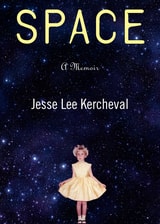
Space
A MemoirJesse Lee Kercheval
University of Wisconsin Press, 2014
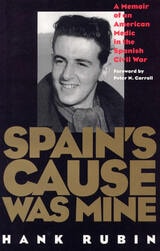
Spain's Cause was Mine
A Memoir of an American Medic in the Spanish WarHank Rubin
Southern Illinois University Press, 1999
“No man ever entered earth more honorably than those who died in Spain.”—Ernest Hemingway
In 1937, Hank Rubin, a twenty-year-old Jewish pre-med student at UCLA, volunteered for service in the International Brigades combating fascists in the Spanish Civil War. In his illustrated memoir, Rubin reflects on those events, making no apologies for his youthful impulsiveness, bravado, and ideology, but recalling the heroics and sufferings he witnessed and experienced in Spain, as well as the disappointing treatment he received upon his return.
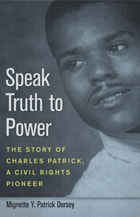
Speak Truth to Power
The Story of Charles Patrick, a Civil Rights PioneerMignette Y. Patrick Dorsey
University of Alabama Press, 2010
"Patrick did not intend to become a civil rights pioneer, but a minor dispute over a parking spot led to his arrest, beating while in custody, and eventual legal tribulations. His daughter's account of his ordeal is well researched, beautifully narrated, and extremely informative." —Journal of Southern History
On December 11, 1954, Charles Patrick drove to downtown Birmingham to buy a Boy Scout uniform for his son. Christmas traffic around the downtown department stores was heavy, and Patrick circled unsuccessfully until at last a streetside spot opened up and he began to pull in. As he did so, he was cut off by a woman who ordered him out of the way, as she was the wife of a city police officer. Patrick pulled away, remarking, "Ma’am, he doesn’t own the streets of Birmingham."
Normal low-level urban hassle? Not in 1954 Birmingham, when the woman was white and Patrick black. The woman reported to her husband that a black man had sassed her, and Patrick was summarily arrested, charged with disorderly conduct, and placed in a cell where he was beaten by the husband and another police officer.
Usually that would have been the end of it, but Patrick was not the sort of man to meekly endure an injustice. He found an attorney, went to court to fight the charges, and brought his assailants to justice--as whites, blacks, politicians and the press offered public support.
This book tells the story of Patrick’s quest for justice in segregated Alabama on the eve of the civil rights movement and represents a telling instance of the growing determination of African Americans to be treated fairly, part of the broadening and deepening stream of resolve that led to the widespread activism of the civil rights movement.
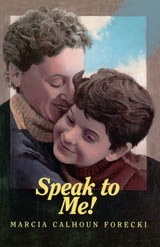
Speak to Me!
Marcia Forecki
Gallaudet University Press, 1985
Marcia Calhoun Forecki has written an engrossing, personal account of her life with Charlie, an adorable, active, deaf seven-year-old. Speak to Me! is the story of an ordinary hearing person confronted with an overwhelming reality—the fact that her son is deaf. Forecki’s struggle as a single parent to care for her child, to find the “right” schools, and to establish communication with her son will strike a familiar chord in all hearing parents of deaf children. All readers, parents or not, will be touched by the mixture of pathos and humor in this well-written account.
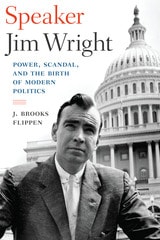
Speaker Jim Wright
Power, Scandal, and the Birth of Modern PoliticsBy J. Brooks Flippen
University of Texas Press, 2018
Honorable Mention, Ramirez Family Award for Most Significant Scholarly Book, Texas Institute of Letters, 2019
Jim Wright made his mark on virtually every major public policy issue in the later twentieth century—energy, education, taxes, transportation, environmental protection, civil rights, criminal justice, and foreign relations, among them. He played a significant role in peace initiatives in Central America and in the Camp David Accords, and he was the first American politician to speak live on Soviet television. A Democrat representing Texas’s twelfth district (Fort Worth), Wright served in the US House of Representatives from the Eisenhower administration to the presidency of George H. W. Bush, including twelve years (1977–1989) as majority leader and speaker. His long congressional ascension and sudden fall in a highly partisan ethics scandal spearheaded by Newt Gingrich mirrored the evolution of Congress as an institution.
Speaker Jim Wright traces the congressman’s long life and career in a highly readable narrative grounded in extensive interviews with Wright and access to his personal diaries. A skilled connector who bridged the conservative and liberal wings of the Democratic party while forging alliances with Republicans to pass legislation, Wright ultimately fell victim to a new era of political infighting, as well as to his own hubris and mistakes. J. Brooks Flippen shows how Wright’s career shaped the political culture of Congress, from its internal rules and power structure to its growing partisanship, even as those new dynamics eventually contributed to his political demise. To understand Jim Wright in all his complexity is to understand the story of modern American politics.
Speculating Daguerre
Art and Enterprise in the Work of L. J. M. DaguerreStephen C. Pinson
University of Chicago Press, 2012
Louis Jacques Mandé Daguerre (1787–1851) was a true nineteenth-century visionary—a painter, printmaker, set designer, entrepreneur, inventor, and pioneer of photography. Though he was widely celebrated beyond his own lifetime for his invention of the daguerreotype, it was his origins as a theatrical designer and purveyor of visual entertainment that paved the way for Daguerre’s emergence as one of the world’s most iconic imagemakers.
In Speculating Daguerre, Stephen C. Pinson reinterprets the story of the man and his time, painting a vivid picture of Daguerre as an innovative artist and savvy impresario whose eventual fame as a photographer eclipsed everything that had come before. Drawing upon previously unpublished correspondence and unplumbed archival sources, Pinson mixes biography with an incisive study of Daguerre’s wide-ranging involvement in visual culture. From his work as a commercial lithographer to his coinvention of the Paris Diorama—a theater in the round in which Daguerre employed natural light and special effects to simulate time and movement in large-scale paintings—here we are given access to Daguerre the artist, whose tireless experimentation, entrepreneurial spirit, and exceptional talent for popular spectacle helped to usher in a new visual age.
Filled with more than one hundred illustrations and including the first complete catalogue of Daguerre’s paintings, works on paper, and daguerreotypes to appear in print, the publication of Speculating Daguerre will be a much-heralded event for anyone with even a passing interest in one of the most fascinating characters in the history of photography.

Speechwright
An Insider's Take on Political RhetoricWilliam F. Gavin
Michigan State University Press, 2011
For almost thirty years, William F. Gavin wrote speeches at the highest levels of government. Speechwright is his insider’s view of politics, a shrewd critique of presidential and congressional rhetoric, and a personal look at the political leaders for whom he wrote speeches. While serving President Richard Nixon and candidate Ronald Reagan, Gavin advocated for “working rhetoric”—well-crafted, clear, hard-hitting arguments that did not off er visions of the unattainable, but instead limited political discourse to achievable ends reached through practical means. Filled with hard-earned wisdom about politics and its discontents, Speechwright describes Gavin’s successes, his failures, and his call for political rhetoric built on strong argument rather than the mere search for eloquence.
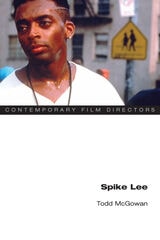
Spike Lee
Tom McGowan
University of Illinois Press, 2014
Since the release of Do the Right Thing in 1989, Spike Lee has established himself as a cinematic icon. Lee's mostly independent films garner popular audiences while at the same time engaging in substantial political and social commentary. He is arguably the most accomplished African American filmmaker in cinematic history, and his breakthrough paved the way for the success of many other African Americans in film.
In this first single-author scholarly examination of Spike Lee's oeuvre, Todd McGowan shows how Lee's films, from She's Gotta Have It through Red Hook Summer, address crucial social issues such as racism, paranoia, and economic exploitation in a formally inventive manner. McGowan argues that Lee uses excess in his films to intervene in issues of philosophy, politics, and art. McGowan contends that it is impossible to watch a Spike Lee film in the way that one watches a typical Hollywood film. By forcing observers to recognize their unconscious enjoyment of violence, paranoia, racism, sexism, and oppression, Lee's films prod spectators to see differently and to confront their own excess. In the process, his films reveal what is at stake in desire, interpersonal relations, work, and artistic creation itself.

Spinning Tea Cups
A Mythical American MemoirAlexandra Teague
Oregon State University Press, 2023
How did people who prided themselves on making everything from scratch manage to afford annual trips to Disney World? Did her mother really have psychic abilities? Why did her sensitive youngest nephew speak in a voice that wasn’t his own? How do family legacies of grief and dysfunction and creativity intersect? How can she escape her circumstances without replicating the escapist fantasies with which she was raised?
Teague attempts to understand and contextualize her family in terms of trauma and mental health, but also with deep love and humor. Carefully attuned to the vagaries of geographical cultures, she weaves her family’s history with explorations of pop culture and the specific cultures of the places she and her family pass through: a Texas city, an Victorian tourist town in Arkansas, a Southwest ghost town, Central Florida, the Bay Area, Kansas City, and a college town in the Inland Northwest.
Spinning Tea Cups will appeal to readers interested in American cultural studies, those concerned with the ongoing crisis of mental illness in this country, and anyone seeking to explore the dangerous and recuperative powers of fantasy.
Spirituality and the Writer
A Personal InquiryThomas Larson
Ohio University Press, 2019
Today, the surprisingly elastic form of the memoir embraces subjects that include dying, illness, loss, relationships, and self-awareness. Writing to reveal the inner self—the pilgrimage into one’s spiritual and/or religious nature—is a primary calling. Contemporary memoirists are exploring this field with innovative storytelling, rigorous craft, and new styles of confessional authorship. Now, Thomas Larson brings his expertise as a critic, reader, and teacher to the boldly evolving and improvisatory world of spiritual literature.
In his book-length essay Spirituality and the Writer, Larson surveys the literary insights of authors old and new who have shaped religious autobiography and spiritual memoir—from Augustine to Thomas Merton, from Peter Matthiessen to Cheryl Strayed. He holds them to an exacting standard: they must render transcendent experience in the writing itself. Only when the writer’s craft prevails can the fleeting and profound personal truths of the spirit be captured. Like its predecessor, Larson’s The Memoir and the Memoirist,Spirituality and the Writer will find a home in writing classrooms and book groups, and be a resource for students, teachers, and writers who seek guidance with exploring their spiritual lives.
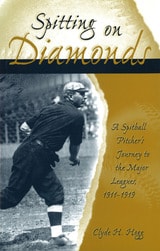
Spitting on Diamonds
A Spitball Pitcher's Journey to the Major Leagues, 1911-1919Clyde H. Hogg
University of Missouri Press, 2005
Sporting Lives
Metaphor and Myth in American Sports AutobiographiesJames W. Pipkin
University of Missouri Press, 2008
Sometimes the crack of the bat or the roar of the crowd fails to capture the meaning of sports as athletes themselves understand it. Books about sports have ignored this dimension of the subject, particularly the athletes’ own autobiographical accounts. In Sporting Lives, the first book to examine the two popular realms of sports and autobiography, James Pipkin looks at recurring patterns found in athletes’ accounts of their lives and sporting experiences, examining language, metaphor, rhetorical strategies, and other elements to analyze sports from the inside out.
Sporting Lives takes a fresh look at memoirs from baseball, football, basketball, golf, and other sports to explore how American athletes see themselves: not only how those images mesh with popular perceptions of them as heroes or celebrities but also how their accounts differ from those of sports journalists and other outsiders. Drawing on the life stories of such well-known figures as Wilt Chamberlain, Babe Ruth, and Martina Navratilova—both as-told-to and self-authored works—Pipkin follows players from the “echoing green” of eternal youth to the sometimes cultlike and isolated status of fame, interpreting recurring patterns both in the living of their lives and in the telling of them. He even considers Dennis Rodman’s four autobiographies to show how the contradictions of his self-portrayals reflect the Janus-faced quality of sports in the era of celebrity culture.
As Pipkin shows, the life of the athlete involves more than mere athleticism; it is also a world of nostalgia and sentiment, missed opportunities and lost youth. He sheds light on athletes’ common obsession with youth and body image—including gender and racial considerations—and explores their descriptions of being “in a zone,” that transcendent state when everything seems to click. And he considers the time that all athletes dread, when their bodies begin to betray them . . . and the cheering stops.
While the lives of athletes may often suggest the magic of Peter Pan, Pipkin’s engaging study reveals that they are in many ways more like the Lost Boys. Sporting Lives shows that the meaning of sports is intertwined with the telling. It is both an eminently readable book for fans and a critically sophisticated analysis that will engage scholars of literature, sports or media studies, and American popular culture.
SportsWorld
An American DreamlandLipsyte, Robert
Rutgers University Press, 2018
In the America of 2017—where the SuperBowl is worth billions, athletes are penalized or forced out of sports for political and anti-racist activism, and Title IX is constantly questioned and undermined—Robert Lipsyte’s 1975 critique remains startlingly and intensely relevant.

Spring, Heat, Rains
A South Indian DiaryDavid Shulman
University of Chicago Press, 2008
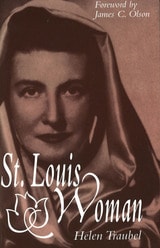
St. Louis Woman
Helen Traubel & Foreword by James C. Olson
University of Missouri Press, 1999
This charming autobiography captures the life story of a fascinating woman—a Missouri girl turned world-class soprano who remained true to her roots through it all. Born and reared in St. Louis and proud of her origins, Helen Traubel grew up in a modest German American family. She spent her teens and twenties singing with church choirs and quartets in the city, studying under first- rate teachers. She did not leave Missouri for New York until she was in her early thirties. Although she replaced the great Kirsten Flagstad at the Metropolitan Opera, she refused to confine herself to singing before elite crowds and prided herself on reaching a larger, more general audience via nightclubs, radio, television, and theater.
St. Louis Woman is filled with candid and amusing stories as full of zest as Traubel herself. In the early 1940s, she secured a rare opportunity to audition for the Ford Hour. Arriving at the studio with a terrible case of poison ivy and an understandably short temper, the diva began singing on cue as the top executives of the program listened from upstairs. During her first song, the booth technicians interrupted her performance with laughter. Furious, she announced she would sing no more and started to leave. Without explanation, the technicians asked her to continue. Traubel later discovered that the higher-ups had called down to the technicians demanding they stop playing the Flagstad record and let "that kid" sing.
The qualities that made Traubel such a notable individual are captured in this entertaining book. Her strong, independent character shines through. Outspoken and at times brutally honest, Traubel recounts her experiences at the Met, as both a popular performer and a teacher. She tells of exasperating moments when she was coaching famous pupil Margaret Truman.
This is not a fact-laden examination of the singer's Wagnerian repertory or a study of high opera; rather this engaging book introduces the reader to a nationally renowned performer who, despite her unmatched talent, retained her hometown identity and lived her life as a St. Louis woman.
Stage, Page, Scandals, & Vandals
William E. Burton and Nineteenth-Century American TheatreDavid L. Rinear
Southern Illinois University Press, 2004
In this first modern book-length biography of native Englander William E. Burton, theatre historian David L. Rinear explores Burton’s diary, letters, published reviews, and various reminiscences to reveal the tumultuous personal and professional lives of the mid-nineteenth-century actor/manager and his role in American literary history. Stage, Page, Scandals, and Vandals: William E. Burton and Nineteenth-Century American Theatre also provides insight into the cultural and artistic climate of an early period in American history when the country was still forming a national identity.
Burton fled England in 1834 and came to America in the wake of a public scandal caused by his marriage to a sixteen-year-old orphan. Burton was then already married with a ten-year-old son. Settling in Philadelphia, the thirty-two-year-old actor rapidly established himself in the city’s theatrical productions and quickly became an audience favorite.
In 1837, while continuing to act, Burton founded and edited The Gentleman’s Magazine, a monthly literary publication later called Burton’s Gentleman’s Magazine. Burton hired struggling author Edgar Allan Poe as coeditor, and the journal achieved literary acclaim as it first published many of Poe’s short stories and poems.
Burton sold the journal in 1841 and used the money to build a new theatre, which he managed, although the depression of the early 1840s soon drove his venture out of business. After declaring bankruptcy the following year, Burton worked as a touring actor before returning to theatre management in 1845. For the next thirteen years, Burton managed a succession of theatres in Philadelphia, Baltimore, and New York.
Burton’s work as a producer of Shakespearean comedies and romances marks him as the first of the intellectual theatre managers to raise the theatrical experience from mere popular culture to high art. Burton made a fortune in his ventures, amassed the finest private Shakespearean library in the country, and built a grand seaside estate in Glen Cove, Long Island. Shrewd in his personal affairs and in business, Burton also had a violent temper, which led him to viciously attack his competitors. His peculiar domestic relationships marred his brilliant career as an actor, manager, and man of letters; he may have been married to three women at once and lived with two of these women simultaneously.
Fully revealing Burton’s contributions to American culture, Rinear traces Burton’s personal and professional pursuits from his emigration to his death in 1860. Bolstered by twenty-two illustrations, Stage, Page, Scandals, and Vandals sheds light on the history of American entertainment during the antebellum era, exposes the ruthless business practices required to succeed in theatre and literary magazine publishing, and reveals a sense of what constituted celebrity status in mid-nineteenth-century America.