Results by title
8113 books match the query 'Literary Criticism' and 542 start with s

Shakespeare’s Legal Ecologies
Law and Distributed SelfhoodKevin Curran
Northwestern University Press, 2017
At the center of the book is Shakespeare’s fascination with questions that are fundamental to both law and philosophy: What are the sources of agency? What counts as a person? For whom am I responsible, and how far does that responsibility extend? What is truly mine? Curran guides readers through Shakespeare’s responses to these questions, paying careful attention to both historical and intellectual contexts.
The result is a book that advances a new theory of Shakespeare’s imaginative relationship to law and an original account of law’s role in the ethical work of his plays and sonnets. Readers interested in Shakespeare, theater and philosophy, law, and the history of ideas will find Shakespeare’s Legal Ecologies to be an essential resource.
Shakespeare’s Politic Comedy
Will Morrisey
St. Augustine's Press, 2022
INTRODUCTORY NOTE: The Politic Character of Shakespeare’s Comedy
PART ONE: THREE REGIMES: OLIGARCHY, ARISTOCRACY, MONARCHY
Chapter One: Shakespearean Comedy: Two Points on the Compass
Chapter Two: Gentlemen and Gentlemanliness
Chapter Three: Royal Dreaming
PART TWO: THE RULE OF LAW
Chapter Four: Comic Errors, Legal Slapstick
Chapter Five: What Will You?
PART THREE: THE COMEDY OF MORALS
Chapter Six: Taming Our Shrewishness
Chapter Seven: What Does Shakespeare Mean When He Says, “As You Like It”?
PART FOUR: THE COMEDY OF POLITICS
Chapter Eight: Is All Well That Ends Well?
Chapter Nine: The Geopolitics of Love
Chapter Ten: The Wisest Beholder
SHAKESPEARE’S POLITIC MERRIMENT
Shakesqueer
A Queer Companion to the Complete Works of ShakespeareMadhavi Menon, ed.
Duke University Press, 2011
Contributors. Matt Bell, Amanda Berry, Daniel Boyarin, Judith Brown, Steven Bruhm, Peter Coviello, Julie Crawford, Drew Daniel, Mario DiGangi, Lee Edelman, Jason Edwards, Aranye Fradenburg, Carla Freccero, Daniel Juan Gil, Jonathan Goldberg, Jody Greene, Stephen Guy-Bray, Ellis Hanson, Sharon Holland, Cary Howie, Lynne Huffer, Barbara Johnson, Hector Kollias, James Kuzner , Arthur L. Little Jr., Philip Lorenz, Heather Love, Jeffrey Masten, Robert McRuer , Madhavi Menon, Michael Moon, Paul Morrison, Andrew Nicholls, Kevin Ohi, Patrick R. O’Malley, Ann Pellegrini, Richard Rambuss, Valerie Rohy, Bethany Schneider, Kathryn Schwarz, Laurie Shannon, Ashley T. Shelden, Alan Sinfield, Bruce Smith, Karl Steel, Kathryn Bond Stockton, Amy Villarejo, Julian Yates
Shakin' Up Race and Gender
Intercultural Connections in Puerto Rican, African American, and Chicano Narratives and Culture (1965–1995)By Marta E. Sánchez
University of Texas Press, 2006
The second phase of the civil rights movement (1965-1973) was a pivotal period in the development of ethnic groups in the United States. In the years since then, new generations have asked new questions to cast light on this watershed era. No longer is it productive to consider only the differences between ethnic groups; we must also study them in relation to one another and to U.S. mainstream society.
In "Shakin' Up" Race and Gender, Marta E. Sánchez creates an intercultural frame to study the historical and cultural connections among Puerto Ricans, African Americans, and Chicanos/as since the 1960s. Her frame opens up the black/white binary that dominated the 1960s and 1970s. It reveals the hidden yet real ties that connected ethnics of color and "white" ethnics in a shared intercultural history. By using key literary works published during this time, Sánchez reassesses and refutes the unflattering portrayals of ethnics by three leading intellectuals (Octavio Paz, Daniel Patrick Moynihan, and Oscar Lewis) who wrote about Chicanos, African Americans, and Puerto Ricans. She links their implicit misogyny to the trope of La Malinche from Chicano culture and shows how specific characteristics of this trope—enslavement, alleged betrayal, and cultural negotiation—are also present in African American and Puerto Rican cultures. Sánchez employs the trope to restore the agency denied to these groups. Intercultural contact—encounters between peoples of distinct ethnic groups—is the theme of this book.
Shaming into Brown
Somatic Transactions of Race in Latina/o LiteratureStephanie Fetta
The Ohio State University Press, 2018
In Shaming into Brown: Somatic Transactions of Race in Latina/o Literature, Stephanie Fetta asserts that our bodies are fundamental to how we live and how we make meaning. Anchored by two psychoanalytic theories, bioenergetic analysis developed by Alexander Lowen and affect theory put forth by Silvan Tomkins, Fetta examines Latinx fiction to draw attention to the cultural role of the intelligent, emotional, and communicative body—the soma—in relation to shame. She argues that we bring the soma—the physical, emotive, and social register of our subjectivity—to the text as we do to our lives,proposing that the power of racialization operates at the level of somatic expression and reception through habituated, socially cued behaviors that are not readily subject to intentional control.
Fetta examines shame beyond individual experiences, looking at literary renderings of the cultural practice of racial shaming that are deeply embedded into our laws, hiring practices, marketing strategies, and more. Grounding her analysis in the works of Gloria Anzaldúa and Cherríe Moraga, Shaming into Brown focuses on exposing the underpinnings of racialized shame and does so through analyzing “scenes of racialization” in prominent works by authors such as Junot Díaz, Sandra Cisneros, and Oscar Zeta Acosta.
Shapeshifting Subjects
Gloria Anzaldua's Naguala and Border ArteKelli D. Zaytoun
University of Illinois Press, 2022
An original and moving analysis, Shapeshifting Subjects draws on unpublished archival material to apply Anzaldúa's ideas to new areas of thought and action.
Shaping Words to Fit the Soul
The Southern Ritual Grounds of Afro-ModernismJürgen E. Grandt
The Ohio State University Press, 2009
Shards of Love
Exile and the Origins of the LyricMaría Rosa Menocal
Duke University Press, 1994
It is in exile that Menocal locates the founding conditions for philology--as a discipline that loves origins--and for the genre of love songs that philology reveres. She crosses the boundaries, both temporal and geographical, of 1492 to recover the "original" medieval culture, with its Mediterranean mix of European, Arabic, and Hebrew poetics. The result is a form of literary history more lyrical than narrative and, Menocal persuasively demonstrates, more appropriate to the Middle Ages than to the revisionary legacy of the Renaissance. In discussions ranging from Eric Clapton's adaption of Nizami's Layla and Majnun, to the uncanny ties between Jim Morrison and Petrarch, Shards of Love deepens our sense of how the Middle Ages is tied to our own age as it expands the history and meaning of what we call Romance philology.
Shattering the Self in Early Modern English Verse
Gender, Sex, and Queerness Beyond the HumanGina Filo
Northwestern University Press, 2026
Rejecting the ideals of stability and sexual mastery demanded of masculine subjects, early modern English poets threw the limits of bodies and selves into question to embrace erotic experiences of genderqueer and transspecies embodiment and affiliation. Through close readings of still-canonical and lesser-read writers including William Shakespeare, John Donne, and Thomas Traherne, Gina Filo shows how these experimental encounters at the limits of the human were inextricable parts of the early modern literary and sexual imaginaries.
In its exploration of nonnormative forms of erotic attachment and embodiment, Shattering the Self in Early Modern English Verse: Gender, Sex, and Queerness Beyond the Human contributes to the burgeoning fields of early modern trans and ecocritical studies while also drawing on contemporary queer theory. Filo neither seeks to naively recuperate a fantasized past nor cedes relationality, sociality, or generativity to the normative. Instead, she shows how the embrace of erotic possibility, flexible, unstable subjectivities, and querying of the limits of “the human” were core features of early modern poetics, reconfiguring our understanding of English literary history and queer relationality today.
Shaw's Daughters
Dramatic and Narrative Constructions of GenderJ. Ellen Gainor
University of Michigan Press, 1992

Shays' Rebellion
The Making of an Agrarian InsurrectionDavid P. Szatmary
University of Massachusetts Press, 1980
Shays' Rebellion: The Making of an Agrarian Insurrection is a landmark work of early American social and economic history that offers a comprehensive examination of one of the most consequential, and often misunderstood, uprisings in the history of the early American republic. Between 1786 and 1787, debt-ridden farmers across western Massachusetts, many of them veterans of the Revolutionary War, rose in armed protest against the state government's crushing tax and debt collection policies. Under the informal leadership of Daniel Shays, the rebels sought to prevent court foreclosures on their farms, demand tax relief, and reform a judicial system they saw as serving the interests of wealthy creditors at the expense of ordinary citizens. The uprising—ultimately suppressed by a privately funded state militia—sent shockwaves through the young nation, alarming leading figures including George Washington and James Madison, and powerfully accelerating the movement toward a stronger central government and the drafting of the U.S. Constitution.
Szatmary frames the rebellion not as an isolated outbreak of lawlessness, but as a deeply rooted agrarian insurrection produced by the collision of two fundamentally different economic worlds in post-Revolutionary New England. His analysis begins by establishing the divergent economic realities of the region: on one side, the commercial and mercantile economy of New England's coastal towns, driven by creditors, merchants, and professional elites integrated into transatlantic trade networks; on the other, the subsistence farming communities of the interior, whose inhabitants operated largely outside the cash economy and bore a disproportionate burden of wartime debt and postwar taxation. Drawing on this structural conflict, Szatmary traces the chain of debt that left rural farmers increasingly unable to meet their obligations, the escalating cycle of court actions and property seizures that pushed them toward organized resistance, and the government's responses, ultimately military, to the protests.
The book is also attentive to the rebellion's broader political consequences, examining how Shays' Rebellion transformed the national debate about governance, federal authority, and the relationship between popular democracy and social order in the new republic. Described by one reviewer as a "well-balanced" study that "classifies Shays' Rebellion as the historical watershed it truly is," the book remains a standard reference in the historiography of the Early American Republic, the Articles of Confederation period, and the origins of the Constitutional Convention.
She Being Dead Yet Speaketh
The Franklin Family PapersMary Franklin and Hannah Burton
Iter Press, 2020
Collected for the first time, this volume of the Franklin Family Papers offers rare insight into the personal lives of three generations of dissenting women.
She Said No
The Gender of Consent from Fairy Tales to #MeTooJennifer Tamas
University of Delaware Press, 2027
She Said NO investigates the gender inequality in the authority to speak—and therefore to refuse—that prevailed in the establishment and interpretation of the French classics. By selecting authors deemed essential to French cultural heritage and erasing the works of women writers, this biased canon has systematically undervalued female agency—even in well-known works by both men and women, such as Beauty and the Beast, The Princess of Clèves, and "Little Red Riding Hood." With this book, Jennifer Tamas fills a striking gap in early modern French studies by conceptualizing consent in a society where being a woman made it structurally difficult to say "no." Yet, women did refuse. The history Tamas explores is one of forgotten, erased, misunderstood, or inadmissible refusals, and how they have been obscured. The #MeToo movement has brought questions of female agency and consent to the fore, and this book retraces an "archive of refusal" to serve as a source of inspiration for contemporary feminist discourse and to change our reception of the French canon.
Shelf Life
Essays, Memoirs, and an InterviewThom Gunn
University of Michigan Press, 1993
Gunn’s criticism communicates his own enthusiasm for poetry. He tries to show his readers how to get a first foothold into the work of some of his favorite poets, whether Wyatt or Whitman, Mina Loy or Robert Creeley.

Shelf Life
Literary Essays and ReviewsWilliam H. Pritchard
University of Massachusetts Press, 2009
Pritchard is convinced that his job as a critic is to talk back to the imagination he has been engaged by. The four sections of this volume look at writers as diverse as the critic Samuel Johnson, the novelist Raymond Chandler, and the poet James Merrill, and at the abrasive epistolary behavior of Evelyn Waugh and Kingsley Amis. Perhaps the book's most original section is its final one, in which Pritchard writes about music-about playing the piano, singing hymns, listening to jazz-and about the teaching life as it appears in literature and in his own classroom. He concludes with appreciative essays on two of his own fondly remembered teachers.
Shelf Life is mannerly and elegant, but venturesome, even bold in its explorations of the artistic performance-of that passionate preference Robert Frost found to be the root of all human expression.
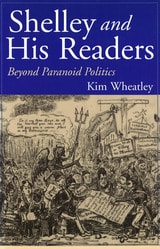
Shelley and His Readers
Beyond Paranoid PoliticsKim Wheatley
University of Missouri Press, 1999
In Shelley and His Readers, the first full-length critical analysis of the dialogue between Shelley's poetry and its contemporary reviewers, Kim Wheatley argues that Shelley's idealism can be recovered through the study of his poetry's reception. Incorporating extensive research in major early-nineteenth-century British periodicals, Wheatley integrates a reception-based methodology with careful textual analysis to demonstrate that the early reception of Shelley's work registers the immediate impact of the poet's increasingly idealistic passion for reforming the world.
Wheatley examines Shelley's poetry within the context of Romantic-era "paranoid politics," a simultaneously empowering and disabling dynamic in which the reviewers employ a heightened language of defensiveness and persecution that paints their adversaries as Satanic rebels against orthodoxy. This "paranoid style" displays a preoccupation with the efficacy of the printed word and singles out radical writers such as Shelley as sources of social contamination.
Using Shelley's Queen Mab to illustrate his early radicalism, Wheatley demonstrates that the poet, like his contemporary reviewers, is caught up in paranoid rhetoric. Failing to challenge the assumptions underlying the paranoid style-conspiracy and contagion-in this poem Shelley takes merely a defiant, oppositional stance. However, Shelley's later poems, exemplified by Prometheus Unbound and Adonais, circumvent the reviewers' rhetoric through their boldly experimental language, a process registered by the reviewers' own responses. These less explicitly political poems transcend the dynamics of cultural paranoia by shifting to an apolitical conception of the aesthetic. In collaboration with its early readers, Shelley's poetry thus moves momentarily beyond paranoid politics.
The final chapter of this study argues that the posthumous reception of Adonais uniquely replicates the elegiac moves and complex idealism of the poem, concluding with a discussion of how the Shelley circle aestheticized the poet after his death.
Shelley and His Readers offers a new approach to the question of how to recuperate Romantic idealism in the face of challenges from both deconstructive and historicist criticism. Its innovative use of reception-based analysis will make this book invaluable not only to specialists of the Romantic period but also to anyone interested in new developments in literary criticism.
Shelley and Synesthesia
Glenn O'Malley
Northwestern University Press, 1964
Shelley with Benjamin
A Critical MosaicMathelinda Nabugodi
University College London, 2023
Shelley with Benjamin is an experiment in comparative reading. Born a century apart, Percy Bysshe Shelley and Walter Benjamin are separated by time, language, temperament, and genre. One is a Romantic poet known for his revolutionary politics and delicate lyricism, and the other is a melancholy intellectual who pioneered a dialectical method of thinking in constellations. Yet, taken together, their ideas are mutually illuminating.
In a series of close readings that are by turns playful, erotic, and violent, Mathelinda Nabugodi unveils affinities between two writers whose works are simultaneously interventions in literary history and blueprints for an emancipated future. In addition to offering fresh interpretations of both major and minor writings, she elucidates the personal and ethical stakes of literary criticism. The book will appeal to readers of Shelley and Benjamin as well as those with an interest in comparative literature, literary theory, romantic poetics, and creative critical writing.
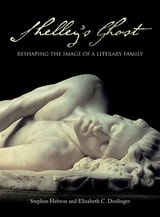
Shelley's Ghost
Reshaping the Image of a Literary FamilyStephen Hebron and Elizabeth C. Denlinger
Bodleian Library Publishing, 2010
It is difficult to think of a family more endowed with literary genius than the Shelley family—from the Romantic poet Percy Bysshe Shelley and his wife, novelist Mary Shelley, to Mary’s parents, William Godwin and Mary Wollstonecraft—all were authors in their own right. Using extensive archival material, Shelley’s Ghost explores the making of this remarkable literary family’s reputation.
Drawing on the Bodleian Library’s outstanding collection of letters, poetry manuscripts, rare printed books, portraits, and other personalia—including Shelley’s working notebooks, Keats’s letters to Shelley, William Godwin’s diary, and the original manuscript of Mary Shelley’s Frankenstein—Stephen Hebron charts the history of this talented yet troubled family. After Percy Bysshe Shelley’s drowning in 1822, Mary published various manuscripts relating to both her husband’s and her father’s lives, and passed this historical legacy to her son, Sir Percy Florence Shelley and his wife, Lady Jane Shelley. As guardians of the archive until they bequeathed it to the Bodleian in 1892, Sir Percy Florence and Lady Jane helped shape the posthumous reputations of these writers. An afterword by Elizabeth Denlinger of the New York Public Library offers an additional perspective, exploring material relating to the Shelley family that slipped beyond the family’s control.
An unparalleled look at one of the most significant families of British Romantic literature, Shelley’s Ghost will be welcomed by scholars and the many fans of this enduring literacy legacy.

Shelley’s Religion
Ellsworth Barnard
University of Minnesota Press, 1936

Sherlock Holmes, Esq., and John H. Watson, M.D.
An Encyclopaedia of Their AffairsOrlando Park
Northwestern University Press, 1962
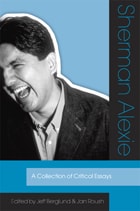
Sherman Alexie
A Collection of Critical EssaysJeff Berglund
University of Utah Press, 2010
Sherman Alexie is, by many accounts, the most widely read American Indian writer in the United States and likely in the world. A literary polymath, Alexie's nineteen published books span a variety of genres and include his most recent National Book Award-winning The Absolutely True Diary of a Part-Time Indian.
Now, for the first time, a volume of critical essays is devoted to Alexie's work both in print and on the big screen. Editors Jeff Berglund and Jan Roush have assembled twelve leading scholars of American Indian literature to provide new perspectives on a writer with his finger on the pulse of America.
Interdisciplinary in their approach to Alexie's work, these essays cover the writer's entire career, and are insightful and accessible to scholars and lay readers alike. This volume is a worthy companion to the work of one of our nations's most recognized contemporary voices.
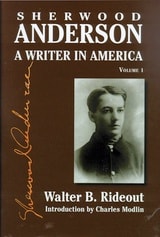
Sherwood Anderson
A Writer in America, Volume 1Walter B. Rideout
University of Wisconsin Press, 2006
Sherwood Anderson: A Writer in America is the definitive biography of this major American writer of novels and short stories, whose work includes the modern classic Winesburg, Ohio. In the first volume of this monumental two-volume work, Walter Rideout chronicles the life of Anderson from his birth and his early business career through his beginnings as a writer and finally to his move in the mid-1920s to “Ripshin,” his house near Marion, Virginia. The second volume will cover Anderson’s return to business pursuits, his extensive travels in the South touring factories, which resulted in his political involvement in labor struggles and several books on the topic, and finally his unexpected death in 1941.
No other existing Anderson biography, the most recent of which was published nearly twenty years ago, is as thoroughly researched, so extensively based on primary sources and interviews with a range of Anderson friends and family members, or as complete in its vision of the man and the writer. The result is an unparalleled biography—one that locates the private man, while astutely placing his life and writings in a broader social and political context.
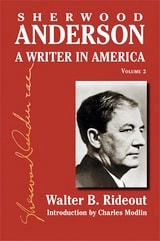
Sherwood Anderson
A Writer in America, Volume 2Walter B. Rideout
University of Wisconsin Press, 2006
Walter Rideout’s Sherwood Anderson: A Writer in America is a seminal work that reintroduces us to this important, yet recently neglected, American writer, giving him long overdue attention. This second volume of the monumental two-volume work covers Anderson’s life after his move in the mid-1920s to “Ripshin,” his house near Marion, Virginia (where Volume 1 ended.) The second volume covers his return to business pursuits; his extensive travels in the South touring factories, which resulted in his political involvement in labor struggles and several books on the topic; and finally his unexpected death in 1941.
No other existing Anderson biography, the most recent of which was published nearly twenty years ago, is as thoroughly researched, so extensively based on primary sources and interviews with a range of Anderson’s friends and family members, or as complete in its vision of the man and the writer. Rideout uncovers much new information about events and people in Anderson’s life and provides a new perspective on many of his works. This two-volume biography presents Anderson’s many remarkable attributes more clearly than ever before, while astutely placing his life and writings in the broader social, political, and artistic movements of his times.
Outstanding Book, selected by the American Association of School Librarians, and Best Books for General Audiences, selected by the Public Library Association
Outstanding Academic Title, Choice Magazine
Winner, Biography Award, Society of Midland Authors
Shipwreck Modernity
Ecologies of Globalization, 1550–1719Steve Mentz
University of Minnesota Press, 2015
Shipwreck Modernity engages early modern representations of maritime disaster in order to describe the global experience of ecological crisis. In the wet chaos of catastrophe, sailors sought temporary security as their worlds were turned upside down. Similarly, writers, poets, and other thinkers searched for stability amid the cultural shifts that resulted from global expansion. The ancient master plot of shipwreck provided a literary language for their dislocation and uncertainty.
Steve Mentz identifies three paradigms that expose the cultural meanings of shipwreck in historical and imaginative texts from the mid-sixteenth through the early eighteenth centuries: wet globalization, blue ecology, and shipwreck modernity. The years during which the English nation and its emerging colonies began to define themselves through oceangoing expansion were also a time when maritime disaster occupied sailors, poets, playwrights, sermon makers, and many others. Through coming to terms with shipwreck, these figures adapted to disruptive change.
Traces of shipwreck ecology appear in canonical literature from Shakespeare to Donne to Defoe and also in sermons, tales of survival, amateur poetry, and the diaries of seventeenth-century English sailors. The isolated islands of Bermuda and the perils of divine anger hold central places. Modern sailor-poets including Herman Melville serve as valuable touchstones in the effort to parse the reality and understandings of global shipwreck.
Offering the first ecocritical account of early modern shipwreck narratives, Shipwreck Modernity reveals the surprisingly modern truths to be found in these early stories of ecological collapse.
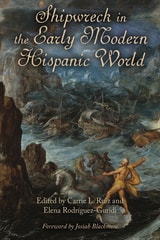
Shipwreck in the Early Modern Hispanic World
Carrie L. Ruiz
Bucknell University Press, 2022
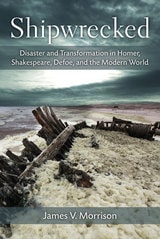
Shipwrecked
Disaster and Transformation in Homer, Shakespeare, Defoe, and the Modern WorldJames V. Morrison
University of Michigan Press, 2014
The recurrent treatment of shipwrecks in the creative arts demonstrates an enduring fascination with this archetypal scene: a shipwreck survivor confronting the elements. It is remarkable, for example, that the characters in the 2004 television show Lost share so many features with those from Homer’s Odyssey and Shakespeare’s The Tempest.
For survivors who are stranded on an island for some period of time, shipwrecks often present the possibility of a change in political and social status—as well as romance and even paradise. In each of the major shipwreck narratives examined, the poet or novelist links the castaways’ arrival on a new shore with the possibility of a new sort of life. Readers will come to appreciate the shift in attitude toward the opportunities offered by shipwreck: older texts such as the Odyssey reveals a trajectory of returning to the previous order. In spite of enticing new temptations, Odysseus—and some of the survivors in The Tempest—revert to their previous lives, rejecting what many might consider paradise. Odysseus is reestablished as king; Prospero travels back to Milan. In such situations, we may more properly speak of potential transformations. In contrast, many recent shipwreck narratives instead embrace the possibility of a new sort of existence. That even now the shipwreck theme continues to be treated, in multiple media, testifies to its long-lasting appeal to a very wide audience.
Shiva's Drum
Stephen Cramer
University of Illinois Press, 2004
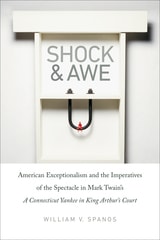
Shock and Awe
American Exceptionalism and the Imperatives of the Spectacle in Mark Twain’s A Connecticut Yankee in King Arthur’s CourtWilliam V. Spanos
Dartmouth College Press, 2013

Shooting the Works
On Poetry and PicturesW. Simone Di Piero
Northwestern University Press, 1996

Short Story Theories
Charles E. May
Ohio University Press, 1977
The essays range from discussions by Poe to comments by John Cheever. Frank O’Connor describes the short story as depicting “an intense awareness of human loneliness,” and Nadine Gordimer suggests that the story is more suitable than the novel in rendering the fragmentary modern experience. Eudora Welty sees the story as something “wrapped in an atmosphere” of its own; Randall Jarrell speaks of the mythic basis of the genre. Elizabeth Bowen and Alberto Moravia discuss thematic and structural distinctions between the novel and the story.
The collection also includes discussions of various types of stories, as satiric and lyric, critical surveys of the development of the modern short story, and the status of the form at the present time. An excellent annotated bibliography is also included, which describes 135 books and articles on the short story, evaluating their contribution to a unified theory of the form.
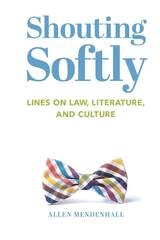
Shouting Softly
Lines on Law, Literature, and CultureAllen Mendenhall
St. Augustine's Press, 2020
The work is given in three parts. The first section on law explores legal minds, rules and commentary on seminal jurisprudence. The second part explores literature and the influence of the writer and the disconcerting truths stories often seek to convey. Thirdly, Mendenhall delves into culture and the more obvious situations wherein we gain insight into our manner of living, and here Mendenhall exudes a Southern accent that in no way compromises his universal bearings. One of the highlights is his echo of Larry Seidentop’s question: “If we in the West do not understand the moral depth of our own tradition, how can we hope to shape the conversation of mankind?” This is all the more meaningful given that Mendenhall is a member of the Millennial generation, and part of the intellectual minority who sees the urgency of “a studied appreciation for nuanced story and linguistic narrative.”

Show Me Your Environment
Essays on Poetry, Poets, and PoemsDavid Baker
University of Michigan Press, 2014
In Show Me Your Environment, a penetrating yet personable collection of critical essays, David Baker explores how a poem works, how a poet thinks, and how the art of poetry has evolved—and is still evolving as a highly diverse, spacious, and inclusive art form. The opening essays offer contemplations on the “environment” of poetry from thoughts on physical places and regions as well as the inner aesthetic environment. Next, Baker looks at the highly distinctive achievements and styles of poets ranging from George Herbert and Emily Dickinson through poets writing today. Finally, he takes joy in reading individual poems—from the canonical to the contemporary; simply and closely.
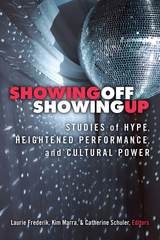
Showing Off, Showing Up
Studies of Hype, Heightened Performance, and Cultural PowerLaurie Frederik, Kim Marra, and Catherine Schuler, Editors
University of Michigan Press, 2017
Shrapnel Minima
Writings from Humanities UndergroundEdited by Prasanta Chakravarty
Seagull Books, 2014
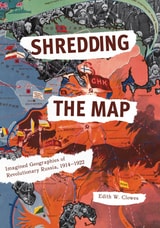
Shredding the Map
Imagined Geographies of Revolutionary Russia, 1914-1922Edith W. Clowes
Amherst College Press, 2024
An innovative, digitally-aided study of Russia’s “imagined geography” during the early decades of the twentieth century, Shredding the Map uncovers vying emotional patterns and responses to Russian ideas of place, some familiar and some quite new. The book includes new visualizations that connect otherwise invisible networks of shared place, feeling, and perception among dozens of writers in order to trace patterns of geospatial identity. A scholarly companion to the “Mapping Imagined Geographies of Revolutionary Russia” website and database, this book offers an innovative analysis of place and identity beyond the centers of power, enhancing our perceptions of Russia and encouraging debate about the possibilities for digital humanities and literary analysis.
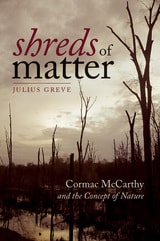
Shreds of Matter
Cormac McCarthy and the Concept of NatureJulius Greve
Dartmouth College Press, 2018
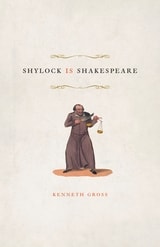
Shylock Is Shakespeare
Kenneth Gross
University of Chicago Press, 2006
Marvelously speculative and articulate, Gross’s book argues that Shylock is a breakthrough for Shakespeare the playwright, an early realization of the Bard’s power to create dramatic voices that speak for hidden, unconscious, even inhuman impulses—characters larger than the plays that contain them and ready to escape the author’s control. Shylock is also a mask for Shakespeare’s own need, rage, vulnerability, and generosity, giving form to Shakespeare’s ambition as an author and his uncertain bond with the audience. Gross’s vision of Shylock as Shakespeare’s covert double leads to a probing analysis of the character’s peculiar isolation, ambivalence, opacity, and dark humor. Addressing the broader resonance of Shylock, both historical and artistic, Gross examines the character’s hold on later readers and writers, including Heinrich Heine and Philip Roth, suggesting that Shylock mirrors the ambiguous states of Jewishness in modernity.
A bravura critical performance, Shylock Is Shakespeare will fascinate readers with its range of reference, its union of rigor and play, and its conjectural—even fictive—means of coming to terms with the question of Shylock, ultimately taking readers to the very heart of Shakespeare’s humanizing genius.

Shylock on Trial
The Appellate BriefsRichard A. Posner and Charles Fried
University of Chicago Press, 2013
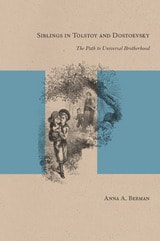
Siblings in Tolstoy and Dostoevsky
The Path to Universal BrotherhoodAnna A. Berman
Northwestern University Press, 2015
Anna A. Berman’s book brings to light the significance of sibling relationships in the writings of Tolstoy and Dostoevsky. Relationships in their works have typically been studied through the lens of erotic love in the former, and intergenerational conflict in the latter.
In close readings of their major novels, Berman shows how both writers portray sibling relationships as a stabilizing force that counters the unpredictable, often destructive elements of romantic entanglements and the hierarchical structure of generations. Power and interconnectedness are cast in a new light. Berman persuasively argues that both authors gradually come to consider siblinghood a model of all human relations, discerning a career arc in each that moves from the dynamics within families to a much broader vision of universal brotherhood.
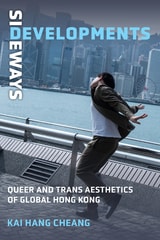
Sideways Developments
Queer and Trans Aesthetics of Global Hong KongKai Hang Cheang
University of Michigan Press, 2026
In this moment of multiple crises, Sideways Developments offers a timely hermeneutic and theory of solidarity and sustainability. The book tracks how sideways aesthetics have evolved from a feature of LGBTQ+ plots, performance, and nonlinear approaches to space-time to a form of togetherness that links postcolonial Hong Kong with struggles worldwide. Using what Cheang terms intersectional formalism as an analytical tool, the book provides a multilayered examination of the alternative pathways exemplified by queer and trans resilience and regeneration.
Sidney's Poetics
Imitating CreationMichael Mack
Catholic University of America Press, 2005
Siena
City of SecretsJane Tylus
University of Chicago Press, 2015
As Tylus leads us through the city, she shares her passion for Siena in novelistic prose, while never losing sight of the historical complexities that have made Siena one of the most fascinating and beautiful towns in Europe. Today, Siena can appear on the surface standoffish and old-fashioned, especially when compared to its larger, flashier cousins Rome and Florence. But first impressions wear away as we learn from Tylus that Siena was an innovator among the cities of Italy: the first to legislate the building and maintenance of its streets, the first to publicly fund its university, the first to institute a municipal bank, and even the first to ban automobile traffic from its city center.
We learn about Siena’s great artistic and architectural past, hidden behind centuries of painting and rebuilding, and about the distinctive characters of its different neighborhoods, exemplified in the Palio, the highly competitive horserace that takes place twice a year in the city’s main piazza and that serves as both a dividing and a uniting force for the Sienese. Throughout we are guided by the assured voice of a seasoned scholar with a gift for spinning a good story and an eye for the telling detail, whether we are traveling Siena’s modern highways, exploring its underground tunnels, tracking the city’s financial history, or celebrating giants of painting like Simone Martini or giants of the arena, Siena’s former Serie A soccer team.
A practical and engaging guide for tourists and armchair travelers alike, Siena is a testament to the powers of community and resilience in a place that is not quite as timeless and serene as it may at first appear.

Sight Unseen
Beckett, Pinter, Stoppard, and Other Contemporary Dramatists on RadioElissa S. Guralnick
Ohio University Press, 1994
In Sight Unseen radio drama, a genre traditionally dismissed as popular culture, is celebrated as high art. The radio plays discussed here range from the conventional (John Arden’s Pearl) to the docudramatic (David Rudkin’s Cries from Casement), from the curtly conversational (Harold Pinter’s A Slight Ache) to the virtually operatic (Robert Ferguson’s Transfigured Night), testifying to radio drama’s variety and literary stature. Two of the plays included in this study pose aesthetic questions—the role of art in politics (Howard Barker’s Scenes from an Execution), and the nature of artistic excellence (Tom Stoppard’s Artist Descending a Staircase).
Guralnick contends that well-crafted radio plays tend to meld to their medium so naturally that they cannot be transferred to the theater or to film without being diminished. Each play is thus shown to exploit, to special effect, one of radio’s fundamental features: its invisible stage (Barker and Stoppard), its affinity to music (Ferguson and Beckett), its ability to imitate the mind’s subjectivity (Kopit and Pinter), its association with world events through features and the news (Rudkin). As for the question of radio’s relation to the theater, the issue is engaged in the work of John Arden, who dares to portray a theatrical stage on the airwaves, while intimating that the radio offers contemporary playwrights an incomparable boon: creative conditions roughly equivalent to those enjoyed by Shakespeare.

Signature Derrida
Jacques Derrida
University of Chicago Press, 2013
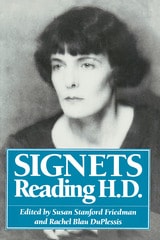
Signets
Reading H.D.Susan S. Friedman
University of Wisconsin Press, 1991
Signets brings together the best essays of H.D. (Hilda Doolittle). Susan Stanford Friedman and Rachel Blau DuPlessis have gathered the most influential and generative studies of H. D.’s work and complemented them with photobiographical, chronological, and bibliographical portraits unique to this volume.
The essays in Signets span H. D.’s career from the origins of Imagism to late modernism, from the early poems of Sea Garden to the novel HER and the epic poems Trilogy and Helen in Egypt. In addition to the editors, the contributors are Diana Collecott, Robert Duncan, Albert Gelpi, Eileen Gregory, Susan Gubar, Barbara Guest, Elizabeth A. Hirsch, Deborah Kelly Kloepfer, Cassandar Laity, Adalaide Morris, Alicia Ostriker, Cyrena N. Pondrom, Perdita Schaffner, and Louis H. Silverstein.
Signets is an essential resource for those interested in H. D., modernism, and feminist criticism and writing.
Signifyin(g), Sanctifyin', and Slam Dunking
A Reader in African American Expressive CultureGena Tabery
University of Massachusetts Press, 1999
Observers of American society have long noted the distinctive contribution of African Americans to the nation's cultural life. We find references to African American music and dance, black forms of oral expression, even a black style of playing basketball. But what do such terms really mean? Is it legitimate to talk about a distinct African American aesthetic, or is this simply a vestige of an outmoded racial essentialism? What makes a particular form of cultural expression “black” other than the fact that some African Americans may practice it? These are some of the questions addressed in the readings gathered in this volume by Gena Dagel Caponi. The essays, some previously published and others new, spring from a variety of disciplines and cover a broad range of topics, from the communal ritual of the ring shout to the evolution of rap to the improvisational genius of Michael Jordan. While each piece focuses on a different aspect of African American expressive culture, together they reveal a set of creative principles, techniques, and practices—a cultural aesthetic—that is remarkably consistent and resilient.
Signifying Bodies
Disability in Contemporary Life WritingG. Thomas Couser
University of Michigan Press, 2010
"Thomas Couser's Signifying Bodies comes at a crucial moment when debates about physician assisted suicide, genetic engineering, and neo-natal screening are raising the question of what constitutes a 'life worth living' for persons with disabilities. Couser's work engages these debates by exploring the extensive number of personal narratives by or about persons with disabilities. As Couser brilliantly demonstrates through synoptic readings, these works challenge the 'preferred rhetorics' by which such narratives are usually written (triumphalist, gothic, nostalgic) while making visible the variegated nature of embodied life."
---Michael Davidson, University of California, San Diego
"Signifying Bodies shows us that life writing about disability is . . . everywhere. . . . From obituary to documentary film to ethnography to literary memoir to the law, the book casts a wide net, detailing how various written and filmed responses to disability both enact and resist conventional narrative patterns. [This] not only broadens our idea about where to look for life writing, but also demonstrates how thoroughly stereotypes about disability mediate our social and artistic languages---even when an author has (so-called) the best intentions."
---Susannah B. Mintz, Skidmore College
Memoirs have enjoyed great popularity in recent years, experiencing significant sales, prominent reviews, and diverse readerships. Signifying Bodies shows that at the heart of the memoir phenomenon is our fascination with writing that focuses on what it means to live in, or be, an anomalous body---in other words, what it means to be disabled. Previous literary accounts of the disabled body have often portrayed it as a stable entity possibly signifying moral deviance or divine disfavor, but contemporary writers with disabilities are defining themselves and depicting their bodies in new ways. Using the insights of disability studies and source material ranging from the Old and New Testaments to the works of authors like Lucy Grealy and Simi Linton and including contemporary films such as Million Dollar Baby, G. Thomas Couser sheds light on a broader cultural phenomenon, exploring topics such as the ethical issues involved in disability memoirs, the rhetorical patterns they frequently employ, and the complex relationship between disability narrative and disability law.
G. Thomas Couser is Professor of English at Hofstra University.
Signifying God
Social Relation and Symbolic Act in the York Corpus Christi PlaysSarah Beckwith
University of Chicago Press, 2001
Introducing a radical new understanding of these plays as "sacramental theater," Beckwith shows how organizing the plays served as a political mechanism for regulating labor, and how theater and sacrament combined in them to do important theological work. She argues, for instance, that the theology of Corpus Christi in the resurrection plays can only be understood as a theatrical exploration of eucharistic absence and presence. Beckwith frames her study with discussions of twentieth-century manifestations of sacramental theater in Barry Unsworth's novel Morality Play and Denys Arcand's film Jesus of Montreal, and the connections between contemporary revivals of the York Corpus Christi plays and England's heritage culture.
Signifying Without Specifying
Racial Discourse in the Age of ObamaLi, Stephanie
Rutgers University Press, 2011
On the campaign trail, Barack Obama faced a difficult task—rallying African American voters while resisting his opponents’ attempts to frame him as “too black” to govern the nation as a whole. Obama’s solution was to employ what Toni Morrison calls “race-specific, race-free language,” avoiding open discussions of racial issues while using terms and references that carried a specific cultural resonance for African American voters.
Stephanie Li argues that American politicians and writers are using a new kind of language to speak about race. Challenging the notion that we have moved into a “post-racial” era, she suggests that we are in an uneasy moment where American public discourse demands that race be seen, but not heard. Analyzing contemporary political speech with nuanced readings of works by such authors as Toni Morrison, Jhumpa Lahiri, and Colson Whitehead, Li investigates how Americans of color have negotiated these tensions, inventing new ways to signal racial affiliations without violating taboos against open discussions of race.