Results by title
3258 books match the query 'Performing Arts' and 306 start with s
Spectacular Digital Effects
CGI and Contemporary CinemaKristen Whissel
Duke University Press, 2014

Spectacular Disappearances
Celebrity and Privacy, 1696-1801Julia H. Fawcett
University of Michigan Press, 2016
Spectacular Passions
Cinema, Fantasy, Gay Male SpectatorshipsBrett Farmer
Duke University Press, 2000
Building on the psychoanalytic concept of the fantasmatic, Farmer works to depathologize gay male subjectivity. While discussing such films as Kiss of the Spider Woman, The Pirate, Suddenly Last Summer, and Sunset Boulevard, and stars ranging from Mae West to Montgomery Clift, Farmer argues that the particularities of gay men’s social and psychic positionings motivate unique receptions of and investments in film. The Hollywood musical, gay camp readings of the extravagant female star, and the explicit homoeroticism of the cinematic male body in gay fanzines are further proof, says Farmer, of how the shifting libidinal profiles of homosexual desire interact with the fantasy scenarios of Hollywood film to produce a range of variable queer meanings.
This fascinating and provocative study makes a significant new contribution to discussions of cinema, spectatorship, and sexuality. As such, it will be welcomed by those in the fields of film theory, queer theory, and cultural studies.
Spectatorship
Shifting Theories of Gender, Sexuality, and MediaEdited by Roxanne Samer and William Whittington
University of Texas Press, 2017
Media platforms continually evolve, but the issues surrounding media representations of gender and sexuality have persisted across decades. Spectator: The University of Southern California Journal of Film and Television Criticism has published groundbreaking articles on gender and sexuality, including some that have become canonical in film studies, since the journal’s founding in 1982. This anthology collects seventeen key articles that will enable readers to revisit foundational concerns about gender in media and discover models of analysis that can be applied to the changing media world today.
Spectatorship begins with articles that consider issues of spectatorship in film and television content and audience reception, noting how media studies has expanded as a field and demonstrating how theories of gender and sexuality have adapted to new media platforms. Subsequent articles show how new theories emerged from that initial scholarship, helping to develop the fields of fandom, transmedia, and queer theory. The most recent work in this volume is particularly timely, as the distinctions between media producers and media spectators grow more fluid and as the transformation of media structures and platforms prompts new understandings of gender, sexuality, and identification. Connecting contemporary approaches to media with critical conversations of the past, Spectatorship thus offers important points of historical and critical departure for discussion in both the classroom and the field.
Specters of War
Hollywood's Engagement with Military ConflictBronfen, Elisabeth
Rutgers University Press, 2012
Specters of War looks at the way war has been brought to the screen in various genres and at different historical moments throughout the twentieth century and into the twenty-first. Elisabeth Bronfen asserts that Hollywood has emerged as a place where national narratives are created and circulated so that audiences can engage with fantasies, ideologies, and anxieties that take hold at a given time, only to change with the political climate.
Such cultural reflection is particularly poignant when it deals with America’s traumatic history of war. The nation has no direct access to war as a horrific experience of carnage and human destruction; we understand our relation to it through images and narratives that transmit and interpret it for us. Bronfen does not discuss actual conflicts but the films by which we have come to know and remember them, including All Quiet on the Western Front, The Best Years of Our Lives, Miracle at St. Anna, The Deer Hunter, and Flags of Our Fathers. Battles and campaigns, the home front and women-who-wait narratives, war correspondents, and court martials are also explored as instruments of cultural memory. Bronfen argues that we are haunted by past wars and by cinematic re-conceptualizations of them, and reveals a national iconography of redemptive violence from which we seem unable to escape.
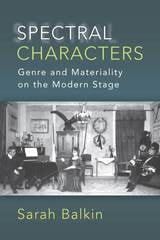
Spectral Characters
Genre and Materiality on the Modern StageSarah Balkin
University of Michigan Press, 2019
Theater’s materiality and reliance on human actors has traditionally put it at odds with modernist principles of aesthetic autonomy and depersonalization. Spectral Characters argues that modern dramatists in fact emphasized the extent to which humans are fictional, made and changed by costumes, settings, props, and spoken dialogue. Examining work by Ibsen, Wilde, Strindberg, Genet, Kopit, and Beckett, the book takes up the apparent deadness of characters whose selves are made of other people, whose thoughts become exteriorized communication technologies, and whose bodies merge with walls and furniture. The ghostly, vampiric, and telepathic qualities of these characters, Sarah Balkin argues, mark a new relationship between the material and the imaginary in modern theater. By considering characters whose bodies respond to language, whose attempts to realize their individuality collapse into inanimacy, and who sometimes don’t appear at all, the book posits a new genealogy of modernist drama that emphasizes its continuities with nineteenth-century melodrama and realism.
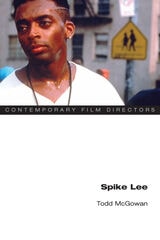
Spike Lee
Tom McGowan
University of Illinois Press, 2014
Since the release of Do the Right Thing in 1989, Spike Lee has established himself as a cinematic icon. Lee's mostly independent films garner popular audiences while at the same time engaging in substantial political and social commentary. He is arguably the most accomplished African American filmmaker in cinematic history, and his breakthrough paved the way for the success of many other African Americans in film.
In this first single-author scholarly examination of Spike Lee's oeuvre, Todd McGowan shows how Lee's films, from She's Gotta Have It through Red Hook Summer, address crucial social issues such as racism, paranoia, and economic exploitation in a formally inventive manner. McGowan argues that Lee uses excess in his films to intervene in issues of philosophy, politics, and art. McGowan contends that it is impossible to watch a Spike Lee film in the way that one watches a typical Hollywood film. By forcing observers to recognize their unconscious enjoyment of violence, paranoia, racism, sexism, and oppression, Lee's films prod spectators to see differently and to confront their own excess. In the process, his films reveal what is at stake in desire, interpersonal relations, work, and artistic creation itself.
Spike, Mike, Slackers & Dykes
A Guided Tour across a Decade of American Independent CinemaBy John Pierson
University of Texas Press, 2014
#66, The 100 Greatest Film Books of All Time, The Hollywood Reporter
The legendary figure who launched the careers of Spike Lee, Michael Moore, and Richard Linklater offers a no-holds-barred look at the deals and details that propel an indie film from a dream to distribution.
Pierson, a producer’s representative, explains how he has helped filmmakers with no profile at the time to get their work made, sold and seen by the world, sharing stories about Lee’s She’s Gotta Have It, Moore’s Roger & Me and Linklater’s Slackers, plus Hoop Dreams, Clerks and many others. Chats with Kevin Smith serve as interstitials between chapters.

Split Britches
Fifty Years OnPeggy Shaw and Lois Weaver, Edited by Benjamin Gillespie
University of Michigan Press, 2027
What does it mean to sustain a creative life over fifty years? Split Britches: Fifty Years On offers an intimate look at the enduring collaboration of Peggy Shaw and Lois Weaver, the artists behind the groundbreaking performance troupe Split Britches. The collection highlights Split Britches’ enduring queer and feminist legacies, tracing how their distinctive butch/femme lesbian aesthetic and collaborative performance practice have evolved over five decades and nearly thirty original productions. It foregrounds their shift toward increasingly autobiographical and introspective work, while also situating their later performances within key theatrical, historical, and critical frameworks–paying particular attention to issues of embodiment, aging, the archive, and queer temporality. Bringing together performance scripts, candid interviews, production photos, accessible essays, and video documentation, Split Britches: Fifty Years On demonstrates how Shaw and Weaver pull from the past in order to critique the present. For scholars, artists, and students, the volume's unique combination of primary texts, critical essays, and multimedia resources makes it an essential volume that considers theatre scholarship and practice, queer and feminist discourses, and the evolution of creativity with age and time.

Spoiler Alert
A Critical GuideAaron Jaffe
University of Minnesota Press, 2019
All of this information at our fingertips—and we might not need any of it
Concurrent with the compulsory connectivity of the digital age is the rise of the spoiler. The inevitability of information has changed the critical quality of modernity, leaving us with acute vertigo—a feeling that nothing new is left out there. Encompassing memes and trigger warnings, Vilem Flusser and Thomas Pynchon, Spoiler Alert wrangles with the state of surprise in post-historical times. Aaron Jaffe delivers a timely corrective to post-critical modes of reading that demonstrates the dangers of forfeiting critical suspicion.
Forerunners: Ideas First
Short books of thought-in-process scholarship, where intense analysis, questioning, and speculation take the lead
Sports Movies
Lester D. Friedman
Rutgers University Press, 2020
In Sports Movies, Lester D. Friedman describes the traditional formulas that have made these movies such crowd-pleasers, including stock figures like the disgraced athlete on a quest for redemption, or the wise old coaches who help mentor the heroes to victory. He also explores how the genre’s attitudes have changed over time, especially in key issues like class, race, masculinity, and women in sports.
Along the way, he takes stock of sports films from the dawn of cinema’s silent era to the present day, including classic baseball movies like Pride of the Yankees and Bull Durham, basketball movies like Hoosiers and He’s Got Game, football movies like Friday Night Lights and Rudy, and boxing movies like Raging Bull and Million Dollar Baby. As Friedman’s analyses reveal, not only do sports movies influence our perceptions about the drama of real-life sports, but they also help to shape our attitudes toward the competitive ethos in American life.
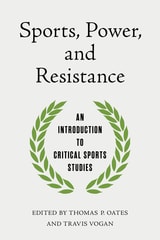
Sports, Power, and Resistance
An Introduction to Critical Sports StudiesEdited by Thomas P. Oates and Travis Vogan
University of Illinois Press, 2026
Topics range from Black coaches in the National Football League to disordered eating within distance running to transgender athletes’ fight to participate in sports. The editors have organized the contributions into three sections. Part one probes how sports build communities that foster belonging as well as exclusion. The essays in part two explore multiple forms of resistance in sports through various performances and representations. In the final section, essayists analyze more explicit efforts to use sports as a platform for activism from various political viewpoints. Throughout, the works nurture and demonstrate a sensibility that encourages humanistic, critical, and interdisciplinary inquiry.
Wide-reaching and accessible, Sports, Power, and Resistance explores timely issues while demonstrating the value of blending perspectives to better understand the games we play and watch.
Contributors: Ali Bouterse, Adrian Burgos, Jr., Michael L. Butterworth, Noah Cohan, Douglas Hartmann, Victoria E. Johnson, Abraham I. Khan, Jason Kido Lopez, Theresa Runstedtler, Jaime Schultz, Samantha N. Sheppard, and Travers

Spring in My Hometown
Andrew David Jackson
Lever Press, 2026
The inaugural volume of the Cinemas of Asia series, this book offers a fresh perspective on South Korean director Lee Kwang-mo’s 1998 film Spring in My Hometown (아름다운 시절). Written and directed by Lee, the intensely personal film tells the story of his grandfather’s relationship with his ten-year-old father during the Korean War. This volume examines the industrial context in which Lee attempted to bring his film into production, the cinematic cycle from which it emerged, and the unique style that captivated festival juries but divided audiences. Jackson’s book offers a rare, historical insight into an important Asian cinematic industry on the verge of commercial transformation at the end of the last century.
Cinemas of Asia is the first series dedicated to the cinemas of South, Southeast, East, Central Asia, and global Asian diasporas. Each volume provides a critical analysis and interpretation of a notable film from Asian cinema and consists of thematic chapters, accessible writing, and screenshots and illustrations. Authors analyze each film from a variety of angles, including film, literary, historical, gender, post-/decolonial studies, and each volume is accessibly written, informative, and appeals to academics, students, cinephiles, and non-experts alike.
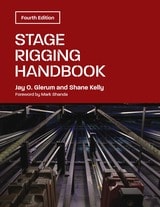
Stage Rigging Handbook, Fourth Edition
Jay O. Glerum and Shane Kelly with a foreword by Mark Shanda
Southern Illinois University Press, 2024
Updating the industry standard stage rigging text for a new generation
First published in 1987 and revised in 1997 and 2007, Stage Rigging Handbook remains the only book in any language that covers the design, operation, and maintenance of stage rigging equipment. Though often unnoticed, these systems are critical in both easing the workload of stage technicians and creating storytelling magic for the audience. This landmark text imparts the foundations for understanding and implementing rigging systems, such that upon completion of the book, the reader is ready to begin hands-on training and practice.
Organized into four sections, the handbook combines research and practical experience to guide riggers through their work. It begins by explaining the construction and care of basic lifting media. Part two analyzes types of rigging systems; then the handbook details the forces that impact rigging, from Newtonian physics to calculating expansive modern systems. Finally, it presents day-to-day best safety practices, including brand new sections on risk assessment and fall protection.
This reorganized and greatly expanded fourth edition of Jay O. Glerum’s industry standard text updates much of the information in the previous editions with the addition of chapters on truss (the framework that supports lighting, screens, and other accessories), motorized chain hoists, hardware, and job safety, including fall protection systems. Award-winning production manager Shane Kelly preserves Glerum’s voice while bringing fresh information to a new generation of riggers, supplementing the text with updated versions of earlier photographs and drawings as well as an additional one hundred illustrations. The handbook facilitates the development of a rigging practice rooted in safety, precision, and professionalism.
Stage Rigging Handbook, Third Edition
Jay O. Glerum
Southern Illinois University Press, 2007
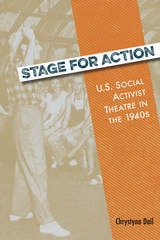
Stage for Action
U.S. Social Activist Theatre in the 1940sChrystyna Dail
Southern Illinois University Press, 2016
Exploring the intersection between performance and politics and the direct impact of the arts on social activism, Dail argues Stage for Action is a theatrical reflection of progressivism and the pro-working-class theatrical aesthetic of the 1940s. The theatre group, which used performance to encourage direct action and personal responsibility for change, eventually would function as the theatrical voice of the United States Progressive Party in the failed presidential campaign of former vice president Henry A. Wallace.
Calling into question the widely held belief that U.S. theatre in the early years of the Cold War was indifferent to activism, Stage for Action offers historians a new interpretation of social activist performance at midcentury.
Stagecraft for Nonprofessionals
F. A. Buerki; Revised by Susan J. Christensen
University of Wisconsin Press, 1983
Staged News
The Federal Theatre Project’s Living Newspapers in New YorkJordana Cox
University of Massachusetts Press, 2023
Finalist for the 2023 Frank Luther Mott - Kappa Tau Alpha Journalism and Mass Communication Research Award
In 1935, a group of journalists and theater artists embarked on an unusual collaboration. With funds from the Federal Theatre Project (FTP), a Depression-era employment initiative established by President Roosevelt’s New Deal, they set out to produce news for the theatrical stage. Over the next four years, the New York–based team created six productions, known as the Living Newspapers. Covering a variety of public issues that included affordable housing, the plight of Dust Bowl farmers, the Tennessee Valley Authority, and labor law, Living Newspaper productions would reach hundreds of thousands of spectators and inspire adaptations across the country.
Staged News interprets the Living Newspaper’s process and repertoire amid journalists’ changing conceptions of their profession. Jordana Cox spotlights marginalized “newsmakers,” particularly Black artists, who challenged the parameters of public knowledge and assumptions surrounding newsworthiness. This timely analysis reveals how a vital theatrical form sprouted from a changing news landscape and reimagined what journalism could do for people seeking democratic change.
Staged Readings
Contesting Class in Popular American Theater and Literature, 1835-75Michael D’Alessandro
University of Michigan Press, 2022
Based in the historical archive, Staged Readings presents a panoramic display of mid-century leisure and entertainment. It examines best-selling novels, such as Harriet Beecher Stowe’s Uncle Tom’s Cabin and George Lippard’s The Quaker City. But it also analyzes a series of sensational melodramas, parlor theatricals, doomsday speeches, tableaux vivant displays, curiosity museum exhibits, and fake volcano explosions. These oft-overlooked spectacles capitalized on consumers’ previous cultural encounters and directed their social identifications. The book will be particularly appealing to those interested in histories of popular theater, literature and reading, social class, and mass culture.
Stages of Conflict
A Critical Anthology of Latin American Theater and PerformanceDiana Taylor and Sarah J. Townsend, Editors
University of Michigan Press, 2008
"An invaluable resource to teachers of Latin American theater, with texts that provide an accurate panorama of Latin American theater."
---Adam Versenyi, University of North Carolina at Chapel Hill
"A most welcome and needed collection . . . Not only is it the first English-language anthology of theater and performance in Latin America from the Conquest onward, but it also includes excellent introductory and background material . . . certain to become an essential source book."
---Marvin Carlson, City University of New York
"A rich resource for teachers and students, and for everyone intrigued by the history of performing Latin America . . . Diana Taylor and Sarah Townsend locate an animating tension between indigenous and colonial performance practices, and between the irreducibly local character of performance and the insistent pressure---as visible in the sixteenth century as in the twenty-first---of a globalizing, often oppressive modernity."
---W. B. Worthen, Barnard College, Columbia University
Stages of Conflict brings together a vast array of dramatic texts, ambitiously tracing the intersection of theater and social and political life in the Americas over the past five centuries. Including eighteen works faithfully translated into English, the collection moves from a sixteenth century Mayan dance-drama to a 2003 production by the first published indigenous playwright in Mexico. Historical pieces from the sixteenth century to the present highlight the encounter between indigenous tradition and colonialism, while contributions from modern playwrights such as Virgilio Pinero, Jose Triana, and Denise Stolkos take on the tumultuous political and social upheavals of the past century.
The editors have added comprehensive critical commentary that details the origins of each play, affording scholars and students of theater, performance studies, and Latin American studies the opportunity to view the history of a continent through its rich and diverse theatrical traditions.
Diana Taylor is Director of The Hemispheric Institute of Performance and Politics and Professor of Performance Studies and Spanish at New York University. Her books include the award-winning volume The Archive and the Repertoire: Performing Cultural Memory in the Americas.
Sarah J. Townsend is a doctoral student at New York University.
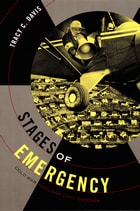
Stages of Emergency
Cold War Nuclear Civil DefenseTracy C. Davis
Duke University Press, 2007
Stages of Emergency covers public education campaigns and school programs—such as the ubiquitous “duck and cover” drills—meant to heighten awareness of the dangers of a possible attack, the occupancy tests in which people stayed sequestered for up to two weeks to simulate post-attack living conditions as well as the effects of confinement on interpersonal dynamics, and the British first-aid training in which participants acted out psychological and physical trauma requiring immediate treatment. Davis also brings to light unpublicized government exercises aimed at anticipating the global effects of nuclear war. Her comparative analysis shows how the differing priorities, contingencies, and social policies of the three countries influenced their rehearsals of nuclear catastrophe. When the Cold War ended, so did these exercises, but, as Davis points out in her perceptive afterword, they have been revived—with strikingly similar recommendations—in response to twenty-first-century fears of terrorists, dirty bombs, and rogue states.
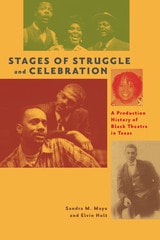
Stages of Struggle and Celebration
A Production History of Black Theatre in TexasBy Sandra M. Mayo and Elvin Holt
University of Texas Press, 2015
From plantation performances to minstrel shows of the late nineteenth century, the roots of black theatre in Texas reflect the history of a state where black Texans have continually created powerful cultural emblems that defy the clichés of horses, cattle, and bravado. Drawing on troves of archival materials from numerous statewide sources, Stages of Struggle and Celebration captures the important legacies of the dramatic arts in a historical field that has paid most of its attention to black musicians.
Setting the stage, the authors retrace the path of the cakewalk and African-inspired dance as forerunners to formalized productions at theaters in the major metropolitan areas. From Houston’s Ensemble and Encore Theaters to the Jubilee in Fort Worth, gospel stage plays of the Black Academy of Arts and Letters in Dallas, as well as San Antonio’s Hornsby Entertainment Theater Company and Renaissance Guild, concluding with ProArts Collective in Austin, Stages of Struggle and Celebration features founding narratives, descriptions of key players and memorable productions, and enlightening discussions of community reception and the business challenges faced by each theatre. The role of drama departments in historically black colleges in training the companies’ founding members is also explored, as is the role the support of national figures such as Tyler Perry plays in ensuring viability. A canon of Texas playwrights completes the tour. The result is a diverse tribute to the artistic legacies that continue to inspire new generations of producers and audiences.
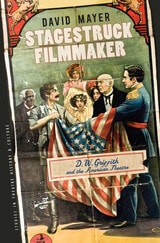
Stagestruck Filmmaker
D. W. Griffith and the American TheatreDavid Mayer
University of Iowa Press, 2009
Combining the raw materials of theatre, circus, minstrelsy, and dance with the newer visual codes of motion pictures, Griffith became the first acknowledged artist of American film. Birth of a Nation in particular demonstrates the degree to which he was influenced by the racist justifications and distorting interpretations of the Civil War and the Reconstruction era. Moving through the major phases of Griffith’s career in chapters organized around key films or groups of films, Mayer provides a mesmerizing account of the American stage and cinema in the final years of the nineteenth century and the first three decades of the twentieth century.
Griffith’s relationship to the theatre was intricate, complex, and enduring. Long recognized as the dominant creative figure of American motion pictures, throughout twenty-six years of making more than five hundred films he pillaged, adapted, reshaped, revitalized, preserved, and extolled. By historicizing his representations of race, ethnicity, and otherness, Mayer places Griffith within an overall template of American life in the years when film rivaled and then surpassed the theatre in popularity.
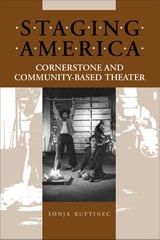
Staging America
Cornerstone and Community-Based TheaterSonja Kuftinec
Southern Illinois University Press, 2005
This captivating studymaps a history and theory of community-based theater in the United States through the Cornerstone Theater Company. Detailing how the performance-making process contributes to an ongoing negotiation of American identity, Sonja Kuftinec investigates community-based theater to trace the historical affiliations of the form and critically examines how community-based theater both enables community and challenges the very notion of “community” as a stable site.
The process of making and unmaking community is vividly illuminated in the work of the Cornerstone Theater Company, a Los Angeles-based ensemble founded in 1986. From 1986 to 1991, Cornerstone toured nationwide, working mainly with rural towns to create adaptations of classical texts. A Wild West musical Hamlet was performed with residents of Marmarth, North Dakota (population 190), and The House on Walker River, an adaptation of the Oresteia trilogy, was developed with a Native American reservation in Nevada. Since 1991, Cornerstone has performed with urban communities, developing original shows and adaptations of Western and non-Western texts incorporating local histories and community players. These performances rearticulate distinctions among various urban group and between amateur and professional theater.
While Cornerstone’s contemporary work can be contextualized within a historical tradition of grassroots performance, it also complicates this tradition, suggesting that identity may be more dynamic than rooted. By using Cornerstone as a case study, Kuftinec’s analysis of community-based theater’s impact upon rural, urban, and professional sites across the United States proposes that “community” and “America” are vital terms of negotiation rather than fixed entities.
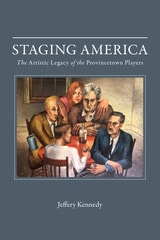
Staging America
The Artistic Legacy of the Provincetown PlayersJeffery Kennedy
University of Alabama Press, 2023
A comprehensive history of the Provincetown Players and their influence on modern American theatre
The Provincetown Players created a revolution in American theatre, making room for truly modern approaches to playwriting, stage production, and performance unlike anything that characterized the commercial theatre of the early twentieth century. In Staging America: The Artistic Legacy of the Provincetown Players, Jeffery Kennedy gives readers the unabridged story in a meticulously researched and comprehensive narrative that sheds new light on the history of the Provincetown Players. This study draws on many new sources that have only become available in the last three decades; this new material modifies, refutes, and enhances many aspects of previous studies.
At the center of the study is an extensive account of the career of George Cram Cook, the Players’ leader and artistic conscience, as well as one of the most significant facilitators of modernist writing in early twentieth-century American literature and theatre. It traces Cook’s mission of “cultural patriotism,” which drove him toward creating a uniquely American identity in theatre. Kennedy also focuses on the group of friends he calls the “Regulars,” perhaps the most radical collection of minds in America at the time; they encouraged Cook to launch the Players in Provincetown in the summer of 1915 and instigated the move to New York City in fall 1916.
Kennedy has paid particular attention to the many legends connected to the group (such as the “discovery” of Eugene O’Neill), and also adds to the biographical record of the Players’ forty-seven playwrights, including Susan Glaspell, Neith Boyce, Edna St. Vincent Millay, Floyd Dell, Rita Wellman, Mike Gold, Djuna Barnes, and John Reed. Kennedy also examines other fascinating artistic, literary, and historical personalities who crossed the Players’ paths, including Emma Goldman, Charles Demuth, Berenice Abbott, Sophie Treadwell, Theodore Dreiser, Claudette Colbert, and Charlie Chaplin. Kennedy highlights the revolutionary nature of those living in bohemian Greenwich Village who were at the heart of the Players and the America they were responding to in their plays.
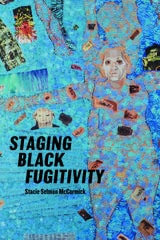
Staging Black Fugitivity
Stacie Selmon McCormick
The Ohio State University Press, 2019
McCormick traces the innovative ways that artists render slavery for present-day audiences. The dramas assembled in this book approach slavery from myriad perspectives—afrofuturist, feminist, and queer—in order to produce new imaginaries that offer more complex depictions of black experience. Through subverting notions of time, race, gender, and familiar histories of slavery themselves, the dramas under discussion produce performances of fugitivity—subversive, radical, and experimental performances of black artistic and political freedom at the site of slavery.
Staging Consciousness
Theater and the Materialization of MindWilliam W. Demastes
University of Michigan Press, 2002
William W. Demastes makes use of the writings of such varied theater practitioners as Antonin Artaud, Jerzy Grotowski, Samuel Beckett, Tony Kushner, Sam Shepard, Spalding Gray, Peter Shaffer, and others, illuminating theater as proof that mind is an extension of body. The living stage incubates and materializes thought in a way that highlights the processes of daily existence outside the theater. This book offers a new way for theater practitioners to look at the unique value of the theater and an invitation for philosophers and scientists to search for new paradigms in theater, the oldest of art forms.
William W. Demastes is Professor of English, Louisiana State University. His previous books include Theatre of Chaos: Beyond Absurdism, into Disorderly Order.
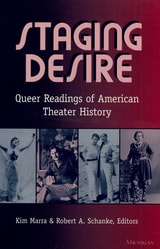
Staging Desire
Queer Readings of American Theater HistoryKim Marra and Robert A. Schanke, Editors
University of Michigan Press, 2002
Essays cover the careers of major figures Clyde Fitch, Rachel Crothers, Mercedes de Acosta, Djuna Barnes, Cole Porter, Lorenz Hart, George Kelly, William Inge, James "Acorn" Oaks, Adam "Vagabond" Badeau, Eric Bentley, Loie Fuller, Robert Edmond Jones, and Jean Rosenthal. Grounded in research into the history of sexuality, the book engages central problems of terminology and evidence in analyzing sexual practices of the past and the modes of articulation of sexuality in theater, conditioned by American culture's peculiar anxieties about both.
Kim Marra is Associate Professor of Theatre Arts, University of Iowa. Robert A. Schanke is Professor of Theatre, Central College, Iowa. They edited Passing Performances: Queer Readings of Leading Players in American Theater History, a previous volume in this series.
Staging Desire
Queer Readings of American Theater HistoryKim Marra and Robert A. Schanke, Editors
University of Michigan Press, 0
Staging Existence
Chekhov's TetralogySvetlana Evdokimova
University of Wisconsin Press, 2023
Svetlana Evdokimova tackles this gap in Chekhov scholarship, examining the profound connections between his unstated philosophy and his artistic production. Arguing that Chekhov’s four major plays (The Cherry Orchard, Three Sisters, The Seagull, and Uncle Vanya) constitute a kind of cycle, Staging Existence offers a major reappraisal of this critical playwright in Russian intellectual history. Evdokimova’s deep, careful research into Chekhov’s engagement with contemporary philosophy provides insight into both Chekhov’s oeuvre and the writer himself.
Staging History
1780-1840Edited by Michael Burden, Wendy Heller, Jonathan Hicks, and Ellen Lockhart
Bodleian Library Publishing, 2016
Drawing on copious new research, Staging History reexamines extraordinary theatrical works of the period to show the role they played in shaping popular interpretations of history. Editors Michael Burden, Wendy Heller, Jonathan Hicks, and Ellen Lockhart are joined by other experts in the field in analyzing theatrical documents, including playbills, set designs, and musical scores, as well as paintings, prints, and other illustrations, in order to explore what counted as historical truth for the writers, performers, and audiences of these plays.
Staging Lives in Latin American Theater
Bodies, Objects, ArchivesPaola S. Hernández
Northwestern University Press, 2021
Richly detailed, nuanced, and theoretically wide-ranging, Staging Lives in Latin American Theater reveals a range of interpretations about how documentary theater can conceptualize the idea of self while also proclaiming a new mode of testimony through theatrical practices.
Staging Masculinity
The Rhetoric of Performance in the Roman WorldErik Gunderson
University of Michigan Press, 2000
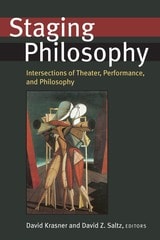
Staging Philosophy
Intersections of Theater, Performance, and PhilosophyDavid Krasner and David Z. Saltz, Editors
University of Michigan Press, 2010
Staging Philosophy raises issues of critical importance by providing case studies of various philosophical movements and schools of thought, including aesthetics, analytic philosophy, phenomenology, deconstruction, critical realism, and cognitive science. The essays, which are organized into three sections—history and method, presence, and reception—take up fundamental issues such as spectatorship, empathy, ethics, theater as literature, and the essence of live performance. While some essays challenge assertions made by critics and historians of theater and performance, others analyze the assumptions of manifestos that prescribe how practitioners should go about creating texts and performances. The first book to bridge the disciplines of theater and philosophy, Staging Philosophy will provoke, stimulate, engage, and ultimately bring theater to the foreground of intellectual inquiry while it inspires further philosophical investigation into theater and performance.
David Krasner is Associate Professor of Theater Studies, African American Studies, and English at Yale University. His books include A Beautiful Pageant: African American Theatre, Drama, and Performance in the Harlem Renaissance, 1910-1920 and Renaissance, Parody, and Double Consciousness in African American Theatre, 1895-1910. He is co-editor of the series Theater: Theory/Text/Performance.
David Z. Saltz is Professor of Theatre Studies and Head of the Department of Theatre and Film Studies at the University of Georgia. He is coeditor of Theater Journal and is the principal investigator of the innovative Virtual Vaudeville project at the University of Georgia.
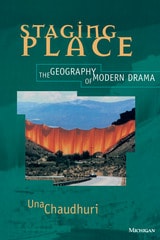
Staging Place
The Geography of Modern DramaUna Chaudhuri
University of Michigan Press, 1997
Chaudhuri starts with a discussion of a "poetics of exile" in early modern drama, where the figure of home is constructed as a locus of two conflicting impulses: the desire to find a stable site for individual identity and the desire to deterritorialize the self. By mid-century, she argues, a new discourse of "failed homecoming" begins to displace this geopathic model and replace the poetics of exile with a grim anti-poetics of immigration. She then employs postmodern and postcolonial theories of place and culture to define the emerging multiculturalism as a creative reworking of the figures of home, homecoming, homelessness, immigration and exile.
"This is a book of real originality. Its treatment of space in modern drama is elegant and powerful. . . ." --William B. Worthen, Northwestern University
"Staging Place is a powerfully written book, deft in its handling of familiar and unfamiliar plays alike and eclectic in its use of theatrical sources." --Essays in Theatre/ Études théâtrales
"This sophisticated and well-written study for graduate students and their teachers explores modern drama's preoccupation with the seemingly irreconcilable discontinuities between the notions of home and homelessness, belonging and exile. . . . The readings of individual plays are fresh and invigorating. . . ." --Choice
Una Chaudhuri is Associate Professor of English, New York University.
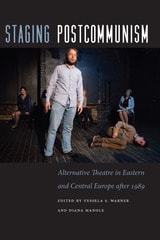
Staging Postcommunism
Alternative Theatre in Eastern and Central Europe after 1989Vessela S. Warner and Diana Manole
University of Iowa Press, 2020
Contributors: Dennis Barnett, Dennis C. Beck, Violeta Decheva, Luule Epner, John Freedman, Barry Freeman, Margarita Kompelmakher, Jaak Rahesoo, Angelina Ros¸ca, Ban¸uta Rubess, Christopher Silsby, Andrea Tompa, S. E. Wilmer
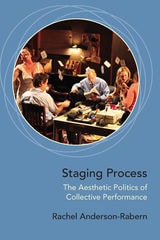
Staging Process
The Aesthetic Politics of Collective PerformanceRachel Anderson-Rabern
Northwestern University Press, 2020
Rachel Anderson-Rabern explores the ideas of boredom and quotidian employment that permeate particular performance projects. Using Henri Lefebvre’s concepts of work roles within everyday philosophy, she demonstrates that collective creation gives rise to new economies of performance. The book also presents theories of the political stakes of danced gestural forms in performance, informed by Giorgio Agamben’s writings on gesture, and elaborates the ways in which these ensembles make use of durational performance to posit ethical frameworks: ways of living in the world.
Conversing with the ideas of Paul Virilio and Guy Debord among others, Anderson- Rabern claims that these groups posit new models of aesthetic politics through careful, speed-based investigations of construction and destruction that unearth the powerful potential of contemporary collaborative methods to be at once aesthetically minded, ethically driven, and politically engaged.
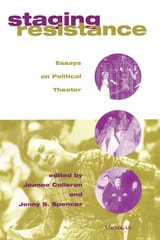
Staging Resistance
Essays on Political TheaterJeanne Colleran and Jenny S. Spencer, Editors
University of Michigan Press, 1998
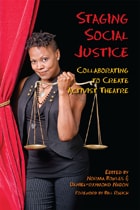
Staging Social Justice
Collaborating to Create Activist TheatreEdited by Norma Bowles and Daniel-Raymond Nadon
Southern Illinois University Press, 2013
Normal.dotm0011901163SIU Press195141012.00false18 pt18 pt00falsefalsefalseFringe Benefits, an award-winning theatre company, collaborates with schools and communities to create plays that promote constructive dialogue about diversity and discrimination issues. Staging Social Justice is a groundbreaking collection of essays about Fringe Benefits’ script-devising methodology and their collaborations in the United States, Australia, Canada and the United Kingdom. The anthology also vividly describes the transformative impact of these creative initiatives on participants and audiences. By reflecting on their experiences working on these projects, the contributing writers—artists, activists and scholars—provide the readerwith tools and inspiration to create their own theatre for social change.
“Contributors to this big-hearted collection share Fringe Benefits’ play devising process, and a compelling array of methods for measuring impact, approaches to aesthetics (with humor high on the list), coalition and community building, reflections on safe space, and acknowledgement of the diverse roles needed to apply theatre to social justice goals. The book beautifully bears witness to both how generative Fringe Benefits’ collaborations have been for participants and to the potential of engaged art in multidisciplinary ecosystems more broadly.”—Jan Cohen-Cruz, editor of Public: A Journal of Imagining America
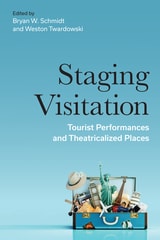
Staging Visitation
Tourist Performances and Theatricalized PlacesBryan Schmidt and Weston Twardowski
University of Michigan Press, 2026
Staging Visitation frames tourism and travel as complex social performances that shape identities, communities, and global imaginaries. This volume proposes “visitation” as a framework that emphasizes the participatory and relational dimensions of travel. While tourism is often pejoratively framed as a commodified or exploitative leisure activity for those with means, its reality is far more nuanced. Tourism stages heritage, provokes encounters across cultural divides, and prompts both visitors and hosts to negotiate values and identities—all while sustaining economies (and the power relations they produce) at global and local scales.
From museums and theme parks to festivals and influencer culture, the essays in this volume trace how transitory encounters—embodied, affective, and historically layered—build travel destinations into theatricalized places. These essays bring theater and performance studies into conversation with cultural geography, sociology, anthropology, and media studies to demonstrate how tourism functions as both a stage and a repertoire for modern life.
Staging Visitation argues that travel is not only about movement across space, but also about the performance of culture itself—its preservation, reinvention, and transformation.
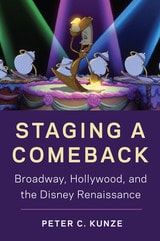
Staging a Comeback
Broadway, Hollywood, and the Disney RenaissancePeter C. Kunze
Rutgers University Press, 2023
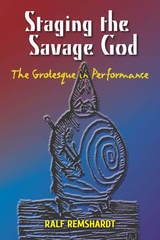
Staging the Savage God
The Grotesque in PerformanceRalf Remshardt
Southern Illinois University Press, 2004
In this broadly conceived study, Ralf Remshardt delineates the theatre’s deep connection with the grotesque and traces the historically extensive and theoretically intensive relationship between performance and its “other,” the grotesque. Staging the Savage God: The Grotesque in Performance examines the aesthetic complicity shared by the two in both art and theatre and presents a general theory of the grotesque.
Performing the grotesque is both a challenge to a culture’s order and the affirmation of certain ethical principles that it recognizes as its own. Remshardt investigates the aesthetics and ideology of grotesque theatre from antiquity—in works such as The Bacchae and Thyestes—to modernity—in Ubu Roi and Hamletmachine—and opens up new critical possibilities for the analysis of both classical and avant-gardetheatre.
Divided into three sections, Staging the Savage God first interrogates the grotesque as primarily a visual artistic and theatrical mode and then inventories various critical approaches to the grotesque, establishing the outlines of a theory with regard to drama. In the most extensive part of the study, Remshardt shifts his emphasis to the theatre of the grotesque, from self-consuming tragedies and the modernist trope of the artificial human figure to the characterology of the grotesque. Remshardt’s conclusion takes bold steps toward unraveling the paradox inherent in the grotesque theatre.
Written in an engaging style and aided by nine illustrations, Staging the Savage God is a comprehensive and rigorous study that incorporates critical approaches from disciplines such as philosophy, psychoanalysis, art history, literature, and theatre to fully investigate the historical function of the grotesque in performance.
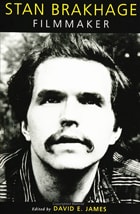
Stan Brakhage
FilmmakerDavid James
Temple University Press, 2005
Stand-up Comedy in Theory, or, Abjection in America
John Limon
Duke University Press, 2000
Limon begins with stand-up comics in the 1950s and 1960s—Lenny Bruce, Carl Reiner, Mel Brooks, Mike Nichols, Elaine May—when the norm of the profession was the Jewish, male, heterosexual comedian. He then moves toward the present with analyses of David Letterman, Richard Pryor, Ellen DeGeneres, and Paula Poundstone. Limon incorporates feminist, race, and queer theories to argue that the “comedification” of America—stand-up comedy’s escape from its narrow origins—involves the repossession by black, female, queer, and Protestant comedians of what was black, female, queer, yet suburbanizing in Jewish, male, heterosexual comedy. Limon’s formal definition of stand-up as abject art thus hinges on his claim that the great American comedians of the 1950s and 1960s located their comedy at the place (which would have been conceived in 1960 as a location between New York City or Chicago and their suburbs) where body is thrown off for the mind and materiality is thrown off for abstraction—at the place, that is, where American abjection has always found its home.
Standby
An Approach to Theatrical DesignJoshua Langman
Southern Illinois University Press, 2022
A groundbreaking philosophy of design for the stage
Standby proposes a practical philosophy of contemporary theatrical design that addresses all design disciplines, all theatrical collaborators, and all forms of theatre, from the traditional to the avant-garde. In a field that is too often dismissed as purely technical, Joshua Langman celebrates design as a transformative force with the power to elevate a performance and enable it to resonate beyond the bounds of its physical production. Beginning with the proposition that design contributes essential layers of meaning to an experience, Standby argues for a unique approach centered on the creation of revelatory theatrical moments.
In a mission to illuminate the soul of the craft, Langman investigates the purposes of design, details the elements of a production concept, uncovers the mechanics of creating meaning, explores the relationship of theatrical design to fine art and art history, and offers practical guidance on designing productions. He also considers what has changed as designers have embraced digital technology and suggests fifteen concrete methods for preserving the magic of live theatre in a digital age. Blending scholarship and storytelling, personal experience and contrarian wisdom, Standby challenges theatre-makers to harness the rich dramatic potential of theatrical design.
For additional information and supplemental materials, please visit www.standbybook.com.

Stanley Kubrick Produces
James Fenwick
Rutgers University Press, 2021
Making use of overlooked archival sources and uncovering newly discovered ‘lost’ Kubrick projects (The Cop Killer, Shark Safari, and The Perfect Marriage among them), as well as providing the first detailed overview of the World Assembly of Youth film, James Fenwick provides a comprehensive account of Kubrick’s life and career and of how he managed to obtain the level of control that he possessed by the 1970s. Along the way, the book traces the rapid changes taking place in the American film industry in the post-studio era, uncovering new perspectives about the rise of young independent producers, the operations of influential companies such as Seven Arts and United Artists, and the whole field of film marketing.

Stanley Kubrick at Look Magazine
Authorship and Genre in Photojournalism and FilmPhilippe D. Mather
Intellect Books, 2013
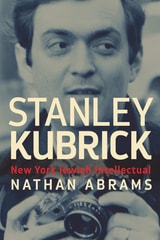
Stanley Kubrick
New York Jewish IntellectualAbrams, Nathan
Rutgers University Press, 2018
Stanley Kubrick reexamines the director’s work in context of his ethnic and cultural origins. Focusing on several of Kubrick’s key themes—including masculinity, ethical responsibility, and the nature of evil—it demonstrates how his films were in conversation with contemporary New York Jewish intellectuals who grappled with the same concerns. At the same time, it explores Kubrick’s fraught relationship with his Jewish identity and his reluctance to be pegged as an ethnic director, manifest in his removal of Jewish references and characters from stories he adapted.
As he digs deep into rare Kubrick archives to reveal insights about the director’s life and times, film scholar Nathan Abrams also provides a nuanced account of Kubrick’s cinematic artistry. Each chapter offers a detailed analysis of one of Kubrick’s major films, including Lolita, Dr. Strangelove, 2001, A Clockwork Orange, Barry Lyndon, The Shining, Full Metal Jacket, and Eyes Wide Shut. Stanley Kubrick thus presents an illuminating look at one of the twentieth century’s most renowned and yet misunderstood directors.
Star Attractions
Twentieth-Century Movie Magazines and Global FandomTamar Jeffers McDonald and Lies Lanckman
University of Iowa Press, 2019
During Hollywood’s “classic era,” from the 1920s to 1950s, roughly twenty major fan magazines were offered each month at American newsstands and abroad. These publications famously fed fan obsessions with celebrities such as Mae West and Elvis Presley. Film studies scholars often regard these magazines with suspicion; perhaps due to their reputation for purveying scandal and gossip, their frequent mingling of gushing tone, and blatant falsehood.
Looking at these magazines with fresh regarding eyes and treating them as primary sources, the contributors of this collection provide unique insights into contemporary assumptions about the relationship between fan and star, performer and viewer. In doing so, they reveal the magazines to be a huge and largely untapped resource on a wealth of subjects, including gender roles, appearance and behavior, and national identity.
Contributors: Emily Chow-Kambitsch, Alissa Clarke, Jonathan Driskell, Lucy Fischer, Ann-Marie Fleming, Oana-Maria Mazilu, Adrienne L. McLean, Sarah Polley, Geneviève Sellier, Michael Williams
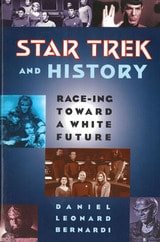
Star Trek and History
Race-ing toward a White FutureBernardi, Daniel Leonard
Rutgers University Press, 1998
Star Trek and History traces the shifting and reforming meaning of race articulated throughout the Star Trek television series, feature films, and fan community. Daniel Bernardi investigates and politicizes the presentation of race in Star Trek in the original series of the 1960s, the feature films and television spin-offs of the 1980s and 1990s, and the current fan community on the Internet. Through both critical and historical analysis, the book proposes a method of studying the framing of race in popular film and television that integrates sociology, critical theory, and cultural studies.
Bernardi examines the representational and narrative functions of race in Star Trek and explores how the meaning of race in the science fiction series has been facilitated or constrained by creative and network decision-making, by genre, by intertextuality, and by fans. He interprets how the changing social and political movements of the times have influenced the production and meaning of Trek texts and the ways in which the ongoing series negotiated and reflected these turbulent histories. Most significantly, Bernardi tells us why is it important for readers to better understand the articulation of race in this enduring icon of American popular culture.