Results by title
4917 books match the query 'Philosophy' and 320 start with s
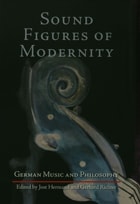
Sound Figures of Modernity
German Music and PhilosophyEdited by Jost Hermand and Gerhard Richter
University of Wisconsin Press, 2006
The rich conceptual and experiential relays between music and philosophy—echoes of what Theodor W. Adorno once called Klangfiguren, or "sound figures"—resonate with heightened intensity during the period of modernity that extends from early German Idealism to the Critical Theory of the Frankfurt School. This volume traces the political, historical, and philosophical trajectories of a specifically German tradition in which thinkers take recourse to music, both as an aesthetic practice and as the object of their speculative work.
The contributors examine the texts of such highly influential writers and thinkers as Schelling, Schopenhauer, Nietzsche, Bloch, Mann, Adorno, and Lukács in relation to individual composers including Beethoven, Wagner, Schönberg, and Eisler. Their explorations of the complexities that arise in conceptualizing music as a mode of representation and philosophy as a mode of aesthetic practice thematize the ways in which the fields of music and philosophy are altered when either attempts to express itself in terms defined by the other.
Contributors: Albrecht Betz, Lydia Goehr, Beatrice Hanssen, Jost Hermand, David Farrell Krell, Ludger Lütkehaus, Margaret Moore, Rebekah Pryor Paré, Gerhard Richter, Hans Rudolf Vaget, Samuel Weber
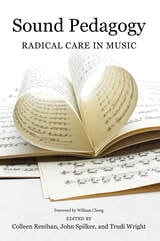
Sound Pedagogy
Radical Care in MusicEdited by Colleen Renihan, John Spilker, and Trudi Wright. Foreword by William Cheng
University of Illinois Press, 2024
Contributors: Molly M. Breckling, William A. Everett, Kate Galloway, Sara Haefeli, Eric Hung, Stephanie Jensen-Moulton, Mark Katz, Nathan A. Langfitt, Matteo Magarotto, Mary Natvig, Frederick A. Peterbark, Laura Moore Pruett, Colleen Renihan, Amanda Christina Soto, John Spilker, Reba A. Wissner, and Trudi Wright

Sound Sentiment
Peter Kivy
Temple University Press, 1989
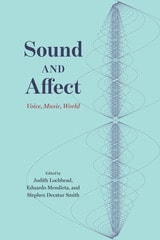
Sound and Affect
Voice, Music, WorldEdited by Judith Lochhead, Eduardo Mendieta, and Stephen Decatur Smith
University of Chicago Press, 2021
Sound and Affect maps a new territory for inquiry at the intersection of music, philosophy, affect theory, and sound studies. The essays in this volume consider objects and experiences marked by the correlation of sound and affect, in music and beyond: the voice, as it speaks, stutters, cries, or sings; music, whether vocal, instrumental, or machine-made; and our sonic environments, whether natural or artificial, and how they provoke responses in us. Far from being stable, correlations of sound and affect are influenced and even determined by factors as diverse as race, class, gender, and social and political experience. Examining these factors is key to the project, which gathers contributions from a cross-disciplinary roster of scholars, including both established and new voices. This agenda-setting collection will prove indispensable to anyone interested in innovative approaches to the study of sound and its many intersections with affect and the emotions.
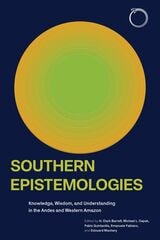
Southern Epistemologies
Knowledge, Wisdom, and Understanding in the Andes and Western AmazonEdited by H. Clark Barrett, Michael L. Cepek, Pablo Quintanilla, Emanuele Fabiano, and Edouard Machery
HAU, 2026
What does it mean to know, and how is knowledge practiced? How can Indigenous perspectives challenge conventional concepts of knowledge in the Global North? Drawing on Indigenous epistemologies from the Andes and Western Amazon, Southern Epistemologies investigates how knowledge, wisdom, and understanding are shaped by local cultures, languages, bodies, and environments.
Bringing together linguists, philosophers, anthropologists, and Indigenous knowledge holders, the volume examines the dynamic interactions between culture, language, and place, showing how the unique linguistic histories and worldviews of Andean and Amazonian societies inform distinct ways of knowing. By interpreting these perspectives on their own terms, the book offers fresh insights into the plurality and diversity of human knowledge.
As the first volume specifically focused on Indigenous South American epistemologies, Southern Epistemologies foregrounds Indigenous knowledge systems and science while fostering dialogue with academic traditions. By opening new interdisciplinary and cross-cultural conversations, this groundbreaking volume challenges conventional notions of knowledge and illuminates how engagement with Indigenous perspectives can expand and enrich our understanding of what it truly means to know.
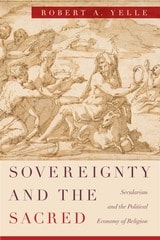
Sovereignty and the Sacred
Secularism and the Political Economy of ReligionRobert A. Yelle
University of Chicago Press, 2018
Developing this close analogy between two elemental domains of society, Sovereignty and the Sacred offers a new theory of religion while suggesting alternative ways of organizing our political and economic life. By rethinking the transcendent foundations and liberating potential of both religion and politics, Yelle points to more hopeful and ethical modes of collective life based on egalitarianism and popular sovereignty. Deliberately countering the narrowness of currently dominant economic, political, and legal theories, he demonstrates the potential of a revived history of religions to contribute to a rethinking of the foundations of our political and social order.
Sovereignty in Ruins
A Politics of CrisisGeorge Edmondson and Kalus Mladek, editors
Duke University Press, 2017
Contributors. Judith Butler, George Edmondson, Roberto Esposito, Carlo Galli, Klaus Mladek, Alberto Moreiras, Andrew Norris, Eric L. Santner, Adam Sitze, Carsten Strathausen, Rei Terada, Cary Wolfe
Sovereignty, Inc.
Three Inquiries in Politics and EnjoymentWilliam Mazzarella, Eric L. Santner, and Aaron Schuster
University of Chicago Press, 2020
Drawing on anthropology, political theory, philosophy, psychoanalysis, and theater, William Mazzarella, Eric L. Santner, and Aaron Schuster show how politics in the age of Trump functions by mobilizing a contradictory and convoluted enjoyment, an explosive mixture of drives and fantasies that eludes existing portraits of our era. The current political moment turns out to be not so much exceptional as exceptionally revealing of the constitutive tension between enjoyment and economy that has always been a key component of the social order. Santner analyzes the collective dream-work that sustains a new sort of authoritarian charisma or mana, a mana-facturing process that keeps us riveted to an excessively carnal incorporation of sovereignty. Mazzarella examines the contemporary merger of consumer brand and political brand and the cross-contamination of politics and economics, warning against all too easy laments about the corruption of politics by marketing. Schuster, focusing on the extreme theatricality and self-satirical comedy of the present, shows how authority reasserts itself at the very moment of distrust and disillusionment in the system, profiting off its supposed decline. A dazzling diagnostic of our present, Sovereignty, Inc., forces us to come to terms with our complicity in Trump’s political presence and will immediately take its place in discussions of contemporary politics.
Space and Pluralism
Can Contemporary Cities Be Places of Tolerance?Stefano Moroni
Central European University Press, 2016

Spacings--of Reason and Imagination
In Texts of Kant, Fichte, HegelJohn Sallis
University of Chicago Press, 1987
Sallis focuses on certain operations of "spacing" in metaphysics—textual lapses and leaps in which reason is displaced or suspended or abridged. In the project of establishing priority of reason, such operations can appear only in disguise, and Sallis reveals the play of imagination and metaphor that masks them. Concentrating on what has been called the closure of metaphysics, he examines texts in which the suppression of spacing would be carried out most rigorously, texts in which even metaphysics itself is seen as only an errant roaming, a spacing that must still be secured, to be replaced by a pure space of truth. And yet, in these very texts Sallis identifies outbreaks of spacing that would disrupt the tranquil space of reason. Rather than closure, he finds an opening of reason to imagination.
Sallis's reading of a metaphorical system in the Critique of Pure Reason reveals a fissuring and historicizing of what would otherwise be called pure reason. Next he traces in Fichte's major work as well as in several lesser-known texts a decentering from reason to imagination, which he characterizes as a power of hovering between opposites and beyond being. Sallis then returns to the Critique of Pure Reason to expose, in relation to the famous question of the common root of reason and sensibility, a certain eccentricity of reason. Proceeding to the Critique of Judgment, he traces a divergence of sublime nature away from that supersensible space of reason to which Kant would otherwise assimilate it—a withdrawal toward an abyss. Finally, Sallis turns to Hegel's Encyclopedia, supplementing his reading with previously unknown notes from Hegel's lectures on those sections dealing with imagination; his reading of those sections serves to expose, within the most rigorous reduction of spacing in the history of metaphysics, an irrepressible and disseminative play of imagination.
Spare the Rod
Punishment and the Moral Community of SchoolsCampbell F. Scribner and Bryan R. Warnick
University of Chicago Press, 2021
Spare the Rod traces the history of discipline in schools and its ever increasing integration with prison and policing, ultimately arguing for an approach to discipline that aligns with the moral community that schools could and should be.
In Spare the Rod, historian Campbell F. Scribner and philosopher Bryan R. Warnick investigate the history and philosophy of America’s punishment and discipline practices in schools. To delve into this controversial subject, they first ask questions of meaning. How have concepts of discipline and punishment in schools changed over time? What purposes are they supposed to serve? And what can they tell us about our assumptions about education? They then explore the justifications. Are public school educators ever justified in punishing or disciplining students? Are discipline and punishment necessary for students’ moral education, or do they fundamentally have no place in education at all? If some form of punishment is justified in schools, what ethical guidelines should be followed?
The authors argue that as schools have grown increasingly bureaucratic over the last century, formalizing disciplinary systems and shifting from physical punishments to forms of spatial or structural punishment such as in-school suspension, school discipline has not only come to resemble the operation of prisons or policing, but has grown increasingly integrated with those institutions. These changes and structures are responsible for the school-to-prison pipeline. They show that these shifts disregard the unique status of schools as spaces of moral growth and community oversight, and are incompatible with the developmental environment of education. What we need, they argue, is an approach to discipline and punishment that fits with the sort of moral community that schools could and should be.
Speaking into the Air
A History of the Idea of CommunicationJohn Durham Peters
University of Chicago Press, 1999
"This is a most interesting and thought-provoking book. . . . Peters maintains that communication is ultimately unthinkable apart from the task of establishing a kingdom in which people can live together peacefully. Given our condition as mortals, communication remains not primarily a problem of technology, but of power, ethics and art." —Antony Anderson, New Scientist
"Guaranteed to alter your thinking about communication. . . . Original, erudite, and beautifully written, this book is a gem." —Kirkus Reviews
"Peters writes to reclaim the notion of authenticity in a media-saturated world. It's this ultimate concern that renders his book a brave, colorful exploration of the hydra-headed problems presented by a rapid-fire popular culture." —Publishers Weekly
What we have here is a failure-to-communicate book. Funny thing is, it communicates beautifully. . . . Speaking Into the Air delivers what superb serious books always do-hours of intellectual challenge as one absorbs the gradually unfolding vision of an erudite, creative author." —Carlin Romano, Philadelphia Inquirer
Speaking the Incomprehensible God
Thomas Aquinas on the Interplay of Positive and Negative TheologyGregory P. Rocca O.P.
Catholic University of America Press, 2004
Speaking the Truth about Oneself
Lectures at Victoria University, Toronto, 1982Michel Foucault
University of Chicago Press, 2021
Just before the summer of 1982, French philosopher Michel Foucault gave a series of lectures at Victoria University in Toronto. In these lectures, which were part of his project of writing a genealogy of the modern subject, he is concerned with the care and cultivation of the self, a theme that becomes central to the second, third, and fourth volumes of his History of Sexuality. Foucault had always been interested in the question of how constellations of knowledge and power produce and shape subjects, and in the last phase of his life, he became especially interested not only in how subjects are formed by these forces but in how they ethically constitute themselves.
In this lecture series and accompanying seminar, Foucault focuses on antiquity, starting with classical Greece, the early Roman empire, and concluding with Christian monasticism in the fourth and fifth centuries AD. Foucault traces the development of a new kind of verbal practice—“speaking the truth about oneself”—in which the subject increasingly comes to be defined by its inner thoughts and desires. He deemed this new form of “hermeneutical” subjectivity important not just for historical reasons, but also due to its enduring significance in modern society.
Speaking
(La Parole)Georges Gusdorf
Northwestern University Press, 1965

Spectacular Death
Interdisciplinary Perspectives on Mortality and (Un)RepresentabilityEdited by Tristanne Connolly
Intellect Books, 2011
A collection of essays on the medical and social articulation of death, this anthologyconsiders to what extent a subject as elusive as death can be examined. Though it touches us all, we can perceive it only in life—with the predictable result that we treat it either as a clinical or social problem to be managed or as a phenomenon to be studied quantitatively.
This volume goes beyond these models to self-reflexively question how the management of death is organized and motivated and the ways that death is at once feared and embraced. Drawing on the very latest in the medical humanities, Spectacular Death gives us an enlightening new perspective on death from the classical world to the twenty-first century.
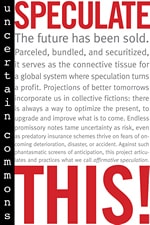
Speculate This!
Uncertain Commons
Duke University Press, 2013
Speculation
Politics, Ideology, EventGlyn Daly
Northwestern University Press, 2019
Speculation: Politics, Ideology, Event develops Hegel’s radical perspective of speculative thought as a way of reclaiming and revitalizing the sense of the future and its possibilities. Engaging with such figures as Alain Badiou, Quentin Meillassoux, Ernesto Laclau, Slavoj Žižek, and Fredric Jameson, Glyn Daly articulates the distinctness of speculative philosophy and draws its implications for new debates in areas of science, politics, capitalism, ideology, ethics, and the event.
In a confrontation with today’s fatalistic milieu, principal emphasis is given to Hegel’s idea of infinity as the intrinsic dimension of negativity within all finitude. Against the modern era’s paradigmatic tendency to externalize social problems in the form of antagonism and Otherness, Daly argues for a renewal of utopian thought based on Hegelian reconciliation and the affirmation of excess as the essence of all being. On these grounds, he advances a new kind of political imagination that in speculative terms centers on uncompromising notions of truth and reason.
Speculative Formalism
Literature, Theory, and the Critical PresentTom Eyers
Northwestern University Press, 2017
Through a combination of philosophical reflection and close rhetorical readings, Eyers explores the possibilities and limits of deconstructive approaches to the literary, the impact of the “digital humanities” on theory, and the prospects for a formalist approach to “world literature.” The book includes sustained close readings of Baudelaire, Mallarmé, Yeats, and Wallace Stevens, as well as Alain Badiou, Paul de Man, and Fredric Jameson.
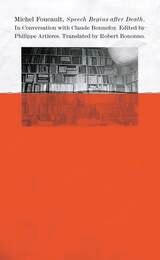
Speech Begins after Death
Michel Foucault
University of Minnesota Press, 2016
In 1968, Michel Foucault agreed to a series of interviews with critic Claude Bonnefoy, which were to be published in book form. Bonnefoy wanted a dialogue with Foucault about his relationship to writing rather than about the content of his books. The project was abandoned, but a transcript of the initial interview survived and is now being published for the first time in English. In this brief and lively exchange, Foucault reflects on how he approached the written word throughout his life, from his school days to his discovery of the pleasure of writing.
Wide ranging, characteristically insightful, and unexpectedly autobiographical, the discussion is revelatory of Foucault’s intellectual development, his aims as a writer, his clinical methodology (“let’s say I’m a diagnostician”), and his interest in other authors, including Raymond Roussel and Antonin Artaud. Foucault discloses, in ways he never had previously, details about his home life, his family history, and the profound sense of obligation he feels to the act of writing. In his Introduction, Philippe Artières investigates Foucault’s engagement in various forms of oral discourse—lectures, speeches, debates, press conferences, and interviews—and their place in his work.
Speech Begins after Death shows Foucault adopting a new language, an innovative autobiographical communication that is neither conversation nor monologue, and is one of his most personal statements about his life and writing.
Speech Genres and Other Late Essays
By M.M. Bakhtin
University of Texas Press, 1986
Speech Genres and Other Late Essays presents six short works from Bakhtin's Esthetics of Creative Discourse, published in Moscow in 1979. This is the last of Bakhtin's extant manuscripts published in the Soviet Union. All but one of these essays (the one on the Bildungsroman) were written in Bakhtin's later years and thus they bear the stamp of a thinker who has accumulated a huge storehouse of factual material, to which he has devoted a lifetime of analysis, reflection, and reconsideration.
Speech and Phenomena
And Other Essays on Husserl's Theory of SignsJacques Derrida
Northwestern University Press, 1973

Spinoza Now
Dimitris Vardoulakis
University of Minnesota Press, 2010
Engaging with Spinoza’s insistence on the centrality of the passions as the site of the creative and productive forces shaping society, this collection critiques the impulse to transcendence and regimes of mastery, exposing universal values as illusory. Spinoza Now pursues Spinoza’s challenge to abandon the temptation to think through the prism of death in order to arrive at a truly liberatory notion of freedom. In this bold endeavor, the essays gathered here extend the Spinozan project beyond the disciplinary boundaries of philosophy to encompass all forms of life-affirming activity, including the arts and literature. The essays, taken together, suggest that “Spinoza now” is not so much a statement about a “truth” that Spinoza’s writings can reveal to us in our present situation. It is, rather, the injunction to adhere to the attitude that affirms both necessity and impossibility.
Contributors: Alain Badou, École Normale Supérieure; Mieke Bal, Amsterdam School for Cultural Analysis; Cesare Casarino, U of Minnesota; Justin Clemens, U of Melbourne; Simon Duffy, U of Sydney; Sebastian Egenhofer, U of Basel; Alexander García Düttmann, Goldsmiths, U of London; Arthur Jacobson, Yeshiva U; A. Kiarina Kordela, Macalester College; Michael Mack, U of Nottingham; Warren Montag, Occidental College; Antonio Negri; Christopher Norris, U of Cardiff, Wales; Anthony Uhlmann, U of Western Sydney.
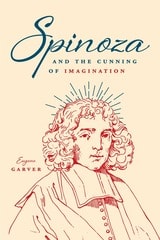
Spinoza and the Cunning of Imagination
Eugene Garver
University of Chicago Press, 2018
Spinoza initially presents imagination as an inadequate and confused way of thinking, always inferior to ideas that adequately represent things as they are. It would seem to follow that one ought to purge the mind of imaginative ideas and replace them with rational ideas as soon as possible, but as Garver shows, the Ethics don’t allow for this ultimate ethical act until one has cultivated a powerful imagination. This is, for Garver, “the cunning of imagination.” The simple plot of progress becomes, because of the imagination, a complex journey full of reversals and discoveries. For Garver, the “cunning” of the imagination resides in our ability to use imagination to rise above it.
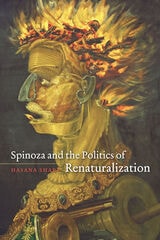
Spinoza and the Politics of Renaturalization
Hasana Sharp
University of Chicago Press, 2011
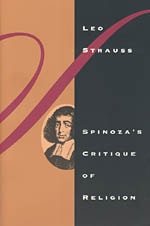
Spinoza's Critique of Religion
Leo Strauss
University of Chicago Press, 1965
Strauss's autobiographical Preface, traces his dilemmas as a young liberal intellectual in Germany during the Weimar Republic, as a scholar in exile, and as a leader of American philosophical thought.
"[For] those interested in Strauss the political philosopher, and also those who doubt whether we have achieved the 'final solution' in respect to either the character of political science or the problem of the relation of religion to the state." —Journal of Politics
"A substantial contribution to the thinking of all those interested in the ageless problems of faith, revelation, and reason." —Kirkus Reviews
Leo Strauss (1899-1973) was the Robert Maynard Hutchins Distinguished Service Professor Emeritus of political science at the University of Chicago. His contributions to political science include The Political Philosophy of Hobbes, The City and the Man, What is Political Philosophy?, and Liberalism Ancient and Modern.
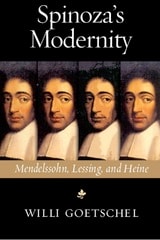
Spinoza's Modernity
Mendelssohn, Lessing, and HeineWilli Goetschel
University of Wisconsin Press, 2004
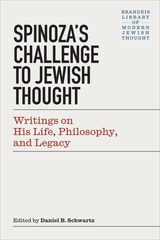
Spinoza’s Challenge to Jewish Thought
Writings on His Life, Philosophy, and LegacyEdited by Daniel B. Schwartz
Brandeis University Press, 2019
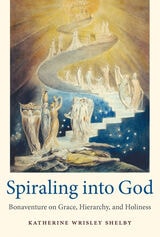
Spiraling Into God
Bonaventure on Grace, Hierarchy , and HolinessKatherine Wrisley Shelby
Catholic University of America Press, 2023
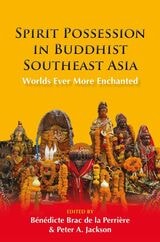
Spirit Possession in Buddhist Southeast Asia
Worlds Ever More EnchantedEdited by Bénédicte Brac de la Perrière and Peter A. Jackson
National University of Singapore Press, 2022
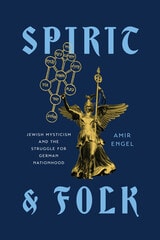
Spirit and Folk
Jewish Mysticism and the Struggle for German NationhoodAmir Engel
University of Chicago Press, 2027
A study of the twentieth-century construction of a Jewish mystical tradition by German Jewish intellectuals.
For most of European history, the notion of Jewish spirituality was unthinkable—buried beneath a pervasive desire to understand Judaism as uniquely material and Christianity as uniquely spiritual. In Spirit and Folk, Amir Engel tells the story of how a group of Jewish intellectuals, seeking greater involvement in political life, worked to invent a mystical tradition for Judaism amid the existential crises of twentieth-century Germany.
Beginning with Martin Buber in 1900 and ending with Gershom Scholem in 1942, Engel traces the rich debate among thinkers both well-known and forgotten about the need to imagine and construct a uniquely Jewish mystical tradition from historical religious sources. This quest and the tradition that emerged, Engel argues, developed in response to one of the most volatile questions of the last century: can Jews be Germans? The invention of Jewish spirituality, Engel shows, was not only a religious innovation but also a political gambit—a demand to be accepted as equal contributors to the German national project.

Spirit's Gift
The Metaphysical Insight of Claude BruaireAntonio López, F.S.C.B.
Catholic University of America Press, 2006

Spirits of the Cold War
Contesting Worldviews in the Classical Age of American Security StrategyNed O'Gorman
Michigan State University Press, 2012
In spring of 1953, newly elected President Eisenhower sat down with his staff to discuss the state of American strategy in the cold war. America, he insisted, needed a new approach to an urgent situation. From this meeting emerged Eisenhower’s teams of “bright young fellows,” charged with developing competing policies, each of which would come to shape global politics. In Spirits of the Cold War, Ned O’Gorman argues that the early Cold War was a crucible not only for contesting political strategies, but also for competing conceptions of America and its place in the world. Drawing on extensive archival research and wide reading in intellectual and rhetorical histories, this comprehensive account shows cold warriors debating “worldviews” in addition to more strictly instrumental tactical aims. Spirits of the Cold War is a rigorous scholarly account of the strategic debate of the early Cold War—a cultural diagnostic of American security discourse and an examination of its origins.
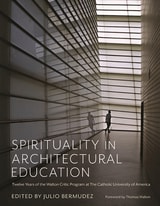
Spirituality in Architectural Education
Twelve Years of the Walton Critic Program at The Catholic University of AmericaJulio Bermudez
Catholic University of America Press, 2021
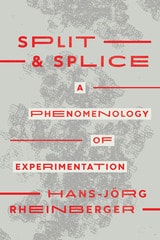
Split and Splice
A Phenomenology of ExperimentationHans-Jörg Rheinberger
University of Chicago Press, 2023
The experiment has long been seen as a test bed for theory, but in Split and Splice, Hans-Jörg Rheinberger makes the case, instead, for treating experimentation as a creative practice. His latest book provides an innovative look at the experimental protocols and connections that have made the life sciences so productive.
Delving into the materiality of the experiment, the first part of the book assesses traces, models, grafting, and note-taking—the conditions that give experiments structure and make discovery possible. The second section widens its focus from micro-level laboratory processes to the temporal, spatial, and narrative links between experimental systems. Rheinberger narrates with accessible examples, most of which are drawn from molecular biology, including from the author’s laboratory notebooks from his years researching ribosomes.
A critical hit when it was released in Germany, Split and Splice describes a method that involves irregular results and hit-or-miss connections—not analysis, not synthesis, but the splitting and splicing that form a scientific experiment. Building on Rheinberger’s earlier writing about science and epistemology, this book is a major achievement by one of today’s most influential theorists of scientific practice.
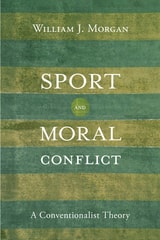
Sport and Moral Conflict
A Conventionalist TheoryWilliam J.Morgan
Temple University Press, 2020
What is the purpose of sport, and how are ethical conceptions of sport shaped by the answers to this question? In Sport and Moral Conflict, William Morgan investigates, examining sport as a moral crucible that puts athletes in competitive, emotionally charged situations where fairness and equality are contested alongside accomplishment.
Morgan looks at the modern Olympics—from 1906 Athens to 1924 Paris, when the Games reached international prestige — in order to highlight the debate about athletic excellence and the amateur-professional divide. Whereas the Americans emphasized winning, the Europeans valued a love of the game. Morgan argues that the existing moral theories of sport—formalism and broad internalism (aka interpretivism), which rely on rules and general principles—fall short when confronted with such a dispute as the transition from amateur to professional sport. As such, he develops a theory of conventionalism, in which the norms at work in athletic communities determine how players should ethically acquit themselves. Presenting his case for an ethical theory of sport, Morgan provides insights regarding the moral controversies and crises that persist today.
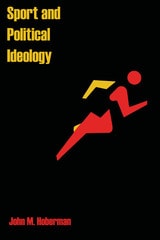
Sport and Political Ideology
By John M. Hoberman
University of Texas Press, 1984
Across the modern political spectrum, left-wing and right-wing political theorists have invested sport with ideological significance. That significance, however, varies distinctively and characteristically with the ideology—a phenomenon John Hoberman terms "ideological differentiation." Taking this phenomenon as its point of departure, this provocative work interprets the major sport ideologies of the twentieth century as distinct expressions of political doctrine.
Hoberman argues that a political ideology's interpretation of sport is shaped in part by the value it assigns to work and play as modes of experience; the political anthropologies of right and left can be distinguished by examining their resistance to—or affinity for—sportive imagery of their leaders and of the state itself; there exists a fascist temperament that shows an affinity to athleticism and the sphere of the body that is not shared by the left.
Tracing modern sport ideology back to its premodern antecedents, Hoberman examines the interpretations of sport that have been promulgated by European political intellectuals, such as cultural conservatives and contemporary neo-Marxists, and by the official ideologists of Nazi Germany, the Soviet Union, the German Democratic Republic, and China before and after Mao.
As a form of mass theater, sport can advertise any ideology. But the deeper relationship between sport and political ideology has never before been explored wth such vigor. Presenting the first general theory of sport and political ideology to appear in any language, Hoberman's groundbreaking work is a unique and invaluable contribution to the intellectual and political history of sport in the twentieth century.
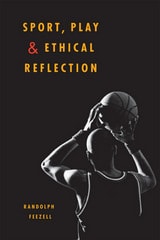
Sport, Play, and Ethical Reflection
Randolph Feezell
University of Illinois Press, 2006
Feezell builds on these conclusions, addressing important ethical issues, arguing that sportsmanship should be seen as a kind of Aristotelian mean between the extremes of over- and under-investment in sport. Chapters on cheating, running up the score, and character building stress sport as a rule-governed, tradition-bound practice with standards of excellence and goods internal to the practice. With clear writing and numerous illuminating examples, Feezell demonstrates deep insight into both of his subjects.

Sport
A Philosophical InquiryPaul Weiss
Southern Illinois University Press, 0
This seminal book breaks new ground and explores new paths: psychological and sociological forms of human behavior exhibited in games; the physiology of athletics, and the efforts of training and conditioning; and the motivation of athletics— the rhythm and aims of contests and games, and the meaning of team play. More importantly, however, Professor Weiss’ s unique contributions lie in his discussions of the distinct contributions that sport makes to civilization.
Professor Weiss discusses at length such topics as the Olympic Games and men and women as amateur and professional athletes— and their sacrifices, defeats, and humiliations. And he delineates the stages the athlete must go through in his progress toward self-completion.

Spurs
Nietzsche's Styles/Eperons: Les Styles de NietzscheJacques Derrida
University of Chicago Press, 1981
Spurs, then, is aptly titled, for Derrida's "deconstructions" of Nietzsche's meanings will surely act as spurs to further thought and controversy. This dual-language edition offers the English-speaking reader who has some knowledge of French an opportunity to examine the stylistic virtuosity of Derrida's writing—of particular significance for his analysis of "the question of style."

Spurs
Nietzsche's Styles/Eperons: Les Styles de NietzscheJacques Derrida
University of Chicago Press, 1981
Spurs, then, is aptly titled, for Derrida's "deconstructions" of Nietzsche's meanings will surely act as spurs to further thought and controversy. This dual-language edition offers the English-speaking reader who has some knowledge of French an opportunity to examine the stylistic virtuosity of Derrida's writing—of particular significance for his analysis of "the question of style."
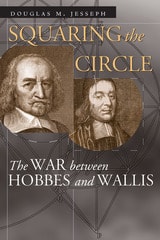
Squaring the Circle
The War between Hobbes and WallisDouglas M. Jesseph
University of Chicago Press, 1999
Hobbes believed that by recasting geometry in a materialist mold, he could solve any geometric problem and thereby demonstrate the power of his materialist metaphysics. Wallis, a prominent Presbyterian divine as well as an eminent mathematician, refuted Hobbes's geometry as a means of discrediting his philosophy, which Wallis saw as a dangerous mix of atheism and pernicious political theory.
Hobbes and Wallis's "battle of the books" illuminates the intimate relationship between science and crucial seventeenth-century debates over the limits of sovereign power and the existence of God.

St. Paul and Epicurus
Norman Wentworth DeWitt
University of Minnesota Press, 1954
St. Paul and Epicurus was first published in 1954. Minnesota Archive Editions uses digital technology to make long-unavailable books once again accessible, and are published unaltered from the original University of Minnesota Press editions.
Everyone who is interesting in the meaning of the Bible will find this a revealing study, for it opens up a new window on the New Testament, a window that was walled up centuries ago by prejudice. Professor DeWitt throws new light on the writings of the Apostle Paul by showing how they were influenced by the teachings of the Greek philosopher Epicurus.
The Epicureanism could have a place in Christian religion may come as a surprise to those familiar with the conventional concept of the philosophy of Epicurus. As demonstrated in the meaning of the English word epicure,derived from the name of the ancient philosopher, the modern world has long associated Epicurus with the indulgence of sensual pleasure in food and drink.
But, as Professor DeWitt makes clear both in this volume and in its predecessor, Epicurus and His Philosophy, the pleasures which the ancient Greek espoused as constituting the chief good of life were not the pleasures of the flesh. The merit and the lure, however, of the Epicurean ethic, which allied happiness with pleasure, were so appealing and so widely acknowledged that Paul had no choice but to adopt it and bless it for his followers with the sanction of religion. He could not, though, admit indebtedness to a philosopher who had long been accused of sensualism and atheism, and there was no choice, therefore, but to consign Epicurus to anonymity.
Through his scholarly investigation into the Epicurean source of certain portions of the Epistles, Professor DeWitt provides new explanations or translations for seventy-six biblical verses. The close scrutiny of biblical passages is carried out, not in a spirit of vandalism, but in a quest for accuracy, and the result is a challenging, readable, and absorbing book.
St. Thomas Aquinas and the Natural Law Tradition
Contemporary PerspectivesJohn Goyette
Catholic University of America Press, 2004
Stacked Deck
A Story of Selfishness in AmericaLawrence E. Mitchell
Temple University Press, 1998
To understand this ideology and its effect on society, Lawrence E. Mitchell instructs us to look at the myth of individualism that pervades our laws, our social thought, our institutions, and our philosophies. It is the touchstone of our national debates on welfare reform, salary equity, FDA regulations, and a criminal defendant's right to a fair trial -- and it even infiltrates our private lives every time we argue about the division of household chores or television time. In Stacked Deck, Mitchell shows us how this artificial reality buries the way we truly live.
Mithcell uses examples drawn from history, politics, law, and culture to show how our singular concern with fairness has diminished our sense of vulnerability, so that our ideas of justice, equality, and efficiency are modeled on the capabilities of the strongest in society. Large scale examples -- such as blue collar layoffs and corporate downsizing, natural disasters and catastrophic illnesses -- illustrates the rickety bridge between comfort and disaster. We must be reminded that we are all vulnerable to the forces of economics, society, politics, and nature. Thus, Mitchell proposes, those who start out at the top tend to stay there, just as the weak tend to remain weak.
Stacked Deck does more than outline this problem of American selfishness; it proposes a solution tha tis nothing less than a massive reconception of the way we relate to one another. Mitchell retains what is productive about the myth of the self-reliant individual, while asserting what is necessary to restore a sense of community. He suggests a sweeping intellectual recovery of fairness available to all levels of American society, thereby reclaiming our true sense of responsibility to others in society.
Staging Existence
Chekhov's TetralogySvetlana Evdokimova
University of Wisconsin Press, 2023
Svetlana Evdokimova tackles this gap in Chekhov scholarship, examining the profound connections between his unstated philosophy and his artistic production. Arguing that Chekhov’s four major plays (The Cherry Orchard, Three Sisters, The Seagull, and Uncle Vanya) constitute a kind of cycle, Staging Existence offers a major reappraisal of this critical playwright in Russian intellectual history. Evdokimova’s deep, careful research into Chekhov’s engagement with contemporary philosophy provides insight into both Chekhov’s oeuvre and the writer himself.
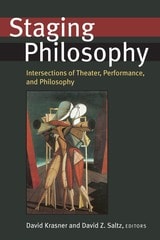
Staging Philosophy
Intersections of Theater, Performance, and PhilosophyDavid Krasner and David Z. Saltz, Editors
University of Michigan Press, 2010
Staging Philosophy raises issues of critical importance by providing case studies of various philosophical movements and schools of thought, including aesthetics, analytic philosophy, phenomenology, deconstruction, critical realism, and cognitive science. The essays, which are organized into three sections—history and method, presence, and reception—take up fundamental issues such as spectatorship, empathy, ethics, theater as literature, and the essence of live performance. While some essays challenge assertions made by critics and historians of theater and performance, others analyze the assumptions of manifestos that prescribe how practitioners should go about creating texts and performances. The first book to bridge the disciplines of theater and philosophy, Staging Philosophy will provoke, stimulate, engage, and ultimately bring theater to the foreground of intellectual inquiry while it inspires further philosophical investigation into theater and performance.
David Krasner is Associate Professor of Theater Studies, African American Studies, and English at Yale University. His books include A Beautiful Pageant: African American Theatre, Drama, and Performance in the Harlem Renaissance, 1910-1920 and Renaissance, Parody, and Double Consciousness in African American Theatre, 1895-1910. He is co-editor of the series Theater: Theory/Text/Performance.
David Z. Saltz is Professor of Theatre Studies and Head of the Department of Theatre and Film Studies at the University of Georgia. He is coeditor of Theater Journal and is the principal investigator of the innovative Virtual Vaudeville project at the University of Georgia.
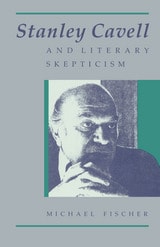
Stanley Cavell and Literary Skepticism
Michael Fischer
University of Chicago Press, 1989
Throughout his study, Fischer focuses on skepticism, a central concern of Cavell's multifaceted work. Cavell, following J. L. Austin and Wittgenstein, does not refute the radical epistemological questioning of Descartes, Hume, and others, but rather characterizes skepticism as a significant human possibility or temptation. As presented by Fischer, Cavell's accounts of both external-world and other-minds skepticism share significant affinities with deconstruction, a connection overlooked by contemporary literary theorists.
Fischer follows Cavell's lead in examining how different genres address the problems raised by skepticism and goes on to show how Cavell draws on American and English romanticism in fashioning a response to it. He concludes by analyzing Cavell's remarks about current critical theory, focusing on Cavell's uneasiness with some of the conclusions reached by its practitioners. Fischer shows that Cavell's insights, grounded in powerful analyses of Descartes, Hume, and Wittgenstein, permit a fresh view of Derrida, Miller, de Man, and Fish. The result is not only a revealing characterization of deconstruction but a much-needed and insightful introduction to Cavell's rich but difficult oeuvre.
Star Apocrypha
Christopher Buckley
Northwestern University Press, 2001

Stardust
Cinematic Archives at the End of the WorldHannah Goodwin
University of Minnesota Press, 2024
An exploration of the fundamental bond between cinema and the cosmos
The advent of cinema occurred alongside pivotal developments in astronomy and astrophysics, including Albert Einstein’s theories of relativity, all of which dramatically altered our conception of time and provided new means of envisioning the limits of our world. Tracing the many aesthetic, philosophical, and technological parallels between these fields, Stardust explores how cinema has routinely looked toward the cosmos to reflect our collective anxiety about a universe without us.
Employing a “cosmocinematic gaze,” Hannah Goodwin uses the metaphorical frameworks from astronomy to posit new understandings of cinematic time and underscore the role of light in generating archives for an uncertain future. Surveying a broad range of works, including silent-era educational films, avant-garde experimental works, and contemporary blockbusters, she carves out a distinctive area of film analysis that extends its reach far beyond mainstream science fiction to explore films that reckon with a future in which humans are absent.
This expansive study details the shared affinities between cinema and the stars in order to demonstrate how filmmakers have used cosmic imagery and themes to respond to the twentieth century’s moments of existential dread, from World War I to the atomic age to our current moment of environmental collapse. As our outlook on the future continues to change, Stardust illuminates the promise of cinema to bear witness to humanity’s fragile existence within the vast expanse of the universe.