Results by title
8812 books match the query 'Political Science' and 537 start with s
Social Science and Policy-Making
A Search for Relevance in the Twentieth CenturyDavid L. Featherman and Maris A. Vinovskis, Editors
University of Michigan Press, 2001
Social Science for What?
Philanthropy and the Social Question in a World Turned Rightside UpAlice O'Connor
Russell Sage Foundation, 2007
Social Science, Social Policy, and the Law
Patricia Ewick
Russell Sage Foundation, 1999
Social Security Pension Reform in Europe
Edited by Martin Feldstein and Horst Siebert
University of Chicago Press, 2002
The essays here highlight the problems that the European pension reform process faces and how it differs from that of the United States. This timely volume will significantly enrich the debate on pension reform worldwide.

Social Security Programs and Retirement Around the World
Pension Reforms and the Health Distribution of RetireesEdited by Axel Börsch-Supan and Courtney C. Coile
University of Chicago Press, 2027
A wide-ranging comparative analysis of the effects of pension reforms on health outcomes among retirees.
Pension reforms enacted in many developed economies since the late 1990s have raised statutory retirement ages and reduced benefit generosity, prompting concerns that working longer, especially in physically demanding jobs, could widen health disparities among retirees. Social Security Programs and Retirement Around the World: Pension Reforms and the Health Distribution of Retirees examines whether these reforms have altered the distribution of health outcomes in nine countries—Belgium, Canada, Denmark, Germany, Italy, Japan, the Netherlands, Spain, and the United States. Drawing on harmonized longitudinal data spanning roughly two decades and measuring health along five dimensions—functional, diagnosed, comprehensive, mental, and cognitive—the country studies find a remarkably consistent picture: in every country but the United States, health inequality among retirees has not increased significantly over the period in which benefits fell and retirement ages rose. The United States, in contrast to the other nations, shows rising inequality in functional and comprehensive health, particularly among women. The findings suggest that in most countries, pension reforms have not so far come at the cost of a widening health gap between richer and poorer retirees, although noisy data and the still-short observation window admit the possibility of effects that have yet to fully emerge.
Social Security Programs and Retirement Around the World
The Effects of Pension Reforms on the Income Distribution of RetireesEdited by Axel Börsch-Supan and Courtney C. Coile
University of Chicago Press, 0
A wide-ranging comparative analysis of the effects of pension reforms on the income distribution among retirees.
Pension reforms enacted in many developed economies since the late 1990s increased labor force participation among older workers. Did they also generate greater inequality in retirement income? Social Security Programs and Retirement Around the World: The Effects of Pension Reforms on the Income Distribution of Retirees examines whether these reforms redistributed social security wealth in ways that disproportionately benefited or harmed retirees at different points in the income distribution. The chapters present country-specific analyses for Belgium, Canada, Denmark, France, Germany, Italy, Japan, the Netherlands, Spain, and the United Kingdom. Using microdata and counterfactual simulations, they find a quite varied picture: in six of the ten countries studied, pension reform reduced income inequality among retirees, while in three countries the reforms expanded it. Across countries, benefit-level changes, rather than behavioral responses to altered retirement incentives, account for most of the redistributive impact. In countries that cut benefits uniformly, lower-income retirees suffered more than higher-income retirees due to shorter life expectancies. When new programs supplemented across-the-board cuts with support for lower earners, however, inequality declined.

Social Security Programs and Retirement around the World
Disability Insurance Programs and RetirementEdited by David A. Wise
University of Chicago Press, 2015
The sixth stage of an ongoing research project studying the relationship between social security programs and labor force participation, this volume draws on the work of an eminent group of international economists to consider the extent to which differences in labor force participation across countries are determined by the provisions of disability insurance programs. Presented in an easily comparable way, their research covers twelve countries, including Canada, Japan, and the United States, and considers the requirements of disability insurance programs, as well as other pathways to retirement.
Social Security Programs and Retirement around the World
Micro-EstimationEdited by Jonathan Gruber and David A. Wise
University of Chicago Press, 2003
In this volume, the authors turn to a country-by-country analysis of retirement behavior based on micro-data. The result of research compiled by teams in twelve countries, the volume shows an almost uniform correlation between levels of social security incentives and retirement behavior in each country. The estimates also show that the effect is strikingly uniform in countries with very different cultural histories, labor market institutions, and other social characteristics.
Social Security Programs and Retirement around the World
The Effects of Reforms on Retirement BehaviorEdited by Axel Börsch-Supan and Courtney C. Coile
University of Chicago Press, 2025
A global analysis of the effects of social security reforms on the retirement incentives and labor force trends of older workers.
Employment among older men and women has increased dramatically in recent years, reversing a downward trend in the closing decades of the twentieth century. Social Security Programs and Retirement around the World examines how changing retirement incentives have reshaped labor force participation trends among older workers. The chapters feature country-specific analyses for Belgium, Canada, Denmark, France, Germany, Italy, Japan, Netherlands, Spain, Sweden, the United Kingdom, and the United States. They find that while there is significant heterogeneity across countries, the reforms of recent decades have generally reduced the implicit tax on work at older ages. These changes correlate positively with labor force participation. The studies exploit the variation in the timing and extent of reforms of retirement incentives and employ microeconometric methods to investigate whether this correlation reflects a causal relationship. Policy changes appear to have contributed to rising labor force activity, but other factors like the role of women in the labor force, improved health, and changes in private pensions likely also play important roles.
Social Security
The Phony CrisisDean Baker and Mark Weisbrot
University of Chicago Press, 1999
According to the authors of this important new study, the answer to these questions is a resounding no. In Social Security: The Phony Crisis, economists Dean Baker and Mark Weisbrot argue that there is no economic, demographic, or actuarial basis for the widespread belief that the program needs to be fixed.
As the authors emphasize, there is virtually no disagreement about the facts of Social Security's finances, or even the projections for its future. Rather, the Social Security debate has been foundering on misconceptions, confusion, and lack of agreement on the meaning of crucial terms.
The authors also take on related issues: that privatization would help save Social Security, that America has a pressing need to increase its national savings, and that future generations will suffer from the costs—especially for health care—of supporting a growing elderly population.
As New York Times columnist Fred Brock recently wrote, "So-called reform of the Social Security system is looking more and more like a solution in search of a problem." In this accessible and insightful work, Baker and Weisbrot seek to cut through some of the myths and fallacies surrounding this crucial policy issue.
"Dean Baker and Mark Weisbrot have no trouble at all demonstrating that even on highly conservative assumptions about economic growth, the much-forecast insolvency of the Social Security system by about 2030 is most unlikely to happen then, if indeed ever."—The Economist
"The authors challenge basic assumptions with vigor and intelligence. . . . An absolutely relevant and important analysis, presented with force and clarity, that asks, basically, what kind of a nation we really are."—Kirkus Reviews
"Proponents—like George W. Bush—of Social Security privatization . . . typically ignore prospects for a stagnant or falling stock market. In Social Security: The Phony Crisis, [Baker and Weisbrot] show how a falling stock market could place pressure on both future Social Security payments and privatization schemes because earnings from the trust fund could actually fall."—Jeff Madrick, New York Review of Books
Social Stratification in Central Mexico, 1500-2000
By Hugo G. Nutini and Barry L. Isaac
University of Texas Press, 2009
In Aztec and colonial Central Mexico, every individual was destined for lifelong placement in a legally defined social stratum or estate. Social mobility became possible after independence from Spain in 1821 and increased after the 1910–1920 Revolution. By 2000, the landed aristocracy that was for long Mexico's ruling class had been replaced by a plutocracy whose wealth derives from manufacturing, commerce, and finance—but rapid growth of the urban lower classes reveals the failure of the Mexican Revolution and subsequent agrarian reform to produce a middle-class majority. These evolutionary changes in Mexico's class system form the subject of Social Stratification in Central Mexico, 1500–2000, the first long-term, comprehensive overview of social stratification from the eve of the Spanish Conquest to the end of the twentieth century.
The book is divided into two parts. Part One concerns the period from the Spanish Conquest of 1521 to the Revolution of 1910. The authors depict the main features of the estate system that existed both before and after the Spanish Conquest, the nature of stratification on the haciendas that dominated the countryside for roughly four centuries, and the importance of race and ethnicity in both the estate system and the class structures that accompanied and followed it. Part Two portrays the class structure of the post-revolutionary period (1920 onward), emphasizing the demise of the landed aristocracy, the formation of new upper and middle classes, the explosive growth of the urban lower classes, and the final phase of the Indian-mestizo transition in the countryside.
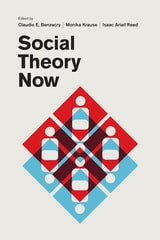
Social Theory Now
Edited by Claudio E. Benzecry, Monika Krause, and Isaac Ariail Reed
University of Chicago Press, 2017
The book provides a strategic window onto social theory based on current research, examining trends in classical traditions and the cutting edge of more recent approaches. From distinctive theoretical positions, contributors address questions about how social order is accomplished; the role of materiality, practice, and meaning; as well as the conditions for the knowledge of the social world. The theoretical traditions presented include cultural sociology, microsociologies, world-system theory and post-colonial theory, gender and feminism, actor network and network theory, systems theory, field theory, rational choice, poststructuralism, pragmatism, and the sociology of conventions. Each chapter introduces a tradition and presents an agenda for further theoretical development. Social Theory Now is an essential tool for sociologists. It will be central to the discussion and teaching of contemporary social theory for years to come.

Social Trust in the Nordic World
Gert Tinggaard Svendsen and Christian Bjørnskov
University of Wisconsin Press, 2023
Is the Nordic countries’ high level of social trust just as important for creating prosperity and happiness within a population as other, more tangible economic factors? If so, where does this stock of social trust in Scandinavia come from? Does it help to explain the development of the universal welfare states and their surprisingly high business competitiveness? Can other nations learn from the region and apply that knowledge to settings where social trust levels are low or in danger of being eroded?
Social trust has proven economic value, and Gert Tinggaard Svendsen warns that its benefits should never be taken for granted. Trust can dissolve and vanish quickly, and once gone, it is very difficult to rebuild. Governments and corporations are gradually increasing their control over people’s public and private lives, with predictably worrying results. When people feel taken advantage of or lied to, public confidence evaporates. Since strong social cohesion drives long-term prosperity, Nordic exceptionalism on maintaining and restoring trust offers valuable lessons.
Social Work Research
Methods for the Helping ProfessionsEdited by Norman A. Polansky
University of Chicago Press, 1975
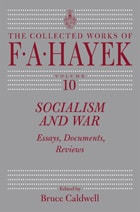
Socialism and War
Essays, Documents, ReviewsF. A. Hayek
University of Chicago Press, 1997
Opening with Hayek's arguments against market socialism, the volume continues with his writings on the economics of war, many in response to the proposals made in John Maynard Keynes's famous pamphlet, How to Pay for the War. The last section presents articles that anticipated The Road to Serfdom, Hayek's classic meditation on the dangers of collectivism. An appendix contains a number of topical book reviews written by Hayek during this crucial period, and a masterful introduction by the volume editor, Bruce Caldwell, sets Hayek's work in context.
Socialism and War will interest not just fans of The Road to Serfdom, but anyone concerned with the ongoing debates over the propriety of government intervention in the economy.
"When he wrote The Road to Serfdom, [Hayek's] was a voice in the wilderness. Now the fight [has] been taken up by people all over the world, by institutions and movements, and the ideas that seemed so strange to many in 1944 can be found from scholarly journals to television programs."—Thomas Sowell, Forbes
"Intellectually [Hayek] towers like a giant oak in a forest of saplings."—Chicago Tribune
"Each new addition to The Collected Works of F. A. Hayek, the University of Chicago's painstaking series of reissues and collections, is a gem."—Liberty on Volume IX of The Collected Works of F. A. Hayek

Socialism, Capitalism and Alternatives
Area Studies and Global TheoriesEdited by Peter J. S. Duncan and Elisabeth Schimpfössl
University College London, 2019
Through analysis of post-Socialist Russia and Central and Eastern Europe, as well as of the United Kingdom, China, and the United States, Socialism, Capitalism and Alternatives confronts the difficulty we face in articulating alternatives to capitalism, socialism, and threatening populist regimes. Beginning with accounts of the impact of capitalism on countries left behind by the planned economies, the book moves on to consider how China has become a beacon of dynamic economic growth, aggressively expanding its global influence. The final section of the book poses alternatives to the ideological dominance of neoliberalism in the West.
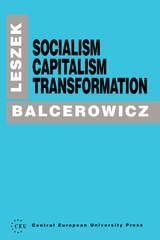
Socialism, Capitalism, Transformation
Leszek Balcerowicz
Central European University Press, 1995

Socialism
An Analysis of its Past and FutureErzsébet Szalai
Central European University Press, 2005

Socialist Feminism
A New ApproachFrieda Afary
Pluto Press, 2022
What is socialist feminism and why is it needed to fight the global rise of authoritarianism and fascism?
Frieda Afary brings the insights gained through her study of feminist philosophy, her international activism, and her work in community education as a public librarian in Los Angeles, offering a bold new vision of an alternative to capitalism, racism, sexism, heterosexism, and alienation.
Socialist Feminism: A New Approach reclaims theories of women’s oppression through a return to humanism, enriched by social reproduction theories, Black feminist intersectionality, abolitionism, queer theories, Marxist-Humanism, and the author’s own experiences as an Iranian American feminist, scholar, and activist.
She looks at global developments in gender relations since the 1980s, the impact of the Covid-19 pandemic, the distinct features of twenty-first-century authoritarianism, and current struggles against it, drawing out lessons for revolutionary theorizing, organizing, and international solidarity including the #MeToo and Black Lives Matter movements.
This book also contains a study guide that transforms it into a useful pedagogical tool for teachers and activists.

Socialist Feminism
A New ApproachFrieda Afary
Pluto Press, 2022
A new take on a powerful and revolutionary movement.
What is socialist feminism and why is it needed to fight the global rise of authoritarianism and fascism?
Frieda Afary brings the insights gained through her study of feminist philosophy, her international activism, and her work in community education as a public librarian in Los Angeles, offering a bold new vision of an alternative to capitalism, racism, sexism, heterosexism, and alienation.
Socialist Feminism: A New Approach reclaims theories of women’s oppression through a return to humanism, enriched by social reproduction theories, Black feminist intersectionality, abolitionism, queer theories, Marxist-Humanism, and the author’s own experiences as an Iranian American feminist, scholar, and activist.
She looks at global developments in gender relations since the 1980s, the impact of the Covid-19 pandemic, the distinct features of twenty-first-century authoritarianism, and current struggles against it, drawing out lessons for revolutionary theorizing, organizing, and international solidarity including the #MeToo and Black Lives Matter movements.
Contains a study guide that transforms it into a useful pedagogical tool for teachers and activists.
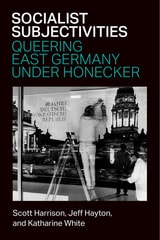
Socialist Subjectivities
Queering East Germany under HoneckerScott Harrison, Jeff Hayton, and Katharine White, Editors
University of Michigan Press, 2025
Whether one was an apparatchik, artist, or alcoholic, the everyday interactions, experiences, and rituals of late socialism proved crucial to establishing the conditions around which subjecthood was constructed. Despite stereotypes of apathy and inertia, East Germans lent a considerable dynamism to their society, and by generating a cacophony of opinions and a heterogeneity of ideas, they constantly transformed state socialism. By foregrounding socialist subjects and the iterative nature of socialism during these decades, this volume paints a richer portrait of East Germany—one that illuminates how East Germans imagined their futures in a society whose collapse they could not foresee.

Society, Power, and Land in Northeastern Zimbabwe, ca. 1560–1960
Admire Mseba
Ohio University Press, 2024
This book refocuses attention on how regimes of power rooted in kinship, gender, generation, and status have, individually and in combination, informed access to land in precolonial northeastern Zimbabwe. It then examines how these regimes of power interacted with colonial policies to inform the African experience in colonial Zimbabwe. Further, the book places land and the ability to ensure its fecundity at the center of the making and moderation of precolonial political power and how this power was impacted by the imposition of colonial rule.
Tracing the dynamics of land and power from precolonial times, together with their entanglement with colonial policies, is important, for this relationship is almost always neglected by both scholars and policymakers drawn to the high drama of colonial and postcolonial politics of land. This oversight has real consequences on our understandings of landed inequalities and how they are addressed. When Zimbabwe’s postcolonial state focused on colonially induced racialized land inequalities, its land reform efforts left older forms of landed inequalities based on gender, generation, and ideas of belonging intact. The book, which details these inequalities, reminds Zimbabweans and others that if the quest for equity espoused in postcolonial land reforms is to be meaningful, it must be attentive to both colonially induced inequalities and those enduring disparities that predated, were deepened by, and outlived colonial rule. At the same time, Zimbabweans who now live with a postcolonial state that is increasingly centralizing power over land may well learn from past societies’ creative efforts to limit the authority of their leaders.
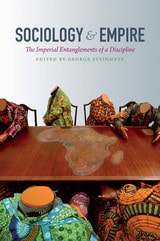
Sociology and Empire
The Imperial Entanglements of a DisciplineGeorge Steinmetz, ed.
Duke University Press, 2013
The collection has a threefold agenda: to trace an intellectual history of sociology as it pertains to empire; to offer empirical studies based around colonies and empires, both past and present; and to provide a theoretical basis for future sociological analyses that may take empire more fully into account. In the 1940s, the British Colonial Office began employing sociologists in its African colonies. In Nazi Germany, sociologists played a leading role in organizing the occupation of Eastern Europe. In the United States, sociology contributed to modernization theory, which served as an informal blueprint for the postwar American empire. This comprehensive anthology critiques sociology's disciplinary engagement with colonialism in varied settings while also highlighting the lasting contributions that sociologists have made to the theory and history of imperialism.
Contributors. Albert Bergesen, Ou-Byung Chae, Andy Clarno, Raewyn Connell, Ilya Gerasimov, Julian Go, Daniel Goh, Chandan Gowda, Krishan Kumar, Fuyuki Kurasawa, Michael Mann, Marina Mogilner, Besnik Pula, Anne Raffin, Emmanuelle Saada, Marco Santoro, Kim Scheppele, George Steinmetz, Alexander Semyonov, Andrew Zimmerman

Sociology on Film
Postwar Hollywood's Prestige CommodityCagle, Chris
Rutgers University Press, 2016

Socrates Founding Political Philosophy in Xenophon's "Economist", "Symposium", and "Apology"
Thomas L. Pangle
University of Chicago Press, 2020
Unlike the Socrates of Plato, Xenophon’s Socrates is more complicated and human, an individual working out the problem of what it means to live well and virtuously. While the Memorabilia defends Socrates by stressing his likeness to conventionally respectable gentlemen, Xenophon’s remaining Socratic texts offer a more nuanced characterization by highlighting how Socrates also diverges from conventions of gentlemanliness in his virtues, behaviors, and peculiar views of quotidian life and governmental rule. One question threads through the three writings: Which way of life best promotes human existence, politics, and economics—that of the Socratic political philosopher with his philosophic virtues or that of the gentleman with his familial, civic, and moral virtues? In uncovering the nuances of Xenophon’s approach to the issue in the Economist, Symposium, and Apology, Pangle’s book cements the significance of these writings for the field and their value for shaping a fuller conception of just who Socrates was and what he taught.
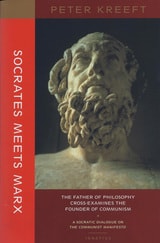
Socrates Meets Marx
The Father of Philosophy Cross-examines the Founder of CommunismPeter Kreeft
St. Augustine's Press, 2003
Humorous, frank, and insightful, this book challenges the reader to step in and take hold of what is right and to cast away what is wrong. Topics covered included such varied subjects as private property, the individual, the Three Philosophies of Man, women, individualism, and more. A wonderful introduction to philosophy for the neophyte, and a joy for the experienced student of thought.
“Imagine two of the most influential thinkers of all time, and two of the most diametrically opposed, thrust together in a no holds barred debate about some of the most important questions: Does man move the world or is he only a puppet of forces beyond his control? Is there a human nature or only market forces? Is Communism the liberator of mankind or a deadly scourge? In Peter Kreeft’s Socrates Meets Marx, the father of philosophy cross examines the founder of communism using the Communist Manifesto, details from the life of Marx himself, and the witnesses of history as evidence to be considered for judgment. If only every edition of the Communist Manifesto would have been bound together with a copy of this book, the world would be a much saner place.” – Christopher Kaczor, author of Proportionalism and the Natural Law Tradition
Soft Corruption
How Unethical Conduct Undermines Good Government and What To Do About ItSchluter, William E
Rutgers University Press, 2017
In this searing personal narrative, the former state senator recounts his fight to expose and reform these acts of government misconduct. Not afraid to cite specific cases of soft corruption in New Jersey politics, he paints a vivid portrait of public servants who care more about political power and personal gain than the public good. By recounting events that he witnessed firsthand in the Garden State, he provides dramatic illustrations of ills that afflict American politics nationwide.
As he identifies five main forms of soft corruption, Schluter diagnoses the state government’s ethical malaise, and offers concrete policy suggestions for how it might be cured. Not simply a dive through the muck of New Jersey politics, Soft Corruption is an important first step to reforming our nation’s political system, a book that will inspire readers to demand that our elected officials can and must do better.
Visit: www.softcorruption.com (http://www.softcorruption.com)
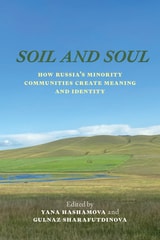
Soil and Soul
How Russia’s Minority Communities Create Meaning and IdentityEdited by Yana Hashamova and Gulnaz Sharafutdinova
University of Wisconsin Press, 2027
By landmass, Russia is the world’s largest country, due largely to centuries of military expansion, imperial rule, and colonization. As a result, it contains people of many ethnicities, nationalities, religions, and languages. Yet Russia’s non-Russian, Indigenous, and minority communities have often been marginalized by state policy and underrepresented in scholarship. Soil and Soul explores how these communities sustain distinct forms of identity and belonging not only through discourse or state institutions but also through embodied relations with land, nature, and animals. These local practices complicate and unsettle state-centered narratives of Russian cultural superiority by showing how meaning and identity are created through relationships with the nonhuman world. Drawing on decolonial, anthropological, environmental, sociological, linguistic, and geographic approaches, this volume reframes minority agency as ecosocial practice embedded in local ecologies, everyday life, and postimperial power asymmetries.
Contributors: Megan Dixon, Yana Hashamova, Kristina Kovalskaya, Jesko Schmoller, Gulnaz Sharafutdinova, Laura Siragusa, Zoia Tarasova, Baasanjav Terbish

Sol Plaatje
Selected WritingsSol T. Plaatje
Ohio University Press, 1997
These books are not Plaatje’s only claim to fame. In the course of a prolific career he wrote letters to the press, newspaper articles and editorials, pamphlets, political speeches, evidence to government commissions of enquiry, unpublished autobiographical writings, and many personal letters. Together they provide both an engaging personal record and a very readable – and revealing – commentary on South African social and political affairs during the era of segregation, from 1899 through to Plaatje’s tragically early death in 1932.
What he wrote has a unique historical importance, all the more meaningful from the perspective of the 1990s.

Soldier's Paradise
Militarism in Africa after EmpireSamuel Fury Childs Daly
Duke University Press, 2024

Soldiers Of Misfortune
lvoirien Tirailleurs of World War IINancy Ellen Lawler
Ohio University Press, 1992
This is a study of the African veterans of a European war. It is a story of men from the Cote d‘Ivoire, many of whom had seldom traveled more than a few miles from their villages, who served France as tirailleurs (riflemen) during World War II.
Thousands of them took part in the doomed attempt to hold back the armies of the Third Relch in 1940; many were to spend the rest of the war as prisoners in Germany or Occupied France.
Others more fortunate came under the authority of Vichy France, and were deployed in the Defense of the “Motherland” and its overseas possessions against the threat posed by the Allies. By 1943, the tirailleur regiments had passed into the service of de Gaulle’s free French and under Allied command, played a significant role in the liberation of Europe.
In describing these complex events, Dr. Lawler draws upon archives in both France and the Cote d’Ivoire. She also carried out an extensive series of interviews with Ivoirien veterans principally, but not exclusively, from the Korhogo region. The vividness of their testimony gives this study a special character. They talk freely not only of their wartime exploits, but also of their experiences after repatriation.
Lawler allows them to speak for themselves. They express their hatred of forced labor and military conscription, which were features of the colonial system, yet at the same time reveal a pride in having come to the defense of France. They describe their role in the nationalist struggle, as foot soldiers of Felix Houphouet-Boigny, but also convey their sense of having become a lost generation. They recognize that their experiences as French soldiers had become sadly irrelevant in a new nation in quest of its history.

Soldiers, Airmen, Spies, and Whisperers
The Gold Coast in World War IINancy Ellen Lawler
Ohio University Press, 2002
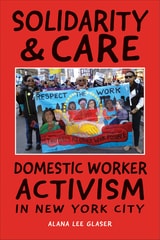
Solidarity & Care
Domestic Worker Activism in New York CityAlana Lee Glaser
Temple University Press, 2023
Solidarity & Care examines the political mobilization of diverse care workers who joined together and supported one another through education, protests, lobbying, and storytelling. Domestic work activists used narrative and emotional appeals to build a coalition of religious communities, employers of domestic workers, labor union members, and politicians to first pass and then to enforce the new law.
Through oral history interviews, as well as ethnographic observation during DWU meetings and protest actions, Glaser chronicles how these women fought (and continue to fight) to improve working conditions. She also illustrates how they endure racism, punitive immigration laws, on-the-job indignities, and unemployment that can result in eviction and food insecurity.
The lessons from Solidarity & Care along with the DWU’s precedent-setting legislative success have applications to workers across industries.
All royalties will go directly to the Domestic Workers United
Solidarity And Contention
Networks Of Polish OppositionMaryjane Osa
University of Minnesota Press, 2003
Offers an innovative model for understanding how social movements occur in repressive societies
After a series of failed attempts at mobilizing society, Poland’s opposition sprang to surprising—and newly effective—life with the formation of the Solidarity trade union in 1980. If not for those past failures, this book suggests, Solidarity might never have succeeded. Solidarity and Contention deftly reconstructs the networks of protest in Communist Poland to show how waves of dissent during the 1950s, 1960s, and 1970s left an organizational residue that both instructed and enabled Solidarity and, ultimately, the Polish revolution.
Using newly available documentary sources, Maryjane Osa establishes links between activists during three waves of protest: 1954 to 1959, 1966 to 1970, and 1976 to 1980. She shows how political challengers, applying lessons drawn from past failures, developed an ideological formula to de-emphasize divisive issues and promote symbolic concerns, thus facilitating coalition building. Solidarity was therefore able to take advantage of a large opposition network already well in place before the founding of the union. An important case study in itself, the book also answers one of the most intriguing questions in social movement research: how can movements emerge in authoritarian states—where media are state controlled, the rights of assembly and speech are restricted, and the risks of collective action are high?
Solidarity and Survival
An Oral History of Iowa Labor in the Twentieth CenturyShelton Stromquist
University of Iowa Press, 1993
In Solidarity and Survival, three generations of Iowa workers tell of their unrelenting efforts to create a labor movement in the coal mines and on the rails, in packinghouses and farm equipment plants, on construction sites and in hospital wards. Drawing on nearly one thousand interviews collected over more than a decade by oral historians working for the Iowa Federation of Labor, AFL-CIO, Shelton Stromquist presents the resonant voices of the men and women who defined a new, prominent place for themselves in the lives of their communities and in the politics of their state.

Solidarity and the Politics of Anti-Politics
Opposition and Reform in Poland since 1968David Ost
Temple University Press, 1991
Solidarity without Borders
Gramscian Perspectives on Migration and Civil SocietyEdited by Óscar García Agustín and Martin Bak Jørgensen
Pluto Press, 2016

Solutions Manual to Elements of Econometrics
Jan Kmenta
University of Michigan Press, 1997
The Solutions Manual to Elements of Econometrics, Second Edition provides chapter solutions to the exercises in the college textbook: Elements of Econometrics, Second Edition by Jan Kmenta.

Solvable
How We Healed the Earth, and How We Can Do It AgainSusan Solomon
University of Chicago Press, 2024
We solved planet-threatening problems before, Susan Solomon argues, and we can do it again. Solomon knows firsthand what those solutions entail. She first gained international fame as the leader of an expedition to Antarctica in 1986, making discoveries that were key to healing the damaged ozone layer. She saw a path—from scientific and public awareness to political engagement, international agreement, industry involvement, and effective action. Solomon, an atmospheric scientist and award-winning author, connects this career-defining triumph to the inside stories of other past environmental victories—against ozone depletion, smog, pesticides, and lead—to extract the essential elements of what makes change possible.
The path to success begins when an environmental problem becomes both personal and perceptible to the general public. Lawmakers, diplomats, industries, and international agencies respond to popular momentum, and effective change takes place in tandem with consumer pressure when legislation and regulation yield practical solutions. Healing the planet is a long game won not by fear and panic but by the union of public, political, and regulatory pressure.
Solvable is a book for anyone who has ever despaired about the climate crisis. As Solomon reminds us, doom and gloom get us nowhere, and idealism will only take us so far. The heroes in these stories range from angry mothers to gang members turned social activists, to upset Long Island birdwatchers to iconoclastic scientists (often women) to brilliant legislative craftsmen. Solomon’s authoritative point of view is an inspiration, a reality check, a road map, and a much-needed dose of realism. The problems facing our planet are Solvable. Solomon shows us how.
Somalia - the Untold Story
The War Through the Eyes of Somali WomenEdited by Judith Gardner and Judy El Bushra
Pluto Press, 2004
In this book, Somali women write and talk about the war, their experiences and the unacceptable choices they often faced. They explain clearly, in their own words, the changes, challenges – and sometimes the opportunities – that war brought, and how they coped with them.
Key themes include the slaughter and loss of men, who were the prime target for killings; rape and sexual violence as a weapon of war; changing roles in the family and within the pastoralist economy; women mobilising for peace; and leading social recovery in a war-torn society.
This book is not only an important record of women's experience of war, but also provides researchers and students of gender and conflict with rare first hand accounts highlighting the impact of war on gender relations, and women's struggle for equal political rights in a situation of state collapse.
Somalis in the Twin Cities and Columbus
Immigrant Incorporation in New DestinationsStephanie Chambers
Temple University Press, 2017
In the early 1990s, Somali refugees arrived in Minneapolis and St. Paul, Minnesota. Later in the decade, an additional influx of immigrants arrived in a second destination of Columbus, Ohio. These refugees found low-skill jobs in warehouses and food processing plants and struggled as social “outsiders,” often facing discrimination based on their religious traditions, dress, and misconceptions that they are terrorists. The immigrant youth also lacked access to quality educational opportunities.
In Somalis in the Twin Cities and Columbus, Stefanie Chambers provides a cogent analysis of these refugees in Midwestern cities where new immigrant communities are growing. Her comparative study uses qualitative and quantitative data to assess the political, economic, and social variations between these urban areas. Chambers examines how culture and history influenced the incorporation of Somali immigrants in the U.S., and recommends policy changes that can advance rather than impede incorporation.
Her robust investigation provides a better understanding of the reasons these refugees establish roots in these areas, as well as how these resettled immigrants struggle to thrive.

Somatic States
On Cartography, Geobodies, Bodily IntegrityFranck Billé
Duke University Press, 2025

Some White Folks
The Interracial Politics of Sympathy, Suffering, and SolidarityJennifer Chudy
University of Chicago Press, 2024
A pioneering exploration of the unexamined roots and effect of racial sympathy within American politics.
There is racial inequality in America, and some people are distressed over it while others are not. This is a book about white people who feel that distress. For decades, political scientists have studied the effects of white racial prejudice, but Jennifer Chudy shows that white racial sympathy for Black Americans’ suffering is also a potent force in modern American politics. Grounded in the history of Black-white relations in America, racial sympathy is unique. It is not equivalent to a low level of racial prejudice or sympathy for other marginalized groups. Some White Folks reveals how racial sympathy shapes a significant number of white Americans’ opinions on policy areas ranging from the social welfare state to the criminal justice system. Under certain circumstances, it can also spur action—although effects on political behavior are weaker and less consistent, for reasons Chudy examines.
Drawing on diverse quantitative and qualitative evidence and integrating insights from multiple disciplines, Chudy explores the origins, importance, and complexity of racial sympathy, as well as the practical implications for political and movement leaders. A companion to the rich literature on prejudice, Some White Folks demonstrates the multifaceted role of race in American politics and public opinion.

Some of the People Who Ate My Barbecue Didn't Vote for Me
The Life of Georgia Governor Marvin GriffinScott E. Buchanan
Vanderbilt University Press, 2011
.
In "Some of the People Who Ate My Barbecue Didn't Vote for Me," Scott Buchanan portrays Marvin Griffin as a Yellow Dog Democrat struggling against inevitable change. Griffin was viewed by many as a charismatic voice of resistance in the Georgia and the South in the wake of Brown v. Board of Education. He combined a staunch segregationist approach with economically progressive policies, assisting in Georgia's transformation from an agrarian economy to a more industrialized one.
Ironically, it was these efforts and the larger shift in politics that doomed Griffin's career, ensuring his administration would last only one term. In many ways, Griffin stands as a clear dividing line between the Old South and the New.
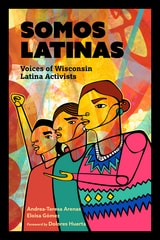
Somos Latinas
Voices of Wisconsin Latina ActivistsAndrea-Teresa Arenas
Wisconsin Historical Society Press, 2018
Celebrated Latina civil rights activist Dolores Huerta once said, “Every moment is an organizing opportunity, every person a potential activist, every minute a chance to change the world.” These are the stories of some of the Latina activists from Wisconsin who have lived Huerta’s words. Somos Latinas shares the powerful narratives of 25 activists—from outspoken demonstrators to collaborative community-builders to determined individuals working for change behind the scenes—providing proof of the long-standing legacy of Latina activism throughout Wisconsin.
Somos Latinas draws on activist interviews conducted as part of the Somos Latinas Digital History Project, housed at the Wisconsin Historical Society, and looks deep into the life and passion of each woman. Though Latinas have a rich history of community activism in the state and throughout the country, their stories often go uncelebrated. Somos Latinas is essential reading for scholars, historians, activists, and anyone curious about how everyday citizens can effect change in their communities.

Sophistry and Political Philosophy
Protagoras' Challenge to SocratesRobert C. Bartlett
University of Chicago Press, 2016
With Sophistry and Political Philosophy, Robert C. Bartlett provides the first close reading of Plato’s two-part presentation of Protagoras. In the “Protagoras,” Plato sets out the sophist’s moral and political teachings, while the “Theaetetus,” offers a distillation of his theoretical and epistemological arguments. Taken together, the two dialogues demonstrate that Protagoras is attracted to one aspect of conventional morality—the nobility of courage, which in turn is connected to piety. This insight leads Bartlett to a consideration of the similarities and differences in the relationship of political philosophy and sophistry to pious faith. Bartlett’s superb exegesis offers a significant tool for understanding the history of philosophy, but, in tracing Socrates’s response to Protagoras’ teachings, Bartlett also builds toward a richer understanding of both ancient sophistry and what Socrates meant by “political philosophy.”

Soul Power
Culture, Radicalism, and the Making of a U.S. Third World LeftCynthia A. Young
Duke University Press, 2006
Young analyzes a range of U.S. figures and organizations, examining how each deployed Third World discourse toward various cultural and political ends. She considers a trip that LeRoi Jones, Harold Cruse, and Robert F. Williams made to Cuba in 1960; traces key intellectual influences on Angela Y. Davis’s writing; and reveals the early history of the hospital workers’ 1199 union as a model of U.S. Third World activism. She investigates Newsreel, a late 1960s activist documentary film movement, and its successor, Third World Newsreel, which produced a seminal 1972 film on the Attica prison rebellion. She also considers the L.A. Rebellion, a group of African and African American artists who made films about conditions in the Watts neighborhood of Los Angeles. By demonstrating the breadth, vitality, and legacy of the work of U.S. Third World Leftists, Soul Power firmly establishes their crucial place in the history of twentieth-century American struggles for social change.
Sound System
The Political Power of MusicDave Randall
Pluto Press, 2017
Sound System is the story of one musician's journey to discover what makes music so powerful. Dave Randall uses his insider's knowledge of the industry to shed light on the secrets of celebrity, commodification and culture.
This is a book of raves, riots and revolution. From the Glastonbury Festival to the Arab Spring, Pop Idol to Trinidadian Carnival, Randall finds political inspiration across the musical spectrum and poses the question: how can we make music serve the interests of the many, rather than the few?
Published in partnership with the Left Book Club.

Sound and Silence
My Experience with China and LiteratureYan Lianke
Duke University Press, 2024

Sounds of the Underground
A Cultural, Political and Aesthetic Mapping of Underground and Fringe MusicStephen Graham
University of Michigan Press, 2016