Results by title
8113 books match the query 'Literary Criticism' and 542 start with s
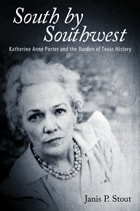
South by Southwest
Katherine Anne Porter and the Burden of Texas HistoryJanis P. Stout
University of Alabama Press, 2013
An interdisciplinary study of Katherine Anne Porter’s troubled relationship to her Texas origins and southern roots, South by Southwest offers a fresh look at this ever-relevant author.
Today, more than thirty years after her death, Katherine Anne Porter remains a fascinating figure. Critics and biographers have portrayed her as a strikingly glamorous woman whose photographs appeared in society magazines. They have emphasized, of course, her writing— particularly the novel Ship of Fools, which was made into an award-winning film, and her collection Pale Horse, Pale Rider, which cemented her role as a significant and original literary modernist. They have highlighted her dramatic, sad, and fragmented personal life. Few, however, have addressed her uneasy relationship to her childhood in rural Texas.
Janis P. Stout argues that throughout Porter’s life she remained preoccupied with the twin conundrums of how she felt about being a woman and how she felt about her Texas origins. Her construction of herself as a beautiful but unhappy southerner sprung from a plantation aristocracy of reduced fortunes meant she construed Texas as the Old South. The Texas Porter knew and re-created in her fiction had been settled by southerners like her grandparents, who brought slaves with them. As she wrote of this Texas, she also enhanced and mythologized it, exaggerating its beauty, fertility, and gracious ways as much as the disaffection that drove her to leave. Her feelings toward Texas ran to both extremes, and she was never able to reconcile them.
Stout examines the author and her works within the historical and cultural context from which she emerged. In particular, Stout emphasizes four main themes in the history of Texas that she believes are of the greatest importance in understanding Porter: its geography and border location (expressed in Porter’s lifelong fascination with marginality, indeterminacy, and escape); its violence (the brutality of her first marriage as well as the lawlessness that pervaded her hometown); its racism (lynchings were prevalent throughout her upbringing); and its marginalization of women (Stout draws a connection between Porter’s references to the burning sun and oppressive heat of Texas and her life with her first husband).

Southern Neogothic
Literary and Cinematic Reckonings from the 1970s to the PresentLee Rozelle
University of Alabama Press, 2026
In Southern Neogothic, Lee Rozelle moves beyond familiar debates that have long dominated studies of the American South, proposing a new framework for understanding how contemporary writers, filmmakers, and artists have transformed the genre’s signature tropes to engage pressing cultural, political, and environmental concerns. Rather than revisiting narratives centered on white grievance, Confederate memory, or Lost Cause mythology, Rozelle examines works that expand Southern Gothic’s reach, connecting regional traditions to global audiences and contemporary struggles over identity, power, and belonging. By demonstrating how contemporary artists have reinvented one of America’s most enduring literary modes, Rozelle offers a fresh and timely account of the genre’s continuing cultural relevance.
Southern Women Playwrights
New Essays in History and CriticismEdited by Robert McDonald and Linda Rohrer Paige
University of Alabama Press, 2001
This timely collection addresses the neglected state of scholarship on southern women dramatists by bringing together the latest criticism on some of the most important playwrights of the 20th century.
Coeditors Robert McDonald and Linda Rohrer Paige attribute the neglect of southern women playwrights in scholarly criticism to "deep historical prejudices" against drama itself and against women artists in general, especially in the South. Their call for critical awareness is answered by the 15 essays they include in Southern Women Playwrights, considerations of the creative work of universally acclaimed playwrights such as Beth Henley, Marsha Norman, and Lillian Hellman (the so-called "Trinity") in addition to that of less-studied playwrights, including Zora Neale Hurston, Carson McCullers, Alice Childress, Naomi Wallace, Amparo Garcia, Paula Vogel, and Regina Porter.
This collection springs from a series of associated questions regarding the literary and theatrical heritage of the southern woman playwright, the unique ways in which southern women have approached the conventional modes of comedy and tragedy, and the ways in which the South, its types and stereotypes, its peculiarities, its traditions-both literary and cultural-figure in these women's plays. Especially relevant to these questions are essays on Lillian Hellman, who resisted the label "southern writer," and Carson McCullers, who never attempted to ignore her southernness.
This book begins by recovering little-known or unknown episodes in the history of southern drama and by examining the ways plays assumed importance in the lives of southern women in the early 20th century. It concludes with a look at one of the most vibrant, diverse theatre scenes outside New York today-Atlanta.
Southwest Asia
The Transpacific Geographies of Chicana/o LiteratureJayson Gonzales Sae-Saue
Rutgers University Press, 2016
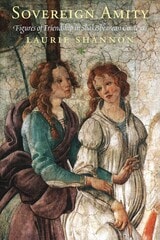
Sovereign Amity
Figures of Friendship in Shakespearean ContextsLaurie Shannon
University of Chicago Press, 2001
Shannon demonstrates that the likeness of sex and station urged in friendship enabled a civic parity not present in other social forms. Early modern friendship was nothing less than a utopian political discourse. It preceded the advent of liberal thought, and it made its case in the terms of gender, eroticism, counsel, and kingship. To show the power of friendship in early modernity, Shannon ranges widely among translations of classical essays; the works of Elizabeth I, Montaigne, Donne, and Bacon; and popular literature, to focus finally on the plays of Shakespeare. Her study will interest scholars of literature, history, gender, sexuality, and political thought, and anyone interested in a general account of the English Renaissance.

Sovereign Fictions
Poetics and Politics in the Age of Russian RealismIlya Kliger
University of Chicago Press, 2024
The nineteenth-century novel is generally assumed to owe its basic social imaginaries to the ideologies, institutions, and practices of modern civil society. In Sovereign Fictions, Ilya Kliger asks what happens to the novel when its fundamental sociohistorical orientation is, as in the case of Russian realism, toward the state. Kliger explores Russian realism’s distinctive construals of sociality through a broad range of texts from the 1830s to the 1870s, including major works by Tolstoy, Dostoevsky, Gogol, Pushkin, Lermontov, Goncharov, and Turgenev, and several lesser-known but influential books of the period, including Alexander Druzhinin’s Polinka Saks (1847), Aleksei Pisemsky’s One Thousand Souls (1858), and Vasily Sleptsov’s Hard Times (1865). Challenging much current scholarly consensus about the social dynamics of nineteenth-century realist fiction, Sovereign Fictions offers an important intervention in socially inflected theories of the novel and in current thinking on representations of power and historical poetics.

Sovereign Selves
American Indian Autobiography and the LawDavid J. Carlson
University of Illinois Press, 2005
Carlson argues that by drawing on the conventions of early colonial treaty-making, nineteenth- and early twentieth-century Indian autobiographers sought to adapt and redefine the terms of Indian law as a way to assert specific property-based and civil rights. Focusing primarily on the autobiographical careers of two major writers (William Apess and Charles Eastman), Sovereign Selves traces the way that their sustained engagement with colonial legal institutions gradually enabled them to produce a new rhetoric of "Indianness."
Sovereignty, Inc.
Three Inquiries in Politics and EnjoymentWilliam Mazzarella, Eric L. Santner, and Aaron Schuster
University of Chicago Press, 2020
Drawing on anthropology, political theory, philosophy, psychoanalysis, and theater, William Mazzarella, Eric L. Santner, and Aaron Schuster show how politics in the age of Trump functions by mobilizing a contradictory and convoluted enjoyment, an explosive mixture of drives and fantasies that eludes existing portraits of our era. The current political moment turns out to be not so much exceptional as exceptionally revealing of the constitutive tension between enjoyment and economy that has always been a key component of the social order. Santner analyzes the collective dream-work that sustains a new sort of authoritarian charisma or mana, a mana-facturing process that keeps us riveted to an excessively carnal incorporation of sovereignty. Mazzarella examines the contemporary merger of consumer brand and political brand and the cross-contamination of politics and economics, warning against all too easy laments about the corruption of politics by marketing. Schuster, focusing on the extreme theatricality and self-satirical comedy of the present, shows how authority reasserts itself at the very moment of distrust and disillusionment in the system, profiting off its supposed decline. A dazzling diagnostic of our present, Sovereignty, Inc., forces us to come to terms with our complicity in Trump’s political presence and will immediately take its place in discussions of contemporary politics.
Soviet-Born
The Afterlives of Migration in Jewish American FictionKarolina Krasuska
Rutgers University Press, 2024
Entering an immigrant, Soviet-born standpoint creates an alternative and sometimes complementary pattern of how the Eastern and Central European past and present resonate with American Jewishness. The novels, short stories, and graphic novels considered here often stage strikingly fresh variations on key older themes, including cultural geography, the memory of World War II and the Holocaust, communism, gender and sexuality, genealogy, and finally, migration. Soviet-Born demonstrates how these diasporic writers, with their critical stance toward identity categories, open up the field of what is canonically Jewish American to broader contemporary debates.
This book is also freely available online as an open-access digital edition.
Space as Storyteller
Spatial Jumps in Architecture, Critical Theory, and LiteratureLaura Chiesa
Northwestern University Press, 2016
Space, Affect, Memory
Literary Geographies in Transnational and Transdisciplinary ComparisonEdited by Fernando Cabo Aseguinolaza and Tomás Espino Barrera
University College London, 2025
Space, Affect, Memory highlights the centrality of space in modern and contemporary culture, both as an object of study and as a concept that underpins research and creative practice. In so doing, the book argues for the necessity of a new approach to space that fully integrates its affective and memorial dimensions. Encompassing lesser-known works in English, Spanish, Portuguese, French, Italian, and Japanese, the essays expand the scope of previous scholarship in literary geography. They also offer a unique analysis of the performative aspect of representation, incorporating analyses of non-textual media like photography, performance, and architecture.
Space, Drama, and Empire
Mapping the Past in Lope de Vega's ComediaJavier Lorenzo
Bucknell University Press, 2023
Spain in the African American Imagination
Rebecca C. Pawel
University of Massachusetts Press, 2027
Revealing how African American intellectuals reframed race, history, and cultural belonging in the modern era
In 1954, Richard Wright rented a car in France and drove south to the Spanish border on the first of two month-long trips that gave rise to the travelogue Pagan Spain, where Wright declared that the Pyrenees, on the France-Spain border, “mark the termination of Europe and the beginning of Africa.” While Spain was not actually seen as an African country, such language suggests instead that Spain would be incomplete without African influences. In the wake of the Spanish-American war of 1898, Americans and Northern Europeans attributed Spain’s weakened economy and loss of international clout to an inability to modernize, which they described in highly racialized terms. As African American modernists explored the country, they compared modernist notions coming out of the United States pertaining to race, gender, and other categories against Spain’s history and contemporary culture.
Spain in the African American Imagination traces how African American intellectuals in the mid-20th century, including Wright, Arthur Schomburg, Langston Hughes, Dorothy Peterson, and Frank Yerby, interpreted Spanish national myths. Rebecca Pawel argues that a literary idea of Spain as eternally “medieval” or “primitive” gave African American writers a conceptual space for thinking about the ways race is constructed through historical narrative. Spain provided a location that was considered ipso facto archaic and thus used racial referents typical of an era removed from the present in a space that was not quite African and not quite European. Ultimately, Pawel argues, Spain became a powerful lens through which African American intellectuals rewrote racial narratives and reimagined modernity across the Atlantic.
Spanish American Poetry at the End of the Twentieth Century
Textual DisruptionsBy Jill Kuhnheim
University of Texas Press, 2005
Has poetry lost its relevance in the postmodern age, unable to keep pace with other forms of cultural production such as film, mass media, and the Internet? Quite the contrary, argues Jill Kuhnheim in this pathfinding book, which explores how recent Spanish American poetry participates in the fundamental cultural debates of its time.
Using a variety of interdisciplinary approaches, Kuhnheim engages in close readings of numerous poetic works to show how contemporary Spanish American poetry struggles with the divisions between politics and aesthetics and between visual and written images; grapples with issues of ethnic, national, sexual, and urban identities; and incorporates rather than rejects technological innovations and elements from the mass media. Her analysis illuminates the ways in which contemporary issues such as indigenismo and Latin America's postcolonial legacy, modernization, immigration, globalization, economic shifts toward neoliberalism and informal economies, urbanization, and the technological revolution have been expressed in—and even changed the very form of—Spanish American poetry since the 1970s.
Spanish American Women's Use of the Word
Colonial through Contemporary NarrativesStacey Schlau
University of Arizona Press, 2001
Spanish Perspectives on Chicano Literature
Literary and Cultural EssaysVanessa Fonseca and Jesús Rosales
The Ohio State University Press, 2017
For Chicanos this interest is intriguing, for they see Spain’s vision of the Chicano both with inviting enthusiasm and justifiable reservation—enthusiasm because this interest shows a humanistic concern in understanding their social issues (national identity, bilingualism, immigration, feminism, and so on) in relation to Spain’s own, and reservation because there still prevails an “open wound” from their historical connection with that country. In other words, a lingering Spanish colonial presence still exists in the Chicano psyche. These Spanish perspectives are important to consider as Chicano literature reflects on its place in twenty-first-century America and its transnational and global aspirations.
Spanish Women Writers and the Essay
Gender, Politics, and the SelfKathleen M. Glenn and Mercedes Mazquirán de Rodríguez
University of Missouri Press, 1998
Never before has a book examined Spanish women and their mastery of the essay. In the groundbreaking collection Spanish Women Writers and the Essay, Kathleen M. Glenn and Mercedes Mazquiarán de Rodríguez help to rediscover the neglected genre, which has long been considered a "masculine" form. Taking a feminist perspective, the editors examine why Spanish women have been so drawn to the essay through the decades, from Concepción Arenal's nineteenth-century writings to the modern works of Rosa Montero.
Spanish women, historically denied a public voice, have discovered an outlet for their expression via the essay. As essayists, they are granted the authority to address subjects they personally deem important, discuss historical and sociopolitical issues, and denounce female subordination. This genre, which attracts a different audience than does the novel or poem, allows Spanish women writers to engage in a direct dialogue with their readers.
Featuring twelve critical investigations of influential female essayists, Spanish Women Writers and the Essay illustrates Spanish women writers' command of the genre, their incorporation of both the ideological and the aesthetic into one concise form, and their skillful use of various strategies for influencing their readers. This fascinating study, which provides English translations for all quotations, will appeal to anyone interested in nineteenth- and twentieth-century Spanish literature, comparative literature, feminist criticism, or women's studies.
Spanish and Empire
Nelsy Echavez-Solano
Vanderbilt University Press, 2007
Spatial and Discursive Violence in the US Southwest
Rosaura Sánchez and Beatrice Pita
Duke University Press, 2020
Speak to Me Words
Essays on Contemporary American Indian PoetryEdited by Dean Rader and Janice Gould
University of Arizona Press, 2003
Speak to Me Words is a stimulating blend of classic articles and original pieces that reflect the energy of modern American Indian literary studies. Highlighting various aspects of poetry written by American Indians since the 1960s, it is a wide-ranging collection that balances the insights of Natives and non-Natives, men and women, old and new voices. Included here are such landmark articles as "Answering the Deer" by Paula Gunn Allen, "Herbs of Healing" by Carter Revard, and "Song, Poetry and Language—Expression and Perception" by Simon Ortiz—all pieces that have shaped how we think about Native poetry. Among the contributions appearing for the first time are Elaine Jahner writing on Paula Gunn Allen's use of formal structures; Robert Nelson addressing pan-Indian tropes of emergence, survival, return, and renewal; and Janet McAdams focusing on Carter Revard's "angled mirrors." Although many Native writers may disregard distinctions between genres, together these writings help readers see the difference between American Indian poetry and other forms of Native literature.
These essays are as broad, encompassing, and provocative as Native poetry itself, branching off from and weaving back into one another. In showing how American Indian poetry redefines our social order and articulates how Indian communities think about themselves, these writers establish a new foundation for the study—and enjoyment—of this vital art.
Speaking Chicana
Voice, Power, and IdentityD. Letticia Galindo
University of Arizona Press, 1999
Part 1. Reconstruction: Language Varieties, Language Use, and Language Attitudes
1. Crossing Social and Cultural Borders: The Road to Language Hybridity, María Dolores Gonzales
2. Fighting Words: Latina Girls, Gangs, and Language Attitudes, Norma Mendoza-Denton
Part 2. Reflection: Testimonios
3. Speaking as a Chicana: Tracing Cultural Heritage through Silence and Betrayal, Jacqueline M. Martínez
4. The Power of Language: From the Back of the Bus to the Ivory Tower, Christine Marín
5. Challenging Tradition: Opening the Headgate, Ida M. Luján
6. Mexican Blood Runs through My Veins, Aurora E. Orozco
Part 3. Innovation: Speaking Creatively/Creatively Speaking
7. Searching for a Voice: Ambiguities and Possibilities, Erlinda Gonzales-Berry
8. Sacred Cults, Subversive Icons: Chicanas and the Pictorial Language of Catholicism, Charlene Villaseñor Black
9. Caló and Taboo Language Use among Chicanas: A Description of Linguistic Appropriation and Innovation, D. Letticia Galindo
10. Máscaras, Trenzas, y Greñas: Un/Masking the Self While Un/Braiding Latina Stories and Legal Discourse, Margaret E. Montoya
Speaking for the Generations
Native Writers on WritingEdited by Simon J. Ortiz
University of Arizona Press, 1997
Of varied backgrounds, the writers represent Indian heritages and cultures from the Pacific Northwest to the northern plains, from Canada to Guatemala. They are poets, novelists, and playwrights. And although their backgrounds are different and their statements intensely personal, they share common themes of their relationship to the land, to their ancestors, and to future generations of their people. From Gloria Bird's powerful recounting of personal and family history to Esther Belin's vibrant tale of her urban Native homeland in Los Angeles, these writers reveal the importance of place and politics in their lives. Leslie Marmon Silko calls upon the ancient tradition of Native American storytelling and its role in connecting the people to the land. Roberta J. Hill and Elizabeth Woody ponder some of the absurdities of contemporary Native life, while Guatemalan Victor Montejo takes readers to the Mayan world, where a native culture had writing and books long before Europeans came.
Together these pieces offer an inspiring portrait of what it means to be a Native writer in the twentieth century. With passion and urgency, these writers are speaking for themselves, for their land, and for the generations.
Speaking for the People
Native Writing and the Question of Political FormMark Rifkin
Duke University Press, 2021
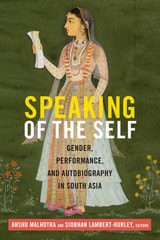
Speaking of the Self
Gender, Performance, and Autobiography in South AsiaAnshu Malhotra and Siobhan Lambert-Hurley, editors
Duke University Press, 2015
Contributors: Asiya Alam, Afshan Bokhari, Uma Chakravarti, Kathryn Hansen, Siobhan Lambert-Hurley, Anshu Malhotra, Ritu Menon, Shubhra Ray, Shweta Sachdeva Jha, Sylvia Vatuk
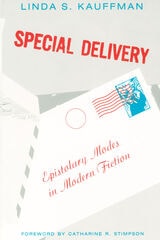
Special Delivery
Epistolary Modes in Modern FictionLinda S. Kauffman
University of Chicago Press, 1992
Kauffman first considers male writers whose works, testing the boundaries of genre and gender, imitate love letters: Viktor Shklovsky's Zoo, Vladimir Nabokov's Lolita, Roland Barthes's A Lover's Discourse, and Jacques Derrida's The Post Card. She then turns to three novels by women who are more preoccupied with politics than passion: Doris Lessing's The Golden Notebook, Alice Walker's The Color Purple, and Margaret Atwood's The Handmaid's Tale. By juxtaposing these "women's productions" with the men's "production of Woman," Special Delivery dismantles the polarities between male and female, theory and fiction, high and low culture, male critical theory, and feminist literary criticism. Kauffman demonstrates how all seven texts mercilessly expose the ideology of individualism and romantic love; each presents alternate paradigms of desire, wrested from Oedipus, grounded in history and politics, giving epistolarity a distinctively postmodern stamp.

Spectacular Disappearances
Celebrity and Privacy, 1696-1801Julia H. Fawcett
University of Michigan Press, 2016
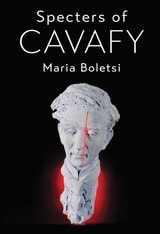
Specters of Cavafy
Maria Boletsi
University of Michigan Press, 2024
Winner of the European Society of Modern Greek Studies Best Monograph Award
The Greek Alexandrian poet C. P. Cavafy (1863–1933) has been recognized as a central figure in European modernism and world literature. His poetry explored the conditions for animating the past and making lost worlds or people haunt the present. Yet he also described himself as “a poet of the future generations.” Indeed, his writings address concerns and desires that permeate the twentieth and twenty-first centuries. How does poetry concerned with the past, memory, loss, and death, carry futurity? How does it haunt, and how is it haunted by, future presents?
Specters of Cavafy broaches these questions by proposing spectral poetics as a novel approach to Cavafy’s work. Drawing from theorizations of specters and haunting, it develops spectrality as a lens for revisiting Cavafy’s poetry and prose, fiction and nonfiction, as well as his poetry’s bearing on our present. By examining Cavafy’s spectral poetics, the book’s first part shows how conjurations work in his writings, and how the spectral permeates the entanglement of modernity and haunting, and of irony and affect. The second part traces the afterlives of specific poems in the Western imagination since the 1990s, in Egypt’s history of debt and colonization, and in Greece during the country’s recent debt crisis. Beyond its original contribution to Cavafy studies, the book proposes tools and modes of reading that are broadly applicable in literary and cultural studies.
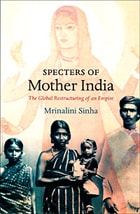
Specters of Mother India
The Global Restructuring of an EmpireMrinalini Sinha
Duke University Press, 2006
Sinha provides a rich historical narrative of the controversy surrounding Mother India, from the book’s publication through the passage in India of the Child Marriage Restraint Act in the closing months of 1929. She traces the unexpected trajectory of the controversy as critics acknowledged many of the book’s facts only to overturn its central premise. Where Mayo located blame for India’s social backwardness within the beliefs and practices of Hinduism, the critics laid it at the feet of the colonial state, which they charged with impeding necessary social reforms. As Sinha shows, the controversy became a catalyst for some far-reaching changes, including a reconfiguration of the relationship between the political and social spheres in colonial India and the coalescence of a collective identity for women.
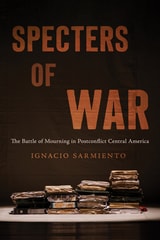
Specters of War
The Battle of Mourning in Postconflict Central AmericaIgnacio Sarmiento
University of Arizona Press, 2025
Specters of War explores mourning practices in postwar Central America, particularly in El Salvador and Guatemala. Ignacio Sarmiento delves into the intricate dynamics of grieving through an interdisciplinary lens, analyzing expressions of mourning in literature, theater, and sites of memory. At the heart of this analysis is the contention over who has the right to mourn, how mourning is performed, and who is included in this process. Sarmiento reveals mourning not as a private affair but as a battleground where different societal factions vie for the possibility of grieving the dead.
Through meticulous research and theoretical nuance, Specters of War sheds light on the politics of mourning in postconflict societies. Sarmiento argues that mourning is not merely a personal experience but a deeply political act intertwined with power struggles and societal divisions. From victims of state terrorism to military elites, various groups engage in a complex dance of grief, revealing the fraught nature of public mourning in postwar Central America. By examining cultural artifacts and memorialization projects, Sarmiento uncovers the multifaceted nature of mourning and its implications for memory, justice, and reconciliation.
This groundbreaking work is essential reading for scholars, students, and professionals interested in Central American history and culture, as well as post-authoritarian societies. Specters of War promises to deepen our understanding of postwar Central America and the legacy of loss in shaping collective identities and narratives of the past.
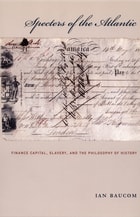
Specters of the Atlantic
Finance Capital, Slavery, and the Philosophy of HistoryIan Baucom
Duke University Press, 2005
Baucom contends that the massacre and the trials that followed it bring to light an Atlantic cycle of capital accumulation based on speculative finance, an economic cycle that has not yet run its course. The extraordinarily abstract nature of today’s finance capital is the late-eighteenth-century system intensified. Yet, as Baucom highlights, since the late 1700s, this rapacious speculative culture has had detractors. He traces the emergence and development of a counter-discourse he calls melancholy realism through abolitionist and human-rights texts, British romantic poetry, Scottish moral philosophy, and the work of late-twentieth-century literary theorists. In revealing how the Zong tragedy resonates within contemporary financial systems and human-rights discourses, Baucom puts forth a deeply compelling, utterly original theory of history: one that insists that an eighteenth-century atrocity is not past but present within the future we now inhabit.
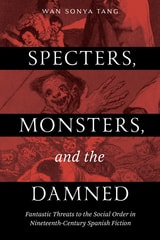
Specters, Monsters, and the Damned
Fantastic Threats to the Social Order in Nineteenth-Century Spanish FictionWan Sonya Tang
Vanderbilt University Press, 2024
Tang offers innovative readings of eleven fantastic short stories and one novella as they first appeared, some serialized and others illustrated, in Spanish periodicals from the late 1800s and early 1900s. Drawing on original archival research, she demonstrates how these stories—in which the everyday is suddenly and inexplicably disrupted by the supernatural—often employ gothic imagery (specifically that of the specter, the monster, and the curse) to depict as threatening those who deviate from cultural norms in terms of class, gender, and race. Tang argues, however, that these unsettling, open‑ended narratives likewise allow readers to question how and why certain designated groups are privileged by society. She contends that the fantastic depiction of reality as unstable in these works ultimately facilitates an interrogation of those values that are accepted as natural by the reigning social order, gesturing toward the inhumanity not of the marginalized, but of the dominant group.
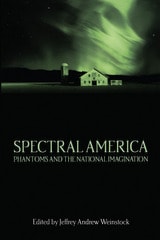
Spectral America
Phantoms and the National ImaginationEdited by Jeffrey Andrew Weinstock
University of Wisconsin Press, 2004
Spectral America asserts that ghosts, whether in oral tradition, literature, or such modern forms as cinema have always been constructions embedded in specific historical contexts and invoked for explicit purposes, often political in nature. The essays address the role of "spectral evidence" during the Salem witch trials, the Puritan belief in good spirits, the convergence of American Spiritualism and technological development in the nineteenth century, the use of the supernatural as a tool of political critique in twentieth-century magic realism, and the "ghosting" of persons living with AIDS. They also discuss ghostly themes in the work of Ambrose Bierce, Edith Wharton, Gloria Naylor, and Stephen King.
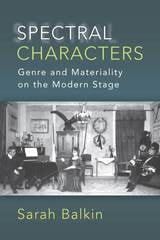
Spectral Characters
Genre and Materiality on the Modern StageSarah Balkin
University of Michigan Press, 2019
Theater’s materiality and reliance on human actors has traditionally put it at odds with modernist principles of aesthetic autonomy and depersonalization. Spectral Characters argues that modern dramatists in fact emphasized the extent to which humans are fictional, made and changed by costumes, settings, props, and spoken dialogue. Examining work by Ibsen, Wilde, Strindberg, Genet, Kopit, and Beckett, the book takes up the apparent deadness of characters whose selves are made of other people, whose thoughts become exteriorized communication technologies, and whose bodies merge with walls and furniture. The ghostly, vampiric, and telepathic qualities of these characters, Sarah Balkin argues, mark a new relationship between the material and the imaginary in modern theater. By considering characters whose bodies respond to language, whose attempts to realize their individuality collapse into inanimacy, and who sometimes don’t appear at all, the book posits a new genealogy of modernist drama that emphasizes its continuities with nineteenth-century melodrama and realism.
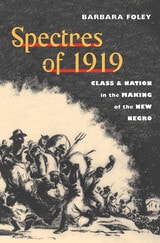
Spectres of 1919
Class and Nation in the Making of the New NegroBarbara Foley
University of Illinois Press, 2002
A look at the violent “Red Summer of 1919” and its intersection with the highly politicized New Negro movement and the Harlem Renaissance
With the New Negro movement and the Harlem Renaissance, the 1920s was a landmark decade in African American political and cultural history, characterized by an upsurge in racial awareness and artistic creativity. In Spectres of 1919 Barbara Foley traces the origins of this revolutionary era to the turbulent year 1919, identifying the events and trends in American society that spurred the black community to action and examining the forms that action took as it evolved.
Unlike prior studies of the Harlem Renaissance, which see 1919 as significant mostly because of the geographic migrations of blacks to the North, Spectres of 1919 looks at that year as the political crucible from which the radicalism of the 1920s emerged. Foley draws from a wealth of primary sources, taking a bold new approach to the origins of African American radicalism and adding nuance and complexity to the understanding of a fascinating and vibrant era.
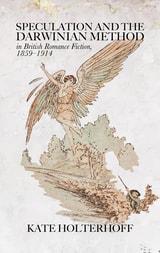
Speculation and the Darwinian Method in British Romance Fiction, 1859-1914
Kate Holterhoff
Ohio University Press, 2025
This study explores how British romance fictions published between 1859 and 1914 absorbed distinctly Darwinian attitudes toward the epistemology of science—one that accorded with scientific speculation. Following the 1859 publication of On the Origin of Species, in which Charles Darwin acknowledged arriving at his thesis by allowing himself “to speculate on the subject” of species transmutation, many romance fiction writers embraced, criticized, and promoted acts of speculating characterized as scientific. The romance fictions discussed in this book recurred to Darwin’s speculative methodology more than to rigorous Baconian empiricism because it permitted them to draw pointedly imaginative conclusions in reasonable ways. Kate Holterhoff’s book examines how romance authors like Grant Allen, H. G. Wells, and Arthur Conan Doyle incorporated Darwinian ideas and speculative thinking into their works to advance their ideological and aesthetic goals. Holterhoff uses five paired genres and methods to analyze this engagement:
- scientific romance and experimentation,
- metaphysical romance and thought experiments,
- anthropological romance and reasoning with imperfect data,
- gothic romance and probability, and
- utopian romance and Malthusian political economy.
By focusing on Darwin’s influence in legitimizing speculative methods in science, the book places the interplay between British science and romance fiction into critical perspective and highlights Darwin’s enduring impact on Western culture.
Speculative Formalism
Literature, Theory, and the Critical PresentTom Eyers
Northwestern University Press, 2017
Through a combination of philosophical reflection and close rhetorical readings, Eyers explores the possibilities and limits of deconstructive approaches to the literary, the impact of the “digital humanities” on theory, and the prospects for a formalist approach to “world literature.” The book includes sustained close readings of Baudelaire, Mallarmé, Yeats, and Wallace Stevens, as well as Alain Badiou, Paul de Man, and Fredric Jameson.
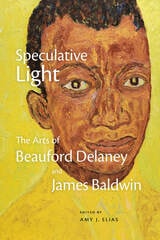
Speculative Light
The Arts of Beauford Delaney and James BaldwinAmy J. Elias, editor
Duke University Press, 2025
Contributors. Hilton Als, Nicholas Boggs, Indie A. Choudhury, Shawn Anthony Christian, Rachel Cohen, Amy J. Elias, Monika Gehlawat, David Leeming, D. Quentin Miller, Fred Moten, Walton M. Muyumba, Robert O’Meally, Ed Pavlić, Levi Prombaum, Robert Reid-Pharr, Tyler T. Schmidt, Abbe Schriber, Jered Sprecher, Stephen C. Wicks, Magdalena Zaborowska
Speculative Whiteness
Science Fiction and the Alt-RightJordan S. Carroll
University of Minnesota Press, 2024
Reveals the alt-right’s project to claim science fiction and—by extension—the future
Fascists such as Richard Spencer interpret science fiction films and literature as saying only white men have the imagination required to invent a high-tech future. Other white nationalists envision racist utopias filled with Aryan supermen and all-white space colonies. Speculative Whiteness traces these ideas through the entangled histories of science fiction culture and white supremacist politics, showing that debates about representation in science fiction films and literature are struggles over who has the right to imagine and inhabit the future. Although fascists insist that tomorrow belongs to them, they have always been and will continue to be contested by antifascist fans willing to fight for the future.
Speculum, volume 100 number 1 (January 2025)
The University of Chicago Press
University of Chicago Press Journals, 2025
Speculum, volume 100 number 2 (April 2025)
The University of Chicago Press
University of Chicago Press Journals, 2025
Speculum, volume 100 number 3 (July 2025)
The University of Chicago Press
University of Chicago Press Journals, 2025
Speculum, volume 100 number 4 (October 2025)
The University of Chicago Press
University of Chicago Press Journals, 2025
Speculum, volume 101 number 1 (January 2026)
The University of Chicago Press
University of Chicago Press Journals, 2026
Speculum, volume 101 number 2 (April 2026)
The University of Chicago Press
University of Chicago Press Journals, 2026
Speculum, volume 101 number 3 (July 2026)
The University of Chicago Press
University of Chicago Press Journals, 2026
Speculum, volume 101 number 4 (October 2026)
The University of Chicago Press
University of Chicago Press Journals, 2026
Speculum, volume 96 number 4 (October 2021)
The University of Chicago Press
University of Chicago Press Journals, 2021
Speculum, volume 97 number 1 (January 2022)
The University of Chicago Press
University of Chicago Press Journals, 2022
Speculum, volume 97 number 2 (April 2022)
The University of Chicago Press
University of Chicago Press Journals, 2022
Speculum, volume 97 number 3 (July 2022)
The University of Chicago Press
University of Chicago Press Journals, 2022