Results by title
53 books match the query '1948-' and 11 start with t

The Administrative Partitioning of Costa Rica
Marilyn April Dorn
University of Chicago Press, 1989
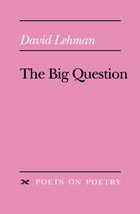
The Big Question
David Lehman
University of Michigan Press, 1995
The Big Question leads off with a major essay explaining and exploring the concept of postmodernism. The next sections include pieces about poetry and fiction, lives and letters, and criticism and controversy.
Other "big questions" addressed include political correctness, the genre of literary biography, academic life and deconstruction. There is a humorous piece on poetry "slams" and the whole "downtown" poetry scene, a feisty op-ed column (on the deconstruction of the Gettysburg Address), a pair of wickedly satirical poems, as well as a group of exceptional book reviews.
The subjects covered range from Philip Larkin to Philip Roth- from the greatest poetry hoax of the twentieth century (which took place in Australia during World War II) to Charles Dickens's unfinished last novel- and from nineteenthth-century American poetry to the political career of Martin Heidegger.
David Lehman is a poet and author of Signs of the Times: Deconstruction and the Fall of Paul de Man. He is series editor of the celebrated Best American Poetry anthology.
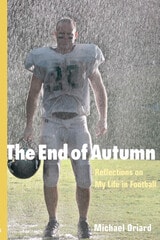
The End of Autumn
Reflections on My Life in FootballMichael Oriard
University of Illinois Press, 2009
After graduating, he signed with the Kansas City Chiefs and head coach Hank Stram. There he learned what it meant to be "owned." He rediscovered the game as it was played by grown men with families who were still treated like children and who dreaded nothing more than the end of their football careers. And without their fully realizing the consequences, every hard tackle inflicted its injury, some gradually growing into chronic conditions, some suddenly cutting a player's career short and ushering him off the field to be soon forgotten.
In this thoughtful narrative, Oriard describes the dreams of glory, the game day anxieties, the brutal training camps and harsh practices, his starry-eyed experience at Notre Dame, and the cold-blooded business of professional football. Told from the inside, the book leaves aside the hype and the pathos of the game to present a direct and honest account of the personal rewards but also the costs players paid to make others rich and entertained.
Originally published in 1982, The End of Autumn recounts the experiences of an ordinary player in a bygone era--before ESPN, before the Bowl Championship Series, before free agency and million-dollar salaries for NFL players. In a new afterword, Oriard reflects on the process of writing the book and how the game has changed in the thirty years since his "retirement" from football at the age of twenty-six.
The Ethics of Swagger
Prizewinning African American Novels, 1977–1993Michael DeRell Hill
The Ohio State University Press, 2013
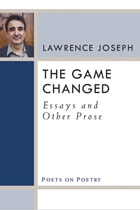
The Game Changed
Essays and Other ProseLawrence Joseph
University of Michigan Press, 2011
Praise for Lawrence Joseph:
"Poetry of great dignity, grace, and unrelenting persuasiveness… Joseph gives us new hope for the resourcefulness of humanity, and of poetry."
---John Ashbery
"Like Henry Adams, Joseph seems to be writing ahead of actual events, and that makes him one of the scariest writers I know."
---David Kirby, The New York Times Book Review
"The most important lawyer-poet of our era."
---David Skeel, Legal Affairs
A volume in the Poets on Poetry series, which collects critical works by contemporary poets, gathering together the articles, interviews, and book reviews by which they have articulated the poetics of a new generation.
Essays on poetry by the most important poet-lawyer of our era
The Game Changed: Essays and Other Prose presents works by prominent poet and lawyer Lawrence Joseph that focus on poetry and poetics, and on what it is to be a poet. Joseph takes the reader through the aesthetics of modernism and postmodernism, a lineage that includes Wallace Stevens, William Carlos Williams, and Gertrude Stein, switching critical tracks to major European poets like Eugenio Montale and Hans Magnus Enzensberger, and back to American masters like James Schuyler and Adrienne Rich.
Always discerning, especially on issues of identity, form, and the pressures of history and politics, Joseph places his own poetry within its critical contexts, presenting narratives of his life in Detroit, where he grew up, and in Manhattan, where he has lived for 30 years. These pieces also portray Joseph’s Lebanese, Syrian, and Catholic heritages, and his life as a lawyer, distinguished law professor, and legal scholar.
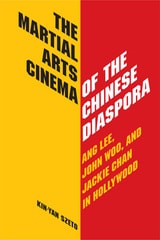
The Martial Arts Cinema of the Chinese Diaspora
Ang Lee, John Woo, and Jackie Chan in HollywoodKin-Yan Szeto
Southern Illinois University Press, 2011
Beginning with a historical retrospective on Chinese martial arts films as a diasporic film genre and the transnational styles and ideologies of the filmmakers themselves, Szeto uses case studies to explore in depth how the forces of colonialism, Chinese nationalism, and Western imperialism shaped the identities and work of Lee, Woo, and Chan. Addressed in the volume is the groundbreaking martial arts swordplay film that achieves global success-Ang Lee's Crouching Tiger, Hidden Dragon- and its revelations about Hollywood representations of Asians, as well as concepts of male and female masculinity in the swordplay film tradition. Also investigated is the invigoration of contemporary gangster, thriller, and war films by John Woo, whose combination of artistic and historical contexts has contributed to his global success.
Szeto then dissects Chan's mimetic representation of masculinity in his films, and the influences of his Chinese theater and martial arts training on his work. Szeto outlines the similarities and differences between the three artists' films, especially their treatments of gender, sexuality, and power. She concludes by analyzing their films as metaphors for their working conditions in the Chinese diaspora and Hollywood, and demonstrating how through their works, Lee, Woo, and Chan communicate not only with the rest of the world but also with each other.
Far from a book simply about three filmmakers, The Martial Arts Cinema of the Chinese Diaspora investigates the transnational nature of films, the geopolitics of culture and race, and the depths of masculinity and power in movies. Szeto's interdisciplinary approach calls for nothing less than a paradigm shift in the study of Chinese diasporic filmmakers and the embodiment of cosmopolitical perspectives in the martial arts genre.
The Politics of Vibration
Music as a Cosmopolitical PracticeMarcus Boon
Duke University Press, 2022
The Problem of Passing
Sandra Harvey
Duke University Press, 2026
The Queer Limit of Black Memory
Black Lesbian Literature and IrresolutionMatt Richardson
The Ohio State University Press, 2013
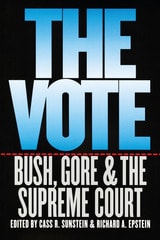
The Vote
Bush, Gore, and the Supreme CourtEdited by Cass R. Sunstein and Richard A. Epstein
University of Chicago Press, 2001
The contributors to this volume were highly visible in the national media while the controversy raged, and here they present fully fleshed-out arguments for the positions they promoted on the airwaves. Readers will find in The Vote equally impassioned defenses for and indictments of the Court's actions, and they will come to understand the practical and theoretical implications of the Court's ruling in the realms of both law and politics. No doubt a spate of books will appear on the 2000 presidential election, but none will claim as distinguished a roster of contributors better qualified to place these recent events in their appropriate historical, legal, and political contexts.
Leading constitutional scholars render their verdicts on the 2000 presidential election controversy
Contributors:
Richard A. Epstein
Elizabeth Garrett
Samuel Issacharoff
Pamela S. Karlan
Michael W. McConnell
Frank I. Michelman
Richard H. Pildes
Richard A. Posner
David A. Strauss
Cass R. Sunstein
John Yoo
An earlier electronic edition of The Vote was available on the University of Chicago Press Web site.
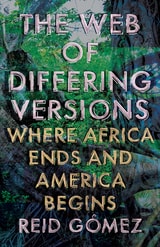
The Web of Differing Versions
Where Africa Ends and America BeginsReid Gómez
University of Minnesota Press, 2026
A visionary reckoning with prophecy, possession, and the grammar of liberation
A bold, experimental intervention in literary and theoretical discourse of colonialism and diaspora, The Web of Differing Versions engages with Leslie Marmon Silko’s 1991 Almanac of the Dead as literature, prophecy, and philosophy. Reid Gómez makes “The Indian Connection” that Silko prophesizes—Land Back!—and offers a prescient response to Silko’s enduring question: who has spiritual possession of the Américas?
Realizing the great capacity of Black and Native studies, Gómez crafts a visionary mode of scholarship that resists acknowledging conceptual, political, spiritual, formal, or linguistic borders. Rather than comparing or separating, she demonstrates how to stop telling things apart: Black|Indian, slavery|colonization, and writing|translation. Gómez shifts focus from racialized identities to the prophesied world itself, working with music, literature, and language to elaborate the connections that exist between racialized bodies, land, and sea as she emphasizes the ubiquity of escape, revolt, and beauty/hózhǫ́.
A theoretical composition, this book enacts a practice of re-visioning that uses Silko’s Almanac to challenge the limits of thought, language, and the very idea of scholarship. Attending the multiplicity of time into times, past into pasts, future into futures, The Web of Differing Versions offers a new grammar for a shared and violent world.
Retail e-book files for this title are screen-reader friendly.