81 books match the query '1980-' and 23 start with t

cover of TV Family Values: Gender, Domestic Labor, and 1980s Sitcoms

TV Family Values

Gender, Domestic Labor, and 1980s Sitcoms

Alice Leppert

Rutgers University Press, 2019

During the 1980s, U.S. television experienced a reinvigoration of the family sitcom genre. In TV Family Values, Alice Leppert focuses on the impact the decade's television shows had on middle class family structure. These sitcoms sought to appeal to upwardly mobile “career women” and were often structured around non-nuclear families and the reorganization of housework. Drawing on Foucauldian and feminist theories, Leppert examines the nature of sitcoms such as Full House, Family Ties, Growing Pains, The Cosby Show, and Who's the Boss? against the backdrop of a time period generally remembered as socially conservative and obsessed with traditional family values. 
[more]
cover of The Body in Late-Capitalist USA

The Body in Late-Capitalist USA

Donald M. Lowe

Duke University Press, 1995

In The Body in Late-Capitalist USA, Donald M. Lowe explores the varied social practices that code and construct the body. Arguing that our bodily lives are shaped by a complex of daily and ongoing practices—how we work, what we buy and consume—Lowe contends that as a result of the commodification of these and other social practices in the late-twentieth century, what we often understand to be the needs of the body are in fact means for capital accumulation.

Moving beyond studies of representations and images of the body, Lowe focuses on the intersection of body practices, language, and the Social to describe concretely the reality of a lived body. His strongly synthetic work brings together Marxist critique, semiotics, Foucaultian discourse analysis, and systems and communications theory to examine those practices that construct the body under late capitalism: habits of work and consumption, the ways we give birth and raise children, socialization, mental and physical healing, reconstructions and contestations of sexuality and gender. Lowe draws upon a wide range of sources, including government and labor studies and statistics, diagnostic and statistical manuals on mental illness, computer manuals, self-help books, and guides to work-related stress disorders, to illustrate the transformation of the body into a nexus of exchange value in postmodern society.

[more]
cover of The Changing Terrain of Race and Ethnicity

The Changing Terrain of Race and Ethnicity

Maria Krysan

Russell Sage Foundation, 2004

The legal institutions of overt racism in the United States have been eliminated, but social surveys and investigations of social institutions confirm the continuing significance of race and the enduring presence of negative racial attitudes. This shift from codified and explicit racism to more subtle forms comes at a time when the very boundaries of race and ethnicity are being reshaped by immigration and a rising recognition that old systems of racial classification inadequately capture a diverse America. In The Changing Terrain of Race and Ethnicity, editors Maria Krysan and Amanda Lewis bring together leading scholars of racial dynamics to study the evolution of America's racial problem and its consequences for race relations in the future. The Changing Terrain of Race and Ethnicity opens by attempting to answer a puzzling question: how is it that so many whites think racism is no longer a problem but so many nonwhites disagree? Sociologist Lawrence Bobo contends that whites exhibit what he calls "laissez faire racism," which ignores historical and structural contributions to racial inequality and does nothing to remedy the injustices of the status quo. Tyrone Forman makes a similar case in his chapter, contending that an emphasis on "color blindness" allows whites to be comforted by the idea that all races are on a level playing field, while not recognizing the advantages they themselves have reaped from years of inequality. The book then moves to a discussion of the new ways that Americans view race. Eduardo Bonilla-Silva and Karen Glover argue that the United States is moving from a black-white divide to a tripartite system, where certain light-skinned, non-threatening minority groups are considered "honorary whites." The book's final section reexamines the theoretical underpinnings of scholarship on race and ethnicity. Joe Feagin argues that research on racism focuses too heavily on how racial boundaries are formed and needs to concentrate more on how those boundaries are used to maintain privileges for certain groups at the expense of others. Manning Marable contends that racism should be addressed at an institutional level to see the prevalence of "structural racism"—deeply entrenched patterns of inequality that are coded by race and justified by stereotypes. The Changing Terrain of Race and Ethnicity provides an in-depth view of racism in modern America, which may be less conspicuous but not necessarily less destructive than its predecessor, Jim Crow. The book's rich analysis and theoretical insight shed light on how, despite many efforts to end America's historic racial problem, it has evolved and persisted into the 21st century.
[more]
cover of The Complete Notebooks

The Complete Notebooks

Albert Camus

University of Chicago Press, 2025

The first complete translation of Albert Camus’s personal notebooks written between 1933 and 1959, published for the first time in one comprehensive volume.
 
Throughout his career, French writer and philosopher Albert Camus kept a series of notebooks that offers an unrivaled glimpse into the writer at his most personal and reflective. These notebooks contain his thoughts on politics, solitude, personal failings and regrets, his travels, and his relationships with friends and rivals. They also provide insight into his process as a thinker—his frustrations, his ideas for novels and plays (some pursued and others abandoned), his routines, his aspirations, and his self-recriminations.

For Camus devotees, there is no more intimate experience than reading these notebooks. On the one hand, his fallibility is on full display: He is irritated by mediocrity, frustrated with his health, plagued by insomnia, and miserable about life’s petty necessities. Yet, he is also intensely curious and observant, sometimes moved to rapture by landscapes and people. Readers will experience the bounty of Camus’s philosophical imagination and witness firsthand how his ideas take shape. The notebooks contain drafts of letters to friends and recorded reflections on the compromises that being in the world demands.

This publication marks the first time Camus’s complete notebooks have been published in one comprehensive volume. Expertly and movingly translated by Ryan Bloom with extensive footnotes contextualizing the entries, The Complete Notebooks will remain a literary treasure for years to come.

[more]
cover of The Conquest of Cool: Business Culture, Counterculture, and the Rise of Hip Consumerism

The Conquest of Cool

Business Culture, Counterculture, and the Rise of Hip Consumerism

Thomas Frank

University of Chicago Press, 1997

While the youth counterculture remains the most evocative and best-remembered symbol of the cultural ferment of the 1960s, the revolution that shook American business during those boom years has gone largely unremarked. In this fascinating and revealing study, Thomas Frank shows how the youthful revolutionaries were joined—and even anticipated —by such unlikely allies as the advertising industry and the men's clothing business.

"[Thomas Frank is] perhaps the most provocative young cultural critic of the moment."—Gerald Marzorati, New York Times Book Review

"An indispensable survival guide for any modern consumer."—Publishers Weekly, starred review

"Frank makes an ironclad case not only that the advertising industry cunningly turned the countercultural rhetoric of revolution into a rallying cry to buy more stuff, but that the process itself actually predated any actual counterculture to exploit."—Geoff Pevere, Toronto Globe and Mail

"The Conquest of Cool helps us understand why, throughout the last third of the twentieth century, Americans have increasingly confused gentility with conformity, irony with protest, and an extended middle finger with a populist manifesto. . . . His voice is an exciting addition to the soporific public discourse of the late twentieth century."—T. J. Jackson Lears, In These Times

"An invaluable argument for anyone who has ever scoffed at hand-me-down counterculture from the '60s. A spirited and exhaustive analysis of the era's advertising."—Brad Wieners, Wired Magazine

"Tom Frank is . . . not only old-fashioned, he's anti-fashion, with a place in his heart for that ultimate social faux pas, leftist politics."—Roger Trilling, Details
[more]
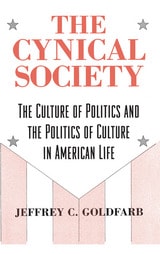
cover of The Cynical Society: The Culture of Politics and the Politics of Culture in American Life

The Cynical Society

The Culture of Politics and the Politics of Culture in American Life

Jeffrey C. Goldfarb

University of Chicago Press, 1991

The Cynical Society is a study of the political despair and abdication of (individual) responsibility Goldfarb calls cynicism—a central but unexamined aspect of contemporary American political and social life. Goldfarb reveals with vivid strokes how cynicism undermines our capacity to think about society's strengths and weaknesses. Drawing on thinkers from Alexis de Tocqueville to Allan Bloom and on such recent works as Beloved, Bonfire of the Vanities, and Mississippi Burning, The Cynical Society celebrates cultural pluralism's role in democracy.
[more]
cover of The Emergence of a New Turkey: Islam, Democracy, and the AK Parti

The Emergence of a New Turkey

Islam, Democracy, and the AK Parti

Yavuz, M. Hakan

University of Utah Press, 2006

Utah Series in Middle East Studies

The start of accession talks between Turkey and the European Union presents an important challenge for Europe and the Muslim world. Although Turkey has often been cited as a model for the accommodation of Islam and secularism, Islam is still a profound factor in Turkish politics.

This book explores the conditions under which an Islamic movement or party ceases to be Islamic. The Emergence of a New Turkey explains the social, economic, and historical origins of the ruling Justice and Development Party, which evolved from Turkey's half-century-old Islamic National Outlook movement. It focuses on the interplay between internal and external forces in the transformation of political Islam into a conservative democratic party. The book also discusses the effect of neoliberal economic policies in Turkey, offering keen insight into one of the most successful transformations of an Islamic movement in the Muslim world.

In addition to satisfying Turkish studies specialists, this lucidly written book is also suited for use in courses on comparative politics, social movements, and Middle East history and politics.

[more]
cover of The End of the Future: Trauma, Memory, and Reconciliation in Peruvian Amazonia

The End of the Future

Trauma, Memory, and Reconciliation in Peruvian Amazonia

Bartholomew Dean

Vanderbilt University Press, 2023

In The End of the Future, author Bartholomew Dean broadens the theoretical framework for understanding memory's role in reconciliation following a violent conflict. This book explores the complicated and confusing linkages between memory and trauma for individuals caught up in civil war and post-conflict reconciliation in the Peruvian Amazon's Huallaga Valley—an epicenter for leftist rebels and a booming shadow economy based on the extraction and circulation of cocaine. The End of the Future tells the story of violent attempts by the Túpac Amaru Revolutionary Movement (Movimiento Revolucionario Túpac Amaru, MRTA) to overthrow the state in the late 1980s and early 1990s from the perspective of the poorest residents of the lower Huallaga's Caynarachi Basin.

To give context to the causes and consequences of the MRTA's presence in the lower and central Huallaga, this book relies on the written works and testimony of Sístero García Torres, an MRTA rebel commander; the government's Truth and Reconciliation Commission; MRTA propaganda; media accounts; and critical historical texts. Besides exposing Huallaga Valley human rights abuses, the book's contribution to political anthropology is consequential for its insistence that reconciliation is by no means equivalent to local, Indigenous notions of "justice" or customary forms of dispute resolution. Without deliberately addressing the diverse socio-cultural contours defining overlapping epistemologies of justice, freedom, and communal well-being, enduring reconciliation will likely remain elusive.

[more]
cover of The Fernando Coronil Reader: The Struggle for Life Is the Matter

The Fernando Coronil Reader

The Struggle for Life Is the Matter

Fernando Coronil

Duke University Press, 2019

In The Fernando Coronil Reader Venezuelan anthropologist Fernando Coronil challenges us to rethink our approaches to key contemporary epistemological, political, and ethical questions. Consisting of work written between 1991 and 2011, this posthumously published collection includes Coronil's landmark essays “Beyond Occidentalism” and “The Future in Question” as well as two chapters from his unfinished book manuscript, "Crude Matters." Taken together, the essays highlight his deep concern with the Global South, Latin American state formation, theories of nature, empire, and postcolonialism, and anthrohistory as an intellectual and ethical approach. Presenting a cross section of Coronil's oeuvre, this volume cements his legacy as one of the most innovative critical social thinkers of his generation.
[more]
cover of The Futures of American Studies

The Futures of American Studies

Donald E. Pease and Robyn Wiegman, eds.

Duke University Press, 2002

Originating as a proponent of U.S. exceptionalism during the Cold War, American Studies has now reinvented itself, vigorously critiquing various kinds of critical hegemony and launching innovative interdisciplinary endeavors. The Futures of American Studies considers the field today and provides important deliberations on what it might yet become. Essays by both prominent and emerging scholars provide theoretically engaging analyses of the postnational impulse of current scholarship, the field's historical relationship to social movements, the status of theory, the state of higher education in the United States, and the impact of ethnic and gender studies on area studies. They also investigate the influence of poststructuralism, postcolonial studies, sexuality studies, and cultural studies on U.S. nationalist—and antinationalist—discourses. No single overriding paradigm dominates the anthology. Instead, the articles enter into a lively and challenging dialogue with one another. A major assessment of the state of the field, The Futures of American Studies is necessary reading for American Studies scholars.

Contributors. Lindon Barrett, Nancy Bentley, Gillian Brown, Russ Castronovo, Eric Cheyfitz, Michael Denning, Winfried Fluck, Carl Gutierrez-Jones, Dana Heller, Amy Kaplan, Paul Lauter, Günter H. Lenz, George Lipsitz, Lisa Lowe, Walter Benn Michaels, José Estaban Muñoz, Dana D. Nelson, Ricardo L. Ortiz, Janice Radway, John Carlos Rowe, William V. Spanos
[more]
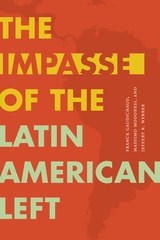
cover of The Impasse of the Latin American Left

The Impasse of the Latin American Left

Franck Gaudichaud, Massimo Modonesi, and Jeffery R. Webber

Duke University Press, 2022

In The Impasse of the Latin American Left, Franck Gaudichaud, Massimo Modonesi, and Jeffery R. Webber explore the region’s Pink Tide as a political, economic, and cultural phenomenon. At the turn of the twenty-first century, Latin American politics experienced an upsurge in progressive movements, as popular uprisings for land and autonomy led to the election of left and center-left governments across Latin America. These progressive parties institutionalized social movements and established forms of state capitalism that sought to redistribute resources and challenge neoliberalism. Yet, as the authors demonstrate, these governments failed to transform the underlying class structures of their societies or challenge the imperial strategies of the United States and China. Now, as the Pink Tide has largely receded, the authors offer a portrait of this watershed period in Latin American history in order to evaluate the successes and failures of the left and to offer a clear-eyed account of the conditions that allowed for a right-wing resurgence.
[more]
cover of The Internationalization of Palace Wars: Lawyers, Economists, and the Contest to Transform Latin American States

The Internationalization of Palace Wars

Lawyers, Economists, and the Contest to Transform Latin American States

Yves Dezalay and Bryant G. Garth

University of Chicago Press, 2002

How does globalization work? Focusing on Latin America, Yves Dezalay and Bryant G. Garth show that exports of expertise and ideals from the United States to Argentina, Brazil, Chile, and Mexico have played a crucial role in transforming their state forms and economies since World War II.

Based on more than 300 extensive interviews with major players in governments, foundations, law firms, universities, and think tanks, Dezalay and Garth examine both the production of northern exports such as neoliberal economics and international human rights law and the ways they are received south of the United States. They find that the content of what is exported and how it fares are profoundly shaped by domestic struggles for power and influence—"palace wars"—in the nations involved. For instance, challenges to the eastern intellectual establishment influenced the Reagan-era export of University of Chicago-style neoliberal economics to Chile, where it enjoyed a warm reception from Pinochet and his allies because they could use it to discredit the previous regime.

Innovative and sophisticated, The Internationalization of Palace Wars offers much needed concrete information about the transnational processes that shape our world.

[more]
cover of The Making and Unmaking of Whiteness

The Making and Unmaking of Whiteness

Birgit Brander Rasmussen, Eric Klinenberg, Irene J. Nexica, and Matt Wray, eds.

Duke University Press, 2001

Bringing together new articles and essays from the controversial Berkeley conference of the same name, The Making and Unmaking of Whiteness presents a fascinating range of inquiry into the nature of whiteness. Representing academics, independent scholars, community organizers, and antiracist activists, the contributors are all leaders in the “second wave” of whiteness studies who collectively aim to combat the historical legacies of white supremacy and to inform those who seek to understand the changing nature of white identity, both in the United States and abroad.
With essays devoted to theories of racial domination, comparative global racisms, and transnational white identity, the geographical reach of the volume is significant and broad. Dalton Conley writes on “How I Learned to Be White.” Allan Bérubé discusses the intersection of gay identity and whiteness, and Mab Segrest describes the spiritual price white people pay for living in a system of white supremacy. Other pieces examine the utility of whiteness as a critical term for social analysis and contextualize different attempts at antiracist activism. In a razor-sharp introduction, the editors not only raise provocative questions about the intellectual, social, and political goals of those interested in the study of whiteness but assess several of the topic’s major recurrent themes: the visibility of whiteness (or the lack thereof); the “emptiness” of whiteness as a category of identification; and conceptions of whiteness as a structural privilege, a harbinger of violence, or an institutionalization of European imperialism.

Contributors. William Aal, Allan Bérubé, Birgit Brander Rasmussen, Dalton Conley, Troy Duster, Ruth Frankenberg, John Hartigan Jr., Eric Klinenberg, Eric Lott, Irene J. Nexica, Michael Omi, Jasbir Kaur Puar, Mab Segrest, Vron Ware, Howard Winant, Matt Wray
[more]
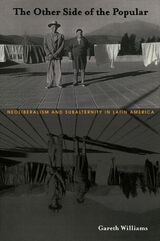
cover of The Other Side of the Popular: Neoliberalism and Subalternity in Latin America

The Other Side of the Popular

Neoliberalism and Subalternity in Latin America

Gareth Williams

Duke University Press, 2002

Drawing on deconstruction, postcolonial theory, cultural studies, and subaltern studies, The Other Side of the Popular is as much a reflection on the limitations and possibilities for thinking about the politics of Latin American culture as it is a study of the culture itself. Gareth Williams pays particular attention to the close relationship between complex cultural shifts and the development of the neoliberal nation-state. The modern Latin American nation, he argues, was built upon the idea of "the people," a citizenry with common interests transcending demographic and cultural differences. As nations have weakened in relation to the global economy, this moment—of the popular as the basis of nation-building—has passed, causing seismic shifts in the relationships between governments and cultural formations. Williams asserts that these changed relationships necessitate the rethinking of fundamental concepts such as "the popular" and "the nation." He maintains that the perspective of subalternity is vital to this theoretical project because it demands the reimagining of the connections between critical reason and its objects of analysis.

Williams develops his argument through studies of events highlighting Latin America’s uneasy, and often violent, transition to late capitalism over the past thirty years. He looks at the Chiapas rebellion in Mexico, genocide in El Salvador, the Sendero in Peru, Chile’s and Argentina’s transitions to democratic governments, and Latin Americans’ migration northward. Williams also reads film, photography, and literary works, including Ricardo Piglia’s The Absent City and the statements of a young Salvadoran woman, the daughter of ex-guerrilleros, living in South Central Los Angeles.

The Other Side of the Popular is an incisive interpretation of Latin American culture and politics over the last few decades as well as a thoughtful meditation on the state of Latin American cultural studies.
[more]
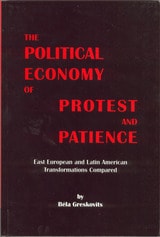
cover of The Political Economy of Protest and Patience: East European and Latin American Trasformations Compared

The Political Economy of Protest and Patience

East European and Latin American Trasformations Compared

Béla Greskovits

Central European University Press, 1998

Despite gloomy prophecies, democracy and the market economy seem to be taking root throughout Central and Eastern Europe, although set against a background of a recession deeper and longer than that of the Great Depression. How is this possible? Why did Eastern Europeans protest less about the brutal social consequences of systemic change than the people of Latin America a decade earlier? Why has the region-wide authoritarian or populist turnabout not occurred? Why has democracy in these countries proved to be crisis-proof? In what ways has economic crisis impacted on the politics of the region?

In addressing these questions, Béla Greskovits uses a comparative analysis of the structures, institutions, cultures, and actors shaping both the Eastern European and the Latin American transformations. He argues that structural, institutional, and cultural factors have put a brake on destabilizing collective actions and have paved the way for the emergence of the enduring, low-level equilibrium between incomplete democracy and imperfect market economy which seems set to characterize the Central and Eastern European experience for the foreseeable future.

[more]
cover of The Politics of Gay Rights

The Politics of Gay Rights

Edited by Craig A. Rimmerman, Kenneth D. Wald, and Clyde Wilcox

University of Chicago Press, 2000

Few issues in American politics inspire such passion as that of civil rights for gays and lesbians. In this group of original essays, scholars and activists writing from a number of different perspectives provide a comprehensive overview of this heated debate. Contributors thoroughly investigate the politics of the gay and lesbian movement, beginning with its political organizations and tactics. The essays also address the strategies and ideology of conservative opposition groups, such as the Christian Right. They focus on key issues for public policy, including gays and lesbians openly serving in the military, anti-discrimination laws, and the ongoing crisis of AIDS. The book ends with chapters that discuss the ways in which the political struggle for gay rights has played out in various arenas—in Congress, in the courts, in state and local governments, and in electoral politics.

Forcefully argued and accessibly written, this collection is an important contribution to the current discussion about civil rights for gays and lesbians.

[more]
cover of The Politics of the Welfare State in Turkey: How Social Movements and Elite Competition Created a Welfare State

The Politics of the Welfare State in Turkey

How Social Movements and Elite Competition Created a Welfare State

Erdem Yörük

University of Michigan Press, 2022

In The Politics of the Welfare State in Turkey, author Erdem Yörük provides a politics-based explanation for the post-1980 transformation of the Turkish welfare system, in which poor relief policies have replaced employment-based social security. This book is one of the results of Yörük’s European Research Council-funded project, which compares the political dynamics in several emerging markets in order to develop a new political theory of welfare in the global south. As such, this book is an ambitious analytical and empirical contribution to understanding the causes of a sweeping shift in the nature of state welfare provision in Turkey during the recent decades—part of a global trend that extends far beyond Turkey. Most scholarship about Turkey and similar countries has explained this shift toward poor relief as a response to demographic and structural changes including aging populations, the decline in the economic weight of industry, and the informalization of labor, while ignoring the effect of grassroots politics. In order to overcome these theoretical shortages in the literature, the book revisits concepts of political containment and political mobilization from the earlier literature on the mid-twentieth-century welfare state development and incorporates the effects of grassroots politics in order to understand the recent welfare system shift as it materialized in Turkey, where a new matrix of political dynamics has produced new large-scale social assistance programs. 
[more]
cover of The Purple Color of Kurdish Politics: Women Politicians Write from Prison

The Purple Color of Kurdish Politics

Women Politicians Write from Prison

Gultan Kisanak

Pluto Press, 2022

Prison writings from twenty-two Kurdish women who were elected to office in Turkey and then imprisoned by the state on political grounds.

Gültan Kışanak, a Kurdish journalist and former MP, was elected co-mayor of Diyarbakır in 2014. Two years later, the Turkish state arrested and imprisoned her. Her story is remarkable, but not unique. While behind bars, she wrote about her own experiences and collected similar accounts from other Kurdish women, all co-chairs, co-mayors, and MPs in Turkey; all incarcerated on political grounds.

The Purple Colour of Kurdish Politics is a one-of-a-kind collection of prison writings from twenty-two Kurdish women politicians. Here they reflect on their personal and collective struggles against patriarchy and anti-Kurdish repression in Turkey; on the radical feminist principles and practices through which they transformed the political structures and state offices in which they operated. They discuss what worked and what didn’t, and the ways in which Turkey’s anti-capitalist and socialist movements closely informed their political stances and practices.

Demonstrating Kurdish women’s ceaseless political determination and refusal to be silenced – even when behind bars – the book ultimately hopes to inspire women living under even the most unjust conditions to engage in collective resistance.

[more]
cover of The Resurgence of Conservatism in Anglo-American Democracies

The Resurgence of Conservatism in Anglo-American Democracies

Barry Cooper, Allan Kornberg, and William Mishler, eds.

Duke University Press, 1987

This work presents analyses by experts on the rise of anew tide of conservative governments in the United States, Canada, and Great Britain in an attempt to find what, if any, common ideologies and programs unite them, with what results, in terms of institutional change and policy direction, have been, and what are the prospects for permanent change.
[more]
cover of The Surrendered: Reflections by a Son of Shining Path

The Surrendered

Reflections by a Son of Shining Path

José Carlos Agüero. Edited and Translated by Michael J. Lazzara and Charles F. Walker

Duke University Press, 2021

When Peruvian public intellectual José Carlos Agüero was a child, the government imprisoned and executed his parents, who were members of Shining Path. In The Surrendered—originally published in Spanish in 2015 and appearing here in English for the first time—Agüero reflects on his parents' militancy and the violence and aftermath of Peru's internal armed conflict. He examines his parents' radicalization, their lives as guerrillas, and his tumultuous childhood, which was spent in fear of being captured or killed, while grappling with the complexities of public memory, ethics and responsibility, human rights, and reconciliation. Much more than a memoir, The Surrendered is a disarming and moving consideration of what forgiveness and justice might mean in the face of hate. This edition includes an editors' introduction, a timeline of the Peruvian conflict, and an extensive interview with the author.
[more]
cover of The World Sixties Made: Politics And Culture In Recent America

The World Sixties Made

Politics And Culture In Recent America

edited by Van Gosse and Richard Moser

Temple University Press, 2003

How can we make sense of the fact that after decades of right-wing political mobilizing the major social changes wrought by the Sixties are more than ever part of American life? The World the Sixties Made, the first academic collection to treat the last quarter of the twentieth century as a distinct period of U.S. history, rebuts popular accounts that emphasize a conservative ascendancy. The essays in this volume survey a vast historical terrain to tease out the meaning of the not-so-long ago. They trace the ways in which recent U.S. culture and politics continue to be shaped by the legacy of the New Left's social movements, from feminism to gay liberation to black power. Together these essays demonstrate that the America that emerged in the 1970s was a nation profoundly, even radically democratized.
[more]
cover of The World Turned: Essays on Gay History, Politics, and Culture

The World Turned

Essays on Gay History, Politics, and Culture

John D Emilio

Duke University Press, 2002

Something happened in the 1990s, something dramatic and irreversible. A group of people long considered a moral menace and an issue previously deemed unmentionable in public discourse were transformed into a matter of human rights, discussed in every institution of American society. Marriage, the military, parenting, media and the arts, hate violence, electoral politics, public school curricula, human genetics, religion: Name the issue, and the the role of gays and lesbians was a subject of debate. During the 1990s, the world seemed finally to turn and take notice of the gay people in its midst. In The World Turned, distinguished historian and leading gay-rights activist John D’Emilio shows how gay issues moved from the margins to the center of national consciousness during the critical decade of the 1990s.

In this collection of essays, D’Emilio brings his historian’s eye to bear on these profound changes in American society, culture, and politics. He explores the career of Bayard Rustin, a civil rights leader and pacifist who was openly gay a generation before almost everyone else; the legacy of radical gay and lesbian liberation; the influence of AIDS activist and writer Larry Kramer; the scapegoating of gays and lesbians by the Christian Right; the gay-gene controversy and the debate over whether people are "born gay"; and the explosion of attention focused on queer families. He illuminates the historical roots of contemporary debates over identity politics and explains why the gay community has become, over the last decade, such a visible part of American life.

[more]
cover of Toward Better Problems: New Perspectives on Abortion, Animal Rights, the Environment, and Justice

Toward Better Problems

New Perspectives on Abortion, Animal Rights, the Environment, and Justice

Anthony Weston

Temple University Press, 1992

"Toward Better Problems is a work of considerable merit.... [Weston] is effective in showing how the 'theoretical' approach obscures the real values at issue and hinders their realization." --James Gouinlock, Emory University In Toward Better Problems, Anthony Weston develops a pragmatic approach to the pressing moral issues of our time. Weston seeks to address practical problems in the spirit of John Dewey: that is, by focusing on specific human concerns and multiple, overlapping values rather than on abstract philosophical principles. Weston showcases his method in sustained discussion of four highly controversial areas: abortion, animal rights, environmentalism, and justice. Weston takes up uncomfortable issues, such as how we raise food animals; test medicines, cosmetics, and chemicals on animals; and justify speciesism. He engages philosophically the treatment of land and seas as limitless garbage dumps, the creation of radioactive wastes and their disposal, and fundamental problems of social justice. But Weston's aim is not to "solve" such problems as if they were some kind of puzzle. The aim instead is to creatively transform such problematic situations into something more promising and tractable, thereby leaving us with "better problems."
[more]