Results by title
87 books match the query 'AIDS (Disease)' and 9 start with t
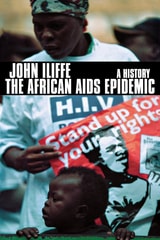
The African AIDS Epidemic
A HistoryJohn Iliffe
Ohio University Press, 2006
A Choice Significant University Press Titles for Undergraduates, 2005–2006
This history of the African AIDS epidemic is a much-needed, accessibly written historical account of the most serious epidemiological catastrophe of modern times. The African AIDS Epidemic: A History answers President Thabo Mbeki’s provocative question as to why Africa has suffered this terrible epidemic.
While Mbeki attributed the causes to poverty and exploitation, others have looked to distinctive sexual systems practiced in African cultures and communities. John Iliffe stresses historical sequence. He argues that Africa has had the worst epidemic because the disease was established in the general population before anyone knew the disease existed. HIV evolved with extraordinary speed and complexity, and because that evolution took place under the eyes of modern medical research scientists, Iliffe has been able to write a history of the virus itself that is probably unique among accounts of human epidemic diseases. In giving the African experience a historical shape, Iliffe has written one of the most important books of our time.
The African experience of AIDS has taught the world much of what it knows about HIV/AIDS, and this fascinating book brings into focus many aspects of the epidemic in the longer context of massive demographic growth, urbanization, and social change in Africa during the latter half of the twentieth century. The African AIDS Epidemic: A History is a brilliant introduction to the many aspects of the epidemic and the distinctive character of the virus.
The Boundaries of Blackness
AIDS and the Breakdown of Black PoliticsCathy Cohen
University of Chicago Press, 1999
The Boundaries of Blackness is the first full-scale exploration of the social, political, and cultural impact of AIDS on the African-American community. Informed by interviews with activists, ministers, public officials, and people with AIDS, Cathy Cohen unflinchingly brings to light how the epidemic fractured, rather than united, the black community. She traces how the disease separated blacks along different fault lines and analyzes the ensuing struggles and debates.
More broadly, Cohen analyzes how other cross-cutting issues—of class, gender, and sexuality—challenge accepted ideas of who belongs in the community. Such issues, she predicts, will increasingly occupy the political agendas of black organizations and institutions and can lead to either greater inclusiveness or further divisiveness.
The Boundaries of Blackness, by examining the response of a changing community to an issue laced with stigma, has much to teach us about oppression, resistance, and marginalization. It also offers valuable insight into how the politics of the African-American community—and other marginal groups—will evolve in the twenty-first century.
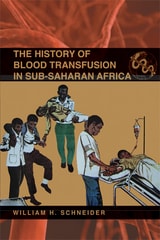
The History of Blood Transfusion in Sub-Saharan Africa
William H. Schneider
Ohio University Press, 2013
This first extensive study of the practice of blood transfusion in Africa traces the history of one of the most important therapies in modern medicine from the period of colonial rule to independence and the AIDS epidemic. The introduction of transfusion held great promise for improving health, but like most new medical practices, transfusion needed to be adapted to the needs of sub-Saharan Africa, for which there was no analogous treatment in traditional African medicine.
This otherwise beneficent medical procedure also created a “royal road” for microorganisms, and thus played a central part in the emergence of human immune viruses in epidemic form. As with more developed health care systems, blood transfusion practices in sub-Saharan Africa were incapable of detecting the emergence of HIV. As a result, given the wide use of transfusion, it became an important pathway for the initial spread of AIDS. Yet African health officials were not without means to understand and respond to the new danger, thanks to forty years of experience and a framework of appreciating long-standing health risks. The response to this risk, detailed in this book, yields important insight into the history of epidemics and HIV/AIDS.
Drawing on research from colonial-era governments, European Red Cross societies, independent African governments, and directly from health officers themselves, this book is the only historical study of the practice of blood transfusion in Africa.
The Night is Young
Sexuality in Mexico in the Time of AIDSHéctor Carrillo
University of Chicago Press, 2002
Carrillo finds that young Mexicans today grapple in a variety of ways with two competing tendencies. On the one hand, many seek to challenge traditional ideas and values they find limiting. But they also want to maintain a sense of Mexico's cultural distinctiveness, especially in relation to the United States. For example, while Mexicans are well aware of the dangers of unprotected sex, they may also prize the surrender to sexual passion, even in casual sexual encounters—an attitude which stems from the strong values placed on collective life, spontaneity, and an openness toward intimacy. Because these expectations contrast sharply with messages about individuality, planning, and overt negotiation commonly promoted in global public health efforts, Carrillo argues that they demand a new approach to AIDS prevention education in Mexico.
A Mexican native, Carrillo has written an exceptionally insightful and accessible study of the relations among sexuality, social change, and AIDS prevention in Mexico. Anyone concerned with the changing place of sexuality in a modern and increasingly globalized world will profit greatly from The Night Is Young.
The Political Economy of Stigma
HIV, Memoir, Medicine, and Crip PositionalitiesAlly Day
The Ohio State University Press, 2021
In The Political Economy of Stigma, Ally Day offers a compelling critique of neoliberal medical practices in the US by coupling an analysis of HIV memoir with a critical examination of narrative medicine practice. Using insights from feminist disability studies and crip theory, Day argues that stories of illness and disability—such as HIV memoirs—operate within a political economy of stigma, which she defines as the formal and informal circulation of personal illness and disability narratives that benefits some while hindering others. On the one hand, this system decreases access to appropriate medical care for those with chronic conditions by producing narratives of personal illness that frame one’s relationship to structural inequality as a result of personal failure. On the other hand, the political economy of stigma rewards those who procure such narratives and circulate them for public consumption.
The political economy of stigma is theorized from three primary research sites: a reading group with women living with HIV, a reading group with AIDS service workers, and participant observation research and critical close reading of practices in narrative medicine. Ultimately, it is the women living with HIV who provide an alternative way to understand disability and illness narratives, a practice of differential reading that can challenge stigmatizing tropes and reconceptualize the creation, reception, and circulation of patient memoir.

The Quiet Hero
A Life of Ryan WhiteNelson Price
Indiana Historical Society Press, 2015
The Republic of Therapy
Triage and Sovereignty in West Africa’s Time of AIDSVinh-Kim Nguyen
Duke University Press, 2010
The Sympathetic State
Disaster Relief and the Origins of the American Welfare StateMichele Landis Dauber
University of Chicago Press, 2012
Treating AIDS
Politics of Difference, Paradox of PreventionSangaramoorthy, Thurka
Rutgers University Press, 2014
Sangaramoorthy documents in detail the work of AIDS prevention programs and their effect on the health and well-being of Haitians, a transnational community long plagued by the stigma of being stereotyped in public discourse as disease carriers. By tracing the ways in which public knowledge of AIDS prevention science circulates from sites of surveillance and regulation, to various clinics and hospitals, to the social worlds embraced by this immigrant community, she ultimately demonstrates the ways in which AIDS prevention programs help to reinforce categories of individual and collective difference, and how they continue to sustain the persistent and pernicious idea of race and ethnicity as risk factors for the disease.