Results by title
56 books match the query 'Academic & Scholarly' and 9 start with t
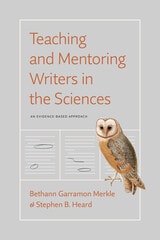
Teaching and Mentoring Writers in the Sciences
An Evidence-Based ApproachBethann Garramon Merkle and Stephen B. Heard
University of Chicago Press, 2025
Every scientist eventually teaches scientific writing or mentors junior scientists as they develop their writing skills—only to discover that the task is both challenging and remarkably time-consuming. If you are in this position, Teaching and Mentoring Writers in the Sciences is the resource you need, offering approaches that will help you help writers develop their skills more effectively and with less time and effort.
Bethann Garramon Merkle and Stephen B. Heard, both experts in scientific communication, offer evidence-based advice that draws on their own extensive experience as well as on proven tactics from writing studies, science studies, and rhetoric and composition. Shorn of the unfamiliar and off-putting jargon that much pedagogy literature adopts, their advice is engaging and accessible to scientists. As you read, you’ll see where developing writers are coming from; how mastering scientific writing matters to the careers of students who do and don’t continue in academia; how writing occurs and is taught in both undergraduate and graduate curricula; how to find and harness teaching resources that help share the workload; how to teach writing to students who speak English as an additional language; and how to navigate the use (by yourself and by developing writers) of tools from pencils and dictionaries to AI writing assistants. If you teach or mentor scientific writers, this book will help you deliver what your students and mentees need most: clear, effective writing guidance.
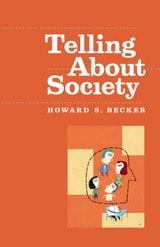
Telling About Society
Howard S. Becker
University of Chicago Press, 2007
Taking Perec’s book as its cue, Telling About Society explores the unconventional ways we communicate what we know about society to others. The third in distinguished teacher Howard Becker’s best-selling series of writing guides for social scientists, the book explores the many ways knowledge about society can be shared and interpreted through different forms of telling—fiction, films, photographs, maps, even mathematical models—many of which remain outside the boundaries of conventional social science. Eight case studies, including the photographs of Walker Evans, the plays of George Bernard Shaw, the novels of Jane Austen and Italo Calvino, and the sociology of Erving Goffman, provide convincing support for Becker’s argument: that every way of telling about society is perfect—for some purpose. The trick is, as Becker notes, to discover what purpose is served by doing it this way rather than that.
With Becker’s trademark humor and eminently practical advice, Telling About Society is an ideal guide for social scientists in all fields, for artists interested in saying something about society, and for anyone interested in communicating knowledge in unconventional ways.
The Art of Witnessing
Documentary Literature, Film and Theater in Eastern Europe and the BalticsJohanna Lindbladh
Central European University Press, 2026
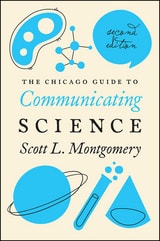
The Chicago Guide to Communicating Science
Second EditionScott L. Montgomery
University of Chicago Press, 2017
For more than a decade, The Chicago Guide to Communicating Science has been the go-to reference for anyone who needs to write or speak about their research. Whether a student writing a thesis, a faculty member composing a grant proposal, or a public information officer crafting a press release, Scott Montgomery’s advice is perfectly adaptable to any scientific writer’s needs.
This new edition has been thoroughly revised to address crucial issues in the changing landscape of scientific communication, with an increased focus on those writers working in corporate settings, government, and nonprofit organizations as well as academia. Half a dozen new chapters tackle the evolving needs and paths of scientific writers. These sections address plagiarism and fraud, writing graduate theses, translating scientific material, communicating science to the public, and the increasing globalization of research.
The Chicago Guide to Communicating Science recognizes that writers come to the table with different needs and audiences. Through solid examples and concrete advice, Montgomery sets out to help scientists develop their own voice and become stronger communicators. He also teaches readers to think about their work in the larger context of communication about science, addressing the roles of media and the public in scientific attitudes as well as offering advice for those whose research concerns controversial issues such as climate change or emerging viruses.
More than ever, communicators need to be able to move seamlessly among platforms and styles. The Chicago Guide to Communicating Science’s comprehensive coverage means that scientists and researchers will be able to expertly connect with their audiences, no matter the medium.
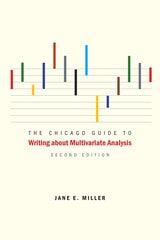
The Chicago Guide to Writing about Multivariate Analysis, Second Edition
Jane E. Miller
University of Chicago Press, 2013
The Chicago Guide to Writing about Multivariate Analysis is the book researchers turn to when looking for guidance on how to clearly present statistical results and break through the jargon that often clouds writing about applications of statistical analysis. This new edition features even more topics and real-world examples, making it the must-have resource for anyone who needs to communicate complex research results.
For this second edition, Jane E. Miller includes four new chapters that cover writing about interactions, writing about event history analysis, writing about multilevel models, and the “Goldilocks principle” for choosing the right size contrast for interpreting results for different variables. In addition, she has updated or added numerous examples, while retaining her clear voice and focus on writers thinking critically about their intended audience and objective. Online podcasts, templates, and an updated study guide will help readers apply skills from the book to their own projects and courses.
This continues to be the only book that brings together all of the steps involved in communicating findings based on multivariate analysis—finding data, creating variables, estimating statistical models, calculating overall effects, organizing ideas, designing tables and charts, and writing prose—in a single volume. When aligned with Miller’s twelve fundamental principles for quantitative writing, this approach will empower readers—whether students or experienced researchers—to communicate their findings clearly and effectively.
The Craft of Scientific Communication
Joseph E. Harmon and Alan G. Gross
University of Chicago Press, 2010
The ability to communicate in print and person is essential to the life of a successful scientist. But since writing is often secondary in scientific education and teaching, there remains a significant need for guides that teach scientists how best to convey their research to general and professional audiences. The Craft of Scientific Communication will teach science students and scientists alike how to improve the clarity, cogency, and communicative power of their words and images.
In this remarkable guide, Joseph E. Harmon and Alan G. Gross have combined their many years of experience in the art of science writing to analyze published examples of how the best scientists communicate. Organized topically with information on the structural elements and the style of scientific communications, each chapter draws on models of past successes and failures to show students and practitioners how best to negotiate the world of print, online publication, and oral presentation.
The Dissertation-to-Book Workbook
Exercises for Developing and Revising Your Book ManuscriptKatelyn E. Knox and Allison Van Deventer
University of Chicago Press, 2023
So, you’ve written a dissertation. Congratulations! But how do you turn it into a book? Even if you know what to do when revising your dissertation, do you know how to do those things? This workbook by Katelyn E. Knox and Allison Van Deventer, creators of the successful online Dissertation-to-Book Boot Camp, offers a series of manageable, concrete steps with exercises to help you revise your academic manuscript into publishable book form.
The Dissertation-to-Book Workbook uses targeted exercises and prompts to take the guesswork out of writing a book. You’ll clarify your book’s core priorities, pinpoint your organizing principle, polish your narrative arc, evaluate your evidence, and much more. Using what this workbook calls “book questions and chapter answers,” you’ll figure out how to thread your book’s main ideas through its chapters. Then, you’ll assemble an argument, and finally, you’ll draft any remaining material and revise the manuscript. And most important, by the time you complete the workbook, you’ll have confidence that your book works as a book—that it’s a cohesive, focused manuscript that tells the story you want to tell.
Indispensible to anyone with an academic manuscript in progress, the prompts, examples, checklists, and activities will give you confidence about all aspects of your project—that it is structurally sound, coherent, free of the hallmarks of “dissertationese," and ready for submission to an academic publisher.
The Inclusive Work of Global Rhetorics
Moushumi Biswas
Utah State University Press, 2026
Envisioning the next step in the ongoing scholarly movement advocating inclusion of global rhetorics in the composition curriculum, The Inclusive Work of Global Rhetorics demonstrates that the question of why or whether to incorporate tenets of global/non-Western rhetorics into writing is long past. The focus has shifted to how to make this change—and to the best practices of such inclusion.
This book showcases the latest scholarship on rethinking the borders of traditional rhetorical studies, which are typically drawn within Greco-Roman and Euro-American confines, with the objective of incorporating non-Eurocentric rhetorical tenets into rhetoric and composition. This work fosters a spirit of inclusivity in the writing classroom by incorporating the many ways of rhetorical thinking gleaned from global/non-Western communication practices while also reflecting on their situatedness and intersectionalities.
Sitting at the crossroads of theory, methodology, and pedagogy, The Inclusive Work of Global Rhetoric puts in perspective a landmark moment in rhetorical studies, a time when it has become imperative to acknowledge the proliferation of non-Western rhetorical traditions in rhetorical practices and communication. Providing heuristics for creating inclusive composition/rhetoric pedagogy, this book serves students, teachers, scholars, and researchers of rhetoric, writing, and communication as both a classroom guide and a reference at the undergraduate and graduate level
The Media and Communications Study Skills Student Guide
Doug Specht
University of Westminster Press, 2019
All the tips, ideas and advice given to, and requested by, MA students in Media and Communications, are brought together in an easy-to-use accessible guide to help students study most effectively.
Based upon many years of teaching study skills and hundreds of lecture slides and handouts this introduction covers a range of general and generic skills that the author relates specifically towards media and communications studies. As well as the mechanics of writing and presentations, the book also shows how students can work on and engage with the critical and contemplative elements of their degrees whilst retaining motivation and refining timekeeping skills.
Of course the nuts and bolts of reading, writing, listening, seminars and the dreaded dissertation and essays are covered too. In addition advice on referencing, citation and academic style is offered for those with concerns over English grammar and expression.
Aimed primarily at postgraduate students, there is significant crossover with undergraduate work, so this book will also prove of use to upper level undergraduate readers whether using English as a first or second language.