Results by title
702 books match the query 'America' and 147 start with t
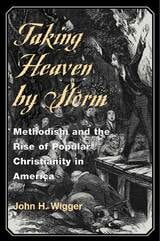
Taking Heaven by Storm
Methodism and the Rise of Popular Christianity in AmericaJohn H. Wigger
University of Illinois Press, 1998
Taking Heaven by Storm shows how Methodism fed into popular religious enthusiasm as well as the social and economic ambitions of the "middling people on the make"--skilled artisans, shopkeepers, small planters, petty merchants--who constituted its core. Wigger describes how the movement expanded its reach and fostered communal intimacy and "intemperate zeal" by means of an efficient system of itinerant and local preachers, class meetings, love feasts, quarterly meetings, and camp meetings. He also examines the important role of African Americans and women in early American Methodism and explains how the movement's willingness to accept impressions, dreams, and visions as evidence of the work and call of God circumvented conventional assumptions about education, social standing, gender, and race.
A pivotal text on the role of religion in American life, Taking Heaven by Storm shows how the enthusiastic, egalitarian, entrepreneurial, lay-oriented spirit of early American Methodism continues to shape popular religion today.
Talking Together
Public Deliberation and Political Participation in AmericaLawrence R. Jacobs, Fay Lomax Cook, and Michael X. Delli Carpini
University of Chicago Press, 2009
Challenging the conventional wisdom that Americans are less engaged than ever in national life and the democratic process, Talking Together paints the most comprehensive portrait available of public deliberation in the United States and explains why it is important to America’s future.
The authors’ original and extensive research reveals how, when, and why citizens talk to each other about the issues of the day. They find that—in settings ranging from one-on-one conversations to e-mail exchanges to larger and more formal gatherings—a surprising two-thirds of Americans regularly participate in public discussions about such pressing issues as the Iraq War, economic development, and race relations. Pinpointing the real benefits of public discourse while considering arguments that question its importance, Talking Together presents an authoritative and clear-eyed assessment of deliberation’s function in American governance. In the process, it offers concrete recommendations for increasing the power of talk to foster political action.

Technology and the Future of Schooling in America
Edited by Stephen T. Kerr
University of Chicago Press, 1996
Guiding this volume is the conviction that advances in technology do not necessarily translate into improvements in education even as the basic structure of teaching programs must be changed to fully exploit the educational uses of technology. The contributors argue that technology should be distributed throughout the educational system, not just in wealthy districts; they examine the impact of communications technologies on relationships between teachers and students, parents and children, and men and women; they consider the ways in which new technologies change the dynamics of learning and teaching; and they show how teachers and administrators can tailor technology-based programs to the particular needs of their school or district.
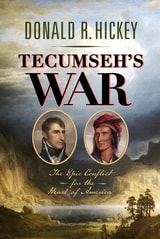
Tecumseh's War
The Epic Conflict for the Heart of AmericaDonald R. Hickey
Westholme Publishing, 2026
The Shawnee leader Tecumseh came to prominence in a war against the United States waged from 1811 to 1815. In 1805, Tecumseh’s younger brother Lalawethika (soon to be known as “the Prophet”) had a vision for an Indian revitalization movement that would restore Native culture and resist American expansion. Tecumseh organized the growing support for this movement, which came from Indigenous peoples across the Old Northwest and parts of the Great Plains, into a loose but powerful military alliance.
In late 1811, while Tecumseh was away on a recruiting mission in the South, General William Henry Harrison led an army to the center of Native resistance at Prophetstown in present-day Indiana. In the early morning hours of November 7, in what came to be known as the Battle of Tippecanoe, Harrison’s men fought off an Indian attack, which marked the beginning of Tecumseh’s War. Seven months later, when the United States declared war on Britain, thus initiating the War of 1812, the British and Tecumseh forged an alliance against the United States. Initially, the Anglo-Indian alliance enjoyed considerable success at Detroit, Chicago, Mackinac, and elsewhere, exposing much of the Old Northwest to border warfare, but the tide turned in 1813 when Harrison invaded Canada. On October 5 the American army defeated a much smaller Anglo-Indian force in the climactic Battle of the Thames. Tecumseh was killed in this battle, and although his confederacy disintegrated, British support ensured that the Indian war would continue for another two years with the Sauk chief Black Hawk now providing the inspiration and leadership. Tecumseh’s War ended only in late 1815 after the British made peace with the United States and abandoned their native allies.
Tecumseh’s War: The Epic Conflict for the Heart of America is the first complete story of this major conflict. Distinguished historian Donald R. Hickey detaches it from the War of 1812, moving Tecumseh’s confederation to center stage to tell the sweeping and engrossing story of this last great Indian War—the last time that Indigenous Peoples had a powerful European ally to oppose United States expansion and thus the lastchance they had of shaping the future of the continent.
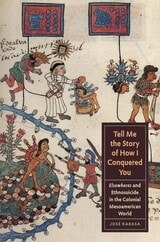
Tell Me the Story of How I Conquered You
Elsewheres and Ethnosuicide in the Colonial Mesoamerican WorldBy José Rabasa
University of Texas Press, 2011
Folio 46r from Codex Telleriano-Remensis was created in the sixteenth century under the supervision of Spanish missionaries in central Mexico. As an artifact of seismic cultural and political shifts, the manuscript painting is a singular document of indigenous response to Spanish conquest. Examining the ways in which the folio's tlacuilo (indigenous painter/writer) creates a pictorial vocabulary, this book embraces the place "outside" history from which this rich document emerged.
Applying contemporary intellectual perspectives, including aspects of gender, modernity, nation, and visual representation itself, José Rabasa reveals new perspectives on colonial order. Folio 46r becomes a metaphor for reading the totality of the codex and for reflecting on the postcolonial theoretical issues now brought to bear on the past. Ambitious and innovative (such as the invention of the concepts of elsewheres and ethnosuicide, and the emphasis on intuition), Tell Me the Story of How I Conquered You embraces the performative force of the native scribe while acknowledging the ineffable traits of 46r—traits that remain untenably foreign to the modern excavator/scholar. Posing provocative questions about the unspoken dialogues between evangelizing friars and their spiritual conquests, this book offers a theoretic-political experiment on the possibility of learning from the tlacuilo ways of seeing the world that dislocate the predominance of the West.
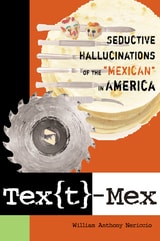
Tex[t]-Mex
Seductive Hallucinations of the "Mexican" in AmericaBy William Anthony Nericcio
University of Texas Press, 2006
A rogues' gallery of Mexican bandits, bombshells, lotharios, and thieves saturates American popular culture. Remember Speedy Gonzalez? "Mexican Spitfire" Lupe Vélez? The Frito Bandito? Familiar and reassuring—at least to Anglos—these Mexican stereotypes are not a people but a text, a carefully woven, articulated, and consumer-ready commodity. In this original, provocative, and highly entertaining book, William Anthony Nericcio deconstructs Tex[t]-Mexicans in films, television, advertising, comic books, toys, literature, and even critical theory, revealing them to be less flesh-and-blood than "seductive hallucinations," less reality than consumer products, a kind of "digital crack."
Nericcio engages in close readings of rogue/icons Rita Hayworth, Speedy Gonzalez, Lupe Vélez, and Frida Kahlo, as well as Orson Welles' film Touch of Evil and the comic artistry of Gilbert Hernandez. He playfully yet devastatingly discloses how American cultural creators have invented and used these and other Tex[t]-Mexicans since the Mexican Revolution of 1910, thereby exposing the stereotypes, agendas, phobias, and intellectual deceits that drive American popular culture. This sophisticated, innovative history of celebrity Latina/o mannequins in the American marketplace takes a quantum leap toward a constructive and deconstructive next-generation figuration/adoration of Latinos in America.
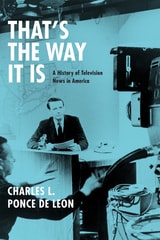
That's the Way It Is
A History of Television News in AmericaCharles L. Ponce de Leon
University of Chicago Press, 2015
The critics may be right. But, as Charles L. Ponce de Leon explains in That’s the Way It Is, TV news has always walked a fine line between hard news and fluff. The familiar story of decline fails to acknowledge real changes in the media and Americans’ news-consuming habits, while also harking back to a golden age that, on closer examination, is revealed to be not so golden after all. Ponce de Leon traces the entire history of televised news, from the household names of the late 1940s and early ’50s, like Eric Sevareid, Edward R. Murrow, and Walter Cronkite, through the rise of cable, the political power of Fox News, and the satirical punch of Colbert and Stewart. He shows us an industry forever in transition, where newsmagazines and celebrity profiles vie with political news and serious investigations. The need for ratings success—and the lighter, human interest stories that can help bring it—Ponce de Leon makes clear, has always sat uneasily alongside a real desire to report hard news.
Highlighting the contradictions and paradoxes at the heart of TV news, and telling a story rich in familiar figures and fascinating anecdotes, That’s the Way It Is will be the definitive account of how television has showed us our history as it happens.

The Accidental Diarist
A History of the Daily Planner in AmericaMolly A. McCarthy
University of Chicago Press, 2013

The African Exchange
Toward a Biological History of Black PeopleKenneth F. Kiple
Duke University Press, 1988
The essays in this volume form the cutting edge of biohistorical research that promises to rewrite the story of humankind's past in significant ways.
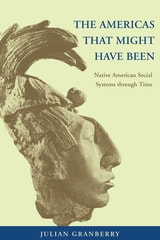
The Americas That Might Have Been
Native American Social Systems through TimeJulian Granberry
University of Alabama Press, 2005
This work answers the hypothetical question: What would the Americas be like today—politically, economically, culturally—if Columbus and the Europeans had never found them, and how would American peoples interact with the world’s other societies? It assumes that Columbus did not embark from Spain in 1492 and that no Europeans found or settled the New World afterward, leaving the peoples of the two American continents free to follow the natural course of their Native lives.
The Americas That Might Have Been is a professional but layman-accessible, fact-based, nonfiction account of the major Native American political states that were thriving in the New World in 1492. Granberry considers a contemporary New World in which the glories of Aztec Mexico, Maya Middle America, and Inca Peru survived intact. He imagines the roles that the Iroquois Confederacy of the American Northeast, the powerful city-states along the Mississippi River in the Midwest and Southeast, the Navajo Nation and the Pueblo culture of the Southwest, the Eskimo Nation in the Far North, and the Taino/Arawak chiefdoms of the Caribbean would play in American and world politics in the 21st Century.
Following a critical examination of the data using empirical archaeology, linguistics, and ethnohistory, Granberry presents a reasoned and compelling discussion of native cultures and the paths they would have logically taken over the past five centuries. He reveals the spectacular futures these brilliant pre-Columbian societies might have had, if not for one epochal meeting that set off a chain of events so overwhelming to them that the course of human history was forever changed.
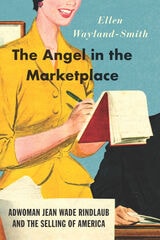
The Angel in the Marketplace
Adwoman Jean Wade Rindlaub and the Selling of AmericaEllen Wayland-Smith
University of Chicago Press, 2020
The Angel in the Marketplace is the story of one of America’s most accomplished advertising executives. It is also the story of how advertisers like Rindlaub sold a postwar American dream of capitalism and a Christian corporate order. Rindlaub was responsible for award-winning, mega sales-generating advertisements for all things domestic, including Oneida silverware, Betty Crocker cake mix, Campbell’s soup, and Chiquita bananas. Her success largely came from embracing, rather than subverting, the cultural expectations of women. She believed her responsibility as an advertiser was not to spring women from their trap, but to make that trap more comfortable.
Rindlaub wasn’t just selling silverware and cakes; she was selling the virtues of free enterprise. By following the arc of Rindlaub’s career from the 1920s through the 1960s, we witness how a range of cultural narratives—advertising chief among them—worked powerfully to shape women’s emotional and economic behavior in support of the free market system. Alongside Rindlaub’s story, Ellen Wayland-Smith provides a riveting history of how women were repeatedly sold the idea that their role as housewives was more powerful, and more patriotic, than any outside the home. And by buying into the image of morality through an unregulated market, many of these women helped fuel backlash against economic regulation and socialization efforts throughout the twentieth century.
The Angel in the Marketplace is a nuanced portrayal of a complex woman, one who both shaped and reflected the complicated cultural, political, and religious forces defining femininity in America at mid-century. This compelling account of one of advertising’s most fervent believers is a tale of a Mad Woman we haven’t been told.

The Anomie of the Earth
Philosophy, Politics, and Autonomy in Europe and the AmericasFederico Luisetti, John Pickles, and Wilson Kaiser, eds.
Duke University Press, 2015
Contributors. Joost de Bloois, Jodi A. Byrd, Gustavo Esteva, Silvia Federici, Wilson Kaiser, Mara Kaufman, Frans-Willem Korsten, Federico Luisetti, Sandro Mezzadra, Walter D. Mignolo, Benjamin Noys, John Pickles, Alvaro Reyes, Catherine Walsh, Gareth Williams, Zac Zimmer
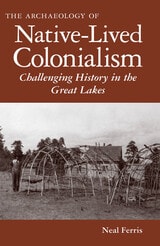
The Archaeology of Native-Lived Colonialism
Challenging History in the Great LakesNeal Ferris
University of Arizona Press, 2009
In reconsidering Native adaptation and resistance to colonial British rule, Ferris reviews five centuries of interaction that are usually read as a single event viewed through the lens of historical bias. He first examines patterns of traditional lifeway continuity among the Ojibwa, demonstrating their ability to maintain seasonal mobility up to the mid-nineteenth century and their adaptive response to its loss. He then looks at the experience of refugee Delawares, who settled among the Ojibwa as a missionary-sponsored community yet managed to maintain an identity distinct from missionary influences. And he shows how the archaeological history of the Six Nations Iroquois reflected patterns of negotiating emergent colonialism when they returned to the region in the 1780s, exploring how families managed tradition and the contemporary colonial world to develop innovative ways of revising and maintaining identity.
The Archaeology of Native-Lived Colonialism convincingly utilizes historical archaeology to link the Native experience of the eighteenth and nineteenth centuries to the deeper history of sixteenth- and seventeenth-century interactions and with pre-European times. It shows how these Native communities succeeded in retaining cohesiveness through centuries of foreign influence and material innovations by maintaining ancient, adaptive social processes that both incorporated European ideas and reinforced historically understood notions of self and community.
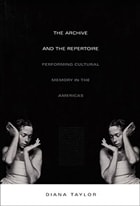
The Archive and the Repertoire
Performing Cultural Memory in the AmericasDiana Taylor
Duke University Press, 2003
Examining various genres of performance including demonstrations by the children of the disappeared in Argentina, the Peruvian theatre group Yuyachkani, and televised astrological readings by Univision personality Walter Mercado, Taylor explores how the archive and the repertoire work together to make political claims, transmit traumatic memory, and forge a new sense of cultural identity. Through her consideration of performances such as Coco Fusco and Guillermo Gómez-Peña’s show Two Undiscovered Amerindians Visit . . . , Taylor illuminates how scenarios of discovery and conquest haunt the Americas, trapping even those who attempt to dismantle them. Meditating on events like those of September 11, 2001 and media representations of them, she examines both the crucial role of performance in contemporary culture and her own role as witness to and participant in hemispheric dramas. The Archive and the Repertoire is a compelling demonstration of the many ways that the study of performance enables a deeper understanding of the past and present, of ourselves and others.
The Art of Authorial Presence
Hawthorne's Provincial TalesG. R. Thompson
Duke University Press, 1993
By focusing on the provincial tales as they were originally conceived--as a narrative cycle--Thompson is able to recover intertextual references that reveal Hawthorne's preoccupation with framing strategies and variations on authorial presence. The author shows how Hawthorne deliberately constructs sentimental narratives, only to deconstruct them. Thompson's analysis provides a new aesthetic context for understanding the whole shape of Hawthorne's career as well as the narrative, ethical, and historical issues within individual works.
Revisionary in its view of one of America's greatest authors, The Art of Authorial Presence also offers invaluable insight into the problems of narratology and historiography, ethics and psychology, romanticism and idealism, and the cultural myths of America.
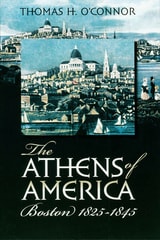
The Athens of America
Boston, 1825-1845Thomas H. O'Connor
University of Massachusetts Press, 2006
Many people are generally familiar with the fact that Boston was once known as “the Athens of America.” Very few, however, are clear about exactly why, except for their recollections of the famous writers and poets who gave the city a reputation for literature and learning.
In this book, historian Thomas H. O'Connor sets the matter straight by showing that Boston's eminence during the first half of the nineteenth century was the result of a much broader community effort. After the nation emerged from its successful struggle for independence, most Bostonians visualized their city not only as the Cradle of Liberty, but also as the new world's Cradle of Civilization.
According to O'Connor, a leadership elite, composed of men of prominent family background, Unitarian beliefs, liberal education, and managerial experience in a variety of enterprises, used their personal talents and substantial financial resources to promote the cultural, intellectual, and humanitarian interests of Boston to the point where it would be the envy of the nation. Not only did writers, scholars, and philosophers see themselves as part of this process, but so did physicians and lawyers, ministers and teachers, merchants and businessmen, mechanics and artisans, all involved in creating a well-ordered city whose citizens would be committed to the ideals of social progress and personal perfectibility.
To accomplish their noble vision, leading members of the Boston community joined in programs designed to cleanse the old town of what they felt were generations of accumulated social stains and human failures, and then to create new programs and more efficient institutions that would raise the cultural and intellectual standards of all its citizens. Like ancient Athens, Boston would be a city of great statesmen, wealthy patrons, inspiring artists, and profound thinkers, headed by members of the “happy and respectable classes” who would assume responsibility for the safety, welfare, and education of the “less prosperous portions of the community.”
Designed for the general reader and the historical enthusiast, The Athens of America is an interpretive synthesis that explores the numerous secondary sources that have concentrated on individual subjects and personalities, and draws their various conclusions into a single comprehensive narrative.
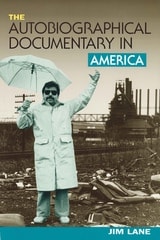
The Autobiographical Documentary in America
Jim Lane
University of Wisconsin Press, 2002
Since the late 1960s, American film and video makers of all genres have been fascinated with themes of self and identity. Though the documentary form is most often used to capture the lives of others, Jim Lane turns his lens on those media makers who document their own lives and identities. He looks at the ways in which autobiographical documentaries—including Roger and Me, Sherman’s March, and Silverlake Life—raise weighty questions about American cultural life. What is the role of women in society? What does it mean to die from AIDS? How do race and class play out in our personal lives? What does it mean to be a member of a family? Examining the history, diversity, and theoretical underpinnings of this increasingly popular documentary form, Lane tracks a fundamental transformation of notions of both autobiography and documentary.
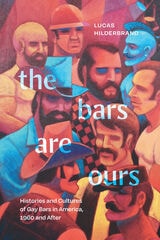
The Bars Are Ours
Histories and Cultures of Gay Bars in America,1960 and AfterLucas Hilderbrand
Duke University Press, 2024

The Battle to Stay in America
Immigration's Hidden Front LineMichael Kagan
University of Nevada Press, 2025
The Battle to Stay in America is the story of a community coming to grips with the federal government’s crackdown on immigrants, and learning how to defend itself. Informative and personal, this is a story about mothers and fathers, lawyers and activists, local police and federal agencies, and a struggle for the identity of a nation. This is the quintessential story of the war on immigrants, as fought and felt on the front lines in the heart of America.

The Battles of Germantown
Effective Public History in AmericaDavid W. Young
Temple University Press, 2019
2020 Philip S. Klein Book Prize Winner, Pennsylvania Historical Association
Known as America’s most historic neighborhood, the Germantown section of Philadelphia (established in 1683) has distinguished itself by using public history initiatives to forge community. Progressive programs about ethnic history, postwar urban planning, and civil rights have helped make historic preservation and public history meaningful. The Battles of Germantown considers what these efforts can tell us about public history’s practice and purpose in the United States.
Author David Young, a neighborhood resident who worked at Germantown historic sites for decades, uses his practitioner’s perspective to give examples of what he calls “effective public history.” The Battles of Germantown shows how the region celebrated “Negro Achievement Week” in 1928 and, for example, how social history research proved that the neighborhood’s Johnson House was a station on the Underground Railroad. These encounters have useful implications for addressing questions of race, history, and memory, as well as issues of urban planning and economic revitalization.
Germantown’s historic sites use public history and provide leadership to motivate residents in an area challenged by job loss, population change, and institutional inertia. The Battles of Germantown illustrates how understanding and engaging with the past can benefit communities today.
The Black Experience in America
Selected EssaysEdited by James C. Curtis and Lewis L. Gould
University of Texas Press, 1970
In the fall of 1968, the University of Texas at Austin sponsored a series of public lectures delivered by outstanding students of the black past in an effort to clarify the role of the African American in America’s history. This volume of essays by eight of the ten participants makes the lectures available to a broader public.
The essays demonstrate that the black experience in America has been integral throughout the nation’s history. Although each contributor deals with a different aspect of this experience, they all share a common commitment to sound historical scholarship. The essays also reflect the intensive research in the field of black history during a time of high racial tension.
Henry Allen Bullock, in an exploration of education in the slave experience, shows that, despite organized attempts to dehumanize the Negro, the black man’s position in the American social order was not static. By training and educating the Negro, the slaveowner was weakening the peculiar institution and preparing the slave for freedom. In the field of cultural anthropology, which had largely ignored blacks in the United States, William S. Willis, Jr., examines the interaction of whites, blacks, and Indians on the Southern colonial frontier. Arthur Zilversmit traces the development of abolitionist attitudes from patience to militance and points out that both those reformers who abandoned action and those who demanded radical violent change were forced into their positions by society’s failure to listen to the arguments of moderate reformers.
William S. McFeely takes a fresh look at the Reconstruction era, one of the only times in American history when white Americans have even come close to wanting for black Americans what black Americans wanted for themselves. In a discussion of protest against segregated streetcars in the South, August Meier and Elliott Rudwick show that the boycotts of the late 1950s had their counterparts in more than twenty-five Southern cities between 1900 and 1906. Thomas R. Cripps attacks the myth of the Southern box office and shows how Hollywood’s own timidity fostered racial stereotyping in American movies. Robert L. Zangrando outlines the role of the NAACP, founded in 1909, in the evolution of civil rights protests during the mid-twentieth century. He argues that the organization’s precarious position in American society prevented it from exercising strong leadership within the black community. Louis R. Harlan concludes the volume by assessing the past and looking toward the future of black history in America.
The Black Model Minority Student
African Immigrants and the Contradictions of Race in AmericaMercy Agyepong
University of Chicago Press, 2027
Explores the contradictory perceptions of African immigrant students in New York City and reveals how anti-Blackness persists even within predominantly Black and Brown schools.
African immigrant students are often celebrated in the United States as academically successful and culturally disciplined. But what happens when praise itself becomes part of a racial hierarchy? In The Black Model Minority Student, sociologist of education Mercy Agyepong traces the complex experiences of West African immigrant students attending public high schools in New York City.
Using ethnographic and interview data from predominantly Black and Brown schools in the Bronx, Agyepong shows that African immigrant students are often viewed through two competing yet coexisting narratives: as intellectually capable and hardworking, yet also as uncivilized or socially inferior. These perceptions are not incidental, but central to how anti-Blackness operates and how racial hierarchies are sustained in the United States. While the model minority stereotype shaped their experiences in Black and Brown high schools, West African immigrant students found that this seemingly favorable stereotype mattered less once they graduated and entered the white spaces of higher education and other social settings. At every step, African students—regardless of their national origins—were disadvantaged by racial stereotypes.
Theoretically grounded yet deeply human, The Black Model Minority Student offers an important new perspective on race, immigration, and education in contemporary America.
The Black Shoals
Offshore Formations of Black and Native StudiesTiffany Lethabo King
Duke University Press, 2019
The Black Tax
150 Years of Theft, Exploitation, and Dispossession in AmericaAndrew W. Kahrl
University of Chicago Press, 2024
American taxation is unfair, and it is most unfair to the very people who critically need its support. Not only do taxpayers with fewer resources—less wealth, power, and land—pay more than the well-off, but they are forced to fight for their rights within an unjust system that undermines any attempts to improve their position or economic standing. In The Black Tax, Andrew W. Kahrl reveals the shocking history and ruinous consequences of inequitable and predatory tax laws in this country—above all, widespread and devastating racial dispossession.
Throughout the twentieth century, African Americans acquired substantial amounts of property nationwide. But racist practices, obscure processes, and outright theft diminished their holdings and their power. Of these, Kahrl shows, few were more powerful, or more quietly destructive, than property taxes. He examines all the structural features and hidden traps within America’s tax system that have forced Black Americans to pay more for less and stripped them of their land and investments, and he reveals the staggering cost. The story of America’s now enormous concentration of wealth at the top—and the equally enormous absence of wealth among most Black households—has its roots here.
Kahrl exposes the painful history of these practices, from Reconstruction up to the present, and tells, for the first time, the story of Black Americans’ experiences as taxpayers and their fight for a more fair and equitable system for raising and spending the public’s money. This is a history that deepens our understanding of the disadvantages and persistent inequalities that African American households continue to face and reveals hidden engines of economic inequality in America. Detailing the hows and whys of America’s profoundly unequal tax system, The Black Tax equips readers with the knowledge needed to combat inequality and injustice today.
The Black Tax
150 Years of Theft, Exploitation, and Dispossession in AmericaAndrew W. Kahrl
University of Chicago Press, 2024
Revealing a history that is deep, broad, and infuriating, The Black Tax casts a bold light on the racist practices long hidden in the shadows of America’s tax regimes.
American taxation is unfair, and it is most unfair to the very people who critically need its support. Not only do taxpayers with fewer resources—less wealth, power, and land—pay more than the well-off, but they are forced to fight for their rights within an unjust system that undermines any attempts to improve their position or economic standing. In The Black Tax, Andrew W. Kahrl reveals the shocking history and ruinous consequences of inequitable and predatory tax laws in this country—above all, widespread and devastating racial dispossession.
Throughout the twentieth century, African Americans acquired substantial amounts of property nationwide. But racist practices, obscure processes, and outright theft diminished their holdings and their power. Of these, Kahrl shows, few were more powerful, or more quietly destructive, than property taxes. He examines all the structural features and hidden traps within America’s tax system that have forced Black Americans to pay more for less and stripped them of their land and investments, and he reveals the staggering cost. The story of America’s now enormous concentration of wealth at the top—and the equally enormous absence of wealth among most Black households—has its roots here.
Kahrl exposes the painful history of these practices, from Reconstruction up to the present, and tells, for the first time, the story of Black Americans’ experiences as taxpayers and their fight for a more fair and equitable system for raising and spending the public’s money. This is a history that deepens our understanding of the disadvantages and persistent inequalities that African American households continue to face and reveals hidden engines of economic inequality in America. Detailing the hows and whys of America’s profoundly unequal tax system, The Black Tax equips readers with the knowledge needed to combat inequality and injustice today.
The Boat People and Achievement in America
A Study of Family Life, Hard Work, and Cultural ValuesNathan Caplan, John K. Whitmore, and Marcella H. Choy
University of Michigan Press, 1989
The Body of Faith
A Biological History of Religion in AmericaRobert C. Fuller
University of Chicago Press, 2013
The postmodern view that human experience is constructed by language and culture has informed historical narratives for decades. Yet newly emerging information about the biological body now makes it possible to supplement traditional scholarly models with insights about the bodily sources of human thought and experience.
The Body of Faith is the first account of American religious history to highlight the biological body. Robert C. Fuller brings a crucial new perspective to the study of American religion, showing that knowledge about the biological body deeply enriches how we explain dramatic episodes in American religious life. Fuller shows that the body’s genetically evolved systems—pain responses, sexual passion, and emotions like shame and fear—have persistently shaped the ways that Americans forge relationships with nature, to society, and to God.
The first new work to appear in the Chicago History of American Religion series in decades, The Body of Faith offers a truly interdisciplinary framework for explaining the richness, diversity, and endless creativity of American religious life.
The Borders of America
Migration, Control, and Resistance Across Latin America and the CaribbeanSoledad Álvarez Velasco, Nicholas De Genova, Gustavo Dias, and Eduardo Domenech, editors
Duke University Press, 2026
Contributors. Soledad Álvarez Velasco, Tanya Basok, Janneth Clavijo, Nicholas De Genova, Gustavo Dias, Eduardo Domenech, Roberto Dufraix-Tapia, Jonathan Echeverri Zuluaga, Valentina Glockner Fagetti, Luin Goldring, Patricia Landolt, Carolina Moulin, Margarita Luz Núñez Chaim, Juan Ordóñez, Daniel Quinteros, Romina Ramos, Martha Rojas-Wiesner, Fabio Santos, Amarela Varela-Huerta, and Laura Velasco Ortiz
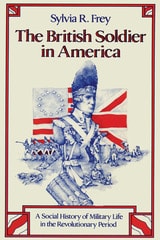
The British Soldier in America
A Social History of Military Life in the Revolutionary PeriodBy Sylvia R. Frey
University of Texas Press, 1981
In her investigation of the social history of the common British soldier in the era of the American Revolution, Sylvia Frey has extensively surveyed recruiting records, contemporary training manuals, statutes, and memoirs in an attempt to provide insight into the soldier's "life and mind." In the process she has discovered more about the common soldier than anyone thought possible: his social origins and occupational background, his size, age, and general physical condition, his personal economics and daily existence. Her findings dispel the traditional assumption that the army was made up largely of criminals and social misfits.
Special attention is given to soldiering as an occupation. Focusing on two of the major campaigns of the war—the Northern Campaign which culminated at Saratoga and the Southern Campaign which ended at Yorktown—Frey describes the human face of war, with particular emphasis on the physical and psychic strains of campaigning in the eighteenth century.
Perhaps the most important part of the work is the analysis of the moral and material factors which induced men to accept the high risks of soldiering. Frey rejects the traditional assumption that soldiers were motivated to fight exclusively by fear and force and argues instead that the primary motivation to battle was generated by regimental esprit, which in the eighteenth century substituted for patriotism. After analyzing the sources of esprit, she concludes that it was the sustaining force for morale in a long and discouraging war.
This book is a contribution to our understanding of the eighteenth century and should appeal not only to military historians but also to social and economic historians and to those interested in the history of medicine.

The Business of America
The Cultural Production of a Post-War NationGraham Thompson
Pluto Press, 2004
The first part of the book examines how white male literary culture has been largely hostile to business during this period and how it has represented transnational shifts in the nature of business as threats to supposedly American values like the individual, the family, or freedom. The book charts the way that such an uneasiness towards business relies upon a discourse about America, business and empire that is increasingly untenable in the post-war world.
By way of comparison, The Business of America looks at how literature by women and by writers from different racial, ethnic and sexual groups often deals with business from the more localised angle of work. Graham Thompson shows how this attention to work provides a less abstract and more oppositional approach to the connection between business and America.
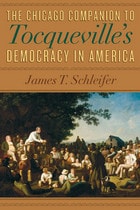
The Chicago Companion to Tocqueville's Democracy in America
James T. Schleifer
University of Chicago Press, 2012
An compact, accessible, authoritative companion to Tocqueville's classic work
One of the greatest books ever to be written on the United States, Democracy in America continues to find new readers who marvel at the lasting insights Alexis de Tocqueville had into our nation and its political culture. The work is, however, as challenging as it is important; its arguments can be complex and subtle, and its sheer length can make it difficult for any reader, especially one coming to it for the first time, to grasp Tocqueville’s meaning. The Chicago Companion to Tocqueville’s “Democracy in America” is the first book written expressly to help general readers and students alike get the most out of this seminal work.
Now James T. Schleifer, an expert on Tocqueville, has provided the background and information readers need in order to understand Tocqueville’s masterwork. In clear and engaging prose, Schleifer explains why Democracy in America is so important, how it came to be written, and how different generations of Americans have interpreted it since its publication. He also presents indispensable insight on who Tocqueville was, his trip to America, and what he meant by equality, democracy, and liberty.
Drawing upon his intimate knowledge of Tocqueville’s papers and manuscripts, Schleifer reveals how Tocqueville’s ideas took shape and changed even in the course of writing the book. At the same time, Schleifer provides a detailed glossary of key terms and key passages, all accompanied by generous citations to the relevant pages in the University of Chicago Press Mansfield/Winthrop translation. The Chicago Companion will serve generations of readers as an essential guide to both the man and his work.
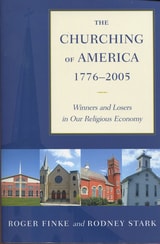
The Churching of America, 1776-2005
Winners and Losers in Our Religious EconomyFinke, Roger
Rutgers University Press, 2005
But, as Finke and Stark show, not all denominations benefited. They explain how and why the early nineteenth-century churches began their descent, while two newcomer sects, the Baptists and the Methodists, gained ground. They also analyze why the Methodists then began a long, downward slide, why the Baptists continued to succeed, how the Catholic Church met the competition of ardent Protestant missionaries, and why the Catholic commitment has declined since Vatican II. The authors also explain why ecumenical movements always fail
In short, Americans are not abandoning religion; they have been moving away from established denominations. A "church-sect process" is always under way, Finke and Stark argue, as successful churches lose their organizational vigor and are replaced by less worldly groups.
Some observers assert that the rise in churching rates indicates increased participation, not increased belief. Finke and Stark challenge this as well. They find that those groups that have gained the greatest numbers have demanded that their followers accept traditional doctrines and otherworldliness. They argue that religious organizations can thrive only when they comfort souls and demand sacrifice. When theology becomes too logical, or too secular, it loses people.
The Color Line and the Quality of Life in America
Reynolds Farley
Russell Sage Foundation, 1987
The Conundrum of Class
Public Discourse on the Social Order in AmericaMartin J. Burke
University of Chicago Press, 1995
Surveying American political, social, and intellectual life from the late 17th to the end of the 19th century, Burke examines in detail the contested discourse about equality—the way Americans thought and wrote about class, class relations, and their meaning in society.
Burke explores a remarkable range of thought to establish the boundaries of class and the language used to describe it in the works of leading political figures, social reformers, and moral philosophers. He traces a shift from class as a legal category of ranks and orders to socio-economic divisions based on occupations and income. Throughout the century, he finds no permanent consensus about the meaning of class in America and instead describes a culture of conflicting ideas and opinions.
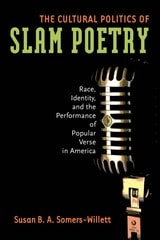
The Cultural Politics of Slam Poetry
Race, Identity, and the Performance of Popular Verse in AmericaSusan B. A. Somers-Willett
University of Michigan Press, 2010
"For a lucid and thorough 'real-world' analysis of the movement from the ground-up--including its history, aesthetics, and culture, there is surely no better place to start than Somers-Willett's trailblazing book."
--- Jerome Sala, Pleiades
"Finally, a clear, accurate, and thoroughly researched examination of slam poetry, a movement begun in 1984 by a mixed bag of nobody poets in Chicago. At conception, slam poetry espoused universal humanistic ideals and a broad spectrum of participants, and especially welcome is the book's analysis of how commercial marketing forces succeeded in narrowing public perception of slam to the factionalized politics of race and identity. The author's knowledge of American slam at the national level is solid and more authentic than many of the slammers who claim to be."
---Marc Kelly Smith, founder/creator of the International Poetry Slam movement
The cultural phenomenon known as slam poetry was born some twenty years ago in white working-class Chicago barrooms. Since then, the raucous competitions have spread internationally, launching a number of annual tournaments, inspiring a generation of young poets, and spawning a commercial empire in which poetry and hip-hop merge.
The Cultural Politics of Slam Poetry is the first critical book to take an in-depth look at slam, shedding light on the relationships that slam poets build with their audiences through race and identity performance and revealing how poets come to celebrate (and at times exploit) the politics of difference in American culture.
With a special focus on African American poets, Susan B. A. Somers-Willett explores the pros and cons of identity representation in the commercial arena of spoken word poetry and, in doing so, situates slam within a history of verse performance, from blackface minstrelsy to Def Poetry. What's revealed is a race-based dynamic of authenticity lying at the heart of American culture. Rather than being mere reflections of culture, Somers-Willett argues, slams are culture---sites where identities and political values get publicly refigured and exchanged between poets and audiences.
Susan B. A. Somers-Willett is a decade-long veteran of slam and teaches creative writing and poetics as an Assistant Professor of English at Montclair State University. She is the author of two books of poetry, Quiver and Roam. Visit the author's website at: http://www.susansw.com/.
Photo by Jennifer Lacy.
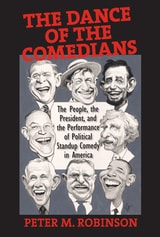
The Dance of the Comedians
The People, the President, and the Performance of Political Standup Comedy in AmericaPeter M. Robinson
University of Massachusetts Press, 2010
Why did Barack Obama court Jon Stewart and trade jokes with Stephen Colbert during the campaign of 2008? Why did Sarah Palin forgo the opportunity to earn votes on the Sunday morning political talk shows but embrace the chance to get laughs on Saturday Night Live? The Dance of the Comedians examines the history behind these questions—the merry, mocking, and highly contested anarchies of standup political comedy that have locked humorists, presidents, and their fellow Americans in an improvisational three-way “dance” since the early years of the American republic.
Peter M. Robinson shows how the performance of political humor developed as a celebration of democracy and an expression of political power, protest, and commercial profit. He places special significance on the middle half of the twentieth century, when presidents and comedians alike—from Calvin Coolidge to Ronald Reagan, from Will Rogers to Saturday Night Live's “Not Ready for Prime Time Players”—developed modern understandings of the power of laughter to affect popular opinion and political agendas, only to find the American audience increasingly willing and able to get in on the act. These years put the long-standing traditions of presidential deference profoundly in play as all three parties to American political humor—the people, the presidents, and the comedy professionals—negotiated their way between reverence for the office of the presidency and ridicule of its occupants.
Although the focus is on humor, The Dance of the Comedians illuminates the process by which Americans have come to recognize that the performance of political comedy has serious and profound consequences for those on all sides of the punch line.
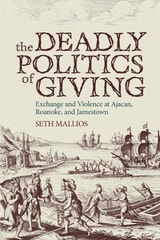
The Deadly Politics of Giving
Exchange and Violence at Ajacan, Roanoke, and JamestownSeth Mallios
University of Alabama Press, 2006
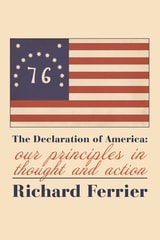
The Declaration of America
Our Principles in Thought and ActionRichard Ferrier
St. Augustine's Press, 2022
Here Ferrier transforms decades of teaching American history and its founding into a reflection on its most important document. Our troubled times call for a return to America's fundamental principles. This book shows their sources, their truth, and their lasting power. It is a labor of love, and of hope.
Anyone seeking opportunity in the United States should read this book and be reminded of the privilege and obligation of the American way of life, all contained in the Declaration of Independence.

The Defoliation of America
Agent Orange Chemicals, Citizens, and ProtestsAmy M. Hay
University of Alabama Press, 2022
Examines the domestic and international use of phenoxy herbicides by the United States in the mid-twentieth century.
In The Defoliation of America: Agent Orange Chemicals, Citizens, and Protests, Amy M. Hay profiles the attitudes, understandings, and motivations of grassroots activists who rose to fight the use of phenoxy herbicides, or Agent Orange chemicals as they are commonly known, in various aspects of American life during the post-WWII era. Hay focuses her analysis on citizen responses to illuminate how regulatory policies were understood, challenged, and negotiated, contributing to a growing body of research on chemical regulatory policies, risk society, and hazardous chemicals. This volume uncovers new understandings about the authority of the state and its obligation to society, the role of scientific authority and expertise, and the protests made by various groups of citizens.
First introduced in 1946, phenoxy herbicides mimic hormones in broadleaf plants, causing them to “grow to death” while grass, grains, and other monocots remain unaffected. By the 1950s, millions of pounds of these chemicals were produced annually for use in brush control, weed eradication, forest management, and other agricultural applications. Pockets of skepticism and resistance began to appear by the late 1950s, and the trend intensified after 1962 when Rachel Carson’s Silent Spring directed mainstream attention to the harm modern chemicals were causing in the natural world. It wasn’t until the Vietnam War, however, when nearly 19 million gallons of Agent Orange and related herbicides were sprayed to clear the canopy and destroy crops in Southeast Asia, that the long-term damage associated with this group of chemicals began to attract widespread attention and alarm.
Using a wide array of sources and an interdisciplinary approach, Hay contributes to the robust fields of chemical toxicity, regulation, environmental management, and public health. This study of the scientists, health and environmental activists, and veterans who fought US chemical regulatory policies and practices reveals the mechanisms, obligations, and constraints of state and scientific authority in mid-twentieth-century America. Hay also shows how these disparate and mostly forgotten citizen groups challenged the political consensus and contested government and industry narratives of chemical safety.
The Dialectics of Our America
Genealogy, Cultural Critique, and Literary HistoryJosé David Saldívar
Duke University Press, 1991
Saldívar pursues this goal through an array of oppositional critical and creative practices. He analyzes a range of North American writers of color (Rolando Hinojosa, Gloria Anzaldúa, Arturo Islas, Ntozake Shange, and others) and Latin American authors (José Martí, Roberto Fernández Retamar, Gabriel García Márquez, and others), whose work forms a radical critique of the dominant culture, its politics, and its restrictive modes of expression. By doing so, Saldívar opens the traditional American canon to a dialog with other voices, not just the voices of national minorities, but those of regional cultures different from the prevalent anglocentric model.
The Dialectics of Our America, in its project to expand the “canon” and define a pan-American literary tradition, will make a critical difference in ongoing attempts to reconceptualize American literary history.
The Diplomacy of Trade and Investment
American Economic Expansion in the Hemisphere, 1865-1900David M. Pletcher
University of Missouri Press, 1998
The move to encourage trade with Canada and Mexico during the 1990s, culminating with the negotiation of the North American Free Trade Agreement (NAFTA), has had a long background extending as far back as the late eighteenth century. American trade with both Canada and Latin America rapidly increased during the last third of the nineteenth century as a result of burgeoning industry and agriculture in the United States. The Diplomacy of Trade and Investment is the first detailed examination of the economic and political forces behind this rapid growth and their effect on government policy.
Based on a thorough examination of government documents, congressional debates and reports, private papers of government and business leaders, and newspapers, David M. Pletcher begins this monumental study with a comprehensive survey of U.S. trade following the Civil War. He goes on to outline the problems of building a coherent trade policy toward Canada, Mexico, Central America, the Caribbean, and South America. The study concludes by analyzing a series of abortive trade reform efforts and examining the effects of the Spanish-American War.
Pletcher rejects the long-held belief that American business and government engaged in a deliberate, consistent drive for economic hegemony in the hemisphere during the late 1800s. Instead he finds that the American government improvised and experimented with ways to further trade expansion. But American businessmen were often more interested in domestic trade than in trade with foreign markets. In fact, many of them resisted efforts to lower the American tariff or otherwise encourage American trade abroad.
The combination of traditionalist and revisionist insight with Pletcher's own deep knowledge and research provides the reader with a comprehensive new interpretation of hemispheric trade expansion at the end of the nineteenth century.
The Discovery of America
Cesare Pascarella
University of Arkansas Press, 1991
Winner of the Harold Morton Landon Translation Award from the Academy of American Poets
The Drama of the American Short Story, 1800-1865
Michael J. Collins
University of Michigan Press, 2016
The book shows how perspectives from theater studies, anthropology, and performance studies can enrich readings of the short-story form. Moving beyond arbitrary distinctions between performance and text, it suggests that this literature had a social life and was engaged with questions of circumatlantic and transnational culture. It suggests that the short story itself was never conceived as a nationalist literary form, but worked by mobilizing cosmopolitan connections and meanings. In so doing, the book resurrects a neglected history of American Federalism and its connections to British literary forms.
The Elusive Promise of Indigenous Development
Rights, Culture, StrategyKaren Engle
Duke University Press, 2010
Conceiving indigenous rights as cultural rights, Engle argues, has largely displaced or deferred many of the economic and political issues that initially motivated much indigenous advocacy. She contends that by asserting static, essentialized notions of indigenous culture, indigenous rights advocates have often made concessions that threaten to exclude many claimants, force others into norms of cultural cohesion, and limit indigenous economic, political, and territorial autonomy.
Engle explores one use of the right to culture outside the context of indigenous rights, through a discussion of a 1993 Colombian law granting collective land title to certain Afro-descendant communities. Following the aspirations for and disappointments in this law, Engle cautions advocates for marginalized communities against learning the wrong lessons from the recent struggles of indigenous peoples at the international level.
The Emerson Effect
Individualism and Submission in AmericaChristopher Newfield
University of Chicago Press, 1995
Christopher Newfield analyzes the interplay of liberal and authoritarian impulses in Emerson's work in various domains: domestic life, the changing New England economy, theories of poetic language, homoerotic friendship, and racial hierarchy. Focusing on neglected later writings, Newfield shows how Emerson explored the tensions between autonomy and community—and consistently resolved these tensions by "abandoning crucial elements of both" and redefining autonomy as a kind of liberating subjection. He argues that in Emersonian individualism, self-determination is accompanied by submission to authority, and examines the influence of this submissive individualism on the history of American liberalism. In a provocative reading of Emerson's early and neglected later works, Newfield analyzes Emerson's emphasis on collective, or "corporate", world-building, rather than private possession. Tracing the development of this corporate individualism, he illuminates contradictions in Emerson's political outlook, and the conjunctions of liberal and authoritarian ideology they produced.
The Emperor's Last Campaign
A Napoleonic Empire in AmericaEmilio Ocampo
University of Alabama Press, 2009
WINNER OF THE 2009 LITERARY AWARD, SPONSORED BY THE INTERNATIONAL NAPOLEONIC SOCIETY/LA SOCIETE NAPOLEONIENNE INTERNATIONALE OF MONTREAL, QUEBEC'S LITERARY COMMITTEE
The fascinating story of the breakdown of the Spanish empire in America and the rise of the United States as a world power
Napoleon’s last campaign didn’t end at Waterloo. After that fateful day on June 1815, hundreds if not thousands of veterans of Napoleon’s army emigrated to America. Many went farther south and joined the rebels fighting for independence in the Spanish colonies, from Mexico to Buenos Aires. The Bonapartists roiled the Western World as they sought fortune, fame, and glory in the expanding United States and in the tumultuous Spanish Americas suffering from repression and civil disorder, and even in the states of Europe. They were joined by adventurers from other nations who shared their admiration for the fallen emperor.
This is the first full-length examination of the Bonapartists who emigrated from France after Napoleon’s defeat and exile, who formed a loose confederation with adventurers and romantics, and who contemplated a new empire in the Western Hemisphere. The scheme had the support and encouragement of the fallen emperor himself and his brother Joseph, former King of Spain, who lived in exile in the United States.
Emilio Ocampo has examined archives on three continents and sources in several languages to ferret out the evidence—a monumental task considering that conspirators tried to leave no evidence of their plans, and that a failed plot, like failure in general, leaves few claimants. Ocampo reinterprets Latin American independence as an international event that drew in all the major powers. By illuminating the complex connections between the shattered France of the Bourbon restoration; an England threatened by radical politician inspired by the French Revolution; Napoleon in exile at St. Helena; the United States, where home-grown adventurers and French émigrés alike saw opportunity; and the collapsing Spanish colonial empire, where revolutionaries were allying themselves with the veterans of Napoleon’s Grande Armée, Ocampo brings together two bodies of scholarship: Napoleonic history and Latin American independence. He does so by tracing the steps of four of the most fascinating characters of the era: two Britons disaffected with their own government—Lord Thomas Cochrane and Sir Robert Wilson—and two former generals of Napolean’s army named Charles Lallemand and Michel Brayer.
The Emperor’s Last Campaign is a fascinating story, well told, and peopled with all sorts of improbable characters and schemes that perhaps just missed coming to full fruition but that in the process contributed to one of the most important events of the nineteenth century: the breakdown of the Spanish empire in America and the rise of the United States as a world power.
The Engineer in America
A Historical Anthology from Technology and CultureEdited by Terry S. Reynolds
University of Chicago Press, 1991
Spanning two centuries and the various subdisciplines of the field, these essays demonstrate the paradoxical role engineers have played in building (although usually not controlling) the infrastructure on which America's prosperity is based. This collection of seventeen essays traces the rise of the engineering profession and its evolving contribution to the development of America's material and economic success. Topics addressed include:
*American engineering's birth from European traditions
*Impact of science on engineering practice
*Changing relationship between engineers and bureaucratic organizations
*Growth of engineering professional institutions
Thoughtfully organized and unique in its scope, this volume will be a welcome overview for both students and scholars of the history of technology.
These essays were originally published in the journal Technology and Culture.

The Establishment of Science in America
150 Years of the American Association for the Advancement of ScienceEdited by Sally Gregory Kohlstedt, Michael M. Sokal, and Bruce V. Lewenstein
Rutgers University Press, 1999
This comprehensive history of the American Association for the Advancement of Science (AAAS), the largest and most significant general organization of scientists in America, provides a unique window on the development of science in the United States during the past 150 years.
The Establishment of Science in America traces the evolution of the role of scientists in American society, public attitudes toward science, and the changing dimensions of the sponsorship of science and its participants. The essays by three distinguished authors connect the AAAS history to issues of continuing importance in American history, such as the integration of women and minority groups into mainstream professions and the role of expert knowledge in a democratic society.
The volume divides the history of the AAAS into three parts: Creating a Forum for Science in the Nineteenth Century; Promoting Science in a New Century: The Middle Years of the AAAS; and Shifting Science from People to Programs: AAAS in the Postwar Years.

The European Revolutions of 1848 and the Americas
Edited by Guy Thomson
University of London Press, 2002
The Fabulous Future?
America and the World in 2040Morton Schapiro and Gary Saul Morson
Northwestern University Press, 2015
Will the future be one of economic expansion, greater tolerance, liberating inventions, and longer, happier lives? Or do we face economic stagnation, declining quality of life, and a technologically enhanced totalitarianism worse than any yet seen? The Fabulous Future? America and the World in 2040 draws its inspiration from a more optimistic time, and tome, The Fabulous Future: America in 1980, in which Fortune magazine celebrated its twenty-fifth anniversary by publishing the predictions of thought leaders of its time.
In the present volume, the world’s leading specialists from diverse fields project developments in their areas of expertise, from religion and the media to the environment and nanotechnology. Will we be happier, and what exactly does happiness have to do with our economic future? Where is higher education heading and how should it develop? And what is the future of prediction itself? These exciting essays provoke sharper questions, reflect unexpectedly on one another, and testify to our present anxieties about the surprising world to come.