Results by title
64 books match the query 'American prose literature' and 21 start with t
Templates for Authorship
American Women's Literary Autobiography of the 1930sWindy Counsell Petrie
University of Massachusetts Press, 2021
Windy Counsell Petrie considers twelve autobiographies from a diverse group of writers, ranging from highbrow modernists such as Gertrude Stein and Harriet Monroe to popular fiction writers like Edith Wharton and Edna Ferber, and lesser known figures such as Grace King and Carolyn Wells. Since there were few existing examples of women's literary autobiography, these writers found themselves marketed and interpreted within four cultural templates: the artist, the activist, the professional, and the celebrity. As they wrote their life stories, the women adapted these templates to counter unwanted interpretations and resist the sentimental feminine traditions of previous generations with innovative strategies of deferral, elision, comedy, and collaboration. This accessible study contends that writing autobiography offered each of these writers an opportunity to define and defend her own literary legacy.
The American Essay in the American Century
Ned Stuckey-French
University of Missouri Press, 2011
The Disobedient Writer
Women and Narrative TraditionBy Nancy A. Walker
University of Texas Press, 1995
For centuries, women who aspired to write had to enter a largely male literary tradition that offered few, if any, literary forms in which to express their perspectives on lived experience. Since the nineteenth century, however, women writers and readers have been producing "disobedient" counter-narratives that, while clearly making reference to the original texts, overturn their basic assumptions.
This book looks at both canonical and non-canonical works, over a variety of fiction and nonfiction genres, that offer counter-readings of familiar Western narratives. Nancy Walker begins by probing women's revisions of two narrative traditions pervasive in Western culture: the biblical story of Adam and Eve, and the traditional fairy tales that have served as paradigms of women's behavior and expectations. She goes on to examine the works of a wide range of writers, from contemporaries Marilynne Robinson, Ursula Le Guin, Anne Sexton, Fay Weldon, Angela Carter, and Margaret Atwood to precursors Caroline Kirkland, Fanny Fern, Mary De Morgan, Mary Louisa Molesworth, Edith Nesbit, and Evelyn Sharp.
The Divided States
Unraveling National Identities in the Twenty-First CenturyEdited by Laura J. Beard and Ricia Anne Chansky
University of Wisconsin Press, 2023
Working across auto/biography studies, American studies, and human geography—all of which deal with the current interest in competing narratives, “alternative facts,” and accountability—the essays engage in and contribute to critical conversations in classrooms, scholarship, and the public sphere. The authors draw from a variety of fields, including anthropology; class analysis; critical race theory; diasporic, refugee, and immigration studies; disability studies; gender studies; graphic and comix studies; Indigenous studies; linguistics; literary studies; sociology; and visual culture. And the genres under scrutiny include diary, epistolary communication, digital narratives, graphic narratives, literary narratives, medical narratives, memoir, oral history, and testimony.
This fresh and theoretically engaged volume will be relevant to anyone interested in the multiplicity of voices that make up the US national narrative.
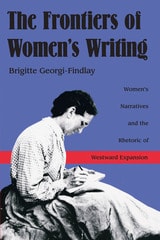
The Frontiers of Women's Writing
Women's Narratives and the Rhetoric of Westward ExpansionBrigitte Georgi-Findlay
University of Arizona Press, 1996
Brigitte Georgi-Findlay presents a range of writings that reflects the diversity of the western experience. Beginning with the narratives of Caroline Kirkland and other women of the early frontier, she reviews the diaries of the overland trails; letters and journals of the wives of army officers during the Indian wars; professional writings, focusing largely on travel, by women such as Caroline Leighton from the regional publishing cultures that emerged in the Far West during the last quarter of the century; and late-nineteenth- and early-twentieth-century accounts of missionaries and teachers on Indian reservations. Most of the writers were white, literate women who asserted their own kind of cultural authority over the lands and people they encountered. Their accounts are not only set in relation to a masculine frontier myth but also investigated for clues about their own involvement with territorial expansion. By exploring the various ways in which women writers actively contributed to and at times rejected the development of a national narrative of territorial expansion based on empire building and colonization, the author shows how their accounts are implicated in expansionist processes at the same time that they formulate positions of innocence and detachment.
Georgi-Findlay has drawn on American studies scholarship, feminist criticism, and studies of colonial discourse to examine the strategies of women's representation in writing about the West in ways that most theorists have not. She critiques generally accepted stereotypes and assumptions--both about women's writing and its difference of view in particular, and about frontier discourse and the rhetoric of westward expansion in general--as she offers a significant contribution to literary studies of the West that will challenge scholars across a wide range of disciplines.
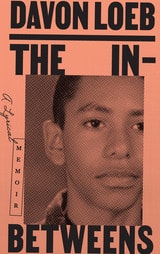
The In-Betweens
A Lyrical MemoirDavon Loeb
West Virginia University Press, 2023
“Utterly captivating and resonant.” —Chicago Review of Books
“Gorgeously told.” —Philadelphia Inquirer
“Resonant. . . . Engagingly delivered, candid reflections on heritage and identity.” —Kirkus Reviews
The In-Betweens tells the story of a biracial boy becoming a man, all the while trying to find himself, trying to come to terms with his white family, and trying to find his place in American society. A rich narrative in the tradition of Justin Torres’s We the Animals and Bryan Washington’s Memorial, Davon Loeb’s memoir is relevant to the country’s current climate and is part of the necessary rewrite of the nation’s narrative and identity.
The son of a Black mother with deep family roots in Alabama and a white Jewish man from Long Island, Loeb grows up in a Black family in the Pine Barrens of New Jersey as one of the few nonwhite children in their suburban neighborhood. Despite his many and ongoing efforts to fit in, Loeb acutely feels his difference—he is singled out in class during Black History Month; his hair doesn’t conform to the latest fad; coaches and peers assume he is a talented athlete and dancer; and on the field trip to the Holocaust Museum, he is the Black Jew. But all is not struggle. In lyrical vignettes, Loeb vibrantly depicts the freedom, joys, and wonder of childhood; the awkwardness of teen years, first jobs, first passions. Loeb tells an individual story universally, and readers, regardless of subjectivity and relation, will see themselves throughout The In-Betweens.
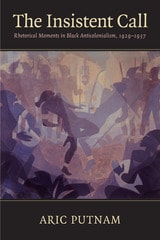
The Insistent Call
Rhetorical Moments in Black Anticolonialism, 1929-1937Aric Putnam
University of Massachusetts Press, 2012
Throughout the nineteenth century, African heritage played an important role in black America, as personal memories and cultural practices continued to shape the everyday experience of people of African descent living under the shadow of slavery. Resisting efforts to de-Africanize their values, customs, and beliefs, Black Americans invoked their African roots in public arguments about their identity and place in the “new” world. At the outset of the twentieth century many still saw Africa primarily as the source of a common cultural and spiritual past. But after the 1920s, the meaning of African heritage changed as people of African descent expressed new relationships between themselves, the United States, and the African Diaspora.
In The Insistent Call, Aric Putnam studies the rhetoric of newspapers, literature, and political pamphlets that expressed this shift. He demonstrates that as people of African descent debated the United States' occupation of Haiti, the Liberian labor crisis, and the Italian invasion of Ethiopia, they formed a new collective identity, one that understood the African Diaspora in primarily political rather than cultural terms. In addition to uncovering a neglected period in the history of Black rhetoric, Putnam shows how rhetoric that articulates the interests of a population not defined by the boundaries of a state can still motivate collective action and influence policies.
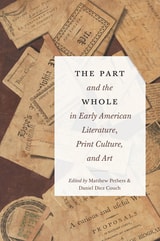
The Part and the Whole in Early American Literature, Print Culture, and Art
Matthew Pethers
Bucknell University Press, 2024
The essays in this pathbreaking collection consider the significance of varied early American fragmentary genres and practices—from diaries and poetry, to almanacs and commonplace books, to sermons and lists, to Indigenous ruins and other material shards and fragments—often overlooked by critics in a scholarly privileging of the “whole.” Contributors from literary studies, book history, and visual culture discuss a host of canonical and non-canonical figures, from Edward Taylor and Washington Irving to Mary Rowlandson and Sarah Kemble Knight, offering insight into the many intellectual, ideological, and material variations of “form” that populated the early American cultural landscape. As these essays reveal, the casting of the fragmentary as aesthetically eccentric or incomplete was a way of reckoning with concerns about the related fragmentation of nation, society, and self. For a contemporary audience, they offer new ways to think about the inevitable gaps and absences in our cultural and historical archive.
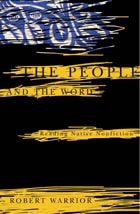
The People and the Word
Reading Native NonfictionRobert Warrior
University of Minnesota Press, 2005
Focusing on autobiographical writings and critical essays, as well as communally authored and political documents, The People and the Word explores how the Native tradition of nonfiction has both encompassed and dissected Native experiences. Warrior begins by tracing a history of American Indian writing from the eighteenth century to the late twentieth century, then considers four particular moments: Pequot intellectual William Apess’s autobiographical writings from the 1820s and 1830s; the Osage Constitution of 1881; narratives from American Indian student experiences, including accounts of boarding school in the late 1880s; and modern Kiowa writer N. Scott Momaday’s essay “The Man Made of Words,” penned during the politically charged 1970s. Warrior’s discussion of Apess’s work looks unflinchingly at his unconventional life and death; he recognizes resistance to assimilation in the products of the student print shop at the Santee Normal Training School; and in the Osage Constitution, as well as in Momaday’s writing, Warrior sees reflections of their turbulent times as well as guidance for our own.
Taking a cue from Momaday’s essay, which gives voice to an imaginary female ancestor, Ko-Sahn, Warrior applies both critical skills and literary imagination to the texts. In doing so, The People and the Word provides a rich foundation for Native intellectuals’ critical work, deeply entwined with their unique experiences.
Robert Warrior is professor of English and Native American studies at the University of Oklahoma. He is author of Tribal Secrets: Recovering American Indian Intellectual Traditions (Minnesota, 1994) and coauthor, with Paul Chaat Smith, of Like a Hurricane: The Indian Movement from Alcatraz to Wounded Knee.
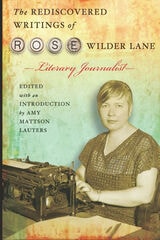
The Rediscovered Writings of Rose Wilder Lane, Literary Journalist
Edited by Amy Mattson Lauters
University of Missouri Press, 2007
This book recovers journalistic work by an American icon for whom scholarly recognition is long overdue. Amy Mattson Lauters introduces readers to Lane’s life through examples of her journalism and argues that her work and career help establish her not only as an author and political rhetorician but also as a literary journalist. Lauters has assembled a collection of rarely seen nonfiction articles that illustrate Lane’s talent as a writer of literary nonfiction, provide on-the-spot views of key moments in American cultural history, and offer sharp commentary on historical events.
Through this collection of Lane’s journalism, dating from early work for Sunset magazine in 1918 to her final piece for Woman’s Day set in 1965 Saigon, Lauters shows how Lane infused her writing with her particular ideology of Americanism and individualism, self-reliance, and freedom from government interference, thereby offering stark commentary on her times. Lane shares her experiences as an extra in a Douglas Fairbanks movie and interviews D.W. Griffith. She reports on average American women struggling to raise a family in wartime and hikes over the Albanian mountains between the world wars. Her own maturing conservative political views provide a lens through which readers can view debates over the draft, war, and women’s citizenship during World War II, and her capstone piece brings us again into a culture torn by war, this time in Southeast Asia.
These writings have not been available to the reading public since they first appeared. They encapsulate important moments for Lane and her times, revealing the woman behind the text, the development of her signature literary style, and her progression as a writer. Lauters’s introduction reveals the flow of Lane’s life and career, offering key insights into women’s history, the literary journalism genre, and American culture in the first half of the twentieth century.
Through these works, readers will discover a writer whose cultural identity was quintessentially American, middle class, midwestern, and simplistic—and who assumed the mantle of custodian to Americanism through women’s arts. The Rediscovered Writings of Rose Wilder Lane traces the extraordinary relationship between one woman and American society over fifty pivotal years and offers readers a treasury of writings to enjoy and discuss.
The Rhetoric of Empire
Colonial Discourse in Journalism, Travel Writing, and Imperial AdministrationDavid Spurr
Duke University Press, 1993
Despite historical differences among British, French, and American versions of colonialism, their rhetoric had much in common. The Rhetoric of Empire identifies these shared features—images, figures of speech, and characteristic lines of argument—and explores them in a wide variety of sources. A former correspondent for the United Press International, the author is equally at home with journalism or critical theory, travel writing or official documents, and his discussion is remarkably comprehensive. Ranging from T. E. Lawrence and Isak Dineson to Hemingway and Naipaul, from Time and the New Yorker to the National Geographic and Le Monde, from journalists such as Didion and Sontag to colonial administrators such as Frederick Lugard and Albert Sarraut, this analysis suggests the degree to which certain rhetorical tactics penetrate the popular as well as official colonial and postcolonial discourse.
Finally, Spurr considers the question: Can the language itself—and with it, Western forms of interpretation--be freed of the exercise of colonial power? This ambitious book is an answer of sorts. By exposing the rhetoric of empire, Spurr begins to loosen its hold over discourse about—and between—different cultures.

The Rhetoric of the "Other" Literature
W. Ross Winterowd
Southern Illinois University Press, 1990
Using traditional and contemporary rhetorical theory, Winterowd argues that the fiction-nonfiction division of literature is unjustified and destructive.
He would bridge the gap between literary scholars and rhetoricians by including both fiction (imaginative literature) and nonfiction (literature of fact) in the canon. The actual difference in literary texts, he notes, lies not in their factuality but in their potential for eliciting an aesthetic response.
With speech act and rhetorical theory as a basis, Winterowd argues that presentational literature gains its power on the basis of its ethical and pathetic appeal, not because of its assertions or arguments.
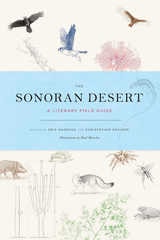
The Sonoran Desert
A Literary Field GuideEdited by Eric Magrane and Christopher Cokinos, Illustrations by Paul Mirocha
University of Arizona Press, 2016
Both literary anthology and hands-on field guide, The Sonoran Desert is a groundbreaking book that melds art and science. It captures the stunning biodiversity of the world’s most verdant desert through words and images. More than fifty poets and writers—including Christopher Cokinos, Alison Hawthorne Deming, Ken Lamberton, Eric Magrane, Jane Miller, Gary Paul Nabhan, Alberto Ríos, Ofelia Zepeda, and many others—have composed responses to key species of this striking desert. Each creative contribution is joined by an illustration by award-winning artist Paul Mirocha and scientific information about the creature or plant authored by the book’s editors.
From the saguaro to the mountain lion, from the black-tailed jackrabbit to the mesquite, the species represented here have evoked compelling and creative responses from each contributor. Just as writers such as Edward Abbey and Ellen Meloy have memorialized the desert, this collection is sure to become a new classic, offering up the next generation of voices of this special and beautiful place, the Sonoran Desert.
The Trouble with Sauling Around
Conversion in Ethnic American Autobiography, 1965-2002Madeline R. Walker
University of Iowa Press, 2011
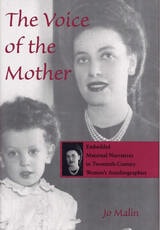
The Voice of the Mother
Embedded Maternal Narratives in Twentieth-Century Women's AutobiographiesJo Malin
Southern Illinois University Press, 2000
Every woman autobiographer is a daughter who writes and establishes her identity through her autobiographical narrative. In The Voice of the Mother, Jo Malin argues that many twentieth-century autobiographies by women contain an intertext, an embedded narrative, which is a biography of the writer/daughter’s mother.
Analyzing this narrative practice, Malin examines ten texts by women who seem particularly compelled to tell their mothers’ stories: Virginia Woolf, Sara Suleri, Kim Chernin, Drusilla Modjeska, Joan Nestle, Carolyn Steedman, Dorothy Allison, Adrienne Rich, Cherríe Moraga, and Audre Lorde. Each author is, in fact, able to write her own autobiography only by using a narrative form that contains her mother’s story at its core. These texts raise interesting questions about autobiography as a genre and about a feminist writing practice that resists and subverts the dominant literary tradition.
Malin theorizes a hybrid form of autobiographical narrative containing an embedded narrative of the mother. The textual relationship between the two narratives is unique among texts in the auto/biographical canon. This alternative narrative practice—in which the daughter attempts to talk both to her mother and about her—is equally an autobiography and a biography rather than one or the other. The technique is marked by a breakdown of subject/object categories as well as auto/biographical dichotomies of genre. Each text contains a “self” that is more plural than singular, yet neither.
In addition to being a theoretical and textual analysis, Malin’s book is also a mother-daughter autobiography and biography itself. She shares her own story and her mother’s story as a way to connect directly with readers and as a way to bridge the gap between theory and practice.
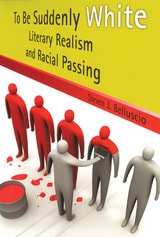
To Be Suddenly White
Literary Realism and Racial PassingSteven J. Belluscio
University of Missouri Press, 2006
To Be Suddenly White offers new readings of traditional passing narratives from the African American literary tradition, such as James Weldon Johnson’s The Autobiography of an Ex-Coloured Man, Nella Larsen’s Passing, and George Schuyler’s Black No More. It is also the first full-length work to consider a number of Jewish American and Italian American prose texts, such as Mary Antin’s The Promised Land, Anzia Yezierska’s Bread Givers, and Guido d’Agostino’s Olives on the Apple Tree, as racial passing narratives in their own right. Belluscio also demonstrates the contradictions that result from the passing narrative’s exploration of racial subjectivity, racial difference, and race itself.
When they are seen in comparison, ideological differences begin to emerge between African American passing narratives and “white ethnic” (Jewish American and Italian American) passing narratives. According to Belluscio, the former are more likely to engage in a direct critique of ideas of race, while the latter have a tendency to become more simplistic acculturation narratives in which a character moves from a position of ethnic difference to one of full American identity.
The desire “to be suddenly white” serves as a continual point of reference for Belluscio, enabling him to analyze how writers, even when overtly aware of the problematic nature of race (especially African American writers), are also aware of the conditions it creates, the transformations it provokes, and the consequences of both. Byexamining the content and context of these works, Belluscio elucidates their engagement with discourses of racial and ethnic differences, assimilation, passing, and identity, an approach that has profound implications for the understanding of American literary history.
Too Numerous
Kent Shaw
University of Massachusetts Press, 2019
What does it really mean when people are viewed as bytes of data? And is there beauty or an imaginative potential to information culture and the databases cataloging it? As Too Numerous reveals, the raw material of bytes and data points can be reshaped and repurposed for ridiculous, melancholic, and even aesthetic purposes.
Grappling with an information culture that is both intimidating and daunting, Kent Shaw considers the impersonality represented by the continuing accumulation of personal information and the felicities—and barriers—that result: “The us that was inside us was magnificent structures. And they weren't going to grow any larger.”
Tourists with Typewriters
Critical Reflections on Contemporary Travel WritingPatrick Holland and Graham Huggan
University of Michigan Press, 2000
The book maps new terrain in a growing area of critical study. Although critical of travel writing's complacency and its often unacknowledged ethnocentrism, the book recognizes its importance as both a literary and cultural form. While travel writing at its worst emerges as a crude expression of economic advantage, at its best it becomes a subtle instrument of cultural self-perception, a barometer for changing views of "other" (i.e., foreign, non-Western) cultures, and a trigger for the information circuits that tap us into the wider world.
Tourists with Typewriters gauges both the best and worst in contemporary travel writing, capturing the excitement of this most volatile--and at times infuriating--of literary genres. The book will appeal to general readers interested in a closer examination of travel writing and to academic readers in disciplines such as literary/cultural studies, geography, history, anthropology, and tourism studies.
"An eminently readable and informative study. It breathes tolerance and intelligence. It is critically perceptive and very au courant. It raises issues (coloniality, postmodernity, gender. . . ) and discusses books that readers of many different stripes will want to find out about." --Ross Chambers, University of Michigan
Patrick Holland, Associate Professor of English, University of Guelph, was born in New Zealand and educated in England, Australia, and Canada. Graham Huggan, Professor of English, University of Munich, was born in Hong Kong and educated in England and in British Columbia.
Traveling Economies
American Women's Travel WritingJennifer Bernhardt Steadman
The Ohio State University Press, 2007
Traveling Women
Narrative Visions of Early AmericaSusan Clair Imbarrato
Ohio University Press, 2006
Susan Clair Imbarrato closely examines women’s accounts of their journeys from 1700 to 1830, including Sarah Kemble Knight’s well-known journal of her trip from Boston to New York in 1704 and many lesser-known accounts, such as Sarah Beavis’s 1779 journal of her travel to Ohio via Kentucky and Susan Edwards Johnson’s account or her 1801–2 journey from Connecticut to North Carolina.
In the women’s keen observations and entertaining wit, readers will find bravado mixed with hesitation, as women set forth on business, to relocate, and for pleasure. These travelers wrote compellingly of crossing rivers and mountains, facing hunger, encountering native Americans, sleeping in taverns, and confronting slavery, expressing themselves in voices that differed in sensibility from male explorers and travelers.
These accounts, as Imbarrato shows, challenge assumptions that such travel was predominately a male enterprise. In addition, Traveling Women provides a more balanced portrait of westward settlement by affirming women’s importance in the settling of early America.
True Stories
A Century of Literary JournalismNorman Sims
Northwestern University Press, 2007