Results by title
71 books match the query 'Antiquities & Archaeology' and 28 start with t
Tel Dan in Its Northern Cultic Context
Andrew R. Davis
SBL Press, 2013
The Ancient Egyptian Netherworld Books
John Coleman Darnell
SBL Press, 2018
The first, complete English translation of the ancient Egyptian Netherworld Books
The ancient Egyptian Netherworld Books, important compositions that decorated the New Kingdom royal tombs in the Valley of the Kings, present humanity's oldest surviving attempts to provide a scientific map of the unseen realms beyond the visible cosmos and contain imagery and annotations that represent ancient Egyptian speculation (essentially philosophical and theological) about the events of the solar journey through the twelve hours of the night. The Netherworld Books describe one of the central mysteries of Egyptian religious belief—the union of the solar god Re with the underworldly god Osiris—and provide information on aspects of Egyptian theology and cosmography not present in the now more widely read Book of the Dead. Numerous illustrations provide overview images and individual scenes from each Netherworld Book, emphasizing the unity of text and image within the compositions. The major texts translated include the Book of Adoring Re in the West (the Litany of Re), the Book of the Hidden Chamber (Amduat), the Book of Gates, the Book of Caverns, the Books of the Creation of the Solar Disk, and the Books of the Solar-Osirian Unity.
Features:
- Accessible presentations of the main concepts of the Netherworld Books and the chief features of each text
- Notes and commentary address major theological themes within the texts as well as lexicographic and/or grammatical issues
- An overview of later uses of these compositions during the first millennium BCE
The Ancient Egyptian Pyramid Texts
James P. Allen
SBL Press, 2005
The Ancient Egyptian Pyramid Texts, Second Edition
James P. Allen
SBL Press, 2015
Completely revised and updated
James P. Allen provides a translation of the oldest corpus of ancient Egyptian religious texts from the six royal pyramids of the Fifth and Sixth Dynasties (ca. 2350–2150 BCE). Allen’s revisions take into account recent advances in the understanding of Egyptian grammar.
Features:
- Sequential translations based on all available sources, including texts newly discovered in the last decade
- Texts numbered according to the most widely used numbering system with new numbers from the latest 2013 concordance
- Translations reflect the primarily atemporal verbal system of Old Egyptian, which conveys the timeless quality that the text’s authors understood the texts to have
The Archaeology of the Kingdom of Judah
Yosef Garfinkel
SBL Press, 2025
The Art of Visual Exegesis
Rhetoric, Texts, ImagesVernon K. Robbins
SBL Press, 2017
A critical study for those interested in the intersection of art and biblical interpretation
With a special focus on biblical texts and images, this book nurtures new developments in biblical studies and art history during the last two or three decades. Analysis and interpretation of specific works of art introduce guidelines for students and teachers who are interested in the relation of verbal presentation to visual production. The essays provide models for research in the humanities that move beyond traditional disciplinary boundaries erected in previous centuries. In particular, the volume merges recent developments in rhetorical interpretation and cognitive studies with art historical visual exegesis. Readers will master the tools necessary for integrating multiple approaches both to biblical and artistic interpretation.
Features
The Athenian Adonia in Context
The Adonis Festival as Cultural PracticeLaurialan Reitzammer
University of Wisconsin Press, 2018
Reitzammer uncovers correlations of the Adonia to Athenian wedding rituals and civic funeral oration and provides illuminating evidence that the festival was a significant cultural template for such diverse works as Aristophanes’ drama Lysistrata and Plato’s dialogue Phaedrus. Her fresh approach is a timely contribution to studies of the ways gender and sexuality intersect with religion and ritual in ancient Greece.
The Cuisine of Sacrifice among the Greeks
Marcel Detienne and Jean-Pierre Vernant
University of Chicago Press, 1989
The fundamental myth is that of Prometheus, who introduced sacrifice and, in the process, both joined us to and separated us from the gods—and ambiguous relation that recurs in marriage and in the growing of grain. Thus we can understand why the ascetic man refuses both women and meat, and why Greek women celebrated the festival of grain-giving Demeter with instruments of butchery.
The ambiguity coded in the consumption of meat generated a mythology of the "other"—werewolves, Scythians, Ethiopians, and other "monsters." The study of the sacrificial consumption of meat thus leads into exotic territory and to unexpected findings.
In The Cuisine of Sacrifice, the contributors—all scholars affiliated with the Center for Comparative Studies of Ancient Societies in Paris—apply methods from structural anthropology, comparative religion, and philology to a diversity of topics: the relation of political power to sacrificial practice; the Promethean myth as the foundation story of sacrificial practice; representations of sacrifice found on Greek vases; the technique and anatomy of sacrifice; the interaction of image, language, and ritual; the position of women in sacrificial custom and the female ritual of the Thesmophoria; the mythical status of wolves in Greece and their relation to the sacrifice of domesticated animals; the role and significance of food-related ritual in Homer and Hesiod; ancient Greek perceptions of Scythian sacrificial rites; and remnants of sacrificial ritual in modern Greek practices.
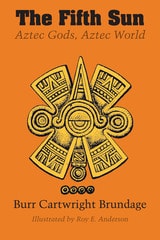
The Fifth Sun
Aztec Gods, Aztec WorldBy Burr Cartwright Brundage
University of Texas Press, 1979
The ancient Aztecs dwelt at the center of a dazzling and complex cosmos. From this position they were acutely receptive to the demands of their gods. The Fifth Sun represents a dramatic overview of the Aztec conception of the universe and the gods who populated it—Quetzalcoatl, the Plumed Serpent; Tezcatlipoca, the Smoking Mirror; and Huitzilopochtli, the Southern Hummingbird. Burr Cartwright Brundage explores the myths behind these and others in the Aztec pantheon in a way that illuminates both the human and the divine in Aztec life.
The cult of human sacrifice is a pervasive theme in this study. It is a concept that permeated Aztec mythology and was the central preoccupation of the aggressive Aztec state. Another particularly interesting belief explored here is the “mask pool,” whereby gods could exchange regalia and, thus, identities.
This vivid and eminently readable study also covers the use of hallucinogens; cannibalism; the calendars of ancient Mexico; tlachtli, the life-and-death ball game; the flower wars; divine transfiguration; and the evolution of the war god of the Mexica. A splendid introduction to Aztec religion, The Fifth Sun also contains insights for specialists in ethnohistory, mythology, and religion.
The First Urban Churches 1
Methodological FoundationsJames R. Harrison
SBL Press, 2015
A fresh look at early urban churches
This collection of essays examines the urban context of early Christian churches in the first-century Roman world. A city-by-city investigation of the early churches in the New Testament clarifies the challenges, threats, and opportunities that urban living provided for early Christians. Readers will come away with a better understanding of how scholars assemble an accurate picture of the cities in which the first Christians flourished.
Features:
- Analysis of urban evidence of the inscriptions, papyri, archaeological remains, coins, and iconography
- Discussion of how to use different types of evidence responsibly
- Outline of what constitutes proper methodological use for establishing a nuanced, informed portrait of ancient urban life
The First Urban Churches 2
Roman CorinthJames R. Harrison
SBL Press, 2016
Investigate the challenges, threats, and opportunities experienced by the early church
Volume two of The First Urban Churches focuses on the urban context of Christian churches in first-century Roman Corinth. An investigation of the material evidence of Corinth helps readers today understand properly the challenges, threats, and opportunities that the early Corinthian believers faced in the city. The essays demonstrate decisively the difference that such an approach makes in grappling with the meaning and context of the Corinthian epistles in the New Testament.
Features:
- Analysis of urban evidence of the inscriptions, papyri, archaeological remains, coins, and iconography
- Proposed reeconstructions of the past and its social, religious, and political significance
- A nuanced, informed portrait of ancient urban life in Corinth
The First Urban Churches 3
EphesusJames R. Harrison
SBL Press, 2018
Investigate the challenges, threats, and opportunities experienced by the early church in Ephesus
The third installment of The First Urban Churches focuses on the urban context of Christian churches in first-century Ephesus. As with previous volumes, contributors illustrate how an investigation of the material evidence will help readers understand properly the challenges, threats, and opportunities that the early Ephesian believers faced in that city. Brad Bitner, James R. Harrison, Michael Haxby, Fredrick J. Long, Guy M. Rogers, Michael Theophilos, Paul Trebilco, and Stephan Witetschek demonstrate decisively the difference that such an approach makes in grappling with the meaning and context of the New Testament writings, particularly Ephesians, Acts, and Revelation.
Features
- Analysis of urban evidence of the inscriptions, papyri, archaeological remains, coins, and iconography
- Proposed reconstructions of the past and its social, religious and political significance
- A nuanced, informed portrait of ancient urban life in Ephesus
The First Urban Churches 4
Roman PhilippiJames R. Harrison
SBL Press, 2018
Investigate the challenges and opportunities experienced by the early church
This fourth installment of The First Urban Churches, edited by James R. Harrison and L. L. Welborn, focuses on the urban context of Christian churches in first-century Roman Philippi. The international team of New Testament and classical scholars contributing to the volume present essays that use inscriptions, papyri, archaeological remains, coins, and iconography to examine the rivalries, imperial context, and ecclesial setting of the Philippian church.
Features:
- Analysis of the material and epigraphic evidence relating to first- and second-century CE Roman Philippi
- Examination of important passages from Philippians within their ancient urban context
- Investigation of the social composition and membership of the Philippian church from the archaeological and documentary evidence
The First Urban Churches 5
Colossae, Hierapolis, and LaodiceaJames R. Harrison
SBL Press, 2019
A fresh examination of early Christianity by an international team of New Testament and classical scholars
Volume 5 of The First Urban Churches investigates the urban context of Christian churches in first-century Roman Colossae, Hierapolis, and Laodicea. Building on the methodologies introduced in the first volume and supplementing the in-depth studies of Corinth, Ephesus, and Philippi (vols. 2-4), essays in this volume challenge readers to reexamine preconceived understandings of the early church and to grapple with the meaning and context of Christianity in its first-century Roman colonial context.
Features:
- Analysis of urban evidence found in inscriptions, papyri, archaeological remains, coins, and iconography
- Proposed reconstructions of the past and its social, religious, and political significance
- A nuanced, informed portrait of ancient urban life in the cities of the Lycus Valley
The First Urban Churches 6
Rome and OstiaJames R. Harrison
SBL Press, 2021
An examination of early Roman Christianity by New Testament and classical scholars
Building on the methodologies introduced in the first volume of The First Urban Churches and supplementing the in-depth studies of Corinth, Ephesus, Philippi, Colossae, Hierapolis, and Laodicea (vols. 2–5), essays in this volume challenge readers to reexamine what we know about the early church within Rome and the port city of Ostia. In the introductory section of the book, James R. Harrison discusses the material and documentary evidence of both cities, which sets the stage for the essays that follow. In the second section, Mary Jane Cuyler, James R. Harrison, Richard Last, Annelies Moeser, Thomas A. Robinson, Michael P. Theophilos, and L. L. Welborn examine a range of topics, including the Ostian Synagogue, Romans 1:2–4 against the backdrop of Julio-Claudian adoption and apotheosis traditions, and the epistle of 1 Clement. In the final section of this volume, Jutta Dresken-Welland and Mark Reasoner engage Peter Lampe’s magnum opus From Paul to Valentinus; Lampe wraps up the section and the volume with a response. Throughout, readers are provided with a rich demonstration of how the material evidence of the city of Rome illuminates the emergence of Roman Christianity, especially in the first century CE.
The First Urban Churches 7
ThessalonicaJames R. Harrison
SBL Press, 2022
The First Urban Churches 7 includes essays focused on the development of early Christianity from the mid-first century through the sixth century CE in the ancient Macedonian city of Thessalonica. An international group of contributors traces the emergence of Thessalonica’s house churches through a close study of the archaeological remains, inscriptions, coins, iconography, and Paul’s two letters to the Thessalonians. After a detailed introduction to the city, including the first comprehensive epigraphic profile of Thessalonica from the Hellenistic age to the Roman Empire, topics discussed include the Roman emperor’s divine honors, coins and inscriptions as sources of imperial propaganda, Thessalonian family bonds, Paul’s apostolic self-image, the role of music at Thessalonica and in early Christianity, and Paul’s response to the Thessalonian Jewish community. Contributors include D. Clint Burnett, Alan H. Cadwallader, Rosemary Canavan, James R. Harrison, Julien M. Ogereau, Isaac T. Soon, Angela Standhartinger, Michael P. Theophilos, and Joel R. White.
The First Urban Churches 8
Galatia and LycaoniaJames R. Harrison
SBL Press, 2025
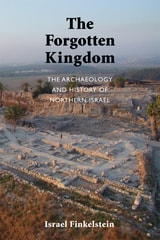
The Forgotten Kingdom
The Archaeology and History of Northern IsraelIsrael Finkelstein
SBL Press, 2013
A new understanding of the history of the northern kingdom from 1350 B.C.E. to 720 B.C.E.
Beginning with the Canaanite city-states, through the Saulide dynasty, to the fall of Israel, Finkelstein presents the first comprehensive history of Israel integrating the analysis of more than thirty years of archaeological work with interpretation of ancient Near Eastern and biblical texts. Though Judah dominates the pages of the Hebrew Bible and contemporary studies, Israel dominates here as Finkelstein reveals the glory of the Omride dynasty, outlines how the two kingdoms of Israel and Judah developed parallel to one another, and highlights Israel’s transformation from kingdom to foundational idea.
Features:
- Archaeological analysis of the region of the northern kingdom
- Primary and secondary textual analysis from the ancient Near East and the biblical narrative
- Maps, tables, and images
- Discussion of Israel’s legacy
The Galilean Economy in the Time of Jesus
David A. Fiensy
SBL Press, 2013
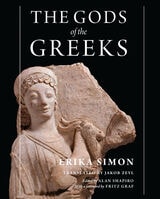
The Gods of the Greeks
Erika Simon, Translated by Jakob Zeyl, Edited by Alan Shapiro
University of Wisconsin Press, 2021
This careful and fluid translation finally makes Simon’s landmark edition accessible to English-language readers. With an abundance of beautiful illustrations, the book examines portrayals of the thirteen major gods in art over the course of two millennia. Scholars who study the lives and practices of those living in ancient Greece will value this newest contribution.
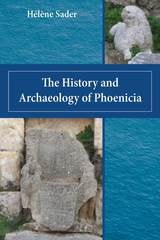
The History and Archaeology of Phoenicia
Hélène Sader
SBL Press, 2019
An insightful historical account of Phoenicia that illustrates its cities, culture, and daily life
Hélène Sader presents the history and archaeology of Phoenicia based on the available contemporary written sources and the results of archaeological excavations in Phoenicia proper. Sader explores the origin of the term Phoenicia; the political and geographical history of the city-states Arwad, Byblos, Sidon, and Tyre; and topography, climate, and natural resources of the Phoenician homeland. Her limited focus on Phoenicia proper, in contrast to previous studies that included information from Phoenician colonies, presents the bare realities of the opportunities and difficulties shaping Phoenician life. Sader’s evaluation and synthesis of the evidence offers a corrective to the common assumption of a unified Phoenician kingdom.
Features
- Historical as well as modern maps with the locations of all relevant archaeological sites
- Faunal and floral analyses that shed light on the Phoenician diet
- Petrographic analysis of pottery that sheds light on trading patterns and developments
The Hittites and Their World
Billie Jean Collins
SBL Press, 2007
The Hodayot (Thanksgiving Psalms)
A Study Edition of 1QHaEileen M. Schuller
SBL Press, 2012
The Last Century in the History of Judah
The Seventh Century BCE in Archaeological, Historical, and Biblical PerspectivesFilip Čapek
SBL Press, 2019
An incomparable interdisciplinary study of the history of Judah
Experts from a variety of disciplines examine the history of Judah during the seventh century BCE, the last century of the kingdom’s existence. This important era is well defined historically and archaeologically beginning with the destruction layers left behind by Sennacherib’s Assyrian campaign (701 BCE) and ending with levels of destruction resulting from Nebuchadnezzar’s Babylonian campaign (588-586 BCE). Eleven essays develop the current ongoing discussion about Judah during this period and extend the debate to include further important insights in the fields of archaeology, history, cult, and the interpretation of Old Testament texts.
Features
- A new chronological frame for the Iron Age IIB-IIC
- Close examinations of archaeology, texts, and traditions related to the reigns of Hezekiah, Manasseh, and Josiah
- An evaluation of the religious, cultic, and political landscape < /UL>
The Middle Maccabees
Archaeology, History, and the Rise of the Hasmonean KingdomAndrea M. Berlin
SBL Press, 2021
A focused, interdisciplinary examination of a tumultuous, history-making era
The Middle Maccabees lays out the charged, complicated beginnings of the independent Jewish state founded in the second century BCE. Contributors offer focused analyses of the archaeological, epigraphic, numismatic, and textual evidence, framed within a wider world of conflicts between the Ptolemies of Egypt, the Seleucids of Syria, and the Romans. The result is a holistic view of the Hasmonean rise to power that acknowledges broader political developments, evolving social responses, and the particularities of local history. Contributors include Uzi ‘Ad, Donald T. Ariel, Andrea M. Berlin, Efrat Bocher, Altay Coşkun, Benedikt Eckhardt, Gerald Finkielsztejn, Christelle Fischer-Bovet, Yuval Gadot, Erich Gruen, Sylvie Honigman, Jutta Jokiranta, Paul J. Kosmin, Uzi Leibner, Catharine Lorber, Duncan E. MacRae, Dvir Raviv, Helena Roth, Débora Sandhaus, Yiftah Shalev, Nitsan Shalom, Danny Syon, Yehiel Zelinger, and Ayala Zilberstein.
Features
- Up-to-date, generously illustrated essays analyzing the relevant archaeological remains
- A revised understanding of how local and imperial histories overlapped and intersected
- New analysis of the book of 1 Maccabees as a tool of Hasmonean strategic interest
The Philistines and Other Sea Peoples in Text and Archaeology
Ann E. Killebrew
SBL Press, 2013
The Quest for the Historical Israel
Debating Archaeology and the History of Early IsraelIsrael Finkelstein
SBL Press, 2007
Transforming the Dead
Culturally Modified Bone in the Prehistoric MidwestEve A. Hargrave
University of Alabama Press, 2015
Revealing how the dead continued to shape the spiritual and social worlds of prehistoric North America.
Transforming the Dead is a collection of essays that examines culturally modified human bones and their roles as “cultural and ritual objects” among prehistoric Eastern Woodland cultures. Previous scholarship has explored the role of human body parts in Native American cultures as trophies of war and revered ancestors. This collection discusses new evidence that human elements were also important components of daily and ritual activities across the Eastern Woodlands. The contributors to this volume discuss each case study within the unique regional and temporal contexts of the material, rather than seeking universal answers to how these objects were used.
Most research addressing modified human bone has focused on cut marks and trauma associated with warfare, trophy taking, and burial practices. The editors and contributors of Transforming the Dead document the varied and often overlooked ways that human bone was intentionally modified through drilling, incising, cutting, and polishing for utilitarian, ornamental, spiritual, or ritual use. Examples include bracelets and gorgets to be worn, as well as musical rasps, pipe stems, masks, and protective talismans. The form and function of these objects are not unusual; their construction from the remains of “another” sets them apart.
Through a flexible but systematic analysis of the archaeological record, the contributors bring into focus how the careful selection, modification, and retention of particular bones or body parts of an individual after death offer insights into concepts of personhood, the body, life, and death among the prehistoric Native Americans in the Midwest.