Results by title
166 books match the query 'Archives' and 31 start with t
Teaching Gender with Libraries and Archives
Sara De Jong
Central European University Press, 2014
Teaching Undergraduates with Archives
Nancy Bartlett
Michigan Publishing Services, 2019
"The contributions to this volume capture exceptionally well the passion and the creativity that archivists and special collections librarians who teach and do outreach with primary sources are bringing to their work in this increasingly important activity domain."
-- Martha O’Hara Conway, Director, Special Collections Research Center, University of Michigan Library
"As teaching with archival materials has moved to the foreground of the archival mission for many institutions, this timely, inspiring, and practical volume, which comes out of the multi-day symposium solely devoted to teaching undergraduates with archival materials, is a required reading for anyone who teaches with archival materials, or who would like to. It really captures the spirit and enthusiasm that these authors brought to that symposium."
-- Josué Hurtado, Coordinator of Public Services & Outreach, Special Collections Research Center, Temple University Libraries
"Reflecting the increasing priority of teaching in archives and special collections libraries, this book captures a variety of perspectives, insights, approaches, and prognostications that will enlighten, challenge, and inspire a growing community of practitioners."
-- Bill Landis, Head of Public Services, Manuscripts and Archives, Yale University Library
"Building on the momentum generated at the symposium, this book is a treasure trove for professionals in the field who are eager for innovative ideas regarding collaboration and experimentation in teaching with archival material."
-- Elizabeth Williams-Clymer, Special Collections Librarian, Kenyon College
Teaching through the Archives
Text, Collaboration, and ActivismEdited by Tarez Samra Graban and Wendy Hayden
Southern Illinois University Press, 2022
Disruptive pedagogies for archival research
In a cultural moment when institutional repositories carry valuable secrets to the present and past, this collection argues for the critical, intellectual, and social value of archival instruction. Graban and Hayden and 37 other contributors examine how undergraduate and graduate courses in rhetoric, history, community literacy, and professional writing can successfully engage students in archival research in its many forms, and successfully model mutually beneficial relationships between archivists, instructors, and community organizations.
Combining new and established voices from related fields, each of the book’s three sections includes a range of form-disrupting pedagogies. Section I focuses on how approaching the archive primarily as text fosters habits of mind essential for creating and using archives, for critiquing or inventing knowledge-making practices, and for being good stewards of private and public collections. Section II argues for conducting archival projects as collaboration through experiential learning and for developing a preservationist consciousness through disciplined research. Section III details praxis for revealing, critiquing, and intervening in historic racial omissions and gaps in the archives in which we all work.
Ultimately, contributors explore archives as sites of activism while also raising important questions that persist in rhetoric and composition scholarship, such as how to decolonize research methodologies, how to conduct teaching and research that promote social justice, and how to shift archival consciousness toward more engaged notions of democracy. This collection highlights innovative classroom and curricular course models for teaching with and through the archives in rhetoric and composition and beyond.
Temptation in the Archives
Essays in Golden Age Dutch CultureLisa Jardine
University College London, 2015
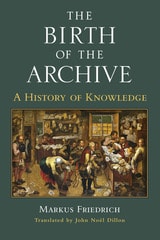
The Birth of the Archive
A History of KnowledgeMarkus Friedrich, translated by John Noël Dillon
University of Michigan Press, 2018
Friedrich provides an essential background to the history of archives over the centuries and enriches the story of their evolution with chapters on key sociocultural aspects of European archival culture. He discusses their meaning and symbolism in European thought, early modern conceptions of the archive’s function, and questions of access and usability. Exploring the close, often vexed relationship between archives and political power, Friedrich illustrates the vulnerability of archives to political upheaval and war. He concludes with an introspective look at how historians used their knowledge of and work with archives to create distinct representations of themselves and their craft.
The Birth of the Archive engages with scholarship in political history, the history of mentalities, conceptions of space, historiography, and the history of everyday life in early modern Europe. It has much to offer for specialists and scholars, while the jargon-free prose of this translation is also accessible to the general reader.

The Division of the World
On Archives, Empires and the Vanity of BordersMartin Zimmerman
Haus Publishing, 2021
At a time when Western nations are being urged to confront their colonial past, this book examines a major archive, revealing the scale of the Spanish colonial enterprise in South and Central America.
Established in 1785, the Archivo General de Indias in Seville holds roughly three hundred years of Spanish colonial history in the Americas. It houses 8,000 charts and around ninety million documents—among them Christopher Columbus’s logbook and the famous Treaty of Tordesillas which, mediated by the Pope and signed in 1494, entitled the Spanish and Portuguese kings to divide the world between them. With this treaty as a starting point, the historian Martin Zimmermann journeys into the age of discovery and recounts stories of dangerous passages, encounters with the unknown, colonial brutality, and the power of cartographers, illustrating the insatiable lust of colonialists to conquer, exploit, and own the world. Ursula Schulz-Dornburg’s photographs show the archive before its redevelopment in 2002, offering a unique view into one of Europe’s most significant archives.
The Erotic as Rhetorical Power
Archives of Romantic Friendship between Women TeachersPamela VanHaitsma
The Ohio State University Press, 2024
Winner, 2025 Marie Hochmuth Nichols Award from the National Communication Association’s Public Address Division
The Erotic as Rhetorical Power offers a queer feminist history of rhetoric that recovers the civic contributions of women teachers in same-sex romantic friendships. Extending perspectives from ancient rhetoric to nineteenth-century progressivism, from Audre Lorde’s Black lesbian feminist theory to its present-day uptakes, Pamela VanHaitsma conceives of the erotic as an interanimation of desires that, in being passionately shared, becomes imbued with the power to forge connection and foment change.
VanHaitsma’s theory of the erotic as rhetorical power emerges from both historiographic and imaginative engagements with more than twenty archives of romantic friendships between women: Sallie Holley and Caroline Putnam, Irene Leache and Anna Wood, Gertrude Buck and Laura Wylie, and Rebecca Primus and Addie Brown. VanHaitsma considers how even as the erotic in these romantic friendships fueled the women’s rhetorical activities toward transformational ends—whether working toward the abolition of slavery, greater educational access, or voting rights—it also energized rhetorical activities that sometimes challenged but also reinforced troubling power dynamics. The Erotic as Rhetorical Power uncovers the erotic’s significance as a conflicted site of power that is central to rhetorical theory and history as well as feminist and LGBTQ+ studies.
The French Revolution Confronts Pius VI
Volume 1: His Writings to Louis XVI, French Cardinals, Bishops, the National Assembly, and the People of France with Special Emphasis on the Civil Constitution of the ClergyJeffrey J. Langan
St. Augustine's Press, 2020
The writings of Pope Pius VI, head of the Catholic Church during the most destructive period of the French Revolution, were compiled in two volumes by M.N.S. Guillon and published in 1798 and 1800. But during the Revolution, the reign of Napoleon, and the various revolutionary movements of the 19th century, there were extraordinary efforts to destroy writings that critiqued the revolutionary ideology. Many books and treatises, if they survived the revolution or the sacking from Napoleon’s armies. To this day, no public copy of Guillon’s work exists in Paris.
Now, for the first time in English, these works comprising the letters, briefs, and other writings of Pius VI on the French Revolution are available. Volume I treats the first shock of the Revolution and the efforts of the Pope in 1790 and 1791 to oppose the Civil Constitution of the Clergy (which famous revolutionary and shrewd diplomat Talleyrand referred to as “the greatest fault of the National Assembly”). Volume II will be published later, and deals with the aftermath of the Civil Constitution through Pius’s death in exile). Editor and translator Jeffrey Langan presents the materials leading up to and directly connected with these decrees, in which the National Assembly attempted to set up a Catholic Church that would be completely submissive to the demands of the Assembly. Volume I also covers Pius’s efforts to deal with the immediate aftermath of the Constitution after the National Assembly implemented it, including his encyclical, Quod Aliquantum.
The letters will show how Pius chose to oppose the Civil Constitution. He did so not by a public campaign, for he had no real temporal power to oppose the violence, but by attempting to work personally with Louis XVI and various archbishops in France to articulate what were the points on which he could concede (matters dealing with the political structures of France) and what were the essential points in which he could not concede (matters dealing with the organization of dioceses and appointment of bishops).
Since the 1980s, with the writings and school that developed around François Furet, as well as Simon Schama’s Citizens, a new debate over the French Revolution has ensued, bringing forth a more objective account of the Revolution, one that avoids an excessively Marxist lens and that brings to light some of its defects and more gruesome parts – the destruction and theft of Church property, and the sadistic methods of torture and killing of priests, nuns, aristocrats, and fellow-revolutionaries.
An examination of the writings of Pius VI will not only help set the historical record straight for English-speaking students of the Revolution, it will also aid them to better understand the principles that the Catholic Church employs when confronted with chaotic political change. They will see that the Church has a principled approach to distinguishing, while not separating, the power of the Church and the power of the state. They will also see, as Talleyrand himself also saw, that one of the essential elements that makes the Church the Church is the right to appoint bishops and to discipline its own bishops. The Church herself recognizes that she cannot long survive without this principle that guarantees her unity.
Pius VI’s efforts were able to keep the Catholic Church intact (though badly bruised) so that she could reconstitute herself and build up a vibrant life in 19th-century France. (He did this in the face of the Church’s prestige having sunk to historic lows; some elites in Europe thought there would be no successor to Pius and jokingly referred to him as “Pius the Last.”) He began a process that led to the restoration of the prestige of the Papacy throughout the world, and he initiated a two-century process that led to the Church finally being able to select bishops without any interference from secular authorities. This had been at least a 1,000-year problem in the history of the Church. By 1990, only two countries of the world, China and Vietnam, were interfering in any significant way in the process that the Church used to select bishops.
Pius VI’s papacy, especially during the years of the French Revolution, was a pivotal point for the French Revolution and for the interaction between Church and state in Western history. All freedom-loving people will be happy to read his distinc-tions between the secular power and the spiritual power. His papacy also was important for the internal developments that the Church would make over the next 200 years with respect to its self-understanding of the Papacy and the role of the bishop.
The Hirschfeld Archives
Violence, Death, and Modern Queer CultureHeike Bauer
Temple University Press, 2017
Influential sexologist and activist Magnus Hirschfeld founded Berlin’s Institute of Sexual Sciences in 1919 as a home and workplace to study homosexual rights activism and support transgender people. It was destroyed by the Nazis in 1933. This episode in history prompted Heike Bauer to ask, Is violence an intrinsic part of modern queer culture? The Hirschfeld Archives answers this critical question by examining the violence that shaped queer existence in the first part of the twentieth century.
Hirschfeld himself escaped the Nazis, and many of his papers and publications survived. Bauer examines his accounts of same-sex life from published and unpublished writings, as well as books, articles, diaries, films, photographs and other visual materials, to scrutinize how violence—including persecution, death and suicide—shaped the development of homosexual rights and political activism.
The Hirschfeld Archives brings these fragments of queer experience together to reveal many unknown and interesting accounts of LGBTQ life in the early twentieth century, but also to illuminate the fact that homosexual rights politics were haunted from the beginning by racism, colonial brutality, and gender violence.
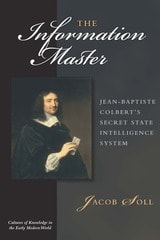
The Information Master
Jean-Baptiste Colbert's Secret State Intelligence SystemJacob Soll
University of Michigan Press, 2011
"Colbert has long been celebrated as Louis XIV's minister of finance, trade, and industry. More recently, he has been viewed as his minister of culture and propaganda. In this lively and persuasive book, Jake Soll has given us a third Colbert, the information manager."
---Peter Burke, University of Cambridge
"Jacob Soll gives us a road map drawn from the French state under Colbert. With a stunning attention to detail Colbert used knowledge in the service of enhancing
royal power. Jacob Soll's scholarship is impeccable and his story long
overdue and compelling."
---Margaret Jacob, University of California, Los Angeles
"Nowadays we all know that information is the key to power, and that the masters of information rule the world. Jacob Soll teaches us that Jean-Baptiste Colbert had grasped this principle three and a half centuries ago, and used it to construct a new kind of state. This imaginative, erudite, and powerfully written book re-creates the history of libraries and archives in early modern Europe, and ties them in a novel and convincing way to the new statecraft of Europe's absolute monarchs."
---Anthony Grafton, Princeton University
"Brilliantly researched, superbly told, and timely, Soll's story is crucial for the history of the modern state."
---Keith Baker, Stanford University
When Louis XIV asked his minister Jean-Baptiste Colbert---the man who was to oversee the building of Versailles and the Royal Academy of Sciences, as well as the navy, the Paris police force, and French industry---to build a large-scale administrative government, Colbert created an unprecedented information system for political power. In The Information Master, Jacob Soll shows how the legacy of Colbert's encyclopedic tradition lies at the very center of the rise of the modern state and was a precursor to industrial intelligence and Internet search engines.
Soll's innovative look at Colbert's rise to power argues that his practice of collecting knowledge originated from techniques of church scholarship and from Renaissance Italy, where merchants recognized the power to be gained from merging scholarship, finance, and library science. With his connection of interdisciplinary approaches---regarding accounting, state administration, archives, libraries, merchant techniques, ecclesiastical culture, policing, and humanist pedagogy---Soll has written an innovative book that will redefine not only the history of the reign of Louis XIV and information science but also the study of political and economic history.
Jacob Soll is Associate Professor of History at Rutgers University and the author of Publishing The Prince: History, Reading, and the Birth of Political Criticism (University of Michigan Press, 2005), and winner of the 2005 Jacques Barzun Prize from the American Philosophical Society and a 2009 Guggenheim Fellowship. Soll edited a special issue of Journal of the History of Ideas titled "The Uses of Historical Evidence in Early Modern Europe"; has cofounded the online journal Republics of Letters; and is editor, along with Anthony Grafton and Ann Blair, of the series Cultures of Knowledge in the Early Modern World.
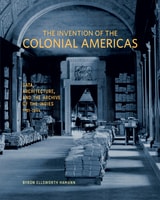
The Invention of the Colonial Americas
Data, Architecture, and the Archive of the Indies, 1781–1844Byron Ellsworth Hamann
J. Paul Getty Trust, The, 2022
The Invention of the Colonial Americas is an architectural history and media-archaeological study of changing theories and practices of government archives in Enlightenment Spain. It centers on an archive created in Seville for storing Spain’s pre-1760 documents about the New World. To fill this new archive, older archives elsewhere in Spain—spaces in which records about American history were stored together with records about European history—were dismembered. The Archive of the Indies thus constructed a scholarly apparatus that made it easier to imagine the history of the Americas as independent from the history of Europe, and vice versa.
In this meticulously researched book, Byron Ellsworth Hamann explores how building layouts, systems of storage, and the arrangement of documents were designed to foster the creation of new knowledge. He draws on a rich collection of eighteenth-century architectural plans, descriptions, models, document catalogs, and surviving buildings to present a literal, materially precise account of archives as assemblages of spaces, humans, and data—assemblages that were understood circa 1800 as capable of actively generating scholarly innovation.

The Library Innovation Toolkit
Ideas, Strategies, and ProgramsAnthony Molaro
American Library Association, 2015
The Marcus Garvey and Universal Negro Improvement Association Papers, Volume XI
The Caribbean Diaspora, 1910–1920Marcus Garvey
Duke University Press, 2011
Praise for the Previous Volumes:
“The Marcus Garvey and Universal Negro Improvement Association Papers will take its place among the most important records of the Afro-American experience. . . . ‘The Marcus Garvey Papers’ lays the groundwork for a long overdue reassessment of Marcus Garvey and the legacy of racial pride, nationalism and concern with Africa he bequeathed to today’s black community.”—Eric Foner, the New York Times Book Review
“Until the publication of The Marcus Garvey and Universal Negro Improvement Association Papers, many of the documents necessary for a full assessment of Garvey’s thought or of his movement’s significance have not been easily accessible. Robert A. Hill and his staff . . . have gathered over 30,000 documents from libraries and other sources in many countries. . . . The Garvey papers will reshape our understanding of the history of black nationalism and perhaps increase our understanding of contemporary black politics.”—Clayborne Carson, the Nation
“Now is our chance, through these important volumes, to finally begin to come to terms with the significance of Garvey’s complex, fascinating career and the meaning of the movement he built.”—Lawrence W. Levine, the New Republic
The Marcus Garvey and Universal Negro Improvement Association Papers, Volume XII
The Caribbean Diaspora, 1920-1921Marcus Garvey
Duke University Press, 2014
Volume XII highlights the centrality of the Caribbean people not only to the convention, but also to the movement. The reports to the convention discussed the range of social and economic conditions obtaining in the Caribbean, particularly their impact on racial conditions. The quality of the discussions and debates were impressive. Contained in these reports are some of the earliest and most clearly enunciated statements in defense of social and political freedom in the Caribbean. These documents form an underappreciated and still underutilized record of the political awakening of Caribbean people of African descent.
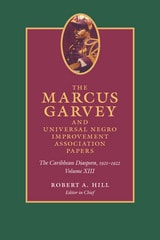
The Marcus Garvey and Universal Negro Improvement Association Papers, Volume XIII
The Caribbean Diaspora, 1921-1922, Volume 13Marcus Garvey
Duke University Press, 2016
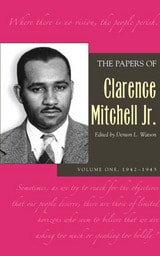
The Papers of Clarence Mitchell Jr., Volume I
1942–1943Clarence Mitchell Jr.
Ohio University Press, 2005
Clarence Mitchell Jr. was the driving force in the movement for passage of civil rights laws in America. The foundation for Mitchell’s struggle was laid during his tenure at the Fair Employment Practice Committee, where he led implementation of President Roosevelt’s policy barring racial discrimination in employment in the national defense and war industry programs. Mitchell’s FEPC reports and memoranda chart the beginning of the modern civil rights movement.
The first two volumes of a projected five-volume documentary edition of The Papers of Clarence Mitchell Jr. illuminate the FEPC’s work as a federal affirmative-action agency and the government’s struggle to enforce the nation’s antidiscrimination policy in industry, federal agencies, and labor unions.
Subsequent volumes will trace Mitchell’s successive enlistment of seven presidents in establishing and enforcing a permanent national nondiscrimination policy. Through his efforts, Congress passed the 1957, 1960, and 1964 Civil Rights Acts prohibiting discrimination in public accommodations, federal spending, and employment based on race, color, sex, and national origin; the 1965 Voting Rights Act; and the 1968 Fair Housing Act.
Editor Denton L. Watson introduces and annotates Mitchell’s writings, providing context and insight for students and scholars of civil rights history, government, law, and sociology.
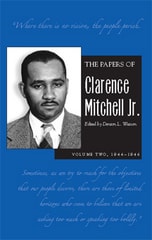
The Papers of Clarence Mitchell Jr., Volume II
1944–1946Clarence Mitchell Jr.
Ohio University Press, 2005
Clarence Mitchell Jr. was the driving force in the movement for passage of civil rights laws in America. The foundation for Mitchell’s struggle was laid during his tenure at the Fair Employment Practice Committee, where he led implementation of President Roosevelt’s policy barring racial discrimination in employment in the national defense and war industry programs. Mitchell’s FEPC reports and memoranda chart the beginning of the modern civil rights movement.
The first two volumes of a projected five-volume documentary edition of The Papers of Clarence Mitchell Jr. illuminate the FEPC’s work as a federal affirmative-action agency and the government’s struggle to enforce the nation’s antidiscrimination policy in industry, federal agencies, and labor unions.
Subsequent volumes will trace Mitchell’s successive enlistment of seven presidents in establishing and enforcing a permanent national nondiscrimination policy. Through his efforts, Congress passed the 1957, 1960, and 1964 Civil Rights Acts prohibiting discrimination in public accommodations, federal spending, and employment based on race, color, sex, and national origin; the 1965 Voting Rights Act; and the 1968 Fair Housing Act.
Editor Denton L. Watson introduces and annotates Mitchell’s writings, providing context and insight for students and scholars of civil rights history, government, law, and sociology.
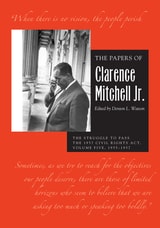
The Papers of Clarence Mitchell Jr., Volume V
The Struggle to Pass the 1957 Civil Rights Act, 1955–1958Clarence Mitchell Jr.
Ohio University Press, 2021
Volume V of The Papers of Clarence Mitchell Jr. records the successful effort to pass the 1957 Civil Rights Act: the first federal civil rights legislation since 1875.
Prior to the US Supreme Court’s landmark 1954 decision in Brown v. Board of Education, the NAACP had faced an impenetrable wall of opposition from southerners in Congress. Basing their assertions on the court’s 1896 “separate but equal” decision in Plessy v. Ferguson, legislators from the South maintained that their Jim Crow system was nondiscriminatory and thus constitutional. In their view, further civil rights laws were unnecessary. In ruling that legally mandated segregation of public schools was unconstitutional, the Brown decision demolished the southerners’ argument. Mitchell then launched the decisive stage of the struggle to pass modern civil rights laws.
The passage of the Civil Rights Act of 1957 was the first comprehensive lobbying campaign by an organization dedicated to that purpose since Reconstruction. Coming on the heels of the Brown decision, the 1957 law was a turning point in the struggle to accord Black citizens full equality under the Constitution. The act’s passage, however, was nearly derailed in the Senate by southern opposition and Senator Strom Thurmond’s record-setting filibuster, which lasted more than twenty-four hours. Congress later weakened several provisions of the act but—crucially—it broke a psychological barrier to the legislative enactment of such measures.
The Papers of Clarence Mitchell Jr. is a detailed record of the NAACP leader’s success in bringing the legislative branch together with the judicial and executive branches to provide civil rights protections during the twentieth century.
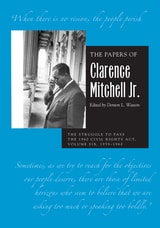
The Papers of Clarence Mitchell Jr., Volume VI
The Struggle to Pass the 1960 Civil Rights Act, 1959–1960Clarence Mitchell Jr.
Ohio University Press, 2021
The Civil Rights Act of 1960 aimed to close loopholes in its 1957 predecessor that had allowed continued voter disenfranchisement for African Americans and for Mexicans in Texas.
In early 1959, the newly seated Eighty-Sixth Congress had four major civil rights bills under consideration. Eventually consolidated into the 1960 Civil Rights Act, their purpose was to correct the weaknesses in the 1957 law. Mitchell’s papers from 1959 to 1960 show the extent to which congressional resistance to the passage of meaningful civil rights laws contributed to the lunch counter sit-ins in Greensboro, North Carolina, and to subsequent demonstrations. The papers reveal how the repercussions of these events affected the NAACP’s work in Washington and how, despite their dislike of demonstrations, NAACP officials used them to intensify the civil rights struggle.
Among the act’s seven titles were provisions authorizing federal inspection of local voter registration rolls and penalties for anyone attempting to interfere with voters on the basis of race or color. The law extended the powers of the US Commission on Civil Rights and broadened the legal definition of the verb to vote to encompass all elements of the process: registering, casting a ballot, and properly counting that ballot. Ultimately, Mitchell considered the 1960 act unsuccessful because Congress had failed to include key amendments that would have further strengthened the 1957 act. In the House, representatives used parliamentary tactics to stall employment protections, school desegregation, poll-tax elimination, and other meaningful civil rights reforms. The fight would continue.
The Papers of Clarence Mitchell Jr. series is a detailed record of the NAACP leader’s success in bringing the legislative branch together with the judicial and executive branches to provide civil rights protections during the twentieth century.

The Public Papers
Louis Sullivan
University of Chicago Press, 1988
This collection is a handy introduction to the full range of Sullivan's thinking, the book with which readers interested in the architect's writings should begin. As a companion volume to Robert Twombly's biography of Sullivan, it gives a comprehensive picture of one of America's most important architects and cultural figures.

The Samuel Gompers Papers, Volume 13
Cumulative IndexSamuel Gompers, Edited by Peter J. Albert and Grace Palladino
University of Illinois Press, 2013
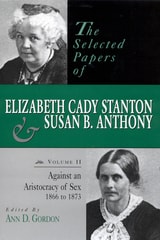
The Selected Papers of Elizabeth Cady Stanton and Susan B. Anthony
Against an Aristocracy of Sex, 1866 to 1873Gordon, Ann D
Rutgers University Press, 2000
The second volume picks up the story of Stanton and Anthony at the end of 1866, when they launched their drive to make universal suffrage the priority of Reconstruction. Through letters, speeches, articles, and diaries, this volume recounts their years as editor and publisher of the weekly paper the Revolution, their extensive travels, and their lobbying with Congress. It touches on the bitter division that occurred among suffragists over such controversial topics as marriage and divorce, and a national debate over the citizenship of women under the Fourteenth and Fifteenth Amendments. By the summer of 1873, when this volume ends, Anthony stood convicted of the federal crime of illegal citizenship of women under the Fourteenth and Fifteenth Amendments. By the summer of 1873, when this volume ends, Anthony stood convicted of the federal crime of illegal voting. An irate Stanton warned, "I felt afresh the mockery of this boasted chivalry of man towards woman."
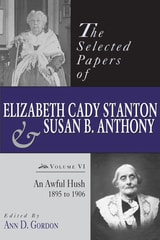
The Selected Papers of Elizabeth Cady Stanton and Susan B. Anthony
An Awful Hush, 1895 to 1906Gordon, Ann D
Rutgers University Press, 2012
The “hush” of the title comes suddenly, when first Elizabeth Cady Stanton dies on October 26, 1902, and three years later Susan B. Anthony dies on March 13, 1906. It is sudden because Stanton, despite near blindness and immobility, wrote so intently right to the end that editors had supplies of her articles on hand to publish several months after her death. It is sudden because Anthony, at the age of eighty-five, set off for one more transcontinental trip, telling a friend on the Pacific Coast, “it will be just as well if I come to the end on the cars, or anywhere, as to be at home.”
Volume VI of this extraordinary series of selected papers is inescapably about endings, death, and silence. But death happens here to women still in the fight. An Awful Hush is about reformers trained “in the school of anti-slavery” trying to practice their craft in the age of Jim Crow and a new American Empire. It recounts new challenges to “an aristocracy of sex,” whether among the bishops of the Episcopal church, the voters of California, or the trustees of the University of Rochester. And it sends last messages about woman suffrage. As Stanton wrote to Theodore Roosevelt on the day before she died, “Surely there is no greater monopoly than that of all men, in denying to all women a voice in the laws they are compelled to obey.”
With the publication of Volume VI, this series is now complete.
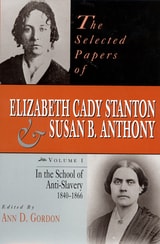
The Selected Papers of Elizabeth Cady Stanton and Susan B. Anthony
In the School of Anti-Slavery, 1840 to 1866Gordon, Ann D
Rutgers University Press, 1997
In the School of Anti-Slavery, 1840-1866 is the first of six volumes of The Selected Papers of Elizabeth Cady Stanton and Susan B. Anthony. The collection documents the lives and accomplishments of two of America's most important social and political reformers. Though neither Stanton nor Anthony lived to see the passage of the Nineteenth Amendment in 1920, each of them devoted fifty-five years to the cause. Their names were synonymous with woman suffrage in the United States and around the world as they mobilized thousands of women to fight for the right to a political voice.
Opening when Stanton was twenty-five and Anthony was twenty, and ending when Congress sent the Fourteenth Amendment to the states for ratification, this volume recounts a quarter of a century of staunch commitment to political change. Readers will enjoy an extraordinary collection of letters, speeches, articles, and diaries that tells a story-both personal and public-about abolition, temperance, and woman suffrage.
When all six volumes are complete, the Selected Papers of Stanton and Anthony will contain over 2,000 texts transcribed from their originals, the authenticity of each confirmed or explained, with notes to allow for intelligent reading. The papers will provide an invaluable resource for examining the formative years of women's political participation in the United States. No library or scholar of women's history should be without this original and important collection.
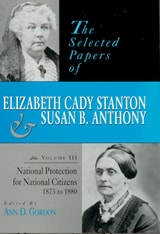
The Selected Papers of Elizabeth Cady Stanton and Susan B. Anthony
National Protection for National Citizens, 1873 to 1880Gordon, Ann D
Rutgers University Press, 2003
National Protection for National Citizens, 1873 to 1880 is the third of six planned volumes of TheSelected Papers of Elizabeth Cady Stanton and Susan B. Anthony. The entire collection documents the friendship and accomplishments of two of America's most important social and political reformers. Though neither Stanton nor Anthony lived to see passage of the Nineteenth Amendment in 1920, each of them devoted fifty-five years to the cause of woman suffrage.
The third volume of the Selected Papers of Elizabeth Cady Stanton and Susan B. Anthony opens while woman suffragists await the decision of the U.S. Supreme Court in cases testing whether the Constitution recognized women as voters within the terms of the Fourteenth and Fifteenth Amendments. At its close they are pursuing their own amendment to the Constitution and pressing the presidential candidates of 1880 to speak in its favor. Through their letters, speeches, articles, and diaries, the volume recounts the national careers of Elizabeth Cady Stanton and Susan B. Anthony as popular lecturers, their work with members of Congress to expand women's rights, their protests during the Centennial Year of 1876, and the launch that same year of their campaign for a Sixteenth Amendment.
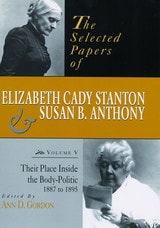
The Selected Papers of Elizabeth Cady Stanton and Susan B. Anthony
Their Place Inside the Body-Politic, 1887 to 1895Gordon, Ann D
Rutgers University Press, 2009
At the beginning, Stanton and Anthony focus their attention on organizing the International Council of Women in 1888. Late in 1887, Lucy Stone’s American Woman Suffrage Association announced its desire to merge with the national association led by Stanton and Anthony. Two years of fractious negotiations preceded the 1890 merger, and years of sharp disagreements followed. Stanton made her last trip to Washington in 1892 to deliver her famous speech “Solitude of Self.” Two states enfranchised women—Wyoming in 1890 and Colorado in 1893—but failures were numerous. Anthony returned to grueling fieldwork in South Dakota in 1890 and Kansas and New York in 1894. From the campaigns of 1894, Stanton emerged as an advocate of educated suffrage and staunchly defended her new position.
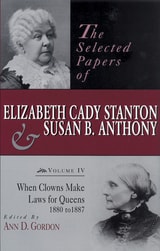
The Selected Papers of Elizabeth Cady Stanton and Susan B. Anthony
When Clowns Make Laws for Queens, 1880-1887Gordon, Ann D
Rutgers University Press, 2006
At the opening of the fourth volume, suffragists hoped to speed passage of a sixteenth amendment to the Constitution through the creation of Select Committees on Woman Suffrage in Congress. Congress did not vote on the amendment until January 1887. Then, in a matter of a week, suffragists were dealt two major blows: the Senate defeated the amendment and the Senate and House reached agreement on the Edmunds-Tucker Act, disenfranchising all women in the Territory of Utah.
As evidenced in this volume's selection of letters, articles, speeches, and diary entries, these were years of frustration. Suffragists not only lost federal and state campaigns for partial and full voting rights, but also endured an invigorated opposition. In spite of these challenges, Stanton and Anthony continued to pursue their life's work. In 1880 both women retired from lecturing to devote attention to their monumental History of Woman Suffrage. They also opened a new transatlantic dialogue about woman's rights during a trip to Europe in 1883.

The Specter of the Archive
Political Practice and the Information State in Early Modern BritainNicholas Popper
University of Chicago Press, 2024
We are used to thinking of ourselves as living in a time when more information is more available than ever before. In The Specter of the Archive, Nicholas Popper shows that earlier eras had to grapple with the same problem—how to deal with too much information at their fingertips.
He reveals that early modern Britain was a society newly drowning in paper, a light and durable technology whose spread allowed statesmen to record drafts, memoranda, and other ephemera that might otherwise have been lost, and also made it possible for ordinary people to collect political texts. As original paperwork and copies alike flooded the government, information management became the core of politics. Focusing on two of the primary political archives of early modern England, the Tower of London Record Office and the State Paper Office, Popper traces the circulation of their materials through the government and the broader public sphere. In this early media-saturated society, we find the origins of many issues we face today: Who shapes the archive? Can we trust the pictures of the past and the present that it shows us? And, in a more politically urgent vein: Does a huge volume of widely available information (not all of it accurate) risk contributing to polarization and extremism?
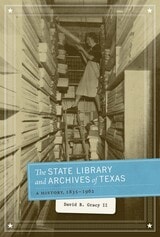
The State Library and Archives of Texas
A History, 1835-1962By David B. Gracy II
University of Texas Press, 2010
The Texas State Library and Archives Commission celebrated its centennial in 2009. To honor that milestone, former State Archivist David Gracy has taken a retrospective look at the agency's colorful and sometimes contentious history as Texas's official information provider and record keeper. In this book, he chronicles more than a century of efforts by dedicated librarians and archivists to deliver the essential, nonpartisan library and archival functions of government within a political environment in which legislators and governors usually agreed that libraries and archives were good and needed—but they disagreed about whatever expenditure was being proposed at the moment.
Gracy recounts the stories of persevering, sometimes controversial state librarians and archivists, and commission members, including Ernest Winkler, Elizabeth West (the first female agency head in Texas government), Fannie Wilcox, Virginia Gambrell, and Louis Kemp, who worked to provide Texans the vital services of the state library and archives—developing public library service statewide, maintaining state and federal records for use by the public and lawmakers, running summer reading programs for children, providing services for the visually impaired, and preserving the historically significant records of Texas as a colony, province, republic, and state. Gracy explains how the agency has struggled to balance its differing library and archival functions and, most of all, to be treated as a full-range information provider, and not just as a collection of disparate services.
There Is No Making It Out
Stories-So-Far and the Possibilities of New StoriesRomeo García
Utah State University Press, 2025
Through the Archival Looking Glass
A Reader on Diversity and InclusionMary A. Caldera
Society of American Archivists, 2014