82 books match the query 'Arts and society' and 13 start with t
cover of Telling About Society

Telling About Society

Howard S. Becker

University of Chicago Press, 2007

I Remember, one of French writer Georges Perec’s most famous pieces, consists of 480 numbered paragraphs—each just a few short lines recalling a memory from his childhood. The work has neither a beginning nor an end. Nor does it contain any analysis. But it nonetheless reveals profound truths about French society during the 1940s and 50s.

Taking Perec’s book as its cue, Telling About Society explores the unconventional ways we communicate what we know about society to others. The third in distinguished teacher Howard Becker’s best-selling series of writing guides for social scientists, the book explores the many ways knowledge about society can be shared and interpreted through different forms of telling—fiction, films, photographs, maps, even mathematical models—many of which remain outside the boundaries of conventional social science. Eight case studies, including the photographs of Walker Evans, the plays of George Bernard Shaw, the novels of Jane Austen and Italo Calvino, and the sociology of Erving Goffman, provide convincing support for Becker’s argument: that every way of telling about society is perfect—for some purpose. The trick is, as Becker notes, to discover what purpose is served by doing it this way rather than that.

With Becker’s trademark humor and eminently practical advice, Telling About Society is an ideal guide for social scientists in all fields, for artists interested in saying something about society, and for anyone interested in communicating knowledge in unconventional ways.

[more]
cover of Terracene: A Crude Aesthetics

Terracene

A Crude Aesthetics

Salar Mameni

Duke University Press, 2023
In Terracene Salar Mameni historicizes the popularization of the scientific notion of the Anthropocene alongside the emergence of the global war on terror. Mameni theorizes the Terracene as an epoch marked by a convergence of racialized militarism and environmental destruction. Both the Anthropocene and the war on terror centered the antagonist figures of the Anthropos and the terrorist as responsible for epochal changes in the new geological and geopolitical world orders. In response, Mameni shows how the Terracene requires radically new engagements with terra (the earth), whose intelligence resides in matters such as oil and phenomena like earthquakes and fires. Drawing on the work of artists whose practices interrogate histories of settler-colonial and imperial interests in land and resources in Iran, Iraq, Yemen, Kuwait, Syria, Palestine, and other regions most affected by the war on terror, Mameni offers speculative paths into the aesthetics of the Terracene.
[more]
cover of Territories and Trajectories: Cultures in Circulation

Territories and Trajectories

Cultures in Circulation

Diana Sorensen, editor

Duke University Press, 2018

The contributors to Territories and Trajectories propose a model of cultural production and transmission based on the global diffusion, circulation, and exchange of people, things, and ideas across time and space. This model eschews a static, geographically bounded notion of cultural origins and authenticity, privileging instead a mobility of culture that shapes and is shaped by geographic spaces. Reading a diverse array of texts and objects, from Ethiopian song and ancient Chinese travel writing to Japanese literature and aerial and nautical images of the Indian Ocean, the contributors decenter national borders to examine global flows of culture and the relationship between thinking at transnational and local scales. Throughout, they make a case for methods of inquiry that encourage innovative understandings of borders, oceans, and territories and that transgress disciplinary divides.

Contributors. Homi Bhabha, Jacqueline Bhabha, Lindsay Bremner, Finbarr Barry Flood, Rosario Hubert, Alina Payne, Kay Kaufman Shelemay, Shu-mei Shih, Diana Sorensen, Karen Thornber, Xiaofei Tian

[more]
cover of The Aesthetic Character of Blackness: Sounds Like Us

The Aesthetic Character of Blackness

Sounds Like Us

Jemma DeCristo

Duke University Press, 2025

In The Aesthetic Character of Blackness, Jemma DeCristo theorizes the means by which black art liberates the free world but does not and cannot liberate black people. Drawing on Frederick Douglass, W. E. B. Du Bois, and Alain Locke and as well as the aesthetic thought of Immanuel Kant, Friedrich Schiller, Friedrich Nietzsche, and Theodor Adorno, DeCristo critiques the exaltation of black culture and art’s saving power by analyzing the violence underneath aesthetic production. She tracks black music’s representational and anti-representational capacities in projects of black non/humanization from nineteenth-century abolitionism and the founding of the recording industry to the emergence of black queer blues performers and the rise of the Black Arts Movement of the 1960s. Theorizing the contemporary neoliberalization of black audio-visual spectacle, DeCristo ultimately demonstrates that the voluptuous world of black aesthetics beautifies an anti-black world that wields black art and culture as a weapon against black life.
[more]
cover of The Afterlife of Taste Hierarchies in Contemporary U.S. Art and Literature

The Afterlife of Taste Hierarchies in Contemporary U.S. Art and Literature

Rooney, Monique

University of Iowa Press, 2026

Connecting literary studies, media theory, and cultural criticism, The Afterlife of Taste Hierarchies in Contemporary U.S. Art and Literature offers a fresh vocabulary for understanding how we evaluate art and each other in an age of digital mediation. Drawing on works and artifacts ranging from Beyoncé’s Lemonade and Andrea Long Chu’s “China Brain” to Ottessa Moshfegh’s My Year of Rest and Relaxation and the viral Bernie Sanders mittens meme, Monique Rooney traces how aspirations to refinement and gestures of condescension—once associated with high-, middle-, and lowbrow culture—continue to define aesthetic experience. This book moves between literary and popular forms, attending as closely to the meme’s dispersed creativity as to the novel’s intentional aesthetics.
[more]
cover of The Black Chicago Renaissance

The Black Chicago Renaissance

Edited by Darlene Clark Hine and John McCluskey Jr.

University of Illinois Press, 2012
Beginning in the 1930s, Black Chicago experienced a cultural renaissance that lasted into the 1950s and rivaled the cultural outpouring in the Harlem Renaissance of the 1920s. The contributors to this volume analyze this prolific period of African American creativity in music, performance art, social science scholarship, and visual and literary artistic expression.
 
Unlike Harlem, Chicago was an urban industrial center that gave a unique working class and internationalist perspective to the cultural work being done in Chicago. This collection's various essays discuss the forces that distinguished the Black Chicago Renaissance from the Harlem Renaissance and placed the development of black culture in a national and international context. Among the topics discussed in this volume are Chicago writers Gwendolyn Brooks and Richard Wright, The Chicago Defender and Tivoli Theater, African American music and visual arts, and the American Negro Exposition of 1940.
 
Contributors are Hilary Mac Austin, David T. Bailey, Murry N. DePillars, Samuel A. Floyd Jr., Erik S. Gellman, Jeffrey Helgeson, Darlene Clark Hine, John McCluskey Jr., Christopher Robert Reed, Elizabeth Schlabach, and Clovis E. Semmes.
[more]
cover of The Cuban Hustle: Culture, Politics, Everyday Life

The Cuban Hustle

Culture, Politics, Everyday Life

Sujatha Fernandes

Duke University Press, 2020
In The Cuban Hustle, Sujatha Fernandes explores the multitudinous ways artists, activists, and ordinary Cubans have hustled to survive and express themselves in the aftermath of the Soviet Union’s collapse. Whether circulating information on flash drives as a substitute for the internet or building homemade antennas to listen to Miami’s hip hop radio stations, Cubans improvise alternative strategies and workarounds to contend with ongoing isolation. Throughout these essays, Fernandes examines the emergence of dynamic youth cultures and social movements as Cuba grappled with economic collapse, new digital technologies, the normalization of diplomatic ties with the United States during the Obama administration, and the regression of US-Cuban relations in the Trump era. From reflections on feminism, new Cuban cinema, and public art to urban slums, the Afro-Cuban movement, and rumba and hip hop, Fernandes reveals Cuba to be a world of vibrant cultures grounded in an ethos of invention and everyday hustle.
[more]
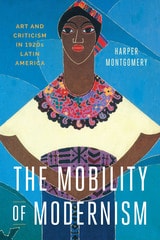
cover of The Mobility of Modernism: Art and Criticism in 1920s Latin America

The Mobility of Modernism

Art and Criticism in 1920s Latin America

By Harper Montgomery

University of Texas Press, 2017

Arvey Foundation Book Award, Association for Latin American Art, 2018

Many Latin American artists and critics in the 1920s drew on the values of modernism to question the cultural authority of Europe. Modernism gave them a tool for coping with the mobility of their circumstances, as well as the inspiration for works that questioned the very concepts of the artist and the artwork and opened the realm of art to untrained and self-taught artists, artisans, and women. Writing about the modernist works in newspapers and magazines, critics provided a new vocabulary with which to interpret and assign value to the expanding sets of abstracted forms produced by these artists, whose lives were shaped by mobility.

The Mobility of Modernism examines modernist artworks and criticism that circulated among a network of cities, including Buenos Aires, Mexico City, Havana, and Lima. Harper Montgomery maps the dialogues and relationships among critics who published in avant-gardist magazines such as Amauta and Revista de Avance and artists such as Carlos Mérida, Xul Solar, and Emilio Pettoruti, among others, who championed esoteric forms of abstraction. She makes a convincing case that, for these artists and critics, modernism became an anticolonial stance which raised issues that are still vital today—the tensions between the local and the global, the ability of artists to speak for blighted or unincorporated people, and, above all, how advanced art and its champions can enact a politics of opposition.

[more]
cover of The Play in the System: The Art of Parasitical Resistance

The Play in the System

The Art of Parasitical Resistance

Anna Watkins Fisher

Duke University Press, 2020
What does artistic resistance look like in the twenty-first century, when disruption and dissent have been co-opted and commodified in ways that reinforce dominant systems? In The Play in the System Anna Watkins Fisher locates the possibility for resistance in artists who embrace parasitism—tactics of complicity that effect subversion from within hegemonic structures. Fisher tracks the ways in which artists on the margins—from hacker collectives like Ubermorgen to feminist writers and performers like Chris Kraus—have willfully abandoned the radical scripts of opposition and refusal long identified with anticapitalism and feminism. Space for resistance is found instead in the mutually, if unevenly, exploitative relations between dominant hosts giving only as much as required to appear generous and parasitical actors taking only as much as they can get away with. The irreverent and often troubling works that result raise necessary and difficult questions about the conditions for resistance and critique under neoliberalism today.
[more]
cover of The Public Life of the Arts in America: The Public Life of the Arts in America, Revised Edition

The Public Life of the Arts in America

The Public Life of the Arts in America, Revised Edition

Cherbo, Joni Maya

Rutgers University Press, 2000

Art and entertainment constitute America’s second-largest export. Most Americans—96%, to be exact—are somehow involved in the arts, whether as audience participants, hobbyists, or via broadcast, recording, video, or the Internet. The contribution of the arts to the U.S. economy is stunning: the nonprofit arts industry alone contributes over 857 billion dollars per year, and America’s fine and performing arts enjoy world-class status.

 Despite its size, quality, and economic impact, the arts community is not articulate about how they serve public interests, and few citizens have an appreciation of the myriad of public policies that influence American arts and culture. The contributors to this volume argue that U.S. policy can—and should—support the arts and that the arts, in turn serve a broad rather than an elite public. Indeed, increased support for the arts and culture equals good economic and trade policy; it also contributes to the quality of life and community, and helps sustain the creativity of American artists and organizations.

By encouraging policy-makers to systematically start investigating the crucial role and importance of all of the arts in the United States, The Arts and Public Purpose moves the field forward with fresh ideas, new concepts, and important new data.
[more]
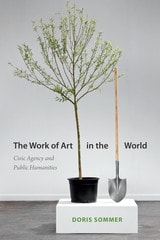
cover of The Work of Art in the World: Civic Agency and Public Humanities

The Work of Art in the World

Civic Agency and Public Humanities

Doris Sommer

Duke University Press, 2014
Celebrating art and interpretation that take on social challenges, Doris Sommer steers the humanities back to engagement with the world. The reformist projects that focus her attention develop momentum and meaning as they circulate through society to inspire faith in the possible. Among the cases that she covers are top-down initiatives of political leaders, such as those launched by Antanas Mockus, former mayor of Bogotá, Colombia, and also bottom-up movements like the Theatre of the Oppressed created by the Brazilian director, writer, and educator Augusto Boal. Alleging that we are all cultural agents, Sommer also takes herself to task and creates Pre-Texts, an international arts-literacy project that translates high literary theory through popular creative practices. The Work of Art in the World is informed by many writers and theorists. Foremost among them is the eighteenth-century German poet and philosopher Friedrich Schiller, who remains an eloquent defender of art-making and humanistic interpretation in the construction of political freedom. Schiller's thinking runs throughout Sommer's modern-day call for citizens to collaborate in the endless co-creation of a more just and more beautiful world.
[more]
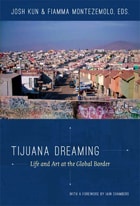
cover of Tijuana Dreaming: Life and Art at the Global Border

Tijuana Dreaming

Life and Art at the Global Border

Josh Kun and Fiamma Montezemolo, eds.

Duke University Press, 2012

Tijuana Dreaming is an unprecedented introduction to the arts, culture, politics, and economics of contemporary Tijuana, Mexico. With many pieces translated from Spanish for the first time, the anthology features contributions by prominent scholars, journalists, bloggers, novelists, poets, curators, and photographers from Tijuana and greater Mexico. They explore urban planning in light of Tijuana's unique infrastructural, demographic, and environmental challenges. They delve into its musical countercultures, architectural ruins, cinema, and emergence as a hot spot on the international art scene. One contributor examines fictional representations of Tijuana's past as a Prohibition-era "city of sin" for U.S. pleasure seekers. Another reflects on the city's recent struggles with kidnappings and drug violence. In an interview, Néstor García Canclini revisits ideas that he advanced in Culturas híbridas (1990), his watershed book about Latin America and cultural hybridity. Taken together, the selections present a kaleidoscopic portrait of a major border city in the age of globalization.

Contributors. Tito Alegría, Humberto Félix Berumen, Roberto Castillo Udiarte, Iain Chambers, Luis Humberto Crosthwaite, Teddy Cruz, Ejival, Tarek Elhaik, Guillermo Fadanelli, Néstor García Canclini, Ingrid Hernández, Jennifer Insley-Pruitt, Kathryn Kopinak, Josh Kun, Jesse Lerner, Fiamma Montezemolo, Rene Peralta, Rafa Saavedra, Lucía Sanromán, Santiago Vaquera-Vásquez, Heriberto Yépez
[more]
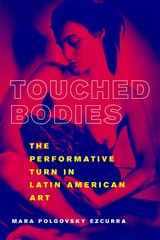
cover of Touched Bodies: The Performative Turn in Latin American Art

Touched Bodies

The Performative Turn in Latin American Art

Mara Polgovsky Ezcurra

Rutgers University Press, 2019

Shortlisted for the 2020 Association for the Study of the Arts of the Present Book Prize​
Winner of the 2019 Art Journal Prize from the College Art Association

What is the role of pleasure and pain in the politics of art? In Touched Bodies, Mara Polgovsky Ezcurra approaches this question as she examines the flourishing of live and intermedial performance in Latin America during times of authoritarianism and its significance during transitions to democracy. Based on original documents and innovative readings, her book brings politics and ethics to the discussion of artistic developments during the “long 1980s”. She describes the rise of performance art in the context of feminism, HIV-activism, and human right movements, taking a close look at the work of Diamela Eltit and Raúl Zurita from Chile, León Ferrari and Liliana Maresca from Argentina, and Marcos Kurtycz, the No Grupo art collective, and Proceso Pentágono from Mexico. The comparative study of the work of these artists attests to a performative turn in Latin American art during the 1980s that, like photography and film before, recast the artistic field as a whole, changing the ways in which we perceive art and understand its role in society.
[more]