51 books match the query 'Arts in Education' and 9 start with t
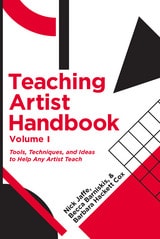
cover of Teaching Artist Handbook, Volume One: Tools, Techniques, and Ideas to Help Any Artist Teach

Teaching Artist Handbook, Volume One

Tools, Techniques, and Ideas to Help Any Artist Teach

Nick Jaffe, Becca Barniskis, and Barbara Hackett Cox

University of Chicago Press, 2015

Teaching Artist Handbook is based on the premise that teaching artists have the unique ability to engage students as fellow artists. In their schools and communities, teaching artists put high quality art-making at the center of their practice and open doors to powerful learning across disciplines.
This book is a collection of essays, stories, lists, examples, dialogues, and ideas, all offered with the aim of helping artists create and implement effective teaching based on their own expertise and strengths. The Handbook addresses three core questions: “What will I teach?” “How will I teach it?” and “How will I know if my teaching is working?” It also recognizes that teaching is a dynamic process that requires critical reflection and thoughtful adjustment in order to foster a supportive artistic environment.
Instead of offering rigid formulas, this book is centered on practice—the actual doing and making of teaching artist work. Experience-based and full of heart, the Teaching Artist Handbook will encourage artists of every experience level to create an original and innovative practice that inspires students and the artist.
[more]
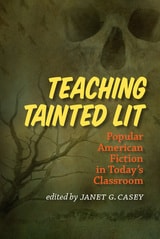
cover of Teaching Tainted Lit: Popular American Fiction in Today's Classroom

Teaching Tainted Lit

Popular American Fiction in Today's Classroom

Janet G. Casey

University of Iowa Press, 2015

Popular American fiction has now secured a routine position in the higher education classroom despite its historic status as culturally suspect. This newfound respect and inclusion have almost certainly changed the pedagogical landscape, and Teaching Tainted Lit explores that altered terrain. If the academy has historically ignored, or even sneered at, the popular, then its new accommodation within the framework of college English is noteworthy: surely the popular introduces both pleasures and problems that did not exist when faculty exclusively taught literature from an established “high” canon. How, then, does the assumption that the popular matters affect teaching strategies, classroom climates, and both personal and institutional notions about what it means to study literature?

The essays in this collection presume that the popular is here to stay and that its instructive implications are not merely noteworthy, but richly nuanced and deeply compelling. They address a broad variety of issues concerning canonicity, literature, genre, and the classroom, as its contributors teach everything from Stephen King and Lady Gaga to nineteenth-century dime novels and the 1852 best-seller Uncle Tom’s Cabin.

It is no secret that teaching popular texts fuels controversies about the value of cultural studies, the alleged relaxation of aesthetic standards, and the possible “dumbing down” of Americans. By implicitly and explicitly addressing such contentious issues, these essays invite a broader conversation about the place of the popular not only in higher education but in the reading lives of all Americans.
[more]
cover of The Arts and Design in Research Universities (pack of 12)

The Arts and Design in Research Universities (pack of 12)

Gabriel Harp

A2RU Intervals, 2018

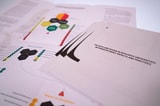
From 2012-2015 (as part of the Mellon-funded SPARC project), the A2RU research team interviewed upper-level administration, faculty, and students at 38 member institutions about the impact of their arts-integration initiatives, including teaching, research, and community projects. We asked about what impact they hoped for and what impact they actually saw. The Impacts Map is a graphic representation of the categories of impact we surfaced, and a framework and logic model for connecting impacts across domains.

This arresting graphic provides a visual overview of the impacts of arts integration and interdisciplinarity in the university. It can be a tool for case-making, communication, and further inquiry.

This listing is for a pack of 12 maps.
[more]
cover of The Arts and Design in Research Universities (pack of 5)

The Arts and Design in Research Universities (pack of 5)

Gabriel Harp

A2RU Intervals, 2018

From 2012-2015 (as part of the Mellon-funded SPARC project), the A2RU research team interviewed upper-level administration, faculty, and students at 38 member institutions about the impact of their arts-integration initiatives, including teaching, research, and community projects. We asked about what impact they hoped for and what impact they actually saw. The Impacts Map is a graphic representation of the categories of impact we surfaced, and a framework and logic model for connecting impacts across domains.

This arresting graphic provides a visual overview of the impacts of arts integration and interdisciplinarity in the university. It can be a tool for case-making, communication, and further inquiry.

This listing is for a pack of 5 maps.
[more]
cover of The Arts and Design in Research Universities: Interdisciplinary Impacts and Practices

The Arts and Design in Research Universities

Interdisciplinary Impacts and Practices

Gabriel Harp

A2RU Intervals, 2018

From 2012-2015 (as part of the Mellon-funded SPARC project), the A2RU research team interviewed upper-level administration, faculty, and students at 38 member institutions about the impact of their arts-integration initiatives, including teaching, research, and community projects. We asked about what impact they hoped for and what impact they actually saw. The Impacts Map is a graphic representation of the categories of impact we surfaced, and a framework and logic model for connecting impacts across domains.

This arresting graphic provides a visual overview of the impacts of arts integration and interdisciplinarity in the university. It can be a tool for case-making, communication, and further inquiry.

[more]
cover of The Case for Arts Integration

The Case for Arts Integration

Research and Authors: Gabriel Harp, Veronica Stanich, Stephanie Gioia - Design/Illustration: Rich Moore, Stephanie Gioia

A2RU Intervals, 2019

The Case for Arts Integration is a tool for connecting across campus, outlining the “what,” “why,” and “how” of arts integration. While this book shows how arts integration can function on campus, and its range of impacts, the case it makes is broad and all-encompassing. On many campuses, a few faculty or staff are champions of arts integration. This book is designed to help them build broader support for arts integration at many levels, including among university leadership. Each university will want to define what arts integration looks like for them and how it fits into their unique cultural landscape.

Like all A2RU’s programs, The Case for Arts Integration is grounded in research and developed through integration and synthesis. This resource supports the work of arts integration on-campus, and draws on insights gathered from over 600 interviews with academic leaders, institutional officers, faculty, staff, and students at over 60 research universities. The A2RU research team systematically reviews these insights for evidence of the positive impacts, successful patterns, best practices, recurring challenges, and salient stories of arts integration.

A companion workbook, The Case for Arts Integration: Workbook, is also available as a hands-on tool designed to help you map how the arts and arts integration advances your university’s mission.

[more]
cover of The Case for Arts Integration Workbook

The Case for Arts Integration Workbook

Research and Authors: Gabriel Harp, Veronica Stanich, Stephanie Gioia - Design/Illustration: Rich Moore, Stephanie Gioia

A2RU Intervals, 2019

This workbook provides an introduction to the insights and questions commonly encountered by A2RU and its research university partners. The goal is to help enable better sensemaking and case-making activities around arts integration, what it means, and how it will unfold on your campus.

This workbook is designed to help you in case-making, developing a workshop, or as a common framework for benchmarking. Properly applied, the workbook will save weeks of work, provide structure and clarity for your group’s work, accelerate your ability to assemble exemplary case-making materials, and raise the quality of your messaging.

This workbook is a companion to The Case for Arts Integration book, which is recommended as a reference and source of inspiration.

[more]
cover of The Intellect Handbook of Dance Education Research

The Intellect Handbook of Dance Education Research

Edited by Lynnette Young Overby, Billie Lepczyk, and Jill Green

Intellect Books, 2025

A global exploration of dance education research, its methodologies, and its impact on the field.

The Intellect Handbook of Dance Education Research is a necessary resource for students, educators, and advocates, offering a broad survey of research methodologies alongside real-world applications from across the globe. This volume brings together voices from both seasoned and emerging scholars, highlighting the diversity of dance research in countries including Korea, South Africa, Jamaica, India, Brazil, Slovenia, and beyond.

Divided into four parts, the book first examines foundational research methodologies, spanning mixed-method approaches as well as innovative techniques like portraiture and a/r/tography. The second section presents dance education research in practice, exploring history, choreography, and community-based initiatives. The third part showcases international perspectives, offering snapshots of research traditions from contrasting cultural contexts. Finally, the fourth section elaborates on the role of dance in social justice, illustrating how movement-based research can drive cultural and societal change. 

A vital tool for researchers, policymakers, and educators alike, this handbook underscores the significance of dance as a transformative force in education, fostering collaboration and meaningful impact in diverse communities.
 
[more]
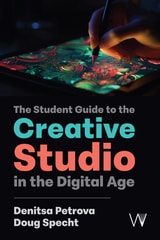
cover of The Student Guide to the Creative Studio in the Digital Age

The Student Guide to the Creative Studio in the Digital Age

Denitsa Petrova and Doug Specht

University of Westminster Press, 2025

This book looks at what it means to work in a creative studio. The volume takes a broad view of the concept of studio, defining it as any creative space that exists in the real or digital world – so this could be your studio at the university, a space or table you have at home, or a digital environment such as Miro where you work alone or with others. This book guides you in setting up a studio space and thinking about how to get the most out of solo and collaborative work within that space. It examines some of the practical elements, such as hardware and tools you might need, along with some of the soft skills, such as time management that will help you in your working.Having helped you to establish your working space, the authors provide guidance on specific creative skills that cross multiple disciplines and ways of working. Providing help with creating portfolios, including those that are needed to get into university, those you might produce while at university, and also ones that might be used after you complete your studies. The book also takes a deep five into how to present your work, both in person and online, synchronously, and asynchronously. Relatedly the volume examines crits, and how you might use and respond to feedback provided by your lecturers and peers. The authors are also joined by more than 20 contributors who help this volume to dive deeply into different subject areas. Ranging from sculpture, textiles, art and graphic design, readers will find tailored expert tips to help them in their own discipline to get the most from the digital creative environment.This book challenges the reader to think about what it means to be creative and how digital can play a role in this. Furthermore, it asks the reader to ask what is next. To think about the career they would like that will engage in creative practices. Think about how the creative studio might differ in the world of work and how you can ensure you keep your creative energies going. Throughout this, though, the authors, with the help of expert contributors, guide and support the reader in exploiting the digital creative environment to its maximum.
[more]