Results by title
200 books match the query 'Asian American & Pacific Islander' and 40 start with t
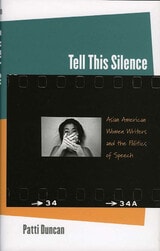
Tell This Silence
Asian American Women Writers And The Politics Of SpeechPatti Duncan
University of Iowa Press, 2004
However, as the writers discussed in Tell This Silence suggest, silence too has multiple meanings especially in contexts like the U.S., where speech has never been a guaranteed right for all citizens. Duncan argues that writers such as Maxine Hong Kingston, Mitsuye Yamada, Joy Kogawa, Theresa Hak Kyung Cha, Nora Okja Keller, and Anchee Min deploy silence as a means of resistance. Juxtaposing their “unofficial narratives” against other histories—official U.S. histories that have excluded them and American feminist narratives that have stereotyped them or distorted their participation—they argue for recognition of their cultural participation and offer analyses of the intersections among gender, race, nation, and sexuality.
Tell This Silence offers innovative ways to consider Asian American gender politics, feminism, and issues of immigration and language. This exciting new study will be of interest to literary theorists and scholars in women's, American, and Asian American studies.
Tell it Slant
John Yau
Omnidawn, 2023
Emily Dickinson begins one of her poems with the oft-quoted line, “Tell all the truth but tell it slant." For Asian Americans, the word “slant” can be heard and read two ways, as both a racializing and an obscuring term. It is this sense of doubleness—culminating in the instability of language and an untrustworthy narrator—that shapes, informs, and inflects the poems in John Yau’s new collection, all of which focus on the questions of who is speaking and who is being spoken for and to. Made up of eight sections, each exploring the idea of address—as place, as person, as memory, and as event —Tell It Slant does as Dickinson commands, but with a further twist. Yau summons spirits who help the author “tell all the truth,” among whom are reimagined traces of poets, movie stars, and science fiction writers, including Charles Baudelaire, Thomas de Quincey, Philip K. Dick, Li Shangyin, and Elsa Lanchester.
Thanks for Letting Us Know You Are Alive
PoemsJennifer Tseng
University of Massachusetts Press, 2024
Crafted with lines from her late father’s letters, Jennifer Tseng’s Thanks for Letting Us Know You Are Alive is a portrait of an immigrant, a rootless person whose unspoken loss—that of his native geography, family, traditions, language—underlies every word. Though her father’s first language was Mandarin, for more than twenty years he wrote these letters in English, so that she could understand them. Some are riddled with errors, some nearly unintelligible. Lines from his letters appear as titles and are scattered throughout the poems, blending voices of father and daughter. This collection enacts what it means to lose someone and commune with them simultaneously—the paradox of grief and all it gives us.
The 44th of July
Jaswinder Bolina
Omnidawn, 2019
In The 44th of July, Jaswinder Bolina offers bracing and often humorous reflections on American culture through the lens of an alienated outsider at a deliberately uncomfortable distance that puts the oddities of the culture on full display. Exploring the nuances of life in an America that doesn’t treat you as one of its own, yet whose benefits still touch your life, these exquisitely crafted poems sing in a kaleidoscopic collaging of language the mundane, yet surreal experience of being in between a cultural heritage of migration and poverty and daily life in a discriminatory yet prosperous nation. Both complicit in global capitalism and victims of the inequality that makes it possible, these are the Americans who are caught in a system with no clear place for them. Bolina opens the space to include the excluded, bringing voice and embodied consciousness to experiences that are essential to Americanness, but get removed from view in the chasms between self and other, immigrant and citizen.
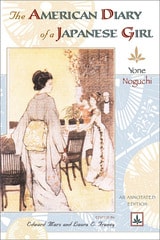
The American Diary of a Japanese Girl
An Annotated EditionYone Noguchi, edited by Edward Marx with Laura E. Franey
Temple University Press, 2007
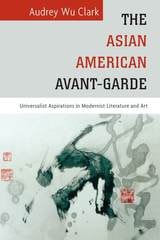
The Asian American Avant-Garde
Universalist Aspirations in Modernist Literature and ArtAudrey Wu Clark
Temple University Press, 2015
The Asian American Avant-Garde is the first book-length study that conceptualizes a long-neglected canon of early Asian American literature and art. Audrey Wu Clark traces a genealogy of counter-universalism in short fiction, poetry, novels, and art produced by writers and artists of Asian descent who were responding to their contemporary period of Asian exclusion in the United States, between the years 1882 and 1945.
Believing in the promise of an inclusive America, these avant-gardists critiqued racism as well as institutionalized art. Clark examines racial outsiders including Isamu Noguchi, Dong Kingman and Yun Gee to show how they engaged with modernist ideas, particularly cubism. She draws comparisons between writers such as Sui Sin Far and Carlos Bulosan with modernist luminaries like Stein, Eliot, Pound, and Proust.
Acknowledging the anachronism of the term “Asian American” with respect to these avant-gardists, Clark attempts to reconstruct it. The Asian American Avant-Garde explores the ways in which these artists and writers responded to their racialization and the Orientalism that took place in modernist writing.
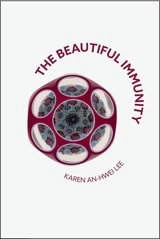
The Beautiful Immunity
Karen An-hwei Lee
Tupelo Press, 2024
The Beautiful Immunity asks how we create good in an imperfect world of fallible souls. Spare and formally daring, these poems were refined through the catastrophes of wildfires, recession, and a major public health crisis through the hope of a beautiful immunity—an everlasting salve for the lost. This slender volume reads as the culmination of more than a decade’s worth of labor, documenting large-scale social, cultural, and political upheavals, as well as the moment when the word “anthropause” floated indelibly into the world’s vocabulary.
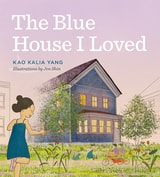
The Blue House I Loved
Kao Kalia Yang
University of Minnesota Press, 2026
A Hmong girl tells the story of her beloved aunt and uncle’s first home in America—long gone, but still alive in the family’s memories
The Blue House I Loved centers on a family of newly arrived Hmong refugees who move into the lower level of a duplex in St. Paul, Minnesota. The narrator loves her aunt and uncle’s home with its mismatched furniture, but it is too small for the large family. The boy cousins sleep in the three-season porch, where their wet hair freezes in wintertime, and the rest of the family crowds into two bedrooms. Yet this is the cherished home where they live and love, their own small corner of a very large and unfamiliar place, and in this blue house a young girl learns about her new country. Eventually, the family moves in search of more space, and years later the house is torn down. Where it was, green grass now grows. But for this girl and her family, the ghost of the house remains, its memories a strong thread that holds time at bay and hearts close together.
Combining Kao Kalia Yang’s lyrical prose with ethereal illustrations by artist and architect Jen Shin, The Blue House I Loved speaks to the multitude of refugee experiences around the world, honoring the challenges they face and the homes they create together.
The Carnivalesque Defunto
Death and the Dead in Modern Brazilian LiteratureRobert H. Moser
Ohio University Press, 2008
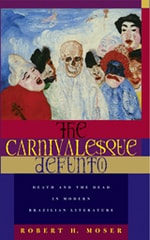
Robert H. Moser details the emergence of a prominent motif in modern Brazilian literature, namely the carnivalesque defunto (the dead) that, in the form of a protagonist or narrator, returns to beseech, instruct, chastise, or even seduce the living. Drawing upon the works of esteemed Brazilian writers such as Machado de Assis, Érico Veríssimo, and Jorge Amado, Moser demonstrates how the defunto, through its mocking laughter and Dionysian resurrection, simultaneously subverts and inverts the status quo, thereby exposing underlying points of tension within Brazilian social and political history.
Incorporating elements of both a celestial advocate and an untrustworthy specter, the defunto also serves as a metaphor for one of modern Brazil’s greatest dilemmas: reconciling the past with the present.
The Carnivalesque Defunto offers a comparative framework by juxtaposing the Brazilian literary ghost with other Latin American, Caribbean, and North American examples. It also presents a cross-disciplinary approach toward understanding the complex relationship forged between Brazil’s spiritual traditions and literary expressions.
The Children of 1965
On Writing, and Not Writing, as an Asian AmericanMin Hyoung Song
Duke University Press, 2013
The Collected Short Stories of Bharati Mukherjee
Edited by Ruth Maxey
Temple University Press, 2023
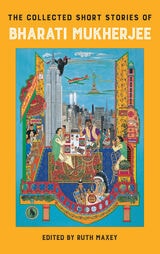
Pioneering Indian American writer Bharati Mukherjee is best known for her novel, Jasmine, and her breakthrough collection, The Middleman and Other Stories, which won the 1988 National Book Critics Circle Award. Her writing is distinguished as much by its narrative style and shifting points of view as it is by Mukherjee’s piercing emotional observations on the immigrant experience and her depiction of racism, nostalgia, and displacement.
The Collected Short Stories of Bharati Mukherjee is the first volume to feature the author’s complete short fiction—all 35 stories. Leading Mukherjee scholar Ruth Maxey edits the collection, unearthing seven unknown stories: five in Mukherjee’s unpublished 1963 Iowa Writer’s Workshop M.F.A. thesis, The Shattered Mirror, and two tales from 2008.
Arranged chronologically, this essential collection brings many of Mukherjee’s stories back into print, from the semi-autobiographical story, “Hindus,” in her 1985 debut collection, Darkness, to her late stories, published from 1997-2012, as well as her classic, “The Management of Grief.”
Maxey contextualizes Mukherjee’s short fiction and the provocative, often prescient political questions it raises about migration, nationhood, class, and history. The Collected Short Stories of Bharati Mukherjee features a Forward by prominent literary studies scholar Nalini Iyer and Afterword by critically acclaimed writer Lysley Tenorio, one of Mukherjee’s former students. It is an essential volume for readers both familiar with Mukherjee’s work and new to her groundbreaking fiction.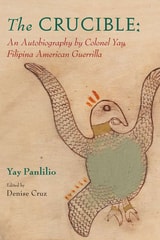
The Crucible
An Autobiography by Colonel Yay, Filipina American GuerrillaCruz, Denise
Rutgers University Press, 2010
On December 8, 1941, as the Pacific War reached the Philippines, Yay Panlilio, a Filipina-Irish American, faced a question with no easy answer: How could she contribute to the war?
In this 1950 memoir, The Crucible: An Autobiography by Colonel Yay, Filipina American Guerrilla, Panlilio narrates her experience as a journalist, triple agent, leader in the Philippine resistance against the Japanese, and lover of the guerrilla general Marcos V. Augustin. From the war-torn streets of Japanese-occupied Manila, to battlegrounds in the countryside, and the rural farmlands of central California, Panlilio blends wry commentary, rigorous journalistic detail, and popular romance.
Weaving together appearances by Douglas MacArthur and Carlos Romulo with dangerous espionage networks, this work provides an insightful perspective on the war. The Crucible invites readers to see new intersections in Filipina/o, Asian American, and American literature studies, and Denise Cruz's introduction imparts key biographical, historical, and cultural contexts to that purpose.
The Cumulus Effect
J. Mae Barizo
Four Way Books, 2015
The Echoes of Trauma
An Oral Historical Study on the Impact of the World War II Mass Incarceration on the Health of Japanese AmericansGwenn M. Jensen
University Press of Colorado, 2026
In Echoes of Trauma, medical anthropologist Gwenn Jensen traces the longitudinal ramifications of racism, the chronic stress of imprisonment in concentration camps, and widespread healthcare inadequacies on the well-being of Japanese American Nisei during WWII and beyond.
Based on ninety oral history interviews conducted between 1995 and 2005, Jensen’s work uncovers long-term health impacts on former incarcerees, relating personal stories of Japanese Americans with archival corroboration of their traumatic experiences of having been made prisoners in their own land. These memories illuminate the betrayal and lifelong consequences of imprisonment not only on physical and psychological health but also including intergenerational trauma passed on to subsequent generations. Echoes of Trauma details these short- and long-term health effects and records the stories of these Americans for posterity.
In the wake of the current political climate, with echoes of this past reverberating, the reexamination of Japanese American incarceration undertaken here underscores the importance of comprehending the fallout from incomprehensible injustice visited upon innocent and law-abiding citizens.
The Ethics and Poetics of Alterity in Asian American Poetry
Xiaojing Zhou
University of Iowa Press, 2006
Poetry by Asian American writers has had a significant impact on the landscape of contemporary American poetry, and a book-length critical treatment of Asian American poetry is long overdue. In this groundbreaking book, Xiaojing Zhou demonstrates how many Asian American poets transform the conventional “I” of lyric poetry—based on the traditional Western concept of the self and the Cartesian “I”—to enact a more ethical relationship between the “I” and its others.
Drawing on Emmanuel Levinas’s idea of the ethics of alterity—which argues that an ethical relation to the other is one that acknowledges the irreducibility of otherness—Zhou offers a reconceptualization of both self and other. Taking difference as a source of creativity and turning it into a form of resistance and a critical intervention, Asian American poets engage with broader issues than the merely poetic. They confront social injustice against the other and call critical attention to a concept of otherness which differs fundamentally from that underlying racism, sexism, and colonialism. By locating the ethical and political questions of otherness in language, discourse, aesthetics, and everyday encounters, Asian American poets help advance critical studies in race, gender, and popular culture as well as in poetry.
The Ethics and Poetics of Alterity is not limited, however, to literary studies: it is an invaluable response to the questions raised by increasingly globalized encounters across many kinds of boundaries.
The Poets
Marilyn Chin, Kimiko Hahn, Myung Mi Kim, Li Young Lee, Timothy Liu, David Mura, and John Yau
The Future
Monica Ferrell
Four Way Books, 2026
The Future is a book about time. The tender, vulnerable, and bitingly funny poems of Monica Ferrell's third collection confront the hours as they stream by, our relatively brief lives that feel so long while we are living them, successive generations and the unwinding story of our species, and the bewilderingly vast geological age of the planet. Traveling across eras, through ice ages to the eighteenth century and the modern day of Ozempic and chatbots, these poems also square up to the obscurity of what comes next as they peer forward into time still to come.
At once irreverent yet elegant, sophisticated yet conversational, these poems capture what it means to get by day to day in a 21st century destabilized by ecological collapse, political havoc, and the incursion of technology into our most private and intimate spaces. “Every day I wake up,” Ferrell writes, “and ask, is it today? The volcano?” Restless in their imaginative scope, these poems leap across the world, from the enduring statues at Angkor Wat and Hampi to Alpine meadows contaminated with plastic to a supermarket in Vermont. Without papering over any of the difficulties we face today, Ferrell nonetheless expands our capacity to wonder, especially about the experience of motherhood, how the future keeps finding a way of breaking through.
This book manifests as that impossible, unimaginable collision that annihilates the world as we thought it was and sees it emerge as pure energy. Ferrell includes us in “the bequest of this battered planet, this sweetly belabored thing,” from one generation to the next, reminding us of the genesis contained inside obliteration: “one November night I too once opened my eyes to the bright.”
The Golden Land
Elizabeth Shick
New Issues Poetry and Prose, 2022
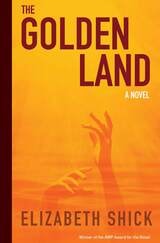
When Etta's grandmother dies, she is compelled to travel to Myanmar to explore complicated adolescent memories of her grandmother's family and the violence she witnessed there. Full of rich detail and complex relationships, The Golden Land explores those personal narratives that might lie beneath the surface of historical accounts.
The Kitchen of Small Hours
Derek N. Otsuji
Southern Illinois University Press, 2021
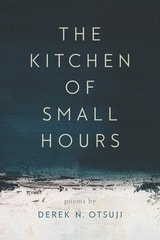
In The Kitchen of Small Hours, Derek N. Otsuji embraces the fragility and endurance of a family of immigrants from two prefectures in Japan: Kagoshima in the south and Okinawa, an island more than four hundred miles from the mainland. In these poems, five generations sing, save, scold, bury, and cook against the culture and history that emerged from the pineapple and sugar cane plantations of mid-nineteenth-century Hawaii, from the bomb-scapes and hatreds of World War II, and from the canning and tourism industry of the twentieth century. Otsuji writes of how his family used stories and rugged cheer to fill the spaces apart from the cane fields and the canning factory. Their recipes, rituals, celebrations, songs, dances, myths, and family stories passed from grandmother to father to son, who folds them into lyrics.
Here too are whispers, failures, and traceable absences: a face removed from photos, a love silenced to be acceptable, a dead firstborn housed in an urn. There are things that no one intended to give. Otsuji’s language hungers for them anyway. The haunting reunions between author and ancestor sink just as deep as roots and hold just as fast. The cooking pot, the family photo, the moon recur as images that feed and comfort. Lyrical and warm, Otsuji’s voice sounds out a sinew of words that make the remnants of heritage and home durable. In these poems each new generation seeks to reimagine for itself the elusive American Dream
The Lengest Neoi
Stephanie Choi
University of Iowa Press, 2024

The Lost Lives of Lena Wu
A NovelAlvin Lu
University of Alabama Press, 2026
Centered around Lena Wu, a middle-aged Taiwanese immigrant and divorcee, the novel is a recursively structured interrogation of the contingencies between past and present; memory and self-understanding; and memoir and fiction.
The Mirror Diary
Selected EssaysGarrett Hongo
University of Michigan Press, 2017
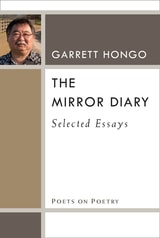
The Mirror Diary tracks the emergence of an original poetic voice and a learned consciousness amid multiple and sometimes competing influences of complex literary traditions and regional and ethnic histories. Beginning with a literary inquiry into the history of Japanese Americans in Hawai`i and California, Garrett Hongo draws on his own history to consider the mosaic of American identities—personal, cultural, and poetic—in the context of a postmodern diaspora.
Hongo’s essays attest to the breadth of what he considers his cultural inheritance and literary antecedents, ranging from the poets of China’s T’ang Dynasty to American poets such as Walt Whitman and Charles Olson. He explains free-verse prosody by way of John Coltrane’s jazz; praises his contemporaries, poets David Mura, Edward Hirsch, and Mark Jarman; and acknowledges his mentors, Bert Meyers and Charles Wright. In other pieces he engages with controversies and contestations in contemporary Asian American literature, confronts the politics of race and the legacy of Japanese American internment during World War II, offers paeans to the Hawaiian landscape, and addresses immigrants newly arrived in America with a warm welcome. The Mirror Diary is the work of a poet fully engaged with contemporary politics and poetics and committed to the study and celebration of diverse traditions.
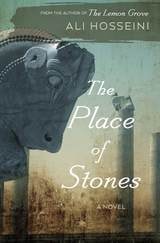
The Place of Stones
A NovelAli Hosseini
Northwestern University Press, 2017
The Place of Stones is Ali Hosseini’s newly translated first novel, his second book to appear in English. In it, he paints a vivid portrait of Sangriz, a village in the southern part of Iran where life has been disrupted by industrialization and the revolution of 1979.
Haydar and Jamal are best friends, and their families have always made their living from the land in the foothills of Iran’s Zagros Mountains. Haydar is a dreamer who searches the hills for an ancient treasure called the Black Globe. Jamal is in love with Haydar’s sister, Golandam, and he attempts to accommodate himself to modernization as a way to create a better life for the two of them. The rapacious conversion of farmland to brick factories draws the trio into escalating conflict with the village landlord.
As Jamal, Haydar, and their families confront land reform, industrialization, revolution, and war, their lives are pulled forcefully toward the explosive events that will change them all. In masterfully crafted prose that never sinks into sentimentality, The Place of Stones illuminates how a lost past continues to shape the present.
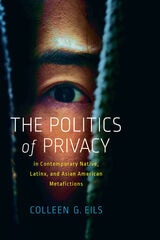
The Politics of Privacy in Contemporary Native, Latinx, and Asian American Metafictions
Colleen G. Eils
The Ohio State University Press, 2020
Eils breaks strict disciplinary silos by putting visibility/surveillance studies, ethnic studies, and narrative studies in conversation with one another. Eils also puts texts in the Native, Latinx, and Asian American literary canon in conversation with each other. She focuses on texts by Viet Thanh Nguyen, David Treuer, Monique Truong, Rigoberto González, Nam Le, and Stephen Graham Jones that call into question our positions as readers and critics. In deliberately and self-consciously evading readers through the form of their fiction, these writers seize privacy as a political tool for claiming and wielding power in both representational and material registers.
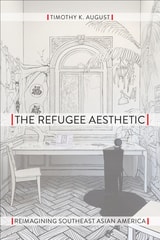
The Refugee Aesthetic
Reimagining Southeast Asian AmericaTimothy August
Temple University Press, 2021
The refugee is conventionally considered a powerless figure, eagerly cast aside by both migrant and host communities. In his book, The Refugee Aesthetic, Timothy August investigates how and why a number of Southeast Asian American artists and writers have recently embraced the figure of the refugee as a particularly transformative position. He explains how these artists, theorists, critics, and culture-makers reconstruct their place in the American imagination by identifying and critiquing the underlying structures of power that create refugees in the contemporary world.
August looks at the outside forces that shape refugee representation and how these expressions are received. He considers the visual legacy of the Southeast Asian refugee experience by analyzing music videos, graphic novels, and refugee artwork. August also examines the power of refugee literature, showing how and why Southeast Asian American writers look to the refugee position to disentangle their complicated aesthetic legacy.
Arguing that “aesthetics” should be central to the conceptualization of critical refugee studies, August shows how representational structures can galvanize or marginalize refugees, depending on how refugee aesthetics are used and circulated.
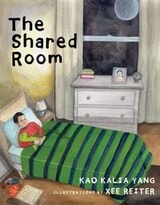
The Shared Room
Kao Kalia Yang
University of Minnesota Press, 2020
A family gradually moves forward after the loss of a child—a story for readers of all ages
When someone you love dies, you know what doesn’t die? Love. On the hot beach, among colorful umbrellas blooming beneath a bright sun, no one saw a little girl walk into the water. Now, many months later, her bedroom remains empty, her drawers hold her clothes, her pillows and sheets still have her scent, and her mother and father, brothers and sister carry her in their hearts, along with their grief, which takes up so much space. Then one snowy day, the mother and father ask the girl’s older brother, “Would you like a room of your own?” He wants to know, “Whose?” They say, “Your sister’s.”
Tenderly, and with refreshing authenticity, beloved Minnesota writer Kao Kalia Yang tells the story of a Hmong American family living with loss and tremendous love. Her direct and poignant words are accompanied by the evocative and expressive drawings of Hmong American artist Xee Reiter. The Shared Room brings a message of comfort and hope to readers young and old.
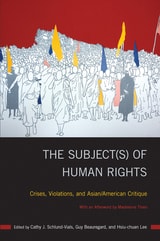
The Subject(s) of Human Rights
Crises, Violations, and Asian/American CritiqueCathy J. Schlund-Vials
Temple University Press, 2020
Human rights violations have always been part of Asian American studies. From Chinese immigration restrictions, the incarceration of Japanese Americans, yellow peril characterizations, and recent acts of deportation and Islamophobia, Asian Americans have consistently functioned as subordinated “subjects” of human rights violations. The Subject(s) of Human Rights brings together scholars from North America and Asia to recalibrate these human rights concerns from both sides of the Pacific.
The essays in this collection provide a sharper understanding of how Asian/Americans have been subjected to human rights violations, how they act as subjects of history and agents of change, and how they produce knowledge around such subjects. The editors of and contributors to The Subject(s) of Human Rights examine refugee narratives, human trafficking, and citizenship issues in twentieth- and twenty-first century literature. These themes further refract issues of American war-making, settler colonialism, military occupation, collateral damage, and displacement that relocate the imagined geographies of Asian America from the periphery to the center of human rights critique.
The Train That Had Wings
Selected Stories of M. MukundanM. Mukundan; Translated from the Malayalam by Donald R. Davis Jr.
University of Michigan Press, 2005
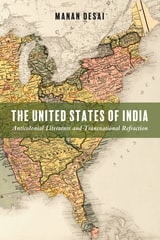
The United States of India
Anticolonial Literature and Transnational RefractionManan Desai
Temple University Press, 2020
The United States of India shows how Indian and American writers in the United States played a key role in the development of anticolonial thought in the years during and immediately following the First World War. For Indians Lajpat Rai and Dhan Gopal Mukerji, and Americans Agnes Smedley, W.E.B. Du Bois, and Katherine Mayo, the social and historical landscape of America and India acted as a reflective surface. Manan Desai considers how their interactions provided a “transnational refraction”—a political optic and discursive strategy that offered ways to imagine how American history could shed light on an anticolonial Indian future.
Desai traces how various expatriate and immigrant Indians formed political movements that rallied for American support for the cause of Indian independence. These intellectuals also developed new forms of writing about subjugation in the U.S. and India. Providing an examination of race, caste, nationhood, and empire, Desai astutely examines this network of Indian and American writers and the genres and social questions that fomented solidarity across borders.
The Water Diviner and Other Stories
Ruvanee Pietersz Vilhauer
University of Iowa Press, 2018
In this thought-provoking collection, Sri Lankan immigrants grapple with events that challenge perspectives and alter lives. A volunteer faces memories of wartime violence when she meets a cantankerous old lady on a Meals on Wheels route. A lonely widow obsessed with an impending apocalypse meets an oddly inspiring man. A maidservant challenges class divisions when she becomes an American professor’s wife. An angry tenant fights suspicion when her landlord is burgled. Hardened inmates challenge a young jail psychiatrist’s competence. A father wonders whether to expose his young son’s bully at a basketball game. A student facing poverty courts a benefactor. And in the depths of an isolated Wyoming winter, a woman tries to resist a con artist. These and other tales explore the immigrant experience with a piercing authenticity.

The White Orchard
Selected Interviews, Essays, and PoemsArthur Sze
Museum of New Mexico Press, 2025
A son of Chinese immigrants who was born and raised in New York City and on Long Island, Sze first studied science at MIT. His call to write poetry pulled him away from that academic pursuit, but the sciences would continue to influence his writing. In 2024, Sze received the National Book Foundation Science + Literature Award for The Glass Constellation: New and Collected Poems (Copper Canyon Press). Sze spent over two decades as an educator, teaching creative writing and poetry to Indigenous students from across America at Santa Fe’s Institute of American Indian Arts (IAIA). In this compilation, Sze is interviewed by his former IAIA student, award-winning Diné poet, editor, and visual artist Esther Belin.
Sze’s fluency in his parents’ native tongue, along with study at the University of California at Berkeley, allowed him to delve into Chinese poetry, both as a student and translator of classical and contemporary works. The White Orchard shows his wider connection to Asian American poetry across the United States and how he has drawn inspiration from translating Chinese poetry into English. Arthur Sze is one of our finest poets, and this collection demonstrates how literature can enrich us all.
They Never Asked
Senryu Poetry from the WWII Portland Assembly CenterShelley Baker-Gard
Oregon State University Press, 2023
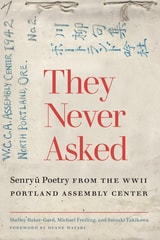
The Japanese American communities in Oregon and southern Washington were relatively small and many of the detainees knew each other; they drew on existing family and community networks to help each other through the long summer, living in inhumane conditions under the constant threat of violence. Several members of Bara Ginsha, a Portland poetry group, decided to continue their work while incarcerated, primarily by writing senryū, a type of Japanese poetry related to haiku.
They Never Asked is a collection of work produced by Bara Ginsha members in the WCCA camp, based on a journal kept by Masaki Kinoshita. The senryū collected here were written by a group of twenty-two poets, who produced hundreds of poems. Individually, the poems reflect the thoughts and feelings the authors experienced while being detained in the Center; collectively, they reflect the resilience and resistance of a community denied freedom. Editors Shelley Baker-Gard, Michael Freiling, and Satsuki Takikawa present translations of the poems alongside the originals, supplemented by historical and literary context and a foreword by Duane Watari, Masaki Kinoshita’s grandson.
This Is All I Choose to Tell
History and Hybridity in Vietnamese American LiteratureAuthored by Isabelle T. Pelaud
Temple University Press, 2010
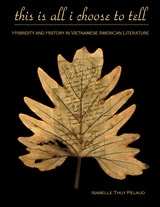
In the first book-length study of Vietnamese American literature, Isabelle Thuy Pelaud probes the complexities of Vietnamese American identity and politics. She provides an analytical introduction to the literature, showing how generational differences play out in genre and text. In addition, she asks, can the term Vietnamese American be disassociated from representations of the war without erasing its legacy?
Pelaud delineates the historical, social, and cultural terrains of the writing as well as the critical receptions and responses to them. She moves beyond the common focus on the Vietnam war to develop an interpretive framework that integrates post-colonialism with the multi-generational refugee, immigrant, and transnational experiences at the center of Vietnamese American narratives.
Her readings of key works, such as Andrew Pham's Catfish and Mandala and Lan Cao's Monkey Bridge show how trauma, racism, class and gender play a role in shaping the identities of Vietnamese American characters and narrators.
Threshold
Joseph O. Legaspi
CavanKerry Press, 2017
Tiananmen Fictions outside the Square
The Chinese Literary Diaspora and the Politics of Global CultureBelinda Kong
Temple University Press, 2012
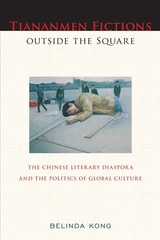
An exciting analysis of the myriad literary effects of Tiananmen, Belinda Kong's Tiananmen Fictions Outside the Square is the first full-length study of fictions related to the 1989 movement and massacre. More than any other episode in recent world history, Tiananmen has brought a distinctly politicized Chinese literary diaspora into stark relief.
Kong redefines Tiananmen's meaning from an event that ended in local political failure to one that succeeded in producing a vital dimension of contemporary transnational writing today. She spotlights key writers-Gao Xingjian, Ha Jin, Annie Wang, and Ma Jian-who have written and published about the massacre from abroad. Their outsider/distanced perspectives inform their work, and reveal how diaspora writers continually reimagine Tiananmen's relevance to the post-1989 world at large.
Compelling us to think about how Chinese culture, identity, and politics are being defined in the diaspora, Tiananmen Fictions Outside the Square candidly addresses issues of political exile, historical trauma, global capital, and state biopower.

Topaz
Brian Komei Dempster
Four Way Books, 2013
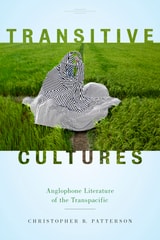
Transitive Cultures
Anglophone Literature of the TranspacificPatterson, Christopher B
Rutgers University Press, 2018
Texts written by Southeast Asian migrants have often been read, taught, and studied under the label of multicultural literature. But what if the ideology of multiculturalism—with its emphasis on authenticity and identifiable cultural difference—is precisely what this literature resists?
Transitive Cultures offers a new perspective on transpacific Anglophone literature, revealing how these chameleonic writers enact a variety of hybrid, transnational identities and intimacies. Examining literature from Malaysia, Singapore, and the Philippines, as well as from Southeast Asian migrants in Canada, Hawaii, and the U.S. mainland, this book considers how these authors use English strategically, as a means for building interethnic alliances and critiquing ruling power structures in both Southeast Asia and North America. Uncovering a wealth of texts from queer migrants, those who resist ethnic stereotypes, and those who feel few ties to their ostensible homelands, Transitive Cultures challenges conventional expectations regarding diaspora and minority writers.
Transnational Asian American Literature
Sites and Transitsedited by Shirley Geok-lin Lim, John Blair Gamber, Stephen Hong Sohn and Gina Valentino
Temple University Press, 2005
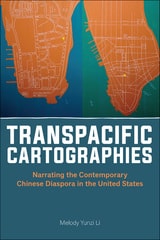
Transpacific Cartographies
Narrating the Contemporary Chinese Diaspora in the United StatesMelody Yunzi Li
Rutgers University Press, 2024
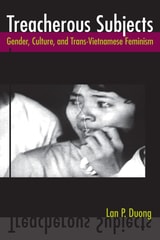
Treacherous Subjects
Gender, Culture, and Trans-Vietnamese FeminismLan P Duong
Temple University Press, 2012
Treacherous Subjects is a provocative and thoughtful examination of Vietnamese films and literature viewed through a feminist lens. Lan Duong investigates the postwar cultural productions of writers and filmmakers, including Tony Bui, Trinh T. Minh-ha, and Tran Anh Hung.
Taking her cue from the double meaning of "collaborator," Duong shows how history has shaped the loyalties and shifting alliances of the Vietnamese, many of whom are caught between opposing/constricting forces of nationalism, patriarchy, and communism. Working at home and in France and the United States, the artists profiled in Treacherous Subjects have grappled with the political and historic meanings of collaboration. These themes, which probe into controversial issues of family and betrayal, figure heavily in fictions such as the films The Scent of Green Papaya and Surname Viet Given Name Nam.
As writers and filmmakers collaborate, Duong suggests that they lay the groundwork for both transnational feminist politics and queer critiques of patriarchy.
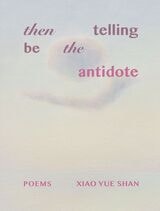
then telling be the antidote
Xiao Yue Shan
Tupelo Press, 2024
By illuminating what has been left untold, these writings present the vivid landscape of a mind layering itself over the world, thinking and speaking its way through a myriad of places, objects, and visions. From rooms overlooking Tokyo rivers to Shanghai streets in the thrall of nighttime, Shan throws light on a nation’s quieted crevices, on the distances between the carnal and the eternal, and most pivotally, on the ability of language to elucidate fact with imagination.