Results by title
70 books match the query 'Authority' and 14 start with t
Televisuality
Style, Crisis, and Authority in American TelevisionJohn T Caldwell
Rutgers University Press, 2020
The Differentiation of Authority
The Medieval Turn toward ExistenceJames Greenaway
Catholic University of America Press, 2012

The Land beyond the Mists
Essays on Identity and Authority in Precolonial Congo and RwandaDavid Newbury
Ohio University Press, 2009
The horrific tragedies of Central Africa in the 1990s riveted the attention of the world. But these crises did not occur in a historical vacuum. By peering through the mists of the past, the case studies presented in The Land Beyond the Mists illustrate the significant advances to have taken place since decolonization in our understanding of the pre-colonial histories of Rwanda, Burundi, and eastern Congo.
Based on both oral and written sources, these essays are important both for their methods—viewing history from the perspective of local actors—and for their conclusions, which seriously challenge colonial myths about the area.
The Misinterpellated Subject
James R. Martel
Duke University Press, 2017
The Mormon Hierarchy
Extensions of PowerD. Michael Quinn
Signature Books, 1997
But by interviewing former church aides, examining hundreds of diaries, and drawing from his own past experience as an insider within the Latter-day Saint historical department, D. Michael Quinn presents a fuller view. His extensive research documents how the governing apostles, seventies, and presiding bishops are likely to be at loggerheads, as much as united. These strong-willed, independent men–like directors of a large corporation or supreme court justices–lobby among their colleagues, forge alliances, out-maneuver opponents, and broker compromises.
There is more: clandestine political activities, investigative and punitive actions by church security forces, personal “loans” from church coffers (later written off as bad debts), and other privileged power-vested activities. Quinn considers the changing role and attitude of the leadership toward visionary experiences, the momentous events which have shaped quorum protocol and doctrine, and day-to-day bureaucratic intrigue from the time of Brigham Young to the dawn of the twenty-first century.
The hierarchy seems at root well-intentioned and even at times aggressive in fulfilling its stated responsibility, which is to expedite the Second Coming. Where they have become convinced that God has spoken, they have set aside personal differences, offered unqualified support, and spoken with a unified voice. This potential for change, when coupled with the tempering effect of competing viewpoints, is something Quinn finds encouraging about Mormonism. But one should not assume that these men are infallible or work in anything approaching uninterrupted unanimity.
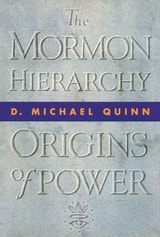
The Mormon Hierarchy
Origins of PowerD. Michael Quinn
Signature Books, 1994
Not until seven years later did Mormons first learn that authority had been restored by angels or of the need for a hierarchy mirroring the Pauline model. That same year (1835) a Quorum of Twelve Apostles was organized, but their jurisdiction was limited to areas outside established stakes (dioceses). Stakes were led by a president, who oversaw spiritual development, and by a bishop, who supervised temporal needs.
At Smith’s martyrdom in 1844, the church had five leading quorums of authority. The most obvious successor to Smith, Illinois stake president William Marks, opposed the secret rites of polygamy, anointing, endowments, and the clandestine political activity that had characterized the church in Illinois. The secret Council of Fifty had recently ordained Smith as King on Earth and sent ambassadors abroad to form alliances against the United States.
The majority of church members knew nothing of these developments, but they followed Brigham Young, head of the Quorum of the Twelve, who spoke forcefully and moved decisively to eliminate contenders for the presidency. He continued to build on Smith’s political and doctrinal innovations and social stratification. Young’s twentieth-century legacy is a well-defined structure without the charismatic spontaneity or egalitarian chaos of the early church.
Historian D. Michael Quinn examines the contradictions and confusion of the first two tumultuous decades of LDS history. He demonstrates how events and doctrines were silently, retroactively inserted into the published form of scriptures and records to smooth out the stormy, haphazard development. The bureaucratization of Mormonism was inevitable, but the manner in which it occurred was unpredictable and will be, for readers, fascinating.
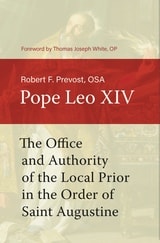
The Office and Authority of the Local Prior in the Order of Saint Augustine
Robert F. Prevost
Catholic University of America Press, 2025
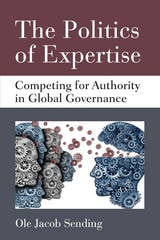
The Politics of Expertise
Competing for Authority in Global GovernanceOle Jacob Sending
University of Michigan Press, 2015
Drawing on insights from sociology, political science, and institutional theory, Sending challenges theories centered on particular actors’ authority, whether it is the authority of so-called epistemic communities, the moral authority of advocacy groups, or the rational-legal authority of international organizations. Using in-depth and historically oriented case studies of population and peacebuilding, he demonstrates that authority is not given nor located in any set of particular actors. Rather, continuous competition for recognition as an authority to determine what is to be governed, by whom, and for what purpose shapes global governance in fundamental ways.
Advancing a field-based approach, Sending highlights the political stakes disguised by the technical language of professionals and thus opens a broader public debate over the key issues of our time.
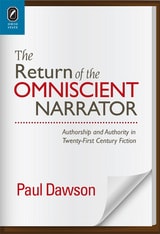
The Return of the Omniscient Narrator
Authorship and Authority in Twenty-First Century FictionPaul Dawson
The Ohio State University Press, 2013
To address this phenomenon, the book reformulates existing definitions of literary omniscience, shifting attention away from questions of narratorial knowledge and toward omniscient narration as a rhetorical performance of narrative authority that invokes and projects a historically specific figure of authorship. Through a study of fiction by authors such as Zadie Smith, Jonathan Franzen, Richard Powers, Martin Amis, Rick Moody, Edward P. Jones, and Nicola Barker, the book analyzes how the conventional narrative authority of omniscient narrators is parlayed into claims for the cultural authority of authors and of the novel itself.
In the course of its investigation, The Return of the Omniscient Narrator engages with major movements in narrative theory—rhetorical, cognitive, and feminist—to challenge and reconsider many key narratological categories, including Free Indirect Discourse, the relation between voice and focalization, and the narrative communication model. This challenge is framed by an argument for a discursive approach to narrative fiction that addresses the neglect of authorship in narrative theory.
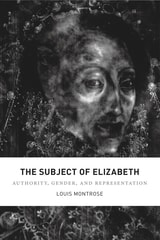
The Subject of Elizabeth
Authority, Gender, and RepresentationLouis Montrose
University of Chicago Press, 2006
Montrose offers a masterful account of the texts, pictures, and performances in which the Queen was represented to her people, to her court, to foreign powers, and to Elizabeth herself. Retrieving this “Elizabethan imaginary” in all its richness and fascination, Montrose presents a sweeping new account of Elizabethan political culture. Along the way, he explores the representation of Elizabeth within the traditions of Tudor dynastic portraiture; explains the symbolic manipulation of Elizabeth’s body by both supporters and enemies of her regime; and considers how Elizabeth’s advancing age provided new occasions for misogynistic subversions of her royal charisma.
This book, the remarkable product of two decades of study by one of our most respected Renaissance scholars, will be welcomed by all historians, literary scholars, and art historians of the period.
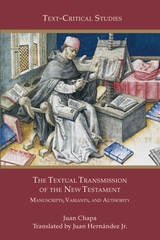
The Textual Transmission of the New Testament
Manuscripts, Variants, and AuthorityJuan Chapa
SBL Press, 2025
Juan Chapa offers nuanced discussions of many topics that currently occupy the field of textual criticism, including debates over the dating of New Testament papyri, the preference for the codex, the liturgical use of texts, the presence of nomina sacra, textual variants, the establishment of the New Testament text, problems with the term original, and the challenge of textual fluidity. His unique approach illustrates how a Catholic perspective, the rule of faith, and the Latin textual tradition can inform our understanding of the origin, preservation, and authority of the New Testament text. Chapa’s work contributes a distinctively Catholic voice to the largely Protestant chorus that has dominated the field, thus filling a lacuna in contemporary text-critical conversations.
The Voice of the Masters
Writing and Authority in Modern Latin American LiteratureBy Roberto González Echevarría
University of Texas Press, 1985
By one of the most original and learned critical voices in Hispanic studies— a timely and ambitious study of authority as theme and authority as authorial strategy in modern Latin American literature.
An ideology is implicit in modern Latin American literature, argues Roberto González Echevarría, through which both the literature itself and criticism of it define what Latin American literature is and how it ought to be read. In the works themselves this ideology is constantly subjected to a radical critique, and that critique renders the ideology productive and in a sense is what constitutes the work. In literary criticism, however, too frequently the ideology merely serves as support for an authoritative discourse that seriously misrepresents Latin American literature.
In The Voice of the Masters, González Echevarría attempts to uncover the workings of modern Latin American literature by creating a dialogue of texts, a dynamic whole whose parts are seven illuminating essays on seminal texts in the tradition. As he says, "To have written a sustained, expository book ... would have led me to make the same kind of critical error that I attribute to most criticism of Latin American literature.... I would have naively assumed an authoritative voice while attempting a critique of precisely that critical gesture."
Instead, major works by Barnet, Cabrera Infante, Carpentier, Cortázar, Fuentes, Gallegos, García Márquez, Roa Bastos, and Rodó are the object of a set of independent deconstructive (and reconstructive) readings. Writing in the tradition of Derrida and de Man, González Echevarría brings to these readings both the penetrative brilliance of the French master and a profound understanding of historical and cultural context. His insightful annotation of Cabrera Infante's "Meta-End," the full text of which is presented at the close of the study, clearly demonstrates these qualities and exemplifies his particular approach to the text.
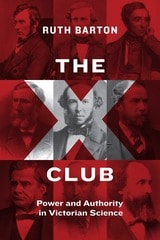
The X Club
Power and Authority in Victorian ScienceRuth Barton
University of Chicago Press, 2018
These six ambitious professionals and three wealthy amateurs—J. D. Hooker, T. H. Huxley, John Tyndall, John Lubbock, William Spottiswoode, Edward Frankland, George Busk, T. A. Hirst, and Herbert Spencer—wanted to guide the development of science and public opinion on issues where science impinged on daily life, religious belief, and politics. They formed a private dining club, which they named the X Club, to discuss and further their plans. As Ruth Barton shows, they had a clear objective: they wanted to promote “scientific habits of mind,” which they sought to do through lectures, journalism, and science education. They devoted enormous effort to the expansion of science education, with real, but mixed, success.
For twenty years, the X Club was the most powerful network in Victorian science—the men succeeded each other in the presidency of the Royal Society for a dozen years. Barton’s group biography traces the roots of their success and the lasting effects of their championing of science against those who attempted to limit or control it, along the way shedding light on the social organization of science, the interactions of science and the state, and the places of science and scientific men in elite culture in the Victorian era.
Transforming the Authority of the Archive
Undergraduate Pedagogy and Critical Digital ArchivesAndi Gustavson and Charlotte Nunes, Editors
Lever Press, 2023
Contributions to this volume represent a range of institutions including small liberal arts colleges, HBCUs, Ivy Leagues, large research institutions, and community-based collections. The assignments, projects, and initiatives described across this volume are fundamentally concerned with the challenge to model digital archival collections so as to center individual and community voices that are historically under-engaged in the archives. To address this challenge, contributors describe various approaches to substantively, often radically, redistribute archival resources and authority. The chapters within Transforming the Authority of the Archive offer thoughtful and creative pedagogical approaches to counter the presumed neutrality of the archive and advocate a shared understanding of the contingency of archival collections. This book is a must-read for liberal arts faculty, graduate students, archivists (both community- and institutionally-affiliated), information-studies professionals, librarians, and other professionals working and teaching in archives, museums, libraries, and other cultural heritage institutions.