Results by title
79 books match the query 'Avant-garde (Aesthetics)' and 23 start with t
Telling It Slant
Avant Garde Poetics of the 1990SMark Wallace
University of Alabama Press, 2001
The finest essays from the newest generation of critics and poet-critics are gathered together in this volume documenting the growth in readership and awareness of avant-garde poetries.
This collection demonstrates the breadth and openness of the field of avant-garde poetry by introducing a wide range of work in poetics, theory, and criticism from emerging writers. Examining the directions innovative poetry has taken since the emergence and success of the Language movement, the essays discuss new forms and the reorientation of older forms of poetry in order to embody present and ongoing involvements. The essays center around four themes: the relation between poetics and contemporary cultural issues; new directions for avant-garde practices; in-depth explorations of current poets and their predecessors; and innovative approaches to the essay form or individual poetics.
Diverging from the traditional, linear argumentative style of academic criticism, many of the essays in this collection instead find critical forms more subtly related to poetry. Viewed as a whole, the essays return to a number of shared issues, namely poetic form and the production of present-day poetry. While focusing on North American poetry, the collection does reference the larger world of contemporary poetics, including potential biases and omissions based on race and ethnicity.
This is cutting-edge criticism at its finest, essential reading for students and scholars of avant-garde poetry, of interest to anyone interested in contemporary American literature and poetry.
The Art of Authorial Presence
Hawthorne's Provincial TalesG. R. Thompson
Duke University Press, 1993
By focusing on the provincial tales as they were originally conceived--as a narrative cycle--Thompson is able to recover intertextual references that reveal Hawthorne's preoccupation with framing strategies and variations on authorial presence. The author shows how Hawthorne deliberately constructs sentimental narratives, only to deconstruct them. Thompson's analysis provides a new aesthetic context for understanding the whole shape of Hawthorne's career as well as the narrative, ethical, and historical issues within individual works.
Revisionary in its view of one of America's greatest authors, The Art of Authorial Presence also offers invaluable insight into the problems of narratology and historiography, ethics and psychology, romanticism and idealism, and the cultural myths of America.
The Art of Living in Avant-Garde Paris
Ethics and Self-Making in Dada, Simultanism, and SurrealismRachel Silveri
University of Chicago Press, 2026
With The Art of Living in Avant-Garde Paris, Rachel Silveri takes a fresh look at the desire to unify art and life, an ambition long regarded as foundational to the European historical avant-gardes. She reveals how many early twentieth-century artists saw their own everyday lives—their bodies, identities, and relationships—as a type of creative material and a central component to their avant-garde practice. These artists abandoned traditional forms of artmaking and venues of art viewing, instead aspiring to integrate art with everyday life, creating an “art of living.”
Considering Tristan Tzara’s performances of Dadaist identity, Sonia Delaunay’s simultaneous fashions and self-branding, and the collective endeavor to open and operate the Surrealist Research Bureau, Silveri offers a new narrative about how the artists of interwar Paris developed experiential life practices that resisted dominant forms of “lifestyle” and normative discourses surrounding gender, ethnicity, and office work. This book argues that ethical questions of “How should I live?” and “How should I relate to others?” were as important to the avant-garde as politics, and that aspirations to change the world played out in daily practices of self-making.
The Asian American Avant-Garde
Universalist Aspirations in Modernist Literature and ArtAudrey Wu Clark
Temple University Press, 2015
The Asian American Avant-Garde is the first book-length study that conceptualizes a long-neglected canon of early Asian American literature and art. Audrey Wu Clark traces a genealogy of counter-universalism in short fiction, poetry, novels, and art produced by writers and artists of Asian descent who were responding to their contemporary period of Asian exclusion in the United States, between the years 1882 and 1945.
Believing in the promise of an inclusive America, these avant-gardists critiqued racism as well as institutionalized art. Clark examines racial outsiders including Isamu Noguchi, Dong Kingman and Yun Gee to show how they engaged with modernist ideas, particularly cubism. She draws comparisons between writers such as Sui Sin Far and Carlos Bulosan with modernist luminaries like Stein, Eliot, Pound, and Proust.
Acknowledging the anachronism of the term “Asian American” with respect to these avant-gardists, Clark attempts to reconstruct it. The Asian American Avant-Garde explores the ways in which these artists and writers responded to their racialization and the Orientalism that took place in modernist writing.
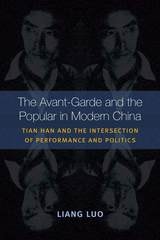
The Avant-Garde and the Popular in Modern China
Tian Han and the Intersection of Performance and PoliticsLiang Luo
University of Michigan Press, 2014

The End of Expressionism
Art and the November Revolution in Germany, 1918-1919Joan Weinstein
University of Chicago Press, 1990
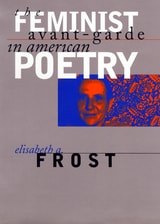
The Feminist Avant-Garde In American Poetry
Elisabeth A. Frost
University of Iowa Press, 2005
The Feminist Avant-Garde in American Poetry offers a historical and theoretical account of avant-garde women poets in America from the 1910s through the 1990s and asserts an alternative tradition to the predominantly male-dominated avant-garde movements. Elisabeth Frost argues that this alternative lineage distinguishes itself by its feminism and its ambivalence toward existing avant-garde projects; she also thoroughly explores feminist avant-garde poets' debts and contributions to their male counterparts.
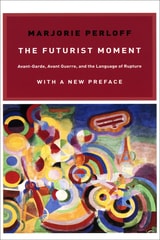
The Futurist Moment
Avant-Garde, Avant Guerre, and the Language of Rupture, with a New PrefaceMarjorie Perloff
University of Chicago Press, 2004

The Janus Face of the German Avant-Garde
From Expressionism Toward PostmodernismRainer Rumold
Northwestern University Press, 2002
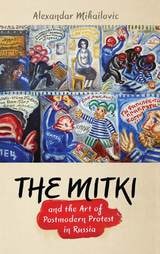
The Mitki and the Art of Postmodern Protest in Russia
Alexandar Mihailovic
University of Wisconsin Press, 2019
More broadly, Alexandar Mihailovic shows, the Mitki pioneered a form of political protest art that has since become a centerpiece of activism in post-Soviet Russia, most visibly today in groups such as Pussy Riot. He draws on extensive interviews with members of the collective and illuminates their critique of the authoritarian state, militarism, and social strictures from the Brezhnev years to the present.
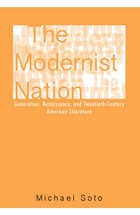
The Modernist Nation
Generation, Renaissance, and Twentieth-Century American LiteratureMichael Soto
University of Alabama Press, 2007
The Modernist Nation examines why America's modern literary movements have come to be characterized as "generations" and "renaissances," such as the Lost Generation and the Beat Generation or the Harlem, Southern, and San Francisco Renaissances. The metaphor of rebirth, Michael Soto argues, offered and continues to offer American writers a kind of shorthand for imagining American cultural history, especially as a departure from Old World (English) trappings.
Soto highlights the interracial dynamics of American literary movements, touching on authors as varied as James Weldon Johnson, Malcolm Cowley, W. E. B. DuBois, Gertrude Stein, Ernest Hemingway, Zora Neale Hurston, and Jack Kerouac. After assessing the origins of the Lost Generation and the Harlem Renaissance, Soto traces the rise of the "bohemian artist" narrative, and demonstrates how a polyethnic cast of writers and critics constructed American literary production in terms of symbolic rebirth.
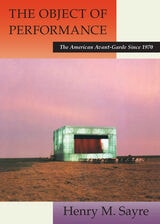
The Object of Performance
The American Avant-Garde since 1970Henry M. Sayre
University of Chicago Press, 1989
"Sayre has written one of the most intelligent, sensible, and readable accounts of the tenents of Postmodern artmaking published to date."—Jeff Abell, New Art Examiner
"No one can read The Object of Performance without gaining a far better idea than before of what has happened to art, and, in some measure, why. . . . I find this book consistently illuminating."—Arthur C. Danto
The Scores Project
Essays on Experimental Notation in Music, Art, Poetry, and Dance, 1950–1975Michael Gallope
J. Paul Getty Trust, The, 2025
Individuals working in and across the fields of visual art, music, poetry, theater, and dance in the mid–twentieth century began to use experimental scores in ways that revolutionized artistic practice and opened up new forms of interdisciplinary collaboration. Their experimental methods—associated with the neo-avant-garde, neo-Dadaism, intermedia, Fluxus, and postmodernism—exploded in notoriety during the 1960s in locales from New York to Europe, East Asia, and Latin America, becoming foundational to global trends in contemporary art and performance.
The Scores Project provides an in-depth view of this historical moment. Through expert commentaries from an interdisciplinary team of scholars with accompanying illustrations, this publication examines a series of experimental scores by John Cage, George Brecht, Sylvano Bussotti, Morton Feldman, Allan Kaprow, Alison Knowles, Jackson Mac Low, Benjamin Patterson, Yvonne Rainer, Mieko Shiomi, David Tudor, and La Monte Young. Ambitious, provocative, and playful, The Scores Project is an illuminating resource to scholars and students who seek to understand this innovative and historically complex moment in the history of art.
An expanded edition of this open-access publication is available for free online at www.getty.edu/publications/scores/. It includes more than 2,800 images, audio/video files, and interactive features. Also available are free PDF and EPUB downloads of the book.
The Sovereign Self
Aesthetic Autonomy from the Enlightenment to the Avant-GardeGrant H. Kester
Duke University Press, 2023
The Struggle for Utopia
Rodchenko, Lissitzky, Moholy-Nagy, 1917-1946Victor Margolin
University of Chicago Press, 1997
"An ambitious effort. This book puts the masters of European Modernism into perfect focus as inventors, propagators, and practitioners of a visual language that continues to hold sway over contemporary graphic style."—Steven Heller
"Worth the wait. . . . Margolin usefully presents what he calls the 'failed hope' of this movement in this valuable effort."—Publishers Weekly
The Transformation of the Avant-Garde
The New York Art World, 1940-1985Diana Crane
University of Chicago Press, 1989
Crane's account is built around discussions of seven styles: Abstract Expressionism in the forties; Pop art and Minimalism in the sixties; Figurative painting, Photorealism, and Pattern painting in the early seventies; and Neo-Expressionism in the early eighties. Demonstrating that the New York art world moved toward increasing acceptance of dominant American cultural trends, Crane offers a fascinating look not only at the intricacies of New York's artistic inner circle but also at the sociology of work and professions, the economics of culture markets such as "dealing art," and the sociology of culture.
The UberReader
SELECTED WORKS OF AVITAL RONELLEdited by Diane Davis
University of Illinois Press, 2007
For twenty years Avital Ronell has stood at the forefront of the confrontation between literary study and European philosophy. She has tirelessly investigated the impact of technology on thinking and writing, with groundbreaking work on Heidegger, dependency and drug rhetoric, intelligence and artificial intelligence, and the obsession with testing. Admired for her insights and breadth of field, she has attracted a wide readership by writing with guts, candor, and wit.
Coyly alluding to Nietzsche’s “gay science,” The ÜberReader presents a solid introduction to Avital Ronell’s later oeuvre. It includes at least one selection from each of her books, two classic selections from a collection of her early essays (Finitude’s Score), previously uncollected interviews and essays, and some of her most powerful published and unpublished talks. An introduction by Diane Davis surveys Ronell’s career and the critical response to it thus far.
With its combination of brevity and power, this Ronell “primer” will be immensely useful to scholars, students, and teachers throughout the humanities, but particularly to graduate and undergraduate courses in contemporary theory.
The Unfinished Art of Theater
Avant-Garde Intellectuals in Mexico and BrazilSarah J. Townsend
Northwestern University Press, 2018
A certain idea of the avant-garde posits the possibility of a total rupture with the past. The Unfinished Art of Theater pulls back on this futuristic impulse by showing how theater became a key site for artists on the semiperiphery of capitalism to reconfigure the role of the aesthetic between 1917 and 1934. The book argues that this “unfinished art”—precisely because of its historic weakness as a representative institution in Mexico and Brazil, where the bourgeois stage had not (yet) coalesced—was at the forefront of struggles to redefine the relationship between art and social change.
Drawing on extensive archival research, Sarah J. Townsend reveals the importance of projects and texts that belie the rhetoric of rupture and immediacy associated with the avant-garde: ethnographic operas with ties to the recording industry, populist puppet plays, children’s radio programs about the wonders of technology, a philosophical drama about the birth of a new race, and an antifascist spectacle written for (but never performed at) a theater shut down by the police. Ultimately, the book makes the case that the very category of avant-garde art is bound up in the experience of dependency, delay, and the uneven development of capitalism.
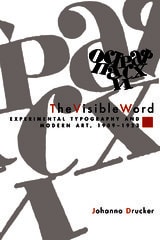
The Visible Word
Experimental Typography and Modern Art, 1909-1923Johanna Drucker
University of Chicago Press, 1994
Drucker suggests a methodology closer to the actual practices of the early avant-garde artists, based on a rereading of their critical and theoretical writings. After reviewing theories of signification, the production of meaning, and materiality, she analyzes the work of four poets active in the typographic experimentation of the 1910s and 1920s: Ilia Zdanevich, Filippo Marinetti, Guillaume Apollinaire, and Tristan Tzara.
Few studies of avant-garde art and literature in the early twentieth century have acknowledged the degree to which typographic activity furthered debates about the very nature and function of the avant-garde. The Visible Word enriches our understanding of the processes of change in artistic production and reception in the twentieth century.
The Williamsburg Avant-Garde
Experimental Music and Sound on the Brooklyn WaterfrontCisco Bradley
Duke University Press, 2023
Theorizing Art Cinemas
Foreign, Cult, Avant-Garde, and BeyondBy David Andrews
University of Texas Press, 2013
The term “art cinema” has been applied to many cinematic projects, including the film d’art movement, the postwar avant-gardes, various Asian new waves, the New Hollywood, and American indie films, but until now no one has actually defined what “art cinema” is. Turning the traditional, highbrow notion of art cinema on its head, Theorizing Art Cinemas takes a flexible, inclusive approach that views art cinema as a predictable way of valuing movies as “art” movies—an activity that has occurred across film history and across film subcultures—rather than as a traditional genre in the sense of a distinct set of forms or a closed historical period or movement.
David Andrews opens with a history of the art cinema “super-genre” from the early days of silent movies to the postwar European invasion that brought Italian Neorealism, the French New Wave, and the New German Cinema to the forefront and led to the development of auteur theory. He then discusses the mechanics of art cinema, from art houses, film festivals, and the academic discipline of film studies, to the audiences and distribution systems for art cinema as a whole. This wide-ranging approach allows Andrews to develop a theory that encompasses both the high and low ends of art cinema in all of its different aspects, including world cinema, avant-garde films, experimental films, and cult cinema. All of these art cinemas, according to Andrews, share an emphasis on quality, authorship, and anticommercialism, whether the film in question is film festival favorite or a midnight movie.
Theory Of The Avant-Garde
Peter Burger
University of Minnesota Press, 1984
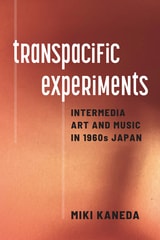
Transpacific Experiments
Intermedia Art and Music in 1960s JapanMiki Kaneda
University of Michigan Press, 2026
Intermedia art—an avant-garde multimedia practice that combines sound and moving images—took root in Japan alongside other places in the 1960s. In Transpacific Experiments, Miki Kaneda analyzes intermedia as a practice that gives form to errant possibilities, unfolding in spaces of the everyday, to offer nuanced insights into the global flow of ideas, influence, and discourses of appropriation. The stories of intermedia art throughout the study offer feminist and transnational perspectives on experimental music and art that disorient existing narratives about the experimental and political in unexpected ways.
Transpacific Experiments contends that social, cultural, and political arrangements local to Japan had a greater influence on the transnational experimental music scene than previously acknowledged. Kaneda’s perspective extends, exceeds, and at times unsettles frameworks for experimental practices, revealing the limitations of any single political or aesthetic lens.