Results by title
81 books match the query 'Boston' and 15 start with t
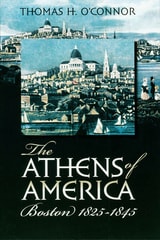
The Athens of America
Boston, 1825-1845Thomas H. O'Connor
University of Massachusetts Press, 2006
Many people are generally familiar with the fact that Boston was once known as “the Athens of America.” Very few, however, are clear about exactly why, except for their recollections of the famous writers and poets who gave the city a reputation for literature and learning.
In this book, historian Thomas H. O'Connor sets the matter straight by showing that Boston's eminence during the first half of the nineteenth century was the result of a much broader community effort. After the nation emerged from its successful struggle for independence, most Bostonians visualized their city not only as the Cradle of Liberty, but also as the new world's Cradle of Civilization.
According to O'Connor, a leadership elite, composed of men of prominent family background, Unitarian beliefs, liberal education, and managerial experience in a variety of enterprises, used their personal talents and substantial financial resources to promote the cultural, intellectual, and humanitarian interests of Boston to the point where it would be the envy of the nation. Not only did writers, scholars, and philosophers see themselves as part of this process, but so did physicians and lawyers, ministers and teachers, merchants and businessmen, mechanics and artisans, all involved in creating a well-ordered city whose citizens would be committed to the ideals of social progress and personal perfectibility.
To accomplish their noble vision, leading members of the Boston community joined in programs designed to cleanse the old town of what they felt were generations of accumulated social stains and human failures, and then to create new programs and more efficient institutions that would raise the cultural and intellectual standards of all its citizens. Like ancient Athens, Boston would be a city of great statesmen, wealthy patrons, inspiring artists, and profound thinkers, headed by members of the “happy and respectable classes” who would assume responsibility for the safety, welfare, and education of the “less prosperous portions of the community.”
Designed for the general reader and the historical enthusiast, The Athens of America is an interpretive synthesis that explores the numerous secondary sources that have concentrated on individual subjects and personalities, and draws their various conclusions into a single comprehensive narrative.
The Case of the Slave-Child, Med
Free Soil in Antislavery BostonKaren Woods Weierman
University of Massachusetts Press, 2019
The Citizen Poets of Boston
A Collection of Forgotten Poems, 1789–1820Edited by Paul Lewis
University Press of New England, 2016
The Combat Zone
Murder, Race, and Boston's Struggle for JusticeJan Brogan
University of Massachusetts Press, 2021
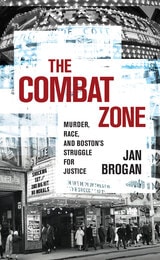
At the end of the 1976 football season, more than forty Harvard athletes went to Boston's Combat Zone to celebrate. In the city's adult entertainment district, drugs and prostitution ran rampant, violent crime was commonplace, and corrupt police turned the other way. At the end of the night, Italian American star athlete Andy Puopolo, raised in the city's North End, was murdered in a stabbing. Three African American men were accused of the crime. His murder made national news and led to the eventual demise of the city's red-light district.
Starting with this brutal murder, The Combat Zone tells the story of the Puopolo family's struggle with both a devastating loss and a criminal justice system that produced two trials with opposing verdicts, all within the context of a racially divided Boston. Brogan traces the contentious relationship between Boston’s segregated neighborhoods during the busing crisis; shines a light on a court system that allowed lawyers to strike potential jurors based purely on their racial or ethnic identity; and lays bare the deep-seated corruption within the police department and throughout the Combat Zone. What emerges is a fascinating snapshot of the city at a transitional moment in its recent past.
The Elusive Ideal
Equal Educational Opportunity and the Federal Role in Boston's Public Schools, 1950-1985Adam R. Nelson
University of Chicago Press, 2005
An ambitious study that spans more than thirty years and covers all facets of educational policy, from legal battles to tax strategies, The Elusive Ideal provides a model from which future inquiries will proceed. A probing and provocative work of urban history with deep relevance for urban public schools today, Nelson's book reveals why equal educational opportunity remains such an elusive ideal.
The Golden Age of Boston Television
Terry Ann Knopf
University Press of New England, 2017
The Last Hurrah
A NovelEdwin O'Connor
University of Chicago Press, 2016
Not quite a roman á clef of notorious Boston mayor James Michael Curley, The Last Hurrah tells the story of Skeffington’s final campaign as witnessed through the eyes of his nephew, who learns a great deal about politics as he follows his uncle to fundraisers, wakes, and into smoke-filled rooms, ultimately coming—almost against his will—to admire the man. Adapted into a 1958 film starring Spencer Tracy and directed by John Ford (and which Curley tried to keep from being made), Edwin O’Connor’s opus reveals politics as it really is, and big cities as they really were. An expansive, humorous novel offering deep insight into the Irish-American experience and the ever-changing nature of the political machine, The Last Hurrah reveals political truths still true today: what the cameras capture is just the smiling face of the sometimes sordid business of giving the people what they want.
The Making of the New Deal Democrats
Voting Behavior and Realignment in Boston, 1920-1940Gerald H. Gamm
University of Chicago Press, 1990
Almost all previous work on the subject has dealt with large-scale national patterns which make it difficult to pin down the precise processes by which the alignment took place. Gamm's work is most remarkable in that it is a close analysis of shifting voter alignments on the precinct and block level in the city of Boston. His extremely detailed and painstaking work of isolating homogeneous ethnic units over a twenty-year period allows one to trace the voting behavior of the particular ethnic groups that ultimately formed the core of the New Deal realignment."—Sidney Verba, Harvard University
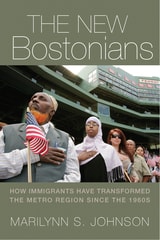
The New Bostonians
How Immigrants Have Transformed the Metro Area since the 1960sMarilynn S. Johnson
University of Massachusetts Press, 2015
How immigrants helped rebuild a city—and redefined what it means to be American
Among the most consequential pieces of Great Society legislation, the Immigration Act of 1965 opened the nation's doors to large-scale immigration from Africa, Asia, and Latin America. A half century later, the impact of the "new immigration" is evident in the transformation of the country's demographics, economy, politics, and culture, particularly in urban America.
In The New Bostonians, Marilynn S. Johnson examines the historical confluence of recent immigration and urban transformation in greater Boston, a region that underwent dramatic decline after World War II. Since the 1980s, the Boston area has experienced an astounding renaissance—a development, she argues, to which immigrants have contributed in numerous ways. From 1970 to 2010, the percentage of foreign-born residents of the city more than doubled, representing far more diversity than earlier waves of immigration. Like the older Irish, Italian, and other European immigrant groups whose labor once powered the region's industrial economy, these newer migrants have been crucial in re-building the population, labor force, and metropolitan landscape of the New Boston, although the fruits of the new prosperity have not been equally shared.
The Other Boston Busing Story
What's Won and Lost Across the Boundary LineSusan E. Eaton
Brandeis University Press, 2020
The Other Brahmins
Boston's Black Upper Class 1750-1950Adelaide Cromwell
University of Arkansas Press, 1995
Adelaide Cromwell’s pioneering work explores race and the social caste system in an atypical northern environment over a period of two centuries. Based on scholarly sources, interviews, and questionnaires, the study identifies those blacks in Boston who exercised political, economic, and social leadership from the end of the eighteenth century to the middle of the twentieth. The central focus is a comparison of black and white upper-class women in the 1940s.
This rare look at a black social microcosm not located in the South is seminal and timely. Because it concludes at a critical period in American history, The Other Brahmins paints a colorful backdrop for evaluating subsequent changes in urban sociology and stratification. In a groundbreaking study, Cromwell effectively challenges the simplistic notions of hierarchy as they pertain to race.

The Saloon
Public Drinking in Chicago and Boston, 1880-1920Perry R. Duis
University of Illinois Press, 1983
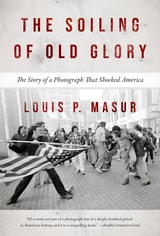
The Soiling of Old Glory
The Story of a Photograph That Shocked AmericaLouis P. Masur
Brandeis University Press, 2024
In 1976, Boston was bitterly divided over a court order to desegregate its public schools. Plans to bus students between predominantly white and Black neighborhoods stoked backlash and heated protests. Photojournalist Stanley Forman was covering one such demonstration at City Hall when he captured an indelible image: a white protester attacking a Black attorney with the American flag. A second white man grabs at the victim, appearing to assist the assailant.
The photo appeared in newspapers across the nation and went on to win the Pulitzer Prize. In The Soiling of Old Glory, esteemed historian Louis P. Masur reveals what happened the day of the assault and the ways these events reverberated long afterward. He interviews the men involved: Forman, who took the photo; Ted Landsmark, a Black, Yale-educated attorney and an activist; Joseph Rakes, the white protester lunging with the flag, a disaffected student; and Jim Kelly, a local politician who opposed busing, but who helped Landsmark to his feet after protesters knocked him to the ground. The photo, Masur discovers, holds more complexities than initially meet the eye. The flag never made contact with the victim, for example, and Kelly was attempting to protect Landsmark, not hurt him.
Masur delves into the history behind Boston’s efforts to desegregate the schools and the anti-busing protests that shook the city. He examines photography’s power to move, inform, and persuade us, as well as the assumptions we each bring to an image as viewers. And he delves into the flag, to explore how other artists and photographers have shaped, bolstered, or challenged its patriotic significance.
Gripping and deeply researched, The Soiling of Old Glory shows how a disturbing event, frozen on a film, impacted Boston and the nation. In an age of renewed calls for visual literacy and disagreements about the flag’s meaning, Masur’s history, now updated with a new foreword by Ted Landsmark and a new preface by the author, is as relevant as ever.
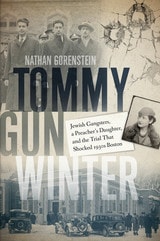
Tommy Gun Winter
Jewish Gangsters, a Preacher's Daughter, and the Trial That Shocked 1930s BostonNathan Gorenstein
University Press of New England, 2015
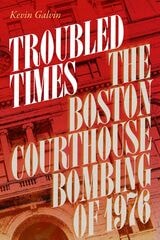
Troubled Times
The Boston Courthouse Bombing of 1976Kevin Galvin
Brandeis University Press, 2026
Interweaves the stories of a revolutionary and a bombing victim to explore the roots and unintended consequences of political violence.
1976. The Vietnam War had ended, but radical political groups still operated clandestinely throughout the United States. Nowhere was the threat of civil unrest greater than in Boston. Racial tensions had been building since a federal judge ordered the desegregation of the Boston Public Schools, and civic leaders were counting on the pageantry of the nation’s Bicentennial to boost both tourism and investment. In April, the Sam Melville-Jonathan Jackson Unit, prison reformers schooled in Marxism and angered by US interventions abroad, bombed the Suffolk County Courthouse, injuring twenty-two people. The site of the blast marked the spot where the lives of two men intersected: a mill town kid who’d been radicalized in Vietnam and prison, and an immigrant waiting in line because he needed to renew a cab license.
Fifty years after the bombing shook the city, Troubled Times tells the story of lives changed by political violence at a time when the American experiment is again in crisis.