Results by title
61 books match the query 'Business Development' and 13 start with t
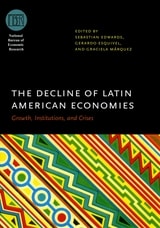
The Decline of Latin American Economies
Growth, Institutions, and CrisesEditied by Sebastian Edwards, Gerardo Esquivel, and Graciela Márquez
University of Chicago Press, 2007
Latin America’s economic performance is mediocre at best, despite abundant natural resources and flourishing neighbors to the north. The perplexing question of how some of the wealthiest nations in the world in the nineteenth century are now the most crisis-prone has long puzzled economists and historians. The Decline of Latin American Economies examines the reality behind the struggling economies of Argentina, Chile, and Mexico.
A distinguished panel of experts argues here that slow growth, rampant protectionism, and rising inflation plagued Latin America for years, where corrupt institutions and political unrest undermined the financial outlook of already besieged economies. Tracing Latin America’s growth and decline through two centuries, this volume illustrates how a once-prosperous continent now lags behind. Of interest to scholars and policymakers alike, it offers new insight into the relationship between political systems and economic development.
The Economics of Aging
Edited by David A. Wise
University of Chicago Press, 1988
The Economics of Aging presents results from an ongoing National Bureau of Economic Research project. Contributors consider the housing mobility and living arrangements of the elderly, their labor force participation and retirement, the economics of their health care, and their financial status. The goal of the research is to further our understanding both of the factors that determine the well-being of the elderly and of the consequences that follow from an increasingly older population with longer individual life spans. Each paper is accompanied by critical commentary.

The Evolution of Agrarian Institutions
A Comparative Study of Post-Socialist Hungary and BulgariaMieke Meurs
University of Michigan Press, 2001

The Federal Future of Europe
From the European Community to the European UnionDusan Sidjanski
University of Michigan Press, 2000
The author argues that federalism is the best antidote to the reemergence of nationalism in Europe. It is also the best guarantee for a peaceful community that balances the claims of national, regional, and local identity against the need for large-scale economies that springs from the forces of globalization, competition, and technical change. The Union preserves diversity within a flexible and innovating European system.
This major study of the development of the European project, informed by a thorough knowledge of the Community and Union over the years and by deep understanding of the relevant literatures in political science and political economy is important for all who study the European Union or work with it as officials and business people.
Dusan Sidjanski is founder and Professor Emeritus of the Department of Political Science, University of Geneva and Professor Emeritus, European Institute. He has authored numerous publications, most recently, The ECE in the Age of Change (United Nations Economic Commission for Europe, United Nations).

The Gender Impact of Social Security Reform
Estelle James, Alejandra Cox Edwards, and Rebeca Wong
University of Chicago Press, 2008
The Gender Impact of Social Security Reform compares the gendered outcomes of social security systems in Chile, Argentina, and Mexico, and presents empirical findings from Eastern and Central European transition economies as well as several OECD countries. Women’s positions have improved relative to men in countries where joint pensions have been required, widows who have worked can keep the joint pension in addition to their own benefit, the public benefit has been targeted toward low earners, and women’s retirement age has been raised to equality with that of men. The Gender Impact of Social Security Reform will force economists and policy makers to reexamine the design features that enable social security systems to achieve desirable gender outcomes.

The Launch Lens
20 Questions Every Entrepreneur Should AskJim Price
Michigan Publishing Services, 2018
Too often, innovative individuals and teams come up with new-business ideas only to hit the proverbial wall, become discouraged, and fail to follow through. How can you get more traction with your ideas and see them through to fruition? As with so many things in life, half the battle is knowing what questions to ask. In this book, serial entrepreneur and business professor Jim Price illustrates a simple, yet powerful framework known as the Launch Lens. Price’s method leads innovators through a structured process to clearly define and communicate their concept, distinguish the good ideas from the not-so-good, and lay the cornerstones of the startup planning process.
The Launch Lens is comprised of twenty critical questions or Focal Points, organized according the classic new-business planning categories: problem, solution, market, business model, marketing and sales, finance, capital, and team. The book leads readers through explanations of how to address each question, illustrated by useful examples, tips, and red flags. Already in active use by thousands of innovators – ranging from aspiring entrepreneurs to early-stage startup teams and venture investors, from incubators and accelerators to intrapreneurs within established corporations and non-profits – The Launch Lens can help you bring your new-business concepts into clear focus.

The Macroeconomics of Populism in Latin America
Edited by Rudiger Dornbusch and Sebastian Edwards
University of Chicago Press, 1991
Economists and political scientists from the United States and Latin America detail in this volume how and why such programs go wrong and what leads policymakers to repeatedly adopt these policies despite a history of failure. Authors examine this pattern in Argentina, Brazil, Chile, Mexico, Nicaragua, and Peru—and show how Colombia managed to avoid it. Despite differences in how each country implemented its policies, the macroeconomic consequences were remarkably similar.
Scholars of Latin America will find this work a valuable resource, offering a distinctive macroeconomic perspective on the continuing controversy over the dynamics of populism.
The Nonprofit Sector in the Mixed Economy
Avner Ben-Ner and Benedetto Gui, Editors
University of Michigan Press, 1993
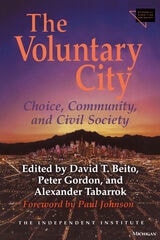
The Voluntary City
Choice, Community, and Civil SocietyDavid T. Beito, Peter Gordon, and Alexander Tabarrok, Editors
University of Michigan Press, 2002
The Wealth and Poverty of Regions
Why Cities MatterMario Polèse
University of Chicago Press, 2009
As the world becomes more interconnected through travel and electronic communication, many believe that physical places will become less important. But as Mario Polèse argues in The Wealth and Poverty of Regions, geography will matter more than ever before in a world where distance is allegedly dead.
This provocative book surveys the globe, from London and Cape Town to New York and Beijing, contending that regions rise—or fall—due to their location, not only within nations but also on the world map. Polèse reveals how concentrations of industries and populations in specific locales often result in minor advantages that accumulate over time, resulting in reduced prices, improved transportation networks, increased diversity, and not least of all, “buzz”—the excitement and vitality that attracts ambitious people. The Wealth and Poverty of Regions maps out how a heady mix of size, infrastructure, proximity, and cost will determine which urban centers become the thriving metropolises of the future, and which become the deserted cities of the past. Engagingly written, the book provides insight to the past, present, and future of regions.

Time, Ignorance, and Uncertainty in Economic Models
Donald W. Katzner
University of Michigan Press, 1998
Donald W. Katzner begins with an extensive investigation of the distinction between potential surprise and probability. He presents a modified version of Shackle's model of decision-making in ignorance and examines in considerable detail its "comparative statics" and operationality properties. The meaning of aggregation and simultaneity under these conditions is also explored, and Shackle's model is applied to the construction of models of the consumer, the firm, microeconomics, and macroeconomics. Katzner concludes with discussions of the roles of history, hysteresis, and empirical investigation in economic inquiry.
Time, Ignorance, and Uncertainty in Economic Models will be of interest to economists and others engaged in the study of uncertainty, probability, aggregation, and simultaneity. Those interested in the microeconomics of consumer and firm behavior, general equilibrium, and macroeconomics will also benefit from this book.
Donald W. Katzner is Professor of Economics, University of Massachusetts.

Transforming Markets
A Development Bank for the 21st Century. A History of the EBRD, Volume 2Andrew Kilpatrick
Central European University Press, 2021
Trust, Ethnicity, and Identity
Beyond the New Institutional Economics of Ethnic Trading Networks, Contract Law, and Gift-ExchangeJanet Tai Landa
University of Michigan Press, 1995
Trust, Ethnicity, and Identity deals with the economic role of laws and institutions in achieving social order in a decentralized economy. Specifically, this book considers the coordinating role of three major nonprice institutions--ethnic trading networks, contract law, and gift-exchange--in economizing on transaction costs and thus facilitating the process of exchange in decentralized economies in different historical contexts.
The major unifying theme of the book is this: identity matters when traders operate in an environment characterized by contract uncertainty, where the legal framework for the enforcement of contracts is not well developed. This in turn points out the importance of trust embedded in particularistic exchange relations such as kinship or ethnicity.
One unique facet of this book is that the author uses a property rights--public choice approach--part of the New Institutional Economics--to provide a unifying theoretical framework to explain such diverse exchange institutions as contract law, ethnic trading networks, and gift-exchange, In addition, it goes beyond the New Institutional Economics paradigm by incorporating some crucial concepts from sociology, anthropology, and bioeconomics, such as social structure, social norms, culture, reciprocity, and kin-related altruism. This broad interdisciplinary framework gives Landa's work a relevance beyond economics to law, political science, sociology, anthropology, and bioeconomics.