335 books match the query 'Caribbean & Latin American Studies' and 69 start with t
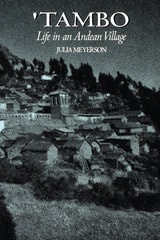
cover of Tambo: Life in an Andean Village

Tambo

Life in an Andean Village

By Julia Meyerson

University of Texas Press, 1990

Perhaps the best way to sharpen one's power's of observation is to be a stranger in a strange land. Julia Meyerson was one such stranger during a year in the village of 'Tambo, Peru, where her husband was conducting anthropological fieldwork. Though sometimes overwhelmed by the differences between Quechua and North American culture, she still sought eagerly to understand the lifeways of 'Tambo and to find her place in the village. Her vivid observations, recorded in this field journal, admirably follow Henry James's advice: "Try to be one of the people upon whom nothing is lost."

With an artist's eye, Meyerson records the daily life of 'Tambo—the cycles of planting and harvest, the round of religious and cultural festivals, her tentative beginnings of friendship and understanding with the Tambinos. The journal charts her progress from tolerated outsider to accepted friend as she and her husband learn and earn, the roles of daughter and son in their adopted family.

With its wealth of ethnographic detail, especially concerning the lives of Andean women, 'Tambo will have great value for students of Latin American anthropology. In addition, scholars preparing to do fieldwork anywhere will find it a realistic account of both the hardships and the rewards of such study.

[more]
cover of Tania León's Stride: A Polyrhythmic Life

Tania León's Stride

A Polyrhythmic Life

Alejandro L. Madrid

University of Illinois Press, 2021

Acclaimed composer, sought-after conductor, esteemed educator, tireless advocate for the arts--Tania León’s achievements encompass but also stretch far beyond contemporary classical music. Alejandro L. Madrid draws on oral history, archival work, and ethnography to offer the first in-depth biography of the artist. Breaking from a chronological account, Madrid looks at León through the issues that have informed and defined moments in her life and her professional works. León’s words become a starting ground--but also a counterpoint--to the accounts of the people in her orbit. What emerges is more than an extraordinary portrait of an artist's journey. It is a story of how a human being reacts to the challenges thrown at her by history itself, be it the Cuban revolution or the struggle for civil and individual rights.

Nuanced and multifaceted, Tania León's Stride looks at the life, legacy, and milieu that created and sustained one of the most important figures in American classical music.
[more]
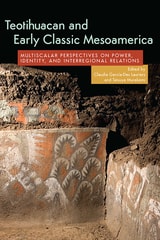
cover of Teotihuacan and Early Classic Mesoamerica: Multiscalar Perspectives on Power, Identity, and Interregional Relations

Teotihuacan and Early Classic Mesoamerica

Multiscalar Perspectives on Power, Identity, and Interregional Relations

Claudia García-Des Lauriers

University Press of Colorado, 2021

The Early Classic period in Mesoamerica has been characterized by the appearance of Teotihuacan-related material culture throughout the region. Teotihuacan, known for its monumental architecture and dense settlement, became an urban center around 100 BC and a regional state over the next few centuries, dominating much of the Basin of Mexico and beyond until its collapse around AD 650. Teotihuacan and Early Classic Mesoamerica explores the complex nature of Teotihuacan’s interactions with other regions from both central and peripheral vantage points.
 
The volume offers a multiscalar view of power and identity, showing that the spread of Teotihuacan-related material culture may have resulted from direct and indirect state administration, colonization, emulation by local groups, economic transactions, single-event elite interactions, and various kinds of social and political alliances. The contributors explore questions concerning who interacted with whom; what kinds of materials and ideas were exchanged; what role interregional interactions played in the creation, transformation, and contestation of power and identity within the city and among local polities; and how interactions on different scales were articulated. The answers to these questions reveal an Early Classic Mesoamerican world engaged in complex economic exchanges, multidirectional movements of goods and ideas, and a range of material patterns that require local, regional, and macroregional contextualization.
 
Focusing on the intersecting themes of identity and power, Teotihuacan and Early Classic Mesoamerica makes a strong contribution to the understanding of the role of this important metropolis in the Early Classic history of the region. The volume will be of interest to scholars and graduate students of Mesoamerican archaeology, the archaeology of interaction, and the archaeology of identity.
 
Contributors: Sarah C. Clayton, Fiorella Fenoglio Limón, Agapi Filini, Julie Gazzola, Sergio Gómez-Chávez, Haley Holt Mehta, Carmen Pérez, Patricia Plunket, Juan Carlos Saint Charles Zetina, Yoko Sugiura, Gabriela Uruñuela, Gustavo Jaimes Vences

 
[more]
cover of That Futebol Feeling: Sport and Play in Brazil's Heartland

That Futebol Feeling

Sport and Play in Brazil's Heartland

David Faflik

Temple University Press, 2025

Futebol, or soccer for Americans, is the planet’s spectator sport of choice. In the Brazilian state of Minas Gerais, nestled in the country’s southeastern heartland, futebol generates powerful, lifelong emotions.

That Futebol Feeling captures the region’s enthrallment with “the beautiful game,” and shows us how and why play is central to the human condition. David Faflik profiles members of the most celebrated local team, Clube Atlético Mineiro (CAM), as well as its passionate, never-say-die fans, to show how futebol and fandom shape their everyday lives and perspectives. He discovers bonds of work and play, as well as pride, identity, and community. Additionally, Faflik’s analysis of Brazil’s futebol culture reflects sports fandom worldwide.

CAM stands as a symbol for a way of life in Minas Gerais, the birthplace of Pelé. Faflik interrogates what playing the game means to those who dedicate their lives to the sport. He writes, “The feelings that football inspires are the best of me.” That Futebol Feeling shares that special feeling with the rest of us.
[more]
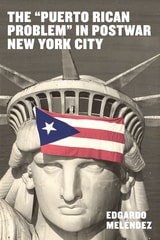
cover of The "Puerto Rican Problem" in Postwar New York City

The "Puerto Rican Problem" in Postwar New York City

Edgardo Meléndez

Rutgers University Press, 2023
The "Puerto-Rican Problem" in Postwar New York City presents the first comprehensive examination of the emergence, evolution, and consequences of the “Puerto Rican problem” campaign and narrative in New York City from 1945 to 1960. This notion originated in an intense public campaign that arose in reaction to the entry of Puerto Rican migrants to the city after 1945. The “problem” narrative influenced their incorporation in New York City and other regions of the United States where they settled. The anti-Puerto Rican campaign led to the formulation of public policies by the governments of Puerto Rico and New York City seeking to ease their incorporation in the city. Notions intrinsic to this narrative later entered American academia (like the “culture of poverty”) and American popular culture (e.g., West Side Story), which reproduced many of the stereotypes associated with Puerto Ricans at that time and shaped the way in which Puerto Ricans were studied and perceived by Americans.
 
[more]
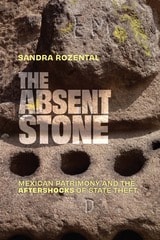
cover of The Absent Stone: Mexican Patrimony and the Aftershocks of State Theft

The Absent Stone

Mexican Patrimony and the Aftershocks of State Theft

Sandra Rozental

Duke University Press, 2026
Where and to whom do ancient things belong? What happens when they are stolen—not by a colonial power, but by a national museum claiming them as state patrimony? What kinds of healing and restitution can follow? In The Absent Stone, Sandra Rozental tells the story of the Piedra de los Tecomates, the largest stone monument in the Americas, popularly identified as the pre-Hispanic rain deity Tlaloc. In 1964, the Mexican state called in the military to forcefully relocate this 167-ton carving from the town of Coatlinchan to Mexico City’s National Anthropology Museum. Using in-depth historical and ethnographic research, Rozental traces how the stone’s absence continues to affect and unsettle Coatlinchan and its residents decades later, revealing the tensions between patrimony, nationalism, territory, memory, and materiality in Mexico. Questioning the premise that historical artifacts belong in museums under state-sanctioned care, The Absent Stone pushes contemporary critical scholarship on monuments and museum collections beyond the language of law, heritage, and cultural property, demonstrating how ancient things remain bound to the people and places they come from even after they are removed and displayed elsewhere.
[more]
cover of The Agrarian Dispute: The Expropriation of American-Owned Rural Land in Postrevolutionary Mexico

The Agrarian Dispute

The Expropriation of American-Owned Rural Land in Postrevolutionary Mexico

John J. Dwyer

Duke University Press, 2008

In the mid-1930s the Mexican government expropriated millions of acres of land from hundreds of U.S. property owners as part of President Lázaro Cárdenas’s land redistribution program. Because no compensation was provided to the Americans a serious crisis, which John J. Dwyer terms “the agrarian dispute,” ensued between the two countries. Dwyer’s nuanced analysis of this conflict at the local, regional, national, and international levels combines social, economic, political, and cultural history. He argues that the agrarian dispute inaugurated a new and improved era in bilateral relations because Mexican officials were able to negotiate a favorable settlement, and the United States, constrained economically and politically by the Great Depression, reacted to the crisis with unaccustomed restraint. Dwyer challenges prevailing arguments that Mexico’s nationalization of the oil industry in 1938 was the first test of Franklin Roosevelt’s Good Neighbor policy by showing that the earlier conflict over land was the watershed event.

Dwyer weaves together elite and subaltern history and highlights the intricate relationship between domestic and international affairs. Through detailed studies of land redistribution in Baja California and Sonora, he demonstrates that peasant agency influenced the local application of Cárdenas’s agrarian reform program, his regional state-building projects, and his relations with the United States. Dwyer draws on a broad array of official, popular, and corporate sources to illuminate the motives of those who contributed to the agrarian dispute, including landless fieldworkers, indigenous groups, small landowners, multinational corporations, labor leaders, state-level officials, federal policymakers, and diplomats. Taking all of them into account, Dwyer explores the circumstances that spurred agrarista mobilization, the rationale behind Cárdenas’s rural policies, the Roosevelt administration’s reaction to the loss of American-owned land, and the diplomatic tactics employed by Mexican officials to resolve the international conflict.
[more]
cover of The Archaeology of Tibes: Life, Death, and Memory at an Early Ceremonial Center in the Caribbean

The Archaeology of Tibes

Life, Death, and Memory at an Early Ceremonial Center in the Caribbean

Edited by L. Antonio Curet and Lisa M. Stringer

University of Alabama Press, 2025

A collection of new essays that brings archaeological insights and discoveries at the Tibes Ceremonial Center up to date

The Archaeology of Tibes is a collection of essays offering a fresh analysis of this important ceremonial center. It brings new insights about social structure, illuminating the smaller-scale daily lives of ancient peoples rather than focusing on large-scale chiefdoms.

Tibes is the earliest known (ca. 400 to 1300 CE) ceremonial center in Puerto Rico. It has been the focus of one of the largest and longest-running archaeological programs in the Caribbean. Early researchers interpreted evidence in the area of a shift from dispersed villages to a ceremonial center as suggesting the development of social stratification and accumulation of power. Seen as the seat of an early chiefdom, Tibes served as a model applied broadly across the Greater Antilles.

New discoveries prompted archaeologists to question their original assumptions about ancient Puerto Rico, and later research failed to produce evidence of social stratification at Tibes. The Archaeology of Tibes therefore incorporates updated and wider perspectives on social formation. It considers agency, decisions, and events and the possibility of more than one form of social organization. It also presents a more accurate “humanized” past: the sociological meanings of that space and its significance for the people who created, used, and occupied it and who influenced rituals, social memory, and community.

Summarizing findings from excavations at Tibes after 2010, the collection also reviews the geoarchaeology of the site. Additional essays cover ceramic pastes, lithic production, faunal remains, coral, burials, and rock art. This work will engender discussion and future research by archaeologists across the Caribbean and beyond.
 

[more]
cover of The Archive and the Aural City: Sound, Knowledge, and the Politics of Listening

The Archive and the Aural City

Sound, Knowledge, and the Politics of Listening

Alejandro L. Madrid

Duke University Press, 2025
In The Archive and the Aural City, Alejandro L. Madrid examines the possibilities for retrieving from the archive sounds that were not meant to be heard. Drawing on Ángel Rama’s notion of the Lettered City, Madrid proposes a notion of the Aural City—a Latin American urban intellectual elite for whom sound and listening are central to the creation, re-creation, and circulation of new types of knowledge. While many of these elites carry forward a nationalistic agenda, Madrid contends that the Aural City’s archives and the ways they are listened to and conceived through sound and music can also help dismantle dominant frameworks of national or colonial culture and build more inclusive spaces for intellectual exchange and political mobilization. From national archives in Latin America and colonial institutions abroad to sound exhibits, instruments, and internet-based archival projects, Madrid demonstrates how the development of urban spaces is understood through sound. In this way, he expands understandings of the archive’s social and sonic power.
[more]
cover of The Archive and the Repertoire: Performing Cultural Memory in the Americas

The Archive and the Repertoire

Performing Cultural Memory in the Americas

Diana Taylor

Duke University Press, 2003

In The Archive and the Repertoire preeminent performance studies scholar Diana Taylor provides a new understanding of the vital role of performance in the Americas. From plays to official events to grassroots protests, performance, she argues, must be taken seriously as a means of storing and transmitting knowledge. Taylor reveals how the repertoire of embodied memory—conveyed in gestures, the spoken word, movement, dance, song, and other performances—offers alternative perspectives to those derived from the written archive and is particularly useful to a reconsideration of historical processes of transnational contact. The Archive and the Repertoire invites a remapping of the Americas based on traditions of embodied practice.

Examining various genres of performance including demonstrations by the children of the disappeared in Argentina, the Peruvian theatre group Yuyachkani, and televised astrological readings by Univision personality Walter Mercado, Taylor explores how the archive and the repertoire work together to make political claims, transmit traumatic memory, and forge a new sense of cultural identity. Through her consideration of performances such as Coco Fusco and Guillermo Gómez-Peña’s show Two Undiscovered Amerindians Visit . . . , Taylor illuminates how scenarios of discovery and conquest haunt the Americas, trapping even those who attempt to dismantle them. Meditating on events like those of September 11, 2001 and media representations of them, she examines both the crucial role of performance in contemporary culture and her own role as witness to and participant in hemispheric dramas. The Archive and the Repertoire is a compelling demonstration of the many ways that the study of performance enables a deeper understanding of the past and present, of ourselves and others.
[more]
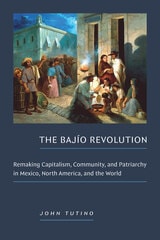
cover of The Bajío Revolution: Remaking Capitalism, Community, and Patriarchy in Mexico, North America, and the World

The Bajío Revolution

Remaking Capitalism, Community, and Patriarchy in Mexico, North America, and the World

John Tutino

Duke University Press, 2025
In The Bajío Revolution, John Tutino examines how popular insurgents reshaped Mexico, the United States, and global capitalism during the nineteenth century. After detailing New Spain’s silver-driven wealth, Tutino shows how the Bajío insurgency of 1810–20 broke silver flows and Asian trades, opening markets to industrial cloth made in England from cotton made by enslaved hands in the US South—while Bajío women claimed pivotal roles making maize to sustain families and guerrilla bands. As Mexico gained independence in 1821, mining remained broken while family growers held strong. Then, in the 1830s, a new silver-industrial capitalism fed by family maize makers rose in the Bajío. Women still led rural families and took on mill labor; one woman became Mexico’s leading silver capitalist. Facing that competition, in the 1840s the United States invaded to claim Texas for cotton and slavery and California for gold. The new Mexican capitalism carried on until the United States mobilized gold taken in war to join a global gold standard in the 1870s—blocking Mexico’s independent route to capitalism.
[more]
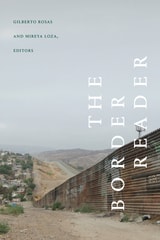
cover of The Border Reader

The Border Reader

Gilberto Rosas and Mireya Loza, editors

Duke University Press, 2023

The Border Reader brings together canonical and cutting-edge humanities and social science scholarship on the US-Mexico border region. Spotlighting the vibrancy of border studies from the field’s emergence to its enduring significance, the essays mobilize feminist, queer, and critical ethnic studies perspectives to theorize the border as a site of epistemic rupture and knowledge production. The chapters speak to how borders exist as regions where people and nation-states negotiate power, citizenship, and questions of empire. Among other topics, these essays examine the lived experiences of the diverse undocumented people who move through and live in the border region; trace the gendered and sexualized experiences of the border; show how the US-Mexico border has become a site of illegality where immigrant bodies become racialized and excluded; and imagine anti- and post-border futures. Foregrounding the interplay of scholarly inquiry and political urgency stemming from the borderlands, The Border Reader presents a unique cross section of critical interventions on the region.

Contributors. Leisy J. Abrego, Gloria E. Anzaldúa, Martha Balaguera, Lionel Cantú, Leo R. Chavez, Raúl Fernández, Rosa-Linda Fregoso, Roberto G. Gonzales, Gilbert G. González, Ramón Gutiérrez, Kelly Lytle Hernández, José E. Limón, Mireya Loza, Alejandro Lugo, Eithne Luibhéid, Martha Menchaca, Cecilia Menjívar, Natalia Molina, Fiamma Montezemolo, Américo Paredes, Néstor Rodríguez, Renato Rosaldo, Gilberto Rosas, María Josefina Saldaña-Portillo, Sonia Saldívar-Hull, Alicia Schmidt Camacho, Sayak Valencia Triana, Carlos G. Vélez-Ibáñez, Patricia Zavella
[more]
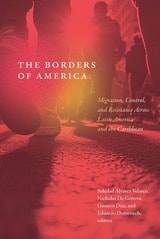
cover of The Borders of America: Migration, Control, and Resistance Across Latin America and the Caribbean

The Borders of America

Migration, Control, and Resistance Across Latin America and the Caribbean

Soledad Álvarez Velasco, Nicholas De Genova, Gustavo Dias, and Eduardo Domenech, editors

Duke University Press, 2026

The Borders of America examines the tension between human migration and the diverse formations of border control and immigration and asylum policy that have arisen across the Americas since the start of the twenty-first century. The collection develops a single analytical framework that is hemispheric in scope, encompassing the United States, Canada, the Caribbean, and the full extent of Latin America. The contributors offer the concept of a “border regime” as an epistemological and methodological approach that comprehends borders not merely as physical demarcations between state territories and jurisdictions but rather as expansive, uneven, and heterogeneous spaces of constant encounter, exchange, dispute, tension, conflict, and contestation. Presenting detailed empirical research into contemporary intra-regional and transcontinental mobilities across the hemisphere, The Borders of America scrutinizes an array of critical nodes in the larger configuration of the trans-American border regime.

Contributors. Soledad Álvarez Velasco, Tanya Basok, Janneth Clavijo, Nicholas De Genova, Gustavo Dias, Eduardo Domenech, Roberto Dufraix-Tapia, Jonathan Echeverri Zuluaga, Valentina Glockner Fagetti, Luin Goldring, Patricia Landolt, Carolina Moulin, Margarita Luz Núñez Chaim, Juan Ordóñez, Daniel Quinteros, Romina Ramos, Martha Rojas-Wiesner, Fabio Santos, Amarela Varela-Huerta, and Laura Velasco Ortiz
[more]
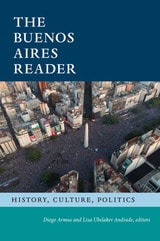
cover of The Buenos Aires Reader: History, Culture, Politics

The Buenos Aires Reader

History, Culture, Politics

Diego Armus and Lisa Ubelaker Andrade, editors

Duke University Press, 2024
The Buenos Aires Reader offers an insider’s look at the diverse lived experiences of the people, politics, and culture of Argentina’s capital city primarily from the nineteenth century to the present. Refuting the tired cliché that Buenos Aires is the “Paris of South America,” this book gives a nuanced view of a city that has long been attentive to international trends yet never ceases to celebrate its local culture. The vibrant opinions, reflections, and voices of Buenos Aires come to life through selections that range from songs, poems, letters, and essays to interviews, cartoons, paintings, and historical documents, many of which have been translated into English for the first time. These selections tell the story of the city’s culture of protest and celebration, its passion for soccer and sport, its gastronomy and food traditions, its legendary nightlife, and its musical, literary, and artistic cultures. Providing an unparalleled look at Buenos Aires’s history, culture, and politics, this volume is an ideal companion for anyone interested in this dynamic, disruptive, and inventive city.
[more]
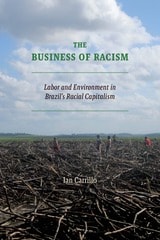
cover of The Business of Racism: Labor and Environment in Brazil's Racial Capitalism

The Business of Racism

Labor and Environment in Brazil's Racial Capitalism

Ian Carrillo

Duke University Press, 2026
In The Business of Racism, Ian Carrillo employs a case study from Brazil’s sugarcane industry to show how racial capitalism is promulgated and maintained through politics and business. As Carrillo recounts, in the mid-2000s, Brazil embarked on a state-led project to improve environmental and labor conditions in sugarcane production. He describes how, seeing increased government regulation of their worksite as a threat to their power, the elites of Brazil’s sugar-ethanol industry repurposed long-standing racial ideologies to undermine progressive institutions and elevate their own leaders. Carrillo’s extensive ethnographic fieldwork in mills and plantations, as well as interviews with federal labor regulators and sugar-ethanol industry elites in Brazil, weaves together an account of how Brazil’s labor and environmental regulations are forged through racial and class struggles at worksites and within the state. The Business of Racism contributes to ongoing sociological debates about race, development, and the environment while highlighting future pathways for achieving racial justice, labor equality, and climate sustainability.
[more]
cover of The Carib, Kalinago, and Garifuna Peoples: Indigeneity, Hybridization, and Mobility in the Americas

The Carib, Kalinago, and Garifuna Peoples

Indigeneity, Hybridization, and Mobility in the Americas

Edited by Paula Prescod

University of Illinois Press, 2026

The Indigenous peoples of the Lesser Antilles used the sea and waterways to sow a diaspora across the Caribbean basin and beyond. Their histories all-too-often reflect colonial viewpoints and stereotypes dating back to the region’s imperial era. Paula Prescod edits a collection of studies that examine the intermingling and interdependencies of indigenous Caribbean populations and the groups they encountered following the European conquest of the Americas. Works in the first section explore the historical entwinement of the Indigenous, European, and African populations thrown together in the region, and the agency and power each group invested in itself to survive. In part 2, contributors illuminate the complex and dynamic natures of interrelatedness and identification of the descendants of Indigenous populations while seeing the Carib, Kalinago, and Garifuna peoples as a heterogeneous group.

An overdue and wide-ranging reconsideration, The Carib, Kalinago, and Garifuna Peoples presents an invaluable collection of multidisciplinary studies that reposition the three groups’ history and experiences.

Contributors: Fernando Y. Alvarado Benítez, Sarah England, Nicholas Faraclas, Adrian Fraser, Sarah-Lee R. Gonsalves, Silke Jansen, Andrea E. Leland, Melinda Maxwell-Gibb, Ernesto Mercado-Montero, Lauren Madrid Poluha, Paula Prescod, Santiago J. Ruiz, and Cesar Andoni Vargas Sabio

[more]
cover of The Climate Trial: Law and Justice on a Melting Planet

The Climate Trial

Law and Justice on a Melting Planet

Noah Walker-Crawford

Duke University Press, 2026
Saúl Luciano Lliuya guides tours in the mountains and his family grow corn, wheat, barley, and potatoes on their farm in Huaraz, Peru, a community of more than 100,000 people in the Andes near Palcacocha, a glacial lake. Palcacocha, however, is growing, as is the major flood risk to Huaraz. Climate change through the emission of greenhouse gases continues to melt the Peruvian glaciers—greenhouse gases that come from corporate polluters not just in Peru, but across the industrialized world. So, Luciano Lliuya decided to sue. Although the German energy company RWE has never operated in Peru, Luciano Lliuya sought to hold the company, which uses coal power generation, liable for damages in a groundbreaking case that, despite being dismissed, established that major emitters can be held liable for climate harms. In The Climate Trial, anthropologist Noah Walker-Crawford draws on years of personal involvement with the lawsuit and extensive fieldwork in Peru and Germany to follow the people, legal strategies, scientific arguments, and political tensions that have shaped the trial. More than a courtroom drama, The Climate Trial is a deeply human story about moral responsibility in a changing world and what it means to be a “good neighbor” while living thousands of miles away.
[more]
cover of The Color of Asylum: The Racial Politics of Safe Haven in Brazil

The Color of Asylum

The Racial Politics of Safe Haven in Brazil

Katherine Jensen

University of Chicago Press, 2023

An ethnography of the difficult experiences of refugees in Brazil.
 
In 2013, as Syrians desperate to escape a brutal war fled the country, Brazil took the remarkable step of instituting an open-door policy for all Syrian refugees. Why did Brazil—in contrast to much of the international community—offer asylum to any Syrian who would come? And how do Syrians differ from other refugee populations seeking status in Brazil?
 
In The Color of Asylum, Katherine Jensen offers an ethnographic look at the process of asylum seeking in Brazil, uncovering the different ways asylum seekers are treated and the racial logic behind their treatment. She focuses on two of the largest and most successful groups of asylum seekers: Syrian and Congolese refugees. While the groups obtain asylum status in Brazil at roughly equivalent rates, their journey to that status could not be more different, with Congolese refugees enduring significantly greater difficulties at each stage, from arrival through to their treatment by Brazilian officials. As Jensen shows, Syrians, meanwhile, receive better treatment because the Brazilian state recognizes them as white, in a nation that has historically privileged white immigration. Ultimately, however, Jensen reaches an unexpected conclusion: Regardless of their country of origin, even migrants who do secure asylum status find their lives remain extremely difficult, marked by struggle and discrimination.

 
[more]
cover of The Color of Love: Racial Features, Stigma, and Socialization in Black Brazilian Families

The Color of Love

Racial Features, Stigma, and Socialization in Black Brazilian Families

By Elizabeth Hordge-Freeman

University of Texas Press, 2015

Winner, Section on the Sociology of Emotions Outstanding Recent Contribution (Book) Award, American Sociological Association, 2016
Charles Horton Cooley Award for Recent Book, Society for the Study of Symbolic Interaction, 2017
Best Publication Award, Section on Body and Embodiment, American Sociological Association (ASA), 2018

The Color Of Love reveals the power of racial hierarchies to infiltrate our most intimate relationships. Delving far deeper than previous sociologists have into the black Brazilian experience, Elizabeth Hordge-Freeman examines the relationship between racialization and the emotional life of a family. Based on interviews and a sixteen-month ethnography of ten working-class Brazilian families, this provocative work sheds light on how families simultaneously resist and reproduce racial hierarchies. Examining race and gender, Hordge-Freeman illustrates the privileges of whiteness by revealing how those with “blacker” features often experience material and emotional hardships. From parental ties, to sibling interactions, to extended family and romantic relationships, the chapters chart new territory by revealing the connection between proximity to whiteness and the distribution of affection within families.

Hordge-Freeman also explores how black Brazilian families, particularly mothers, rely on diverse strategies that reproduce, negotiate, and resist racism. She frames efforts to modify racial features as sometimes reflecting internalized racism, and at other times as responding to material and emotional considerations. Contextualizing their strategies within broader narratives of the African diaspora, she examines how Salvador’s inhabitants perceive the history of the slave trade itself in a city that is referred to as the “blackest” in Brazil. She argues that racial hierarchies may orchestrate family relationships in ways that reflect and reproduce racial inequality, but black Brazilian families actively negotiate these hierarchies to assert their citizenship and humanity.
[more]
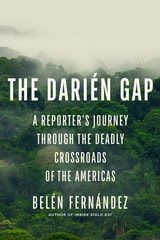
cover of The Darién Gap: A Reporter's Journey through the Deadly Crossroads of the Americas

The Darién Gap

A Reporter's Journey through the Deadly Crossroads of the Americas

Belén Fernández

Rutgers University Press, 2025

The narrow Darién Gap, the only land bridge connecting South and Central America, encompasses a spectacularly hostile jungle, covered in steep mountains, dense rainforests, and flood-prone marshes. Known in Spanish as el infierno verde, or “the green hell,” it is one of the most inhospitable places in the world. Its terrain is too treacherous for roads, yet hundreds of thousands of refuge seekers contend with its horrors every year in the hopes of reaching the United States, still some three thousand miles away. And of the countless who set out for the border, an untold number never arrive.
 
In this book, journalist Belén Fernández travels through the Darién Gap to report on the dehumanizing and deadly stretch of land that has become a mass graveyard for migrants. Fernández’s journey brings her into contact with refuge seekers, people smugglers, law enforcement officials, and many more whose stories bring life to a place overwhelmingly associated with death. Combining history, on-the-ground reporting, travelogue, memoir, and searing politico-economic analysis, she shines light on a largely made-in-the-USA crisis that has come to define our modern era.
 
Engrossing and heartrending, The Darién Gap is a poignant and compassionate indictment of structural inequality and institutionalized inhumanity in a world where the have-nots must risk death for a chance at a better life—or any life at all.
[more]
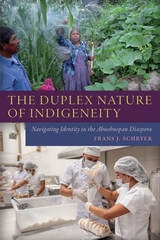
cover of The Duplex Nature of Indigeneity: Navigating Identity in the Ahuehuepan Diaspora

The Duplex Nature of Indigeneity

Navigating Identity in the Ahuehuepan Diaspora

Frans J. Schryer

University Press of Colorado, 2025

The Duplex Nature of Indigeneity is a detailed ethnography centered on Ahuehuepan, a Mexican town in the Alto Balsas region of the state of Guerrero, where an exodus of more than half the population to the United States and other parts of Mexico has altered both livelihoods and social identities. Frans Schryer traces the people, including families and descendants, who locate their identity in the Alto Balsas—a place some of them may never have seen.
 
Using a variety of sources, perspectives, and methods, Schryer takes a duplexity approach, which allows understanding the complexity of social reality and its complementary nature—it identifies fields, clusters, and layers as interconnected components of social life. The innovative methods consist of the combination of ethnographic description and an ethnohistorical census that provides information on every person going back to approximately 1850. That census is further examined with the use of inferential and non-inferential statistical techniques, archival research in locations not normally accessible to scholars, Facebook, phone interviews conducted over several years, and help from Nahuatl-speaking people whose perspectives on the findings generate additional information and insights.
 
Unique in this presentation, which dips into the lives of generations of people to draw insight on those who lay claim to transnational Indigeneity, Schryer’s work contributes to research and theoretical discussion in the field of migration and globalization studies through a close examination of one Indigenous community over the course of many years, utilizing a mix of qualitative and quantitative research methods in anthropology.
 
[more]
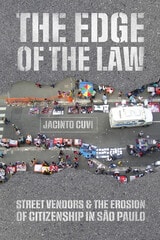
cover of The Edge of the Law: Street Vendors and the Erosion of Citizenship in São Paulo

The Edge of the Law

Street Vendors and the Erosion of Citizenship in São Paulo

Jacinto Cuvi

University of Chicago Press, 2025

How street vendors tangle with the law in São Paulo, Brazil.
 
With a little initiative and very little startup money, an outgoing individual might sell you a number of delights and conveniences familiar to city dwellers—from cold water bottles while you’re sitting in traffic to a popsicle from a cart on a summer afternoon in the park. Such vendors form a significant share of the workforce in São Paulo, Brazil, but their ubiquity belies perpetual struggle. Some have the right to practice their trade; others do not. All of them strive to make it—or stay afloat.
 
In The Edge of the Law, sociologist Jacinto Cuvi introduces us to the world of street vendors and teases out the relationship between the construction of legality and the experience of citizenship. As São Paulo’s city government undertakes a large-scale plan to cancel street vending licenses and evict street vendors, Cuvi reveals how the rights of informal workers can be revoked or withheld and how the lines can be redrawn between work that is “legal” and work that takes place under constant fear of law enforcement. Alongside the mechanics of disenfranchisement, Cuvi captures the lived experience of criminalization, dissecting the distribution of (shallow) rights among vendors who continually reinvent strategies to eke out a living while dealing with the constraints and pressures of informal citizenship at the edge of the law.
 
[more]
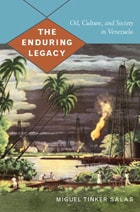
cover of The Enduring Legacy: Oil, Culture, and Society in Venezuela

The Enduring Legacy

Oil, Culture, and Society in Venezuela

Miguel Tinker Salas

Duke University Press, 2009

Oil has played a major role in Venezuela’s economy since the first gusher was discovered along Lake Maracaibo in 1922. As Miguel Tinker Salas demonstrates, oil has also transformed the country’s social, cultural, and political landscapes. In The Enduring Legacy, Tinker Salas traces the history of the oil industry’s rise in Venezuela from the beginning of the twentieth century, paying particular attention to the experiences and perceptions of industry employees, both foreign and Venezuelan. He reveals how class ambitions and corporate interests combined to reshape many Venezuelans’ ideas of citizenship. Middle-class Venezuelans embraced the oil industry from the start, anticipating that it would transform the country by introducing modern technology, sparking economic development, and breaking the landed elites’ stranglehold. Eventually Venezuelan employees of the industry found that their benefits, including relatively high salaries, fueled loyalty to the oil companies. That loyalty sometimes trumped allegiance to the nation-state.

North American and British petroleum companies, seeking to maintain their stakes in Venezuela, promoted the idea that their interests were synonymous with national development. They set up oil camps—residential communities to house their workers—that brought Venezuelan employees together with workers from the United States and Britain, and eventually with Chinese, West Indian, and Mexican migrants as well. Through the camps, the companies offered not just housing but also schooling, leisure activities, and acculturation into a structured, corporate way of life. Tinker Salas contends that these practices shaped the heart and soul of generations of Venezuelans whom the industry provided with access to a middle-class lifestyle. His interest in how oil suffused the consciousness of Venezuela is personal: Tinker Salas was born and raised in one of its oil camps.
[more]
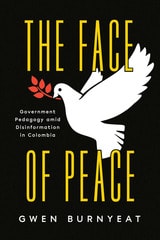
cover of The Face of Peace: Government Pedagogy amid Disinformation in Colombia

The Face of Peace

Government Pedagogy amid Disinformation in Colombia

Gwen Burnyeat

University of Chicago Press, 2022

A multi-scale ethnography of government pedagogy in Colombia and its impact on peace. 

Colombia’s 2016 peace agreement with the FARC guerrillas sought to end fifty years of war and won President Juan Manuel Santos the Nobel Peace Prize. Yet Colombian society rejected it in a polarizing referendum, amid an emotive disinformation campaign. Gwen Burnyeat joined the Office of the High Commissioner for Peace, the government institution responsible for peace negotiations, to observe and participate in an innovative “peace pedagogy” strategy to explain the agreement to Colombian society. Burnyeat’s multi-scale ethnography reveals the challenges government officials experienced communicating with skeptical audiences and translating the peace process for public opinion. She argues that the fatal flaw in the peace process lay in government-society relations, enmeshed in culturally liberal logics and shaped by the politics of international donors. The Face of Peace offers the Colombian case as a mirror to the global crisis of liberalism, shattering the fantasy of rationality that haunts liberal responses to “post-truth” politics.
[more]
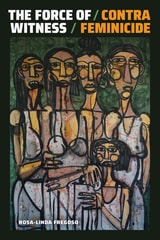
cover of The Force of Witness: Contra Feminicide

The Force of Witness

Contra Feminicide

Rosa-Linda Fregoso

Duke University Press, 2023
In The Force of Witness Rosa-Linda Fregoso examines the contra feminicide movement in Mexico and other feminist efforts to eradicate gender violence. Drawing on interviews, art, documentaries, and her years of activism, Fregoso traces the micro and macro scales of misogyny and the patterns of state complicity with gender violence. She shows how different forms of witnessing—from activist-mothers’ bearing witness to the memories of their daughters and expert witnesses in court cases to communal witnessing and a scholar-activist-citizen witnessing her own actions—are key to resisting feminicidal violence. Fregoso situates these forms of witness in the histories, contexts, structures, bodies, and intersectional struggles they emerge from. By outlining the complexities of feminicidal violence in relation to witnessing processes, Fregoso challenges the notion of witness as an individual or autonomous subject inscribed solely in the legal or religious arenas. Rather, she theorizes witness as a force of collectivity and a constellation of multiple social locations and intersectional practices that work together to abolish feminicidal violence.
[more]
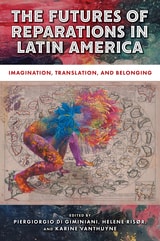
cover of The Futures of Reparations in Latin America: Imagination, Translation, and Belonging

The Futures of Reparations in Latin America

Imagination, Translation, and Belonging

Piergiorgio Di Giminiani

Rutgers University Press, 2026
Over the last thirty years, Latin America has undergone an unprecedented wave of reparations targeting victims of political violence during military regimes, Indigenous and Afro-Latin groups affected by historical processes of dispossession, and citizens suffering from environmental harm. Reparations prompt us to face uncomfortable pasts and in so doing, create conditions for imagination of multiple futures. In representing the experiences and hopes of those affected by political violence in El Salvador and Argentina, environmental harm in Guatemala and Peru, and colonial dispossession in Chile and Bolivia, reparations are built upon conflictive forms of future imagination, translation of harm and new forms of belonging to and beyond the nation state, which reifies as much as challenges state authority over the promises of actual repair. In today’s Latin American political debate, hopes for justice and democracy remain anchored to the question of the kinds of future that can be imagined through and after reparation.
 
[more]
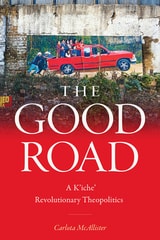
cover of The Good Road: A K’iche’ Revolutionary Theopolitics

The Good Road

A K’iche’ Revolutionary Theopolitics

Carlota McAllister

Duke University Press, 2026
The Good Road situates Guatemala’s early 1980s Indigenous uprising and the genocide that crushed it within a five-hundred-year history of Indigenous resistance to colonization and exploitation. Drawing on decades of archival and ethnographic research, Carlota McAllister traces the emergence of conciencia, a Spanish word meaning both "consciousness" and "conscience," in a Maya-K’iche’-speaking community called Chupol after the Pan-American highway was built through it in 1956. Foregrounding the role of the Catholic Church in mediating state-Indigenous relations and promoting rural transformation in Cold War–era Guatemala, McAllister shows how Chupolenses came to embrace revolutionary armed struggle as both a moral and political imperative. She argues that Chupol’s participation in revolution unfolded through organizational processes and political concepts animated by longstanding Indigenous theopolitical critiques of the organization of power in the Americas. The Good Road shows how, despite the uprising’s bloody defeat, the theopolitical imperative to build a “good road” forward continues to animate Indigenous politics in twenty-first-century Guatemala.
[more]
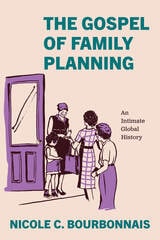
cover of The Gospel of Family Planning: An Intimate Global History

The Gospel of Family Planning

An Intimate Global History

Nicole C. Bourbonnais

University of Chicago Press, 2025

An engaging, insightful history of the family planning movement and its connection to broader social and political developments across the globe.
 
In the twentieth century, the idea that people should consciously plan (and limit) the size of their families became a global cause. Historical accounts of the global family planning movement have largely focused on the most prominent activists and those at the helm of international organizations, philanthropic foundations, and government programs. In The Gospel of Family Planning, however, historian Nicole C. Bourbonnais shifts our attention to frontline workers—doctors, social workers, nurses, fieldworkers, consultants, church groups, and volunteers—who, she compellingly shows, played a central (if complicated) role in preaching contraception around the world.
 
Through a mix of collective biography and microhistory, Bourbonnais visits clinics, doorsteps, and bedrooms, revealing the everyday, ground-level workings of grassroots family planning campaigns, state population control programs, and the movements for reproductive rights and justice that arose to contest them. Throughout the book, Bourbonnais invites readers to consider how the intertwined histories of missionary work, humanitarianism, feminism, decolonization, and international development shaped intimate interventions into people’s reproductive lives around the world.
[more]
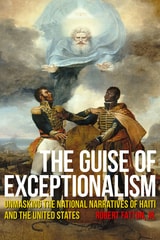
cover of The Guise of Exceptionalism: Unmasking the National Narratives of Haiti and the United States

The Guise of Exceptionalism

Unmasking the National Narratives of Haiti and the United States

Robert Fatton

Rutgers University Press, 2021
The Guise of Exceptionalism compares the historical origins of Haitian and American exceptionalisms. It also traces how exceptionalism as a narrative of uniqueness has shaped relations between the two countries from their early days of independence through the contemporary period. Exceptionalism is at the core of every national founding narrative. It allows countries to purge history of injurious stains, and embellish it with mythical innocence and claims of distinction. Exceptionalism also builds the bonds of solidarity that forge an imagined national fellowship of the chosen, but it excludes those deemed unfit for membership because of their race, ethnicity, gender, or class. Exceptionalism, however, is not frozen. As a social invention, it changes over time, but always within the parameters of its original principles. Our capacity to reinvent it is dependent on the degree of hegemony achieved by the ruling class, and if this class has the infrastructural power to gradually co-opt and include €the groups it had once excluded.
[more]
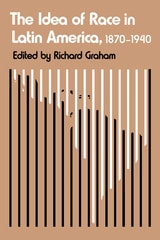
cover of The Idea of Race in Latin America, 1870-1940

The Idea of Race in Latin America, 1870-1940

Edited and with an introduction by Richard Graham

University of Texas Press, 1990

From the mid-nineteenth century until the 1930s, many Latin American leaders faced a difficult dilemma regarding the idea of race. On the one hand, they aspired to an ever-closer connection to Europe and North America, where, during much of this period, "scientific" thought condemned nonwhite races to an inferior category. Yet, with the heterogeneous racial makeup of their societies clearly before them and a growing sense of national identity impelling consideration of national futures, Latin American leaders hesitated. What to do? Whom to believe?

Latin American political and intellectual leaders' sometimes anguished responses to these dilemmas form the subject of The Idea of Race in Latin America. Thomas Skidmore, Aline Helg, and Alan Knight have each contributed chapters that succinctly explore various aspects of the story in Brazil, Argentina, Cuba, and Mexico. While keenly alert to the social and economic differences that distinguish one Latin American society from another, each author has also addressed common issues that Richard Graham ably draws together in a brief introduction. Written in a style that will make it accessible to the undergraduate, this book will appeal as well to the sophisticated scholar.

[more]
cover of The Invention of Order: On the Coloniality of Space

The Invention of Order

On the Coloniality of Space

Don Thomas Deere

Duke University Press, 2025
In The Invention of Order, Don Thomas Deere retraces the colonial origins of spatial organization in the Americas and the Caribbean and its lasting impact on modern structures of knowledge, power, race, gender as well as understandings of global modernity. The coloniality of space dispossessed Indigenous, African, and mixed populations as it constructed new systems of control and movement. Deere demonstrates how these developments manifested, among other forms, in urban grid patterns imposed during the development of Spanish colonial cities as well as totalizing trade routes crisscrossing the Atlantic. Drawing on a range of thinkers including Enrique Dussel, Édouard Glissant, and Sylvia Wynter, Deere reveals how movement—who travels, who settles, and who is excluded—becomes an essential component of control under colonial rule. Against the violence of spatial reordering, Deere outlines how novel forms of resistance and insurgency geographies still take hold, particularly in the Caribbean, where landscapes remain excessive, eruptive, and uncaptured by the order of modernity.
[more]
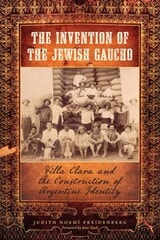
cover of The Invention of the Jewish Gaucho: Villa Clara and the Construction of Argentine Identity

The Invention of the Jewish Gaucho

Villa Clara and the Construction of Argentine Identity

By Judith Noemí Freidenberg

University of Texas Press, 2009

By the mid-twentieth century, Eastern European Jews had become one of Argentina's largest minorities. Some represented a wave of immigration begun two generations before; many settled in the province of Entre Ríos and founded an agricultural colony. Taking its title from the resulting hybrid of acculturation, The Invention of the Jewish Gaucho examines the lives of these settlers, who represented a merger between native cowboy identities and homeland memories.

The arrival of these immigrants in what would be the village of Villa Clara coincided with the nation's new sense of liberated nationhood. In a meticulous rendition of Villa Clara's social history, Judith Freidenberg interweaves ethnographic and historical information to understand the saga of European immigrants drawn by Argentine open-door policies in the nineteenth century and its impact on the current transformation of immigration into multicultural discourses in the twenty-first century. Using Villa Clara as a case study, Freidenberg demonstrates the broad power of political processes in the construction of ethnic, class, and national identities. The Invention of the Jewish Gaucho draws on life histories, archives, material culture, and performances of heritage to enhance our understanding of a singular population—and to transform our approach to social memory itself.

[more]
cover of The Japanese in Latin America

The Japanese in Latin America

Daniel M. Masterson with Sayaka Funada-Classen

University of Illinois Press, 2003

Latin America is home to 1.5 million persons of Japanese descent. Combining detailed scholarship with rich personal histories, Daniel M. Masterson, with the assistance of Sayaka Funada-Classen, presents the first comprehensive study of the patterns of Japanese migration on the continent as a whole. 

When the United States and Canada tightened their immigration restrictions in 1907, Japanese contract laborers began to arrive at mines and plantations in Latin America. The authors examine Japanese agricultural colonies in Latin America, as well as the subsequent cultural networks that sprang up within and among them, and the changes that occurred as the Japanese moved from wage labor to ownership of farms and small businesses. They also explore recent economic crises in Brazil, Argentina, and Peru, which, combined with a strong Japanese economy, caused at least a quarter million Latin American Japanese to migrate back to Japan. 

Illuminating authoritative research with extensive interviews with migrants and their families, The Japanese in Latin America tells the story of immigrants who maintained strong allegiances to their Japanese roots, even while they struggled to build lives in their new countries.

[more]
cover of The Kidney and the Cane: Planetary Health and Plantation Labor in Nicaragua

The Kidney and the Cane

Planetary Health and Plantation Labor in Nicaragua

Alex M. Nading

Duke University Press, 2025
The recent unprecedented growth of Nicaragua’s sugarcane industry has brought promises of more jobs, better health care, and cleaner energy. But these promises have been overshadowed by an epidemic of chronic kidney disease of nontraditional causes (CKDnt). Unknown before the late 1990s, this disease has sickened and killed thousands of sugarcane plantation workers. Scientific studies link the disease to rises in mean average annual temperatures, chronic water scarcity, and the overuse of toxic agrochemicals. CKDnt is now understood as a consequence of global climate change. In The Kidney and the Cane, Alex M. Nading situates this epidemic within a deeper history of sugarcane plantation violence, arguing that CKDnt is not a result of climate change: it is climate change. Outlining a place-based approach to planetary health, Nading follows activists, scientists, and residents in the sugarcane zone wrestling with the consequences of plantation life. Along the way, he raises critical questions about the capacity of corporations and states to care for people and ecosystems; the ability of citizens and experts to regulate toxic substances; and the future of work on a warming planet.
[more]
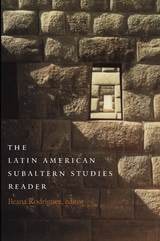
cover of The Latin American Subaltern Studies Reader

The Latin American Subaltern Studies Reader

Ileana Rodríguez, ed.

Duke University Press, 2001

Sharing a postrevolutionary sympathy with the struggles of the poor, the contributors to this first comprehensive collection of writing on subalternity in Latin America work to actively link politics, culture, and literature. Emerging from a decade of work and debates generated by a collective known as the Latin American Studies Group, the volume privileges the category of the subaltern over that of class, as contributors focus on the possibilities of investigating history from below.
In addition to an overview by Ranajit Guha, essay topics include nineteenth-century hygiene in Latin American countries, Rigoberta Menchú after the Nobel, commentaries on Haitian and Argentinian issues, the relationship between gender and race in Bolivia, and ungovernability and tragedy in Peru. Providing a radical critique of elite culture and of liberal, bourgeois, and modern epistemologies and projects, the essays included here prove that Latin American Subaltern Studies is much more than the mere translation of subaltern studies from South Asia to Latin America.

Contributors. Marcelo Bergman, John Beverley, Robert Carr, Sara Castro-Klarén, Michael Clark, Beatriz González Stephan, Ranajit Guha, María Milagros López , Walter Mignolo, Alberto Moreiras, Abdul-Karim Mustapha, José Rabasa, Ileana Rodríguez, Josefina Saldaña-Portillo, Javier Sanjinés, C. Patricia Seed, Doris Sommer, Marcia Stephenson, Mónica Szurmuk, Gareth Williams, Marc Zimmerman
[more]
cover of The Libertine Colony: Creolization in the Early French Caribbean

The Libertine Colony

Creolization in the Early French Caribbean

Doris Garraway

Duke University Press, 2005

Presenting incisive original readings of French writing about the Caribbean from the inception of colonization in the 1640s until the onset of the Haitian Revolution in the 1790s, Doris Garraway sheds new light on a significant chapter in French colonial history. At the same time, she makes a pathbreaking contribution to the study of the cultural contact, creolization, and social transformation that resulted in one of the most profitable yet brutal slave societies in history. Garraway’s readings highlight how French colonial writers characterized the Caribbean as a space of spiritual, social, and moral depravity. While tracing this critique in colonial accounts of Island Carib cultures, piracy, spirit beliefs, slavery, miscegenation, and incest, Garraway develops a theory of “the libertine colony.” She argues that desire and sexuality were fundamental to practices of domination, laws of exclusion, and constructions of race in the slave societies of the colonial French Caribbean.

Among the texts Garraway analyzes are missionary histories by Jean-Baptiste Du Tertre, Raymond Breton, and Jean-Baptiste Labat; narratives of adventure and transgression written by pirates and others outside the official civil and religious power structures; travel accounts; treatises on slavery and colonial administration in Saint-Domingue; the first colonial novel written in French; and the earliest linguistic description of the native Carib language. Garraway also analyzes legislation—including the Code noir—that codified slavery and other racialized power relations. The Libertine Colony is both a rich cultural history of creolization as revealed in Francophone colonial literature and an important contribution to theoretical arguments about how literary critics and historians should approach colonial discourse and cultural representations of slave societies.
[more]
cover of The Miskitu People of Awastara

The Miskitu People of Awastara

By Philip A. Dennis

University of Texas Press, 2004

"Most anthropologists who have lived among other people . . . feel a periodic need to go back," writes Philip A. Dennis in the introduction to this book. "Fieldwork gives you a stake in the people themselves, a set of relationships that last the rest of your life . . . and when the time is right, it is important to go back."

Dennis first journeyed to Awastara, a village on the northeastern coast of Nicaragua, during 1978-1979 as a postdoctoral student. He had come to study a culture-bound syndrome in which young women are possessed by devils. In the process, he became fascinated by other aspects of Miskitu culture—turtle fishing, Miskitu Christianity, community development efforts—the whole pattern of Miskitu community life. He also formed deep friendships to carry into the future.

Twenty years later he was able to return and continue his ethnographic work. Utilizing ideas from recent interpretive anthropology and a vivid writing style, Dennis describes food habits, language, health practices, religious beliefs, and storytelling, inviting the reader to experience life in Awastara along with him. Building upon earlier work by Mary Helms, Bernard Nietschmann, Edmund Gordon, and Charles Hale, The Miskitu People of Awastara makes its own original contribution. It is the first full-length study of a coastal Miskitu community north of Puerto Cabezas, contrasting life before and after the war years of the 1980s. It will be a valuable addition to the literature on this indigenous group and should appeal to anthropologists and other social scientists, as well as all readers interested in peoples of the Caribbean coast.
[more]
cover of The Mixe of Oaxaca: Religion, Ritual, and Healing

The Mixe of Oaxaca

Religion, Ritual, and Healing

By Frank J. Lipp

University of Texas Press, 1991

The Mixe of Oaxaca was the first extensive ethnography of the Mixe, with a special focus on Mixe religious beliefs and rituals and the curing practices associated with them. It records the procedures, design-plan, corresponding prayers, and symbolic context of well over one hundred rituals. Frank Lipp has written a new preface for this edition, in which he comments on the relationship of Mixe religion to current theoretical understandings of present-day Middle American folk religions.
[more]
cover of The Mystic of Friendship: Divining the Present in Settler Amazonia

The Mystic of Friendship

Divining the Present in Settler Amazonia

Ashley Lebner

University of Chicago Press, 2025

A vivid portrait of how divine and human intimacies sustain colonization in the Amazon.
 
On Brazil’s Amazonian frontier, settlers pursue land and opportunity, but they also gather for prayer and pilgrimage, yearning for a deep relationship with God and one another. In this book, anthropologist Ashley Lebner examines how everyday religious practices and feelings, what she calls a mystic of friendship, shape and sustain colonization in the Amazon.

Lebner invites us to a stretch of highway in Pará, Brazil, where violent colonization coexists with prophetic dreams, Afro-Brazilian prayers, and emerging evangelicalism. She shows how, amid political tensions and physical hardship, settlers believe that the violence they experience and enact derives from the bestial nature of earthly life that must be overcome. In exposing a longing for divinely-infused friendship that animates colonization, Lebner offers a powerful new perspective on the forces driving colonialism as much as religious and political expression.
[more]
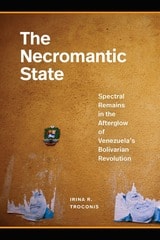
cover of The Necromantic State: Spectral Remains in the Afterglow of Venezuela's Bolivarian Revolution

The Necromantic State

Spectral Remains in the Afterglow of Venezuela's Bolivarian Revolution

Irina R. Troconis

Duke University Press, 2025
In the spring of 2013, televisions across Venezuela announced the death of then-president Hugo Chávez, leader of the Bolivarian Revolution and key political actor in Latin America’s “turn to the left.” Chávez’s death, however, was not the end of Chávez’s life. In The Necromantic State, Irina R. Troconis examines how Chávez, as a “specter,” has lingered in Venezuela’s public, private, and digital spaces. Focusing on contemporary Venezuela and drawing from a diverse corpus that includes tattoos, toys, memes, graffiti, and a hologram haunting the streets of downtown Caracas, Troconis contends that, in moments of failed transitions, political tensions, and crises of legitimacy, the state brings the dead back to life to negotiate the terms of its survival. By showing how this necromantic performance enables the state’s material and visual manifestations in public and private spaces, Troconis untangles a sociopolitical moment in which the ghostly acts as the affective, social, and political force that grounds state authority and ensures the preservation of the status quo, as it circumscribes acts of political imagination and limits popular resistance.
[more]
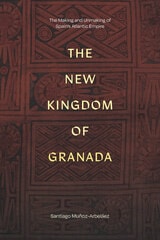
cover of The New Kingdom of Granada: The Making and Unmaking of Spain's Atlantic Empire

The New Kingdom of Granada

The Making and Unmaking of Spain's Atlantic Empire

Santiago Muñoz-Arbeláez

Duke University Press, 2025
The New Kingdom of Granada tells the history of the making and unmaking of empire in the diverse and decentralized Indigenous landscapes of the Northern Andes. Santiago Muñoz-Arbeláez examines the intricate and disputed processes that reshaped the peoples and landscapes of present-day Colombia into a kingdom within the global Spanish monarchy. Drawing on correspondence, visitation reports, judicial records, maps, textiles, and accounting and legal documents created by Europeans and Indigenous peoples, Muñoz-Arbeláez outlines the painstaking century-long effort between 1530 and 1630 to consolidate the kingdom. A diverse group of people that included Indigenous interpreters, scribes, and intellectuals spearheaded these projects, which eventually expanded colonial control outward from its base in the highland Andean plateaus down to the lowland river valleys. Meanwhile, autonomous Indigenous political projects constantly threatened imperial rule, as rebels often encircled the kingdom and seized the corridors that linked it to Spain. By foregrounding the kingdom’s difficult establishment and tenuous hold on power, Muñoz-Arbeláez challenges traditional understandings of imperial politics and the myriad ways Indigenous peoples participated in, disputed, and negotiated the establishment of colonial rule.
[more]
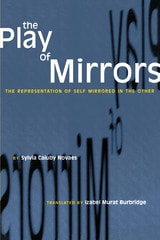
cover of The Play of Mirrors: The Representation of Self Mirrored in the Other

The Play of Mirrors

The Representation of Self Mirrored in the Other

By Sylvia Caiuby Novaes

University of Texas Press, 1997

Focusing on the Bororo people of west-central Brazil, this book addresses the construction of self-identity through interethnic interaction. By presenting the images the Bororo have of themselves as well as the images of others who have interacted with them, Brazilian anthropologist Sylvia Caiuby Novaes argues convincingly that Bororo self-images are constructed with the aid of a peculiar looking-glass—it is in the images of others that they see themselves.

Incorporating contributions from psychology, psychoanalysis, linguistics, and semiotics, Play of Mirrors focuses on symbols, images, discourse, and meanings rather than solely on the problem of acculturation. It thus reflects the thinking of a new generation of Brazilian anthropologists who have shifted their focus from native communities as isolated entities to an examination of their embeddedness within broader national and international arenas.
[more]
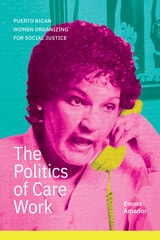
cover of The Politics of Care Work: Puerto Rican Women Organizing for Social Justice

The Politics of Care Work

Puerto Rican Women Organizing for Social Justice

Emma Amador

Duke University Press, 2025
In The Politics of Care Work, Emma Amador tells the story of Puerto Rican women’s involvement in political activism for social and economic justice in Puerto Rico and the United States throughout the twentieth century. Amador focuses on the experiences and contributions of Puerto Rican social workers, care workers, and caregivers who fought for the compensation of reproductive labor in society and the establishment of social welfare programs. These activists believed conflicts over social reproduction and care work were themselves high-stakes class struggles for women, migrants, and people of color. In Puerto Rico, they organized for women’s rights, socialism, labor standards, and Puerto Rican independence. They continued this work in the United States by advocating for migrant rights, participating in the civil rights movement, and joining Puerto Rican-led social movements. Amador shows how their relentless efforts gradually shifted the field of social work toward social justice and community-centered activism. The profound and enduring impact of their efforts on Puerto Rican communities underscores the crucial role of Puerto Rican women’s caregiving labor and activism in building and sustaining migrant communities.
[more]
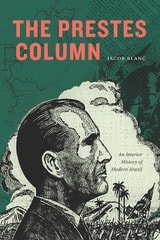
cover of The Prestes Column: An Interior History of Modern Brazil

The Prestes Column

An Interior History of Modern Brazil

Jacob Blanc

Duke University Press, 2024
In The Prestes Column, Jacob Blanc offers a new interpretation of the legendary rebellion, in which a band of rebel officers and soldiers marched fifteen thousand miles through the vast interior regions of Brazil between 1924 and 1927. Blanc’s analysis of the Prestes Column is a showcase of what he calls “interior history.” At a pivotal moment in national politics, the long march of the column came to embody the constructed duality of Brazil’s interior: a space that was seen by coastal elites as simultaneously backward—in relation to the more modern coast—and dormant, an expanse of untapped potential waiting to be brought into the nation. Drawing on a range of materials, from officers’ memoirs and local eyewitness accounts to physical memorials and government archives, Blanc’s framework of interior history helps explain the column’s initial rise to fame and also its enduring legacy across the twentieth century, offering a new approach for the study of space and nation.
[more]
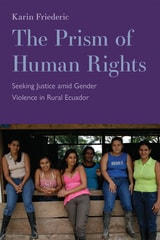
cover of The Prism of Human Rights: Seeking Justice amid Gender Violence in Rural Ecuador

The Prism of Human Rights

Seeking Justice amid Gender Violence in Rural Ecuador

Karin Friederic

Rutgers University Press, 2023

Gender violence has been at the forefront of women’s human rights struggles for decades, shaping political movements and NGO and government programs related to women’s empowerment, community development, and public health. Drawing on over twenty years of research and activism in rural Ecuador, Karin Friederic provides a remarkably intimate view of what these rights-based programs actually achieve over the long term. The Prism of Human Rights brings us into the lives of women, men, and children who find themselves entangled in intimate partner violence, structural violence, political economic change, and a global cultural project in which “rights” are associated with modernity, development, and democratic states. She details the multiple forms of violence that rural women experience; shows the diverse ways they make sense of, endure, and combat this violence; and helps us understand how people are grappling with new ideas of gender, rights, and even of violence itself. Ultimately, Friederic demonstrates that rights-based interventions provide important openings for women seeking a life free of violence, but they also unwittingly expose “liberated” women to more extreme dynamics of structural violence. Thus, these interventions often reduce women’s room to maneuver and encourage communities to hide violence in order to appear “modern” and “developed.” This analysis of human rights in practice is essential for anyone seeking to promote justice in a culturally responsible manner, and for anyone who hopes to understand how the globalization of rights, legal institutions, and moral visions is transforming distant locales and often perpetuating violence in the process.
[more]
cover of The Quiet Zone: Caribbean Expressive Cultures and the Feminist Aesthetics of Disturbance

The Quiet Zone

Caribbean Expressive Cultures and the Feminist Aesthetics of Disturbance

Petal Kimberly Samuel

Rutgers University Press, 2026
A serene beach. The classroom of an elite private school. The still nights in an upscale residential neighborhood. An acclaimed poet with a quiet, dignified mode of address. The sonic etiquette and experience of quiet is integral to each of these scenes. The Quiet Zone examines what the emergence of quiet as an elite aesthetic, privilege, and entitlement means for minoritized people who are often narrated as loud, disruptive, and disturbing, sonically, visually, and otherwise. Taking the Caribbean and its diasporas as its key sites of study, the book explores what we can learn from efforts to transform the region into the quintessential site of quiet leisure, in part, through the enactment of regimes of sonic discipline and surveillance directed against its majority Black population. Analyzing the work of Afro-Caribbean artists that catalog and critique sonic surveillance, the book questions the ways that quiet gets produced both as a regulatory ideal of racial, gender, sexual, national, and civilizational belonging and as a universal object of desire
[more]
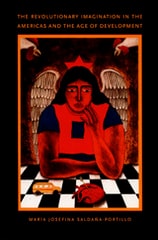
cover of The Revolutionary Imagination in the Americas and the Age of Development

The Revolutionary Imagination in the Americas and the Age of Development

María Josefina Saldaña-Portillo

Duke University Press, 2003

In The Revolutionary Imagination in the Americas and the Age of Development, María Josefina Saldaña-Portillo boldly argues that crucial twentieth-century revolutionary challenges to colonialism and capitalism in the Americas have failed to resist—and in fact have been constitutively related to—the very developmentalist narratives that have justified and naturalized postwar capitalism. Saldaña-Portillo brings the critique of development discourse to bear on such exemplars of revolutionary and resistant political thought and practice as Ernesto “Che” Guevara, Malcolm X, the Sandinista government of Nicaragua, and the Guatemalan guerrilla resistance. She suggests that for each of these, developmentalist constructions frame the struggle as a heroic movement from unconsciousness to consciousness, from a childlike backwardness toward a disciplined and self-aware maturity.

Reading governmental reports, memos, and policies, Saldaña-Portillo traces the arc of development narratives from its beginnings in the 1944 Bretton Woods conference through its apex during Robert S. McNamara's reign at the World Bank (1968–1981). She compares these narratives with models of subjectivity and agency embedded in the autobiographical texts of three revolutionary icons of the 1960s and 1970s—those of Che Guevara, Guatemalan insurgent Mario Payeras, and Malcolm X—and the agricultural policy of the Sandinista National Liberation Front (FSLN). Saldaña-Portillo highlights a shared paradigm of a masculinist transformation of the individual requiring the "transcendence" of ethnic particularity for the good of the nation. While she argues that this model of progress often alienated the very communities targeted by the revolutionaries, she shows how contemporary insurgents such as Rigoberta Menchú, the Zapatista movement, and queer Aztlán have taken up the radicalism of their predecessors to retheorize revolutionary subjectivity for the twenty-first century.

[more]
cover of The Rule of Dons: Criminal Leaders and Political Authority in Urban Jamaica

The Rule of Dons

Criminal Leaders and Political Authority in Urban Jamaica

Rivke Jaffe

Duke University Press, 2024
Throughout Kingston, Jamaica, figures known as “dons” exercise political authority and are seen as legitimate leaders despite their associations with crime and violence. In the absence of strong government support, they provide impoverished residents with access to security, conflict resolution, and various forms of welfare through their own resources and connections to Jamaica’s political parties. In The Rule of Dons, Rivke Jaffe shows how dons’ power relies on a widespread belief in their right to rule, explaining how criminal power is legitimized through a set of aesthetic, affective, and spatial mechanisms. She argues that dons must credibly embody an outlaw persona that stands outside of the political establishment while also connecting strategically to state institutions and mobilizing democratic ideals such as freedom and equality. As such, dons represent a form of authority that involves balancing an autocratic form of rule with an established democratic order. While donmanship represents a historically and culturally specific type of political authority, Jaffe’s analysis of this phenomenon offers insights into the entanglement of violent autocratic rule and democratic institutions far beyond Jamaica.
[more]
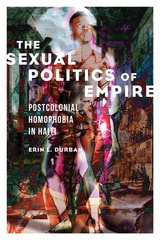
cover of The Sexual Politics of Empire: Postcolonial Homophobia in Haiti

The Sexual Politics of Empire

Postcolonial Homophobia in Haiti

Erin L. Durban

University of Illinois Press, 2023

Winner in the LAMMY Awards – Lambda Literary Awards, LGBTQ+ Studies category

Evangelical Christians and members of the global LGBTQI human rights movement have vied for influence in Haiti since the 2010 earthquake. Each side accuses the other of serving foreign interests. Yet each proposes future foreign interventions on behalf of their respective causes despite the country’s traumatic past with European colonialism and American imperialism. As Erin L. Durban shows, two discourses dominate discussions of intervention. One maintains imperialist notions of a backward Haiti so riddled with cultural deficiencies that foreign supervision is necessary to overcome Haitians’ resistance to progress. The other sees Haiti as a modern but failed state that exists only through its capacity for violence, including homophobia. In the context of these competing claims, Durban explores the creative ways that same-sex desiring and gender creative Haitians contend with anti-LGBTQI violence and ongoing foreign intervention.

Compelling and thought-provoking, The Sexual Politics of Empire examines LGBTQI life in contemporary Haiti against the backdrop of American imperialism and intervention.
[more]
cover of The Space In-Between: Essays on Latin American Culture

The Space In-Between

Essays on Latin American Culture

Silviano Santiago

Duke University Press, 2001

Silviano Santiago has been a pioneer in the development of concepts crucial to the discourse of contemporary critical and cultural theory, especially postcolonial theory. The notions of “hybridity” and “the space in-between” have been so completely absorbed into current theory that few scholars even realize these terms began with Santiago. He was the first to introduce poststructuralist thought to Brazil—via his publication of the Glossario de Derrida and his role as a prominent teacher. The Space In-Between translates many of his seminal essays into English for the first time and, in the process, introduces the thought of one of Brazil’s foremost critics and theorists of the late twentieth century.
Santiago’s work creates a theoretical field that transcends both the study of a specific national literature and the traditional perspectives of comparative literature. He examines the pedagogical and modernizing mission of Western voyagers from the conquistadors to the present. He deconstructs the ideas of “original” and “copy,” unpacking their implications for the notions of so-called dominant and dominated cultures. Santiago also confronts questions of cultural dependency and analyzes the problems involved in the imposition of an alien European history, the cultural displacements experienced by the Indians through their religious conversion, and the hierarchical suppression of native and Afro-Brazilian values.
Elegantly written and translated, The Space In-Between will provide insights and perspectives that will interest cultural and literary theorists, postcolonial scholars, and other students of contemporary culture.
[more]