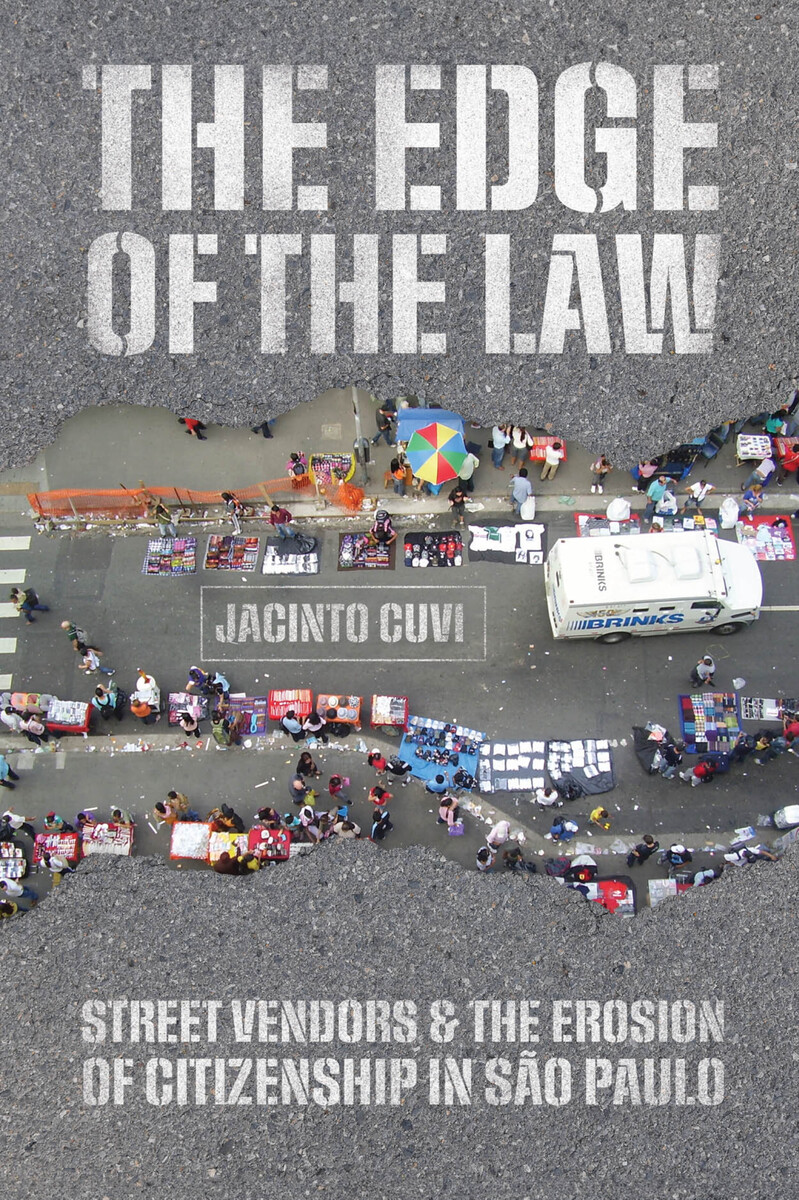
The Edge of the Law: Street Vendors and the Erosion of Citizenship in São Paulo
University of Chicago Press, 2025
Cloth: 978-0-226-84087-1 | Paper: 978-0-226-84089-5 | eISBN: 978-0-226-84088-8 (all)
Library of Congress Classification HF5459.B6C88 2025
Dewey Decimal Classification 381.18098161
Cloth: 978-0-226-84087-1 | Paper: 978-0-226-84089-5 | eISBN: 978-0-226-84088-8 (all)
Library of Congress Classification HF5459.B6C88 2025
Dewey Decimal Classification 381.18098161
ABOUT THIS BOOK | AUTHOR BIOGRAPHY | REVIEWS | TOC | REQUEST ACCESSIBLE FILE
ABOUT THIS BOOK
How street vendors tangle with the law in São Paulo, Brazil.
With a little initiative and very little startup money, an outgoing individual might sell you a number of delights and conveniences familiar to city dwellers—from cold water bottles while you’re sitting in traffic to a popsicle from a cart on a summer afternoon in the park. Such vendors form a significant share of the workforce in São Paulo, Brazil, but their ubiquity belies perpetual struggle. Some have the right to practice their trade; others do not. All of them strive to make it—or stay afloat.
In The Edge of the Law, sociologist Jacinto Cuvi introduces us to the world of street vendors and teases out the relationship between the construction of legality and the experience of citizenship. As São Paulo’s city government undertakes a large-scale plan to cancel street vending licenses and evict street vendors, Cuvi reveals how the rights of informal workers can be revoked or withheld and how the lines can be redrawn between work that is “legal” and work that takes place under constant fear of law enforcement. Alongside the mechanics of disenfranchisement, Cuvi captures the lived experience of criminalization, dissecting the distribution of (shallow) rights among vendors who continually reinvent strategies to eke out a living while dealing with the constraints and pressures of informal citizenship at the edge of the law.
See other books on: Edge | Employee rights | Informal sector (Economics) | Marginality, Social | São Paulo
See other titles from University of Chicago Press