Results by title
86 books match the query 'Chile' and 14 start with t
The Araucaniad
Alonso de Ercilla y Zuniga
Vanderbilt University Press, 1945
The Chile Reader
History, Culture, PoliticsElizabeth Quay Hutchison, Thomas Miller Klubock, Nara B. Milanich, and Peter Winn, eds.
Duke University Press, 2013
Texts and images, each introduced by the editors, provide insights into the ways that Chile's unique geography has shaped its national identity, the country's unusually violent colonial history, and the stable but autocratic republic that emerged after independence from Spain. They shed light on Chile's role in the world economy, the social impact of economic modernization, and the enduring problems of deep inequality. The Reader also covers Chile's bold experiments with reform and revolution, its subsequent descent into one of Latin America's most ruthless Cold War dictatorships, and its much-admired transition to democracy and a market economy in the years since dictatorship.
The Inferno
A Story of Terror and Survival in ChileLuz Arce; Translated by Stacey Alba Skar
University of Wisconsin Press, 2004
As a member of Salvador Allende’s Personal Guards (GAP), Luz Arce worked with leaders of the Socialist Party during the Popular Unity Government from 1971 to1973. In the months following the coup, Arce served as a militant with others from the Left who opposed the military junta led by Augusto Pinochet, which controlled the country from 1973 to1990. Along with thousands of others in Chile, Arce was detained and tortured by Chile’s military intelligence service, the DINA, in their attempt to eliminate alternative voices and ideologies in the country. Arce’s testimonial offers the harrowing story of the abuse she suffered and witnessed as a survivor of detention camps, such as the infamous Villa Grimaldi.
But when faced with threats made to her family, including her young son, and with the possibility that she could be murdered as thousands of others had been, Arce began to collaborate with the Chilean military in their repression of national resistance groups and outlawed political parties. Her testimonial thus also offers a unique perspective from within the repressive structures as she tells of her work as a DINA agent whose identifications even lead to the capture of some of her former friends and compañeros.
During Chile’s return to democracy in the early 1990s, Arce experienced two fundamental changes in her life that led to the writing of her story. The first was a deep spiritual renewal through her contacts with the Catholic Church whose Vicariate of Solidarity had fought for human rights in the country during the dictatorship. The second was her decision to participate within the legal system to identify and bring to justice those members of the military who were responsible for the crimes committed from 1973 to1990. Luz Arce’s book invites readers to rethink the definition of testimonial narrative in Latin America through the unique perspective of a survivor-witness-confessor.
The Insubordination of Signs
Political Change, Cultural Transformation, and Poetics of the CrisisNelly Richard
Duke University Press, 2004
In The Insubordination of Signs Richard theorizes the cultural reactions—particularly within the realms of visual arts, literature, and the social sciences—to the oppression of the Chilean dictatorship. She reflects on the role of memory in the historical shadow of the military regime and on the strategies offered by marginal discourses for critiquing institutional systems of power. She considers the importance of Walter Benjamin for the theoretical self-understanding of the Latin American intellectual left, and she offers revisionary interpretations of the Chilean neo-avantgarde in terms of its relationships with the traditional left and postmodernism. Exploring the gap between Chile’s new left social sciences and its “new scene” aesthetic and critical practices, Richard discusses how, with the return of democracy, the energies that had set in motion the democratizing process seemed to exhaust themselves as cultural debate was attenuated in order to reduce any risk of a return to authoritarianism.
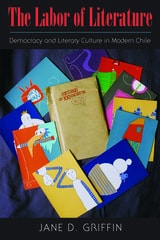
The Labor of Literature
Democracy and Literary Culture in Modern ChileJane D. Griffin
University of Massachusetts Press, 2016
By examining alternative literary publications, Griffin recasts the seventeen-year Pinochet dictatorship as a time of editorial experimentation despite widespread cultural oppression and shows how grassroots cultural activism has challenged government-approved corporate publishing models throughout the postdictatorship period. Griffin's work also points to the growing importance of autogestión, or do-it-yourself cultural production, where individuals combine artisanal forms with new technologies to make and share creative work on a global scale.
The Military and Politics in Postauthoritarian Chile
Gregory Weeks
University of Alabama Press, 2003
"The Military and Politics in Post-Authoritarian Chile should be read by everyone concerned with the relation between democracy and the armed forces. It is a well-researched, well-written volume that should prove both interesting and useful to scholars and students alike." —Perspectives on Politics
Why have political leaders of developing and authoritarian nations run into so many obstacles as they attempt to establish civilian supremacy over armed forces in the democratization of their countries? This is the question Gregory Weeks poses in his study of Chile from 1990 onward. He explains how the Chilean military has maintained a high level of political influence in the tumultuous aftermath of dictatorial rule by Army General Augusto Pinochet, thus confounding a smooth transition to civilian authority.
Even after the reins of power were officially handed over in 1990, Pinochet continued as commander in chief of the army until 1998, when he took a lifetime seat in the Senate and led the military’s efforts to retain its legal and constitutional prerogatives while limiting civilian oversight of military affairs. This assertion of guardianship by the military has produced a political tug-of-war between it and civilian authorities the two contenders for political primacy in Chile. In addition to recounting the historical background of this situation, Weeks’s study examines where conflict between these two contenders has been most productive and accord has been highest. His findings suggest that formal contacts, conducted through formal institutions, have been the most conducive to civil supremacy and, therefore, the consolidation of democracy.
Based on interviews, government documents, military journals, newspapers, and other archival sources, The Military and Politics in Postauthoritarian Chile describes how presidents, military officers, members of Congress, and judges have interacted since the end of the military regime. With implications for conflict resolution studies, this book will be valuable for Chileanists and policymakers and analysts of Latin American regimes, as well as academic libraries, military historians, social scientists, and students and scholars of Latin American history and politics.
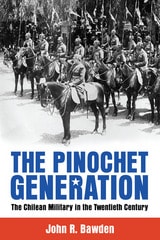
The Pinochet Generation
The Chilean Military in the Twentieth CenturyJohn R. Bawden
University of Alabama Press, 2016
Understanding the military generation that transformed modern Chile.
Chilean soldiers in the twentieth century appear in most historical accounts, if they appear at all, as decontextualized figures or simply as a single man: Augusto Pinochet. In his incisive study The Pinochet Generation: The Chilean Military in the Twentieth Century, John R. Bawden provides compelling new insights into the era and posits that Pinochet and his men were responsible for two major transformations in Chile’s constitution as well as the political and economic effects that followed.
Determined to refocus what he sees as a “decontextualized paucity” of historical information on Chile’s armed forces, Bawden offers a new perspective to explain why the military overthrew the government in 1973 as well as why and how Chile slowly transitioned back to a democracy at the end of the 1980s. Standing apart from other views, Bawden insists that the Chilean military’s indigenous traditions and customs did more than foreign influences to mold their beliefs and behavior leading up to the 1973 coup of Salvador Allende.
Drawing from defense publications, testimonial literature, and archival materials in both the United States and Chile, The Pinochet Generation characterizes the lens through which Chilean officers saw the world, their own actions, and their place in national history. This thorough analysis of the Chilean services’ history, education, values, and worldview shows how this military culture shaped Chilean thinking and behavior, shedding light on the distinctive qualities of Chile’s armed forces, the military’s decision to depose Allende, and the Pinochet dictatorship’s resilience, repressiveness, and durability.
Bawden’s account of Chile’s vast and complex military history of the twentieth century will appeal to political scientists, historians, faculty and graduate students interested in Latin America and its armed forces, students of US–Latin American diplomacy, and those interested in issues of human rights.
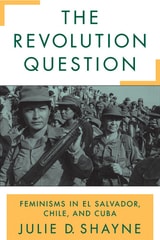
The Revolution Question
Feminisms in El Salvador, Chile, and CubaShayne, Julie D.
Rutgers University Press, 2004
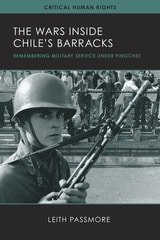
The Wars inside Chile's Barracks
Remembering Military Service under PinochetLeith Passmore
University of Wisconsin Press, 2020
Relying on unpublished material, testimony, interviews, and field notes, Passmore locates these individuals' narratives of victimhood at the intersection of long-term histories of patriotism, masculinity, and cyclical poverty. These accounts reveal in detail how Pinochet's war against his own citizens—as well as the "almost-wars" with neighboring Peru, Bolivia, and Argentina—were also waged inside Chile's army barracks.
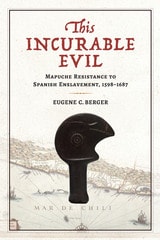
This Incurable Evil
Mapuche Resistance to Spanish Enslavement, 1598–1687Eugene C.Berger
University of Alabama Press, 2023
Documents how initial Mapuche-Spanish alliances were built and how they were destroyed by increasingly powerful slave-trading elites operating like organized crime families
The history of Spanish presence in the Americas is usually viewed as a one-sided conquest. In This Incurable Evil: Mapuche Resistance to Spanish Enslavement, 1598–1687, Eugene C. Berger provides a major corrective in the case of Chile. For example, in the south, indigenous populations were persistent in their resistance against Spanish settlement. By the end of the sixteenth century, Spanish aspirations to conquer the entire Pacific Coast were dashed at least twice by armed resistance from the Mapuche peoples. By 1600, the Mapuche had killed two Spanish governors and occupied more than a dozen Spanish towns. Chile’s colonial future was quite uncertain.
As Berger documents, for much of the seventeenth century it seemed that there could be peace along the Spanish-Mapuche frontier. Through trade, intermarriage, and even mutual distrust of Dutch and English pirates, the Mapuche and the Spanish began to construct a colonial entente. However, this growing alliance was obliterated by the “incurable evil,” an ever-expanding enslavement of Mapuches, and one which prompted a new generation of Mapuche resistance. This trade saw Mapuche rivals, neutrals, and even friends placed in irons and forced to board ships in Valdivia and Concepción or to march northward along the Andes. The Mapuche labored in the gold mines of La Serena, in urban workshops in Lima, in the silver mines of Potosí, or on the thousands of haciendas in between and would never return to their homes. With this tragic betrayal, Chile was left a more corrupt, violent, and polarized place, which would cause deep wounds for centuries.
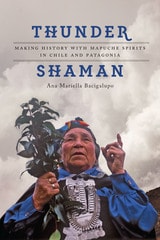
Thunder Shaman
Making History with Mapuche Spirits in Chile and PatagoniaBy Ana Mariella Bacigalupo
University of Texas Press, 2016
As a “wild,” drumming thunder shaman, a warrior mounted on her spirit horse, Francisca Kolipi’s spirit traveled to other historical times and places, gaining the power and knowledge to conduct spiritual warfare against her community’s enemies, including forestry companies and settlers. As a “civilized” shaman, Francisca narrated the Mapuche people’s attachment to their local sacred landscapes, which are themselves imbued with shamanic power, and constructed nonlinear histories of intra- and interethnic relations that created a moral order in which Mapuche become history’s spiritual victors.
Thunder Shaman represents an extraordinary collaboration between Francisca Kolipi and anthropologist Ana Mariella Bacigalupo, who became Kolipi’s “granddaughter,” trusted helper, and agent in a mission of historical (re)construction and myth-making. The book describes Francisca’s life, death, and expected rebirth, and shows how she remade history through multitemporal dreams, visions, and spirit possession, drawing on ancestral beings and forest spirits as historical agents to obliterate state ideologies and the colonialist usurpation of indigenous lands. Both an academic text and a powerful ritual object intended to be an agent in shamanic history, Thunder Shaman functions simultaneously as a shamanic “bible,” embodying Francisca’s power, will, and spirit long after her death in 1996, and an insightful study of shamanic historical consciousness, in which biography, spirituality, politics, ecology, and the past, present, and future are inextricably linked. It demonstrates how shamans are constituted by historical-political and ecological events, while they also actively create history itself through shamanic imaginaries and narrative forms.
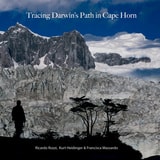
Tracing Darwin's Path in Cape Horn
Ricardo Rozzi
University of North Texas Press, 2019
Traumatic States
Gendered Violence, Suffering, and Care in ChileNia Parson
Vanderbilt University Press, 2013
In Traumatic States, anthropologist Nia Parson explores the development of methods of care and recovery from domestic violence. She interviews and contextualizes the lives of numerous individuals who have confronted these acts, as victims, authorities, and activists. Ultimately, Traumatic States argues that facing the challenges of healing both body and mind, and addressing the fundamental inequalities that make those challenges even more formidable, are part of the same battle.
Travels and Archaeology in South Chile
Bird, Junius B.
University of Iowa Press, 1988