Results by title
56 books match the query 'Chinese Americans' and 10 start with t

The Anti-Chinese Movement in California
Elmer Clarence Sandmeyer. Foreword and supplementary bibliographies by Roger Daniels
University of Illinois Press, 1991
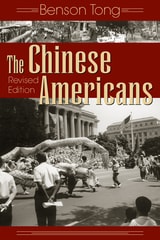
The Chinese Americans, Revised Edition
Benson Tong
University Press of Colorado, 2003
The Chinese of Early Tucson
Historic Archaeology from the Tucson Urban Renewal ProjectFlorence C. Lister and Robert H. Lister
University of Arizona Press, 1989
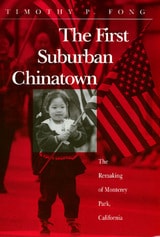
The First Suburban Chinatown
The Remaking of Monterey Park, CaliforniaTimothy P. Fong
Temple University Press, 1994
Monterey Park, California, only eight miles east of downtown Los Angeles, was dubbed by the media as the "First Suburban Chinatown." The city was a predominantly white middle-class bedroom community in the 1970s when large numbers of Chinese immigrants transformed it into a bustling international boomtown. It is now the only city in the United States with a majority Asian American population. Timothy P. Fong examines the demographic, economic, social, and cultural changes taking place there, and the political reactions to the change.
Fong, a former journalist, reports on how pervasive anti-Asian sentiment fueled a series of initiatives intended to strengthen "community control," including a movement to make English the official language. Recounting the internal strife and the beginnings of recovery, Fong explores how race and ethnicity issues are used as political organizing tools and weapons.
In the series Asian American History and Culture, edited by Sucheng Chan, David Palumbo-Liu, Michael Omi, K. Scott Wong, and Linda Trinh Võ.
The Mouth That Begs
Hunger, Cannibalism, and the Politics of Eating in Modern ChinaGang Yue
Duke University Press, 1999
Yue’s discussion begins with a brief look at ancient Chinese alimentary writing and then moves on to its main concern: the exploration and textual analysis of themes of eating in modern Chinese literature from the May Fourth period through the post-Tiananmen era. The broad historical scope of this volume illustrates how widely applicable eating-related metaphors can be. For instance, Yue shows how cannibalism symbolizes old China under European colonization in the writing of Lu Xun. In Mo Yan’s 1992 novel Liquorland, however, cannibalism becomes the symbol of overindulgent consumerism. Yue considers other writers as well, such as Shen Congwen, Wang Ruowang, Lu Wenfu, Zhang Zianliang, Ah Cheng, Zheng Yi, and Liu Zhenyun. A special section devoted to women writers includes a chapter on Xiao Hong, Wang Anyi, and Li Ang, and another on the Chinese-American women writers Jade Snow Wong, Maxine Hong Kingston, and Amy Tan. Throughout, the author compares and contrasts the work of these writers with similarly themed Western literature, weaving a personal and political semiotics of eating.
The Mouth That Begs will interest sinologists, literary critics, anthropologists, cultural studies scholars, and everyone curious about the semiotics of food.
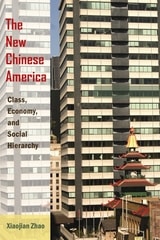
The New Chinese America
Class, Economy, and Social HierarchyZhao, Xiaojian
Rutgers University Press, 2010
In this detailed and comprehensive study of contemporary Chinese America, Xiaojian Zhao uses class analysis to illuminate the difficulties of everyday survival for poor and undocumented immigrants and analyzes the process through which social mobility occurs. Through ethnic ties, Chinese Americans have built an economy of their own in which entrepreneurs can maintain a competitive edge given their access to low-cost labor; workers who are shut out of the mainstream job market can find work and make a living; and consumers can enjoy high quality services at a great bargain. While the growth of the ethnic economy enhances ethnic bonds by increasing mutual dependencies among different groups of Chinese Americans, it also determines the limits of possibility for various individuals depending on their socioeconomic and immigration status.
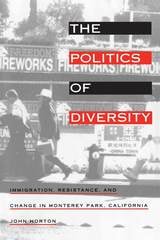
The Politics of Diversity
Immigration, Resistance, and Change in Monterey Park, CaliforniaJohn Horton
Temple University Press, 1995
Advertised in Asia as "The Chinese Beverly Hills," this small city minutes east of downtown Los Angeles, became by the late 1970s a regional springboard for a new type of Chinese immigration—suburban and middle class with a diversified and globally-oriented economy. Freed from the isolation of old Chinatowns, new immigrants now confronted resistance from more established Anglo, Asian American, and Latino neighbors, whose opposition took the form of interconnected "English Only" and slow-growth movements.
In The Politics of Diversity, a multiethnic team of researches employ ethnography, interviewing, and exit polls to capture the process of change as newcomers and established residents come to terms with the meaning of diversity and identity in their everyday lives. The result is an engaging grass-roots account of immigration and change: the decline of the loyal old-boy Anglo network; the rise of women, minorities, and immigrants in the political scene; and a transformation of ethnic and American identities.
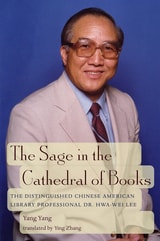
The Sage in the Cathedral of Books
The Distinguished Chinese American Library Professional Dr. Hwa-Wei LeeYang Yang
Ohio University Press, 2016
The biography of Dr. Hwa-Wei Lee, who was awarded the highly prestigious Melvil Dewey Medal by the American Library Association in 2015, will be welcomed by readers interested in knowing not only more about Lee’s personal achievements and contributions in librarianship but also about the rapid changes in the library profession in general. The biography, written by Ms. Yang Yang of China Central Television in Beijing, was first published in Chinese in China in 2011. It was republished in Taiwan with added information in 2014. This English edition, translated by Dr. Ying Zhang of the Universityof California in Irvine, was updated by Lee.
Throughout his childhood and youth, Lee experienced tremendous hardship during the brutal Sino-Japanese War and then the Chinese civil war, described in the first three chapters. After arriving in the United States as a graduate student from Taiwan in 1957, he struggled to realize the American dream by studying hard and working diligently in the field of librarianship for nearly half a century.
The biography explores Lee’s career at major academic libraries, beginning at the University of Pittsburgh to his retirement from Ohio University, including his seven years of library directorship at the Asian Institute of Technology in Bangkok, Thailand, under the sponsorship of the U.S. Agency for International Development. After his first retirement, Lee was invited by OCLC to become a Visiting Distinguished Scholar. From there he was appointed Chief of the Asian Division at the Library of Congress and retired for the second time in 2008.
The biography also highlights Lee’s contributions in international librarianship, especially in the promotion of library cooperation between the United States and China.
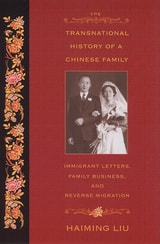
The Transnational History of a Chinese Family
Immigrant Letters, Family Business, and Reverse MigrationLiu, Haiming
Rutgers University Press, 2005
Family and home are one word—jia—in the Chinese language. Family can be separated and home may be relocated, but jia remains intact. It signifies a system of mutual obligation, lasting responsibility, and cultural values. This strong yet flexible sense of kinship has enabled many Chinese immigrant families to endure long physical separation and accommodate continuities and discontinuities in the process of social mobility.
Based on an analysis of over three thousand family letters and other primary sources, including recently released immigration files from the National Archives and Records Administration, Haiming Liu presents a remarkable transnational history of a Chinese family from the late nineteenth century to the 1970s. For three generations, the family lived between the two worlds. While the immigrant generation worked hard in an herbalist business and asparagus farming, the younger generation crossed back and forth between China and America, pursuing proper education, good careers, and a meaningful life during a difficult period of time for Chinese Americans. When social instability in China and hostile racial environment in America prevented the family from being rooted in either side of the Pacific, transnational family life became a focal point of their social existence.
This well-documented and illustrated family history makes it clear that, for many Chinese immigrant families, migration does not mean a break from the past but the beginning of a new life that incorporates and transcends dual national boundaries. It convincingly shows how transnationalism has become a way of life for Chinese American families.
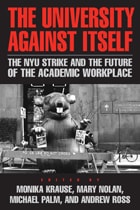
The University Against Itself
The NYU Strike and the Future of the Academic Workplaceedited by Monika Krause, Mary Nolan, Michael Palm and Andrew Ross
Temple University Press, 2008
All of the contributors were either participants in the NYU strike -- graduate students, faculty, and organizers -- or are nationally recognized as writers on academic labor. They are deeply troubled by the ramifications of corporatizing universities. Here they spell out their concerns, offering lessons from one historic strike as well as cautions about the future of all universities.
Contributors include: Stanley Aronowitz, Barbara Bowen, Andrew Cornell, Ashley Dawson, Stephen Duncombe, Steve Fletcher, Greg Grandin, Adam Green, Kitty Krupat, Gordon Lafer, Micki McGee, Sarah Nash, Cary Nelson, Matthew Osypowski, Ed Ott, Ellen Schrecker, Susan Valentine, and the editors.