Results by title
128 books match the query 'Church of Jesus Christ of Latter-day Saints' and 29 start with t
The Ancient Order of Things
Essays on the Mormon TempleChristian Larsen
Signature Books, 2019
Christian Larsen has assembled a collection of essays that illuminate the role of the temple and its rocky relationship with controversial subjects such as race and marriage. Some temples were built, abandoned, and given new life; others were either constructed for temporary use or never built at all. The nature of LDS temple ordinances is such that what LDS members deem sacred, others dismiss as secret.
The Angel and Beehive
THE MORMON STRUGGLE WITH ASSIMILATIONArmand L. Mauss
University of Illinois Press, 1994
This retrenchment among Mormons is the main theme of Mauss's book, which analyzes the last forty years of Mormon history from a sociological perspective. At the official ecclesiastical level, Mauss finds, the retrenchment can be seen in the greatly increased centralization of bureaucratic control and in renewed emphases on obedience to modern prophets, on genealogy and vicarious temple work, and on traditional family life; retrenchment is also apparent in extensive formal religious indoctrination by full-time professionals and in increased sophistication and intensity of proselytizing.
The Bible and the Latter-day Saint Tradition
Edited by Taylor G. Petrey, Cory Crawford, and Eric A. Eliason
University of Utah Press, 2022
Like other Christian denominations, the Church of Jesus Christ of Latter-day Saints (Mormons) has been engaged in the battle for the Bible since challenges to biblical authority began to exert significant influence in America toward the end of the nineteenth century. Other believing communities have responded with various reevaluations of the biblical text. Latter-day Saints have experimented with similar approaches, often taking liberal positions on biblical authority and conservative positions on history and authorship. However, Latter-day Saints accept additional scripture and embrace a theology notably distinct from traditional Christianity. Hence, they relate to the Bible differently from other Christians, creating gaps with mainstream biblical studies. This volume bridges that gap.
From comparing the Book of Mormon to the Bible or the Dead Sea Scrolls, to Mormon feminists’ views on the Gospels, this volume takes a comprehensive and inclusive approach to understanding Bible scholarship’s role in Mormon history, exploring these differences for both scholars and students. A diverse group of contributors presents an accessible resource to mediate between Latter-day Saint traditions and the broader context of biblical history, literature, and scholarship. Each essay provides a synopsis of relevant major scholarly views and delivers new insights into varied crosscurrents of biblical studies.
The Book of Queer Mormon Joy
Pray, Kerry Spencer
Signature Books, 2024
The story of queer Mormons is one that some might not expect to be joyful. The Church of Jesus Christ of Latter-day Saints has traditionally asserted that queerness is counter to God’s plan and that gender as determined at birth is eternal. Any marriage other than a monogamous pairing of male and female is “counterfeit.” So called “wickedness,” we are told, “never was happiness.”
But queer Mormons tell different stories—stories filled with joy. This collection includes essays by queer Mormons across the LGBTQ spectrum who, when they looked inside themselves, found divinity rather than sin. Stories by people who are made exactly as they are meant to be, and live accordingly.
Queer Mormons who feel forced out of the institutional church don’t typically find despair on the outside or abandonment by the divine. Instead, their lives are rich and beautiful—made all the more so by the struggle. The Book of Mormon tells us, “Men are that they might have joy.” The Book of Queer Mormon Joy affirms that trans, nonbinary, intersex, asexual, bisexual, polyamorous, and gay people have joy. Joy is for everyone.
The Challenge of Honesty
Essays for Latter-day Saints by Frances Lee MenloveDan Wotherspoon, editor
Signature Books, 2013
These words remain as fresh and bracing today as they were nearly fifty years ago. The sixteen other essays and devotionals in this collection, some published here for the first time, are equally bold, exposing injustice masked as God’s will. They contain an underlying theme of personal integrity and striving for spiritual transformation. They stand perceived wisdom on its head in the same way that scripture so often does. Readers will want to share these essays with family and friends but will also find the concepts again and again occupying their own private thoughts.
The Council of Fifty
A Documentary HistoryJedediah S. Rogers
Signature Books, 2014
One member downplayed the significance of this secret legislative body in 1849 as “nothing but a debating School.” On the contrary, a typical meeting included decisions regarding irrigation, fencing, and adobe housing, after which the group sang a song written by Parley P. Pratt: “Come ye sons of doubt and wonder; Indian, Moslem, Greek or Jew; … Be to all a friend and brother; Peace on Earth, good will to men.” Two weeks later, the council called for “blood to flow” to enforce its laws.
As the nineteenth century waned and the LDS Church moved toward the American mainstream, ending its emphasis on the imminent End of Days, there was no longer a need for a Church-managed municipal group destined to become the millennial world government. The council became irrelevant but survives today as a historical artifact available in fragmented documentary pieces which are presented here for the first time.
The Earth Will Appear as the Garden of Eden
Essays on Mormon Environmental HistoryJedediah S. Rogers and Matthew C. Godfrey
University of Utah Press, 2018
Since Joseph Smith’s revelations, Mormons have interacted with nature in significant ways—whether perceiving it as a place to find God, uncorrupted spaces in which to build communities to usher in the Second Coming, wildness needing domestication and control, or a world brimming with natural resources to ensure economic well-being. The essays in this volume—written by leading scholars in both environmental history and Mormon history—explore how nature has influenced Mormon beliefs and how these beliefs inform Mormons’ encounters with nature. Introducing overarching environmental ideas, contributors examine specific aspects of nature and Mormon theology to glean new insights into the Mormon experience.
The Essential B. H. Roberts
Brigham D. Madsen
Signature Books, 2000
On one occasion Roberts defended the traditional Mormon view of the godhead—perfected men who “eat, drink … and procreate” as exalted mortals; another time he seemed less comfortable imposing limitations on a God who cannot be fixed to a single location, for whom Jesus was a mortal incarnation, and for whom the term “trinity” seemed more eloquent than the “presidency of heaven.”
His most famous and penetrating analysis focused on the Book of Mormon. In this collection Roberts discusses the mode of its translation, while stopping short of saying that God, who speaks to humans in their own language, could have authored the inconsistent grammar that appeared luminously in Joseph Smith’s seer stone. Instead he credits this to Smith’s own linguistic contribution, thereby preserving for God a fitting transcendence. Later Roberts went so far as to question the Book of Mormon’s historicity.
A final example of Roberts’s complexity: He proclaimed in public the perfect unity and harmony found at church conferences, but he privately castigated his colleagues for what he considered to be obstinance. He once asked what additional, irrational proposal “may occur to some genius” in the Quorum of the Twelve.
A paradox still, this feisty president of the church’s Seventies continues to provoke mixed and heated feelings, as expressed by a Scottish immigrant working in the First Presidency’s office who one day said to Roberts: “Aye, mon, the frankness of it. How dare you do it, mon?” But for those who are sincere and secure in their faith, Roberts can provide a delightfully rewarding journey. Consider just the following four, short excerpts from this compilation—two are originally from Roberts’s published works and two are from his personal letters:
“It is not given to mortal man always to walk upon that plane where the sunlight of God’s inspiration is playing upon him. Sometimes the servants of God speak merely from their human knowledge, influenced by passions; influenced by the interests of men, and by anger, and vexation. When they so speak, that is not likely to be the word of God. In any event it must be allowed by us that many unwise things were said in times past that did not possess the value of scripture, or anything like it; and it was not revelation.”
“What has become, in the church, of the principle that governments derive their just powers from the consent of the governed? Will it be enough to say that the consent of the governed can come later when nominations have been made by leaders? The procedure may be so, and the quorums thus ignored may silently submit, and the matter going on in a dull, gray, and sullen manner; but you will have no esprit de corps in the quorums; and young men of active minds will grow restive. Why not regard them as having some judgment, and right to have a voice in nominating those with whom they are to work?”
“So I say that when the churches turn to secular government to enforce religious doctrines and discipline, they abandon their legitimate sphere and enter one wholly repugnant to their principles. When churches thus abandon their confidence in the power of truth, they play havoc with their own authority.”
“My dear Bishop Nibley, let me commend you for the delicacy with which you can tell the poor ‘theorist’ to ‘get off the earth.’ I know not if you were born with such delicacy or have acquired it, but in either event it challenges one’s admiration. You write that ‘You (myself) are a theorist, while he (Senator-Apostle Smoot) is needed and has a place in the economy of things.’ That is decidedly good. There is but one thing more you could have suggested to my advantage; you might have indicated the particular location in oblivion where you would be willing for me to sit.”
Brigham Henry Roberts was born in England in 1857. Among his other achievements, he was president of the LDS First Quorum of Seventy and Assistant Church Historian. His numerous books include: (historical) A Comprehensive History of the Church, Joseph Smith: The Prophet-Teacher, The Life of John Taylor, Outlines of Ecclesiastical History, and (theological) A New Witness for God, the Mormon Doctrine of Deity, and the Seventy’s Course in Theology—all of which are considered authoritative, and for which Roberts earned the epithet, “Defender of the Faith.” He died in 1933.
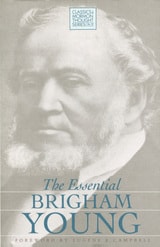
The Essential Brigham Young
Eugene E. Campbell
Signature Books, 1992
Self-educated and preoccupied with the day-to-day business of his widespread empire, Young rarely found time to read. But he delivered hundreds of lively, extemporaneous sermons which blended common sense with theological speculation. Such homespun treatises carried an immediacy that was absent from the philosophically-oriented studies of his ecclesiastical colleague Orson Pratt, though, at the same time, Young’s speeches could be unfocused and contradictory.
Several of the more controversial teachings that Young promulgated—Adam-as-God, divine omniscience, and blood atonement—have sparked considerable debate since they were first uttered more than one hundred years ago. “Will you love your brothers and sisters likewise,” he once asked, “when they have committed a sin that cannot be atoned for without the shedding of their blood? Will you love that man or woman well enough to shed their blood?”
Other favorite topics were the “personality of God,” “election and reprobation,” and “the resurrection.” His sermons usually begin in a chatty way: “I remarked last Sunday that I had not felt much like preaching,” or “When I contemplate the subject of salvation, and rise before a congregation to speak upon that all-important matter, it has been but a few times in my life that I could see a beginning point to it, or a stopping place.” Readers will find themselves drawn into the rhythm of Young’s rhetoric in the same way as his original hearers were.
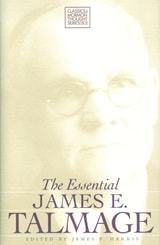
The Essential James E. Talmage
James P. Harris
Signature Books, 1997
This was not the first time that Talmage had been of service to his church. As a geology professor, he was consulted about underground ventilation options for the Salt Lake Tabernacle and about the scientific evidence for organic evolution, which he cautiously promoted. At the church president’s request, Talmage also delivered a series of lectures on church theology which would form the basis for his later influential books.
Not that Talmage was unaccustomed to controversy. When his book, The Articles of Faith, first appeared, he was accused of “apostasy” and narrowly escaped church sanction. When he read from an advance text of Jesus the Christ in general conference, some leaders objected to the doctrinal content and had the offending paragraphs excised from the published conference proceedings.
Scholars have noted that much of Talmage’s work reflects the thinking of his day, particularly in his reliance on Frederick Farrar’s Life of Christ and in his portrayal of a so-called “Victorian Jesus.” But as James P. Harris observes, Talmage also “supplemented the biblical narrative with modern revelation” and produced “a source of information and inspiration to church members worldwide.”
The Essential James E. Talmage includes some of the apostle’s lesser-known works. For Talmage’s more popular writings, the editor has included relevant diary entries and material omitted from later editions. Readers will appreciate the process by which these seminal works were produced and the character of the man who composed them.
The LDS Gospel Topics Series
A Scholarly EngagementMatthew L. Harris and Newell G. Bringhurst
Signature Books, 2020
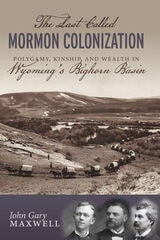
The Last Called Mormon Colonization
Polygamy, Kinship, and Wealth in Wyoming's Bighorn BasinJohn Gary Maxwell
University of Utah Press, 2021
The LDS Church officially abandoned polygamy in 1890, but evidence that the practice was still tolerated (if not officially sanctioned) by the church circulated widely, resulting in intense investigations by the U.S. Senate. In 1896 Abraham Owen Woodruff, a rising star in LDS leadership and an ardent believer in polygamy, was appointed to head the LDS Colonization Company. Maxwell explores whether under Woodruff’s leadership the Bighorn Basin colony was intended as a means to insure the secret survival of polygamy and if his untimely death in 1904, together with the excommunication of two equally dedicated proponents of polygamy—Apostles John Whitaker Taylor and Matthias Foss Cowley—led to its collapse.
Maxwell also details how Mormon settlers in Wyoming struggled with finance, irrigation, and farming and how they brought the same violence to indigenous peoples over land and other rights as did non-Mormons.
The 1900 Bighorn Basin colonization provides an early twentieth-century example of a Mormon syndicate operating at the intersection of religious conformity, polygamy, nepotism, kinship, corporate business ventures, wealth, and high priesthood status. Maxwell offers evidence that although in many ways the Bighorn Basin colonization failed, Owen Woodruff’s prophecy remains unbroken: “No year will ever pass, from now until the coming of the Savior, when children will not be born in plural marriage.”

The Last Pioneer
John Taylor, a Mormon ProphetSamuel W. Taylor
Signature Books, 1999
As half the church fell away in Ohio, the Taylors escaped to Missouri with the faithful, just in time for the 1838 Mormon War. John’s role became that of an advocate with Congress—to convince them that it was the non-Mormons who had sacked the county seat and burned their own homes, for instance. As a literary experience, this was good preparation for later editorships of church newspapers in Illinois, New York, and Liverpool.
From his personal letters and speeches, and from the diaries and reminiscences of associates, vivid images of Taylor’s life appear: his children crossing the Missouri River on the backs of oxen “bulls”; one of his ten plural wives packing a piano instead of a cookstove for the trip and then later regretting it; and Native Americans teaching him how to burn a cricket-infested field, gather the roasted insects, and grind the carcasses into flour.
Taylor’s eventual tenure as church president was spent “on the dodge” from federal marshals, and prior to that he often lived out of a suitcase, rotating from one of his sixteen families to the next. Among his greatest achievements was the settlement of as much territory as was colonized by his more famous predecessor, Brigham Young. Taylor was also a visionary man. His personal spirituality led the church through one of its most turbulent times; his revelations later inspired the Mormon fundamentalist schism, as well. This controversy, mingled with the drama of internecine power struggles and interpersonal conflict, makes The Last Pioneer suspenseful and largely unforgettable.
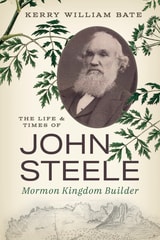
The Life and Times of John Steele
Mormon Kingdom BuilderKerry William Bate
University of Utah Press, 2025
Among the founders of Salt Lake City, Parowan, and Las Vegas, and an explorer of Zion National Park and the Grand Canyon, John Steele's legacy is etched across the American West. The Life and Times of John Steele follows the remarkable journey of this Irish-born convert to Mormonism from his birth into scarcity through his final days in Kanarraville, Utah.
A fervent believer in utopian ideals, Steele sought to build an egalitarian Kingdom of Christ in the last days, becoming a key figure in early Utah history. His multifaceted roles—missionary, city founder, militia major, justice of the peace, and self-taught doctor using folk medicine, charms, and the occult—make his story unique. This meticulously researched biography offers new insights into pivotal events such as the Mountain Meadows Massacre and the communal economics of the Church of Jesus Christ of Latter-day Saints, drawing from Steele’s extensive personal diaries and papers to bring his complex, colorful life and times to light.
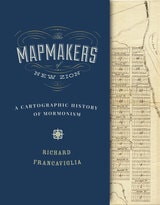
The Mapmakers of New Zion
A Cartographic History of MormonismRichard Francaviglia
University of Utah Press, 2015
From their earliest days on the American frontier through their growth into a worldwide church, the spatially expansive Mormons made maps to help them create idealized communities, migrate to and colonize large parts of the American West, visualize the stories in their sacred texts, and spread their message internationally through a well-organized missionary system. This book identifies many Mormon mapmakers who played an important but heretofore unsung role in charting the course of Latter-day Saint history. For Mormons, maps had and continue to have both practical and spiritual significance. In addition to using maps to help build their new Zion and to explore the Intermountain West, Latter-day Saint mapmakers used them to depict locations and events described in the Book of Mormon.
Featuring over one hundred historical maps reproduced in full color—many never before published—The Mapmakers of New Zion sheds new light on Mormonism and takes readers on a fascinating journey through maps as both historical documents and touchstones of faith.
Winner of the Southwest Book Design and Production Award from the New Mexico Book Association.
Selected as one of the American Library Association's Best of the Best from University Presses.
The Missouri Mormon Experience
Edited by Thomas M. Spencer
University of Missouri Press, 2010
The Mormon Church and Blacks
A Documentary HistoryEdited by Matthew L. Harris and Newell G. Bringhurst
University of Illinois Press, 2015
The Mormon Hierarchy
Origins of PowerD. Michael Quinn
Signature Books, 1994
Not until seven years later did Mormons first learn that authority had been restored by angels or of the need for a hierarchy mirroring the Pauline model. That same year (1835) a Quorum of Twelve Apostles was organized, but their jurisdiction was limited to areas outside established stakes (dioceses). Stakes were led by a president, who oversaw spiritual development, and by a bishop, who supervised temporal needs.
At Smith’s martyrdom in 1844, the church had five leading quorums of authority. The most obvious successor to Smith, Illinois stake president William Marks, opposed the secret rites of polygamy, anointing, endowments, and the clandestine political activity that had characterized the church in Illinois. The secret Council of Fifty had recently ordained Smith as King on Earth and sent ambassadors abroad to form alliances against the United States.
The majority of church members knew nothing of these developments, but they followed Brigham Young, head of the Quorum of the Twelve, who spoke forcefully and moved decisively to eliminate contenders for the presidency. He continued to build on Smith’s political and doctrinal innovations and social stratification. Young’s twentieth-century legacy is a well-defined structure without the charismatic spontaneity or egalitarian chaos of the early church.
Historian D. Michael Quinn examines the contradictions and confusion of the first two tumultuous decades of LDS history. He demonstrates how events and doctrines were silently, retroactively inserted into the published form of scriptures and records to smooth out the stormy, haphazard development. The bureaucratization of Mormonism was inevitable, but the manner in which it occurred was unpredictable and will be, for readers, fascinating.
The Mormon Hierarchy
Wealth and Corporate PowerD. Michael Quinn
Signature Books, 2017
Early in the twentieth century, it was possible for Latter-day Saints to have lifelong associations with businesses managed by their leaders or owned and controlled by the church itself. For example, one could purchase engagement rings from Daynes Jewelry, honeymoon at the Hotel Utah, and venture off on the Union Pacific Railroad, all partially owned and run by church apostles.
Families could buy clothes at Knight Woolen Mills. The husband might work at Big Indian Copper or Bullion-Beck, Gold Chain, or Iron King mining companies. The wife could shop at Utah Cereal Food and buy sugar supplied by Amalgamated or U and I Sugar, beef from Nevada Land and Livestock, and vegetables from the Growers Market. They might take their groceries home in parcels from Utah Bag Co. They probably read the Deseret News at home under a lamp plugged into a Utah Power and Light circuit. They could take out a loan from Zion’s Co-operative and insurance from Utah Home and Fire.
The apostles had a long history of community involvement in financial enterprises to the benefit of the general membership and their own economic advantage. This volume is the result of the author’s years of research into LDS financial dominance from 1830 to 2010.

The Mormon History Association’s Tanner Lectures
The First Twenty YearsEdited by Dean L. May and Reid L. Neilsonwith Richard Lyman Bushman, Jan Shipps, and Thomas G. Alexander
University of Illinois Press, 2000
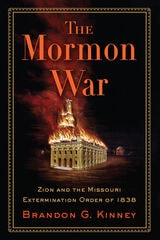
The Mormon War
Zion and the Missouri Extermination Order of 1838Brandon G. Kinney
Westholme Publishing, 2011
How the Violent Expulsion of the Mormons from Missouri Changed the History of America and the West
In 1831, Joseph Smith, Jr., the founder of the Church of Christ—later to be renamed the Church of Jesus Christ of Latter Day Saints—revealed that Zion, or “New Jerusalem,” was to be established in Jackson County, Missouri. Smith sent some of his followers to begin the settlement, but they were soon expelled by locals who were suspicious of their religion and their abolitionist sympathies. Smith led an expedition to regain the settlement, but was unsuccessful. Seven years later, in January 1838, Smith fled to Missouri from Ohio to avoid a warrant for his arrest, and joined the Mormon community in the town of Far West, which became the new Zion. The same prejudices recurred and the Mormons found themselves subject to attacks from non-Mormons, including attempts to prevent them from voting. Despite his abhorrence of violence, Smith decided that it was necessary for Mormons to defend themselves, which resulted in a short and sharp conflict known as the Mormon War. A covert Mormon paramilitary unit, the Danites, was formed to pillage non- Mormon towns, while angry rhetoric rose from both sides. After the Missouri state militia was attacked at the Battle of Crooked River, Missouri governor Liburn William Boggs issued Executive Order 44, which called for Mormons to be “exterminated or driven from the State.” Non-Mormons responded by attacking a Mormon settlement at Haun’s Mill, killing men and boys and firing on the women. Following this massacre, the state militia surrounded Far West and arrested Smith and other Mormon leaders. Smith was tried for treason and narrowly avoided execution, but was allowed to go and join the rest of his followers who were forced from Missouri to Illinois, where they founded their next major town, Nauvoo. There, Smith would be murdered and the church would split into several factions, with Brigham Young leading the movement’s largest group to Utah.
In The Mormon War: Zion and the Missouri Extermination Order of 1838, Brandon G. Kinney unravels the complex series of events that led to a religious and ideological war of both blood and words. The Mormon War not only challenged the protection afforded by the First Amendment, it foreshadowed the partisan violence over slavery and states’ rights that would erupt across Missouri and Kansas. The war also fractured Smith’s Church and led ultimately to the unexpected settlement of a vast area of the West as a Mormon homeland. By tracing the life of Joseph Smith, Jr. and his quest for Zion, the author reveals that the religion he founded was destined for conflict—both internal and external—as long as he remained its leader.
The New Mormon History
Revisionist Essays on the PastD. Michael Quinn
Signature Books, 1992
In this collection, D. Michael Quinn has selected fifteen essays which demonstrate the methods of this new history. Contributors include Thomas G. Alexander, James B. Allen, Leonard J. Arrington, Maureen Ursenbach Beecher, Eugene E. Campbell, Kenneth L. Cannon II, Mario S. DePillis, Robert B. Flanders, Klaus J. Hansen, William G. Hartley, Stanley S. Ivins, Dean L. May, Linda King Newell, B. H. Roberts, Jan Shipps, and Ronald W. Walker. Participants offer new ideas and give readers the opportunity to determine for themselves the relative success of these approaches by presenting examples. The collection demonstrates areas of interpretation that may be considered revisionist as well.
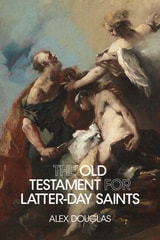
The Old Testament for Latter-day Saints
Douglas, Alex
Signature Books, 2023
This book also explores the intriguing ways in which Latter-day Saints have interpreted and engaged with this ancient text and the author navigates their diverse interpretations of it. He examines how individuals have alternately embraced the Old Testament as myth or history, law or legend, wise counsel or sacred scripture. He shows where many traditional interpretations have come from, and offers many ways to encourage a more nuanced understanding of the text.
Drawing from a wealth of scholarly research and his own unique perspective, Douglas presents a compelling and multidimensional analysis of the Old Testament. However readers approach the text, this book sheds light on the complex nature of the Old Testament and its enduring relevance to the Latter-day Saint tradition.
The September Six and the Struggle for the Soul of Mormonism
Patterson, Sara M.
Signature Books, 2023
The Sound of Mormonism
A Media History of Latter-day SaintsJared Farmer
Utah State University Press, 2024
The Arrington Lecture series, established in honor of one of the twentieth-century American West’s most distinguished historians, Leonard Arrington, has become a leading forum for prominent scholars to address topics related to Latter-day Saint history. Utah State University hosts the Leonard J. Arrington Mormon History Lecture Series through the Merrill-Cazier Library’s Special Collections and Archives.
The Testimony of Two Nations
How the Book of Mormon Reads, and Rereads, the BibleMichael Austin
University of Illinois Press, 2024
Like the Hebrew Bible and the Christian Bible, the Book of Mormon uses narratives to develop ideas and present instruction. Michael Austin reveals how the Book of Mormon connects itself to narratives in the Christian Bible with many of the same tools that the New Testament used to connect itself to the Hebrew Bible to create the Christian Bible. As Austin shows, the canonical context for interpreting the Book of Mormon includes the Christian Bible, the Book of Mormon itself, and other writings and revelations that hold scriptural status in most Restoration denominations. Austin pays particular attention to how the Book of Mormon connects itself to the Christian Bible both to form a new canon and to use the canonical relationship to reframe and reinterpret biblical narratives. This canonical context provides an important and fruitful method for interpreting the Book of Mormon.

This Is the Plate
Utah Food TraditionsEdited by Carol Edison, Eric A Eliason, and Lynne S McNeill
University of Utah Press, 2019
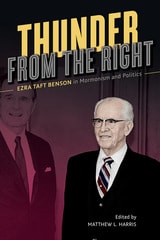
Thunder from the Right
Ezra Taft Benson in Mormonism and PoliticsEdited by Matthew L. Harris
University of Illinois Press, 2019
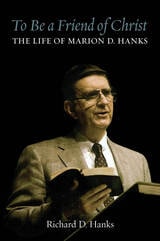
To Be a Friend of Christ
The Life of Marion D. HanksHanks, Richard D.
Signature Books, 2024
Marion Duff Hanks (1921–2011) was one of the most beloved and influential leaders of the Church of Jesus Christ of Latter-day Saints in the twentieth century, serving as a General Authority (senior leader) for forty years. He was also a leader of national import. As a recognized expert on youth, five US presidents appointed him to their President’s Council on Physical Fitness and Sports. Hanks also served as an executive leader of Rotary International and the Boy Scouts of America.
Author Richard Hanks draws on previously unavailable primary sources—journals, correspondence, notebooks, and recordings—to share this first and only authorized biography of his father. Hanks traces his father’s influence as he advocated for numerous changes in the institutional church, including humanitarian efforts, refugee relief services, missionary community service, a focus on mercy for the sinner, and a churchwide emphasis on “coming unto Christ.” A Renaissance man, Duff Hanks felt comfortable mingling with presidents and world leaders and speaking from pulpits and podiums to huge audiences and on television. But he found his greatest joy in assisting the individual, encouraging each in their personal search for happiness. Once, when asked about his goals, he replied, “My strongest desire is to qualify to be a friend of Christ.”