Results by title
80 books match the query 'Clergy' and 21 start with t
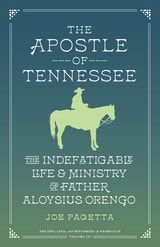
The Apostle of Tennessee
The Indefatigable Life and Ministry of Father Aloysius OrengoJoe Pagetta
Vanderbilt University Press, 2026
When Nashville became a Catholic diocese in 1837, it was mostly an aspirational exercise. The few Catholics scattered throughout the state were ministered to only occasionally by missionary priests who traveled by horseback from Kentucky. It is believed that Hugh Rogan, who arrived in Middle Tennessee in 1780 after working as a surveyor for the Continental Army, did not see a priest for fifty years.
That all changed when the Italian-born Father Aloysius “Luigi” Orengo arrived in Nashville in 1848. He traveled all over the state, sleeping in the woods, using his saddle for a pillow, and eating cheese and crackers. He’s credited with building churches in Franklin, Columbia, Pulaski, East Nashville, Tracy City, Gallatin, Humboldt, Brownsville, Grand Junction, Covington, Jackson, and McEwen.
But as influential as he was, Father Orengo’s story remained untold—until now.
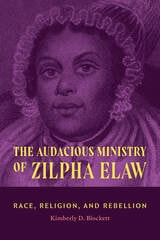
The Audacious Ministry of Zilpha Elaw
Race, Religion, and RebellionKimberly D. Blockett
Duke University Press, 2026
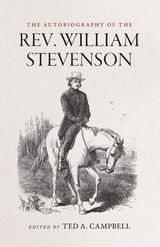
The Autobiography of the Rev. William Stevenson
Ted A. Campbell
Bridwell Press, 2024
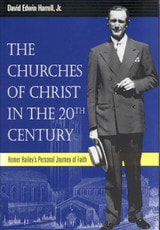
The Churches of Christ in the 20th Century
Homer Hailey's Personal Journey of FaithDavid Edwin Harrell
University of Alabama Press, 2002
The story of one of this country's major religious movements is told through the spiritual odyssey of one of its prominent spokesmen.
When Homer Hailey sparked controversy within Churches of Christ congregations over his stand on divorce and remarriage, he spoke to a movement already sundered. Historian David Edwin Harrell tells Hailey's story as a means of presenting the larger drama of faith and feuding within those churches.
A nondenominational movement of autonomous congregations, Churches of Christ have been among the fastest-growing religious bodies in the 20th century. Throughout the movement's history, church leaders debated issues ranging from missionary societies to the use of instrumental music in worship. Although some disagreements affected only the ties between congregations, others led to the creation of three distinct groups calling themselves Churches of Christ identified by their sociological and theological positions.
This book shows how the story of the Churches of Christ is reflected by Homer Hailey, a preacher, educator, and author whose life puts in perspective the personal journeys traveled by members in this century. Writing from the perspective of the non-institutional wing within the movement, Harrell avoids mainstream biases to describe the various dissenting views as fully and fairly as possible.
Combining institutional history and biography, Harrell's book is the first to bring the story of the Churches of Christ to century's end. It provides new insight into how this movement realigned itself and shows how one man's career reflected a century of spiritual growth and change for the church as a whole.
The Clerical Dilemma
Peter of Blois and Literate Culture in the Twelfth CenturyJohn D. Cotts
Catholic University of America Press, 2009
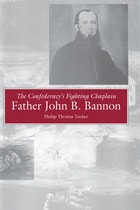
The Confederacy's Fighting Chaplain
Father John B. BannonPhillip Thomas Tucker
University of Alabama Press, 1992
The Confederacy’s Fighting Chaplain is the remarkable story of the Irishman who brought the Bible and his own resourcefulness and daring to both the battlefield and the diplomatic field—a story that has been largely ignored for more than 130 years. The biography of John B. Bannon also chronicles the forgotten Southerners—the Irish immigrants of the Confederacy—whose colorful and crucial role in the Civil War has been seriously neglected.
The Future is Mestizo
Life Where Culture Meet, Revised EditionVirgilio Elizondo
University Press of Colorado, 2000

The Heavenly Contract
Ideology and Organization in Pre-Revolutionary PuritanismDavid Zaret
University of Chicago Press, 1985
The Inner Lives of Medieval Inquisitors
Karen Sullivan
University of Chicago Press, 2011
There have been numerous studies in recent decades of the medieval inquisitions, most emphasizing larger social and political circumstances and neglecting the role of the inquisitors themselves. In this volume, Karen Sullivan sheds much-needed light on these individuals and reveals that they had choices—both the choice of whether to play a part in the orthodox repression of heresy and, more frequently, the choice of whether to approach heretics with zeal or with charity.
In successive chapters on key figures in the Middle Ages—Bernard of Clairvaux, Dominic Guzmán, Conrad of Marburg, Peter of Verona, Bernard Gui, Bernard Délicieux, and Nicholas Eymerich—Sullivan shows that it is possible to discern each inquisitor making personal, moral choices as to what course of action he would take. All medieval clerics recognized that the church should first attempt to correct heretics through repeated admonitions and that, if these admonitions failed, it should then move toward excluding them from society. Yet more charitable clerics preferred to wait for conversion, while zealous clerics preferred not to delay too long before sending heretics to the stake. By considering not the external prosecution of heretics during the Middles Ages, but the internal motivations of the preachers and inquisitors who pursued them, as represented in their writings and in those of their peers, The Inner Lives of Medieval Inquisitors explores how it is that the most idealistic of purposes can lead to the justification of such dark ends.
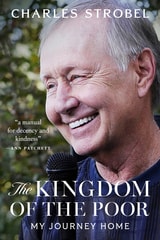
The Kingdom of the Poor
My Journey HomeEdited by Katie Seigenthaler and Amy Frogge
Vanderbilt University Press, 2024
The “why” of Charlie Strobel’s life, which was devoted to helping those without support systems and homes to call their own, was a simple belief that we are all poor and we are all worthy of love.
The Kingdom of the Poor is the story of the people and experiences that led him to this understanding and inspired him to live his life accordingly.
The Perils and Prospects of Southern Black Leadership
Gordon Blaine Hancock, 1884–1970Raymond Gavins
Duke University Press, 1993
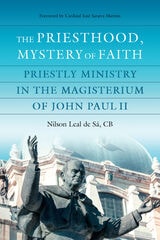
The Priesthood, Mystery of Faith
Priestly Ministry in the Magisterium of John Paul IINilson Leal de Sa, CB
Catholic University of America Press, 2022

The Psalms of Israel Jones
A NovelEd Davis
West Virginia University Press, 2014
Secrets and snakes, rock and gospel, guilt and grace.
The Psalms of Israel Jones is the story of a father and son’s journey towards spiritual redemption. This novel tells the tale of a famous father trapped inside the suffocating world of rock and roll, and his son who is stranded within the bounds of conventional religion.
When Reverend Thomas Johnson receives an anonymous phone call, he learns his Dylanesque rock star father is acting deranged on stage, where he’s being worshipped by a cult of young people who slash their faces during performances. In his declining years, Israel Jones has begun to incite his fans to violence. They no longer want to watch the show—they want to be the show.
Eager to escape troubles with his congregation as well as gain an apology from his dad for abandoning his family, Reverend Johnson leaves town and joins Israel Jones’s Eternal Tour. This decision propels him to the center of a rock and roll hell, giving him one last chance to reconnect with his father, wife, congregation—and maybe even God.
The Psalms of Israel Jones is the 2010 Hackney Literary Award winner for an unpublished manuscript.
The Reader's Repentance
Women Preachers, Women Writers, and Nineteenth-Century Social DiscourseChristine L. Krueger
University of Chicago Press, 1992
Christine L. Krueger persuasively argues that Evangelical Christianity, by assuming the spiritual equality of women and men and the moral superiority of middle-class women, opened a space for the linguistic empowerment of women and fostered the emergence of women orators and writers who, in complex and contradictory ways, became powerful public figures. In the light of unpublished or long out-of-print writing by eighteenth- and nineteenth-century women preachers, Krueger shows how these women drew on religious language to critique forms of male domination, promote female political power, establish communities of women, and, most significantly, feminize social discourse. She traces the legacy of these preachers through the work of writers as diverse as Hannah More, Charlotte Elizabeth Tonna, Elizabeth Gaskell, and George Eliot—women who, despite political differences, shared an evangelical strategy for placing women's concerns on the social agenda of their time.
Documenting and analyzing the tradition of women's preaching as a powerful and distinctly feminist force in the development of nineteenth-century social fiction, The Reader's Repentance reconstitutes a significant chapter in the history of women and culture. This original work will be of interest to students of women's history, literature, and eighteenth- and nineteenth-century society.
The Revelation of Your Words
The New Evangelization and the Role of the Seminary Professor of Sacred ScriptureKevin Zilverberg
Saint Paul Seminary Press, 2021
The Reverend Jacob Bailey, Maine Loyalist
For God, King, Country, and for SelfJames S. Leamon
University of Massachusetts Press, 2012
Reverend Bailey's persistence in praying for the king and his refusal to publicize the Declaration of Independence from his Pownalborough pulpit aroused hostilities that drove him and his family to the safety of Nova Scotia. There, in exile, Bailey devoted himself to assisting fellow refugees while defending himself from others. During this time, he wrote almost obsessively: poems, dramas, novels, histories. Though few were ever completed, and even fewer published, in one way or another most of his writings depicted the trauma he underwent as a loyalist.
Leamon's study of the Reverend Jacob Bailey depicts the complex nature and burdens of one person's loyalism while revealing much about eighteenth-century American life and culture.
The Spiritual Formation of Seminarians
Learning to Live in Intimate and Unceasing Union with GodJames Keating
Catholic University of America Press, 2025
The Travels of Increase Joseph
A Historical Novel about a Pioneer PreacherJerry Apps
University of Wisconsin Press, 2010
Link Lake, Wisconsin, 1852: Preacher Increase Link and the Standalone Fellowship settle near a lake that they name in his honor. Increase’s gifted tongue calls people to his mission to protect the land: “Unless we take care of the land we shall all perish.” To finance the fellowship activities, Increase sells his special cure-all tonic—fifty cents per bottle!
Inspired by actual events that took place in upstate New York and Wisconsin in the mid-nineteenth century, The Travels of Increase Joseph is the first in Jerry Apps’s series set in fictional Ames County, Wisconsin. The four novels in the series—which also includes In a Pickle, Blue Shadows Farm, and the forthcoming Cranberry Red—all take place around Link Lake at different points in history. They convey Apps’s deep knowledge of rural life and his own concern for land stewardship.
The Travels of Reverend Olafur Egilsson
Karl Smari Hreinsson
Catholic University of America Press, 2016
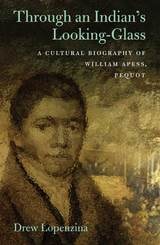
Through an Indian's Looking-Glass
A Cultural Biography of William Apess, PequotDrew Lopenzina
University of Massachusetts Press, 2017
The life of William Apess (1798–1839), a Pequot Indian, Methodist preacher, and widely celebrated writer, provides a lens through which to comprehend the complex dynamics of indigenous survival and resistance in the era of America's early nationhood. Apess's life intersects with multiple aspects of indigenous identity and existence in this period, including indentured servitude, slavery, service in the armed forces, syncretic engagements with Christian spirituality, and Native struggles for political and cultural autonomy. Even more, Apess offers a powerful and provocative voice for the persistence of Native presence in a time and place that was long supposed to have settled its “Indian question” in favor of extinction.
Through meticulous archival research, close readings of Apess's key works, and informed and imaginative speculation about his largely enigmatic life, Drew Lopenzina provides a vivid portrait of this singular Native American figure. This new biography will sit alongside Apess's own writing as vital reading for those interested in early America and indigeneity.
To Do Justice
The Civil Rights Ministry of Reverend Robert E. HughesRandall C. Jimerson
University of Alabama Press, 2022
A minister’s call to justice in the struggle for civil rights.
A native Alabamian, Reverend Robert E. Hughes worked full-time in the civil rights movement as executive director of the Alabama Council of Human Relations, where he developed a close relationship with Dr. Martin Luther King Jr. After facing backlash from the Ku Klux Klan, spending four days in jail for refusing to disclose ACHR membership lists, and ultimately being forced to leave the state of Alabama, he served as a Methodist missionary in Southern Rhodesia (now part of Zimbabwe). After two years of organizing Black liberation groups, he was banned as a “prohibited immigrant” by the Ian Smith government. His lifelong commitment to social justice, racial equality, and peaceful resolution of conflicts marks a fascinating career richly documented in this comprehensive biography.
To Do Justice: The Civil Rights Ministry of Reverend Robert E. Hughes traces the life and career of an admirable and lesser-known civil rights figure who fought injustice on two continents. This account presents valuable new evidence about the civil rights movement in the United States as well as human rights and liberation issues in colonial Southern Rhodesia in the years leading up to independence and self-rule. It provides an intimate portrait of a courageous individual who worked outside of the public spotlight but provided essential support and informational resources to public activists and news reporters
Randall C. Jimerson explores the interwoven threads of race relations and religious beliefs on two continents, focusing on the dual themes of the American civil rights movement and the African struggles for decolonization and majority rule. The life and career of Robert Hughes provide insight into the international dimensions of racial prejudice and discrimination that can be viewed in comparative context to similar oppressions in other colonial lands.