Results by title
65 books match the query 'Comedy' and 22 start with t
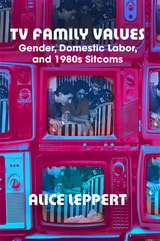
TV Family Values
Gender, Domestic Labor, and 1980s SitcomsAlice Leppert
Rutgers University Press, 2019
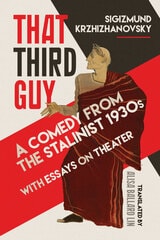
That Third Guy
A Comedy from the Stalinist 1930s with Essays on TheaterSigizmund Krzhizhanovsky, Translated and edited by Alisa Ballard Lin, Foreword by Caryl Emerson
University of Wisconsin Press, 2018
The volume also features selections from Krzhizhanovsky's compelling and idiosyncratic essays on Shakespeare, Pushkin, Shaw, and the philosophy of theater. Professionally, he worked with director Alexander Tairov at the Moscow Kamerny Theater, and his original philosophy of the stage bears comparison with the great theater theorists of the twentieth century. In these writings, he reflects on the space and time of the theater, the resonance of language onstage, the experience of the actor, and the relationship between the theater and the everyday. Commentary by Alisa Ballard Lin and Caryl Emerson contextualizes Krzhizhanovsky's writings.
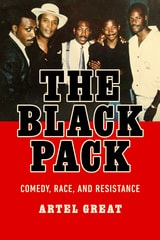
The Black Pack
Comedy, Race, and ResistanceArtel Great
Rutgers University Press, 2025
Working together as writers, directors, producers, actors, and consultants, the Black Pack created some of the most provocative and enduring Black films and television shows of the twentieth century, including classic productions like In Living Color, Coming to America, Hollywood Shuffle, and The Arsenio Hall Show. The Black Pack collective was armed with a signature comedic style which combined politically-Black satire with edgy social humor that entertained millions, shattered box-office records, and slyly critiqued America’s racial condition. Amid escalating social tensions in the 1980s, the Black Pack’s comedic output transformed anger into art, wielding the cloak of humor as a rebellious tool to confront unjust business practices in Hollywood and challenge racial narratives embedded in American culture. Their work empowered unapologetically Black voices and expanded creative possibilities for Black artists in the entertainment industry.
In The Black Pack, Artel Great delivers the most comprehensive analysis of this groundbreaking comedy collective, uncovering how the group’s socially and politically-charged humor defied systemic barriers to achieve unprecedented commercial success and establish a cultural legacy that continues to inspire media creators today and across new generations.

The Castaways
How Producers Lost Their Independence and Conjured Up the Outsider SitcomLarry Durst
Rutgers University Press, 2027
In the early 1960s a new style of situation comedy took over primetime as Bewitched, Gilligan’s Island, Gomer Pyle, U.S.M.C., I Dream of Jeannie, My Favorite Martian, and other “Outsider Sitcoms” featuring alien characters disrupting their TV environments shot to the top of the ratings. Departing from a critical approach that understands these series as reflections of the decade’s many social disruptions, The Castaways reveals the programs as emotional responses by their creators to a more personal upheaval: their loss of influence in the broadcast industry. As network executives turned increasingly to audience research, independent producers felt the ability that had been most crucial to their success in broadcasting was being devalued: gut creative intuition. Drawing on memoirs, show treatments, and other original documents, The Castaways uncovers how leading characters on the programs served as emotional proxies for their creators’ fears of industry irrelevance as they were cast out from the corporate halls of power where their series’—and personal—fates were decided.
The Comedy Studies Reader
Edited by Nick Marx and Matt Sienkiewicz
University of Texas Press, 2018
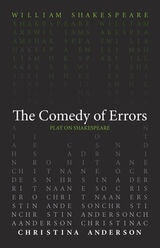
The Comedy of Errors
William Shakespeare
Arizona Center for Medieval and Renaissance Studies, 2022
One of Shakespeare’s earliest plays, The Comedy of Errors is a farcical tale of separated twins and mistaken identities. This slapstick play is a staple of the genre, including madcap bawdiness, love at first sight, reunions, and happily-ever-afters. Christina Anderson’s translation dives deep into the joy of the original text, reinterpreting the metaphor, antiquated slang, and double and triple entendre for a contemporary audience.
This translation of The Comedy of Errors was written as part of the Oregon Shakespeare Festival’s Play On! project, which commissioned new translations of thirty-nine Shakespeare plays. These translations present work from “The Bard” in language accessible to modern audiences while never losing the beauty of Shakespeare’s verse. Enlisting the talents of a diverse group of contemporary playwrights, screenwriters, and dramaturges from diverse backgrounds, this project reenvisions Shakespeare for the twenty-first century. These volumes make these works available for the first time in print—a new First Folio for a new era.
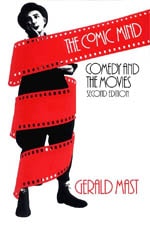
The Comic Mind
Comedy and the MoviesGerald Mast
University of Chicago Press, 1979
Blending information with interpretation, description with analysis, Mast traces the development of screen comedy from the first crude efforts of Edison and Lumière to the subtlety and psychological complexity of Annie Hall. As he guides the reader through detailed discussions of specific films, Mast reveals the structures, the values, and the cinematic techniques which have appeared and reappeared in comic cinema.
The second edition of The Comic Mind treats the comic developments of the 1970s in terms of the traditions of film comedy set forth in the first edition, including a discussion of the evolution of Jacques Tati and the emergence of Mel Brooks and Woody Allen as the two greatest American comic stylists of the seventies.
"The most comprehensive study of film comedy yet written in English. . . .The book's extensive index with references to companies from which 16mm prints of many of the cited films may be rented will be of great value to the film teacher and audiovisual librarian."—Choice
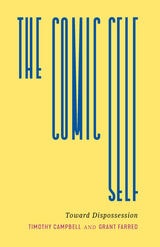
The Comic Self
Toward DispossessionTimothy C. Campbell
University of Minnesota Press, 2023
A provocative and unconventional call to dispossess the self of itself
Challenging the contemporary notion of “self-care” and the Western mania for “self-possession,” The Comic Self deploys philosophical discourse and literary expression to propose an alternate and less toxic model for human aspiration: a comic self. Timothy Campbell and Grant Farred argue that the problem with the “care of the self,” from Foucault onward, is that it reinforces identity, strengthening the relation between I and mine. This assertion of self-possession raises a question vital for understanding how we are to live with each other and ourselves: How can you care for something that is truly not yours?
The answer lies in the unrepresentable comic self. Campbell and Farred range across philosophy, literature, and contemporary comedy—engaging with Socrates, Burke, Hume, Hegel, Marx, Nietzsche, Heidegger, Derrida, Deleuze, and Levinas; Shakespeare, Cervantes, Woolf, Kafka, and Pasolini; and Stephen Colbert, David Chappelle, and the cast of Saturday Night Live. They uncover spaces where the dispossession of self and, with it, the dismantling of the regime of self-care are possible. Arguing that the comic self always keeps a precarious closeness to the tragic self, while opposing the machinations of capital endemic to the logic of self-possession, they provide a powerful and provocative antidote to the tragic self that so dominates the tenor of our times.
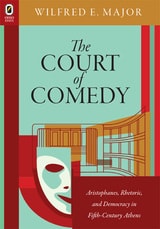
The Court of Comedy
Wilfred E. Major
The Ohio State University Press, 2013

The Cultural Set Up of Comedy
Affective Politics in the United States Post 9/11Julie Webber
Intellect Books, 2013
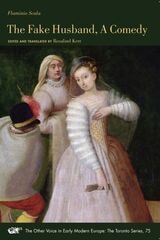
The Fake Husband, A Comedy
Flaminio Scala
Iter Press, 2020
The Other Voice in Early Modern Europe - The Toronto Series, volume 75
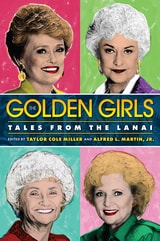
The Golden Girls
Tales from the LanaiTaylor Cole Miller
Rutgers University Press, 2025
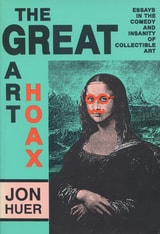
The Great Art Hoax
Essays in the Comedy and Insanity of Collectible ArtJon Huer
University of Wisconsin Press, 1990
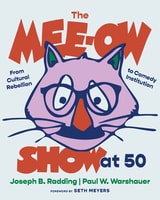
The Mee-Ow Show at 50
From Cultural Rebellion to Comedy InstitutionJoseph B. Radding and Paul W. Warshauer
Northwestern University Press, 2025
The fifty-year history of the Mee-Ow Show at Northwestern University and its influence on contemporary comedy
In the fall of 1973, two students at Northwestern University resolved to create something on stage that was wholly their own. Soon, they would be joined by a cohort of performers, musicians, and staff, and the resulting production would go on to launch the careers of scores of entertainment professionals, including some of the most well-known and awarded names in comedy today. This book is not only an account of the rebellious fifty-year history of the Mee-Ow Show, now the longest-running student sketch comedy and improv show in the country, but also its far-reaching influence. The storied group’s alumni include such household names as Craig Bierko, Ana Gasteyer, Julia Louis-Dreyfus, John Cameron Mitchell, Dermot Mulroney, Seth Meyers, and Kristen Schaal.
Based on more than a hundred new interviews with group members, presenting their words alongside never-before-published photographs and ephemera, The Mee-Ow Show at 50 provides a chronicle of the last half-century of the American undergraduate experience—and reveals how, from New York to Los Angeles, contemporary comedy can trace its roots to an upstart student production in Evanston, Illinois.
The Principles of Comedy Improv
Truths, Tales, and How to ImproviseTom Blank
University of Iowa Press, 2023
The Queer Fantasies of the American Family Sitcom
Pugh, Tison
Rutgers University Press, 2018
The Queer Fantasies of the American Family Sitcom examines the evasive depictions of sexuality in domestic and family-friendly sitcoms. Tison Pugh charts the history of increasing sexual depiction in this genre while also unpacking how sitcoms use sexuality as a source of power, as a kind of camouflage, and as a foundation for family building. The book examines how queerness, at first latent, became a vibrant yet continually conflicted part of the family-sitcom tradition.
Taking into account elements such as the casting of child actors, the use of and experimentation with plot traditions, the contradictory interpretive valences of comedy, and the subtle subversions of moral standards by writers and directors, Pugh points out how innocence and sexuality conflict on television. As older sitcoms often sit on a pedestal of nostalgia as representative of the Golden Age of the American Family, television history reveals a deeper, queerer vision of family bonds.
Download open access ebook here.
The Time of Laughter
Comedy and the Media Cultures of JapanDavid Humphrey
University of Michigan Press, 2023
The Tragedy and Comedy of Life
Plato's PhilebusPlato
University of Chicago Press, 1993
In The Tragedy and Comedy of Life, Seth Benardete focuses on the idea of the good in what is widely regarded as one of Plato's most challenging and complex dialogues, the Philebus. Traditionally the Philebus is interpreted as affirming the doctrine that the good resides in thought and mind rather than in pleasure or the body. Benardete challenges this view, arguing that Socrates vindicates the life of the mind over the life of pleasure not by separating the two and advocating a strict asceticism, but by mixing pleasure and pain with mind in such a way that the philosophic life emerges as the only possible human life.
Benardete combines a probing and challenging commentary that subtly mirrors and illuminates the complexities of this dialogue with the finest English translation of the Philebus yet available. The result is a work that will be of great value to classicists, philosophers, and political theorists alike.
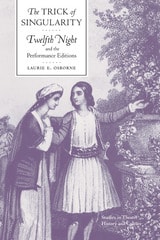
The Trick of Singularity
"Twelfth Night" and the Performance EditionsLaurie E. Osborne
University of Iowa Press, 1996
In this innovative union of textual studies and performance criticism, Laurie Osborne explores the important ways in which an apparently single, unproblematic text is in fact multiple and various. Through a close analysis of the performance editions of Twelfth Night, she argues that the complex interaction between text and performance establishes a comedy as a work realized within changing social and erotic constructions.
Because it appears in a relatively clean and dated version in the Folio, Twelfth Night seems to be exempt from arguments for variant texts—but there are significant and persistent variations represented in the performance editions. Osborne's careful reading of these provides a crucial bridge linking theatre history and textual criticism. She employs a wide variety of approaches and disciplines—Shakespearean and Renaissance studies, theatre history, gender studies, contemporary literary criticism, and cultural history—to provide a fresh and engaging yet rigorous view.
Although she focuses on Twelfth Night, Osborne's argument applies more broadly to the history of performance and criticism, including a chapter on video versions of the play. Widely read in Shakespearean and Renaissance scholarship, she employs her archival research in promptbooks, the publishing history of the plays, and the history of Shakespearean production to accomplish a major job of scholarly integration and analysis of Shakespearean drama in performance.
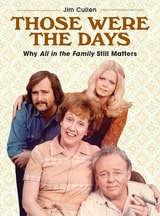
Those Were the Days
Why All in the Family Still MattersJim Cullen
Rutgers University Press, 2020
Between 1971 and 1979, All in the Family was more than just a wildly popular television sitcom that routinely drew 50 million viewers weekly. It was also a touchstone of American life, so much so that the living room chairs of the two main characters have spent the last 40 years on display at the Smithsonian. How did a show this controversial and boundary-breaking manage to become so widely beloved?
Those Were the Days is the first full-length study of this remarkable television program. Created by Norman Lear and produced by Bud Yorkin, All in the Family dared to address such taboo topics as rape, abortion, menopause, homosexuality, and racial prejudice in a way that no other sitcom had before. Through a close analysis of the sitcom’s four main characters—boorish bigot Archie Bunker, his devoted wife Edith, their feminist daughter Gloria, and her outspoken liberal husband Mike—Jim Cullen demonstrates how All in the Family was able to bridge the generation gap and appeal to a broad spectrum of American viewers in an age when a network broadcast model of television created a shared national culture.
Locating All in the Family within the larger history of American television, this book shows how it transformed the medium, not only spawning spinoffs like Maude and The Jeffersons, but also helping to inspire programs like Roseanne, Married... with Children, and The Simpsons. And it raises the question: could a show this edgy ever air on broadcast television today?
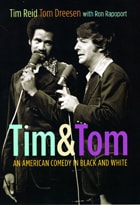
Tim and Tom
An American Comedy in Black and WhiteTim Reid and Tom Dreesen with Ron Rapoport
University of Chicago Press, 2008
Tim and Tom tells the story of that pioneering duo, the first interracial comedy team in the history of show business--and the last. Tim Reid and Tom Dreesen polished their act in the nightclubs of Chicago, then took it on the road, not only in the North, but in the still-simmering South as well, developing routines that even today remain surprisingly frank--and remarkably funny--about race. Most nights, the shock of seeing an integrated comedy team quickly dissipated in uproarious laughter, but on some occasions the audience’s confusion and discomfort led to racist heckling, threats, and even violence. Though Tim and Tom perpetually seemed on the verge of making it big throughout their five years together, they grudgingly came to realize that they were ahead of their time: America was not yet ready to laugh at its own failed promise.
Eventually, the grind of the road took its toll, as bitter arguments led to an acrimonious breakup. But the underlying bond of friendship Reid and Dreesen had forged with each groundbreaking joke has endured for decades, while their solo careers delivered the success that had eluded them as a team. By turns revealing, shocking, and riotously funny, Tim and Tom unearths a largely forgotten chapter in the history of comedy.
Tragedy Plus Time
National Trauma and Television ComedyBy Philip Scepanski
University of Texas Press, 2021
Following the most solemn moments in recent American history, comedians have tested the limits of how soon is “too soon” to joke about tragedy. Comics confront the horrifying events and shocking moments that capture national attention and probe the acceptable, or “sayable,” boundaries of expression that shape our cultural memory. In Tragedy Plus Time, Philip Scepanski examines the role of humor, particularly televised comedy, in constructing and policing group identity and memory in the wake of large-scale events.
Tragedy Plus Time is the first comprehensive work to investigate tragedy-driven comedy in the aftermaths of such traumas as the JFK assassination and 9/11, as well as during the administration of Donald Trump. Focusing on the mass publicization of television comedy, Scepanski considers issues of censorship and memory construction in the ways comedians negotiate emotions, politics, war, race, and Islamophobia. Amid the media frenzy and conflicting expressions of grief following a public tragedy, comedians provoke or risk controversy to grapple publicly with national traumas that all Americans are trying to understand for themselves.