Results by title
355 books match the query 'Communism, Post-Communism & Socialism' and 72 start with t

Terms of Disorder
Keywords for an InterregnumAlberto Toscano
Seagull Books, 2023
There is widespread agreement, across a voluble political spectrum and around the planet, that we live in times of intensifying insecurity and turmoil. If ours is an age of transition, its direction is anything but certain. Momentous transformations in ecology, geopolitics, and everyday life are shadowed by a suffocating sense of stasis. The limits to capital and the limits of nature are entangled in frightful ways, while the profoundly obsolete form of leadership, domination, and conflict exacerbate an already baleful situation. And yet struggles for liberation have not been quelled. Terms of Disorder confronts this moment by probing some of the defining terms in the modern vocabulary of emancipation, with the aim of testing their capacity to name and orient collective action set on abolishing the present state of things. Ranging from communism to leadership, the eleven keywords addressed in this book provide a set of interlocking points of entry into the common task of forging a political language capable of navigating our disorientation. If, as Gramsci famously noted, the interregnum is a time when the new struggles to be born while the old order is moribund, we may wish to heed Cedric Robinson’s call to “choose wisely among the dying.”

The Agrarian Question Volume 1
Karl Kautsky
Pluto Press, 1988
Lenin described The Agrarian Question as the first systematic Marxist study of capitalism and agriculture and the most important event in economic literature since the third volume of Capital. This great work is regarded as Kautsky's main achievement and is a classic work of analysis.
Kautsky's pariah status in the eyes of revolutionary Marxists resulted in many years of neglect, but his role and work are now commanding great attention. The analysis of the transformation of peasant economies by capital in The Agrarian Question is now seen as particularly relevant to contemporary Third World peasant economies.
This remarkable translation, which brings out the humanity - and the humour - in Kautksy's writing, is more than a work of economic analysis: in a manner ahead of his time, Kautsky integrates questions of political strategy, ecology, sexuality and the family.
The illuminating reassessment of The Agrarian Question in the introduction by Professor Teodor Shanin and Hamza Alavi examines in detail the political context, Kautsky's own life, the development of Kautsky's ideas within the work, and its contribution to our understanding of the world today. This timely re-evaluation of Kautsky's significance is long overdue.
The Agrarian Question Volume 2
Karl Kautsky
Pluto Press, 1988
Lenin described The Agrarian Question as the first systematic Marxist study of capitalism and agriculture and the most important event in economic literature since the third volume of Capital. This great work is regarded as Kautsky's main achievement and is a classic work of analysis.
Kautsky's pariah status in the eyes of revolutionary Marxists resulted in many years of neglect, but his role and work are now commanding great attention. The analysis of the transformation of peasant economies by capital in The Agrarian Question is now seen as particularly relevant to contemporary Third World peasant economies.
This remarkable translation, which brings out the humanity - and the humour - in Kautksy's writing, is more than a work of economic analysis: in a manner ahead of his time, Kautsky integrates questions of political strategy, ecology, sexuality and the family.
The illuminating reassessment of The Agrarian Question in the introduction by Professor Teodor Shanin and Hamza Alavi examines in detail the political context, Kautsky's own life, the development of Kautsky's ideas within the work, and its contribution to our understanding of the world today. This timely re-evaluation of Kautsky's significance is long overdue.
The Ambivalence of Power in the Twenty-First Century Economy
Cases from Russia and BeyondEdited by Vadim Radaev and Zoya Kotelnikova
University College London, 2022
This book explores the ambivalent nature of power as wielded in economic practices from an empirical perspective. It offers a collection of country-based cases and critically assesses the existing conceptions of power from a cross-disciplinary perspective. Analyzing power at the macro, meso, and micro levels allows the volume to highlight the complexity of political economy in the twenty-first century. Each chapter addresses key elements of a given political economy (from the ambivalence of the cases of former communist countries that do not conform with the grand narratives about democracy and markets to the dual utility of new technologies such as face-recognition), thus providing mounting evidence for the centrality of understanding ambivalence in the analysis of power.
The Anatomy of Post-Communist Regimes
A Conceptual FrameworkBálint Magyar
Central European University Press, 2021
Offering a single, coherent framework of the political, economic, and social phenomena that characterize post-communist regimes, this is the most comprehensive work on the subject to date. Focusing on Central Europe, the post-Soviet countries and China, the study provides a systematic mapping of possible post-communist trajectories.
At exploring the structural foundations of post-communist regime development, the work discusses the types of state, with an emphasis on informality and patronalism; the variety of actors in the political, economic, and communal spheres; the ways autocrats neutralize media, elections, etc. The analysis embraces the color revolutions of civil resistance (as in Georgia and in Ukraine) and the defensive mechanisms of democracy and autocracy; the evolution of corruption and the workings of “relational economy”; an analysis of China as “market-exploiting dictatorship”; the sociology of “clientage society”; and the instrumental use of ideology, with an emphasis on populism. Beyond a cataloguing of phenomena—actors, institutions, and dynamics of post-communist democracies, autocracies, and dictatorships—Magyar and Madlovics also conceptualize everything as building blocks to a larger, coherent structure: a new language for post-communist regimes.
While being the most definitive book on the topic, the book is nevertheless written in an accessible style suitable for both beginners who wish to understand the logic of post-communism and scholars who are interested in original contributions to comparative regime theory. The book is equipped with QR codes that link to www.postcommunistregimes.com, which contains interactive, 3D supplementary material for teaching.
The Anthrobscene
Jussi Parikka
University of Minnesota Press, 2014
Forerunners: Ideas First is a thought-in-process series of breakthrough digital publications. Written between fresh ideas and finished books, Forerunners draws on scholarly work initiated in notable blogs, social media, conference plenaries, journal articles, and the synergy of academic exchange. This is gray literature publishing: where intense thinking, change, and speculation take place in scholarship.
The Anti-Capitalist Book of Fashion
Tansy E.
Pluto Press, 2022
The award-winning classic on why we must revolutionise the fashion industry
*Selected by Emma Watson for her Ultimate Book List*
Fashion is political. From the red carpets of the Met Gala to online fast fashion, clothes tell a story of inequality, racism, and climate crisis. In The Anti-Capitalist Book of Fashion, Tansy E. Hoskins unpicks the threads of capitalist industry to reveal the truth about our clothes.
Fashion brands entice us to consume more by manipulating us to feel ugly, poor and worthless, sentiments that line the pockets of billionaires exploiting colonial supply chains. Garment workers on poverty pay risk their lives in dangerous factories, animals are tortured, fossil fuels extracted and toxic chemicals spread just to keep this season's collections fresh.
We can do better than this. Moving between Karl Lagerfeld and Karl Marx, The Anti-Capitalist Book of Fashion goes beyond ethical fashion and consumer responsibility showing that if we want to feel comfortable in our clothes, we need to reshape the system and ensure this is not our last season.
The Anti-Capitalist Chronicles
David Harvey
Pluto Press, 2020
Amidst waves of economic crises, health crises, class struggle and neo-fascist reaction, few possess the clarity and foresight of world-renowned theorist, David Harvey. Since the publication of his bestselling A Brief History of Neoliberalism, Harvey has been tracking the evolution of the capitalist system as well as tides of radical opposition rising against it. In The Anti-Capitalist Chronicles, Harvey introduces new ways of understanding the crisis of global capitalism and the struggles for a better world.
While accounting for violence and disaster, Harvey also chronicles hope and possibility. By way of conversations about neoliberalism, capitalism, globalization, the environment, technology, social movements and crises like COVID-19, he outlines, with characteristic brilliance, how socialist alternatives are being imagined under very difficult circumstances.
In understanding the economic, political and social dimensions of the crisis, Harvey’s analysis in The Anti-Capitalist Chronicles will be of strategic importance to anyone wanting to both understand and change the world.
The Collectivization of Agriculture in Communist Eastern Europe
Comparison and EntanglementsConstantin Iordachi
Central European University Press, 2014
The Communal Experience
Anarchist and Mystical Communities in Twentieth Century AmericaLaurence R. Veysey
University of Chicago Press, 1978
Veysey compares the history of secular communities such as the early Ferrer Colony and Modern School, of Shelton, New Jersey, with contemporary anarchist communities in New York, Vermont, and New Mexico. Religious communes—"Communities of Discipline"—such as the Vedanta monasteries of the early twentieth century are compared with contemporary mystical communities in New Mexico. Distinctions between the anarchist and the mystical groups are most obvious from their approach to communal life. As Veysey shows, anarchist communities are loose, unstructured, voluntaristic; the mystics establish more rigid life-styles, focus on spiritual leaders, and hold community a secondary goal to self-realization. In a new preface written for this Phoenix Edition, he describes his return to a New Mexican mystical community and the changes that have occurred in the six years since his last visit.
The Communist Party in Maryland, 1919-57
Vernon L. Pedersen
University of Illinois Press, 2001
Bolsheviks in Baltimore charts the uneven transformation of Baltimore's fledgling Communists into underground revolutionaries in the 1920s. Pedersen documents the mercurial careers of local organizers, their devotion to the Soviet cause, and their efforts to convert the Party from a hodgepodge of ethnic groups to an effective instrument of class interests. He also tracks the public's changing perception of the Communists, from amused unconcern to alarm, and details how the Ober antisubversive law and the HUAC hearings of the 1950s dismantled the Party from without while planting seeds of paranoia that destroyed it from within.
Behind the public fear of a Communist conspiracy against the U.S. government, Pedersen finds a party fractured by conflicting agendas, ineffectual leadership, and unstable membership. However, he also uncovers new evidence that Communists in the United States, acting on Soviet orders, used their influence in unions and front groups to sway American foreign policy in ways that benefited the Soviet Union. He documents the consolidation of an espionage apparatus in Baltimore and demonstrates that while espionage activities may have involved only a few individuals, all Party members shared an attitude of willing support for the activities of the Soviet Union that made these covert practices possible.
Paying tribute to the fervor and the effort dedicated by the Maryland Communists, often at the expense of their own physical and financial well-being, to a cause that ultimately failed them, Bolsheviks in Baltimore assesses an ambiguous legacy of admirable social vision, haphazard international conspiracy, and fierce internal conflict.
The Crisis of Socialism in Europe
Christiane Lemke and Gary Marks, eds.
Duke University Press, 1991
The collection begins with an historical overview of socialism in Western Europe and moves toward the suggestion of a framework for a post-socialist discourse. Among the topics covered are: the birth and death of communism and a regime type in Eastern Europe; how different forms of national communism were smothered by Sovietization in the postwar period; the origins of revolutions in Eastern Europe; the potential for social democracy in Hungary; the role of the Left in a reunified German; and directions for the Left in general.
Contributors. Geoff Eley, Konrad Jarausch, Herbert Kitschelt, Christiane Lemke, Andrei Markovits, Gary Marks, Wolfgang Merkel, Norman Naimark, Iván and Szonja Szelénya, Sharon Wolchik
The Cuban Revolution in the 21st Century
George Lambie
Pluto Press, 2010
While most books and articles on Cuba seek to analyse the island’s socialist experiment from the perspective of internal dynamics or international relations, this book attempts to understand the revolutionary process as part of a counter-current against neoliberal globalisation.
Rather than presenting Cuba as a socialist survivor, whose performance must be measured against the standards set by the ‘international community’, George Lambie judges Cuban socialism on the goals which the revolution sets for itself. He shows that despite Cuba’s isolation in the ‘New World Order’, and the enormous pressures it has faced to ‘conform’, its faith in an alternative socialist project has continued and grown.
Now that neoliberalism is in crisis, Cuba’s promotion of socialist values is finding a renewed relevance. In this fascinating study Lambie argues that Cuba is again becoming a symbol, and practical example, of socialism in action. This book is essential reading for students of politics and Latin American studies.
The Discourse of Domination
From the Frankfurt School to PostmodernismBen Agger
Northwestern University Press, 1992
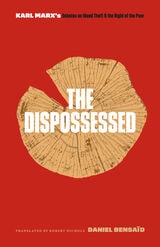
The Dispossessed
Karl Marx’s Debates on Wood Theft and the Right of the PoorDaniel Bensaïd
University of Minnesota Press, 2021
Excavating Marx’s early writings to rethink the rights of the poor and the idea of the commons in an era of unprecedented privatization
The politics of dispossession are everywhere. Troubling developments in intellectual property, genomics, and biotechnology are undermining established concepts of property, while land appropriation and ecological crises reconfigure basic institutions of ownership. In The Dispossessed, Daniel Bensaïd examines Karl Marx’s early writings to establish a new framework for addressing the rights of the poor, the idea of the commons, and private property as a social institution.
In his series of articles from 1842–43 about Rhineland parliamentary debates over the privatization of public lands and criminalization of poverty under the rubric of the “theft of wood,” Marx identified broader anxieties about customary law, property rights, and capitalist efforts to privatize the commons. Bensaïd studies these writings to interrogate how dispossession continues to function today as a key modality of power. Brilliantly tacking between past and present, The Dispossessed discloses continuity and rupture in our relationships to property and, through that, to one another.
In addition to Bensaïd’s prescient work of political philosophy, The Dispossessed includes new translations of Marx’s original “theft of wood” articles and an introductory essay by Robert Nichols that lucidly contextualizes the essays.
The End and the Beginning
The Revolutions of 1989 and the Resurgence of HistoryVladimir Tismaneanu
Central European University Press, 2012
The End of Czechoslovakia
Jirí Musil
Central European University Press, 1995
Scholars and practitioners from both sides of the divide, Czech and Slovak, as well as international experts, take an in-depth look at the causes of Czechoslovakia's break-up, and explain why a seemingly successful country should disintegrate so quickly after the collapse of the communist regime. Besides exploring the political processes leading to the split, the authors analyse the underlying social, economic and cultural differences between the two nations and examine the historical roots of the problems. Particular attention is paid to changing Czech and Slovak attitudes towards the common state and towards each other, from the heyday of the First Republic to the disillusionment of the post-1989 period.
The Future of Black Studies
Abdul Alkalimat
Pluto Press, 2022
At a turning point for the growing field of Black Studies, one of its founders looks to its future
'A timely, future-oriented and necessary contribution which provides clarity to the multivalent tendencies in this field' - Carole Boyce Davies
The marginalization of Black voices from the academy is a problem in the Western world. But Black Studies, where it exists, is a powerful, boundary-pushing discipline, grown out of struggle and community action. Here, Abdul Alkalimat, one of the founders of Black Studies in the US, presents a reimagining of the future trends in the study of the Black experience.
Taking Marxism and Black Experientialism, Afro-Futurist and Diaspora frameworks, he projects a radical future for the discipline at this time of social crisis. Choosing cornerstones of culture, such as the music of Sun Ra, the movie Black Panther and the writer Octavia Butler, he looks at the trajectory of Black liberation thought since slavery, including new research on the rise in the comparative study of Black people all over the world.
Turning to look at how digital tools enhance the study of the discipline, this book is a powerful read that will inform and inspire students and activists.
The Future of Totality
Fredric Jameson and the Prospects of Critical TheoryNicholas Brown, Maria Elisa Cevasco, Fabio Akcelrud Durão, and Robert T. Tally Jr., editors
Duke University Press, 2026
The Global Police State
William I Robinson
Pluto Press, 2020
"Karl Marx aspired to a world in which our animal needs would be satisfied and our human needs could be addressed. It is a realistic possibility now, as William Robinson outlines—or the alternative that is taking shape before our eyes: a 'global police state' controlled by narrowly concentrated capital with 'surplus humanity' left to survive somehow on its own. The choice is in our hands."
—Noam Chomsky, author of Who Rules the World?
As the world becomes ever more unequal, people become ever more “disposable.” Today, governments systematically exclude sections of their populations from society through heavy-handed policing. But it doesn't always go to plan.
William I. Robinson exposes the nature and dynamics of this out-of-control system, arguing for the urgency of creating a movement capable of overthrowing it. The global police state uses a variety of ingenious methods of control, including mass incarceration, police violence, US-led wars, the persecution of immigrants and refugees, and the repression of environmental activists.
He writes in his Introduction, “I offer a ‘big picture” of the emerging global police state in a short book that is eminently readable. The pages to follow may startle many readers and make them angry. I trust the work will serve as a warning of the dystopic future that is upon us. More importantly, by exposing the nature and dynamic of this out-of-control system, I hope it will contribute to the struggles to bring about an alternative future based on human freedom and liberation.”
Movements have emerged to combat the increasing militarization, surveillance and social cleansing; however, many of them appeal to a moral sense of social justice rather than addressing its root: global capitalism.
Using shocking data which reveals how far capitalism has become a system of repression, Robinson argues that the emerging megacities of the world are becoming the battlegrounds where the excluded and the oppressed face off against the global police state.
The Government of Mistrust
Illegibility and Bureaucratic Power in Socialist VietnamKen MacLean
University of Wisconsin Press, 2013
The Greatest Menace
Organized Crime in Cold War AmericaLee Bernstein
University of Massachusetts Press, 2002
The term Cold War has long been associated with the “red menace” of communism at home and abroad. Yet as Lee Bernstein shows in this illuminating study, during the 1950s the threat posed by organized crime preoccupied Americans at least as much as the fear of communist subversion. At the beginning of the decade, the televised hearings of Senator Estes Kefauver's crime committee, focusing on colorful mob figures such as Lucky Luciano and Frank Costello, attracted far more attention than the spy trial of Julius and Ethel Rosenberg. In the years that followed, public concern about gangsters and racketeering continued unabated, even after the anticommunist fever of McCarthyism had begun to subside.
Drawing on a broad range of evidence, from government records to films, television shows, and pulp novels, Bernstein explains how the campaign against organized crime, like the crusade against communism, reflected deep social and political anxieties. Just as the inquisitions of Senator McCarthy fed on popular fears of international conspiracy and alien infiltration, the anticrime investigations of the 1950s raised the specter of a foreign-based criminal cartel—the Sicilian Mafia— preying on a vulnerable American public. In both cases, the association of the foreign-born with criminal or un-American activity led to the creation of state and local citizens committees and to calls for new restrictions on immigration. Labor unions also came under attack, particularly after the McClellan Committee and its chief counsel, Robert F. Kennedy, claimed to have found a link between the International Brotherhood of Teamsters, led by Jimmy Hoffa, and the Mafia.
As Bernstein points out, despite significant changes in the way organized crime actually operated, and despite repeated protests from Italian Americans, the popular image of the sinister gangster persisted, because it served a more profound need. In an era marked by widespread uncertainty and rapid social change, the fight against a common enemy, real or imagined, helped forge a Cold War consensus across shifting lines of race, class, and ethnicity by redefining what it meant to be an American.
The Historiography of Communism
Michael E. Brown
Temple University Press, 2008
The Hungarian Patient
Social Opposition to an Illiberal DemocracyJon Van Til
Central European University Press, 2015
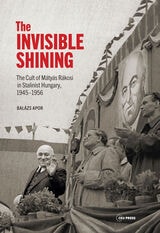
The Invisible Shining
The Cult of Mátyás Rákosi in Stalinist Hungary, 19451956Balazs Apor
Central European University Press, 2018
The Labor of Job
The Biblical Text as a Parable of Human LaborAntonio Negri
Duke University Press, 2009
The Labor of Job was first published in Italy in 1990. Negri began writing it in the early 1980s, while he was a political prisoner in Italy, and it was the first book he completed during his exile in France (1983–97). As he writes in the preface, understanding suffering was for him in the early 1980s “an essential element of resistance. . . . It was the problem of liberation, in prison and in exile, from within the absoluteness of Power.” Negri presents a Marxist interpretation of Job’s story. He describes it as a parable of human labor, one that illustrates the impossibility of systems of measure, whether of divine justice (in Job’s case) or the value of labor (in the case of late-twentieth-century Marxism). In the foreword, Michael Hardt elaborates on this interpretation. In his commentary, Roland Boer considers Negri’s reading of the book of Job in relation to the Bible and biblical exegesis. The Labor of Job provides an intriguing and accessible entry into the thought of one of today’s most important political philosophers.
The Long 1989
Decades of Global RevolutionKyrill Kunakhovich
Central European University Press, 2019
The Long Détente
Changing Concepts of Security and Cooperation in Europe, 1950s–1980sPoul Villaume
Central European University Press, 2017

The Long Night of the Watchman
Essays by Vaclav Benda, 1977-1989F. Flagg Taylor
St. Augustine's Press, 2017
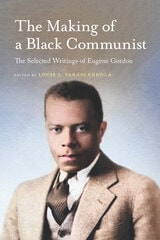
The Making of a Black Communist
The Selected Writings of Eugene GordonLouis J. Parascandola, Editor
University of Massachusetts Press, 2025
Eugene Gordon (1891–1974) was a major writer involved in the development of the burgeoning Black literary scene in Boston in the 1920s, an active player in the Harlem Renaissance, and a longtime member of the Communist Party. Despite his credentials as a reporter, editor, fiction writer, and political activist, he is rarely mentioned in studies of the Harlem Renaissance or Marxist politics. Here, Louis J. Parascandola has pulled together Gordon’s journalism, autobiographical writing, and fiction. This new collection, featuring both previously published pieces from a wide variety of publications as well as material that has never before been published, demonstrates his range and his skill while establishing his importance as a critical voice of his time.
Gordon was born and raised in the South but made his way north at a young age. In Boston, he founded the Saturday Evening Quill Club, an African American literary group that included other notable writers such as Helene Johnson and Dorothy West. He later became editor of and contributor to two major publications coming out of the era: the Messenger and Opportunity: A Journal of Negro Life. As he grew more political, he joined the Communist Party in the 1930s and became editor of and contributor to the New Masses. Scholars looking to research him have struggled to find disparate writings to get a fuller sense of his literary stylings as well as his political commitments. This welcome new volume establishes Gordon as a significant, understudied figure.
The Making of a Socialist Night
Society, Imagination and Everyday Life in Czechoslovakia 1945-1960Lucie Dusková
Central European University Press, 2026

The Man Who Stayed Behind
Sidney Rittenberg and Amanda Bennett
Duke University Press, 2001
Both a memoir and a documentary history of the Chinese revolution from 1949 through the Cultural Revolution, The Man Who Stayed Behind provides a human perspective on China’s efforts to build a new society. Critical of both his own mistakes and those of the Communist leadership, Rittenberg nevertheless gives an even-handed account of a country that is now free of internal war for the first time in a hundred years.
The Money Mandarins
The Making of a Supranational Economic OrderHoward M. Wachtel
Pluto Press, 1991
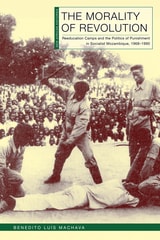
The Morality of Revolution
Reeducation Camps and the Politics of Punishment in Socialist Mozambique, 1968–1990Benedito Luís Machava
Ohio University Press, 2024
The Moulding of Ukraine
The Constitutional Politics of State FormationKataryna Wolczuk
Central European University Press, 2002

The Muslim Brotherhood
Ideology, History, DescendantsJoas Wagemakers
Amsterdam University Press, 2022
The Passing of an Illusion
The Idea of Communism in the Twentieth CenturyFrançois Furet
University of Chicago Press, 1999
"This may well be the most illuminating study ever devoted to the question of appeal exerted not only by Communism but also by the Nazi and other fascist varieties of totalitarianism in this century."—Hilton Kramer, New Criterion
"A subtle, nuanced but gripping study of the most pervasive and destructive illusion in the 20th century." —Kirkus Reviews, starred review
"The Passing of an Illusion . . . is both a profound work of intellectual history that takes its place alongside other great studies of the leftist heresy . . . and a relentless diagnosis of the self-subversive risks that are inherent in democratic regimes. "—Roger Kaplan, Washington Times
" A remarkable book. . . . Stimulating and challenging. . . . A man widely read in several languages, Furet clearly knew his way around 20th-century Europe, even unto the dark alleys that figure on no existing map. "—Mark Falcoff, Commentary
"A history of ideas, this work is not for the faint of heart, yet those who challenge it will discover a signal contribution to the literature of Communism."—Booklist
"Imperious and stunningly confident, grand in conception and expansive in manner, packed with fascinating detail and often incisive judgements."—John Dunn, Times Higher Education Supplement
"The Passing of an Illusion is brilliant, and one would be hard pressed to find better writing of history than the first chapter, which traces the roots of modern political thinking back to the nineteenth century."—J. Arch Getty, Atlantic Monthly
"A brilliant and important book. . . . The publication of the American edition makes accessible to the general reader the most thought-provoking historical assessment of communism in Europe to appear since its collapse."—Jeffrey Herf, Wall Street Journal
François Furet (1927-1997), educator and author, was a Chevalier of the Legion of Honor and was elected, in 1997, to become one of the "Forty Immortals" of the Académie Française, the highest intellectual honor in France. His many books include Interpreting the French Revolution, Marx and the French Revolution, and Revolutionary France. Deborah Furet, his widow, collaborated with him on many projects.
The Philosopher and His Poor
Jacques Rancière
Duke University Press, 2004
Jacques Rancière’s The Philosopher and His Poor meditates on these questions in close readings of major texts of Western thought in which the poor have played a leading role—sometimes as the objects of philosophical analysis, sometimes as illustrations of philosophical argument. Published in France in 1983 and made available here for the first time in English, this consummate study assesses the consequences for Marx, Sartre, and Bourdieu of Plato’s admonition that workers should do “nothing else” than their own work. It offers innovative readings of these thinkers’ struggles to elaborate a philosophy of the poor. Presenting a left critique of Bourdieu, the terms of which are largely unknown to an English-language readership, The Philosopher and His Poor remains remarkably timely twenty years after its initial publication.
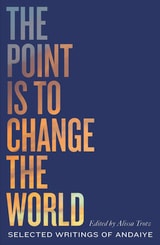
The Point is to Change the World
Selected Writings of AndaiyeAlissa Andaiye
Pluto Press, 2020
Through essays, letters and journal entries, Andaiye's thinking on the intersections of gender, race, class and power are profoundly articulated, Caribbean histories emerge, and stories from a life lived at the barricades are revealed. We learn about the early years of the Working People's Alliance, the meaning and impact of the murder of Walter Rodney and the fall of the Grenada Revolution. Throughout, we bear witness to Andaiye's acute understanding of politics rooted in communities and the daily lives of so-called ordinary people.
Featuring forewords by Clem Seecharan and Robin DG Kelley, these texts will become vital tools in our own struggles to 'overturn the power relations which are embedded in every unequal facet of our lives'.
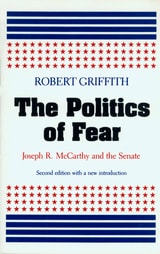
The Politics of Fear
Joseph R. McCarthy and the SenateRobert Griffith
University of Massachusetts Press, 1970
Winner of the Organization of American Historians’ Frederick Jackson Turner Award
Originally published in 1970, and now a classic in its field, The Politics of Fear traces the rise and fall of one of America’s most notorious political demagogues. Robert Griffith concludes that McCarthy’s enormous power owed less to the force of the senator’s unique personality than to the issues and symbols with which he identified and that McCarthy was the product, not the progenitor, of the postwar politics of anticommunism. For this edition, Griffith has provided a new introduction covering the recent literature on McCarthyism and the changing views on the topic.
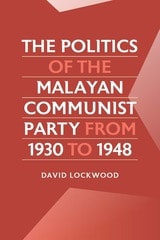
The Politics of the Malayan Communist Party from 1930 to 1948
David Lockwood
National University of Singapore Press, 2024
By 1946, the Malayan Communist Party (MCP) had become one of the most successful communist parties in Asia. From its foundation in 1930, it had built up a membership in the thousands, mainly among Chinese and Indian workers in Malaya. When the Japanese arrived, the MCP organized the Malayan People’s Anti-Japanese Army (MPAJA), the only effective resistance force. After the War, when the British returned, the Party launched a legal campaign for independence, but by 1948, the MCP had surrendered its achievements and taken many members underground to launch a disastrous, failed insurrection against the British.
To understand these momentous turns of history, a fresh view is required of the Malayan Communist Party as a political actor. The Politics of the Malayan Communist Party from 1930 to 1948 gives a political history of the Party and explains why the MCP self-destructed in 1948. In particular, David Lockwood questions assumptions that post-war politics led inevitably to armed struggle and questions the accepted narrative of Party Chairman Lai Tek's treachery. This is a revisionist history of a period, and political force, that has left a lasting mark on the politics of Malaya and Singapore.
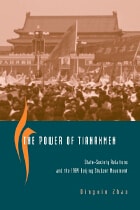
The Power of Tiananmen
State-Society Relations and the 1989 Beijing Student MovementDingxin Zhao
University of Chicago Press, 2001
Dingxin Zhao's award-winning The Power of Tiananmen is the definitive treatment of these historic events. Along with grassroots tales and interviews with the young men and women who launched the demonstrations, Zhao carries out a penetrating analysis of the many parallel changes in China's state-society relations during the 1980s. Such changes prepared an alienated academy, gave rise to ecology-based student mobilization, restricted government policy choices, and shaped student emotions and public opinion, all of which, Zhao argues, account for the tragic events in Tiananmen.
The Privatization Process in Central Europe
Roman Frydman
Central European University Press, 1993
The Privatization Process in Russia, the Ukraine, and the Baltic States
Roman Frydman
Central European University Press, 1993
The Pãltinis Diary
A Paideic Model in Humanist CultureGabriel Liiceanu
Central European University Press, 2000
The intellectual resistance to totalitarian regimes can take many forms. This remarkable volume portrays one such story of resistance in Romania during the reign of Ceauşescu: that of Constantin Noica, one of the country’s foremost intellectuals.
Noica was an original thinker belonging to the remarkable intellectual generation of important figures such as Mircea Eliade, E. M. Cioran and Eugene Ionescu, but he chose to stay in Romania after the communist takeover when many others fled. Harassed and jailed for six years, Noica retreated to the mountains and gathered around him some brilliant young minds and future talent to challenge and nurture them in a time when communism denied them the materials of true intellectual importance.
This group of students withdrew to Noica’s retreat for intensive philosophical sessions to debate the works of Kant, Plato, Heidegger and discuss humanistic values. The author of this volume Liiceanu, himself a brilliant philosopher, was Noica’s closest disciple and during every meeting he noted every conversation in a diary which came to be known as The Păltiniş Diary. These conversations were secretly published and quickly devoured by intellectuals in Romania who were prepared to sacrifice part of their food provisions to acquire the book. The Păltiniş Diary sold out within a matter of days and because of Secret Police censorship, was not published again in Romania until 1991 by which time Noica had died and the group had disbanded to help with the reconstruction of post-Ceauşescu Romania.
The Păltiniş Diary is a wonderful homage to an intellectual master and to the power of intellect and freedom. The book will be of interest to philosophers, non-philosophers alike, and to anyone who seeks to grasp the true meaning of survival under totalitarian conditions.
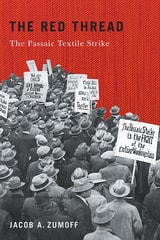
The Red Thread
The Passaic Textile StrikeJacob A. Zumoff
Rutgers University Press, 2021

The Restoration of Order
The Normalization of Czechoslovakia 1969–1976Milan Šimecka
Karolinum Press, 2025
In an engaging style, not lacking in irony and detachment, Milan Šimečka describes the process of restoring order and its result—so-called real socialism—in a brilliant analysis of the “normalization” regime in Czechoslovakia that came to power after the Soviet-led invasion that crushed the Prague Spring of 1968. These poignant reflections and essays coincided with Šimečka’s first-hand experience of the consequences of the time’s political and cultural purges.
This second edition of Cold War classics, first written between 1975 and 1977, with a new preface from Martin Šimečka and afterword from Jonathan Bolton, highlights chilling parallels with contemporary political developments and current civic and ethical questions.
The Return of Ideology
The Search for Regime Identities in Postcommunist Russia and ChinaCheng Chen
University of Michigan Press, 2016
As a nation makes the transition from communism to democracy or another form of authoritarianism, its regime must construct not only new political institutions, but also a new political ideology that can guide policy and provide a sense of mission. The new ideology is crucial for legitimacy at home and abroad, as well as the regime’s long-term viability. In The Return of Ideology, Cheng Chen compares post-communist regimes, with a focus on Russia under Putin and post-Deng China, investigating the factors that affect the success of an ideology-building project and identifies the implications for international affairs.
Successful ideology-building requires two necessary—but not sufficient—conditions. The regime must establish a coherent ideological repertoire that takes into account the nation’s ideological heritage and fresh surges of nationalism. Also, the regime must attract and maintain a strong commitment to the emerging ideology among the political elite.
Drawing on rich primary sources, including interviews, surveys, political speeches, writings of political leaders, and a variety of publications, Chen identifies the major obstacles to ideology-building in modern Russia and China and assesses their respective long-term prospects. Whereas creating a new regime ideology has been a protracted and difficult process in China, it has been even more so in Russia. The ability to forge an ideology is not merely a domestic concern for these two nations, but a matter of international import as these two great powers move to assert and extend their influence in the world.
The Rise of China and the Demise of the Capitalist World-Economy
Minqi Li
Pluto Press, 2008
Minqi Li examines the future global prospects from the perspectives of Marxism, world-system theories, and ecological limits to growth. He argues that China is likely to exacerbate many of the major contradictions of world capitalism, which could lead to the demise of the existing world-system.
This is an essential text for students of political economy, economics and global politics.
The Rise of the Green Left
Inside the Worldwide Ecosocialist MovementDerek Wall
Pluto Press, 2010
Climate change and other ecological ills are driving the creation of a grassroots global movement for change. From Latin America to Europe, Australia and China a militant movement merging red and green is taking shape.
Ecosocialists argue that capitalism threatens the future of humanity and the rest of nature. From indigenous protest in the Peruvian Amazon to the green transition in Cuba to the creation of red-green parties in Europe, ecosocialism is defining the future of left and green politics globally. Latin American leaders such as Morales and Chavez are increasingly calling for an ecosocialist transition.
Drawing on the work of key thinkers such as Joel Kovel and John Bellamy Foster, Derek Wall provides an unique insider view of how ecosocialism has developed and a practical guide to focused ecosocialist action. A great handbook for activists and engaged students of politics.