Results by title
89 books match the query 'Communities' and 8 start with t
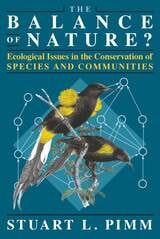
The Balance of Nature?
Ecological Issues in the Conservation of Species and CommunitiesStuart L. Pimm
University of Chicago Press, 1991
Ecologists describing phenomena on larger scales often use terms like "stability," "balance of nature," and "fragility," and Pimm begins by considering the various specific meanings of these terms. He addresses five kinds of ecological stability—stability in the strict sense, resilience, variability, persistence, and resistance—and shows how they provide ways of comparing natural populations and communities as well as theories about them. Each type of stability depends on characteristics of the species studied and also on the structure of the food web in which the species is embedded and the physical features of the environment.
The Balance of Nature? provides theoretical ecology with a rich array of questions—questions that also underpin pressing problems in practical conservation biology. Pimm calls for nothing less than new approaches to ecology and a new alliance between theoretical and empirical studies.

The Blue Guitar
Political Representation and CommunityNancy L. Schwartz
University of Chicago Press, 1988
In The Blue Guitar (the title alludes to a poem by Wallace Stevens), Nancy L. Schwartz offers a radically new understanding of representation. As she sees it, representatives should be—and, in the past, have been—more than mere delegates or trustees of individual desires and interests and the process of representation more than the appropriation of power and control. Ideally, representation should transform both representative and citizen. Representatives should be caretakers of the community, not the watchdogs of special interest groups or individuals. Citizens in turn should feel increased personal responsibility for the whole that membership in the community entails. Moreover, representatives should serve as founders of their constituencies, constituting communities whose members value citizenship as an end in itself.
In her analysis, Schwartz canvasses the political experience of ancient, medieval, and Renaissance city-states to discover the communitarian meaning of citizenship, and she draws on classical political theory from Plato to Rousseau and Hegel, on the political sociology of Marx and Weber, and on such contemporary theorists as Arendt and Pitkin. Schwartz also enters the controversy over whether local, state, and national legislators should be selected by district or at-large elections. After examining a set of key Supreme Court cases on voting rights and district elections, she proposes that representatives come from single-member geographic districts.
The Community in Rural America
Kenneth P. Wilkinson
University Press of Colorado, 2022
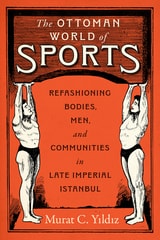
The Ottoman World of Sports
Refashioning Bodies, Men, and Communities in Late Imperial IstanbulMurat C. Yildiz
University of Texas Press, 2025
2026 co-winner of the Ottoman and Turkish Studies Association Book Prize
A revision of the history of modern sports in late Ottoman Istanbul, showing how Muslims, Christians, and Jews created a shared sports culture that was simultaneously global, imperial, and local.
The history of sports in Turkey is deeply contested. Over the decades, journalists, pundits, non-professional historians, sports scholars, and everyday people have offered competing narratives about the origins of modern sports in the late Ottoman Empire.
The Ottoman World of Sports tells the story of how Istanbul’s Muslims, Christians, and Jews—gymnastics teachers, football coaches, weightlifters, journalists, athletes, and fans—created a gendered and class-stratified civic project that promoted athletics as a source of fun, beauty, and moral education. Influenced by the emerging global vogue for organized sports, all boys from the expanding middle class of the late nineteenth- and early twentieth-century imperial capital were expected to exercise and compete on the playing field in order to develop into moral men. Yet even as the embrace of modern athletics transcended ethnoreligious divisions, it did not erase them. Drawing on a wide range of archival research in multiple languages, historian Murat Cihan Yıldız shows that sportsmen created new communal boundaries in team affiliations, fandom, and sports media. Adeptly reconstructing Istanbul’s imperial culture as it was experienced more than a century ago, The Ottoman World of Sports recovers a lived imperial culture whose defining features were shaped by its multiethnic, multireligious, and multilingual sportsmen.

The Trouble with Community
Anthropological Reflections on Movement, Identity and CollectivityVered Amit and Nigel Rapport
Pluto Press, 2002
The trouble with 'community' is that this is not necessarily so; the personal social networks of individuals' actual experience crosscut collective categories, situations and institutions. Communities can prove unviable or imprisoning; the reality of community life and identity can often be very different from the ideology and the ideal.
In this provocative new book, anthropologists Vered Amit and Nigel Rapport draw on their various ethnographic experiences to reappraise the concept and the reality of 'community', in the light of globalization, religious fundamentalism, identity politics, and renascent localisms. How might anthropology better apprehend social identities which are intrinsically plural, transgressive and ironic? What has anthropology to say about the way in which civil society might hope to accommodate the on-going construction and the rightful expression of such migrant identities? Nigel Rapport and Vered Amit give their own answers to these questions before entering into dialogue to assess each other's positions.
Nigel Rapport is Professor of Anthropological and Philosophical Studies at the University of St. Andrews. He is author of Transcendent Individual (1997). Vered Amit is an Associate Professor at Concordia University in Montreal. She is the editor of Realizing Community (2002).
Thinking - Resisting - Reading the Political
Current Perspectives on Politics and Communities in the Arts Vol. 2Edited by Anneka Esch-van Kan, Stephan Packard, and Philipp Schulte
Diaphanes, 2013
The essays collected in “Thinking Resistances. Current Perspectives on Politics, Community, and Art“ engage with political phenomena in their interrelations with arts as well as with recent theoretical and philosophical perspectives on the very meaning of politics, the political, and community.
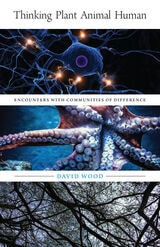
Thinking Plant Animal Human
Encounters with Communities of DifferenceDavid Wood
University of Minnesota Press, 2020
Collected essays by a leading philosopher situating the question of the animal in the broader context of a relational ontology
There is a revolution under way in our thinking about animals and, indeed, life in general, particularly in the West. The very words man, animal, and life have turned into flimsy conceptual husks—impediments to thinking about the issues in which they are embroiled. David Wood was a founding member of the early 1970s Oxford Group of philosophers promoting animal rights; he also directed Ecology Action (UK). Thinking Plant Animal Human is the first collection of this major philosopher’s influential essays on “animals,” bringing together his many discussions of nonhuman life, including the classic “Thinking with Cats.”
Exploring our connections with cats, goats, and sand crabs, Thinking Plant Animal Human introduces the idea of “kinnibalism” (the eating of mammals is eating our own kin), reflects on the idea of homo sapiens, and explores the place of animals both in art and in children’s stories. Finally, and with a special focus on trees, the book delves into remarkable contemporary efforts to rescue plants from philosophical neglect and to rethink and reevaluate their status. Repeatedly bubbling to the surface is the remarkable strangeness of other forms of life, a strangeness that extends to the human.
Wood shows that the best way of resisting simplistic classification is to attend to our manifold relationships with other living beings. It is not anthropocentric to focus on such relationships; they cast light in complex ways on the living communities of which we are part, and exploring them recoils profoundly on our understanding of ourselves.
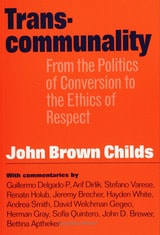
Transcommunality
From The Politics Of ConversionJohn Brown Childs
Temple University Press, 2003