Results by title
69 books match the query 'Conduct of life' and 17 start with t
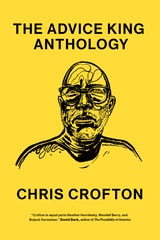
The Advice King Anthology
Chris Crofton
Vanderbilt University Press, 2022
If you are looking for traditional advice, this might not be the book for you. But if you care to find the incendiary, subversive, and hilarious alongside actual thoughts about addiction, depression, gentrification, politics, poetry, music, economic policy, living in New Nashville, and (inevitably) romance, the Advice King has much to offer.
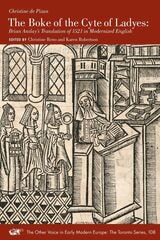
The Boke of the Cyte of Ladyes
Brian Anslay's Translation of 1521 in Modernized EnglishChristine de Pizan
Iter Press, 2025
Christine de Pizan's defense of women against centuries of misogyny, Cité des dames, was the only work of literature translated into English by Brian Anslay, an administrator in the household of King Henry VII. While numerous manuscripts were held in royal and aristocratic libraries, Anslay’s printed translation enabled a broader range of readers to appreciate the arguments for female rule crucial to the reigns of Mary I and Elizabeth I. Anslay’s translation also played a key role in the late-nineteenth-century revival of interest in Christine. This modernization of Anslay’s Tudor English makes his translation accessible to contemporary readers while preserving the rhythms of early Tudor prose. It includes an extensive introduction and notes highlighting both the history of the language and the cultural references embodied in the text.
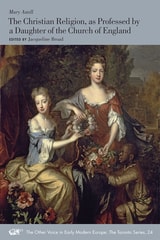
The Christian Religion, as Professed by a Daughter of the Church of England
Mary Astell
Iter Press, 2013
The Culture of Merit
Nobility, Royal Service, and the Making of Absolute Monarchy in France, 1600-1789Jay M. Smith
University of Michigan Press, 1996
Jay M. Smith argues that the early modern nobility instinctively drew a correlation between the meaning of merit and an image of the "sovereign's gaze." In the early seventeenth century, merit meant the qualities traditionally associated with aristocratic values: generosity, fidelity, and honor. Nobles sought to display those qualities before the appreciative gaze of the king himself. But the expansion of the monarchy forced the routinization of the sovereign's gaze, and Louis XIV began to affirm and reward new qualities--talent and application--besides those thought innately noble.
The contradictions implicit within the absolute monarchy's culture of merit are demonstrated by the eighteenth-century French army, which was dominated by the nobility, but also committed to efficiency and expertise. Smith shows that the army's continuous efforts to encourage and reward "merit" led to a clash of principles. The ever-growing emphasis on talent and discipline led reformers--the great majority of them noble--to attack the most egregious examples of privilege and favoritism in the army. Smith's analysis of the long-term evolution in conceptions of royal service suggests a new explanation for the shift in values signified by the French Revolution. The transition away from the "personal" gaze of the king toward the "public" gaze of the monarchy and nation foretold the triumph of a new culture of merit in which noble birth would have no meaning.
The Culture of Merit will interest historians and other social scientists concerned with issues of aristocratic identity, state formation, professionalization, and the changing political culture of pre-Revolutionary France.
Jay M. Smith is Assistant Professor of History, University of North Carolina, Chapel Hill.
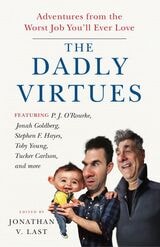
The Dadly Virtues
Adventures from the Worst Job You'll Ever LoveJonathan V. Last
Templeton Press, 2015
The Dadly Virtues is a tongue-in-cheek collection of encouragement and guidance for any stage of fatherhood, from pacifying babies to prepping for senior prom, from cutting the cord to getting the first, “Best Grandpa” t-shirt. P.J. O’Rourke sets the stage with the chapter, “What Do Men Get from Fatherhood? Besides What They Put In …” and then is followed by:
•Matthew Continetti’s, “Newborn Terror: The Moment You Realize that ‘Bundle of Joy’ Is a Euphemism for Something Very Different.”
•Stephen F. Hayes’ “Siblings: The Best Gift You’ll Ever Give Your Kids.”
•Jonah Goldberg’s “Get Your Kid a Dog: The Moral Case for Pets.”
•Tucker Carlson’s “In Praise of Adventure: How to Fill a Child’s Life with Excitement and Danger (without Getting Them Killed).”
•Michael Graham’s, “Dating: Enjoy the Movie and Please Keep the Impregnation to a Minimum.”
•Christopher Caldwell’s “College: It’s Not as Bad as You Think; It’s Worse.”
•Andrew Ferguson’s “Emerging Adults and Empty Nesters: Just When You Had Fatherhood All Figured Out.”
•Toby Young’s “The Dark Side: Bad Parenting and the Things We Think, but Do Not Say.”
•Joseph Epstein’s “Thanks, Grandpa: Grandfatherhood and the Spirit of the Age.”
•And more.
Father-to-be, two-time-dad, or granddad, each essay will make you laugh and, at the same time, reinforce your commitment to the virtuous—the dadly—life.
The Education of a Christian Woman
A Sixteenth-Century ManualJuan Luis Vives
University of Chicago Press, 2000
Praised by Erasmus and Thomas More, Vives advocated education for all women, regardless of social class and ability. From childhood through adolescence to marriage and widowhood, this manual offers practical advice as well as philosophical meditation and was recognized soon after publication in 1524 as the most authoritative pronouncement on the universal education of women. Arguing that women were intellectually equal if not superior to men, Vives stressed intellectual companionship in marriage over procreation, and moved beyond the private sphere to show how women's progress was essential for the good of society and state.
The Essential Worldwide Laws of Life
Sir John Templeton
Templeton Press, 2012
What does it mean to live a good life?
The major scriptures of the world, various schools of philosophical thought, storytellers, scientists, artists, and historians have all offered answers to this question. Surprisingly, these answers are common among nearly all sources. Famed investor and philanthropist Sir John Templeton called these commonalities the “laws of life.”
Templeton gathers the best of these teachings in The Essential Worldwide Laws of Life. This handsome volume shows readers of all ages, from all parts of the world, how to make their lives more joyous and useful by learning the universal truths that transcend time and culture.
Each law is presented in an essay format, with stories, commentary, and quotations to illustrate its importance. The material is designed to inspire the reader to put these laws into practice and to enjoy the rewarding life that will result.
The Good Life
Yi-Fu Tuan
University of Wisconsin Press, 1986
“[Tuan] explores answers to an old and unanswerable question: how should we live? . . . The Good Life is a little anthology of good feeling, touchstones of joy . . . These pleasures make the book a pleasure, not of conviction or belief, but of conversation’s meandering exploration.”—New York Times Book Review
“Tuan, after all, is one of the few geographers who can be read for pleasure, and by the public as well as by the professional. But read not merely for pleasure, nor yet to mark, learn, and inwardly digest. Rather, consider Tuan’s challenge to identify your concept of the good life, and then try to construct that life.”—Environment and Planning D: Society and Space
The Ninth Decade
An Octogenarian’s ChronicleKlaus, Carl H.
University of Iowa Press, 2021
The multi-year scope of his chronicle reveals the numerous physical and mental problems that arise during octogenarian life and how eighty-year-olds have dealt with those challenges. The Ninth Decade is a unique, first-hand source of information for anyone in their sixties, seventies, or eighties, as well as for persons devoted to care of the aged. Though the challenges of octogenarian life often require specialized care, The Ninth Decade also shows the pleasures of it to be so special as to have inspired Lillian Hellman’s paradoxical description of “longer life” as “the happy problem of our time.”
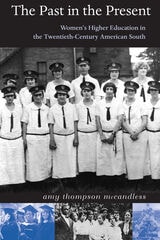
The Past in the Present
Women's Higher Education in the Twentieth-Century American SouthAmy T. McCandless
University of Alabama Press, 1999
The Seven Deadly Virtues
18 Conservative Writers on Why the Virtuous Life is Funny as HellJonathan V. Last
Templeton Press, 2014
The book’s contributors include Sonny Bunch, Christopher Buckley, David “Iowahawk” Burge, Christopher Caldwell, Andrew Ferguson, Jonah Goldberg, Michael Graham, Mollie Hemingway, Rita Koganzon, Matt Labash, James Lileks, Rob Long, Larry Miller, P. J. O’Rourke, Joe Queenan, Christine Rosen, and Andrew Stiles. Jonathan V. Last, senior writer at the Weekly Standard, editor of the collection, is also a contributor. All eighteen essays in this book are appearing for the first time anywhere.
In the book’s opening essay, P. J. O’Rourke observes: “Virtue has by no means disappeared. It’s as much in public view as ever. But it’s been strung up by the heels. Virtue is upside down. Virtue is uncomfortable. Virtue looks ridiculous. All the change and the house keys are falling out of Virtue’s pants pockets.”
Here are the virtues everyone (including the book’s contributors) was taught in Sunday school but have totally forgotten about until this very moment. In this sanctimony-free zone:
• Joe Queenan observes: “In essence, thrift is a virtue that resembles being very good at Mahjong. You’ve heard about people who can do it, but you’ve never actually met any of them.”
• P. J. O’Rourke notes: “Fortitude is quaint. We praise the greatest generation for having it, but they had aluminum siding, church on Sunday, and jobs that required them to wear neckties or nylons (but never at the same time). We don’t want those either.”
• Christine Rosen writes: “A fellowship grounded in sociality means enjoying the company of those with whom you actually share physical space rather than those with whom you regularly and enthusiastically exchange cat videos.”
• Rob Long offers his version of modern day justice: if you sleep late on the weekend, you are forced to wait thirty minutes in line at Costco.
• Jonah Goldberg offers: “There was a time when this desire-to-do-good-in-all-things was considered the only kind of integrity: ‘Angels are better than mortals. They’re always certain about what is right because, by definition, they’re doing God’s will.’ Gabriel knew when it was okay to remove a mattress tag and Sandalphon always tipped the correct amount.”
• Sonny Bunch dissects forbearance, observing that the fictional Two Minutes Hate of George Orwell’s 1984 is now actually a reality directed at living, breathing people. Thanks, in part, to the Internet, “Its targets are designated by a spontaneously created mob—one that, due to its hive-mind nature—is virtually impossible to call off.”
By the time readers have completed The Seven Deadly Virtues, they won’t even realize that they’ve just been catechized into an entirely different—and better—moral universe.
The Thinking Student's Guide to College
75 Tips for Getting a Better EducationAndrew Roberts
University of Chicago Press, 2010
Each fall, thousands of eager freshmen descend on college and university campuses expecting the best education imaginable: inspiring classes taught by top-ranked professors, academic advisors who will guide them to a prestigious job or graduate school, and an environment where learning flourishes outside the classroom as much as it does in lecture halls. Unfortunately, most of these freshmen soon learn that academic life is not what they imagined. Classes are taught by overworked graduate students and adjuncts rather than seasoned faculty members, undergrads receive minimal attention from advisors or administrators, and potentially valuable campus resources remain outside their grasp.
Andrew Roberts’ Thinking Student’s Guide to College helps students take charge of their university experience by providing a blueprint they can follow to achieve their educational goals—whether at public or private schools, large research universities or small liberal arts colleges. An inside look penned by a professor at Northwestern University, this book offers concrete tips on choosing a college, selecting classes, deciding on a major, interacting with faculty, and applying to graduate school. Here, Roberts exposes the secrets of the ivory tower to reveal what motivates professors, where to find loopholes in university bureaucracy, and most importantly, how to get a personalized education. Based on interviews with faculty and cutting-edge educational research, The Thinking Student’s Guide to College is a necessary handbook for students striving to excel academically, creatively, and personally during their undergraduate years.
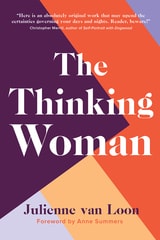
The Thinking Woman
Julienne van Loon
Rutgers University Press, 2021
While women have struggled to gain recognition in the discipline of philosophy, there is no shortage of brilliant female thinkers. What can these women teach us about ethics, politics, and the nature of existence, and how might we relate these big ideas back to the smaller everyday concerns of domestic life, work, play, love, and relationships?
Australian novelist Julienne van Loon goes on a worldwide quest to answer these questions, by engaging with eight world-renowned thinkers who have deep insights on humanity and society: media scholar Laura Kipnis, novelist Siri Hustvedt, political philosopher Nancy Holmstrom, psychoanalytic theorist Julia Kristeva, domestic violence reformer Rosie Batty, peace activist Helen Caldicott, historian Marina Warner, and feminist philosopher Rosi Braidotti. As she speaks to these women, she reflects on her own experiences. Combining the intimacy of a memoir with the intellectual stimulation of a theoretical text, The Thinking Woman draws novel connections between the philosophical, personal, and political. Giving readers a new appreciation for both the ethical complexities and wonder of everyday life, this book is inspiration to all thinking people.
The Third and Only Way
Reflections on Staying AliveHelen Bevington
Duke University Press, 1996
The unique Bevington way of autobiography recreates lessons and insights of other lives, historical figures, and compelling incidents, and combines them in a narrative that follows the emotional currents of her life. Evoking a wide range of historical and literary figures, including Chekhov, Marcus Aurelius, Flannery O’Connor, Simone de Beauvoir, Thoreau, Beatrix Potter, Sappho, Yeats, Alexander the Great, Montaigne, Saint Cecilia, Virginia Woolf, Liv Ullmann, and many others, Bevington finds in these lives a path that has guided her search away from solitude. Through her reflections on the ten years that followed her son’s death, we become aware of how far she has traveled, how the search has brightened, how she has eloquently evolved into old age. In the end she is sitting, like the Buddha, under her own fig tree, waiting not for death but for further illumination.
An original contemplation of the universal dilemmas and tragedies of existence, The Third and Only Way is at once warm, funny, and inspiring—full of learning and wisdom.
There's a Disco Ball Between Us
A Theory of Black Gay LifeJafari S. Allen
Duke University Press, 2021
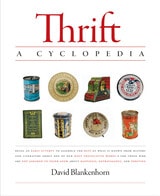
Thrift
A CyclopediaDavid Blankenhorn
Templeton Press, 2008
In today's consumer-driven society, extolling the virtues of thrift might seem like a quaint relic of a bygone era. Americans have embraced the ideas of easy credit, instant gratification, and spending as a tool to combat everything from recessions to the effects of natural disasters and terrorist attacks. In David Blankenhorn's new compendium, Thrift: A Cyclopedia, he reminds readers of a time when thrift was one of America's most cherished cultural values.
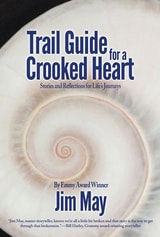
Trail Guide for a Crooked Heart
Stories and Reflections for Life's JourneyJim May
Parkhurst Brothers, Inc., 2016
"A brilliant mixture of story, philosophy, humor and wisdom, this book reminds us that---if we are open to story, dreams, imagination, and myth---we can open doors within our soul."
—Jay O’Callahan, author, storyteller, and NPR commentator
A lifetime collection of stories, wise words, assembled musings and quotations about overcoming hurdles, elusive enlightenment, personal evolution, persistence in the face of discouragement, this pastiche is designed to encourage the downhearted, lift up the strivers, and add wings to the heels of spiritual seekers.