Results by title
54 books match the query 'Constitution' and 26 start with t

The Architecture of Matter
Stephen Toulmin and June Goodfield
University of Chicago Press, 1982
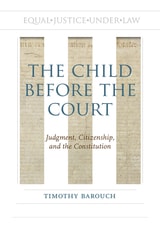
The Child before the Court
Judgment, Citizenship, and the ConstitutionTimothy Barouch
University of Alabama Press, 2021
A study that challenges our notions about citizenship and judgment by considering the place of children in historical and contemporary legal discourse.
Many of the most controversial political issues of our time focus on the actions and well-being of children such as Greta Thunberg’s climate movement; youth activists standing up for racial justice, safe schools, and an equitable economy; and the furor over separating migrant children from their families. When do we treat children as competent citizens, when do we treat them as dependents in need of protection, and why?
The Child before the Court: Judgment, Citizenship, and the Constitution provides answers to these foundational questions. It analyzes landmark US Supreme Court cases involving children’s free speech and due process rights and argues that our ideas about civic and legal judgment are deeply contested concepts instead of simple character traits. These cases serve as analytic touchstones for these problems, and the Court’s opinions seemingly articulate clear rules through a pragmatic balancing of interests.
Timothy Barouch shows how these cases continually reshape constitutional thought, breaking from a vocabulary of wardship and recasting the child as a liberal individual. He analyzes these legal opinions as judicial novelizations and focuses on their rhetorical markers: the range of tropes, idioms, figures, and arguments that emerge across nearly two centuries of jurisprudence in this important but oft-neglected area. The careful and subtle readings of these cases demonstrate how judicial representations of the child provide key resources for thinking about the child as citizen and, more broadly, citizenship itself. It serves as a bold call to think through the relationship between the liberal individual and the problem of civic judgment as it manifests in public culture in a wide array of contexts at a time when liberal democracy is under siege.
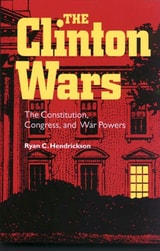
The Clinton Wars
The Constitution, Congress, and War PowersRyan C. Hendrickson
Vanderbilt University Press, 2002
Ryan Hendrickson examines the behavior of the Clinton administration and Congress in dealing with the range of American military operations that occurred during the Clinton presidency. He uses a case-study approach, laying out the foreign background and domestic political controversies in separate chapters on Somalia, Haiti, Bosnia, Kosovo, and Iraq. Of special interest after the World Trade Center attacks is the chapter "Terrorism: Usama Bin Laden."
The author analyzes a number of factors that influence the domestic decision-making process. We see the president relying on congressional consultation and approval during periods of political or personal weakness, and, conversely, in better times we see a president with a freer hand. Also influential is the ability of the public to comprehend and support the reasons for a particular action, with troops in Bosnia requiring more explanation than cruise missiles over Baghdad. Consideration is given to the relevance and effectiveness of the War Powers Resolution of 1973, a Watergate-era attempt by Congress to restore what it perceived to be its legitimate constitutional role in the decision to use force abroad.
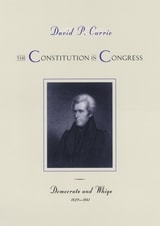
The Constitution in Congress
Democrats and Whigs, 1829-1861David P. Currie
University of Chicago Press, 2005
Like its predecessors, The Constitution in Congress: Democrats and Whigs will be an invaluable reference for legal scholars and constitutional historians alike.
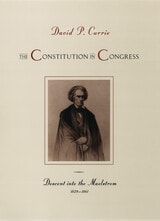
The Constitution in Congress
Descent into the Maelstrom, 1829-1861David P. Currie
University of Chicago Press, 2005
This acclaimed series serves as a biography of the U.S. Constitution, offering an indispensable survey of the congressional history behind its development. In a rare examination of the role that both the legislative and executive branches have played in the development of constitutional interpretation, The Constitution in Congress shows how the actions and proceedings of these branches reveal perhaps even more about constitutional disputes than Supreme Court decisions of the time.
The centerpiece for the fourth volume in this series is the great debate over slavery and how this divisive issue led the country into the maelstrom of the Civil War. From the Jacksonian revolution of 1829 to the secession of Southern states from the Union, legal scholar David P. Currie provides an unrivaled analysis of the significant constitutional events—the Wilmot Proviso, the Compromise of 1850, the Kansas-Nebraska Act, the Lincoln-Douglas Debates, and "Bleeding Kansas"—that led up to the war. Exploring how slavery was addressed in presidential speeches and debated in Congress, Currie shows how the Southern Democrats dangerously diminished federal authority and expanded states' rights, threatening the nation's very survival.
Like its predecessors, this fourth volume of The Constitution in Congress will be an invaluable reference for legal scholars and constitutional historians alike.
The Constitution in Congress
The Federalist Period, 1789-1801David P. Currie
University of Chicago Press, 1997
"A joy to read."—Appellate Practive Journal and Update
"[A] patient and exemplary analysis of the work of the first six Congresses."—Geoffrey Marshall, Times Literary Supplement
The Constitution in Congress
The Jeffersonians, 1801-1829David P. Currie
University of Chicago Press, 2001
legislative and executive action in the United States, legal scholars
have traditionally looked only to the courts for guidance in
interpreting the Constitution. This, the second book in David P.
Currie's multivolume series, looks to the legislative and executive
branches for insights into the development of constitutional
interpretation.
Currie examines the period of Republican hegemony from the
inauguration of Thomas Jefferson in 1801 to the election of Andrew
Jackson in 1829. During this time of great leadership and
controversy, many benchmark issues—the abolition of the new Circuit
Courts, the Louisiana Purchase, the Burr conspiracy, the War of 1812,
the Monroe Doctrine, and the Missouri Compromise, among others—were
debated and decided almost exclusively in the legislative and
executive arenas. With its uniquely legal perspective and
comprehensive coverage, The Constitution in Congress
illustrates how the executive and legislative branches matched the
Supreme Court in putting flesh and blood onto the skeleton of the
Constitution.

The Constitution in Wartime
Beyond Alarmism and ComplacencyMark Tushnet, ed.
Duke University Press, 2005
Some of the essays are broad in scope, reflecting on national character, patriotism, and political theory; exploring whether war and republican government are compatible; and considering in what sense we can be said to be in wartime circumstances today. Others are more specific, examining the roles of Congress, the presidency, the courts, and the international legal community. Throughout the collection, balanced, unbiased analysis leads to some surprising conclusions, one of which is that wartime conditions have sometimes increased, rather than curtailed, civil rights and civil liberties. For instance, during the cold war, government officials regarded measures aimed at expanding African Americans’ freedom at home as crucial to improving America’s image abroad.
Contributors. Sotirios Barber, Mark Brandon, James E. Fleming, Mark Graber, Samuel Issacharoff, David Luban, Richard H. Pildes, Eric Posner, Peter Spiro, William Michael Treanor, Mark Tushnet, Adrian Vermeule
The Constitution in the Supreme Court
The First Hundred Years, 1789-1888David P. Currie
University of Chicago Press, 1985
"A thorough, systematic, and careful assessment. . . . As a reference work for constitutional teachers, it is a gold mine."—Charles A. Lofgren, Constitutional Commentary
The Constitution in the Supreme Court
The Second Century, 1888-1986David P. Currie
University of Chicago Press, 1990
"Elegant and readable. Whether you are in favor of judicial restraint or judicial activism, whatever your feelings about the Warren Court, or the Renquist Court, this is a book that justifies serious study."—Robert Stevens, New York Times Book Review
The Constitution of Liberty
F. A. Hayek
University of Chicago Press, 1978
"A reflective, often biting, commentary on the nature of our society and its dominant thought by one who is passionately opposed to the coercion of human beings by the arbitrary will of others, who puts liberty above welfare and is sanguine that greater welfare will thereby ensue."—Sidney Hook, New York Times Book Review
In this classic work Hayek restates the ideals of freedom that he believes have guided, and must continue to guide, the growth of Western civilization. Hayek's book, first published in 1960, urges us to clarify our beliefs in today's struggle of political ideologies.
The Constitution of Liberty
The Definitive EditionF. A. Hayek
University of Chicago Press, 2011
From the $700 billion bailout of the banking industry to president Barack Obama’s $787 billion stimulus package to the highly controversial passage of federal health-care reform, conservatives and concerned citizens alike have grown increasingly fearful of big government. Enter Nobel Prize–winning economist and political theorist F. A. Hayek, whose passionate warning against empowering states with greater economic control, The Road to Serfdom, became an overnight sensation last summer when it was endorsed by Glenn Beck. The book has since sold over 150,000 copies.
The latest entry in the University of Chicago Press’s series of newly edited editions of Hayek’s works, The Constitution of Liberty is, like Serfdom, just as relevant to our present moment. The book is considered Hayek’s classic statement on the ideals of freedom and liberty, ideals that he believes have guided—and must continue to guide—the growth of Western civilization. Here Hayek defends the principles of a free society, casting a skeptical eye on the growth of the welfare state and examining the challenges to freedom posed by an ever expanding government—as well as its corrosive effect on the creation, preservation, and utilization of knowledge. In opposition to those who call for the state to play a greater role in society, Hayek puts forward a nuanced argument for prudence. Guided by this quality, he elegantly demonstrates that a free market system in a democratic polity—under the rule of law and with strong constitutional protections of individual rights—represents the best chance for the continuing existence of liberty.
Striking a balance between skepticism and hope, Hayek’s profound insights are timelier and more welcome than ever before. This definitive edition of The Constitution of Liberty will give a new generation the opportunity to learn from his enduring wisdom.
The Constitution of Society
Edward Shils
University of Chicago Press, 1982
Professor Shils has attempted to develop a theory that has a place for more than those parts of society that are generated from the biological nature of human beings and those parts that are engendered by the desires of individuals, acting for themselves or for groups and categories of individuals, to maintain and increase their power over other human beings and to secure material goods and services for themselves. He has argued that there are constituents of society in which human beings seek and cultivate connections with objects that transcend those needed to satisfy biological necessity and the desire for material objects and power over others. This third stratum of social existence, he concludes, cannot be reduced to the other two and cannot be disregarded in any serious attempt to understand the function of any society. Thus Edward Shils, without disregarding its many valuable achievements, has nevertheless parted ways with much of modern sociology.
For this collection of papers the author has written an introductory intellectual autobiography that places each essay in the setting of the development of his thought and that connects it with his other writings.

The Constitution of a Historical Transcendental in Hegel's "Phenomenology of Spirit"
Graduate Thesis in Philosophy, 1949Michel Foucault
University of Chicago Press, 0
The first English translation of Foucault’s previously lost master’s thesis, itself an original contribution to the study of Hegel’s philosophy.
On June 11, 1949, a twenty-three-year-old Michel Foucault defended his master’s thesis in philosophy at the Sorbonne entitled The Constitution of a Historical Transcendental in Hegel’s “Phenomenology of Spirit.” Long considered a lost holy grail of French philosophy, the thesis was only recently rediscovered, and it is presented here in English for the first time.
In his master’s thesis, Foucault offers an original reading of Hegel that understands “absolute knowing,” the famous but enigmatic final figure of experience in the Phenomenology, as inextricably bound to time, language, and historical experience. Indeed, readers will discover how many of Foucault’s famous later concepts—the historical a priori, the episteme, and the limit-experience—are intimately rooted in his early, intense engagement with Hegel’s philosophy.
An introduction and critical apparatus provided by Hegel scholar Christophe Bouton traces previously unknown connections between the thesis and Foucault’s later masterpieces, particularly History of Madness and The Order of Things. Introducing a fundamental shift in our understanding of Foucault’s intellectual trajectory, this book is an essential text for anyone interested in Foucault, Hegel, and the dramatic evolution of twentieth-century continental philosophy.
The Constitution of the Federal Republic of Germany
David P. Currie
University of Chicago Press, 1994
Beginning with an overview of the essential features of the Basic Law of Germany, Currie then elucidates those features by analyzing a number of decisions of the German Constitutional Court. Contrasting German constitutional law with the American model, Currie further illuminates the German system and provides an invaluable comparative perspective on American institutions, judicial methods, and constitutional principles.
The German constitutional court recently has become the object of international attention as it has grappled with controversies involving abortion, ratification of the Maastricht Treaty, and the reunification of East and West. Currie examines these issues and their impact on the German constitution.
An appendix includes (in English translation) the complete Basic Law for the Federal Republic of Germany of May 23, 1949 as amended to December 1, 1993.
The Constitution of the United States
A Primer for the PeopleDavid P. Currie
University of Chicago Press, 2000
A masterly introduction to the United States Constitution, this slim book leads the reader through a concise overview of the document's individual articles and amendments. With clear and accessible language, Currie then examines each of the three branches of the federal government and explains the relation between the federal and state governments. He analyzes those constitutional provisions that are designed to protect citizens from governmental interference, such as the due process and equal protection clauses and the confusing first amendment provisions respecting the separation of church and state, and includes discussions of judicial review and freedom of speech and of the press.
A sympathetic yet critical guide, Currie's book enables students and laypersons to understand one of the cornerstones of the Western political tradition. The second edition, along with an updated chronology and bibliography, incorporates the Supreme Court decisions over the past decade that have affected constitutional interpretation.
The Constitution of the United States
A Primer for the PeopleDavid P. Currie
University of Chicago Press, 2000
A masterly introduction to the United States Constitution, this slim book leads the reader through a concise overview of the document's individual articles and amendments. With clear and accessible language, Currie then examines each of the three branches of the federal government and explains the relation between the federal and state governments. He analyzes those constitutional provisions that are designed to protect citizens from governmental interference, such as the due process and equal protection clauses and the confusing first amendment provisions respecting the separation of church and state, and includes discussions of judicial review and freedom of speech and of the press.
A sympathetic yet critical guide, Currie's book enables students and laypersons to understand one of the cornerstones of the Western political tradition. The second edition, along with an updated chronology and bibliography, incorporates the Supreme Court decisions over the past decade that have affected constitutional interpretation.
"Superb . . . highly recommended for those seeking a reliable, understandable, and useful introduction to our constitution."—Appellate Practice Journal and Update

The Constitution, the Law, and Freedom of Expression
1787-1987James Brewer Stewart
Southern Illinois University Press, 1987
In recognition of the bicentennial of the Constitution of the United States, former chief justice Warren E. Burger, Justice Antonin Scalia, ACLU president Norman Dorsen, and others delivered papers at the first annual DeWitt Wallace Conference on the Liberal Arts, held at Macalester College, St. Paul.
Joining some of the best legal minds in America were novelist John Edgar Wideman, chemist Harry B. Gray, historian Mary Beth Norton, and psychiatrist and social psychologist Robert Jay Lifton.
Opening the conference and this book, former chief Justice Burger emphasizes the daring of those who drafted the Constitution. Justice Scalia, noting the great reduction in curbs to freedom of expression since World War I, points out that the proliferation of freedom has forced courts to distinguish between types of expression.
Although the views expressed in these essays differ widely, opinion concerning the major issue falls into two definite camps: Burger, Scalia, and Dorsen contend that freedom of expression depends on the legal structure for survival; Wideman, Gray, Lifton, and Norton maintain that social forces determine freedom of expression.
The Effective Republic
Administration and Constitution in the Thought of Alexander HamiltonHarvey Flaumenhaft
Duke University Press, 1992
Although Hamilton exterted an extraordinary influence on American institutions, his contribution and the thinking behind it often have been obscured and misconstrued by piecemeal approaches to his voluminous writings. Here, Flaumenhaft draws upon more than two dozen volumes of Hamilton’s papers to produce a comprehensive account of his thought on the principles of politics—the account which Hamilton himself hoped to give in a multivolume treatise, but died before producing.
Beginning with a discussion of the place of general principles in Hamilton’s thought, The Effective Republic proceeds to his views on popular representation as a safeguard of individual liberty. Flaumenhaft then elaborates on Hamilton’s thinking about efficacious administration, especially how the President and Senate meet the requirements of unity and duration in a republic, and on the importance of an independent judiciary for constitutional integrity. What emerges clearly as Hamilton’s chief concern is the need to make government not only safe but effective—hindered from doing harm by its popular base, but also, through the differentiation of administrative powers and tasks, capable of doing good.
Interpreting, linking, and, and arranging Hamilton’s words, Flaumenhaft allows Hamilton to speak for himself, to explain his benificiaries his vision of what the republican experiment needed in order to succeed.
The Militia and the Right to Arms, or, How the Second Amendment Fell Silent
H. Richard Uviller and William G. Merkel
Duke University Press, 2002
—Amendment II, United States Constitution
The Second Amendment is regularly invoked by opponents of gun control, but H. Richard Uviller and William G. Merkel argue the amendment has nothing to contribute to debates over private access to firearms. In The Militia and the Right to Arms, or, How the Second Amendment Fell Silent, Uviller and Merkel show how postratification history has sapped the Second Amendment of its meaning. Starting with a detailed examination of the political principles of the founders, the authors build the case that the amendment's second clause (declaring the right to bear arms) depends entirely on the premise set out in the amendment's first clause (stating that a well-regulated militia is necessary to the security of a free state). The authors demonstrate that the militia envisioned by the framers of the Bill of Rights in 1789 has long since disappeared from the American scene, leaving no lineal descendants. The constitutional right to bear arms, Uviller and Merkel conclude, has evaporated along with the universal militia of the eighteenth century.
Using records from the founding era, Uviller and Merkel explain that the Second Amendment was motivated by a deep fear of standing armies. To guard against the debilitating effects of militarism, and against the ultimate danger of a would-be Caesar at the head of a great professional army, the founders sought to guarantee the existence of well-trained, self-armed, locally commanded citizen militia, in which service was compulsory. By its very existence, this militia would obviate the need for a large and dangerous regular army. But as Uviller and Merkel describe the gradual rise of the United States Army and the National Guard over the last two hundred years, they highlight the nation's abandonment of the militia ideal so dear to the framers. The authors discuss issues of constitutional interpretation in light of radically changed social circumstances and contrast their position with the arguments of a diverse group of constitutional scholars including Sanford Levinson, Carl Bogus, William Van Alstyne, and Akhil Reed Amar.
Espousing a centrist position in the polarized arena of Second Amendment interpretation, this book will appeal to those wanting to know more about the amendment's relevance to the issue of gun control, as well as to those interested in the constitutional and political context of America's military history.

The Press and the Constitution, 1931-1947
J. Edward Gerald
University of Minnesota Press, 1948
The Press and the Constitution, 1931–1947 was first published in 1948. Minnesota Archive Editions uses digital technology to make long-unavailable books once again accessible, and are published unaltered from the original University of Minnesota Press editions.
Sixteen dramatic years—from the Minnesota gag law case in 1931 to the Taft-Hartley Act in 1947. Sixteen years in which the American system of freedom developed new strength and conferred new benefits on the common man. In The Press and the Constitution J. Edward Gerald has told the story of these years as they have influenced the development of freedom of the press.
During this turbulent time American newspapers, in spite of their claims to protection under the First and Fourteenth amendments, have found themselves subjected to increasing legal restraints. The guarantee of freedom of the press affects the lives of a wide range of individuals—from publishers to pickets, from Big Business leaders to itinerant evangelists. To show this, Mr. Gerald includes in his discussion the anti-trust laws, newspaper taxes, wage and hour legislation, censorship, picketing, licensing, and the contempt power.
The book analyzes a series of cases decided by the United States Supreme Court from 1931 to 1947. Among the more celebrated are the Chicago Sun-Chicago Tribune antitrust case, the Esquire case, in which the powers of the Postmaster General were limited, and the Jehovah's Witnesses cases, in which the line between religion and commerce was defined.
The author concludes that American law definitely establishes—and carries out—the concept of the common welfare, even to the point of government intervention to increase freedom of the press for some while restricting it for others.
The Pursuit of Happiness in the Founding Era
An Intellectual HistoryCarli N. Conklin
University of Missouri Press, 2020
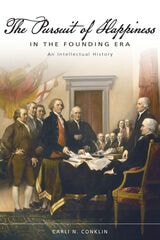
Scholars have long debated the meaning of the pursuit of happiness, yet have tended to define it narrowly, focusing on a single intellectual tradition, and on the use of the term within a single text, the Declaration of Independence. In this insightful volume, Carli Conklin considers the pursuit of happiness across a variety of intellectual traditions, and explores its usage in two key legal texts of the Founding Era, the Declaration and William Blackstone’s Commentaries on the Laws of England.
For Blackstone, the pursuit of happiness was a science of jurisprudence, by which his students could know, and then rightly apply, the first principles of the Common Law. For the founders, the pursuit of happiness was the individual right to pursue a life lived in harmony with the law of nature and a public duty to govern in accordance with that law. Both applications suggest we consider anew how the phrase, and its underlying legal philosophies, were understood in the founding era. With this work, Conklin makes important contributions to the fields of early American intellectual and legal history.
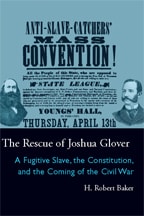
The Rescue of Joshua Glover
A Fugitive Slave, the Constitution, and the Coming of the Civil WarH. Robert Baker
Ohio University Press, 2006
On March 11, 1854, the people of Wisconsin prevented agents of the federal government from carrying away the fugitive slave, Joshua Glover. Assembling in mass outside the Milwaukee courthouse, they demanded that the federal officers respect his civil liberties as they would those of any other citizen of the state. When the officers refused, the crowd took matters into its own hands and rescued Joshua Glover. The federal government brought his rescuers to trial, but the Wisconsin Supreme Court intervened and took the bold step of ruling the Fugitive Slave Act unconstitutional.
The Rescue of Joshua Glover delves into the courtroom trials, political battles, and cultural equivocation precipitated by Joshua Glover’s brief, but enormously important, appearance in Wisconsin on the eve of the Civil War.
H. Robert Baker articulates the many ways in which this case evoked powerful emotions in antebellum America, just as the stage adaptation of Uncle Tom’s Cabin was touring the country and stirring antislavery sentiments. Terribly conflicted about race, Americans struggled mightily with a revolutionary heritage that sanctified liberty but also brooked compromise with slavery. Nevertheless, as The Rescue of Joshua Glover demonstrates, they maintained the principle that the people themselves were the last defenders of constitutional liberty, even as Glover’s rescue raised troubling questions about citizenship and the place of free blacks in America.
The Right To Privacy
Gays, Lesbians, and the ConstitutionVincent J. Samar
Temple University Press, 1992
Where did the right to privacy come from and what does it mean? Grappling with the critical issues involving women and gays that relate to the recent Supreme Court appointment, Vincent J. Samar develops a definition of legal privacy, discusses the reasons why and the degree to which privacy should be protected, and shows the relationship between privacy and personal autonomy. He answers former Supreme Court nominee Robert Bork’s questions about scope, content, and legal justification for a general right to privacy and emphasizes issues involving gays and lesbians, Samar maintains that these privacy issues share a common constitutional-ethical underpinning with issues such as abortion, surrogate motherhood, drug testing, and the right to die.
The Rise of Populist Nationalism
Social Resentments and Capturing the Constitution in HungaryBalázs Majtényi
Central European University Press, 2020
The State as a Work of Art
The Cultural Origins of the ConstitutionEric Slauter
University of Chicago Press, 2009
The founding of the United States after the American Revolution was so deliberate, so inspired, and so monumental in scope that the key actors considered this new government to be a work of art framed from natural rights. Recognizing the artificial nature of the state, these early politicians believed the culture of a people should inform the development of their governing rules and bodies. Eric Slauter explores these central ideas in this extensive and novel account of the origins and meanings of the Constitution of the United States. Slauter uncovers the hidden cultural histories upon which the document rests, highlights the voices of ordinary people, and considers how the artifice of the state was challenged in its effort to sustain inalienable natural rights alongside slavery and to achieve political secularization at a moment of growing religious expression.
A complement to classic studies of the Constitution’s economic, ideological, and political origins, The State as a Work of Art sheds new light on the origins of the Constitution and on ongoing debates over its interpretation.