Results by title
90 books match the query 'Constitutional history' and 41 start with t
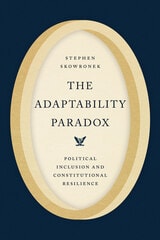
The Adaptability Paradox
Political Inclusion and Constitutional ResilienceStephen Skowronek
University of Chicago Press, 2025
Has American democracy outstripped its constitutional accommodations?
Faith in the resilience and adaptability of the US Constitution rests on a long history of finding new ways to make the system work. In The Adaptability Paradox, political scientist Stephen Skowronek examines the rearrangements that regenerated the American government in the past and brings that experience to bear on our current predicament. He shows how a constitution framed in writing some 230 years ago can run into serious difficulties directly related to its long and impressive history of adaptation.
Skowronek connects questions about the Constitution’s adaptability to the challenges of democratization. For most of American history, serial rearrangements of constitutional relationships widened the government’s purview as a national democracy without giving either nationalism or democracy free rein. Skowronek argues that the politics of adaptation shifted fundamentally with the “Rights Revolution” of the 1960s and `70s when American national democracy approached the inclusion of all its citizens on equal footing. Since then, power and authority have been reconfigured in ways that have steadily magnified conflicts over the essentials of good order. Conservatives aim to dismantle a Constitution that progressives are intent on building upon, and the consensus necessary for a constitutional democracy to function effectively has all but evaporated. No longer a socially bound framework for national action, the Constitution has become an abstract matrix of possibilities, a disembodied opportunity structure open to starkly different, mutually unacceptable futures.
Rather than being liberated by this unbound Constitution, the American people now appear entrapped by it. Is it possible that the development of American democracy has exhausted the adaptive capacities of the Constitution? A timely reminder that constitutional democracies do not survive on faith alone, The Adaptability Paradox is a sober appraisal of the unfamiliar ground on which we now tread.
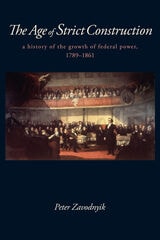
The Age of Strict Construction
a History of the Growth of Federal Power, 1789-1861Peter Zavodnyik
Catholic University of America Press, 2007
The American Supreme Court
Robert G. McCloskey
University of Chicago Press, 2000
As in the second edition, McCloskey's original text remains unchanged. In his historical interpretation, he argues that the strength of the Court has always been its sensitivity to the changing political scene, as well as its reluctance to stray too far from the main currents of public sentiments. In two new chapters, Levinson discusses the Court's more recent role, especially during the 1960s, as protector of the civil rights and liberties of minorities. He updates as well the Court's continuing role as monitor of the welfare state, looking at the litigation following the 1996 changes in welfare policy by Congress and the President. Also covered in this new edition are the recent Court decisions on federalism, which perhaps portend an enhanced role for the court as the "umpire" of the federal system; the clash between Congress and the Court over the scope of the required accommodation by government of religious conduct; and the Court's role in the impeachment of President Clinton.
Wonderfully readable and concisely written, McCloskey's book is an essential guide to the past, present, and future prospects of America's highest court.
The American Supreme Court
Robert G. McCloskey
University of Chicago Press, 2004
As in previous editions, McCloskey's original text remains unchanged. He argues that the Court's strength has always been its sensitivity to the changing political scene, as well as its reluctance to stray too far from the main currents of public sentiment. Levinson's two new chapters show how McCloskey's approach continues to illuminate recent developments, such as the Court's seeming return to its pre-1937 role as "umpire" of the federal system. It is in Bush v. Gore, however, where the implications of McCloskey's interpretation stand out most clearly.
The best and most concise account of the Supreme Court and its place in American politics, McCloskey's wonderfully readable book is an essential guide to its past, present, and future prospects of this institution.
The American Supreme Court, Sixth Edition
Robert G. McCloskey and Sanford Levinson
University of Chicago Press, 2016
As in prior editions, McCloskey’s original text remains unchanged. In his historical interpretation, he argues that the strength of the Court has always been its sensitivity to the changing political scene, as well as its reluctance to stray too far from the main currents of public sentiment. In this new edition, Sanford Levinson extends McCloskey’s magisterial treatment to address developments since the 2010 election, including the Supreme Court’s decisions regarding the Defense of Marriage Act, the Affordable Care Act, and gay marriage.
The best and most concise account of the Supreme Court and its place in American politics, McCloskey's wonderfully readable book is an essential guide to the past, present, and future prospects of this institution.
The American Supreme Court
Fifth EditionRobert G. McCloskey
University of Chicago Press, 2010
Celebrating its fiftieth anniversary, Robert McCloskey’s classic work on the Supreme Court’s role in constructing the U.S. Constitution has introduced generations of students to the workings of our nation’s highest court. For this new fifth edition, Sanford Levinson extends McCloskey’s magisterial treatment to address the Court’s most recent decisions.
As in prior editions, McCloskey’s original text remains unchanged. In his historical interpretation, he argues that the strength of the Court has always been its sensitivity to the changing political scene, as well as its reluctance to stray too far from the main currents of public sentiments. In two revised chapters, Levinson shows how McCloskey’s approach continues to illuminate developments since 2005, including the Court’s decisions in cases arising out of the War on Terror, which range from issues of civil liberty to tests of executive power. He also discusses the Court’s skepticism regarding campaign finance regulation; its affirmation of the right to bear arms; and the increasingly important nomination and confirmation process of Supreme Court justices, including that of the first Hispanic justice, Sonia Sotomayor.
The best and most concise account of the Supreme Court and its place in American politics, McCloskey's wonderfully readable book is an essential guide to the past, present, and future prospects of this institution.
The Anti-Federalist
An Abridgment of The Complete Anti-FederalistEdited by Herbert J. Storing
University of Chicago Press, 1985
This one-volume edition presents the essence of the other side of that crucial dialogue. It can be read as a genuine counterpart to the Federalist Papers; as an original source companion to Storing's brilliant essay What the Anti-Federalists Were For (volume I of The Complete Anti-Federalist, available as a separate paperback); or as a guide to exploring the full range of Anti-Federalist writing. The Anti-Federalist makes a fundamental source of our political heritage accessible to everyone.
The Articles of Confederation
An Interpretation of the Social-Constitutional History of the American Revolution, 1774-1781Merrill Jensen
University of Wisconsin Press, 1959
"An admirable analysis. It presents, in succinct form, the results of a generation of study of this chapter of our history and summarizes fairly the conclusions of that study."—Henry Steele Commager, New York Times Book Review
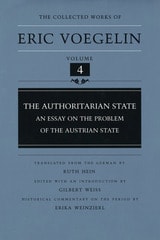
The Authoritarian State (CW4)
An Essay on the Problem of the Austrian StateEric Voegelin, Edited & Intro by Gilbert Weiss, Translated by Ruth Hein, & Historical Commentary by Erika Weinzierl
University of Missouri Press, 1999
Published in Vienna in 1936, The Authoritarian State by Eric Voegelin has remained virtually unknown to the public until now. Sales of the German edition were halted following the Nazi invasion of Austria in 1938, and the entire printing was later destroyed by wartime bombing. In this volume, Voegelin offers a critical examination of the most prominent European theories of state and constitutional law of the period while providing a political and historical analysis of the Austrian situation. He discusses the dismissal of Parliament in 1933, the civil war, the murder of Federal Chancellor Dollfuss, the adoption of the "Authoritarian Constitution" of 1934, and the predicament of being sandwiched between Hitler and Mussolini.
A radical critique of Hans Kelsen's pure theory of law lies at the heart of this work, marking Voegelin's definitive departure from Neo-Kantian epistemology. For the first time, Voegelin elaborates on the important distinction between theoretical concepts and political symbols as a basis for explaining the nontheoretical and speculative character of ideologies, both left and right. He shows that total and authoritarian are symbols of ideological self-interpretation that have no theoretical value, a distinction basic to his later work in The New Science of Politics.
Available for the first time in English, The Authoritarian State is a valuable addition to the Voegelin canon and to the field of intellectual history in general.
The Complete Anti-Federalist
Edited by Herbert J. Storing
University of Chicago Press, 2007
The Complete Anti-Federalist, first published in 1981, contains an unprecedented collection of all the significant pamphlets, newspaper articles and letters, essays, and speeches that were written in opposition to the Constitution during the ratification debate. Storing’s work includes introductions to each entry, along with his own consideration of the Anti-Federalist thought.
This new three-volume set includes all the contents of the original seven-volume publication in a convenient, manageable format.
“A work of magnificent scholarship. Publication of these volumes is a civic event of enduring importance.”—Leonard W. Levy, New York Times Book Review
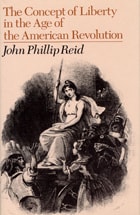
The Concept of Liberty in the Age of the American Revolution
John Phillip Reid
University of Chicago Press, 1988
As John Philip Reid goes on to make clear, "liberty" did not mean to the eighteenth-century mind what it means today. In the twentieth century, we take for granted certain rights—such as freedom of speech and freedom of the press—with which the state is forbidden to interfere. To the revolutionary generation, liberty was preserved by curbing its excesses. The concept of liberty taught not what the individual was free to do but what the rule of law permitted. Ultimately, liberty was law—the rule of law and the legalism of custom. The British constitution was the charter of liberty because it provided for the rule of law.
Drawing on an impressive command of the original materials, Reid traces the eighteenth-century notion of liberty to its source in the English common law. He goes on to show how previously problematic arguments involving the related concepts of licentiousness, slavery, arbitrary power, and property can also be fit into the common-law tradition. Throughout, he focuses on what liberty meant to the people who commented on and attempted to influence public affairs on both sides of the Atlantic. He shows the depth of pride in liberty—English liberty—that pervaded the age, and he also shows the extent—unmatched in any other era or among any other people—to which liberty both guided and motivated political and constitutional action.
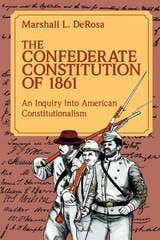
The Confederate Constitution of 1861
An Inquiry into American ConstitutionalismMarshall L. DeRosa
University of Missouri Press, 1991
In The Confederate Constitution of 1861, Marshall DeRosa argues that the Confederate Constitution was not, as is widely believed, a document designed to perpetuate a Southern "slaveocracy," but rather an attempt by the Southern political leadership to restore the Anti-Federalist standards of limited national government. In this first systematic analysis of the Confederate Constitution, DeRosa sheds new light on the constitutional principles of the CSA within the framework of American politics and constitutionalism. He shows just how little the Confederate Constitution departed from the U.S. Constitution on which it was modeled and examines closely the innovations the delegates brought to the document.
The Constitution in Congress
Democrats and Whigs, 1829-1861David P. Currie
University of Chicago Press, 2005
Like its predecessors, The Constitution in Congress: Democrats and Whigs will be an invaluable reference for legal scholars and constitutional historians alike.
The Constitution in Congress
Descent into the Maelstrom, 1829-1861David P. Currie
University of Chicago Press, 2005
This acclaimed series serves as a biography of the U.S. Constitution, offering an indispensable survey of the congressional history behind its development. In a rare examination of the role that both the legislative and executive branches have played in the development of constitutional interpretation, The Constitution in Congress shows how the actions and proceedings of these branches reveal perhaps even more about constitutional disputes than Supreme Court decisions of the time.
The centerpiece for the fourth volume in this series is the great debate over slavery and how this divisive issue led the country into the maelstrom of the Civil War. From the Jacksonian revolution of 1829 to the secession of Southern states from the Union, legal scholar David P. Currie provides an unrivaled analysis of the significant constitutional events—the Wilmot Proviso, the Compromise of 1850, the Kansas-Nebraska Act, the Lincoln-Douglas Debates, and "Bleeding Kansas"—that led up to the war. Exploring how slavery was addressed in presidential speeches and debated in Congress, Currie shows how the Southern Democrats dangerously diminished federal authority and expanded states' rights, threatening the nation's very survival.
Like its predecessors, this fourth volume of The Constitution in Congress will be an invaluable reference for legal scholars and constitutional historians alike.
The Constitution in Congress
The Federalist Period, 1789-1801David P. Currie
University of Chicago Press, 1997
"A joy to read."—Appellate Practive Journal and Update
"[A] patient and exemplary analysis of the work of the first six Congresses."—Geoffrey Marshall, Times Literary Supplement
The Constitution in Congress
The Jeffersonians, 1801-1829David P. Currie
University of Chicago Press, 2001
legislative and executive action in the United States, legal scholars
have traditionally looked only to the courts for guidance in
interpreting the Constitution. This, the second book in David P.
Currie's multivolume series, looks to the legislative and executive
branches for insights into the development of constitutional
interpretation.
Currie examines the period of Republican hegemony from the
inauguration of Thomas Jefferson in 1801 to the election of Andrew
Jackson in 1829. During this time of great leadership and
controversy, many benchmark issues—the abolition of the new Circuit
Courts, the Louisiana Purchase, the Burr conspiracy, the War of 1812,
the Monroe Doctrine, and the Missouri Compromise, among others—were
debated and decided almost exclusively in the legislative and
executive arenas. With its uniquely legal perspective and
comprehensive coverage, The Constitution in Congress
illustrates how the executive and legislative branches matched the
Supreme Court in putting flesh and blood onto the skeleton of the
Constitution.
The Constitution in the Supreme Court
The First Hundred Years, 1789-1888David P. Currie
University of Chicago Press, 1985
"A thorough, systematic, and careful assessment. . . . As a reference work for constitutional teachers, it is a gold mine."—Charles A. Lofgren, Constitutional Commentary
The Constitution in the Supreme Court
The Second Century, 1888-1986David P. Currie
University of Chicago Press, 1990
"Elegant and readable. Whether you are in favor of judicial restraint or judicial activism, whatever your feelings about the Warren Court, or the Renquist Court, this is a book that justifies serious study."—Robert Stevens, New York Times Book Review
The Constitutional Bind
How Americans Came to Idolize a Document That Fails ThemAziz Rana
University of Chicago Press, 2024
An eye-opening account of how Americans came to revere the Constitution and what this reverence has meant domestically and around the world.
Some Americans today worry that the Federal Constitution is ill-equipped to respond to mounting democratic threats and may even exacerbate the worst features of American politics. Yet for as long as anyone can remember, the Constitution has occupied a quasi-mythical status in American political culture, which ties ideals of liberty and equality to assumptions about the inherent goodness of the text’s design. The Constitutional Bind explores how a flawed document came to be so glorified and how this has impacted American life.
In a pathbreaking retelling of the American experience, Aziz Rana shows that today’s reverential constitutional culture is a distinctively twentieth-century phenomenon. Rana connects this widespread idolization to another relatively recent development: the rise of US global dominance. Ultimately, such veneration has had far-reaching consequences: despite offering a unifying language of reform, it has also unleashed an interventionist national security state abroad while undermining the possibility of deeper change at home.
Revealing how the current constitutional order was forged over the twentieth century, The Constitutional Bind also sheds light on an array of movement activists—in Black, Indigenous, feminist, labor, and immigrant politics—who struggled to imagine different constitutional horizons. As time passed, these voices of opposition were excised from memory. Today, they offer essential insights.

The Constitutional Convention and Formation of Union
Edited by Winton U. Solberg
University of Illinois Press, 1990
The Constitutionalism of American States
Edited by George E. Connor & Christopher W. Hammons
University of Missouri Press, 2008
This comparative study of American state constitutions offers insightful overviews of the general and specific problems that have confronted America’s constitution writers since the founding. Each chapter reflects the constitutional history and theory of a single state, encompassing each document’s structure, content, and evolution.
The text is grounded in the model presented by constitutional scholar Donald S. Lutz in The Origins of American Constitutionalism so that even when a state has a relatively stable constitutional history, Lutz’s framework can be used to measure the evolving meaning of the document. With contributors drawn from state governments as well as academia, this is the first work to offer a framework by which state constitutions can be analyzed in relation to one another and to the federal Constitution.
The volume begins with chapters on the New England, Mid-Atlantic, Border, and Southern states. While regional similarities within and between the New England and Mid-Atlantic states are noteworthy, the colonial aspect of their history laid the foundation for national constitution-making. And while North and South moved in distinct directions, the Border states wrestled with conflicting constitutional traditions in the same way that they wrestled with their place in the Union.
Southern states that seceded are shown to have had a common set of problems in their constitutions, and the post–Civil War South emerged from that conflict with a constitutionalism that was defined for it by the war’s victors. These chapters reveal that constitutional self-definition, while not evident in all of the former Confederate states, has redeveloped in the South in the intervening 140 years.
Sections devoted to the Midwest, the Plains, the Mountain West, the Southwest, and the West reflect the special circumstances of states that arose from American expansion. Chapters describe how states of the Midwest, united by common roots in the Northwest Ordinance, wrote constitutions that were defined by that act’s parameters while reflecting the unique cultural and political realities of each state. Meanwhile, the Plains states developed a constitutionalism that was historically rooted in progressivism and populism, sometimes in the clash between these two ideologies.
Perhaps more than any other region, the Mountain West was defined by the physical landscape, and these chapters relate how those states were able to define their individual constitutional identities in spite of geography rather than because of it. And although western states borrowed heavily from those with much older constitutional traditions, the contributors reveal that they borrowed differently—and in different proportions—in order to craft constitutions that were uniquely adapted to their historical situation and peoples.
This work demonstrates the diversity of our governmental arrangements and provides a virtual introduction to the political culture of each—many offering stories of constitutional foundings that are rich with meaning. Although these fifty documents are defined in a federal context, state constitutions are necessary to complete the constitutionalism of the United States.
The Democratic Constitution
Experimentalism and InterpretationBrian E. Butler
University of Chicago Press, 2017
Butler offers an alternative democratic conception of constitutional law, “democratic experimentalism,” and applies it in a thorough reconstruction of Supreme Court cases across the centuries, such as Brown v. Board of Education, Citizens United v. Federal Election Commission, Lucas v. South Carolina Coastal Council, and Lochner v. New York. In contrast to the traditional tools and conceptions of legal analysis that see the law as a formally unique and separate type of practice, democratic experimentalism combines democratic aims and experimental practice. Butler also suggests other directions jurisprudential roles could take: for example, adjudication could be performed by primary stakeholders with better information. Ultimately, Butler argues persuasively for a move away from the current absolute centrality of courts toward a system of justice that emphasizes local rule and democratic choice.
The Dred Scott Case
Historical and Contemporary Perspectives on Race and LawDavid Thomas Konig
Ohio University Press, 2010
In 1846 two slaves, Dred and Harriet Scott, filed petitions for their freedom in the Old Courthouse in St. Louis, Missouri. As the first true civil rights case decided by the U.S. Supreme Court, Dred Scott v. Sandford raised issues that have not been fully resolved despite three amendments to the Constitution and more than a century and a half of litigation.
The Dred Scott Case: Historical and Contemporary Perspectives on Race and Law presents original research and the reflections of the nation’s leading scholars who gathered in St. Louis to mark the 150th anniversary of what was arguably the most infamous decision of the U.S. Supreme Court. The decision, which held that African Americans “had no rights” under the Constitution and that Congress had no authority to alter that, galvanized Americans and thrust the issue of race and law to the center of American politics. This collection of essays revisits the history of the case and its aftermath in American life and law. In a final section, the present-day justices of the Missouri Supreme Court offer their reflections on the process of judging and provide perspective on the misdeeds of their nineteenth-century predecessors who denied the Scotts their freedom.
Contributors: Austin Allen, Adam Arenson, John Baugh, Hon. Duane Benton, Christopher Alan Bracey, Alfred L. Brophy, Paul Finkelman, Louis Gerteis, Mark Graber, Daniel W. Hamilton, Cecil J. Hunt II, David Thomas Konig, Leland Ware, Hon. Michael A. Wolff
The End of Catholic Mexico
Causes and Consequences of the Mexican Reforma (1855–1861)David Gilbert
Vanderbilt University Press, 2024
Gilbert’s fresh account of this pivotal moment in Mexican history will be of interest to scholars of postindependence Mexico, Latin American religious history, nineteenth-century church history, and US historians of the antebellum republic.
The Glorious Revolution and the Continuity of Law
Richard S. Kay
Catholic University of America Press, 2014
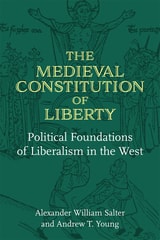
The Medieval Constitution of Liberty
Political Foundations of Liberalism in the WestAlexander William Salter and Andrew T. Young
University of Michigan Press, 2023
Why did enduring traditions of economic and political liberty emerge in Western Europe and not elsewhere? Representative democracy, constitutionalism, and the rule of law are crucial for establishing a just and prosperous society, which we usually treat as the fruits of the Renaissance and Enlightenment, as Western European societies put the Dark Ages behind them.
In The Medieval Constitution of Liberty, Salter and Young point instead to the constitutional order that characterized the High Middle Ages. They provide a historical account of how this constitutional order evolved following the fall of the Western Roman Empire. This account runs from the settlements of militarized Germanic elites within the imperial frontiers, to the host of successor kingdoms in the sixth and seventh centuries, and through the short-lived Carolingian empire of the late eighth and ninth centuries and the so-called “feudal anarchy” that followed its demise. Given this unique historical backdrop, Salter and Young consider the resulting structures of political property rights. They argue that the historical reality approximated a constitutional ideal type, which they term polycentric sovereignty. Salter and Young provide a theoretical analysis of polycentric sovereignty, arguing that bargains between political property rights holders within that sort of constitutional order will lead to improvements in governance.
The Moulding of Ukraine
The Constitutional Politics of State FormationKataryna Wolczuk
Central European University Press, 2002
The Myth of Coequal Branches
Restoring the Constitution’s Separation of FunctionsDavid J. Siemers
University of Missouri Press, 2026
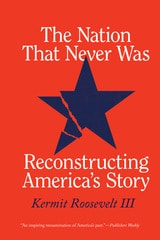
The Nation That Never Was
Reconstructing America's StoryKermit Roosevelt III
University of Chicago Press, 2022
There’s a common story we tell about America: that our fundamental values as a country were stated in the Declaration of Independence, fought for in the Revolution, and made law in the Constitution. But, with the country increasingly divided, this story isn’t working for us anymore—what’s more, it’s not even true. As Kermit Roosevelt argues in this eye-opening reinterpretation of the American story, our fundamental values, particularly equality, are not part of the vision of the Founders. Instead, they were stated in Lincoln’s Gettysburg Address and were the hope of Reconstruction, when it was possible to envision the emergence of the nation committed to liberty and equality.
We face a dilemma these days. We want to be honest about our history and the racism and oppression that Americans have both inflicted and endured. But we want to be proud of our country, too. In The Nation That Never Was, Roosevelt shows how we can do both those things by realizing we’re not the country we thought we were. Reconstruction, Roosevelt argues, was not a fulfillment of the ideals of the Founding but rather a repudiation: we modern Americans are not the heirs of the Founders but of the people who overthrew and destroyed that political order. This alternate understanding of American identity opens the door to a new understanding of ourselves and our story, and ultimately to a better America.
America today is not the Founders’ America, but it can be Lincoln’s America. Roosevelt offers a powerful and inspirational rethinking of our country’s history and uncovers a shared past that we can be proud to claim and use as a foundation to work toward a country that fully embodies equality for all.

The Nicaraguan Constitution of 1987
English Translation and CommentaryKenneth J. Mijeski
Ohio University Press, 1991
This volume of seven essays on the 1987 Nicaraguan constitution does not accept a priori the judgment that Latin American constitutions are as fragile as egg shells, easily broken and discarded if found to be inconvenient to the interests of the rulers. Rather, they are viewed as being central to understanding political life in contemporary Nicaragua.
The perspectives of the analysts and their conclusions are not consensual. They prohibit glib and facile general conclusions. Some find the constitution to be nothing more than a façade for arbitrary and capricious rule; others that the document reflects clear commitments to the democratic rule of law. Thus far the implementation of the constitution has resulted in the peaceful transition of power from the Sandinistas to the National Opposition Union.
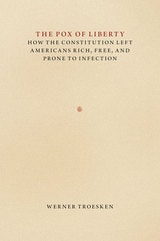
The Pox of Liberty
How the Constitution Left Americans Rich, Free, and Prone to InfectionWerner Troesken
University of Chicago Press, 2015
Werner Troesken looks at the history of the United States with a focus on three diseases—smallpox, typhoid fever, and yellow fever—to show how constitutional rules and provisions that promoted individual liberty and economic prosperity also influenced, for good and for bad, the country’s ability to eradicate infectious disease. Ranging from federalism under the Commerce Clause to the Contract Clause and the Fourteenth Amendment, Troesken argues persuasively that many institutions intended to promote desirable political or economic outcomes also hindered the provision of public health. We are unhealthy, in other words, at least in part because our political and legal institutions function well. Offering a compelling new perspective, The Pox of Liberty challenges many traditional claims that infectious diseases are inexorable forces in human history, beyond the control of individual actors or the state, revealing them instead to be the result of public and private choices.
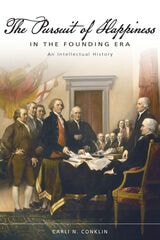
The Pursuit of Happiness in the Founding Era
An Intellectual HistoryCarli N. Conklin
University of Missouri Press, 2020
Scholars have long debated the meaning of the pursuit of happiness, yet have tended to define it narrowly, focusing on a single intellectual tradition, and on the use of the term within a single text, the Declaration of Independence. In this insightful volume, Carli Conklin considers the pursuit of happiness across a variety of intellectual traditions, and explores its usage in two key legal texts of the Founding Era, the Declaration and William Blackstone’s Commentaries on the Laws of England.
For Blackstone, the pursuit of happiness was a science of jurisprudence, by which his students could know, and then rightly apply, the first principles of the Common Law. For the founders, the pursuit of happiness was the individual right to pursue a life lived in harmony with the law of nature and a public duty to govern in accordance with that law. Both applications suggest we consider anew how the phrase, and its underlying legal philosophies, were understood in the founding era. With this work, Conklin makes important contributions to the fields of early American intellectual and legal history.
The Reconstruction Amendments
The Essential Documents, Volume 1Edited by Kurt T. Lash
University of Chicago Press, 2021
Volume I outlines a broad historical context for the Reconstruction Amendments and contains materials related to the Thirteenth Amendment, which abolished slavery, while Volume 2 covers the Fourteenth and Fifteenth Amendments on the rights of citizenship and enfranchisement. The documents in this collection encompass a sweeping range of primary sources, from congressional debates to court cases, public speeches to newspaper articles. As a whole, the volumes meticulously depict a significant period of legal change even as they illuminate the ways in which people across the land grappled with the process of constitutional reconstruction. Filling a major gap in the literature on the era, The Reconstruction Amendments will be indispensable for readers in politics, history, and law, as well as anyone seeking a better understanding of the post–Civil War basis of American constitutional democracy.
The Reconstruction Amendments
The Essential Documents, Volume 2Edited by Kurt T. Lash
University of Chicago Press, 2021
Volume I outlines a broad historical context for the Reconstruction Amendments along with materials related to the Thirteenth Amendment, which abolished slavery, while Volume II covers the Fourteenth and Fifteenth Amendments on the rights of citizenship and enfranchisement. The documents in this collection encompass a sweeping range of primary sources, from congressional talks to court cases, public speeches to newspaper articles. As a whole, the volumes meticulously depict a significant period of legal change even as they illuminate the ways in which people across the land grappled with the process of constitutional reconstruction. Filling a major gap in the literature on the era, The Reconstruction Amendments will be indispensable for readers in politics, history, and law, as well as anyone seeking a better understanding of the post–Civil War basis of American constitutional democracy.
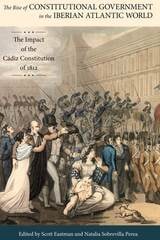
The Rise of Constitutional Government in the Iberian Atlantic World
The Impact of the Cádiz Constitution of 1812Scott Eastman
University of Alabama Press, 2015
Exploring the constitution that transformed governance, citizenship, and political culture across the Hispanic Atlantic world.
In March 1812, while Napoleon’s brother Joseph sat on the throne of Spain and the armies of France occupied much of the country, legislators elected from Spain and its overseas territories met in the Andalusian city of Cádiz. There, as the cornerstone of a government in exile, they drafted and adopted the first liberal constitution in the Hispanic world, a document that became known as the Cádiz Constitution of 1812.
The 1812 Constitution was extremely influential in and beyond Europe, and this collection of essays explores how its enduring legacy not only shaped the history of state-building, elections, and municipal governance in Iberian America, but also affected national identities and citizenship as well as the development of race and gender in the region.
A bold blueprint for governing a global, heterogeneous monarchy, the Constitution represented a rupture with Spain’s Antiguo Régimen (Old Regime) in numerous ways—in the limits it placed on the previously autocratic Bourbon monarchs, in the admission to its governing bodies of deputies from Spain’s American viceroyalties as equals, and in its framers’ vociferous debate over the status of castas (those of mixed ancestry) and slaves. The Rise of Constitutional Government in the Iberian Atlantic World covers these issues and adopts a transatlantic perspective that recovers the voices of those who created a vibrant political culture accessible to commoners and elite alike.
The bicentenary of the Constitution of 1812 offered scholars an excellent moment to reexamine the form and role of constitutions across the Spanish-speaking world. Constitutionalism remains a topic of intense debate in Latin America, while contemporary Spain itself continues to seek ways to balance a strong central government with centripetal forces in its regions, notably the Basque and Catalan provinces. The multifaceted essays compiled here by Scott Eastman and Natalia Sobrevilla Perea both shed new light on the early, liberal Hispanic societies and show how the legacies of those societies shape modern Spain and Latin America.
The Rise of Populist Nationalism
Social Resentments and Capturing the Constitution in HungaryBalázs Majtényi
Central European University Press, 2020
The Roundtable Talks and the Breakdown of Communism
Edited by Jon Elster
University of Chicago Press, 1996
These essays capture the historical circumstances of these countries—their traditions, customs, and the balance of influence between competing factions—that often took precedence over constitutional ideals. In five country-specific reports, senior scholars provide detailed accounts of the talks in Bulgaria, Poland, Hungary, Czechoslovakia, and the German Democratic Republic. Also included is an essay on the political factors underlying the failure of negotiations between reform groups and the Chinese regime, providing an illuminating counterpoint to the path taken in Eastern Europe.
This book is an invaluable resource for scholars of constitutional design and democratization and for specialists in Eastern Europe.

The Roundtable Talks of 1989
The Genesis of Hungarian DemocracyAndrás Bozóki
Central European University Press, 2002
This is the first book in English which provides comprehensive analysis and documentary history on the Roundtable talks, the major event of the “negotiated revolution” of Hungary. These negotiations occurred during the summer months of 1989 between the representatives of the Communist Party, the Opposition Roundtable, and the so-called Third Side (which brought some pro-Communist satellite organizations together).
The authors offer much more than just a detailed account on the negotiations: they also put the process of constitutional revolution into a comparative and historical perspective. They believe that the Roundtable Talks amounted to much more than just a sideshow and in fact they constituted the hub of the revolutionary transformation.
The Shaping of American Liberalism
The Debates over Ratification, Nullification, and SlaveryDavid F. Ericson
University of Chicago Press, 1993
Focusing on three critical debates in American history—the debate between Anti-Federalists and Federalists over the ratification of the Constitution; the debate between the national republicans and the states-rights republicans over the nullification of the tariff; and the Lincoln-Douglas debates over slavery and pluralist democracy—Ericson shows that republicanism, rather than being opposed to liberalism, is in fact an offshoot of it. His descriptions of republicanism and pluralism represent the poles of an evolving tradition of liberal ideas in America: the former championing the claims of the public sphere, general welfare, and civic virtue; the latter protecting the rights of the individual to liberty, property, and privacy.
Republicanism and pluralism are therefore more properly understood as two sets of competing ideas that evolved from common roots. Ericson concludes that although republican themes persist in American politics, the profound transformations brought about by the Civil War made the ascendancy of pluralism virtually inevitable.
This highly original discussion of the relation between liberalism and republicanism—the central concern of much of the recent scholarship in American political thought—will be important reading for those interested in American politics, history, and culture.
The State as a Work of Art
The Cultural Origins of the ConstitutionEric Slauter
University of Chicago Press, 2009
The founding of the United States after the American Revolution was so deliberate, so inspired, and so monumental in scope that the key actors considered this new government to be a work of art framed from natural rights. Recognizing the artificial nature of the state, these early politicians believed the culture of a people should inform the development of their governing rules and bodies. Eric Slauter explores these central ideas in this extensive and novel account of the origins and meanings of the Constitution of the United States. Slauter uncovers the hidden cultural histories upon which the document rests, highlights the voices of ordinary people, and considers how the artifice of the state was challenged in its effort to sustain inalienable natural rights alongside slavery and to achieve political secularization at a moment of growing religious expression.
A complement to classic studies of the Constitution’s economic, ideological, and political origins, The State as a Work of Art sheds new light on the origins of the Constitution and on ongoing debates over its interpretation.
Tribes, Treaties, and Constitutional Tribulations
By Vine Deloria, Jr., and David E. Wilkins
University of Texas Press, 2000
"Federal Indian law . . . is a loosely related collection of past and present acts of Congress, treaties and agreements, executive orders, administrative rulings, and judicial opinions, connected only by the fact that law in some form has been applied haphazardly to American Indians over the course of several centuries. . . . Indians in their tribal relation and Indian tribes in their relation to the federal government hang suspended in a legal wonderland."
In this book, two prominent scholars of American Indian law and politics undertake a full historical examination of the relationship between Indians and the United States Constitution that explains the present state of confusion and inconsistent application in U.S. Indian law. The authors examine all sections of the Constitution that explicitly and implicitly apply to Indians and discuss how they have been interpreted and applied from the early republic up to the present. They convincingly argue that the Constitution does not provide any legal rights for American Indians and that the treaty-making process should govern relations between Indian nations and the federal government.