Results by title
66 books match the query 'Constitutions' and 19 start with t
The Adaptability Paradox
Political Inclusion and Constitutional ResilienceStephen Skowronek
University of Chicago Press, 2025
Has American democracy outstripped its constitutional accommodations?
Faith in the resilience and adaptability of the US Constitution rests on a long history of finding new ways to make the system work. In The Adaptability Paradox, political scientist Stephen Skowronek examines the rearrangements that regenerated the American government in the past and brings that experience to bear on our current predicament. He shows how a constitution framed in writing some 230 years ago can run into serious difficulties directly related to its long and impressive history of adaptation.
Skowronek connects questions about the Constitution’s adaptability to the challenges of democratization. For most of American history, serial rearrangements of constitutional relationships widened the government’s purview as a national democracy without giving either nationalism or democracy free rein. Skowronek argues that the politics of adaptation shifted fundamentally with the “Rights Revolution” of the 1960s and `70s when American national democracy approached the inclusion of all its citizens on equal footing. Since then, power and authority have been reconfigured in ways that have steadily magnified conflicts over the essentials of good order. Conservatives aim to dismantle a Constitution that progressives are intent on building upon, and the consensus necessary for a constitutional democracy to function effectively has all but evaporated. No longer a socially bound framework for national action, the Constitution has become an abstract matrix of possibilities, a disembodied opportunity structure open to starkly different, mutually unacceptable futures.
Rather than being liberated by this unbound Constitution, the American people now appear entrapped by it. Is it possible that the development of American democracy has exhausted the adaptive capacities of the Constitution? A timely reminder that constitutional democracies do not survive on faith alone, The Adaptability Paradox is a sober appraisal of the unfamiliar ground on which we now tread.

The Bonfire of The Decencies
Repairing and Restoring the British ConstitutionPeter Hennessy and Andrew Blick
Haus Publishing, 2022
In The Bonfire of the Decencies, Peter Hennessy and Andrew Blick use Boris Johnson’s tenure as prime minister to argue that mechanisms for the upholding of constitutional principles in the United Kingdom are deficient and require an overhaul. They show that, from the outset, Johnson’s time in office was a source of serious disruption that saw standards and integrity compromised, as well as constitutional values violated. Those problems, however, did not end with Johnson’s removal from office. Rather, they are part of longer-term tendencies in the UK, and of a worrying international trend towards the weakening of democracy. Hennessy and Blick analyze the pre-existing vulnerabilities that Johnson exposed in the UK system of government and conclude with a series of proposals to repair the damage and prevent a repetition of this anxious episode in the UK’s political history.
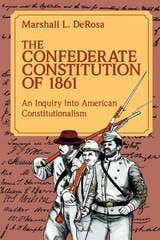
The Confederate Constitution of 1861
An Inquiry into American ConstitutionalismMarshall L. DeRosa
University of Missouri Press, 1991
In The Confederate Constitution of 1861, Marshall DeRosa argues that the Confederate Constitution was not, as is widely believed, a document designed to perpetuate a Southern "slaveocracy," but rather an attempt by the Southern political leadership to restore the Anti-Federalist standards of limited national government. In this first systematic analysis of the Confederate Constitution, DeRosa sheds new light on the constitutional principles of the CSA within the framework of American politics and constitutionalism. He shows just how little the Confederate Constitution departed from the U.S. Constitution on which it was modeled and examines closely the innovations the delegates brought to the document.
The Constitutional Bind
How Americans Came to Idolize a Document That Fails ThemAziz Rana
University of Chicago Press, 2024
An eye-opening account of how Americans came to revere the Constitution and what this reverence has meant domestically and around the world.
Some Americans today worry that the Federal Constitution is ill-equipped to respond to mounting democratic threats and may even exacerbate the worst features of American politics. Yet for as long as anyone can remember, the Constitution has occupied a quasi-mythical status in American political culture, which ties ideals of liberty and equality to assumptions about the inherent goodness of the text’s design. The Constitutional Bind explores how a flawed document came to be so glorified and how this has impacted American life.
In a pathbreaking retelling of the American experience, Aziz Rana shows that today’s reverential constitutional culture is a distinctively twentieth-century phenomenon. Rana connects this widespread idolization to another relatively recent development: the rise of US global dominance. Ultimately, such veneration has had far-reaching consequences: despite offering a unifying language of reform, it has also unleashed an interventionist national security state abroad while undermining the possibility of deeper change at home.
Revealing how the current constitutional order was forged over the twentieth century, The Constitutional Bind also sheds light on an array of movement activists—in Black, Indigenous, feminist, labor, and immigrant politics—who struggled to imagine different constitutional horizons. As time passed, these voices of opposition were excised from memory. Today, they offer essential insights.
The Constitutional Bind
How Americans Came to Idolize a Document That Fails ThemAziz Rana
University of Chicago Press, 2024
This is an auto-narrated audiobook version of this book.
An eye-opening account of how Americans came to revere the Constitution and what this reverence has meant domestically and around the world.
Some Americans today worry that the Federal Constitution is ill-equipped to respond to mounting democratic threats and may even exacerbate the worst features of American politics. Yet for as long as anyone can remember, the Constitution has occupied a quasi-mythical status in American political culture, which ties ideals of liberty and equality to assumptions about the inherent goodness of the text’s design. The Constitutional Bind explores how a flawed document came to be so glorified and how this has impacted American life.
In a pathbreaking retelling of the American experience, Aziz Rana shows that today’s reverential constitutional culture is a distinctively twentieth-century phenomenon. Rana connects this widespread idolization to another relatively recent development: the rise of US global dominance. Ultimately, such veneration has had far-reaching consequences: despite offering a unifying language of reform, it has also unleashed an interventionist national security state abroad while undermining the possibility of deeper change at home.
Revealing how the current constitutional order was forged over the twentieth century, The Constitutional Bind also sheds light on an array of movement activists—in Black, Indigenous, feminist, labor, and immigrant politics—who struggled to imagine different constitutional horizons. As time passed, these voices of opposition were excised from memory. Today, they offer essential insights.
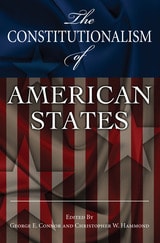
The Constitutionalism of American States
Edited by George E. Connor & Christopher W. Hammons
University of Missouri Press, 2008
This comparative study of American state constitutions offers insightful overviews of the general and specific problems that have confronted America’s constitution writers since the founding. Each chapter reflects the constitutional history and theory of a single state, encompassing each document’s structure, content, and evolution.
The text is grounded in the model presented by constitutional scholar Donald S. Lutz in The Origins of American Constitutionalism so that even when a state has a relatively stable constitutional history, Lutz’s framework can be used to measure the evolving meaning of the document. With contributors drawn from state governments as well as academia, this is the first work to offer a framework by which state constitutions can be analyzed in relation to one another and to the federal Constitution.
The volume begins with chapters on the New England, Mid-Atlantic, Border, and Southern states. While regional similarities within and between the New England and Mid-Atlantic states are noteworthy, the colonial aspect of their history laid the foundation for national constitution-making. And while North and South moved in distinct directions, the Border states wrestled with conflicting constitutional traditions in the same way that they wrestled with their place in the Union.
Southern states that seceded are shown to have had a common set of problems in their constitutions, and the post–Civil War South emerged from that conflict with a constitutionalism that was defined for it by the war’s victors. These chapters reveal that constitutional self-definition, while not evident in all of the former Confederate states, has redeveloped in the South in the intervening 140 years.
Sections devoted to the Midwest, the Plains, the Mountain West, the Southwest, and the West reflect the special circumstances of states that arose from American expansion. Chapters describe how states of the Midwest, united by common roots in the Northwest Ordinance, wrote constitutions that were defined by that act’s parameters while reflecting the unique cultural and political realities of each state. Meanwhile, the Plains states developed a constitutionalism that was historically rooted in progressivism and populism, sometimes in the clash between these two ideologies.
Perhaps more than any other region, the Mountain West was defined by the physical landscape, and these chapters relate how those states were able to define their individual constitutional identities in spite of geography rather than because of it. And although western states borrowed heavily from those with much older constitutional traditions, the contributors reveal that they borrowed differently—and in different proportions—in order to craft constitutions that were uniquely adapted to their historical situation and peoples.
This work demonstrates the diversity of our governmental arrangements and provides a virtual introduction to the political culture of each—many offering stories of constitutional foundings that are rich with meaning. Although these fifty documents are defined in a federal context, state constitutions are necessary to complete the constitutionalism of the United States.
The Documentary History of the Ratification of the Constitution Volume 26
Ratification of the Constitution by the States, Rhode Island, No. 3John P. Kaminski
Wisconsin Historical Society Press, 2013
Pulitzer Prize-winning historian Michael Kammen has noted that The Documentary History of the Ratification of the Constitution series "will be of enduring value centuries hence" and described it as "one of the most interesting documentary publications we have ever had." The American Bar Association Journal has stated, "Each new volume now fills another vital part of the mosaic of national history."
The Documentary History of the Ratification of the Constitution, Volume 11
Ratification of the Constitution by the States, Maryland, No. 1John P. Kaminski
Wisconsin Historical Society Press, 2015
The Documentary History of the Ratification of the Constitution, Volume 12
Ratification of the Constitution by the States, Maryland, No. 1John P. Kaminski
Wisconsin Historical Society Press, 2015
The Economics and the Ethics of Constitutional Order
James M. Buchanan
University of Michigan Press, 1991
The Ecosystem Approach in Anthropology serves as a foundational methodology guide for modern ecological and environmental anthropology. The book advocates for a rigorous, integrative approach to studying human societies by framing them as deeply interconnected components of larger biological ecosystems. Moran gathers a diverse cohort of leading researchers to demonstrate how abstract ecosystem concepts can be translated into concrete, empirical field practices across varying environments, ranging from tropical rainforests to arid landscapes. By bridging the gap between cultural anthropology and natural sciences like ecology, soil science, and demography, the volume offers critical frameworks for quantifying energy flows, resource consumption, and human-environmental feedback loops, making it an indispensable resource for analyzing complex social-ecological systems and anthropogenic environmental changes.

The Economics and the Ethics of Constitutional Order
James M. Buchanan
University of Michigan Press, 1991

The Kingfisher's Wings
Glimpsing the British Constitution in the 2020sPeter Hennessy and Andrew Blick
Haus Publishing, 2024
The Medieval Constitution of Liberty
Political Foundations of Liberalism in the WestAlexander William Salter and Andrew T. Young
University of Michigan Press, 2023
Why did enduring traditions of economic and political liberty emerge in Western Europe and not elsewhere? Representative democracy, constitutionalism, and the rule of law are crucial for establishing a just and prosperous society, which we usually treat as the fruits of the Renaissance and Enlightenment, as Western European societies put the Dark Ages behind them.
In The Medieval Constitution of Liberty, Salter and Young point instead to the constitutional order that characterized the High Middle Ages. They provide a historical account of how this constitutional order evolved following the fall of the Western Roman Empire. This account runs from the settlements of militarized Germanic elites within the imperial frontiers, to the host of successor kingdoms in the sixth and seventh centuries, and through the short-lived Carolingian empire of the late eighth and ninth centuries and the so-called “feudal anarchy” that followed its demise. Given this unique historical backdrop, Salter and Young consider the resulting structures of political property rights. They argue that the historical reality approximated a constitutional ideal type, which they term polycentric sovereignty. Salter and Young provide a theoretical analysis of polycentric sovereignty, arguing that bargains between political property rights holders within that sort of constitutional order will lead to improvements in governance.
The Militia and the Right to Arms, or, How the Second Amendment Fell Silent
H. Richard Uviller and William G. Merkel
Duke University Press, 2002
—Amendment II, United States Constitution
The Second Amendment is regularly invoked by opponents of gun control, but H. Richard Uviller and William G. Merkel argue the amendment has nothing to contribute to debates over private access to firearms. In The Militia and the Right to Arms, or, How the Second Amendment Fell Silent, Uviller and Merkel show how postratification history has sapped the Second Amendment of its meaning. Starting with a detailed examination of the political principles of the founders, the authors build the case that the amendment's second clause (declaring the right to bear arms) depends entirely on the premise set out in the amendment's first clause (stating that a well-regulated militia is necessary to the security of a free state). The authors demonstrate that the militia envisioned by the framers of the Bill of Rights in 1789 has long since disappeared from the American scene, leaving no lineal descendants. The constitutional right to bear arms, Uviller and Merkel conclude, has evaporated along with the universal militia of the eighteenth century.
Using records from the founding era, Uviller and Merkel explain that the Second Amendment was motivated by a deep fear of standing armies. To guard against the debilitating effects of militarism, and against the ultimate danger of a would-be Caesar at the head of a great professional army, the founders sought to guarantee the existence of well-trained, self-armed, locally commanded citizen militia, in which service was compulsory. By its very existence, this militia would obviate the need for a large and dangerous regular army. But as Uviller and Merkel describe the gradual rise of the United States Army and the National Guard over the last two hundred years, they highlight the nation's abandonment of the militia ideal so dear to the framers. The authors discuss issues of constitutional interpretation in light of radically changed social circumstances and contrast their position with the arguments of a diverse group of constitutional scholars including Sanford Levinson, Carl Bogus, William Van Alstyne, and Akhil Reed Amar.
Espousing a centrist position in the polarized arena of Second Amendment interpretation, this book will appeal to those wanting to know more about the amendment's relevance to the issue of gun control, as well as to those interested in the constitutional and political context of America's military history.
The Nation That Never Was
Reconstructing America's StoryKermit Roosevelt III
University of Chicago Press, 2022
There’s a common story we tell about America: that our fundamental values as a country were stated in the Declaration of Independence, fought for in the Revolution, and made law in the Constitution. But, with the country increasingly divided, this story isn’t working for us anymore—what’s more, it’s not even true. As Kermit Roosevelt argues in this eye-opening reinterpretation of the American story, our fundamental values, particularly equality, are not part of the vision of the Founders. Instead, they were stated in Lincoln’s Gettysburg Address and were the hope of Reconstruction, when it was possible to envision the emergence of the nation committed to liberty and equality.
We face a dilemma these days. We want to be honest about our history and the racism and oppression that Americans have both inflicted and endured. But we want to be proud of our country, too. In The Nation That Never Was, Roosevelt shows how we can do both those things by realizing we’re not the country we thought we were. Reconstruction, Roosevelt argues, was not a fulfillment of the ideals of the Founding but rather a repudiation: we modern Americans are not the heirs of the Founders but of the people who overthrew and destroyed that political order. This alternate understanding of American identity opens the door to a new understanding of ourselves and our story, and ultimately to a better America.
America today is not the Founders’ America, but it can be Lincoln’s America. Roosevelt offers a powerful and inspirational rethinking of our country’s history and uncovers a shared past that we can be proud to claim and use as a foundation to work toward a country that fully embodies equality for all.
The New Jersey State Constitution
A Reference GuideWilliams, Robert F
Rutgers University Press, 1997
The year 1997 marks the fiftieth anniversary of New Jerseys wellregarded state constitution. State constitutions, although the highest source of law within a state, are not well understood by citizens, government officials, historians, political scientists, lawyers, or even judges.
This book is the first single volume to combine a detailed review of New Jersey's constitutional history and analysis of each section of the current constitution. It is the standard work on New Jersey constitutional development and law. Divided into two parts, the book first covers the historical development of the constitutions of 1776, 1844, the Constitutional Commission of 1873, and the current constitution written in 1947. It then traces the origins and major judicial interpretations of each section of the present-day constitution. It concludes with an exhaustive bibliographical essay which organizes the most complete listing of primary and secondary sources to date.

The Nicaraguan Constitution of 1987
English Translation and CommentaryKenneth J. Mijeski
Ohio University Press, 1991
This volume of seven essays on the 1987 Nicaraguan constitution does not accept a priori the judgment that Latin American constitutions are as fragile as egg shells, easily broken and discarded if found to be inconvenient to the interests of the rulers. Rather, they are viewed as being central to understanding political life in contemporary Nicaragua.
The perspectives of the analysts and their conclusions are not consensual. They prohibit glib and facile general conclusions. Some find the constitution to be nothing more than a façade for arbitrary and capricious rule; others that the document reflects clear commitments to the democratic rule of law. Thus far the implementation of the constitution has resulted in the peaceful transition of power from the Sandinistas to the National Opposition Union.
The Politics of Decency
Peter Hennessy and Giles Edwards
Haus Publishing, 2026
A thoughtful examination of how to recenter decency in politics and public life, told through conversations between long-time historian and public servant Peter Hennessy and influential friends, decision makers, and leaders.
Having surveyed eighty years of the UK's political and constitutional journey, Hennessy prepares to bid farewell to public life. And he’s left with one thought: that the essential quality of decency needs to be placed—once again—back at the heart of public life and public discourse. But what does decency look like today, where does it spring from, and how might we all play a role in recentering it in public life? In The Politics of Decency, Hennessy considers such issues alongside a group of people who might pick up his baton. After inviting public servants, colleagues, and those he has long admired, along with younger voices from politics and public life, into his home for conversations about what decency means to them, he reflects on what they have shared with him. Hennessy’s interest in this question springs from a concern about constitutional proprieties, but these conversations range much further afield—from the constitution to service delivery, from schooling to social media. What he hears is both worrying and uplifting: a sense that there is a problem, a real commitment to tackle it, and ideas for how that might be done—and what role all of us can play in doing it.
The Rise of Constitutional Government in the Iberian Atlantic World
The Impact of the Cádiz Constitution of 1812Scott Eastman
University of Alabama Press, 2015
Exploring the constitution that transformed governance, citizenship, and political culture across the Hispanic Atlantic world.
In March 1812, while Napoleon’s brother Joseph sat on the throne of Spain and the armies of France occupied much of the country, legislators elected from Spain and its overseas territories met in the Andalusian city of Cádiz. There, as the cornerstone of a government in exile, they drafted and adopted the first liberal constitution in the Hispanic world, a document that became known as the Cádiz Constitution of 1812.
The 1812 Constitution was extremely influential in and beyond Europe, and this collection of essays explores how its enduring legacy not only shaped the history of state-building, elections, and municipal governance in Iberian America, but also affected national identities and citizenship as well as the development of race and gender in the region.
A bold blueprint for governing a global, heterogeneous monarchy, the Constitution represented a rupture with Spain’s Antiguo Régimen (Old Regime) in numerous ways—in the limits it placed on the previously autocratic Bourbon monarchs, in the admission to its governing bodies of deputies from Spain’s American viceroyalties as equals, and in its framers’ vociferous debate over the status of castas (those of mixed ancestry) and slaves. The Rise of Constitutional Government in the Iberian Atlantic World covers these issues and adopts a transatlantic perspective that recovers the voices of those who created a vibrant political culture accessible to commoners and elite alike.
The bicentenary of the Constitution of 1812 offered scholars an excellent moment to reexamine the form and role of constitutions across the Spanish-speaking world. Constitutionalism remains a topic of intense debate in Latin America, while contemporary Spain itself continues to seek ways to balance a strong central government with centripetal forces in its regions, notably the Basque and Catalan provinces. The multifaceted essays compiled here by Scott Eastman and Natalia Sobrevilla Perea both shed new light on the early, liberal Hispanic societies and show how the legacies of those societies shape modern Spain and Latin America.