Results by title
123 books match the query 'Courts' and 59 start with t
The Bilingual Courtroom
Court Interpreters in the Judicial Process, Second EditionSusan Berk-Seligson
University of Chicago Press, 2017
Susan Berk-Seligson’s groundbreaking book draws on more than one hundred hours of audio recordings of Spanish/English court proceedings in federal, state, and municipal courts—along with a number of psycholinguistic experiments involving mock juror reactions to interpreted testimony—to present a systematic study of court interpreters that raises some alarming, vitally important concerns. Contrary to the assumption that interpreters do not affect the dynamics of court proceedings, Berk-Seligson shows that interpreters could potentially make the difference between a defendant being found guilty or not guilty of a crime.
This second edition of the The Bilingual Courtroom includes a fully updated review of both theoretical and policy-oriented research relevant to the use of interpreters in legal settings, particularly from the standpoint of linguistic pragmatics. It provides new insights into interpreting in quasi-judicial, informal, and specialized judicial settings, such as small claims court, jails, and prisons; updates trends in interpreter certification and credentialing, both in the United States and abroad; explores remote interpreting (for example, by telephone) and interpreter training programs; looks at political trials and tribunals to add to our awareness of international perspectives on court interpreting; and expands upon cross-cultural issues. Also featuring a new preface by Berk-Seligson, this second edition not only highlights the impact of the previous versions of The Bilingual Courtroom, but also draws attention to the continued need for critical study of interpreting in our ever diversifying society.
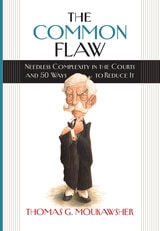
The Common Flaw
Needless Complexity in the Courts and 50 Ways to Reduce ItThomas Moukawsher
Brandeis University Press, 2023
Americans are losing faith in their courts. After long delays, judges often get rid of cases for technical reasons, or force litigants to settle rather than issue a decision. When they do decide cases, we can't understand why.
The Common Flaw seeks to rid the American lawsuit of this needless complexity. The book proposes fifty changes from the filing of a complaint in court to the drafting of appellate decisions to replace the legal system’s formalism with a kind of humanism. Thomas G. Moukawsher calls for courts that decide cases promptly based more on the facts than the law, that prioritize the parties involved over lawyers, that consider the consequences for the people and the public, and that use words we can all understand. Sure to spark an important conversation about court reform, The Common Flaw makes the case for a more effective and credible legal system with warmth and humor, incorporating cartoons alongside insightful reflection.
The Congressional Black Caucus, Minority Voting Rights, and the U.S. Supreme Court
Christina R. Rivers
University of Michigan Press, 2014
Both the U.S. Supreme Court and the Congressional Black Caucus (CBC) claim to advocate minority political interests, yet they disagree over the intent and scope of the Voting Rights Act (VRA), as well as the interpretation of the equal protection clause of the 14th Amendment. Whereas the Court promotes color-blind policies, the CBC advocates race-based remedies. Setting this debate in the context of the history of black political thought, Rivers examines a series of high-profile districting cases, from Rodgers v. Lodge (1982) through NAMUDNO v. Holder (2009). She evaluates the competing approaches to racial equality and concludes, surprisingly, that an originalist, race-conscious interpretation of the 14th Amendment, along with a revised states' rights position regarding electoral districting, may better serve minority political interests.
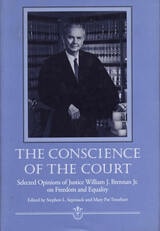
The Conscience of the Court
Selected Opinions of Justice William J. Brennan Jr. on Freedom and EqualityEdited by Stephen L. Sepinuck and Mary Pat Treuthart
Southern Illinois University Press, 1999
The Conscience of the Court celebrates the work of Justice William J. Brennan Jr., who served on the United States Supreme Court for thirty-four years (1956–1990).
Stephen L. Sepinuck and Mary Pat Treuthart introduce and present selected judicial opinions written by Justice Brennan on issues involving personal freedom, civil liberties, and equality. Brennan is ranked by many as the best writer ever to have served on the Supreme Court, and his written opinions depict real people, often in desperate, emotional situations. Remarkable for their clarity of analysis, for their eloquence, and for their forcefulness and persuasiveness, his opinions demonstrate that judicial thought need not be a proprietary enclave of lawyers or the intellectual elite.
The extended excerpts selected by Sepinuck and Treuthart highlight Brennan's approach to judicial decision making. Concerned always with how each decision would actually affect people's lives, Brennan possessed a rare quality of empathy. In Brennan, the editors note, "people and groups who lacked influence in society—Communists and flag burners, children and foreigners, criminal defendants and racial minorities"—found a champion they could count on "to listen to their causes and judge them unmoved by the passions of the politically powerful."
In their introduction to each opinion, the editors provide background facts, discuss how the excerpted opinion transformed the law or otherwise fit into the realm of constitutional jurisprudence, and delve into Justice Brennan's judicial philosophy, his method of constitutional interpretation, and the language he used.

The Courts and Education
Clifford P. Hooker
University of Chicago Press, 1978

The Courts of International Trade
Judicial Specialization, Expertise, and Bureaucratic PolicymakingIsaac Unah
University of Michigan Press, 1998
This book will be of interest to scholars studying the judiciary, bureaucracies, and international trade law and administration.
Isaac Unah is Assistant Professor of Political Science, University of North Carolina.
The Development of a Russian Legal Consciousness
Richard S. Wortman
University of Chicago Press, 1976
The First Fifteen
How Asian American Women Became Federal JudgesSusan Oki Mollway
Rutgers University Press, 2022
This book tells the stories of the first fifteen. In the process, it recounts remarkable tales of Asian women overcoming adversity and achieving the American dream, despite being the daughters of a Chinese garment worker, Japanese Americans held in internment camps during World War II, Vietnamese refugees, and penniless Indian immigrants. Yet The First Fifteen also explores how far Asian Americans and women still have to go before the federal judiciary reflects America as a whole.
In a candid series of interviews, these judges reflect upon the personal and professional experiences that led them to this distinguished position, as well as the nerve-wracking political process of being nominated and confirmed for an Article III judgeship. By sharing their diverse stories, The First Fifteen paints a nuanced portrait of how Asian American women are beginning to have a voice in determining American justice.
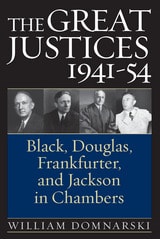
The Great Justices, 1941-54
Black, Douglas, Frankfurter, and Jackson in ChambersWilliam Domnarski
University of Michigan Press, 2006
This is rare and little-examined territory: in the public consciousness the Supreme Court is usually seen as an establishment whose main actors, the justices, remain above emotion, vitriol, and gossip, the better to interpret our nation of laws. Yet the Court's work is always an interchange of ideas and individuals, and the men and women who make up the Court, despite or because of their best intentions, are as human as the rest of us. Appreciating that human dimension helps us to discover some of the Court's secrets, and a new way to understand the Court and its role.
Comparing four brilliant but very different jurists of the Roosevelt Court-Hugo Black, William O. Douglas, Felix Frankfurter, and Robert Jackson-William Domnarski paints a startling picture of the often deeply ambiguous relationship between ideas and reality, between the law and the justices who interpret and create it. By pulling aside the veil of decorous tradition, Domnarski brings to light the personalities that shaped one of the greatest Courts of our time-one whose decisions continue to affect judicial thinking today.
William Domnarski is the author of In the Opinion of the Court (1996), a study of the history and nature of federal court judicial opinions. He holds a J.D. from the University of Connecticut and a Ph.D. in English from the University of California. Domnarski currently practices law in California, where he is also working on a forthcoming biography of legendary Hollywood lawyer Bert Fields.
The History of Courts and Procedure in Medieval Canon Law
Wilfried Hartmann
Catholic University of America Press, 2016
The History of Indiana Law
David J. Bodenhamer
Ohio University Press, 2006
The History of Indiana Law explores the ways in which the state’s legal culture responded to—and at times resisted—the influence of national legal developments, including the tortured history of race relations in Indiana. Legal issues addressed by the contributors include the Indiana constitutional tradition, civil liberties, race, women’s rights, family law, welfare and the poor, education, crime and punishment, juvenile justice, the role of courts and judiciary, and landmark cases. The essays describe how Indiana law has adapted to the needs of an increasingly complex society.
The History of Indiana Law is an indispensable reference and invaluable first source to learn about law and society in Indiana during almost two centuries of statehood.
The Hollow Hope
Can Courts Bring About Social Change?Gerald N. Rosenberg
University of Chicago Press, 1991
Rosenberg presents, with remarkable skill, an overwhelming case that efforts to use the courts to generate significant reforms in civil rights, abortion, and women's rights were largely failures.
"The real strength of The Hollow Hope . . . is its resuscitation of American Politics—the old-fashioned representative kind—as a valid instrument of social change. Indeed, the flip side of Mr. Rosenberg's argument that courts don't do all that much is the refreshing view that politics in the best sense of the word—as deliberation and choice over economic and social changes, as well as over moral issues—is still the core of what makes America the great nation it is. . . . A book worth reading."—Gary L. McDowell, The Washington Times
The Hollow Hope
Can Courts Bring About Social Change?Gerald N. Rosenberg
University of Chicago Press, 2023
Since its first publication in 1991, The Hollow Hope has spurred debate and challenged assumptions on both the left and the right about the ability of courts to bring about durable political and social change. What Gerald N. Rosenberg argued then, and what he confirms today through new evidence in this edition, is that it is nearly impossible to generate significant reforms through litigation: American courts are ineffective and relatively weak, far from the uniquely powerful sources for change they are often portrayed to be.
This third edition includes new data and a substantially updated analysis of civil rights, abortion rights and access, women’s rights, and marriage equality. Addressing changes in the political and social environment, Rosenberg draws lessons from the re-segregation of public schools, victories in marriage equality, and new obstacles to abortion access. Through these and other cases, the third edition confirms the power of the book’s original explanatory framework and deepens our understanding of the limits of judicial action in support of social reform, as well as the conditions under which courts do produce change. Up-to-date, thorough, and thought-provoking, The Hollow Hope remains vital reading.
The Hollow Hope
Can Courts Bring About Social Change? Second EditionGerald N. Rosenberg
University of Chicago Press, 2008
Finding that the answer is still a resounding no, Rosenberg reaffirms his powerful contention that it’s nearly impossible to generate significant reforms through litigation. The reason? American courts are ineffective and relatively weak—far from the uniquely powerful sources for change they’re often portrayed as. Rosenberg supports this claim by documenting the direct and secondary effects of key court decisions—particularly Brown v. Board of Education and Roe v. Wade. He reveals, for example, that Congress, the White House, and a determined civil rights movement did far more than Brown to advance desegregation, while pro-choice activists invested too much in Roe at the expense of political mobilization. Further illuminating these cases, as well as the ongoing fight for same-sex marriage rights, Rosenberg also marshals impressive evidence to overturn the common assumption that even unsuccessful litigation can advance a cause by raising its profile.
Directly addressing its critics in a new conclusion, The Hollow Hope, Second Edition promises to reignite for a new generation the national debate it sparked seventeen years ago.
The Judicial Power of the Purse
How Courts Fund National Defense in Times of CrisisNancy Staudt
University of Chicago Press, 2011
Congress and the president are not the only branches that deal with fiscal issues in times of war. In this innovative book, Nancy Staudt focuses on the role of federal courts in fiscal matters during warfare and high-cost national defense emergencies. There is, she argues, a judicial power of the purse that becomes evident upon examining the budgetary effects of judicial decision making. The book provides substantial evidence that judges are willing—maybe even eager—to redirect private monies into government hands when the country is in peril, but when the judges receive convincing cues that ongoing wartime activities undermine the nation’s interests, they are more likely to withhold funds from the government by deciding cases in favor of private individuals and entities who show up in court.
In stark contrast with conventional legal, political, and institutional thought that privileges factors associated with individual preferences, The Judicial Power of the Purse sheds light on environmental factors in judicial decision making and will be an excellent read for students of judicial behavior in political science and law.
The Medieval Origins of the Legal Profession
Canonists, Civilians, and CourtsJames A. Brundage
University of Chicago Press, 2008
By the end of the eleventh century, Brundage argues, renewed interest in Roman law combined with the rise of canon law of the Western church to trigger a series of consolidations in the profession. New legal procedures emerged, and formal training for proctors and advocates became necessary in order to practice law in the reorganized church courts. Brundage demonstrates that many features that characterize legal advocacy today were already in place by 1250, as lawyers trained in Roman and canon law became professionals in every sense of the term. A sweeping examination of the centuries-long power struggle between local courts and the Christian church, secular rule and religious edict, The Medieval Origins of the Legal Profession will be a resource for the professional and the student alike.

The Medieval Risk-Reward Society
Courts, Adventure, and Love in the European Middle AgesWill Hasty
The Ohio State University Press, 2016
The Medieval Risk-Reward Society: Courts, Adventure, and Love in the European Middle Ages takes a descriptive approach to the competitions in religion, politics, and poetry that are constitutive of medieval culture. Culture is considered always to be happening, and to be happening on the cultural cutting edge as competitions for rewards involving the element of chance. This study finds adventure and love—the principal concerns of medieval European romance poetry—to be cultural game changers, and thereby endeavors to make a humanist contribution to the development of a cultural game theory.
The Most Activist Supreme Court in History
The Road to Modern Judicial ConservatismThomas M. Keck
University of Chicago Press, 2004
Ranging from 1937 to the present, The Most Activist Supreme Court in History traces the legal and political forces that have shaped the modern Court. Thomas M. Keck argues that the tensions within modern conservatism have produced a court that exercises its own power quite actively, on behalf of both liberal and conservative ends. Despite the long-standing conservative commitment to restraint, the justices of the Rehnquist Court have stepped in to settle divisive political conflicts over abortion, affirmative action, gay rights, presidential elections, and much more. Keck focuses in particular on the role of Justices O'Connor and Kennedy, whose deciding votes have shaped this uncharacteristically activist Court.

The Presidency in the Courts
Glendon A. Schubert, Jr.
University of Minnesota Press, 1957
The Presidency in the Courts was first published in 1957. Minnesota Archive Editions uses digital technology to make long-unavailable books once again accessible, and are published unaltered from the original University of Minnesota Press editions.
Do the American courts restrain the President from committing illegal and unconstitutional acts? If so, how? These are the fundamental questions which are answered here through a systematic and comprehensive analysis of the opinions and decisions of the courts themselves. As Clinton Rossiter, author of "The American Presidency," points out, "Too many books on the Presidency deal with the powers of this great office, too few with the restraints that fix its place in our system of government. Students of the system will be grateful to Professor Schubert for this tough-minded, even-tempered, exhaustive study of a neglected aspect of the Presidency."
Professor Schubert analyzes hundreds of judicial cases, both federal and state, involving challenges to the legality of presidential action. The period covered is the entire lifetime of the republic and the material is arranged according to the President's major institutional roles, those of chief administrator, chief of state, commander in chief, and chief magistrate.
There are chapters on presidential management of public personnel and the public domain, his control of foreign relations and the tariff, his military powers, enemy aliens, the presidential seizure power and other emergency powers, legal sources of presidential power, due process in presidential lawmaking, and the scope of judicial review of presidential action. Both the theory and practice of presidential rule making and adjudication are examined in detail.
The book, the first of its kind, reveals how far from actuality are the generally held beliefs regarding the power of the courts versus the power of the Presidency. The significance of such a study is readily apparent in view of the fact that the fate not only of the United States but of Western civilization will hang in the balance of the President's exercise of his official powers during the next decade.
The Supreme Court Review, 1960
Edited by Philip B. Kurland
University of Chicago Press Journals, 1960
The Supreme Court Review, 1961
Edited by Philip B. Kurland
University of Chicago Press Journals, 1961
The Supreme Court Review, 1962
Edited by Philip B. Kurland
University of Chicago Press Journals, 1962
The Supreme Court Review, 1963
Edited by Philip B. Kurland
University of Chicago Press Journals, 1963
The Supreme Court Review, 1966
Edited by Philip B. Kurland
University of Chicago Press Journals, 1966
The Supreme Court Review, 1967
Edited by Philip B. Kurland
University of Chicago Press Journals, 1967
The Supreme Court Review, 1968
Edited by Philip B. Kurland
University of Chicago Press Journals, 1968
The Supreme Court Review, 1969
Edited by Philip B. Kurland
University of Chicago Press Journals, 1969
The Supreme Court Review, 1971
Edited by Philip B. Kurland
University of Chicago Press Journals, 1971
The Supreme Court Review, 1973
Edited by Philip B. Kurland
University of Chicago Press Journals, 1974
The Supreme Court Review, 1974
Edited by Philip B. Kurland
University of Chicago Press Journals, 1975
The Supreme Court Review, 1975
Edited by Philip B. Kurland
University of Chicago Press Journals, 1976
The Supreme Court Review, 1976
Edited by Philip B. Kurland
University of Chicago Press Journals, 1977
The Supreme Court Review, 1977
Edited by Philip B. Kurland
University of Chicago Press Journals, 1978
The Supreme Court Review, 1979
Edited by Philip B. Kurland
University of Chicago Press Journals, 1980
The Supreme Court Review, 1981
Edited by Philip B. Kurland
University of Chicago Press Journals, 1982
The Supreme Court Review, 1982
Edited by Philip B. Kurland
University of Chicago Press Journals, 1983
The Supreme Court Review, 1983
Edited by Philip B. Kurland
University of Chicago Press Journals, 1984
The Supreme Court Review, 1985
Edited by Philip B. Kurland
University of Chicago Press Journals, 1986
The Supreme Court Review, 1986
Edited by Philip B. Kurland, Gerhard Casper, and Dennis J. Hutchinson
University of Chicago Press Journals, 1987
The Supreme Court Review, 1987
Edited by Philip B. Kurland, Gerhard Casper, and Dennis J. Hutchinson
University of Chicago Press Journals, 1988
The Supreme Court Review, 1988
Edited by Philip B. Kurland, Gerhard Casper, and Dennis J. Hutchinson
University of Chicago Press Journals, 1989
The Supreme Court Review, 1989
Edited by Philip B. Kurland, Gerhard Casper, and Dennis J. Hutchinson
University of Chicago Press Journals, 1990
The Supreme Court Review, 1994
Edited by Dennis J. Hutchinson, David A. Strauss, and Geoffrey R. Stone
University of Chicago Press Journals, 1995
The Supreme Court Review, 1996
Edited by Dennis J. Hutchinson, David A. Strauss, and Geoffrey R. Stone
University of Chicago Press Journals, 1997
The Supreme Court Review, 1997
Edited by Dennis J. Hutchinson, David A. Strauss, and Geoffrey R. Stone
University of Chicago Press Journals, 1998
The Supreme Court Review, 2017
Edited by Dennis J. Hutchinson, David A. Strauss, and Geoffrey R. Stone
University of Chicago Press Journals, 2018
The Supreme Court Review, 2018
Edited by David A. Strauss, Geoffrey R. Stone, and Justin Driver
University of Chicago Press Journals, 2019
This year’s volume features prominent scholars assessing major legal events, including:
Mark Tushnet on President Trump’s “Muslim Ban”
Kate Andrias on Union Fees in the Public Sector
Cass R. Sunstein on Chevron without Chevron
Tracey Maclin on the Fourth Amendment and Unauthorized Drivers
Frederick Schauer on Precedent
Pamela Karlan on Gay Equality and Racial Equality
Randall Kennedy on Palmer v. Thompson
Lisa Marshall Manheim and Elizabeth G. Porter on Voter Suppression
Melissa Murray on Masterpiece Cakeshop
Vikram David Amar on Commandeering
Laura K. Donohue on Carpenter, Precedent, and Originalism
Evan Caminker on Carpenter and Stability
The Supreme Court Review, 2019
Edited by David A. Strauss, Geoffrey R. Stone, and Justin Driver
University of Chicago Press Journals, 2020
This year’s volume features incisive assessments of major legal events, including:
Gillian E. Metzger on The Roberts Court's Administrative Law
Paul Butler on Peremptory Strikes in Mississippi v. Flowers
Nicholas O. Stephanopoulos on Partisan Gerrymandering
Kent Greenfield on Hate Speech
Jennifer M. Chacon on Department of Commerce v. New York
Micah Schwartzman & Nelson Tebbe on Establishment Clause Appeasement
William Baude on Precedent and Originalism
Linda Greenhouse on The Supreme Court’s Challenge to Civil Society
James T. Kloppenberg on James Madison
The Supreme Court Review, 2020
Edited by David A. Strauss, Geoffrey R. Stone, and Justin Driver
University of Chicago Press Journals, 2021
Since it first appeared in 1960, The Supreme Court Review (SCR) has won acclaim for providing a sustained and authoritative survey of the implications of the Court's most significant decisions. SCR is an in-depth annual critique of the Supreme Court and its work, keeping up on the forefront of the origins, reforms, and interpretations of American law. SCR is written by and for legal academics, judges, political scientists, journalists, historians, economists, policy planners, and sociologists.
This year’s volume features incisive assessments of major legal events, including:
Cristina M. Rodríguez on the Political Significance of Law
Martha Minow on Little Sisters of the Poor
Cass R. Sunstein and Adrian Vermeule on the Unitary Executive
Cary Franklin on Living Textualism
David A. Strauss on Sexual Orientation and the Dynamics of Discrimination
Saikrishna Bangalore Prakash on the Executive’s Privileges and Immunities
Reva B. Siegel on Abortion Restrictions
Maggie Blackhawk on McGirt v. Oklahoma
Richard J. Lazarus on Advocacy History
The Supreme Court Review, 2021
Edited by David A. Strauss, Geoffrey R. Stone, Justin Driver, and William Baude
University of Chicago Press Journals, 2022
Since it first appeared in 1960, the Supreme Court Review has won acclaim for providing a sustained and authoritative survey of the implications of the Court's most significant decisions. SCR is an in-depth annual critique of the Supreme Court and its work, analyzing the origins, reforms, and modern interpretations of American law. SCR is written by and for legal academics, judges, political scientists, journalists, historians, economists, policy planners, and sociologists.