4531 books match the query 'Cultural & Ethnic Studies' and 804 start with t
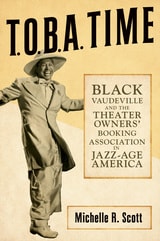
cover of T.O.B.A. Time: Black Vaudeville and the Theater Owners’ Booking Association in Jazz-Age America

T.O.B.A. Time

Black Vaudeville and the Theater Owners’ Booking Association in Jazz-Age America

Michelle R. Scott

University of Illinois Press, 2023

Black vaudevillians and entertainers joked that T.O.B.A. stood for “tough on black artists.” But the Theater Owner’s Booking Association (T.O.B.A.) played a foundational role in the African American entertainment industry and provided a training ground for icons like Cab Calloway, Bessie Smith, Ethel Waters, Sammy Davis Jr., the Nicholas Brothers, Count Basie, and Butterbeans and Susie.

Michelle R. Scott’s institutional history details T.O.B.A.’s origins and practices while telling the little-known stories of the managers, producers, performers, and audience members involved in the circuit. Looking at the organization over its eleven-year existence (1920–1931), Scott places T.O.B.A. against the backdrop of what entrepreneurship and business development meant in black America at the time. Scott also highlights how intellectuals debated the social, economic, and political significance of black entertainment from the early 1900s through T.O.B.A.’s decline during the Great Depression.

Clear-eyed and comprehensive, T.O.B.A. Time is a fascinating account of black entertainment and black business during a formative era.
[more]
cover of Taboo Subjects: Race, Sex, and Psychoanalysis

Taboo Subjects

Race, Sex, and Psychoanalysis

Gwen Bergner

University of Minnesota Press, 2005

In American literature, a traumatic scene of racial and sexual awakening - frequently involving photographs, mirrors, or acts of witnessing - often precipitates a character's "discovery" of racial identity. Similarly, in the annals of psychoanalysis, notions of self and sexual identity often arise from visual trauma such as the mirror stage and primal scene. Noting this parallel between specular births of racial and sexual subjectivity, Gwen Bergner uses a comparative analysis of psychoanalytic theory and American literature to develop a theory of racialization - the process through which individuals assume an identity as black or white. Examining the primal scenes of double consciousness in works by Frederick Douglass, William Faulkner, and Toni Morrison, among others, alongside the formative visual traumas of psychoanalytic theory of Lacan and Freud, Taboo Subjects reveals how literature disrupts psychoanalysis's conventional models of race and gender identification, forcing a reconfiguration of many foundational psychoanalytic texts. And from psychoanalysis Bergner derives a critical vocabulary for theorizing racialization as it intersects with sex and gender, for both black and white Americans.
[more]
cover of Tacit Racism

Tacit Racism

Anne Warfield Rawls and Waverly Duck

University of Chicago Press, 2020

We need to talk about racism before it destroys our democracy. And that conversation needs to start with an acknowledgement that racism is coded into even the most ordinary interactions.

Every time we interact with another human being, we unconsciously draw on a set of expectations to guide us through the encounter. What many of us in the United States—especially white people—do not recognize is that centuries of institutional racism have inescapably molded those expectations. This leads us to act with implicit biases that can shape everything from how we greet our neighbors to whether we take a second look at a resume. This is tacit racism, and it is one of the most pernicious threats to our nation.

In Tacit Racism, Anne Warfield Rawls and Waverly Duck illustrate the many ways in which racism is coded into the everyday social expectations of Americans, in what they call Interaction Orders of Race. They argue that these interactions can produce racial inequality, whether the people involved are aware of it or not, and that by overlooking tacit racism in favor of the fiction of a “color-blind” nation, we are harming not only our society’s most disadvantaged—but endangering the society itself.

Ultimately, by exposing this legacy of racism in ordinary social interactions, Rawls and Duck hope to stop us from merely pretending we are a democratic society and show us how we can truly become one.
[more]
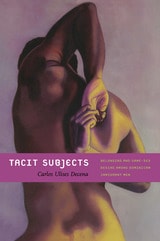
cover of Tacit Subjects: Belonging and Same-Sex Desire among Dominican Immigrant Men

Tacit Subjects

Belonging and Same-Sex Desire among Dominican Immigrant Men

Carlos Ulises Decena

Duke University Press, 2011

Tacit Subjects is a pioneering analysis of how gay immigrant men of color negotiate race, sexuality, and power in their daily lives. Drawing on ethnographic research with Dominicans in New York City, Carlos Ulises Decena explains that while the men who shared their life stories with him may self-identify as gay, they are not the liberated figures of traditional gay migration narratives. Decena contends that in migrating to Washington Heights, a Dominican enclave in New York, these men moved from one site to another within an increasingly transnational Dominican society. Many of them migrated and survived through the resources of their families and broader communities. Explicit acknowledgment or discussion of their homosexuality might rupture these crucial social and familial bonds. Yet some of Decena’s informants were sure that their sexuality was tacitly understood by their family members or others close to them. Analyzing their recollections about migration, settlement, masculinity, sex, and return trips to the Dominican Republic, Decena describes how the men at the center of Tacit Subjects contest, reproduce, and reformulate Dominican identity in New York. Their stories reveal how differences in class, race, and education shape their relations with fellow Dominicans. They also offer a view of “gay New York” that foregrounds the struggles for respect, belonging, and survival within a particular immigrant community.
[more]
cover of Take Up the Black Man's Burden: Kansas City's African American Communities, 1865-1939

Take Up the Black Man's Burden

Kansas City's African American Communities, 1865-1939

Charles E. Coulter

University of Missouri Press, 2006

 
Unlike many cities farther north, Kansas City, Missouri—along with its sister city in Kansas—had a significant African American population by the midnineteenth century and also served as a way station for those migrating north or west. “Take Up the Black Man’s Burden” focuses on the people and institutions that shaped the city’s black communities from the end of the Civil War until the outbreak of World War II, blending rich historical research with first-person accounts that allow participants in this historical drama to tell their own stories of struggle and accomplishment.
 
Charles E. Coulter opens up the world of the African American community in its formative years, making creative use of such sources as census data, black newspapers, and Urban League records. His account covers social interaction, employment, cultural institutions, housing, and everyday lives within the context of Kansas City’s overall development, placing a special emphasis on the years 1919 to 1939 to probe the harsh reality of the Depression for Kansas City blacks—a time when many of the community’s major players also rose to prominence.
 
“Take Up the Black Man’s Burden” is a rich testament not only of high-profile individuals such as publisher Chester A. Franklin, activists Ida M. Becks and Josephine Silone Yates, and state legislator L. Amasa Knox but also of ordinary laborers in the stockyards, domestics in white homes, and railroad porters. It tells how various elements of the population worked together to build schools, churches, social clubs, hospitals, the Paseo YMCA/YWCA, and other institutions that made African American life richer. It also documents the place of jazz and baseball, for which the community was so well known, as well as movie houses, amusement parks, and other forms of leisure.
While recognizing that segregation and discrimination shaped their reality, Coulter moves beyond race relations to emphasize the enabling aspects of African Americans’ lives and show how people defined and created their world. As the first extensive treatment of black history in Kansas City, “Take Up the Black Man’s Burden” is an exceptional account of minority achievement in America’s crossroads. By showing how African Americans saw themselves in their own world, it gives readers a genuine feel for the richness of black life during the interwar years of the twentieth century.
[more]
cover of Taking It to the Streets: The Social Protest Theater of Luis Valdez and Amiri Baraka

Taking It to the Streets

The Social Protest Theater of Luis Valdez and Amiri Baraka

Harry J. Elam, Jr.

University of Michigan Press, 2001
The performances of Luis Valdez's El Teatro Campesino, the farmworkers' theater, and Amiri Baraka's (LeRoi Jones's) Black Revolutionary Theater (BRT) during the 1960s and 1970s, offer preeminent examples of social protest theater during a momentous and tumultuous historical juncture. The performances of these groups linked the political, the cultural, and the spiritual, while agitating against the dominant power structure and for the transformation of social and theatrical practices in the U.S. Founded during the Delano Grape Pickers' Strike and Black Power rebellions of the mid-1960s, both El Teatro and the BRT professed cultural pride and group unity as critical corollaries to self-determination and revolutionary social action. Taking It to the Streets compares the performance methodologies, theories, and practices of the two groups, highlighting their cross-cultural commonalties, and providing insights into the complex genre of social protest performance and its interchange with its audience. It examines the ways in which ritual can be seen to operate within the productions of El Teatro and the BRT, uniting audience and performers in subversive, celebratory protest by transforming spectators into active participants within the theater walls --and into revolutionary activists outside. During this critical historical period, these performances not only encouraged community empowerment, but they inculcated a spirit of collective faith and revolutionary optimism. Elam's critical reexamination and recontextualization of the ideologies and practices of El Teatro and the BRT aid in our understanding of contemporary manipulations of identity politics, as well as current strategies for racial representation and cultural resistance. "A major contribution to our understanding of how social protest came to be so strong and how Black and Chicano theatre contributed to the synergy of those times." --Janelle Reinelt, University of California, Davis Harry J. Elam, Jr., is Associate Professor of Drama and Director of the Committee on Black Performing Arts, Stanford University.
[more]
cover of Taking Their Word: Literature and the Signs of Central America

Taking Their Word

Literature and the Signs of Central America

Arturo Arias

University of Minnesota Press, 2007

Central Americans are one of the largest Latino population groups in the United States. Yet, Arturo Arias argues, the cultural production of Central Americans remains little known to North Americans.

In Taking Their Word, Arias complicates notions of the cultural production of Central America, from Mexico in the North to Panama in the South. He charts the literature of Central America’s liberation struggles of the 1970s and 1980s, its transformation after peace treaties were signed, the emergence of a new Maya literature that decenters Latin American literature written in Spanish, and the rise and fall of testimonio. Arias demonstrates that Central America and its literature are marked by an indigenousness that has never before been fully theorized or critically grasped. Never one to avoid controversy, Arias proffers his views of how the immigration of Central Americans to North America has changed the cultural topography of both zones.

With this groundbreaking work, Arias establishes the importance of Central American literature and provides a frame for future studies of the region’s culture.

Arturo Arias is director of Latin American studies at the University of Redlands. He is the author of six novels in Spanish and editor of The Rigoberta Menchú Controversy (Minnesota, 2001).
[more]
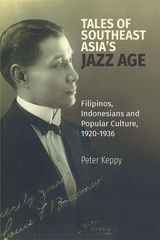
cover of Tales of Southeast Asia’s Jazz Age: Filipinos, Indonesians and Popular Culture, 1920-1936

Tales of Southeast Asia’s Jazz Age

Filipinos, Indonesians and Popular Culture, 1920-1936

Peter Keppy

National University of Singapore Press, 2019

Luis Borromeo was the Philippines’s “King of Jazz,” who at the height of his popularity created a Filipino answer to the Ziegfeld Follies. Miss Riboet was a world-famous Javanese opera singer who ruled the theater world. While each represented a unique corner of the entertainment world, the rise and fall of these two superstar figures tell an important story of Southeast Asia’s 1920s Jazz Age.
This artistic era was marked by experimentation and adaption, and this was reflected in both Borromeo’s and Riboet’s styles. They were pioneering cultural brokers who dealt in hybrids. They were adept at combining high art and banal entertainment, tradition and modernity, and the foreign and the local.
Leaning on cultural studies and the work on cosmopolitanism and modernity by Henry Jenkins and Joel Kahn, Peter Keppy examines pop culture at this time as a contradictory social phenomenon. He challenges notions of Southeast Asia’s popular culture as lowbrow entertainment created by elites and commerce to manipulate the masses, arguing instead that audiences seized on this popular culture to channel emancipatory activities, to articulate social critique, and to propagate an inclusive nationalism without being radically anticolonial.
[more]
cover of Tales of Times Now Past: Sixty-Two Stories from a Medieval Japanese Collection

Tales of Times Now Past

Sixty-Two Stories from a Medieval Japanese Collection

Marian Ury

University of Michigan Press, 1993
Tales of Times Now Past is a translation of 62 outstanding tales freshly selected from Konjaku monogatari shu, a Japanese anthology dating from the early twelfth century. The original work, unique in world literature, contains more than one thousand systematically arranged tales from India, China, and Japan. It is the most important example of a genre of collections of brief tales which, because of their informality and unpretentious style, were neglected by Japanese critics until recent years but which are now acknowledged to be among the most significant prose literature of premodern Japan. “Konjaku” in particular has aroused the enthusiasm of such leading 20th-century writers as Akutagawa Ryunosuke and Tanizaki Jun’ichiro.
The stories, with sources in both traditional lore and contemporary gossip, cover an astonishing range—homiletic, sentimental, terrifying, practical-minded, humorous, ribald. Their topics include the life of the Buddha, descriptions of Heaven and Hell, feats of warriors, craftsmen, and musicians, unsuspected vice, virtue, and ingenuity, and the ways and wiles of bandits, ogres, and proverbially greedy provincial governors, to name just a few. Composed perhaps a century after the refined, allusive, aristocratic Tale of Genji, Konjaku represents a masculine outlook and comparatively plebeian social orientation, standing in piquant contrast to the earlier masterpiece. The unknown compiler was interested less in exploring psychological subtleties than in presenting vivid portraits of human foibles and eccentricities. The stories in the present selection have been chosen to provide an idea of the scope and structure of the book as a whole, and also for their appeal to the modern reader. And the translation is based on the premise that the most faithful rendering is also the liveliest.
[more]
cover of Tales of the Metric System: A Novel

Tales of the Metric System

A Novel

Imraan Coovadia

Ohio University Press, 2016
In Tales of the Metric System, Coovadia explores a turbulent South Africa from 1970 into the present. He takes his home country’s transition from imperial to metric measurements as his catalyst, holding South Africa up and examining it from the diverse perspectives of his many characters. An elite white housewife married to a radical intellectual; a rock guitarist; the same guitarist’s granddaughter thirty years later; a teenaged boy at the mercy of mob justice—each story takes place over one of ten days across the decades, and each protagonist has his own stakes, her own moment in time, but each is equally caught in the eddies of change. Tales of the Metric System is clear eyed, harrowing, and daring.
[more]
cover of Talking #browntv: Latinas and Latinos on the Screen

Talking #browntv

Latinas and Latinos on the Screen

Frederick Luis Aldama and William Anthony Nericcio

The Ohio State University Press, 2019

Like two friends sitting down in front of the television together, in Talking #browntv, Frederick Luis Aldama and William Anthony Nericcio dialogue about the representations of Latina/os in American television and film from the twentieth century to the present day. One part conversation, one part critique, one part visual cultural studies, and one part rant against the culture industry profiting off warped caricatures of Latina/o subjectivities, Aldama and Nericcio analyze the ways in which Latinx performers have been mediated—with varying degrees of complexity—on the American screen. A comprehensive review of the history of Mexicans, Mexican Americans, Hispanics, Chicana/os, Latina/os, and Latinx performers in television and film, Talking #browntv boldly interrogates one of the largest paradoxes in the history of American television: Why are there so few Latina/os on television, and why, when they do appear, are they so often narcos, maids, strumpets, tarts, flakes, and losers?
 
From the subversive critiques embedded in well-loved children’s characters like Speedy Gonzalez to the perpetuation of racial stereotypes in modern-era pornography, from Eva Longoria as ethnic mannequin to J-Lo flipping the sexy Latina music video on its head in “I Luh Ya Papi,” and with more than 150 full-color images, Aldama and Nericcio seek to expose the underlying causes as to why Latina/os constitute only 2 percent of mainstream cultural production when they’re the majority minority in the US. In a moment when anti-Mexican and anti-immigrant rhetoric oozes from TV sets and medias platform, Talking #browntv emerges as a bold antidote, an eloquent rejoinder, and a thoughtful meditation on Latina/os on the American screen and in America today.
[more]
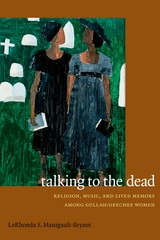
cover of Talking to the Dead: Religion, Music, and Lived Memory among Gullah/Geechee Women

Talking to the Dead

Religion, Music, and Lived Memory among Gullah/Geechee Women

LeRhonda S. Manigault-Bryant

Duke University Press, 2014

Talking to the Dead is an ethnography of seven Gullah/Geechee women from the South Carolina lowcountry. These women communicate with their ancestors through dreams, prayer, and visions and traditional crafts and customs, such as storytelling, basket making, and ecstatic singing in their churches. Like other Gullah/Geechee women of the South Carolina and Georgia coasts, these women, through their active communication with the deceased, make choices and receive guidance about how to live out their faith and engage with the living. LeRhonda S. Manigault-Bryant emphasizes that this communication affirms the women's spiritual faith—which seamlessly integrates Christian and folk traditions—and reinforces their position as powerful culture keepers within Gullah/Geechee society. By looking in depth at this long-standing spiritual practice, Manigault-Bryant highlights the subversive ingenuity that lowcountry inhabitants use to thrive spiritually and to maintain a sense of continuity with the past.
[more]
cover of Tambo: Life in an Andean Village

Tambo

Life in an Andean Village

By Julia Meyerson

University of Texas Press, 1990

Perhaps the best way to sharpen one's power's of observation is to be a stranger in a strange land. Julia Meyerson was one such stranger during a year in the village of 'Tambo, Peru, where her husband was conducting anthropological fieldwork. Though sometimes overwhelmed by the differences between Quechua and North American culture, she still sought eagerly to understand the lifeways of 'Tambo and to find her place in the village. Her vivid observations, recorded in this field journal, admirably follow Henry James's advice: "Try to be one of the people upon whom nothing is lost."

With an artist's eye, Meyerson records the daily life of 'Tambo—the cycles of planting and harvest, the round of religious and cultural festivals, her tentative beginnings of friendship and understanding with the Tambinos. The journal charts her progress from tolerated outsider to accepted friend as she and her husband learn and earn, the roles of daughter and son in their adopted family.

With its wealth of ethnographic detail, especially concerning the lives of Andean women, 'Tambo will have great value for students of Latin American anthropology. In addition, scholars preparing to do fieldwork anywhere will find it a realistic account of both the hardships and the rewards of such study.

[more]
cover of Tania León's Stride: A Polyrhythmic Life

Tania León's Stride

A Polyrhythmic Life

Alejandro L. Madrid

University of Illinois Press, 2021

Acclaimed composer, sought-after conductor, esteemed educator, tireless advocate for the arts--Tania León’s achievements encompass but also stretch far beyond contemporary classical music. Alejandro L. Madrid draws on oral history, archival work, and ethnography to offer the first in-depth biography of the artist. Breaking from a chronological account, Madrid looks at León through the issues that have informed and defined moments in her life and her professional works. León’s words become a starting ground--but also a counterpoint--to the accounts of the people in her orbit. What emerges is more than an extraordinary portrait of an artist's journey. It is a story of how a human being reacts to the challenges thrown at her by history itself, be it the Cuban revolution or the struggle for civil and individual rights.

Nuanced and multifaceted, Tania León's Stride looks at the life, legacy, and milieu that created and sustained one of the most important figures in American classical music.
[more]
cover of Taoist Meditation and Longevity Techniques

Taoist Meditation and Longevity Techniques

Edited by Livia Kohn, in cooperation with Yoshinobu Sakade

University of Michigan Press, 1989
Taoist Meditation and Longevity Techniques covers the major areas of Taoist meditation and longevity techniques in roughly chronological order. The book addresses itself to the China area specialist or the scholar of religion and the history of science who wishes to know more about (and perhaps even must teach) aspects of Chinese culture that involve Taoism and traditional medicine. [viii, ix]
Other topics include Japanese interpretations of longevity techniques, drugs and immortality, visualization and ecstatic experience, and qigong and gymnastics.
[more]
cover of Taste of Control: Food and the Filipino Colonial Mentality under American Rule

Taste of Control

Food and the Filipino Colonial Mentality under American Rule

R. Alexander D. Orquiza, Jr.

Rutgers University Press, 2020

Winner of the 2021 Gourmand Awards, Asian Section & Culinary History Section

Filipino cuisine is a delicious fusion of foreign influences, adopted and transformed into its own unique flavor. But to the Americans who came to colonize the islands in the 1890s, it was considered inferior and lacking in nutrition. Changing the food of the Philippines was part of a war on culture led by Americans as they attempted to shape the islands into a reflection of their home country.

Taste of Control tells what happened when American colonizers began to influence what Filipinos ate, how they cooked, and how they perceived their national cuisine. Food historian René Alexander D. Orquiza, Jr. turns to a variety of rare archival sources to track these changing attitudes, including the letters written by American soldiers, the cosmopolitan menus prepared by Manila restaurants, and the textbooks used in local home economics classes. He also uncovers pockets of resistance to the colonial project, as Filipino cookbooks provided a defense of the nation’s traditional cuisine and culture.

Through the topic of food, Taste of Control explores how, despite lasting less than fifty years, the American colonial occupation of the Philippines left psychological scars that have not yet completely healed, leading many Filipinos to believe that their traditional cooking practices, crops, and tastes were inferior. We are what we eat, and this book reveals how food culture served as a battleground over Filipino identity.
[more]
cover of Tattered Kimonos in Japan: Remaking Lives from Memories of World War II

Tattered Kimonos in Japan

Remaking Lives from Memories of World War II

Robert Rand

University of Alabama Press, 2024

Examines Japan’s war generation—Japanese men and women who survived World War Two and rebuilt their lives from memories of that conflict.

Since John Hersey’s Hiroshima—the classic account, published in 1946, of the aftermath of the atomic bombing of that city—very few books have examined the meaning and impact of World War II through the eyes of Japanese men and women who survived that conflict. Tattered Kimonos in Japan does just that: It is an intimate journey into contemporary Japan from the perspective of the generation of Japanese soldiers and civilians who survived World War II, by a writer whose American father and Japanese father-in-law fought on opposite sides of the conflict.

The author, a former NPR senior editor, is Jewish, and he approaches the subject with the sensibilities of having grown up in a community of Holocaust survivors. Mindful of the power of victimhood, memory, and shared suffering, he travels across Japan, including Hiroshima and Nagasaki, meeting a compelling group of men and women whose lives, even now, are defined by the trauma of war, and by lingering questions of responsibility and repentance for Japan’s wartime aggression.

The image of a tattered kimono from Hiroshima is the thread that drives the narrative arc of this emotional story about a writer’s encounter with history, inside the Japan of his father’s generation, on the other side of his father’s war. This is a book about history with elements of family memoir. It offers a fresh and truly unique perspective for readers interested in World War II, Japan, or Judaica; readers seeking cross-cultural journeys; and readers intrigued by Japanese culture, particularly the kimono.
 

[more]
cover of Tautua: Service and Disability Activism in Samoa

Tautua

Service and Disability Activism in Samoa

Juliann Anesi

Temple University Press, 2026

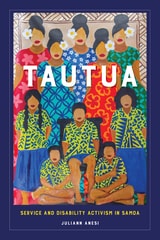
The Sāmoan concept of tautua is the cultural practice of service—to family, village, church, and nation. For Juliann Anesi, tautua includes an ethical responsibility that extends to caring for people living with disabilities. Anesi learned this value from her aunty Sina, who was instrumental in founding two schools for youths in the mid-1970s—Aoga Fiamalamalama and Loto Taumafailike. These schools were designed for students like Sina’s son Gele, students excluded from private and public education because of intellectual or physical disabilities.

Tautua recounts how the Indigenous community organized and resisted ableist paradigms in colonial institutions by changing the education system to a more inclusive environment. Anesi explains how funding was arranged for the schools through NGOs. She also uses oral histories, personal narratives, archival documents, and newspapers to offer insights about how students experienced oppression and erasure as well as shame and sexism in their communities.

Highlighting advocacy and belonging, Tautua argues that these schools for students with disabilities centered Sāmoan concepts of service, advocacy, and self-determination in an attempt to decolonize elementary education. In doing so, Anesi shows what disability activism in Sāmoa can teach us about educability, school inclusion, and collective care.
 
In the series Dis/color
[more]
cover of Teacher Education across Minority-Serving Institutions: Programs, Policies, and Social Justice

Teacher Education across Minority-Serving Institutions

Programs, Policies, and Social Justice

Petchauer, Emery

Rutgers University Press, 2017

Winner of the 2018 AERA Division K Exemplary Research in Teaching and Teacher Education Award

The first of its kind, Teacher Education across Minority-Serving Institutions brings together innovative work from the family of institutions known as minority-serving institutions: Historically Black Colleges and Universities, Tribal Colleges and Universities, Hispanic Serving Institutions, and Asian American and Native American Pacific Islander Serving Institutions. The book moves beyond a singular focus on teacher racial diversity that has characterized scholarship and policy work in this area. Instead, it pushes for scholars to consider that racial diversity in teacher education is not simply an end in itself but is, a means to accomplish other goals, such as developing justice-oriented and asset-based pedagogies.
[more]
cover of Teaching Black History to White People

Teaching Black History to White People

By Leonard N. Moore

University of Texas Press, 2021

Leonard Moore has been teaching Black history for twenty-five years, mostly to white people. Drawing on decades of experience in the classroom and on college campuses throughout the South, as well as on his own personal history, Moore illustrates how an understanding of Black history is necessary for everyone.

With Teaching Black History to White People, which is “part memoir, part Black history, part pedagogy, and part how-to guide,” Moore delivers an accessible and engaging primer on the Black experience in America. He poses provocative questions, such as “Why is the teaching of Black history so controversial?” and “What came first: slavery or racism?” These questions don’t have easy answers, and Moore insists that embracing discomfort is necessary for engaging in open and honest conversations about race. Moore includes a syllabus and other tools for actionable steps that white people can take to move beyond performative justice and toward racial reparations, healing, and reconciliation.
[more]
cover of Teaching Gloria E. Anzaldúa: Pedagogy and Practice for Our Classrooms and Communities

Teaching Gloria E. Anzaldúa

Pedagogy and Practice for Our Classrooms and Communities

Edited by Margaret Cantú-Sánchez, Candace de León-Zepeda, Norma E. Cantú

University of Arizona Press, 2020

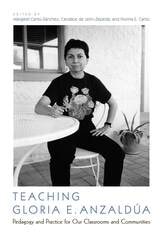
Gloria Evangelina Anzaldúa—theorist, Chicana, feminist—famously called on scholars to do work that matters. This pronouncement was a rallying call, inspiring scholars across disciplines to become scholar-activists and to channel their intellectual energy and labor toward the betterment of society. Scholars and activists alike have encountered and expanded on these pathbreaking theories and concepts first introduced by Anzaldúa in Borderlands/La frontera and other texts.

Teaching Gloria E. Anzaldúa is a pragmatic and inspiring offering of how to apply Anzaldúa’s ideas to the classroom and in the community rather than simply discussing them as theory. The book gathers nineteen essays by scholars, activists, teachers, and professors who share how their first-hand use of Anzaldúa’s theories in their classrooms and community environments.

The collection is divided into three main parts, according to the ways the text has been used: “Curriculum Design,” “Pedagogy and Praxis,” and “Decolonizing Pedagogies.” As a pedagogical text, Teaching Gloria E. Anzaldúa also offers practical advice in the form of lesson plans, activities, and other suggested resources for the classroom. This volume offers practical and inspiring ways to deploy Anzaldúa’s transformative theories with real and meaningful action.

Contributors
Carolina E. Alonso
Cordelia Barrera
Christina Bleyer
Altheria Caldera
Norma E. Cantú
Margaret Cantú-Sánchez
Freyca Calderon-Berumen
Stephanie Cariaga
Dylan Marie Colvin
Candace de León-Zepeda
Miryam Espinosa-Dulanto
Alma Itzé Flores
Christine Garcia
Patricia M. García
Patricia Pedroza González
María del Socorro Gutiérrez-Magallanes
Leandra H. Hernández
Nina Hoechtl
Rían Lozano
Socorro Morales
Anthony Nuño
Karla O’Donald
Christina Puntasecca
Dagoberto Eli Ramirez
José L. Saldívar
Tanya J. Gaxiola Serrano
Verónica Solís
Alexander V. Stehn
Carlos A. Tarin
Sarah De Los Santos Upton
Carla Wilson
Kelli Zaytoun
[more]
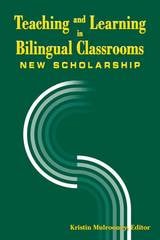
cover of Teaching and Learning in Bilingual Classrooms: New Scholarship

Teaching and Learning in Bilingual Classrooms

New Scholarship

Kristin J. Mulrooney

Gallaudet University Press, 2014

A new initiative known as the Scholarship of Teaching and Learning (SoTL) strives to improve education today by methodically examining and assessing the vital component of classroom interaction. This collection presents research by five professors who adopted SoTL methodology to study their own classrooms at Gallaudet University, a uniquely diverse bilingual institution that employs both American Sign Language (ASL) and written English. The Gallaudet study, called the GSTLI, intended to create an engaged learning community that investigated, reflected upon, and documented strategies that most effectively enhance learning for linguistically diverse, visually oriented populations.

     After extensive SoTL training, the GSTLI professors reviewed interaction in their respective classrooms. Through meticulous study of class videos and written assignments in three General Studies Requirements courses for first-year students, the teachers learned how to ensure connecting with students who have a variety of language differences and communication methods.

     The other professors assessed bottlenecks in classes on the linguistic structure of ASL, and on criminal justice. The linguistics professor identified the bottleneck as the students’ inability to conceptualize the interrelationship between definitions and examples, a fundamental skill to scientific thinking. In the criminal justice class, the professor saw the need to guide students through linguistic bottlenecks by providing materials in both ASL and English. The successes of the GSTLI presented in this unique volume can benefit other teachers by better preparing them to meet the needs of bilingual diverse learners in more effective ways.
[more]
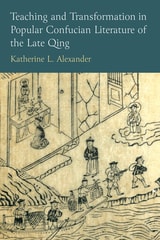
cover of Teaching and Transformation in Popular Confucian Literature of the Late Qing

Teaching and Transformation in Popular Confucian Literature of the Late Qing

Katherine L. Alexander

University of Michigan Press, 2025

The Taiping Civil War (1851–1864) was one of the most destructive wars in Chinese history, with the death toll estimated between twenty and thirty million. What visions did survivors have for restoring their fractured society once the war ended? Katherine L. Alexander’s Teaching and Transformation in Popular Confucian Literature of the Late Qing approaches these questions through literature by examining the works of evangelical Confucian teacher Yu Zhi (1809-1874), who gave a voice to the zealous side of conservative Confucian reform efforts before, during, and after the Taiping War. His works offer radical visions of a world that could be restored through collective effort and goodness, while also revealing the shifting nature of power and the cracks in Qing society.

Yu’s works complicate the picture of socio-moral reform, particularly the Confucian mission of jiaohua (teaching and transformation). Though he viewed the disasters of the late Qing as the natural consequence of jiaohua’s failure to compete against socially disruptive media, such as vernacular fiction and theatrical productions, he also wanted reformers to engage closely with these genres. Yu became a vocal advocate of teaching with moral vernacular literature that he believed met commoners at their level. He emphasized the hope that by writing, printing, and performing such texts, every member of his audience could be transformed into teachers themselves, restoring society from the bottom up.
[more]
cover of Teaching with Tension: Race, Resistance, and Reality in the Classroom

Teaching with Tension

Race, Resistance, and Reality in the Classroom

Edited by Philathia Bolton, Cassander L. Smith, and Lee Bebout

Northwestern University Press, 2019

Teaching with Tension is a collection of seventeen original essays that address the extent to which attitudes about race, impacted by the current political moment in the United States, have produced pedagogical challenges for professors in the humanities. As a flashpoint, this current political moment is defined by the visibility of the country's first black president, the election of his successor, whose presidency has been associated with an increased visibility of the alt-right, and the emergence of the neoliberal university. Together these social currents shape the tensions with which we teach.

Drawing together personal reflection, pedagogical strategies, and critical theory, Teaching with Tension offers concrete examinations that will foster student learning. The essays are organized into three thematic sections: "Teaching in Times and Places of Struggle" examines the dynamics of teaching race during the current moment, marked by neoconservative politics and twenty-first century freedom struggles. "Teaching in the Neoliberal University" focuses on how pressures and exigencies of neoliberalism (such as individualism, customer-service models of education, and online courses) impact the way in which race is taught and conceptualized in college classes. The final section, "Teaching How to Read Race and (Counter)Narratives," homes in on direct strategies used to historicize race in classrooms comprised of millennials who grapple with race neutral ideologies. Taken together, these sections and their constitutive essays offer rich and fruitful insight into the complex dynamics of contemporary race and ethnic studies education.

 
[more]
cover of Tear Down the Walls: White Radicalism and Black Power in 1960s Rock

Tear Down the Walls

White Radicalism and Black Power in 1960s Rock

Patrick Burke

University of Chicago Press, 2021
From the earliest days of rock and roll, white artists regularly achieved fame, wealth, and success that eluded the Black artists whose work had preceded and inspired them. This dynamic continued into the 1960s, even as the music and its fans grew to be more engaged with political issues regarding race. In Tear Down the Walls, Patrick Burke tells the story of white American and British rock musicians’ engagement with Black Power politics and African American music during the volatile years of 1968 and 1969. The book sheds new light on a significant but overlooked facet of 1960s rock—white musicians and audiences casting themselves as political revolutionaries by enacting a romanticized vision of African American identity. These artists’ attempts to cast themselves as revolutionary were often naïve, misguided, or arrogant, but they could also reflect genuine interest in African American music and culture and sincere investment in anti-racist politics. White musicians such as those in popular rock groups Jefferson Airplane, the Rolling Stones, and the MC5, fascinated with Black performance and rhetoric, simultaneously perpetuated a long history of racial appropriation and misrepresentation and made thoughtful, self-aware attempts to respectfully present African American music in forms that white leftists found politically relevant. In Tear Down the Walls Patrick Burke neither condemns white rock musicians as inauthentic nor elevates them as revolutionary. The result is a fresh look at 1960s rock that provides new insight into how popular music both reflects and informs our ideas about race and how white musicians and activists can engage meaningfully with Black political movements.
[more]
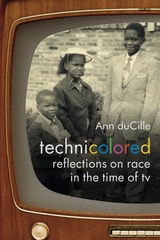
cover of Technicolored: Reflections on Race in the Time of TV

Technicolored

Reflections on Race in the Time of TV

Ann duCille

Duke University Press, 2018
From early sitcoms such as I Love Lucy to contemporary prime-time dramas like Scandal and How to Get Away with Murder, African Americans on television have too often been asked to portray tired stereotypes of blacks as villains, vixens, victims, and disposable minorities. In Technicolored black feminist critic Ann duCille combines cultural critique with personal reflections on growing up with the new medium of TV to examine how televisual representations of African Americans have changed over the last sixty years. Whether explaining how watching Shirley Temple led her to question her own self-worth or how televisual representation functions as a form of racial profiling, duCille traces the real-life social and political repercussions of the portrayal and presence of African Americans on television. Neither a conventional memoir nor a traditional media study, Technicolored offers one lifelong television watcher's careful, personal, and timely analysis of how television continues to shape notions of race in the American imagination.
[more]
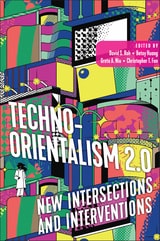
cover of Techno-Orientalism 2.0: New Intersections and Interventions

Techno-Orientalism 2.0

New Intersections and Interventions

David S. Roh

Rutgers University Press, 2025
Building on the groundbreaking Techno-Orientalism: Imagining Asia in Speculative Fiction, History, and Media, published by Rutgers University Press in 2015, Techno-Orientalism 2.0: New Intersections and Interventions addresses the impact of a volatile post-pandemic present on speculative futures by and about Asians. The backdrop of this highly anticipated follow-up is a world that is radically different than in 2015: COVID-19, threats of a “new cold war” with China, Russia’s invasion of Ukraine, and the reemergence of “strong man” politics around the world. An essential volume for this new critical juncture in Asian American history, Techno-Orientalism 2.0 catalogs intersectional dialogue with discourses such as Afrofuturism, Indigenous futurities, environmentalism, and disability studies. It also engages with recent high-profile and lesser-known works of Asian and Asian American speculative fiction, film, television, anime, art, music, journalism, architecture, state-sponsored policies and infrastructural projects, and the now-dominant China Panic.
 
[more]
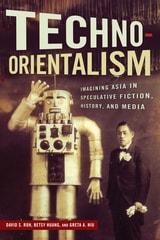
cover of Techno-Orientalism: Imagining Asia in Speculative Fiction, History, and Media

Techno-Orientalism

Imagining Asia in Speculative Fiction, History, and Media

Roh, David S.

Rutgers University Press, 2015
What will the future look like? To judge from many speculative fiction films and books, from Blade Runner to Cloud Atlas, the future will be full of cities that resemble Tokyo, Hong Kong, and Shanghai, and it will be populated mainly by cold, unfeeling citizens who act like robots. Techno-Orientalism investigates the phenomenon of imagining Asia and Asians in hypo- or hyper-technological terms in literary, cinematic, and new media representations, while critically examining the stereotype of Asians as both technologically advanced and intellectually primitive, in dire need of Western consciousness-raising. 
 
The collection’s fourteen original essays trace the discourse of techno-orientalism across a wide array of media, from radio serials to cyberpunk novels, from Sax Rohmer’s Dr. Fu Manchu to Firefly.  Applying a variety of theoretical, historical, and interpretive approaches, the contributors consider techno-orientalism a truly global phenomenon. In part, they tackle the key question of how these stereotypes serve to both express and assuage Western anxieties about Asia’s growing cultural influence and economic dominance. Yet the book also examines artists who have appropriated techno-orientalist tropes in order to critique racist and imperialist attitudes. 
 
Techno-Orientalism is the first collection to define and critically analyze a phenomenon that pervades both science fiction and real-world news coverage of Asia. With essays on subjects ranging from wartime rhetoric of race and technology to science fiction by contemporary Asian American writers to the cultural implications of Korean gamers, this volume offers innovative perspectives and broadens conventional discussions in Asian American Cultural studies. 


[more]
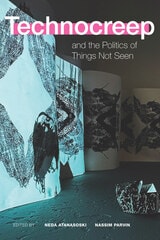
cover of Technocreep and the Politics of Things Not Seen

Technocreep and the Politics of Things Not Seen

Neda Atanasoski and Nassim Parvin, editors

Duke University Press, 2025

New and emerging technologies, especially ones that infiltrate intimate spaces, relations, homes, and bodies, are often referred to as creepy in media and political discourses. In Technocreep and the Politics of Things Not Seen, Neda Atanasoski and Nassim Parvin introduce a feminist theory of creep that they substantiate through critical engagement with smart homes, smart dust, smart desires, and smart forests toward dreams of feminist futures. Contributing authors further illuminate what is otherwise obscured, assumed, or dismissed in characterizations of technology as creepy or creeping. Considering diverse technologies such as border surveillance and China’s credit system to sexcams and home assistants, the volume’s essays and artworks demonstrate that the potentials and pitfalls of artificial intelligence and digital and robotic technologies cannot be assessed through binaries of seeing/being seen, privacy/surveillance, or harmful/useful. Together, their multifaceted and multimodal approach transcends such binaries, accounting for technological relations that exceed sight to include touch, presence, trust, and diverse modes of collectivity. As such, this volume develops creep as a feminist analytic and creative mode on par with technology’s complex entanglement with intimate, local, and global politics.

Contributors. Neda Atanasoski, Katherine Bennett, Iván Chaar López, Sushmita Chatterjee, Hayri Dortdivanlioglu, Sanaz Haghani, Jacob Hagelberg, Jennifer Hamilton, Antonia Hernández, Marjan Khatibi, Tamara Kneese, Erin McElroy, Vernelle A. A. Noel, Jessica Olivares, Nassim Parvin, Beth Semel, Renee Shelby, Tanja Wiehn

[more]
cover of Technological Democracy: Bureaucracy and Citizenry in the German Energy Debate

Technological Democracy

Bureaucracy and Citizenry in the German Energy Debate

Carol J. Hager

University of Michigan Press, 1995
What are the prospects for democratic participation in the modern technological state? Is technology a force of emancipation or enslavement? Intellectuals such as Max Weber have prophesied that complex issues would ultimately be decided by technical experts instead of by those who were affected or their political representatives—and that politics would give way to technocracy. Technological Democracy explores the connection between environmental and democratizing concerns in Germany, to see what answers environmental groups might provide to the question of the citizen's role in a technological society. The volume explores the ways in which lay citizens can participate in policy decisions of a technical nature, and whether in doing so they can repoliticize and democratize those policy areas that have become the territory of experts. Technological Democracy will be of interest to scholars and students in German history, political science, and sociology.
[more]
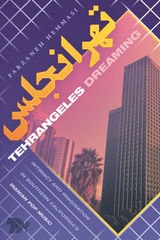
cover of Tehrangeles Dreaming: Intimacy and Imagination in Southern California's Iranian Pop Music

Tehrangeles Dreaming

Intimacy and Imagination in Southern California's Iranian Pop Music

Farzaneh Hemmasi

Duke University Press, 2020
Los Angeles, called Tehrangeles because it is home to the largest concentration of Iranians outside of Iran, is the birthplace of a distinctive form of postrevolutionary pop music. Created by professional musicians and media producers fleeing Iran's revolutionary-era ban on “immoral” popular music, Tehrangeles pop has been a part of daily life for Iranians at home and abroad for decades. In Tehrangeles Dreaming Farzaneh Hemmasi draws on ethnographic fieldwork in Los Angeles and musical and textual analysis to examine how the songs, music videos, and television made in Tehrangeles express modes of Iranianness not possible in Iran. Exploring Tehrangeles pop producers' complex commercial and political positioning and the histories, sensations, and fantasies their music makes available to global Iranian audiences, Hemmasi shows how unquestionably Iranian forms of Tehrangeles popular culture exemplify the manner in which culture, media, and diaspora combine to respond to the Iranian state and its political transformations. The transnational circulation of Tehrangeles culture, she contends, transgresses Iran's geographical, legal, and moral boundaries while allowing all Iranians the ability to imagine new forms of identity and belonging.
[more]
cover of Televising Chineseness: Gender, Nation, and Subjectivity

Televising Chineseness

Gender, Nation, and Subjectivity

Geng Song

University of Michigan Press, 2022
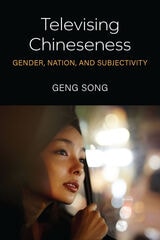
The serial narrative is one of the most robust and popular forms of storytelling in contemporary China. With a domestic audience of one billion-plus and growing transnational influence and accessibility, this form of storytelling is becoming the centerpiece of a fast-growing digital entertainment industry and a new symbol and carrier of China’s soft power. Televising Chineseness: Gender, Nation, and Subjectivity explores how television and online dramas imagine the Chinese nation and form postsocialist Chinese gendered subjects. The book addresses a conspicuous paradox in Chinese popular culture today: the coexistence of increasingly diverse gender presentations and conservative gender policing by the government, viewers, and society. Using first-hand data collected through interviews and focus group discussions with audiences comprising viewers of different ages, genders, and educational backgrounds, Televising Chineseness sheds light on how television culture relates to the power mechanisms and truth regimes that shape the understanding of gender and the construction of gendered subjects in postsocialist China.
[more]
cover of Television, Japan, and Globalization

Television, Japan, and Globalization

Mitsuhiro Yoshimoto, Eva Tsai, and JungBong Choi, Editors

University of Michigan Press, 2010
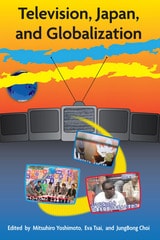
Television, Japan, and Globalization makes a monumental contribution to the literature of television studies, which has increasingly recognized its problematic focus on US and Western European media, and a compelling intervention in discussions of globalization, through its careful attention to contradictory and complex phenomena on Japanese TV. Case studies include talent and stars, romance, anime, telops, game and talk shows, and live-action nostalgia shows. The book also looks at Japanese television from a political and economic perspective, with attention to Sky TV, production trends, and Fuji TV as an architectural presence in Tokyo.
The combination of textual analysis, clear argument, and historical and economic context makes this book ideal for media studies audiences. Its most important contribution may be moving the study of Japanese popular culture beyond the tired truisms about postmodernism and opening up new lines of thinking about television and popular culture within and between nations.
[more]
cover of Tell This Silence: Asian American Women Writers And The Politics Of Speech

Tell This Silence

Asian American Women Writers And The Politics Of Speech

Patti Duncan

University of Iowa Press, 2004

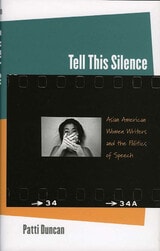
Tell This Silence by Patti Duncan explores multiple meanings of speech and silence in Asian American women's writings in order to explore relationships among race, gender, sexuality, and national identity. Duncan argues that contemporary definitions of U.S. feminism must be expanded to recognize the ways in which Asian American women have resisted and continue to challenge the various forms of oppression in their lives. There has not yet been adequate discussion of the multiple meanings of silence and speech, especially in relation to activism and social-justice movements in the U.S. In particular, the very notion of silence continues to invoke assumptions of passivity, submissiveness, and avoidance, while speech is equated with action and empowerment.

However, as the writers discussed in Tell This Silence suggest, silence too has multiple meanings especially in contexts like the U.S., where speech has never been a guaranteed right for all citizens. Duncan argues that writers such as Maxine Hong Kingston, Mitsuye Yamada, Joy Kogawa, Theresa Hak Kyung Cha, Nora Okja Keller, and Anchee Min deploy silence as a means of resistance. Juxtaposing their “unofficial narratives” against other histories—official U.S. histories that have excluded them and American feminist narratives that have stereotyped them or distorted their participation—they argue for recognition of their cultural participation and offer analyses of the intersections among gender, race, nation, and sexuality.

Tell This Silence offers innovative ways to consider Asian American gender politics, feminism, and issues of immigration and language. This exciting new study will be of interest to literary theorists and scholars in women's, American, and Asian American studies.

[more]
cover of Telling Deaf Lives: Agents of Change

Telling Deaf Lives

Agents of Change

Kristin Snoddon

Gallaudet University Press, 2014

In July 2012, the 8th Deaf History International (DHI) Conference featured 27 presentations from members of Deaf communities around the world who related their own autobiographies as well as the biographies of historical Deaf individuals. The presenters came from 12 different countries, but their stories traverse many other locales. Thus, they created a transnational phenomenon of widespread interest in the collection, documentation, and dissemination of Deaf history by and for members of the deaf community. Telling Deaf Lives: Agents of Change brings together the best of the DHI Conference offerings in this volume.

     Due to the dearth of formal research on deaf people, Deaf community historians drove the preservation of the stories in this collection. Their diversity is remarkable: Melissa Anderson and Breda Carty describe the Cosmopolitan Correspondence Club, a group of Deaf individuals who corresponded in the early 20th century from Australia to Western Europe to the United States; Ulla-Bell Thorin recounts first-hand growing up deaf in Sweden and her process in authoring six memoirs; Harry Lang reflects on writing biographies of numerous Deaf Americans in the arts and science; Akio Suemori profiles the first Deaf president of a Japanese school for the Deaf; Tatiana Davidenko writes about her Deaf family’s experience during the World War II siege of Leningrad; Theara Yim and Julie Chateauvert look at the evolution of ASL poetry by analyzing works of prominent ASL poets Clayton Valli, Peter Cook, and Kenny Lerner. These and the other contributions here enshrine Deaf people in collective memory by virtue of disseminating and preserving their stories.
[more]
cover of Telling and Being Told: Storytelling and Cultural Control in Contemporary Yucatec Maya Literatures

Telling and Being Told

Storytelling and Cultural Control in Contemporary Yucatec Maya Literatures

Paul M. Worley

University of Arizona Press, 2013

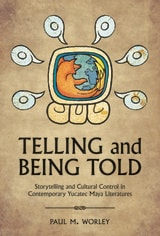
Through performance and the spoken word, Yucatec Maya storytellers have maintained the vitality of their literary traditions for more than five hundred years. Telling and Being Told presents the figure of the storyteller as a symbol of indigenous cultural control in contemporary Yucatec Maya literatures. Analyzing the storyteller as the embodiment of indigenous knowledge in written and oral texts, this book highlights how Yucatec Maya literatures play a vital role in imaginings of Maya culture and its relationships with Mexican and global cultures.
 
Through performance, storytellers place the past in dynamic relationship with the present, each continually evolving as it is reevaluated and reinterpreted. Yet non-indigenous actors often manipulate the storyteller in their firsthand accounts of the indigenous world. Moreover, by limiting the field of literary study to written texts, Worley argues, critics frequently ignore an important component of Latin America’s history of conquest and colonization: The fact that Europeans consciously set out to destroy indigenous writing systems, making orality a key means of indigenous resistance and cultural continuity.
 
Given these historical factors, outsiders must approach Yucatec Maya and other indigenous literatures on their own terms rather than applying Western models. Although oral literature has been excluded from many literary studies, Worley persuasively demonstrates that it must be included in contemporary analyses of indigenous literatures as oral texts form a key component of contemporary indigenous literatures, and storytellers and storytelling remain vibrant cultural forces in both Yucatec communities and contemporary Yucatec writing.
[more]
cover of Telling to Live: Latina Feminist Testimonios

Telling to Live

Latina Feminist Testimonios

Latina Feminist Group

Duke University Press, 2001

Telling to Live embodies the vision that compelled Latina feminists to engage their differences and find common ground. Its contributors reflect varied class, religious, ethnic, racial, linguistic, sexual, and national backgrounds. Yet in one way or another they are all professional producers of testimonios—or life stories—whether as poets, oral historians, literary scholars, ethnographers, or psychologists. Through coalitional politics, these women have forged feminist political stances about generating knowledge through experience. Reclaiming testimonio as a tool for understanding the complexities of Latina identity, they compare how each made the journey to become credentialed creative thinkers and writers. Telling to Live unleashes the clarifying power of sharing these stories.
The complex and rich tapestry of narratives that comprises this book introduces us to an intergenerational group of Latina women who negotiate their place in U.S. society at the cusp of the twenty-first century. These are the stories of women who struggled to reach the echelons of higher education, often against great odds, and constructed relationships of sustenance and creativity along the way. The stories, poetry, memoirs, and reflections of this diverse group of Puerto Rican, Chicana, Native American, Mexican, Cuban, Dominican, Sephardic, mixed-heritage, and Central American women provide new perspectives on feminist theorizing, perspectives located in the borderlands of Latino cultures.
This often heart wrenching, sometimes playful, yet always insightful collection will interest those who wish to understand the challenges U.S. society poses for women of complex cultural heritages who strive to carve out their own spaces in the ivory tower.

Contributors. Luz del Alba Acevedo, Norma Alarcón, Celia Alvarez, Ruth Behar, Rina Benmayor, Norma E. Cantú, Daisy Cocco De Filippis, Gloria Holguín Cuádraz, Liza Fiol-Matta, Yvette Flores-Ortiz, Inés Hernández-Avila, Aurora Levins Morales, Clara Lomas, Iris Ofelia López, Mirtha N. Quintanales, Eliana Rivero, Caridad Souza, Patricia Zavella
[more]
cover of Temporalities in Mesoamerican Ritual Practices

Temporalities in Mesoamerican Ritual Practices

Valentina Vapnarsky

University Press of Colorado, 2024

Temporalities in Mesoamerican Ritual Practices examines the time-based dimensions of ritual activities in past and present Mesoamerican societies, including the prehispanic, colonial, and modern periods. The authors explore ritual around three principal categories of action—creating, transforming, and destroying—as significant cultural manifestations of the temporal dimension of transition processes.
 
Based on specific case studies, new analysis of fieldwork data, and long-term collaboration between authors, chapters engage empirically and theoretically with the multiple temporalities of ritual in relation to both the unfolding of ritual performance and its external and symbolic anchors. Taking rituals as a series of specific, formalized actions that produce transitory changes within an initial context, the authors examine activities that generate change linked to artifact production, life cycles, healing, conflict resolution, crisis management, the enthronement of rulers and transfers of responsibilities, and practices relating to the occupation, abandonment, reuse, or conversion of socialized spaces.
 
Adopting a multidisciplinary approach in archaeology, ethnohistory, anthropology, and linguistic anthropology, Temporalities in Mesoamerican Ritual Practices offers new insights into ritual time approached through multi-semiotic, material, sensorial, and pragmatic perspectives that encourage further interdisciplinary dialogue.
 
 
[more]
cover of Tension: Mental Distress and Embodied Inequality in the Western Himalayas

Tension

Mental Distress and Embodied Inequality in the Western Himalayas

Nikita Kaur Simpson

Duke University Press, 2026
In Tension, Nikita Kaur Simpson examines the effects of rapid development in the Himalayas on the minds and bodies of the Gaddi people who inhabit them through attention to the multifaceted state of distress they call “tension.” This “tension” takes many forms: Kamzori, or weakness, in the bodies of elderly women; “Future tension” accumulating in the minds of young girls; or Opara, or black magic, afflicting whole families. Through her long-term ethnographic fieldwork, Simpson follows the ways in which Gaddi people tie this distress to broader structural changes, such as land dispossession and caste, class, tribal and gender inequality, which are growing alongside modernity and prosperity. In doing so, she shows how “tension” acts as an everyday diagnostic of the problems of cultural, economic and environmental change as they shape intimate life. At once a lived historical account, a cartography of care relations, and a multi-sensory exploration of the intimate experiences of atmosphere and body, Tension puts forth a novel theory of distress, that inequality is often determined by who is made to feel, hold, and absorb distress.
[more]
cover of Tensions in the American Dream: Rhetoric, Reverie, or Reality

Tensions in the American Dream

Rhetoric, Reverie, or Reality

Roderick Bush

Temple University Press, 2015

Could the promise of upward mobility have a dark side? In Tensions in the American Dream, Melanie and Roderick Bush ask, how does a "nation of immigrants" pledge inclusion, yet marginalize so many citizens based on race, class, and gender? The authors consider the origins and development of the U.S. nation and empire; the founding principles of belonging, nationalism, and exceptionalism; and their lived reality.
 
Tensions in the American Dream also addresses the relevancy of nation to empire in the context of the historical world capitalist system. The authors ask, is the American Dream a reality only questioned by those unwilling or unable to achieve it? What is the "good life" and how is it particularly "American"?
[more]
cover of Teotihuacan and Early Classic Mesoamerica: Multiscalar Perspectives on Power, Identity, and Interregional Relations

Teotihuacan and Early Classic Mesoamerica

Multiscalar Perspectives on Power, Identity, and Interregional Relations

Claudia García-Des Lauriers

University Press of Colorado, 2021

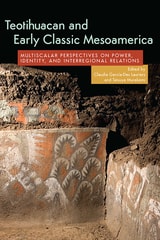
The Early Classic period in Mesoamerica has been characterized by the appearance of Teotihuacan-related material culture throughout the region. Teotihuacan, known for its monumental architecture and dense settlement, became an urban center around 100 BC and a regional state over the next few centuries, dominating much of the Basin of Mexico and beyond until its collapse around AD 650. Teotihuacan and Early Classic Mesoamerica explores the complex nature of Teotihuacan’s interactions with other regions from both central and peripheral vantage points.
 
The volume offers a multiscalar view of power and identity, showing that the spread of Teotihuacan-related material culture may have resulted from direct and indirect state administration, colonization, emulation by local groups, economic transactions, single-event elite interactions, and various kinds of social and political alliances. The contributors explore questions concerning who interacted with whom; what kinds of materials and ideas were exchanged; what role interregional interactions played in the creation, transformation, and contestation of power and identity within the city and among local polities; and how interactions on different scales were articulated. The answers to these questions reveal an Early Classic Mesoamerican world engaged in complex economic exchanges, multidirectional movements of goods and ideas, and a range of material patterns that require local, regional, and macroregional contextualization.
 
Focusing on the intersecting themes of identity and power, Teotihuacan and Early Classic Mesoamerica makes a strong contribution to the understanding of the role of this important metropolis in the Early Classic history of the region. The volume will be of interest to scholars and graduate students of Mesoamerican archaeology, the archaeology of interaction, and the archaeology of identity.
 
Contributors: Sarah C. Clayton, Fiorella Fenoglio Limón, Agapi Filini, Julie Gazzola, Sergio Gómez-Chávez, Haley Holt Mehta, Carmen Pérez, Patricia Plunket, Juan Carlos Saint Charles Zetina, Yoko Sugiura, Gabriela Uruñuela, Gustavo Jaimes Vences

 
[more]
cover of Terracene: A Crude Aesthetics

Terracene

A Crude Aesthetics

Salar Mameni

Duke University Press, 2023
In Terracene Salar Mameni historicizes the popularization of the scientific notion of the Anthropocene alongside the emergence of the global war on terror. Mameni theorizes the Terracene as an epoch marked by a convergence of racialized militarism and environmental destruction. Both the Anthropocene and the war on terror centered the antagonist figures of the Anthropos and the terrorist as responsible for epochal changes in the new geological and geopolitical world orders. In response, Mameni shows how the Terracene requires radically new engagements with terra (the earth), whose intelligence resides in matters such as oil and phenomena like earthquakes and fires. Drawing on the work of artists whose practices interrogate histories of settler-colonial and imperial interests in land and resources in Iran, Iraq, Yemen, Kuwait, Syria, Palestine, and other regions most affected by the war on terror, Mameni offers speculative paths into the aesthetics of the Terracene.
[more]
cover of Terrifying Muslims: Race and Labor in the South Asian Diaspora

Terrifying Muslims

Race and Labor in the South Asian Diaspora

Junaid Rana

Duke University Press, 2011
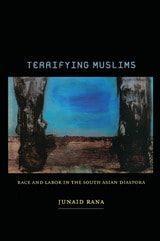
Terrifying Muslims highlights how transnational working classes from Pakistan are produced, constructed, and represented in the context of American empire and the recent global War on Terror. Drawing on ethnographic research that compares Pakistan, the Middle East, and the United States before and after 9/11, Junaid Rana combines cultural and material analyses to chronicle the worldviews of Pakistani labor migrants as they become part of a larger global racial system. At the same time, he explains how these migrants’ mobility and opportunities are limited by colonial, postcolonial, and new imperial structures of control and domination. He argues that the contemporary South Asian labor diaspora builds on and replicates the global racial system consolidated during the period of colonial indenture. Rana maintains that a negative moral judgment attaches to migrants who enter the global labor pool through the informal economy. This taint of the illicit intensifies the post-9/11 Islamophobia that collapses varied religions, nationalities, and ethnicities into the threatening racial figure of “the Muslim.” It is in this context that the racialized Muslim is controlled by a process that beckons workers to enter the global economy, and stipulates when, where, and how laborers can migrate. The demonization of Muslim migrants in times of crisis, such as the War on Terror, is then used to justify arbitrary policing, deportation, and criminalization.
[more]
cover of Territorial Natures: Imperial Japan and the Mongolian Question

Territorial Natures

Imperial Japan and the Mongolian Question

Sakura Christmas

University of Chicago Press, 2026

A critical account of the Japanese occupation in Inner Mongolia.
 
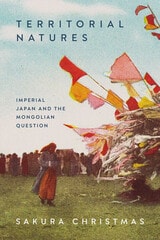
Early in the twentieth century, the steppe borderlands between China and Mongolia erupted in violence. As imperial Japan expanded into the area, this crisis between nomadic and settler communities posed fundamental problems in governance. In response, Japanese and Mongol leaders together proposed a radical solution: demarcating an autonomous region in Manchukuo for minority peoples, a new kind of political space that would later define the territorial structure of Communist China. 
 
In Territorial Natures, Sakura Christmas explores how the fraught partition of this autonomous region warped the ethnic and environmental boundaries of Manchukuo. She challenges its origin story as a socialist invention by the Chinese state, instead seeing it as also a fascist extension of the Japanese occupation. By reading Chinese and Mongolian sources against Japanese archives, Christmas reveals how this contested history seeded the volatile landscape of autonomous regions in the People’s Republic of China today.
 

[more]
cover of Territories of the Soul: Queered Belonging in the Black Diaspora

Territories of the Soul

Queered Belonging in the Black Diaspora

Nadia Ellis

Duke University Press, 2015
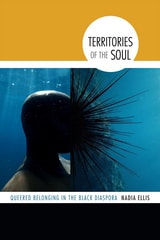
Nadia Ellis attends to African diasporic belonging as it comes into being through black expressive culture. Living in the diaspora, Ellis asserts, means existing between claims to land and imaginative flights unmoored from the earth—that is, to live within the territories of the soul. Drawing on the work of Jose Muñoz, Ellis connects queerness' utopian potential with diasporic aesthetics. Occupying the territory of the soul, being neither here nor there, creates in diasporic subjects feelings of loss, desire, and a sensation of a pull from elsewhere. Ellis locates these phenomena in the works of C.L.R. James, the testy encounter between George Lamming and James Baldwin at the 1956 Congress of Negro Artists and Writers in Paris, the elusiveness of the queer diasporic subject in Andrew Salkey's novel Escape to an Autumn Pavement, and the trope of spirit possession in Nathaniel Mackey's writing and Burning Spear's reggae. Ellis' use of queer and affect theory shows how geographies claim diasporic subjects in ways that nationalist or masculinist tropes can never fully capture. Diaspora, Ellis concludes, is best understood as a mode of feeling and belonging, one fundamentally shaped by the experience of loss.
[more]
cover of Terrorist Assemblages: Homonationalism in Queer Times

Terrorist Assemblages

Homonationalism in Queer Times

Jasbir K. Puar

Duke University Press, 2007

In this pathbreaking work, Jasbir K. Puar argues that configurations of sexuality, race, gender, nation, class, and ethnicity are realigning in relation to contemporary forces of securitization, counterterrorism, and nationalism. She examines how liberal politics incorporate certain queer subjects into the fold of the nation-state, through developments including the legal recognition inherent in the overturning of anti-sodomy laws and the proliferation of more mainstream representation. These incorporations have shifted many queers from their construction as figures of death (via the AIDS epidemic) to subjects tied to ideas of life and productivity (gay marriage and reproductive kinship). Puar contends, however, that this tenuous inclusion of some queer subjects depends on the production of populations of Orientalized terrorist bodies. Heteronormative ideologies that the U.S. nation-state has long relied on are now accompanied by homonormative ideologies that replicate narrow racial, class, gender, and national ideals. These “homonationalisms” are deployed to distinguish upright “properly hetero,” and now “properly homo,” U.S. patriots from perversely sexualized and racialized terrorist look-a-likes—especially Sikhs, Muslims, and Arabs—who are cordoned off for detention and deportation.

Puar combines transnational feminist and queer theory, Foucauldian biopolitics, Deleuzian philosophy, and technoscience criticism, and draws from an extraordinary range of sources, including governmental texts, legal decisions, films, television, ethnographic data, queer media, and activist organizing materials and manifestos. Looking at various cultural events and phenomena, she highlights troublesome links between terrorism and sexuality: in feminist and queer responses to the Abu Ghraib photographs, in the triumphal responses to the Supreme Court’s Lawrence decision repealing anti-sodomy laws, in the measures Sikh Americans and South Asian diasporic queers take to avoid being profiled as terrorists, and in what Puar argues is a growing Islamophobia within global queer organizing.
[more]
cover of Terrorist Assemblages: Homonationalism in Queer Times

Terrorist Assemblages

Homonationalism in Queer Times

Jasbir K. Puar

Duke University Press, 2017

Tenth Anniversary Expanded Edition

Ten years on, Jasbir K. Puar’s pathbreaking Terrorist Assemblages remains one of the most influential queer theory texts and continues to reverberate across multiple political landscapes, activist projects, and scholarly pursuits. Puar argues that configurations of sexuality, race, gender, nation, class, and ethnicity are realigning in relation to contemporary forces of securitization, counterterrorism, and nationalism. She examines how liberal politics incorporate certain queer subjects into the fold of the nation-state, shifting queers from their construction as figures of death to subjects tied to ideas of life and productivity. This tenuous inclusion of some queer subjects depends, however, on the production of populations of Orientalized terrorist bodies. Heteronormative ideologies that the U.S. nation-state has long relied on are now accompanied by what Puar calls homonationalism—a fusing of homosexuality to U.S. pro-war, pro-imperialist agendas. 

As a concept and tool of biopolitical management, homonationalism is here to stay. Puar’s incisive analyses of feminist and queer responses to the Abu Ghraib photographs, the decriminalization of sodomy in the wake of the Patriot Act, and the profiling of Sikh Americans and South Asian diasporic queers are not instances of a particular historical moment; rather, they are reflective of the dynamics saturating power, sexuality, race, and politics today. 

This Tenth Anniversary Expanded Edition features a new foreword by Tavia Nyong’o and a postscript by Puar entitled “Homonationalism in Trump Times.” Nyong’o and Puar recontextualize the book in light of the current political moment while reposing its original questions to illuminate how Puar’s interventions are even more vital and necessary than ever.
[more]
cover of Terrorizing Latina/o Immigrants: Race, Gender, and Immigration Policy Post-9/11

Terrorizing Latina/o Immigrants

Race, Gender, and Immigration Policy Post-9/11

Anna Sampaio

Temple University Press, 2015

Immigration politics has been significantly altered by the advent of America’s war on terror and the proliferation of security measures. In her cogent study, Terrorizing Latina/o Immigrants, Anna Sampaio examines how these processes are racialized and gendered and how they impose inequitable burdens on Latina/o immigrants. She interrogates the rise of securitization, restrictive legislation, and the return of large-scale immigration raids and describes how these re-articulate and re-inscribe forms of racial and gender hierarchy.  

Terrorizing Latina/o Immigrants demonstrates how the ascendance of America as a security state serves as a template to scrutinize, harass, and encumber immigrants while also reconfiguring citizenship. Sampaio uses intersectional analysis coupled with theoretical and empirical approaches to develop a critical framework for analyzing current immigration politics.

Sampaio provides a sustained and systematic examination of policy and enforcement shifts impacting Latinas/os. Her book concludes with an examination of immigration reform under the Obama administration, contrasting the promise of hope and change with the reality of increased detentions, deportations, and continued marginalization.
[more]
cover of Testimonio: On The Politics Of Truth

Testimonio

On The Politics Of Truth

John Beverley

University of Minnesota Press, 2004

A revealing perspective on the controversial literature of witnessing

These four germinal essays by John Beverley sparked the widespread discussion and debate surrounding testimonio—the socially and politically charged Latin American narrative of witnessing—that culminated with David Stoll’s highly publicized attack on Rigoberta Menchú’s celebrated testimonial text. Challenging Hardt and Negri’s Empire, Beverley’s extensive new introduction examines the broader historical, political, and ethical issues that this literature raises, tracing the development of testimonio from its emergence in the Cold War era to the rise of a globalized economy and U.S. political hegemony.

Informed by postcolonial studies and the current debate over multiculturalism and identity politics, Testimonio reaches across disciplinary boundaries to show how this particular literature at once represents and enacts new forms of agency on the part of previously repressed social subjects, as well as its potential as a new form of “alliance politics” between those subjects and artists, scientists, teachers, and intellectuals in a variety of local, national, and international contexts.

[more]
cover of Texan Crucible: How the Irish, Germans, and Czechs Became Anglo

Texan Crucible

How the Irish, Germans, and Czechs Became Anglo

Marian J. Barber

University of Texas Press, 2026

A history of European immigrants in Texas and how they redefined racial identity.

While the creation of a Black-White racial binary was foundational to most of the United States, nineteenth-century Texas developed a unique tripartite system that acknowledged the role of individuals of Mexican ancestry in a region that was Spanish, Mexican, and an independent nation before becoming a US (and briefly Confederate) state. Yet this framework was fraught, struggling to accommodate new arrivals from beyond North America, in particular the Irish, Germans, and Czechs. Texan Crucible tells the story of these immigrants and how they became Anglo.

Marian Barber reveals the ways language, religion, alcohol use, and attitudes toward slavery distinguished these newcomers to Texas from those arriving from the eastern United States and how they nevertheless created thriving, influential communities. Their status was shaped by events inside and far beyond Texas, including an 1887 prohibition fight, the Civil War, and two world wars that encouraged them to erase their distinctiveness. As segregation was formally outlawed and civil rights activism grew, understandings of race shifted, cementing these groups’ status as Anglo. Texan Crucible recovers the histories of German, Irish, and Czech immigrants and unveils the social construction of racial difference underpinning Texan identity.

[more]