Results by title
91 books match the query 'Deaf people' and 12 start with t
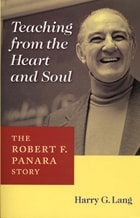
Teaching from the Heart and Soul
The Robert F. Panara StoryHarry G. Lang
Gallaudet University Press, 2007
The Sixth Volume in the Deaf Lives Series
Robert F. Panara lost his hearing from spinal meningitis in 1931 at the age of ten. However, he could read and write, and with his friends’ help, Bob (as he was known), made it through high school. His new solitude created a new passion – reading, reading, and reading. The stage was set for the emergence of one of the great deaf educators in modern time, a life fully captured in Harry G. Lang’s Teaching from the Heart and Soul: The Robert F. Panara Story.
Bob Panara’s many achievements began after his discovery of Gallaudet College in the 1940s. There, he wrote “The Significance of the Reading Problem,” which first expressed his belief that teaching “comes from the heart and soul.” The article secured him his first job at the New York School for the Deaf in White Plains. Bob returned to teach at Gallaudet College from 1948 until 1965, when he left to help found the National Technical Institute for the Deaf (NTID) and the National Theatre of the Deaf (NTD) — all in the same year. He continued to expand arts and literature at NTID until his retirement in 1987.
Bob Panara’s genius resides in the people he inspired with his vivacious teaching style. He believed ardently in involving students, that they should “be the book.” Former students tell story after story about his fabulous interpretations of drama and poetry, a legacy confirmed by his own story in Teaching from the Heart and Soul.
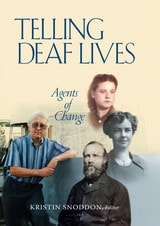
Telling Deaf Lives
Agents of ChangeKristin Snoddon
Gallaudet University Press, 2014
Due to the dearth of formal research on deaf people, Deaf community historians drove the preservation of the stories in this collection. Their diversity is remarkable: Melissa Anderson and Breda Carty describe the Cosmopolitan Correspondence Club, a group of Deaf individuals who corresponded in the early 20th century from Australia to Western Europe to the United States; Ulla-Bell Thorin recounts first-hand growing up deaf in Sweden and her process in authoring six memoirs; Harry Lang reflects on writing biographies of numerous Deaf Americans in the arts and science; Akio Suemori profiles the first Deaf president of a Japanese school for the Deaf; Tatiana Davidenko writes about her Deaf family’s experience during the World War II siege of Leningrad; Theara Yim and Julie Chateauvert look at the evolution of ASL poetry by analyzing works of prominent ASL poets Clayton Valli, Peter Cook, and Kenny Lerner. These and the other contributions here enshrine Deaf people in collective memory by virtue of disseminating and preserving their stories.
The Art of Being Deaf
A MemoirDonna McDonald
Gallaudet University Press, 2014
Born in 1950s Australia, McDonald was placed in an oral deaf school when she was five. There, she was trained to communicate only in spoken English. Afterwards, she attended mainstream schools where she excelled with speechreading and hard work. Her determination led to achievements that proved her to be “the deaf girl that had made good.” Yet, despite her constant focus on fitting in the hearing world, McDonald soon realized that she missed her deaf schoolmates and desired to explore her closed-off feelings about being deaf.
When she reconnected with her friends, one urged her to write about her experiences to tell all about “the Forgotten Generation, the orally-raised deaf kids that no one wants to talk about.” In writing her memoir, McDonald did learn to reconcile her deaf-self with her “hearing-deaf” persona, and she realized that the art of being deaf is the art of life, the art of love.
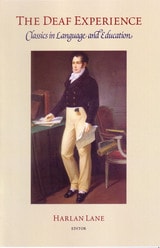
The Deaf Experience
Classics in Language and EducationHarlan Lane
Gallaudet University Press, 2006
The fifth volume in the Gallaudet Classics in Deaf Studies series features works written from 1764 up to1840. Pierre Desloges offers a stirring paean to sign language in an excerpt from his book, the first ever published by a deaf person. Saboureux de Fontenay and Jean Massieu, two prominent leaders, relate their respective experiences in autobiographical accounts. In separate essays, Charles-Michel de l’Epée and Roch-Ambroise Sicard describe systems for teaching manual French, followed by a critique of these methods by Roch-Ambroise Bébian, a well-known hearing friend of Deaf people during that era. Ferdinand Berthier, a renowned Deaf teacher and writer in the 19th century, concludes with a history of Deaf people up to that time.
The Deaf Experience shows clearly how this extraordinary era of French deaf education influenced the adoption of the manual method by the first schools for deaf students in America, in sharp contrast to the oral movement that repressed sign-language-centered education for nearly a century afterward. Deaf studies scholars and students alike will welcome the return of this invaluable resource.
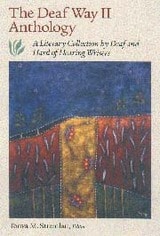
The Deaf Way II Anthology
A Literary Collection by Deaf and Hard of Hearing WritersTonya M. Stremlau
Gallaudet University Press, 2002
In July 2002, the second Deaf Way Conference and Festival took place at Gallaudet University in Washington, D.C., attracting more than 5,000 people worldwide. Researchers, artists, performers, and others converged to create a singular blend of scholarship and social interaction, which inspired The Deaf Way II Anthology.
The Deaf Way II Anthology brings together stellar contributions by 16 international writers who are deaf or hard of hearing. This remarkable collection features poetry, essays, short stories, and one play, all of which offer thought-provoking perspectives on elements from the personal universes of these gifted authors. Many are American writers well-known for their past publications, such as Douglas Bullard, Willy Conley, Christopher Heuer, and Raymond Luczak, while the outstanding work of John Lee Clark, volume editor Tonya Stremlau, Melissa Whalen, and several others have been collected for the first time in this volume. The international contributions further distinguish this anthology, ranging from poetry by Romanian Carmen Cristiu, verse by Sibylle Gurtner May from Switzerland, to a play by Nigerian Sotonwa Opeoluwa.
All of the writers showcased in The Deaf Way II Anthology portray the Deaf experience with unmatched authenticity, presenting a perfect introduction to the Deaf world. Simultaneously, their work demonstrates that deaf and hard of hearing people can write at the highest aesthetic level and offer invaluable insights on the complete human spectrum.
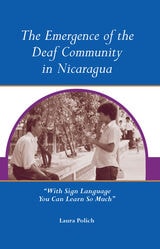
The Emergence of the Deaf Community in Nicaragua
“With Sign Language You Can Learn So Much”Laura Polich
Gallaudet University Press, 2005
The sudden discovery of Nicaraguan Sign Language (NSL) enthralled scholars worldwide who hoped to witness the evolution of a new language. But controversy erupted regarding the validity of NSL as a genuinely spontaneous language created by young children. Laura Polich’s fascinating book recounts her nine-year study of the Deaf community in Nicaragua and her findings about its formation and that of NSL in its wake.
Polich crafted The Emergence of the Deaf Community in Nicaragua from her copious research in Nicaragua’s National Archives, field observations of deaf pupils in 20 special education schools, polls of the teachers for deaf children about their education and knowledge of deafness, a survey of 225 deaf individuals about their backgrounds and living conditions, and interviews with the oldest members of the National Nicaraguan Association of the Deaf.
Polich found that the use of a “standardized” sign language in Nicaragua did not emerge until there was a community of users meeting on a regular basis, especially beyond childhood. The adoption of NSL did not happen suddenly, but took many years and was fed by multiple influences. She also discovered the process that deaf adolescents used to attain their social agency, which gained them recognition by the larger Nicaraguan hearing society. Her book illustrates tremendous changes during the past 60 years, and the truth in one deaf Nicaraguan’s declaration, “With sign language you can learn so much.”
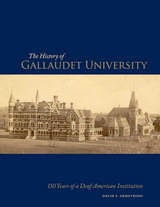
The History of Gallaudet University
150 Years of a Deaf American InstitutionDavid F. Armstrong
Gallaudet University Press, 2014
At first a tiny college of fewer than 200 students, Gallaudet’s growth paralleled the emergence of the American Deaf Community and the history of the nation in general. In the same way that the country’s land-grant universities brought higher education to more American students than ever before, Gallaudet offered the same opportunities to deaf students for the first time. Gallaudet mirrored other institutions in addressing major issues of the time, from legislated segregation to the Civil Rights movement that inspired the struggle by deaf people to gain control of the governance of their university. Most critically, this volume details poignantly the evolution of American Sign Language as a language of scholarship at Gallaudet during a time when its use in educational institutions was largely discouraged or prohibited. Through story and image, it traces the historic path that Gallaudet traveled to be recognized as the finest institution of higher education for deaf people in the world.
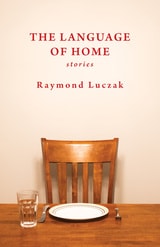
The Language of Home
StoriesRaymond Luczak
Gallaudet University Press, 2025
This short story collection offers readers many possible answers that reveal the Deaf experience in all its complexities. Written over nearly forty years by celebrated Deaf author Raymond Luczak, this collection of thirty stories paints a vivid panorama of Deaf lives. From a young DeafBlind boy feeling lost within his hearing family to a hearing son of Deaf parents caught between their infighting and a hearing mother realizing in the split second of her own death the full impact of the missteps she has taken while raising her Deaf son, Luczak crafts narratives that resonate with authenticity. Other stories feature an ASL interpreter feeling conflicted about a Deaf neighbor and a Deaf woman who becomes blacklisted as a backstabber. These characters often navigate the murky waters of the hearing world, sometimes with a touch of ASL gloss. The Language of Home is an exciting literary contribution that offers rare, nuanced representations of Deaf characters.

The Proper Way to Educate the Deaf
A Modern Annotated TranslationThe Abbé Charles-Michel de l’Epée
Gallaudet University Press, 2024
De l’Épée provides an anecdotal account of his methods and philosophy for educating deaf children using a sign system based on the French Sign Language of the era but adapted to visually represent the linguistic features of spoken and written French. His work laid the foundation for the use of the “manual method,” or sign language, in deaf education. One section of the text, originally published in Latin, outlines the intellectual clash between de l’Épée and Samuel Heinicke, an early proponent of oral education who contested the use of sign language.
De l’Épée’s text holds significant cultural and historical value for the fields of deaf studies and deaf education. This English language translation reveals de l’Épée’s own story of how he came to be known as the “father of the deaf” and is enriched by scholarly contributions that provide essential historical context and a framework for modern understanding.

The Silents
Charlotte Abrams
Gallaudet University Press, 1996
The Silents departs from other narratives about deaf parents and hearing children when the family discovers that Abrams’ mother is becoming blind. With resiliency, the family turned the secret, terrifying sorrow their mother felt at losing her only contact with the world into a quest for the best way to bring it back. Should she learn Braille? Should she use a cane? All of the old communication and day-to-day living routines had to be relearned. And through it all, the family and their neighbors, hearing and deaf, worked together to ensure that Abrams’ parents remained the close, vital members of the community that they had always been.
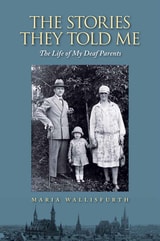
The Stories They Told Me
The Life of My Deaf ParentsMaria Wallisfurth
Gallaudet University Press, 2017
Despite their dissimilar backgrounds and the political circumstances that roiled their lives, the author’s parents showed great love for each other and their only daughter. The Stories They Told Me is a richly detailed document of time and place and a rare account of deaf lives during this era.
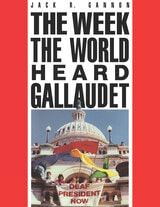
The Week the World Heard Gallaudet
Jack R. Gannon
Gallaudet University Press, 2009