Results by title
61 books match the query 'Dialogue' and 9 start with t

The Chekhovian Intertext
Dialogue with a ClassicLyudmila Parts
The Ohio State University Press, 2008
In The Chekhovian Intertext Lyudmila Parts explores contemporary Russian writers’ intertextual engagement with Chekhov and his myth. She offers a new interpretative framework to explain the role Chekhov and other classics play in constructing and maintaining Russian national identity and the reasons for the surge in the number of intertextual engagements with the classical authors during the cultural crisis in post-perestroika Russia.
The book highlights the intersection of three distinct concepts: cultural memory, cultural myth, and intertextuality. It is precisely their interrelation that explains how intertextuality came to function as a defense mechanism of culture, a reaction of cultural memory to the threat of its disintegration.
In addition to offering close readings of some of the most significant short stories by contemporary Russian authors and by Chekhov, as a theoretical case study the book sheds light on important processes in contemporary literature: it explores the function of intertextuality in the development of Russian literature, especially post-Soviet literature; it singles out the main themes in contemporary literature, and explains their ties to national cultural myths and to cultural memory. The Chekhovian Intertext may serve as a theoretical model and impetus for examinations of other national literatures from the point of view of the relationship between intertextuality and cultural memory.

The Dialogue of Earth and Sky
Dreams, Souls, Curing, and the Modern Aztec UnderworldTimothy J. Knab
University of Arizona Press, 2004
The Diversity of Religions
A Christian PerspectiveJ. A. DiNoia, O.P.
Catholic University of America Press, 1992
The Idea of India
A DialogueGayatri Chakravorty Spivak and Romila Thapar
Seagull Books, 2024
Through a stimulating dialogue, two old friends trace the history of the idea of India through digressions, anecdotes, and observations. Historian Romila Thapar and theorist Gayatri Chakravorty Spivak reflect on the challenges posed by essentialism and exclusion whenever cultures attempt to define and assert themselves. They also emphasize the role of education in fostering a more inclusive and accurate understanding of the nation’s complex history. Their conversation revolves around the narratives that have shaped Indian identity—from Vedic times to the present—and those whose voices and visions for this land remain unheard and unseen.
Ranging from nationalism to religion and beyond, TheIdea of India discusses an urgent question: What does it mean to be an Indian in contemporary society?
The Interpretation of Dialogue
Edited by Tulio Maranhão
University of Chicago Press, 1990
The Specter of Relativism
Truth, Dialogue, and Phronesis in Philosophical HermeneuticsLawrence Schmidt
Northwestern University Press, 1995
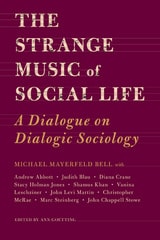
The Strange Music of Social Life
A Dialogue on Dialogic SociologyAuthored by Michael Mayerfeld Bell, edited by Ann Goetting
Temple University Press, 2011
The Strange Music of Social Life presents a dialogue on dialogic sociology, explored through the medium of music. Sociologist and composer Michael Mayerfeld Bell presents an argument that both sociology and classical music remain largely in the grip of a nineteenth-century totalizing ambition of prediction and control. He provides the refreshing approach of "strangency" to explain a sociology that tries to understand not only the regularities of social life but also the social conditions in which people do what we do not expect.
Nine important sociologists and musicians respond-often vigorously-to the conversation Bell initiates by raising pivotal questions. The Strange Music of Social Life concludes with Bell's reply to those responses and offers new insight into sociology and music sociology.

Theology as an Ecclesial Discipline
Ressourcement and DialogueJ. Augustine Di Noia
Catholic University of America Press, 2024

Toward an Islamic Theology of Nonviolence
In Dialogue with René GirardAdnane Mokrani
Michigan State University Press, 2022