Results by title
204 books match the query 'Direction & Production' and 36 start with t

Talkin' With Your Mouth Full
Conversations with the Videos of Steve FaginSteve Fagin, ed.
Duke University Press, 1998
Combining elements of criticism with various modes of artistic expression, these responses take the form of reviews, letters, interviews, and in one case an imaginary TV programming schedule. Interspersed with—and sometimes literally interrupting—the video scripts, these contributions interact with one another on multiple levels and complement Fagin’s scripts. Historical, political, and theoretical issues dovetail, ricochet, and interplay in this book, revealing a multiplicity of voices, concerns, and cultural revelations.
Unique in its structure and intellectual approach, Talkin’ with Your Mouth Full will appeal equally to those who have seen Fagin’s videos and those who have not. Students of art history and cultural critique, and anyone interested in the ongoing dialogue between artists and theorists, will find particular value in this book.
Contributors. Gregg Bordowitz, Constance DeJong, Leslie Dick, Steve Fagin, Barry Gifford, Victoria Gill, Bill Horrigan, Bertha Jottar, Ivone Margulies, Patricia Mellencamp, Margaret Morse, Constance Penley, Vicente L. Rafael, Mark Rappaport, Andrew Ross, Vivian Sobchack, Trinh T. Minh-ha, John Welchman, Peter Wollen
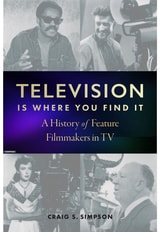
Television Is Where You Find It
A History of Feature Filmmakers in TVCraig S. Simpson
Rutgers University Press, 0
Television Is Where You Find It is a revelatory journey into the overlooked world of feature filmmakers who brought their cinematic vision to the small screen between 1955 and 1990—long before directing for television became trendy in the age of “Prestige TV.” With ten compelling case studies—from legends like Alfred Hitchcock, David Lynch, and Orson Welles to trailblazers like Ida Lupino, Melvin Van Peebles, and Martin Scorsese—author Craig S. Simpson uncovers how these directors reshaped the language of television with style and imagination.
Far from simply dabbling in a “lesser” medium, these filmmakers pushed the boundaries of what TV could do, crafting bold, innovative work that challenges the old notion that television belongs solely to writers and producers. In this fresh, critical study, Television Is Where You Find It makes a case for rediscovering and reevaluating a rich chapter of television history—one in which cinematic artistry quietly flourished, often hidden in plain sight.

Television, Tabloids, and Tears
Fassbinder and Popular CultureJane Shattuc
University of Minnesota Press, 1995
Television, Tabloids, and Tears was first published in 1995. Minnesota Archive Editions uses digital technology to make long-unavailable books once again accessible, and are published unaltered from the original University of Minnesota Press editions.
"I am Biberkopf," Rainer Werner Fassbinder declared, aligning himself with the protagonist of his widely seen television adaptation of Berlin Alexanderplatz. The statement provoked an unprecedented national debate about what constituted an acceptable German artist and who has the power to determine art. More than any recent German director, Fassbinder embodied this debate, and Jane Shattuc shows us how much this can tell us, not just about the man and his work, but also about the state of "culture" in Germany.
It is fascinating in itself that Fassbinder, a highly controversial public figure, was chosen to direct Berlin Alexanderplatz, Germany's longest, costliest, and most widely viewed television drama. Shattuc exposes the dichotomy of institutional support for this project versus the scandalous controversial reputation of Fassbinder as a gay man who flaunted his sexuality and involvement with drugs.
Fassbinder built his reputation on two separate images of the director-the faithful adapter and the underground star; with Berlin Alexanderplatz these two identities came together explosively. Tracing the two artistic paths that led Fassbinder to this moment, Shattuc offers us a look at cultural class divisions in Germany. Her account of Fassbinder's history as an Autor reveals both the triumph and the failure of bourgeois cultural domination in postwar West Germany.
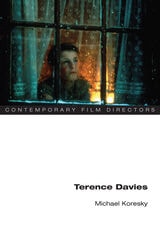
Terence Davies
Michael Koresky
University of Illinois Press, 2014
Film critic Michael Koresky explores the unique emotional tenor of Davies's work by focusing on four paradoxes within the director's oeuvre: films that are autobiographical yet fictional; melancholy yet elating; conservative in tone and theme yet radically constructed; and obsessed with the passing of time yet frozen in time and space. Through these contradictions, the films' intricate designs reveal a cumulative, deeply personal meditation on the self. Koresky also analyzes how Davies's ongoing negotiation of--and struggle with--questions of identity related to his past and his homosexuality imbue the details and jarring juxtapositions in his films with a queer sensibility, which is too often overlooked due to the complexity of Davies's work and his unfashionable ambivalence toward his own sexual orientation.
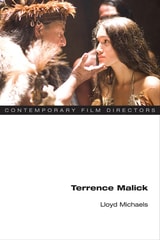
Terrence Malick
Lloyd Michaels
University of Illinois Press, 2008
For a director who has made a limited number of feature films over four-plus decades, Terrence Malick sustains an extraordinary reputation as one of America’s most original and independent directors. Lloyd Michaels analyzes Malick’s first four features in depth, emphasizing both repetitive formal techniques such as voiceover and long lens cinematography as well as recurrent themes drawn from the director’s academic training in modern philosophy. Like Heidegger, Malick seems to regard the human experience of nature as a mystery revealed primarily through moods rather than cognition. Like Wittgenstein, he is less concerned with apprehending the world than with simply acknowledging its beingness
Michaels's critical approach explores Malick’s synthesis of the romance of mythic American experience and the aesthetics of European art film. He pays particular attention to paradigmatic moments: the billboard sequence in Badlands, the opening credits for Days of Heaven, the philosophical colloquies between Witt and Welsh in The Thin Red Line, and the epilogue of The New World. Michaels also sheds light on the two dark decades separating Days of Heaven from The Thin Red Line, when the director mostly lived as an expatriate in Paris. Two 1975 interviews with the famously elusive Malick round out the volume.
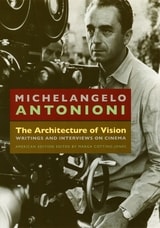
The Architecture of Vision
Writings and Interviews on CinemaMichelangelo Antonioni
University of Chicago Press, 2007
Through autobiographical sketches, theoretical essays, interviews, and conversations with such luminaries as Jean-Luc Godard and Alberto Moravia, this compelling volume explores the director’s unique brand of narrative-defying cinema as well as the motivations and anxieties of the man behind the camera.
“The Architecture of Vision provides a filmmaker’s absorbing reflections and insights on his career. . . . Antonioni’s comments . . . deepen and humanize a sometimes cerebral book.”—Publishers Weekly
“[Antonioni’s] erudition is astonishing . . . few of his peers can match his verbal articulateness.”—Film Quarterly
“This valuable resource offers entrée to material difficult to gain access to under other circumstances.”—Library Journal
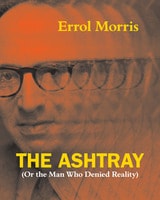
The Ashtray
(Or the Man Who Denied Reality)Errol Morris
University of Chicago Press, 2018
In 1972, philosopher of science Thomas Kuhn threw an ashtray at Errol Morris. This book is the result.
At the time, Morris was a graduate student. Now we know him as one of the most celebrated and restlessly probing filmmakers of our time, the creator of such classics of documentary investigation as The Thin Blue Line and The Fog of War. Kuhn, meanwhile, was—and, posthumously, remains—a star in his field, the author of The Structure of Scientific Revolutions, a landmark book that has sold well over a million copies and introduced the concept of “paradigm shifts” to the larger culture. And Morris thought the idea was bunk.
The Ashtray tells why—and in doing so, it makes a powerful case for Morris’s way of viewing the world, and the centrality to that view of a fundamental conception of the necessity of truth. “For me,” Morris writes, “truth is about the relationship between language and the world: a correspondence idea of truth.” He has no patience for philosophical systems that aim for internal coherence and disdain the world itself. Morris is after bigger game: he wants to establish as clearly as possible what we know and can say about the world, reality, history, our actions and interactions. It’s the fundamental desire that animates his filmmaking, whether he’s probing Robert McNamara about Vietnam or the oddball owner of a pet cemetery. Truth may be slippery, but that doesn’t mean we have to grease its path of escape through philosophical evasions. Rather, Morris argues powerfully, it is our duty to do everything we can to establish and support it.
In a time when truth feels ever more embattled, under siege from political lies and virtual lives alike, The Ashtray is a bracing reminder of its value, delivered by a figure who has, over decades, uniquely earned our trust through his commitment to truth. No Morris fan should miss it.
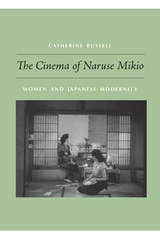
The Cinema of Naruse Mikio
Women and Japanese ModernityCatherine Russell
Duke University Press, 2008
Naruse was a studio-based director, a company man renowned for bringing films in on budget and on time. During his long career, he directed movies in different styles of melodrama while displaying a remarkable continuity of tone. His films were based on a variety of Japanese literary sources and original scripts; almost all of them were set in contemporary Japan. Many were “women’s films.” They had female protagonists, and they depicted women’s passions, disappointments, routines, and living conditions. While neither Naruse or his audiences identified themselves as “feminist,” his films repeatedly foreground, if not challenge, the rigid gender norms of Japanese society. Given the complex historical and critical issues surrounding Naruse’s cinema, a comprehensive study of the director demands an innovative and interdisciplinary approach. Russell draws on the critical reception of Naruse in Japan in addition to the cultural theories of Harry Harootunian, Miriam Hansen, and Walter Benjamin. She shows that Naruse’s movies were key texts of Japanese modernity, both in the ways that they portrayed the changing roles of Japanese women in the public sphere and in their depiction of an urban, industrialized, mass-media-saturated society.
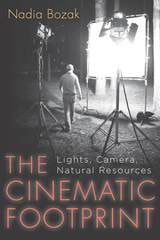
The Cinematic Footprint
Lights, Camera, Natural ResourcesBozak, Nadia
Rutgers University Press, 2011
Film is often used to represent the natural landscape and, increasingly, to communicate environmentalist messages. Yet behind even today’s “green” movies are ecologically unsustainable production, distribution, and consumption processes. Noting how seemingly immaterial moving images are supported by highly durable resource-dependent infrastructures, The Cinematic Footprint traces the history of how the “hydrocarbon imagination” has been central to the development of film as a medium.
Nadia Bozak’s innovative fusion of film studies and environmental studies makes provocative connections between the disappearance of material resources and the emergence of digital media—with examples ranging from early cinema to Dziga Vertov’s prescient eye, from Chris Marker’s analog experiments to the digital work of Agnès Varda, James Benning, and Zacharias Kunuk. Combining an analysis of cinema technology with a sensitive consideration of film aesthetics, The Cinematic Footprint offers a new perspective on moving images and the natural resources that sustain them.
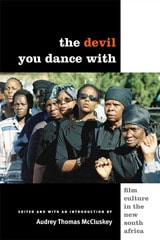
The Devil You Dance With
Film Culture in the New South AfricaEdited and with an Introduction by Audrey McCluskey
University of Illinois Press, 2008
This extraordinary volume presents twenty-five in-depth interviews with established and emerging South African filmmakers, collected and edited by Audrey Thomas McCluskey. The interviews capture the filmmakers’ spirit, energy, and ambition as they attempt to give birth to a film culture that reflects the heart and aspirations of their diverse and emergent nation. The collection includes a biographical profile of each filmmaker, as well an introductory essay by McCluskey, pointing to the themes, as well as creative differences and similarities, among the filmmakers.
The Direct Cinema of David and Albert Maysles
Jonathan B. Vogels
Southern Illinois University Press, 2005
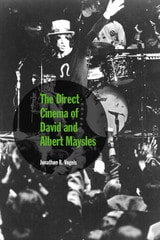
Boldly signifying the cultural issues of the 1960s and 1970s in groundbreaking pieces such as Grey Gardens, Gimme Shelter, and Showman, filmmakers and brothers David and Albert Maysles used an approach to documentary film that involved spontaneous observation of naturally occurring events. With no rehearsed footage and no preconceived plots, their revolutionary work eschewed the authoritative voice-over narrator, didactic scripts, and the traditional problem-and-solution format used by the majority of their predecessors in the genre and duly influenced subsequent directors in both fiction and nonfiction film. Their collaboration from 1962 until David’s death in 1987 wrought thirteen major works in which the brothers critiqued the concept of celebrity with unglamorous footage of iconic figures, explored how commercialism hinders communication, and questioned the possibility of seeing anything clearly in a world abounding with both real and constructed images.
Jonathan B. Vogels outlines how the Maysles brothers blended a unique amalgam of direct cinema characteristics, a modern humanist aesthetic, and a collaborative working process that included other directors and editors. Looking at the films as both shapers and reflections of American culture, he points out that the works offer insights into a wide range of contemporary topics including materialism, celebrity, modern art, and the American family. In addition to describing the changes in technology that made direct cinema possible, Vogels provides careful, scene-by-scene analyses that allow for a consideration of the Maysles brothers’ films as films, a tactic not frequently employed in nonfiction film studies.
The Eloquent Screen
A Rhetoric of FilmGilberto Perez
University of Minnesota Press, 2019
A lifetime of cinematic writing culminates in this breathtaking statement on film’s unique ability to move us
Cinema is commonly hailed as “the universal language,” but how does it communicate so effortlessly across cultural and linguistic borders? In The Eloquent Screen, influential film critic Gilberto Perez makes a capstone statement on the powerful ways in which film acts on our minds and senses.
Drawing on a lifetime’s worth of viewing and re-viewing, Perez invokes a dizzying array of masters past and present—including Chaplin, Ford, Kiarostami, Eisenstein, Malick, Mizoguchi, Haneke, Hitchcock, and Godard—to explore the transaction between filmmaker and audience. He begins by explaining how film fits into the rhetorical tradition of persuasion and argumentation. Next, Perez explores how film embodies the central tropes of rhetoric––metaphor, metonymy, allegory, and synecdoche––and concludes with a thrilling account of cinema’s spectacular capacity to create relationships of identification with its audiences.
Although there have been several attempts to develop a poetics of film, there has been no sustained attempt to set forth a rhetoric of film—one that bridges aesthetics and audience. Grasping that challenge, The Eloquent Screen shows how cinema, as the consummate contemporary art form, establishes a thoroughly modern rhetoric in which different points of view are brought into clear focus.
The Extraordinary Image
Orson Welles, Alfred Hitchcock, Stanley Kubrick, and the Reimagining of CinemaKolker, Robert P
Rutgers University Press, 2016

The Films of Bong Joon Ho
Nam Lee
Rutgers University Press, 2020
Bong Joon Ho won the Oscar® for Best Director for Parasite (2019), which also won Best Picture, the first foreign film to do so, and two other Academy Awards. Parasite was the first Korean film to win the Palme d’Or at Cannes. These achievements mark a new career peak for the director, who first achieved wide international acclaim with 2006’s monster movie The Host and whose forays into English-language film with Snowpiercer (2013) and Okja (2017) brought him further recognition.
As this timely book reveals, even as Bong Joon Ho has emerged as an internationally known director, his films still engage with distinctly Korean social and political contexts that may elude many Western viewers. The Films of Bong Joon Ho demonstrates how he hybridizes Hollywood conventions with local realities in order to create a cinema that foregrounds the absurd cultural anomie Koreans have experienced in tandem with their rapid economic development. Film critic and scholar Nam Lee explores how Bong subverts the structures of the genres he works within, from the crime thriller to the sci-fi film, in order to be truthful to Korean realities that often deny the reassurances of the happy Hollywood ending. With detailed readings of Bong’s films from Barking Dogs Never Bite (2000) through Parasite (2019), the book will give readers a new appreciation of this world-class cinematic talent.
The Films of Denys Arcand
Jim Leach
Rutgers University Press, 2020
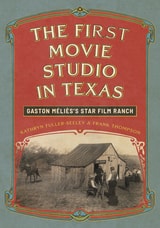
The First Movie Studio in Texas
Gaston Méliès's Star Film RanchKathryn Fuller-Seeley and Frank Thompson
University of Texas Press, 2026
The story of the Star Film Ranch and its pioneering crew, who created the first “authentic” Westerns filmed in Texas.
In 1910, the Méliès Star Film Company of Manhattan set up a moving-picture studio outside San Antonio, the first in Texas. Determined to make the most authentic Westerns possible, the company filmed there for a little over a year. In that brief time, it created more than seventy single-reel films, leaving a lasting mark on moviemaking.
Film historians Kathryn Fuller-Seeley and Frank Thompson return to a moment when on-location filmmaking was emerging as an artform. We meet producer Gaston Méliès, older brother of early-cinema legend Georges Méliès, and his cast and crew of young innovators, old hands, and genuine cowboys—like seventeen-year-old Edith Storey, the tomboy star who helped to ignite modern celebrity culture, and Francis Ford, who learned the art of film directing on the job and mentored his younger brother, Hollywood legend John Ford. The First Movie Studio in Texas traces the company’s trials and accomplishments, its influence on the depiction of race and gender in Western filmmaking, its surviving works, and its crowning achievement: The Immortal Alamo (1911), the earliest cinematic depiction of that famous battle.
Finally recovered from the shadows, the forgotten Méliès brother proves to be one of the key founders of the Western myth on screen.
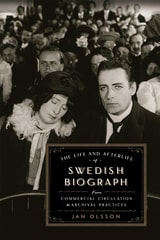
The Life and Afterlife of Swedish Biograph
From Commercial Circulation to Archival PracticesJan Olsson
University of Wisconsin Press, 2022
Sweden’s early film industry was dominated by Swedish Biograph (Svenska Biografteatern), home to star directors like Victor Sjöström and Mauritz Stiller. It is nostalgically remembered as the generative site of a nascent national artform, encapsulating a quintessentially Nordic aesthetic—the epicenter of Sweden’s cinematic Golden Age. In The Life and Afterlife of Swedish Biograph, veteran film scholar Jan Olsson takes a hard look at this established, romanticized narrative and offers a far more complete, complex, and nuanced story.
Nearly all of the studio’s original negatives were destroyed in an explosion in 1941, but Olsson’s comprehensive archival research shows how the company operated in a commercial, international arena, and how it was influenced not just by Nordic aesthetics or individual genius but also by foreign audiences’ expectations, technological demands, Hollywood innovations, and the gritty back-and-forth between economic pressures, government interference, and artistic desires. Olsson’s focus is wide, encompassing the studio’s production practices, business affairs, and cinematographic conventions, as well as the latter-day archival efforts that both preserved and obscured parts of Swedish Biograph’s story, helping construct the company’s rosy legacy. The result is a necessary rewrite to Swedish film historiography and a far fuller picture of a canonical film studio.
The Limits of Auteurism
Case Studies in the Critically Constructed New HollywoodGodfrey, Nicholas
Rutgers University Press, 2018
The book explores the role that contemporary critics played in determining how the movies of this period were understood and how, in turn, strategies of distribution influenced critical responses and dictated the conditions of entry into the rapidly codifying New Hollywood canon. Focusing on a small number of industrially significant films, this new history advances our understanding of this important moment of transition from Classical to contemporary modes of production.
The Long Take
Art Cinema and the WondrousLutz Koepnick
University of Minnesota Press, 2017
In The Long Take, Lutz Koepnick posits extended shot durations as a powerful medium for exploring different modes of perception and attention in our fast-paced world of mediated stimulations. Grounding his inquiry in the long takes of international filmmakers such as Béla Tarr, Tsai Ming-liang, Abbas Kiarostami, Apichatpong Weerasethakul, and Michael Haneke, Koepnick reveals how their films evoke wondrous experiences of surprise, disruption, enchantment, and reorientation. He proceeds to show how the long take has come to thrive in diverse artistic practices across different media platforms: from the work of photographer Hiroshi Sugimoto to the screen-based installations of Sophie Calle and Tacita Dean, from experimental work by Francis Alÿs and Janet Cardiff to durational images in contemporary video games.
Deeply informed by film and media theory, yet written in a fluid and often poetic style, The Long Take goes far beyond recent writing about slow cinema. In Koepnick’s account, the long take serves as a critical hallmark of international art cinema in the twenty-first century. It invites viewers to probe the aesthetics of moving images and to recalibrate their sense of time. Long takes unlock windows toward the new and unexpected amid the ever-mounting pressures of 24/7 self-management.
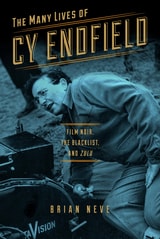
The Many Lives of Cy Endfield
Film Noir, the Blacklist, and <i>Zulu</i>Brian Neve
University of Wisconsin Press, 2015
The Many Lives of Cy Endfield is the first book on this fascinating figure. The fruit of years of archival research and personal interviews by Brian Neve, it documents Endfield’s many identities: among them second-generation immigrant, Jew, Communist, and exile. Neve paints detailed scenes not only of the political and personal dramas of the blacklist era, but also of the attempts by Hollywood directors in the postwar 1940s and early 1950s to address social and political controversies of the day. Out of these efforts came two crime melodramas (what would become known as film noir) on inequalities of class and race: The Underworld Story and The Sound of Fury (also known as Try and Get Me!). Neve reveals the complex production and reception histories of Endfield’s films, which the critic Jonathan Rosenbaum saw as reflective of “an uncommon intelligence so radically critical of the world we live in that it’s dangerous.”
The Many Lives of Cy Endfield is at once a revealing biography of an independent, protean figure, an insight into film industry struggles, and a sensitive and informed study of an underappreciated body of work.
Best Five Books of the Year list, Iranian 24 Monthly, London UK
“Make[s] a case for [Endfield’s] distinctive voice while tracing the way struggle, opposition, and thwarted ambition both defined his life and became the powerful themes of his best work.”—Cineaste

The Morality of Mrs. Dulska
A Play by Gabriela ZapolskaGabriela Zapolska
Intellect Books, 2007
The Movie Musical
Desirée J. Garcia
Rutgers University Press, 2021
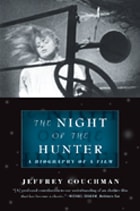
The Night of the Hunter
A Biography of a FilmJeffrey Couchman
Northwestern University Press, 2009
Reaching simultaneously into the realms of film and literature, this detailed exploration of The Night of the Hunter examines the genesis and the eclectic form of each work and the process of transformation by which the novel became a motion picture. It provides the first major study of the long-lost first-draft screenplay by James Agee and confronts a fifty-year controversy about the authorship of the film. This is a story of artistic convergence on many levels--of novelist and director, director and actor, and cinematic form and tastes. The novel, a 1953 debut from Davis Grubb, was a popular and critical success, remaining on the New York Times best-seller list for four months. Hollywood responded to its atmospheric lyricism, and in the hands of first time director Charles Laughton, the book became a film that is equal parts thriller, allegory, and fever dream, filled with slow, inexorable suspense. On the set, Laughton functioned both as an auteur and a collaborator to create his vision of the book, mixing cinematic flourishes both realistic and abstract in sometimes tense situations. The talents that clashed or came together along the road from book to movie make the final film a product of rich stylistic contradiction and rewarding complexity. Through biography, production history, and critical analysis of the novel and film, author Jeffrey Couchman makes the case that this initially overlooked cinematic gem is a prismatic work that continually reveals new aspects of itself.
The Passion of Ingmar Bergman
Frank Gado
Duke University Press, 1986
Gado concludes that whatever the outward appearance of Bergman's works, they contain an elementary psychic fantasy that links them all, revealing an artist who hoped to be a dramatist, "the new Strindberg," and who saw the camera as an extension of his pen.
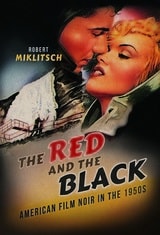
The Red and the Black
American Film Noir in the 1950sRobert Miklitsch
University of Illinois Press, 2017
Mixing scholarship with a fan's devotion to the crooked roads of critique, Miklitsch autopsies marquee films like D.O.A., Niagara, and Kiss Me Deadly plus a number of lesser-known classics. Throughout, he addresses the social and technological factors that dealt deuce after deuce to the genre--its celebrated style threatened by new media and technologies such as TV and 3-D, color and widescreen, its born losers replaced like zombies by All-American heroes, the nation rocked by the red menace and nightmares of nuclear annihilation. But against all odds, the author argues, inventive filmmakers continued to make formally daring and socially compelling pictures that remain surprisingly, startlingly alive.
Cutting-edge and entertaining, The Red and the Black reconsiders a lost period in the history of American movies.
The Visual Guillotine
The Cinematic Cut and Politics in Latin AmericaThomas Matusiak
University of Minnesota Press, 2026
The violence of the cinematic cut in twentieth-century Latin American film
Splice, montage, close-up: modern cinema routinely presents bodies in pieces. Not unlike the guillotine, argues Thomas Matusiak, these techniques have served both overt and symbolic political ends as they accomplish and project the efficient production of severed bodies. In The Visual Guillotine, Matusiak traces the use of cinematic tools of dismemberment in twentieth-century Latin American film to theorize the symbolic and material violence of the cut.
A robust genealogy of Latin American cinematic politics, The Visual Guillotine encompasses national filmmaking traditions; radical and reactionary political registers; and the proliferated aesthetics of narrative, documentary, experimental, and expanded cinema through an innovative critical viewing practice. From the national cinemas of the 1930s to the decapitation videos produced in the Mexican narco-conflict and beyond, Matusiak shows how the cinematic cut has been employed to inspire terror as well as invoke and critique a range of political programs.
A refreshing dialogue between film theory and Latin American cultural studies, The Visual Guillotine offers a new way for film to conceptualize politics. In our present political moment, with rapidly generated and circulated visual media central to a resurgent leftist-populist battle against oligarchy and authoritarianism, this book calls for readers to reassess their viewing position when confronted with violent imagery.
Retail e-book files for this title are screen-reader friendly with images accompanied by short alt text and/or extended descriptions.
The Zoom
Drama at the Touch of a LeverHall, Nick
Rutgers University Press, 2018
Theater Games for Rehearsal
A Director's Handbook, Updated EditionViola Spolin with a foreword by Rob Reiner
Northwestern University Press, 2010
An updated edition of a key reference text by “the high priestess of improvisational theater”
A major force in the development of American theater, Viola Spolin devised pedagogical techniques that have influenced and inspired legions of actors, improvisers, and directors. Theater Games for Rehearsal: A Director's Handbook, first published in 1985, is a practical application of Spolin's famous method that guides directors and their companies step-by-step through all phases of the rehearsal period.
In Theater Games for Rehearsal, Spolin shows in easy-to-follow detail how her techniques can be used for a variety of theater needs, from selecting performance material, casting, and building a harmonious company to warming up actors, creating stage space, and overcoming opening-night jitters. This new edition, edited by Carol Bleackley Sills, incorporates Spolin's wished-for updates: four important exercises have been added, and instructions presenting her improvisational approach have been clarified throughout. Sidecoaching instructions and game evaluations are boxed and highlighted for on-the-spot reading by the director during rehearsal.
With these additions and improvements, Theater Games for Rehearsal: A Director's Handbook brings Spolin's ideas to a new generation with greater accessibility and excitement. Featuring a new foreword by renowned film director Rob Reiner, the updated edition is mandatory for any theater bookshelf.
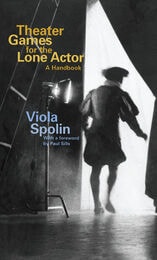
Theater Games for the Lone Actor
A HandbookViola Spolin
Northwestern University Press, 2001
Spolin's improvisational techniques changed the nature and practice of modern theater. Her work has inspired actors, directors, teachers, and writers in theater, television, and film. Her techniques have also influenced the fields of education, mental health, social work, and psychology.
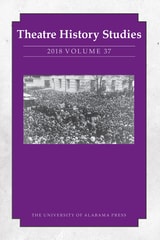
Theatre History Studies 2018, Vol. 37
Sara Freeman
University of Alabama Press, 2018
THEATRE HISTORY STUDIES, VOLUME 37
STEFAN AQUILINA
Meyerhold and The Revolution: A Reading through Henri Lefebvre’s Theories on “Everyday Life”
VIVIAN APPLER
“Shuffled Together under the Name of a Farce”: Finding Nature in Aphra Behn’s The Emperor of the Moon
KRISTI GOOD
Kate Soffel’s Life of Crime: A Gendered Journey from Warden’s Wife to Criminal Actress
PETER A. CAMPBELL
Staging Ajax’s Suicide: A Historiography
BRIAN E. G. COOK
Rousing Experiences: Theatre, Politics, and Change
MEGAN LEWIS
Until You See the Whites of Their Eyes: Brett Bailey’s Exhibit B and the Consequences of Staging the Colonial Gaze
PATRICIA GABORIK
Taking the Theatre to the People: Performance Sponsorship and Regulation in Mussolini’s Italy
ILINCA TODORUT AND ANTHONY SORGE
To Image and to Imagine: Walid Raad, Rabih Mouré, and the Arab Spring
SHULAMITH LEV-ALADGEM
Where Has the Political Theatre in Israel Gone? Rethinking the Concept of Political Theatre Today
CHRISTINE WOODWORTH
“Equal Rights By All Means!”: Beatrice Forbes-Robertson’s 1910 Suffrage Matinee and the Onstage Junction of the US And UK Franchise Movements
LURANA DONNELS O’MALLEY
“Why I Wrote the Phyllis Wheatley Pageant-Play”: Mary Church Terrell’s Bicentennial Activism
JULIET GUZZETTA
The Lasting Theatre of Dario Fo and Franca Rame
ASHLEY E. LUCAS
Chavez Ravine: Culture Clash and the Political Project of Rewriting History
NOE MONTEZ
The Heavy Lifting: Resisting the Obama Presidency’s Neoliberalist Conceptions of the American Dream in Kristoffer Diaz’s The Elaborate Entrance of Chad Deity
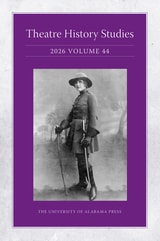
Theatre History Studies 2026, Vol 44
Edited by Jocelyn L. Buckner
University of Alabama Press, 2026
The official journal of the Mid-America Theatre Conference
Theatre History Studies (THS) is a peer-reviewed journal of theatre history and scholarship published annually since 1981 by the Mid-America Theatre Conference (MATC), a regional body devoted to theatre scholarship and practice. The conference is dedicated to the growth and improvement of all forms of theatre throughout a twelve-state region encompassing Illinois, Indiana, Iowa, Kansas, Michigan, Minnesota, Missouri, Nebraska, North Dakota, Ohio, South Dakota, and Wisconsin. The purposes of the conference are to unite people and organizations within the region and elsewhere who have an interest in theatre and to promote the growth and development of all forms of theatre. THS is a member of the Council of Editors of Learned Journals and is included in the MLA Directory of Periodicals. THS is cataloged in numerous periodical indexes and databases.
Along with sixteen book reviews on the latest publications from established and emerging voices in the field, this issue of Theatre History Studies contains four sections with two introductions and nine essays total. In the general section, three essays consider performance histories and reevaluations of historiographical approaches. The special section on queer historiographies responds to calls for a more expansive and inclusive understanding of trans histories and for centralizing contemporary queer performers. In part III, the Robert A. Schanke Research Award-winning paper from the 2024 MATC conference by Ali-Reza Mirsajadi addresses erasures in the theatrical archive and highlights the long legacy of queer, Southwest Asian, and North African representation in dramatic texts. Taken together, volume 44 captures how this journal serves theatre historians as scholars and laborers as they work to attend and tend to their field.
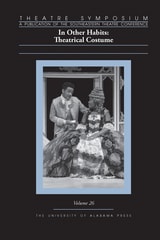
Theatre Symposium, Vol. 26
In Other Habits: Theatrical CostumeSarah McCarroll
University of Alabama Press, 2018
Stage costumes reveal character. They tell audiences who the character is or how a character functions within the world of the play, among other things. Theatrical costuming, however, along with other forms of theatre design, has often been considered merely a craft, rather than part of the deeply systemic creation of meaning onstage. In what ways do our clothes shape and reveal our habits of behavior? How do stage costumes work to reveal one kind of habit via the manipulation of another? How might theatre practitioners learn to most effectively exploit this dynamic? Theatre Symposium, Volume 26 analyzes the ways in which meaning is conveyed through costuming for the stage and explores the underlying assumptions embedded in theatrical practice and costume production.
THEATRE SYMPOSIUM, VOLUME 26
MICHELE MAJER
Plus que Reine: The Napoleonic Revival in Belle Epoque Theatre and Fashion
CAITLIN QUINN
Creating a Realistic Rendering Pedagogy: The Fashion Illustration Problem
ALY RENEE AMIDEI
Where'd I Put My Character?: The Costume Character Body and Essential Costuming for the Ensemble Actor
KYLA KAZUSCHYK
Embracing the Chaos: Creating Costumes for Devised Work
DAVID S. THOMPSON
Dressing the Image: Costumes in Printed Theatrical Advertising
LEAH LOWE
Costuming the Audience: Gentility, Consumption, and the Lady’s Theatre Hat in Gilded Age America
JORGE SANDOVAL
The RuPaul Effect: The Exploration of the Costuming Rituals of Drag Culture in Social Media and the Theatrical Performativity of the Male Body in the Ambit of the Everyday
GREGORY S. CARR
A Brand New Day on Broadway: The Genius of Geoffrey Holder’s Artistry and His Intentional Evocation of the African Diaspora
ANDREW GIBB
On the [Historical] Sublime: J. R. Planché’s King John and the Romantic Ideal of the Past
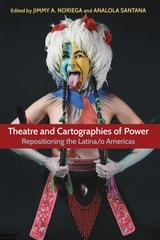
Theatre and Cartographies of Power
Repositioning the Latina/o AmericasEdited by Jimmy A. Noriega and Analola Santana
Southern Illinois University Press, 2018
Building on hemispheric and transnational models, this book demonstrates the capacity of theatre studies to challenge the up-down/North-South approach that dominates scholarship in the United States and presents a strong case for a repositioning of the Latina/o Americas in theatrical histories and practices.
Thomas Holcroft’s Revolutionary Drama
Reception and AfterlivesAmy Garnai
Bucknell University Press, 2023
Todd Solondz
Julian Murphet
University of Illinois Press, 2019
Tough as Nails
The Life and Films of Richard BrooksDouglass K. Daniel
University of Wisconsin Press, 2011