Results by title
59 books match the query 'Drugs' and 18 start with t
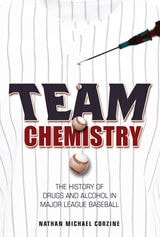
Team Chemistry
The History of Drugs and Alcohol in Major League BaseballNathan Corzine
University of Illinois Press, 2016
- In 1889, Pud Galvin tried a testosterone-derived "elixir" to help him pile up some of his 646 complete games.
- Sandy Koufax needed Codeine and an anti-inflammatory used on horses to pitch through his late-career elbow woes.
- Players returning from World War II mainstreamed the use of the amphetamines they had used as servicemen.
- Vida Blue invited teammates to cocaine parties, Tim Raines used it to stay awake on the bench, and Will McEnaney snorted it between innings.
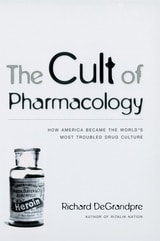
The Cult of Pharmacology
How America Became the World's Most Troubled Drug CultureRichard DeGrandpre
Duke University Press, 2006
Exploring how this rather benign relationship with psychoactive drugs was transformed into one of confusion and chaos, The Cult of Pharmacology tells the dramatic story of how, as one legal drug after another fell from grace, new pharmaceutical substances took their place. Whether Valium or OxyContin at the pharmacy, cocaine or meth purchased on the street, or alcohol and tobacco from the corner store, drugs and drug use proliferated in twentieth-century America despite an escalating war on “drugs.”
Richard DeGrandpre, a past fellow of the National Institute on Drug Abuse and author of the best-selling book Ritalin Nation, delivers a remarkably original interpretation of drugs by examining the seductive but ill-fated belief that they are chemically predestined to be either good or evil. He argues that the determination to treat the medically sanctioned use of drugs such as Miltown or Seconal separately from the illicit use of substances like heroin or ecstasy has blinded America to how drugs are transformed by the manner in which a culture deals with them.
Bringing forth a wealth of scientific research showing the powerful influence of social and psychological factors on how the brain is affected by drugs, DeGrandpre demonstrates that psychoactive substances are not angels or demons irrespective of why, how, or by whom they are used. The Cult of Pharmacology is a bold and necessary new account of America’s complex relationship with drugs.
The Long War on Drugs
Anne L. Foster
Duke University Press, 2023
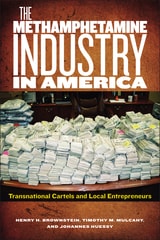
The Methamphetamine Industry in America
Transnational Cartels and Local EntrepreneursBrownstein, Henry H
Rutgers University Press, 2016
The Methamphetamine Industry in America describes the reality that the methamphetamine industry is a social phenomenon connecting local, national, and international communities and markets. The book details the results of a groundbreaking three-stage study, part of a joint initiative of the National Institute on Drug Abuse and the National Institute of Justice, in which police agencies across the United States were surveyed and their responses used to identify likely areas of study. The authors then visited these areas to observe and interview local participants, from users and dealers to law enforcement officers and clinical treatment workers.
Through the eyes and words of these participants, the book tells the story of the evolution of methamphetamine markets in the United States over the past several years, given changes in public policies and practices and changing public opinion about methamphetamine. The authors look closely at how the markets are part of a larger industry, how they are socially organized, and how they operate. They also consider the relationships among the people involved and those around them, and the national, regional, and local culture of the markets. Their work demonstrates the importance of understanding the business of methamphetamine—and by extension other drugs in society—through a lens that focuses on social behavior, social relationships, and the cultural elements that shape the organization and operation of this illicit but effective industry.
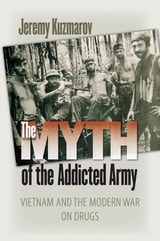
The Myth of the Addicted Army
Vietnam and the Modern War on DrugsJeremy Kuzmarov
University of Massachusetts Press, 2009
The image of the drug-addicted American soldier—disheveled, glassy-eyed, his uniform adorned with slogans of antiwar dissent—has long been associated with the Vietnam War. More specifically, it has persisted as an explanation for the U.S. defeat, the symbol of a demoralized army incapable of carrying out its military mission.
Yet as Jeremy Kuzmarov documents in this deeply researched book, popular assumptions about drug use in Vietnam are based more on myth than fact. Not only was alcohol the intoxicant of choice for most GIs, but the prevalence of other drugs varied enormously. Although marijuana use among troops increased over the course of the war, for the most part it remained confined to rear areas, and the use of highly addictive drugs like heroin was never as widespread as many imagined.
Like other cultural myths that emerged from the war, the concept of an addicted army was first advanced by war hawks seeking a scapegoat for the failure of U.S. policies in Vietnam, in this case one that could be linked to “permissive” liberal social policies and the excesses of the counterculture. But conservatives were not alone. Ironically, Kuzmarov shows, elements of the antiwar movement also promoted the myth, largely because of a presumed alliance between Asian drug traffickers and the Central Intelligence Agency. While this claim was not without foundation, as new archival evidence confirms, the left exaggerated the scope of addiction for its own political purposes.
Exploiting bipartisan concern over the perceived “drug crisis,” the Nixon administration in the early 1970s launched a bold new program of federal antidrug measures, especially in the international realm. Initially, the “War on Drugs” helped divert attention away from the failed quest for “peace with honor” in Southeast Asia. But once institutionalized, it continued to influence political discourse as well as U.S. drug policy in the decades that followed.
The Professional Guinea Pig
Big Pharma and the Risky World of Human SubjectsRoberto Abadie
Duke University Press, 2010
The Social History of Alcohol and Drugs, volume 35 number 2 (Fall 2021)
The University of Chicago Press
University of Chicago Press Journals, 2021
The Social History of Alcohol and Drugs, volume 36 number 1 (Spring 2022)
The University of Chicago Press
University of Chicago Press Journals, 2022
The Social History of Alcohol and Drugs, volume 36 number 2 (Fall 2022)
The University of Chicago Press
University of Chicago Press Journals, 2022
The Social History of Alcohol and Drugs, volume 37 number 1 (Spring 2023)
The University of Chicago Press
University of Chicago Press Journals, 2023
The Social History of Alcohol and Drugs, volume 37 number 2 (Fall 2023)
The University of Chicago Press
University of Chicago Press Journals, 2023
The Social History of Alcohol and Drugs, volume 38 number 1 (Spring 2024)
The University of Chicago Press
University of Chicago Press Journals, 2024
The Social History of Alcohol and Drugs, volume 38 number 2 (Fall 2024)
The University of Chicago Press
University of Chicago Press Journals, 2024
The Social History of Alcohol and Drugs, volume 39 number 1 (Spring 2025)
The University of Chicago Press
University of Chicago Press Journals, 2025
The Social History of Alcohol and Drugs, volume 39 number 2 (Fall 2025)
The University of Chicago Press
University of Chicago Press Journals, 2025
The Social History of Alcohol and Drugs, volume 40 number 1 (Spring 2026)
The University of Chicago Press
University of Chicago Press Journals, 2026
The Social History of Alcohol and Drugs, volume 40 number 2 (Fall 2026)
The University of Chicago Press
University of Chicago Press Journals, 2026
The War on Drugs and the Global Colour Line
Edited by Kojo Koram
Pluto Press, 2019
While laws prohibiting the production, sale and use of particular drugs are presented as politically neutral and objective, this collection reveals the racist impact of the War on Drugs across multiple continents and in numerous situations. From racialised drugs policing at festivals in the UK to the necropolitical wars in Juarez, Mexico and from the exchange of drug policing programs between the United States and Israel to the management of black bodies in Brazil, this collection proves that the regulation of drugs and race is an international, and intentional, disaster.
Pushing forward the debate and activism led by groups such as Black Lives Matter and calling for radical changes in drug policy legislation and prison reform, both nationally and internationally, this collection cuts deep and rings true for all people fighting racism today.