Results by title
30 books match the query 'Whiteness'
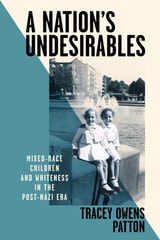
A Nation’s Undesirables
Mixed-Race Children and Whiteness in the Post-Nazi EraTracey Owens Patton
The Ohio State University Press, 2024
An innovative investigation of the entangled histories of race, transnational adoption, and post-Nazi Germany.
In a moving blend of family history and cutting-edge scholarship, Tracey Owens Patton’s A Nation’s Undesirables synthesizes work in rhetorical postmemory studies, critical adoption studies, Afrofuturism, and more to tell the story of her mother and aunt, Lore and Lilli. Two of thousands of children born to white German women and Black American men after World War II, the twins moved to the United States at age seven, where their mother renounced her parental rights and put them into the adoption system. They did not see her again for fifty-two years.Patton takes up the twins’ story and their reckoning with their mixed-race, Black German identity to disrupt standard narratives around World War II, Black experiences in Germany, and race and adoption. Combining family interviews, historical artifacts, and autoethnographic reflection, Patton composes a new narrative of women and Black German children in the postwar era. In examining the systemic racism of Germany’s efforts to move children like Lore and Lilli out of the country—and the suppression of German women’s bodily autonomy—Patton amplifies the once unacknowledged identities of these Black German children to broaden our understanding of citizenship, racism, and sexism after World War II.

Beyond The Whiteness of Whiteness
Memoir of a White Mother of Black SonsJane Lazarre
Duke University Press, 1997
Lazarre has spent over twenty-five years living in a Black American family, married to an African American man, birthing and raising two sons. A teacher of African American literature, she has been influenced by an autobiographical tradition that is characterized by a speaking out against racism and a grounding of that expression in one’s own experience—an overlapping of the stories of one’s own life and the world. Like the stories of that tradition, Lazarre’s is a recovery of memories that come together in this book with a new sense of meaning. From a crucial moment in which consciousness is transformed, to recalling and accepting the nature and realities of whiteness, each step describes an aspect of her internal and intellectual journey. Recalling events that opened her eyes to her sons’ and husband’s experience as Black Americans—an operation, turned into a horrific nightmare by a doctor’s unconscious racism or the jarring truths brought home by a visit to an exhibit on slavery at the Richmond Museum of the Confederacy—or her own revealing missteps, Lazarre describes a movement from silence to voice, to a commitment to action, and to an appreciation of the value of a fluid, even ambiguous, identity. It is a coming of age that permits a final retelling of family history and family reunion.
With her skill as a novelist and her experience as a teacher, Jane Lazarre has crafted a narrative as compelling as it is telling. It eloquently describes the author’s delight at being accepted into her husband’s family and attests to the power of motherhood. And as personal as this story is, it is a remarkably incisive account of how perceptions of racial difference lie at the heart of the history and culture of America.
Beyond the Whiteness of Whiteness
Memoir of a White Mother of Black SonsJane Lazarre
Duke University Press, 1996

Classic Hollywood, Classic Whiteness
Daniel Bernardi
University of Minnesota Press, 2001
Leading scholars address the myriad ways in which America’s attitudes about race informed the production of Hollywood films from the 1920s through the 1960s. From the predominantly white star system to segregated mise-en-scènes, Hollywood films reinforced institutionalized racism. The contributors to this volume examine how assumptions about white superiority and colored inferiority and the politics of segregation and assimilation affected Hollywood’s classic period.
Contributors: Eric Avila, UCLA; Aaron Baker, Arizona State U; Karla Rae Fuller, Columbia College; Andrew Gordon, U of Florida; Allison Graham, U of Memphis; Joanne Hershfield, U of North Carolina; Cindy Hing-Yuk Wond, College of Staten Island, CUNY; Arthur Knight, William and Mary; Sarah Madsen Hardy, Bryn Mawr; Gina Marchetti, U of Maryland; Gary W. McDonogh; Chandra Mukerji, UC, San Diego; Martin F. Norden, U of Massachusetts; Brian O'Neil, U of Southern Mississippi; Roberta E. Pearson, Cardiff U; Marguerite H. Rippy, Marymount U; Nicholas Sammond; Beretta E. Smith-Shomade, U of Arizona; Peter Stanfield, Southampton Institute; Kelly Thomas; Hernan Vera, U of Florida; Karen Wallace, U of Wisconsin, Oshkosh; Thomas E. Wartenberg, Mount Holyoke; Geoffrey M. White, U of Hawai’i; and Jane Yi.

Diploma of Whiteness
Race and Social Policy in Brazil, 1917–1945Jerry Dávila
Duke University Press, 2003
Providing a unique historical perspective on how racial attitudes move from elite discourse into people’s lives, Diploma of Whiteness shows how public schools promoted the idea that whites were inherently fit and those of African or mixed ancestry were necessarily in need of remedial attention. Analyzing primary material—including school system records, teacher journals, photographs, private letters, and unpublished documents—Dávila traces the emergence of racially coded hiring practices and student-tracking policies as well as the development of a social and scientific philosophy of eugenics. He contends that the implementation of the various policies intended to “improve” nonwhites institutionalized subtle barriers to their equitable integration into Brazilian society.

From the Nation-Building Debate to the Bolsa Família Program
Whiteness, Gender, and Poverty in BrazilBeatriz Junqueira Lage Carbone
Campus Verlag, 2023
Bolsa Familia was a social welfare program launched in Brazil in 2003 that made cash payments to poor families, provided they kept their children in school and got them vaccinated. Over time, the program became controversial, intertwined with struggles over race and gender, and President Jair Bolsonaro canceled it in 2021. This book examines the discourse around the program and its effects, illuminating conflicts over national identity and the roles of sexism and racism in Brazil.

Innocent Subjects
Feminism and WhitenessTerese Jonsson
Pluto Press, 2020
Despite a rich history of Black and postcolonial critiques of racist and imperial feminist politics, racism still exists within contemporary British feminism. To explain why, Terese Jonsson examines the history of feminism over the last forty years. She argues that Black feminism's role in shaping the movement has been marginalised through narratives which repeatedly position white women at the centre of the story, from the women's liberation movement in the 1970s to today.
Analysing the ways in which whiteness continues to pervade feminist literature, as well as feminist debates in the liberal media, Jonsson demonstrates that, despite an increased attention to race, intersectionality and difference, stories told by white feminists are shaped by their desire to maintain an 'innocent' position towards racism.
Look, A White!
Philosophical Essays on WhitenessGeorge Yancy
Temple University Press, 2012
Look, a White! returns the problem of whiteness to white people. Prompted by Eric Holder's charge, that as Americans, we are cowards when it comes to discussing the issue of race, noted philosopher George Yancy's essays map out a structure of whiteness.
He considers whiteness within the context of racial embodiment, film, pedagogy, colonialism, its "danger," and its position within the work of specific writers. Identifying the embedded and opaque ways white power and privilege operate, Yancy argues that the Black countergaze can function as a "gift" to whites in terms of seeing their own whiteness more effectively.
Throughout Look, a White! Yancy pays special attention to the impact of whiteness on individuals, as well as on how the structures of whiteness limit the capacity of social actors to completely untangle the way whiteness operates, thus preventing the erasure of racism in social life.

Making Space for Empire
Colonial Elites, Whiteness, and the Planning of Modern Puerto RicoJoaquin Villanueva
Duke University Press, 2027
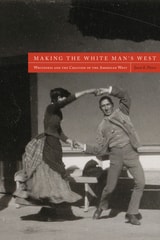
Making the White Man's West
Whiteness and the Creation of the American WestJason E. Pierce
University Press of Colorado, 2016
The West, especially the Intermountain states, ranks among the whitest places in America, but this fact obscures the more complicated history of racial diversity in the region. In Making the White Man’s West, author Jason E. Pierce argues that since the time of the Louisiana Purchase, the American West has been a racially contested space. Using a nuanced theory of historical “whiteness,” he examines why and how Anglo-Americans dominated the region for a 120-year period.
In the early nineteenth century, critics like Zebulon Pike and Washington Irving viewed the West as a “dumping ground” for free blacks and Native Americans, a place where they could be segregated from the white communities east of the Mississippi River. But as immigrant populations and industrialization took hold in the East, white Americans began to view the West as a “refuge for real whites.” The West had the most diverse population in the nation with substantial numbers of American Indians, Hispanics, and Asians, but Anglo-Americans could control these mostly disenfranchised peoples and enjoy the privileges of power while celebrating their presence as providing a unique regional character. From this came the belief in a White Man’s West, a place ideally suited for “real” Americans in the face of changing world.
The first comprehensive study to examine the construction of white racial identity in the West, Making the White Man’s West shows how these two visions of the West—as a racially diverse holding cell and a white refuge—shaped the history of the region and influenced a variety of contemporary social issues in the West today.
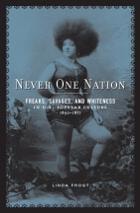
Never One Nation
Freaks, Savages, and Whiteness in U.S. Popular Culture, 1850-1877Linda Frost
University of Minnesota Press, 2005
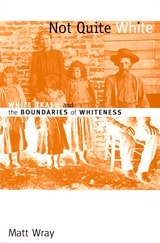
Not Quite White
White Trash and the Boundaries of WhitenessMatt Wray
Duke University Press, 2006
Of crucial importance are the ideas about poor whites that circulated through early-twentieth-century public health campaigns, such as hookworm eradication and eugenic reforms. In these crusades, impoverished whites, particularly but not exclusively in the American South, were targeted for interventions by sanitarians who viewed them as “filthy, lazy crackers” in need of racial uplift and by eugenicists who viewed them as a “feebleminded menace” to the white race, threats that needed to be confined and involuntarily sterilized.
Part historical inquiry and part sociological investigation, Not Quite White demonstrates the power of social categories and boundaries to shape social relationships and institutions, to invent groups where none exist, and to influence policies and legislation that end up harming the very people they aim to help. It illuminates not only the cultural significance and consequences of poor white stereotypes but also how dominant whites exploited and expanded these stereotypes to bolster and defend their own fragile claims to whiteness.
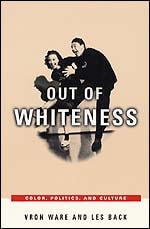
Out of Whiteness
Color, Politics, and CultureVron Ware and Les Back
University of Chicago Press, 2002
Vron Ware and Les Back look at key points in recent American and British culture where the "color line" has been blurred. Through probing accounts of racial masquerades in popular literature, the growth of the white power music scene on the Internet, the meteoric rise of big band jazz during the Second World War, and the pivotal role of white session players in crafting rhythm and blues classics by black artists, Ware and Back upset the idea of race as a symbol of inherent human attributes. Their book gives us a timely reckoning of the forces that continue to make people "white," and reveals to us the polyglot potential of identities and cultures.

Parenting Empires
Class, Whiteness, and the Moral Economy of Privilege in Latin AmericaAna Yolanda Ramos-Zayas
Duke University Press, 2020
Possessive Investment In Whiteness
George Lipsitz
Temple University Press, 1998
Lipsitz's ultimate point is not to condemn all white people as racists but to challenge everyone to begin a principled examination of personal actions and political commitments. Exposing the system of unfairness is not enough. People of all groups -- but especially white people because they benefit from that system -- have to work toward eradicating the rewards of whiteness.
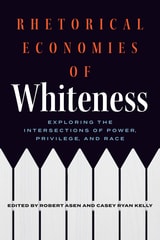
Rhetorical Economies of Whiteness
Exploring the Intersections of Power, Privilege, and RaceEdited by Robert Asen and Casey Ryan Kelly
The Ohio State University Press, 2024
Contributors:
Godfried Asante, Robert Asen, Charles Athanasopoulos, Paulami Banerjee, Anne Bonds, Linsay M. Cramer, Derek G. Handley, V. Jo Hsu, Kelly Jensen, Casey Ryan Kelly, Kyle R. Larson, George (Guy) F. McHendry Jr., Thomas K. Nakayama, Adedoyin Ogunfeyimi, Rico Self, Stacey K. Sowards, Corinne Mitsuye Sugino
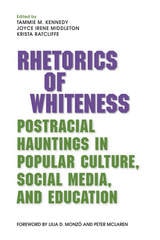
Rhetorics of Whiteness
Postracial Hauntings in Popular Culture, Social Media, and EducationEdited by Tammie M. Kennedy, Joyce Irene Middleton, Krista Ratcliffe, with a foreword by Lilia D. Monzó and Peter McLaren
Southern Illinois University Press, 2017
With the election of our first black president, many Americans began to argue that we had finally ended racism, claiming that we now live in a postracial era. Yet near-daily news reports regularly invoke white as a demographic category and recount instances of racialized violence as well as an increased sensitivity to expressions of racial unrest. Clearly, American society isn’t as color-blind as people would like to believe. In Rhetorics of Whiteness: Postracial Hauntings in Popular Culture, Social Media, and Education, contributors reveal how identifications with racialized whiteness continue to manifest themselves in American culture.
The sixteen essays that comprise this collection not only render visible how racialized whiteness infiltrates new twenty-first-century discourses and material spaces but also offer critical tactics for disrupting this normative whiteness. Specifically, contributors examine popular culture (novels, films, TV), social media (YouTube, eHarmony, Facebook), education (state law, the textbook industry, dual credit programs), pedagogy (tactics for teaching via narratives, emotional literacy, and mindfulness) as well as cultural theories (concepts of racialized space, anti-dialogicism, and color blindness). Offering new approaches to understanding racialized whiteness, this volume emphasizes the importance of a rhetorical lens for employing whiteness studies’ theories and methods to identify, analyze, interpret, and interrupt representations of whiteness.
Although whiteness studies has been waning as an active research field for the past decade, the contributors to Rhetorics of Whiteness assert that it hasn’t lost its relevancy because racialized whiteness and issues of systemic racism persist in American society and culture today. Few whiteness studies texts have been published in rhetoric and composition in the past decade, so this collection should quickly become mandatory reading. By focusing on common, yet often overlooked, contemporary examples of how racialized whiteness haunts U.S. society, Rhetorics of Whiteness serves as a valuable text for scholars in the field as well as anyone else interested in the topic.
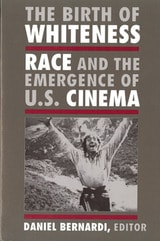
The Birth of Whiteness
Race and the Emergence of United States CinemaEdited by Daniel Leonard Bernardi
Rutgers University Press, 1996
As indelible components of the history of the United States, race and racism have permeated nearly all aspects of life: cultural, economic, political, and social. In this first anthology on race in early cinema, fourteen scholars examine the origins, dynamics, and ramifications of racism and Eurocentrism and the resistance to both during the early years of American motion pictures. Any discussion of racial themes and practices in any arena inevitably begins with the definition of race. Is race an innate and biologically determined "essence" or is it a culturally constructed category? Is the question irrelevant? Perhaps race exists as an ever-changing historical and social formation that, regardless of any standard definition, involves exploitation, degradation, and struggle. In his introduction, Daniel Bernardi writes that "early cinema has been a clear partner in the hegemonic struggle over the meaning of race" and that it was steadfastly aligned with a Eurocentric world view at the expense of those who didn't count as white.
The contributors to this work tackle these problems and address such subjects as biological determinism, miscegenation, Manifest Destiny, assimilation, and nativism and their impact on early cinema. Analyses of The Birth of a Nation, Romona, Nanook of the North and Madame Butterfly and the directorial styles of D. W. Griffith, Oscar Micheaux, and Edwin Porter are included in the volume.

The Color of Sex
Whiteness, Heterosexuality, and the Fictions of White SupremacyMason Stokes
Duke University Press, 2001
The Color of Sex reveals what happens when race and sexuality meet, when white desire encounters its own ambivalence. As Stokes argues, whiteness and heterosexuality exist in anxious relation to one another. Mutually invested in “the normal,” they support each other in their desperate insistence on the cultural logic of exclusion. At the same time, however, they threaten one another in their attempt to create and sustain a white future, since reproducing whiteness necessarily involves the risk of contamination
Charting the curious movements of this “white heterosexuality,” The Color of Sex inaugurates a new moment in our ongoing attempt to understand the frenzied interplay of race and sexuality in America. As such, it will appeal to scholars interested in race theory, sexuality studies, and American history, culture, and literature.
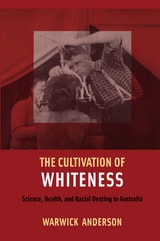
The Cultivation of Whiteness
Science, Health, and Racial Destiny in AustraliaWarwick Anderson
Duke University Press, 2006
“[Anderson] writes with passion, wit, and panache, and the principal virtues of The Cultivation of Whiteness are the old-fashioned ones of thoroughness, accuracy, and impeccable documentation. . . . [His] sensitive study is a model of how contentious historical issues can be confronted.”—W. F. Bynum, Times Literary Supplement
“One of the virtues of The Cultivation of Whiteness is that it brings together aspects of Australian life and history that are now more often separated—race and environment, blood and soil, medicine and geography, tropical science and urban health, biological thought and national policy, Aboriginality and immigration, the body and the mind. The result is a rich and subtle history of ideas that is both intellectual and organic, and that vividly evokes past states of mind and their lingering, haunting power.”—Tom Griffiths, Sydney Morning Herald

The Heart of Whiteness
Normal Sexuality and Race in America, 1880–1940Julian B. Carter
Duke University Press, 2007
Carter builds her intricate argument from detailed readings of an array of popular texts, focusing on how sex education for children and marital advice for adults provided significant venues for the dissemination of the new ideal of normality. She concludes that because its overt concerns were love, marriage, and babies, normality discourse facilitated white evasiveness about racial inequality. The ostensible focus of “normality” on matters of sexuality provided a superficially race-neutral conceptual structure that whites could and did use to evade engagement with the unequal relations of power that continue to shape American life today.

The Indies Diaspora in the Netherlands
Essays on Race, Whiteness, and Identity in Dutch LiteratureAlfred Birney; Translated by Annemarie Toebosch and Marjolein van Pagee
Michigan Publishing Services, 2021

The Machinery of Whiteness
Studies in the Structure of RacializationAuthored by Steve Martinot
Temple University Press, 2010
In this follow up to his book, The Rule of Racialization—which considered the way class structure is formed in the U.S.—Steve Martinot now examines how the structures of racialization reside at the core of all social, cultural, and political institutions in the U.S. In The Machinery of Whiteness, Martinot examines how race and racism are produced in the United States, analyzing the politics of racialization, and the preponderance of racial segregation and racial deprivation that have kept the U.S. a white dominated society throughout its history. Martinot dedicates this work to expunging white supremacy from the earth.
The Machinery of Whiteness investigates how “whiteness” came to be as foundational to the process that then produced the modern concept of race. Martinot addresses the instrumentalization of women as a necessary step in its formation, furthering the debates regarding the relationships of race and gender. And he addresses U.S. international interventionism, the anti-immigrant movements, and white racist populism to describe the political forms that white supremacy takes.
Martinot puts these together to analyze the underlying cultural structures of racialization that have driven and conditioned the resurgence of white supremacy and white entitlement in the wake of the Civil Rights movements. This book is a call to transform the cultural structures of the U.S. to make justice and democracy, which depend on inclusion and not segregation, possible.
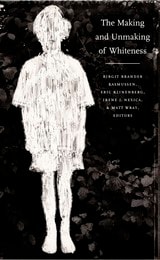
The Making and Unmaking of Whiteness
Birgit Brander Rasmussen, Eric Klinenberg, Irene J. Nexica, and Matt Wray, eds.
Duke University Press, 2001
With essays devoted to theories of racial domination, comparative global racisms, and transnational white identity, the geographical reach of the volume is significant and broad. Dalton Conley writes on “How I Learned to Be White.” Allan Bérubé discusses the intersection of gay identity and whiteness, and Mab Segrest describes the spiritual price white people pay for living in a system of white supremacy. Other pieces examine the utility of whiteness as a critical term for social analysis and contextualize different attempts at antiracist activism. In a razor-sharp introduction, the editors not only raise provocative questions about the intellectual, social, and political goals of those interested in the study of whiteness but assess several of the topic’s major recurrent themes: the visibility of whiteness (or the lack thereof); the “emptiness” of whiteness as a category of identification; and conceptions of whiteness as a structural privilege, a harbinger of violence, or an institutionalization of European imperialism.
Contributors. William Aal, Allan Bérubé, Birgit Brander Rasmussen, Dalton Conley, Troy Duster, Ruth Frankenberg, John Hartigan Jr., Eric Klinenberg, Eric Lott, Irene J. Nexica, Michael Omi, Jasbir Kaur Puar, Mab Segrest, Vron Ware, Howard Winant, Matt Wray
The Possessive Investment in Whiteness
How White People Profit from Identity PoliticsGeorge Lipsitz
Temple University Press, 2018
George Lipsitz’s classic book The Possessive Investment in Whiteness argues that public policy and private prejudice work together to create a possessive investment in whiteness that is responsible for the racialized hierarchies of our society. Whiteness has a cash value: it accounts for advantages that come to individuals through profits made from housing secured in discriminatory markets, through the unequal educational opportunities available to children of different races, through insider networks that channel employment opportunities to the friends and relatives of those who have profited most from past and present discrimination, and especially through intergenerational transfers of inherited wealth that pass on the spoils of discrimination to succeeding generations. White Americans are encouraged to invest in whiteness, to remain true to an identity that provides them with structured advantages.
In this twentieth anniversary edition, Lipsitz provides a new introduction and updated statistics; as well as analyses of the enduring importance of Hurricane Katrina; the nature of anti-immigrant mobilizations; police assaults on Black women, the killings of Trayvon Martin, Michael Brown, and Freddie Gray; the legacy of Obama and the emergence of Trump; the Charleston Massacre and other hate crimes; and the ways in which white fear, white fragility, and white failure have become drivers of a new ethno-nationalism.
As vital as it was upon its original publication, the twentieth anniversary edition of The Possessive Investment in Whiteness is an unflinching but necessary look at white supremacy.
The Possessive Investment in Whiteness
How White People Profit from Identity Politics, Revised and Expanded EditionGeorge Lipsitz
Temple University Press, 2006
Unsettling
Jews, Whiteness, and Incest in American Popular CultureEli Bromberg
Rutgers University Press, 2021
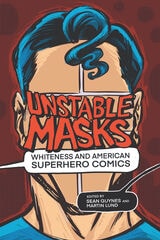
Unstable Masks
Whiteness and American Superhero ComicsEdited by Sean Guynes and Martin Lund
The Ohio State University Press, 2020
In Unstable Masks: Whiteness and American Superhero Comics, Sean Guynes and Martin Lund bring together a series of essays that contextualize the histories and stakes of whiteness studies, superhero comics, and superhero studies for academics, fans, and media-makers alike. The volume illustrates how the American comic book superhero is fundamentally a figure of white power and white supremacy and ultimately calls for diversity in superhero comics as well as a democratized media culture.
Contributors not only examine superhero narratives but also delve into the production, distribution, audience, and reception of those narratives, highlighting the imbrication of forces that have helped to create, normalize, question, and sometimes even subvert American beliefs about whiteness and race. Unstable Masks considers the co-constitutive nature of identity, representation, narrative, production and consumption, and historical and cultural contexts in forging the stereotypes that decide who gets to be a superhero and who gets to be American on the four-color pages of comic books.
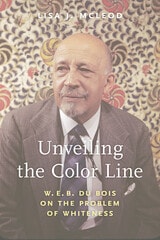
Unveiling the Color Line
W. E. B. Du Bois on the Problem of WhitenessLisa J. McLeod
University of Massachusetts Press, 2024
In The Souls of Black Folk, W. E. B. Du Bois brilliantly details the African American experience. Yet the renowned sociologist was also an astute chronicler of white people, particularly their racism. As Unveiling the Color Line demonstrates, Du Bois’s trenchant analysis of whiteness and white supremacy began in his earliest work—his 1890 speech on Jefferson Davis—and continued in every major book he published in his more than sixty-year career, up to The Black Flame Trilogy.
Lisa J. McLeod traces the development of Du Bois’s conception of whiteness, and the racism inherent to it, as an all-encompassing problem, whether predicated on ignorance, moral failure, or the inability to recognize the humanity in other people. In clear, elegant prose, McLeod investigates Du Bois’s complex and nuanced thinking, putting his insights into dialogue with contemporary racial theorists to demonstrate his continuing value to present-day critical thought and activism.
White Women, Race Matters
The Social Construction of WhitenessRuth Frankenberg
University of Minnesota Press, 1993
American Sociological Association’s Jessie Bernard Book Award winner
Gustavus Myers Center for the Study of Human Rights’s Outstanding Book Award winner